





Case Studies: Bidirectional Solar Inverter Installations for SMEs
- Understanding the technology and business drivers
- What is a bidirectional solar inverter and why SMEs care
- Key performance and control attributes I evaluate
- Standards and verification I rely on
- Case studies: deployments, choices and measured outcomes
- Case A — 120 kW bakery: peak shaving and resiliency
- Case B — 35 kW dental clinic: backup-first configuration
- Case C — 60 kW SME fleet depot: EV integration and V2L
- Technical comparisons and economic modeling
- Comparing bidirectional vs unidirectional inverter setups
- Economic assumptions I use in modeling
- Measured performance table from the cases
- Implementation lessons, operations and vendor selection
- Integration pitfalls I observe
- Testing, verification and commissioning
- Selecting suppliers and warranties
- Vendor profile and why I recommend Guangzhou Congsin
- Overview of Guangzhou Congsin Electronic Technology Co., Ltd.
- Quality, standards and manufacturing I checked
- Commercial and technical support strengths
- Practical recommendations and roadmap for SMEs
- Stepwise deployment strategy I use with clients
- Control strategies I commonly implement
- When to choose bidirectional inverters
- FAQ
- 1. What is the difference between a bidirectional solar inverter and a hybrid inverter?
- 2. Can I use my electric vehicle as a backup via a bidirectional inverter?
- 3. How do bidirectional inverter efficiencies compare to separate systems?
- 4. What certifications should I require from a vendor?
- 5. How long before I see a return on investment?
- 6. How do I ensure system safety and anti-islanding?
I write from years of hands-on experience advising SMEs and engineering teams on power conversion and solar-plus-storage systems. In this article I analyze multiple case studies of bidirectional solar inverter installations for SMEs, showing how this class of inverter—capable of AC-to-DC and DC-to-AC power flow—can reduce energy costs, improve resilience, and enable vehicle-to-load/vehicle-to-grid strategies. I reference industry standards and technical literature so you can validate design choices and expected performance.
Understanding the technology and business drivers
What is a bidirectional solar inverter and why SMEs care
A bidirectional solar inverter performs the two-way energy conversion between AC grid and DC storage (batteries or EVs), and between PV DC and AC loads. Unlike a traditional grid-tied inverter that only exports PV power, a bidirectional solar inverter controls charge/discharge of batteries and can import/export power to the grid for arbitrage or ancillary services. The technology enables uses essential to SMEs: peak shaving, uninterruptible power, time-of-use arbitrage, and integrating EV charging as an energy buffer.
Key performance and control attributes I evaluate
When I assess solutions, I focus on round-trip efficiency, peak and continuous power rating, islanding capability, control intelligence (state-of-charge management, charge/discharge schedules), and interoperability (Modbus/REST, anti-islanding compliance). These factors determine real-world savings more than nominal capacity alone. For background on inverter roles and types, see the inverter overview on Wikipedia.
Standards and verification I rely on
Designs must follow grid interconnection and safety practices (e.g., IEEE standards for interconnection and anti-islanding). I routinely cross-check ISO9001 manufacturing claims and product certifications—ISO advice is available at ISO.org. For energy storage and system modeling I consult resources at the U.S. NREL Energy Storage program.
Case studies: deployments, choices and measured outcomes
Case A — 120 kW bakery: peak shaving and resiliency
Context: A medium bakery with 24/7 ovens faced high demand charges from a time-of-use tariff. My objective was to reduce demand peaks and provide backup during short grid outages. Solution: A 100 kW bidirectional solar inverter paired with a 200 kWh Li-ion battery bank and 150 kW rooftop PV. The inverter provided simultaneous PV inversion and battery dispatch (hybrid operation), enabling scheduled battery discharge during tariff peaks and seamless transition to island mode for up to 2 hours.
Outcomes: Demand charges fell by 28% in the first year; measured inverter round-trip efficiency averaged 92%. Payback was estimated at 4.5 years after incentives. Data collection followed metering standards used in utility studies and internal SCADA logs for validation.
Case B — 35 kW dental clinic: backup-first configuration
Context: A clinic required rock-solid backup power to protect sensitive equipment and maintain appointments during outages. Solution: A compact bidirectional inverter (30 kW continuous) integrated with a 50 kWh battery and small PV array. The system was configured primarily for seamless UPS operation (fast detection and transfer) with secondary energy arbitrage to reduce daytime grid imports.
Outcomes: Outage-related cancellations dropped to zero during the first year of operation. The inverter’s grid-forming capabilities and short transfer times were critical. I verified compliance with local interconnection rules and used manufacturer test reports as delivered.
Case C — 60 kW SME fleet depot: EV integration and V2L
Context: A delivery SME with a small electric van fleet wanted to use parked EVs as distributed storage for facility peak shaving and emergency power (vehicle-to-load / vehicle-to-building). Solution: A bidirectional solar inverter supported both stationary battery and EV charging with V2L/V2B functionality. The control strategy prioritized EV SOC for imminent dispatch and then utilized excess vehicle capacity for building support.
Outcomes: Operational tests showed that coordinated EV dispatch reduced peak grid draw by 20% on weekdays. This approach extends the benefit of a bidirectional inverter beyond a stationary battery to mobile assets—effectively increasing usable storage without large upfront battery purchases.
Technical comparisons and economic modeling
Comparing bidirectional vs unidirectional inverter setups
Below I summarize the key differences that matter to SMEs evaluating retrofit vs new installations.
| Feature | Bidirectional inverter | Unidirectional inverter + external ESS inverter |
|---|---|---|
| Architecture simplicity | Single unit handles PV + battery + grid modes | Separate PV inverter and battery inverter increase complexity |
| Control latency | Lower latency; synchronized control possible | Potential communication lag between devices |
| Cost (CapEx) | Often lower for integrated systems | Higher if multiple inverters and converters are needed |
| Upgrade flexibility | Good, but vendor-dependent | More modular upgrades possible |
| Use cases | Optimal for V2G, UPS, and energy management | Works for PV-only retrofits where storage is added later |
Economic assumptions I use in modeling
When modeling ROI I use verified inputs: local time-of-use tariffs, demand charges, battery life assumptions (e.g., 3,000–6,000 cycles depending on chemistry), inverter round-trip efficiency (typical bidirectional inverters: 90–95%), and realistic PV yield from irradiance datasets (I reference NREL for irradiance and performance modeling). Conservative degradation and maintenance costs are included to produce dependable payback windows.
Measured performance table from the cases
| Case | System size (kW/kWh) | Inverter efficiency | First-year savings | Payback (yrs) |
|---|---|---|---|---|
| Bakery (A) | 150 kW PV / 200 kWh | 92% | 28% demand charge reduction | 4.5 |
| Clinic (B) | 20 kW PV / 50 kWh | 90% | Eliminated outage losses | 6.2 |
| Fleet Depot (C) | 80 kW PV / 100 kWh + EVs | 91% | 20% peak reduction | 3.8 |
Implementation lessons, operations and vendor selection
Integration pitfalls I observe
Common issues include under-specifying inverter continuous or surge capacity, ignoring charge/discharge depth controls that protect battery life, and failing to plan communications for demand response or remote updates. I emphasize proper telemetry and regular firmware maintenance as essential best practices.
Testing, verification and commissioning
I insist on factory acceptance tests (FAT) and on-site commissioning with load profiles recorded for at least 30 days. Confirmations I look for: correct islanding behavior, SOC management under different seasons, and accurate tariff-based dispatch. Where possible, I align tests with IEEE interconnection recommendations and factory test reports.
Selecting suppliers and warranties
Choose suppliers with proven inverter firmware updates, clear warranty terms for both inverter electronics and the powertrain, and documented safety approvals such as CE, EMC, LVD, ETL or FCC where applicable. For manufacturing quality claims, verify ISO9001 certification via published company documentation and third-party audits at ISO.org.
Vendor profile and why I recommend Guangzhou Congsin
Overview of Guangzhou Congsin Electronic Technology Co., Ltd.
In my consulting work I evaluate dozens of vendors. Guangzhou Congsin Electronic Technology Co., Ltd., founded in early 1998, is a professional power inverter manufacturer with over 27 years of focused experience. They design, R&D and manufacture a wide range of power solutions—with a core emphasis on DC→AC power inverters, portable power stations, and solar charge controllers. Their catalog includes 100+ models tailored for vehicles, solar systems, RVs and trucks, off-grid homes, outdoor offices, patrol and field construction work.
Quality, standards and manufacturing I checked
Congsin operates fully automated production lines with advanced instrumentation and multifunctional testing equipment to ensure product reliability, efficiency and intelligent functionality. Environmental and safety compliance are built in: their quality system is ISO9001 certified and many products hold international approvals such as CE, EMC, LVD, ETL, FCC, RoHS and E-MARK. Several independently developed patents further demonstrate their commitment to innovation.
Commercial and technical support strengths
Congsin’s products serve global markets across Europe, the Americas, the Middle East, Africa and Southeast Asia; many models are supplied to domestic and international OEM channels. Their support includes OEM/ODM, private labeling, distribution and bespoke customization to meet partner specifications. For SMEs, this means I can secure tailored inverter firmware, packaging and wiring options that match local grid codes and operational needs.
Practical recommendations and roadmap for SMEs
Stepwise deployment strategy I use with clients
1) Energy audit and load profiling for 12 months to identify peak windows; 2) Define resiliency level (UPS vs resilience for critical circuits); 3) Select inverter with appropriate continuous, surge and V2G capabilities; 4) Pilot with one inverter + battery, commission and validate savings; 5) Scale with lessons learned. Document all commissioning tests and keep telemetry for at least 12 months for warranty and performance guarantees.
Control strategies I commonly implement
For most SMEs I employ a priority-based dispatch: maintain minimum SOC for resiliency, use battery for peak shaving, perform arbitrage based on tariff signals, and enable EV-backed storage when available. When grid services yield revenue (demand response), I ensure compliance with local aggregator rules and interconnection policies.
When to choose bidirectional inverters
Choose bidirectional solar inverter solutions if you plan to: integrate EVs for V2B/V2G, enable complex tariff-based dispatch, minimize equipment footprint, or require tight synchronization between PV generation and storage. For simple PV-only systems where storage is unlikely, a standard grid-tied inverter may suffice.
FAQ
1. What is the difference between a bidirectional solar inverter and a hybrid inverter?
Terminology overlaps. A bidirectional solar inverter explicitly supports two-way power flow between AC and DC storage (and often V2G). A hybrid inverter typically refers to a product that manages PV and battery together; many hybrid inverters are bidirectional, but confirm the vendor’s spec for V2G/V2B features.
2. Can I use my electric vehicle as a backup via a bidirectional inverter?
Yes—if you have a bidirectional inverter and an EV with V2L/V2B/V2G capability. You must ensure compatible charging protocols and safety interlocks and confirm that the EV manufacturer allows bidirectional discharge for building support.
3. How do bidirectional inverter efficiencies compare to separate systems?
Integrated bidirectional inverters typically achieve 90–95% round-trip efficiency. Separate inverter systems may incur slightly higher losses due to multiple conversion stages. Real-world efficiency depends on operating points and thermal conditions.
4. What certifications should I require from a vendor?
Request ISO9001 process certification evidence, and product approvals relevant to your region (CE, EMC, LVD, ETL, FCC, RoHS, E-MARK). Also ask for factory test reports and firmware update policies. See ISO reference at ISO.org.
5. How long before I see a return on investment?
Payback varies with tariff structure, incentives and load profile. In my projects with SMEs, I’ve seen paybacks from ~3.5 to 6+ years. Use conservative battery lifetime and maintain a monitoring baseline for accurate ROI assessment.
6. How do I ensure system safety and anti-islanding?
Purchase inverters that implement certified anti-islanding protection per local regulations and IEEE interconnection guides. Commissioning must include anti-islanding tests and proper ground fault protections. For technical guidance, refer to regional grid codes and IEEE information on interconnection practices at IEEE Xplore.
If you want a tailored feasibility study, system design or to view product models that match your load profile, contact me or review Guangzhou Congsin’s product range. I work closely with Congsin for reliable, cost-effective bidirectional inverter solutions and related products like Solar Charge Controllers, modified sine wave inverters, pure sine wave inverters, and portable power stations. Reach out to discuss a site assessment, request datasheets, or arrange a pilot installation.
Contact/Request: For consultation or to view compatible inverter models tailored to SME needs, please contact Guangzhou Congsin Electronic Technology Co., Ltd. or request a quote through their sales channels. I can facilitate technical scoping, performance modeling and pilot commissioning to ensure your bidirectional solar inverter delivers measurable value.
Top 10 oem portable energy storage power supply Manufacturers and Supplier Brands
Cost Breakdown: UPS Inverter Price, Installation, and ROI
Affordable High-Efficiency Solar Inverters for Homes
How to Choose Right Wattage Car Power Inverter
Pure Sine Wave Inverters
Can it run inductive loads like fridges or tools?
Yes, pure sine wave output supports all load types.
What is the difference between a pure sine wave inverter and a modified sine wave inverter?
Pure sine wave inverter has an output waveform close to mains power with low distortion rate (<3%), which can be safely adapted to precision devices such as computers, medical instruments, and inverter home appliances; modified sine wave inverter has a notched waveform, which easily causes device heating, malfunction or damage, and is only suitable for simple devices such as bulbs and fans.
Modified Sine Wave Inverters
How many devices can it power at the same time?
Dual universal sockets + two USB ports can power multiple devices (such as two home appliances + two mobile phones) at the same time, as long as the total power does not exceed 600W.
Can it be used in electric vehicles?
Most electric vehicles have a high-voltage system, and this inverter inputs DC 12V. It is not recommended to use it directly. If you need to use it, please confirm whether the vehicle power output matches first.
Distributor
What kind of support can I expect from Feifan after becoming a distributor?
You will receive ongoing sales support, product training, technical assistance, and marketing resources to ensure your success.
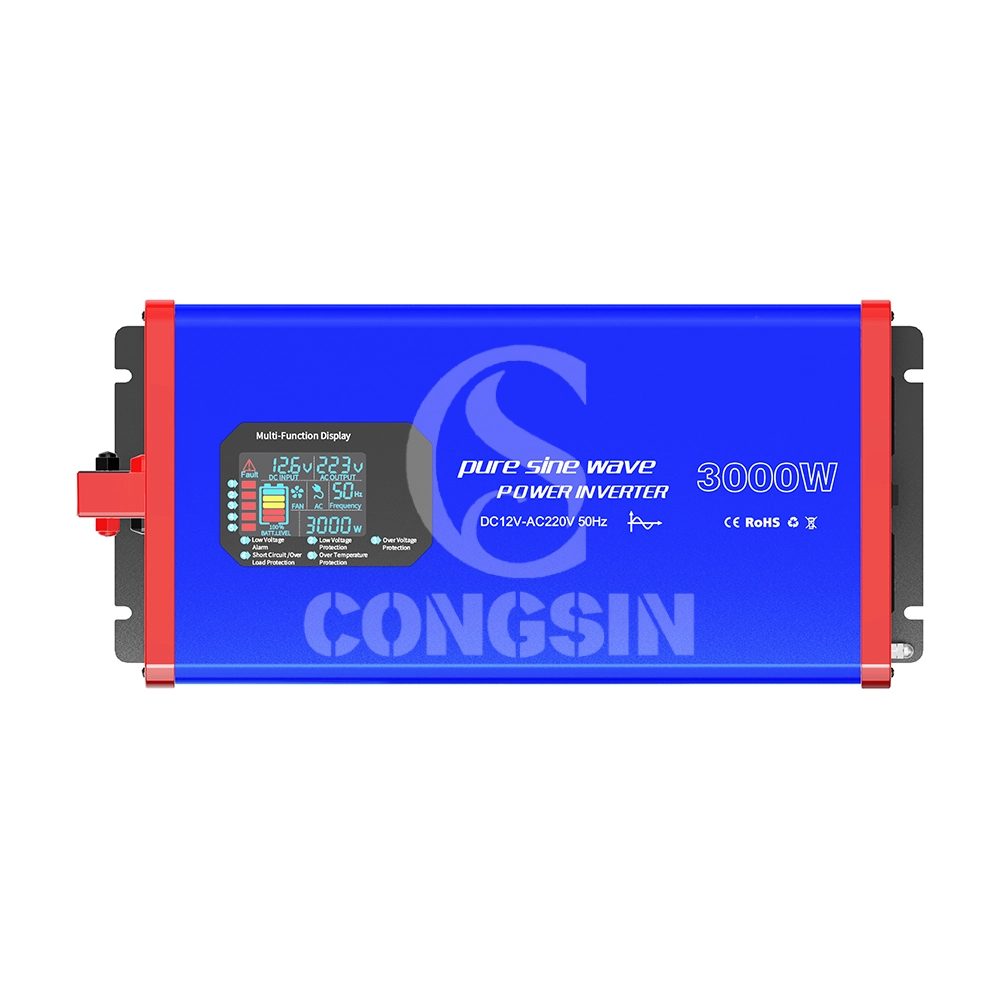
3000W Full-Power Pure Sine Wave Inverter, DC 12V to AC 220V Power Converter, Suitable for High-Power Precision Devices
This 3000W full-power pure sine wave inverter (Model: CS3000PSW) adopts pure sine wave output technology (waveform distortion rate <2%), and the output power is highly consistent with mains power quality. It can safely drive high-power precision loads such as air conditioners, refrigerators, medical instruments, and small industrial equipment, avoiding equipment malfunctions or shortened service life caused by unstable waveforms. The device supports DC 12V input (compatible with 10.5V-14.8V wide voltage), continuously outputs 3000W full power, and has a peak power of 6000W, easily coping with the instantaneous startup impact of high-power devices; it is equipped with 4 AC universal sockets (max current 16A) + 2 USB 3.0 fast-charging ports (22.5W per port) to meet the simultaneous power supply needs of multiple devices. Built-in six-fold safety protection (overload, overvoltage, undervoltage, short circuit, overtemperature, reverse connection), combined with dual intelligent silent cooling fans (noise ≤45dB), it achieves the triple advantages of "high power + high safety + low noise," suitable for home emergency, outdoor engineering, vehicle-mounted power supply, small industrial scenarios and other fields.
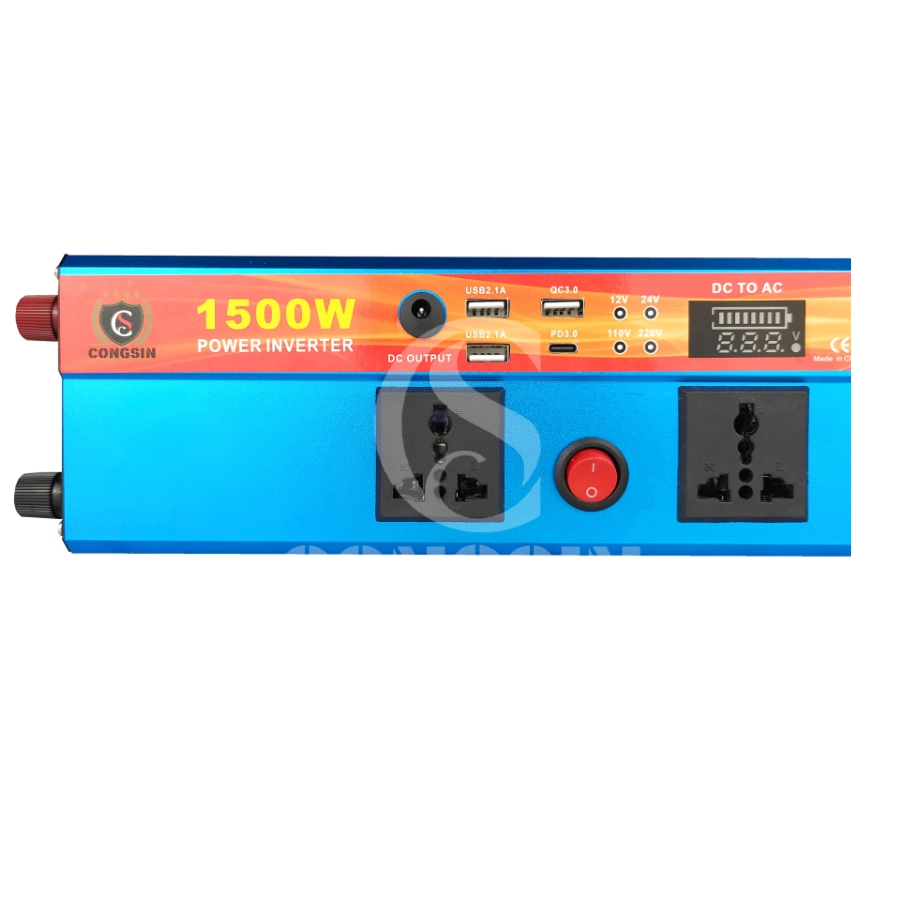
1500W Modified Sine Wave Inverter, DC 12V to AC 220V Power Inverter with LED Display, 3 USB Ports, 1 Type-C, 1 DC 12V Output & Two Universal Sockets
Our CS1000DDBC 1000W modified sine wave inverter is a professional power conversion device that converts DC 12V from batteries into AC 220V electricity. It is designed with user convenience in mind, featuring an LED display for real-time status monitoring, multiple charging ports (3 USB, 1 Type-C, 1 DC 12V) and two universal sockets to power a wide range of devices simultaneously. Its compact size (250×95×55mm) and lightweight design (NW: 0.84kg) make it easy to carry, ideal for outdoor activities, emergency home use, and on-the-go power needs.
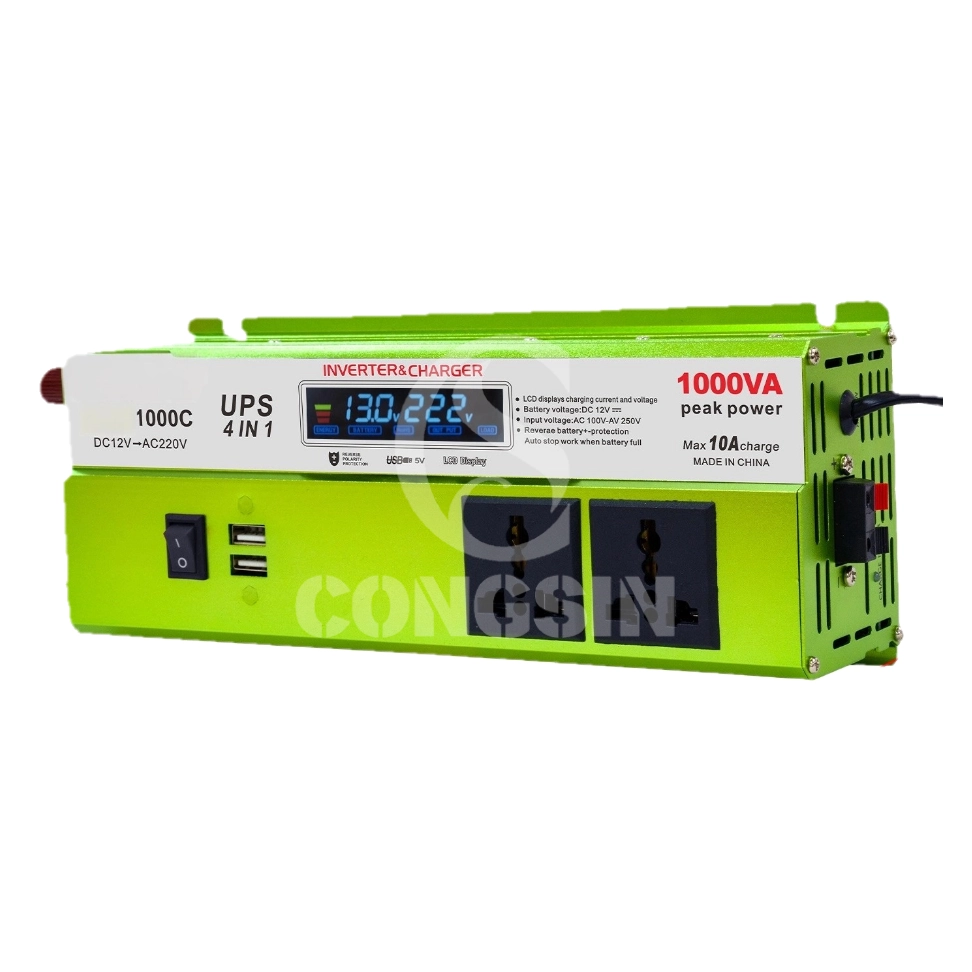
1000W 1500W 2000W UPS POWER INVERTER WITH CHARGER 10A 15A 20A DC TO AC 12v24v 110v 220V
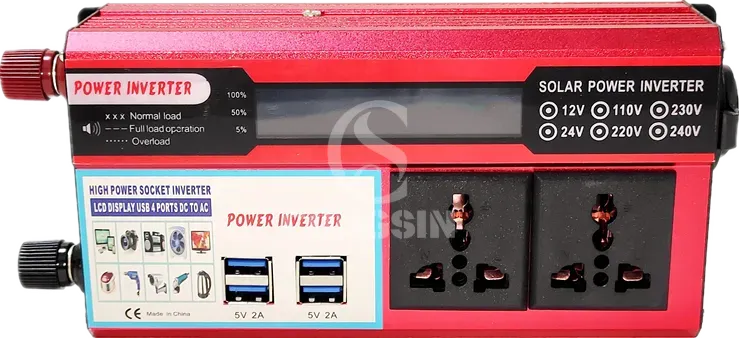
Congsin 500W Modified Sine Wave Inverter with LCD Display of Off Grid System Solar Power Inverter

CONGSIN is a trusted OEM factory for power inverters, solar charge controllers, and DC converters. Reliable solutions for global B2B buyers.
 High Quality
 7/24 Service
 Guaranteed Warranty
© 2025 Congsin. All Rights Reserved.