





Battery Types Explained for UPS Power Inverters
- Why battery selection matters for backup power
- Impact on runtime, reliability and cost
- Compatibility with inverter charging and BMS
- Safety, regulations and environmental considerations
- Common battery chemistries used with UPS power inverters
- Lead-acid: Flooded (wet cell)
- Lead-acid: VRLA — AGM and Gel
- Lithium-ion: LiFePO4 (LFP)
- How to compare batteries: metrics you must evaluate
- Key metrics explained
- Practical runtime calculation
- Comparison table: typical battery types for UPS inverters
- Deployment considerations: installation, maintenance and lifecycle cost
- Temperature management and placement
- Charging systems and inverter compatibility
- Safety, monitoring and end-of-life
- Special topics: parallel strings, charging rates and fast transient loads
- Using parallel battery strings
- Charging rates (C-rate) and system sizing
- Handling high inrush and nonlinear loads
- Choosing the right battery for your UPS power inverter: decision checklist
- Questions to answer before purchase
- Recommended matches by application
- Cost-benefit example
- About Guangzhou Congsin Electronic Technology Co., Ltd. and why partner with us
- FAQ
- 1. Which battery type gives the longest lifecycle for a UPS power inverter?
- 2. Can I replace my VRLA batteries with LiFePO4 in an existing inverter system?
- 3. How do I calculate the battery capacity needed for my UPS inverter?
- 4. What maintenance do flooded lead-acid batteries require?
- 5. Are LiFePO4 batteries safe for indoor UPS installations?
- 6. How should I dispose of or recycle old batteries?
- Contact and next steps
This article explains how different battery types affect the performance, reliability and total cost of ownership of an ups power inverter system. It provides actionable guidance for choosing batteries for backup power, solar-coupled inverters and mobile inverter applications based on cycle life, energy density, safety, environmental factors and compatibility with inverter chargers and battery management systems. The guidance here is grounded in industry resources such as Wikipedia on UPS and technical references like Battery University.
Why battery selection matters for backup power
Impact on runtime, reliability and cost
The battery is the energy reservoir for any ups power inverter. Battery chemistry and sizing determine runtime (how long the inverter can supply AC load), reliability (how predictable the stored energy is under different temperatures and loads) and lifecycle cost (replacement frequency and maintenance). A poor battery choice can reduce expected backup time, increase maintenance needs and raise lifecycle cost significantly.
Compatibility with inverter charging and BMS
Modern DC→AC inverters and inverter chargers require specific charging profiles and battery protection. Lead-acid batteries commonly use IUoU or float charging profiles, while lithium iron phosphate (LiFePO4) needs CC-CV charging with a Battery Management System (BMS) to protect from overcharge/discharge and cell imbalance. Ensure the inverter/inverter-charger supports the battery type or that an appropriate external charger/BMS is installed.
Safety, regulations and environmental considerations
Installation standards (local electrical codes) and transportation rules differ by battery type. Flooded lead-acid batteries need venting and controlled rooms; sealed VRLA types are simpler but still regulated. Lithium batteries require certified BMS and often additional protection to comply with fire and shipping regulations. For regulatory context, see IEC/IEEE standards and general UPS guidance on Wikipedia.
Common battery chemistries used with UPS power inverters
Lead-acid: Flooded (wet cell)
Flooded lead-acid batteries have liquid electrolyte and are historically common for stationary UPS installations. They are cost-effective per amp-hour but require regular maintenance (electrolyte topping, ventilation) and dedicated battery rooms. Typical cycle life is lower than sealed types and lithium alternatives; depth of discharge (DoD) is generally limited to prolong life.
Lead-acid: VRLA — AGM and Gel
Valve-regulated lead-acid (VRLA) batteries include Absorbent Glass Mat (AGM) and gel types. They are sealed, maintenance-free, and suited for indoor UPS and inverter installations. AGM offers better high-rate discharge performance (useful for inrush loads), while gel compensates better for deep discharges in some designs. VRLA requires less ventilation and simpler handling than flooded cells.
Lithium-ion: LiFePO4 (LFP)
LiFePO4 batteries are increasingly used with ups power inverter systems because of high cycle life (often 2000+ cycles at 80% DoD), high energy density, low maintenance, and wide temperature tolerance. They require a proper BMS and compatible charging algorithm. For critical backup and off-grid inverters, LiFePO4 reduces footprint and overall lifecycle cost despite higher initial capital expense. For chemistry references see LiFePO4 on Wikipedia.
How to compare batteries: metrics you must evaluate
Key metrics explained
When selecting batteries for an ups power inverter, evaluate: capacity (Ampere-hours, Ah), usable energy (kWh considering DoD), C-rate (charge/discharge current capability), depth of discharge (recommended DoD for longevity), cycle life (number of full cycles before end-of-life), energy density (Wh/kg and Wh/L), temperature sensitivity, maintenance needs, safety and upfront cost vs lifecycle cost.
Practical runtime calculation
To estimate runtime: calculate required watt-hours = load power (W) × runtime (h). Then add inverter efficiency losses (typical pure sine wave inverters 90–95%). Derived battery capacity in Ah = required Wh / battery nominal voltage (V). Include system margin and DoD. Example: For a 1000 W load for 2 hours with a 12 V battery and 90% inverter efficiency: required Wh = 2000 Wh; battery Ah = 2000 / (12 × 0.9) ≈ 185 Ah. For lifecycle and performance, prefer to size above this to reduce stress and prolong battery life.
Comparison table: typical battery types for UPS inverters
| Metric | Flooded Lead-Acid | VRLA AGM/Gel | LiFePO4 (LFP) |
|---|---|---|---|
| Energy density (Wh/kg) | 30–40 | 30–40 | 90–160 |
| Cycle life (typical) | 500–800 cycles (at shallow DoD) | 600–1200 cycles | 2000–5000 cycles |
| Maintenance | High (watering, equalization) | Low (sealed) | Low (BMS required) |
| Temperature sensitivity | Sensitive to high temps | Moderate | Better tolerance; BMS temp management |
| Cost per kWh (initial) | Low | Medium | High |
| Typical use cases | Large stationary UPS with onsite maintenance | Indoor UPS, telecom closets, small to medium inverters | Residential & commercial UPS, portable power stations, off-grid systems |
Data ranges compiled from industry sources such as Battery University and manufacturer specifications. Exact values vary by model and operating conditions.
Deployment considerations: installation, maintenance and lifecycle cost
Temperature management and placement
Batteries age faster at elevated temperatures. For lead-acid, every 10°C rise above 25°C roughly halves service life. LiFePO4 degrades less quickly with temperature but still benefits from temperature-controlled environments. Place battery banks in ventilated, dry locations away from direct sunlight and heat sources.
Charging systems and inverter compatibility
Match the inverter charger’s charging algorithm to the battery chemistry. Many inverter-chargers support selectable battery types (AGM, flooded, custom profiles). For LiFePO4, ensure the charger provides appropriate charge voltages and termination and that the BMS communicates where necessary. When connecting battery banks in parallel, verify inverter and charger current sharing, and use appropriate fusing and cable sizing to prevent imbalance and high inrush currents.
Safety, monitoring and end-of-life
Install battery monitoring (voltage, current, temperature) and alarms. For critical UPS systems, consider redundancy (parallel strings with isolation) and hot-swap designs. Plan for recycling: lead-acid recycling is well-established; lithium recycling infrastructure is developing but less ubiquitous. Track capacity fade and schedule replacements before end-of-life to maintain guaranteed UPS runtimes. Industry-standard testing equipment and procedures help validate capacity and health; many manufacturers provide test protocols aligned with IEC/IEEE guidelines.
Special topics: parallel strings, charging rates and fast transient loads
Using parallel battery strings
Parallel strings increase capacity but introduce imbalance risk. Use identical battery modules with matched state-of-charge, identical age and internal resistance. Implement string-level fusing and periodic balancing. For LiFePO4 systems, many modular packs include integrated balancing and communication to maintain uniform cell voltages across strings.
Charging rates (C-rate) and system sizing
Battery charge/discharge current is expressed in C-rate. For example, a 100 Ah battery charged at 0.5C receives 50 A. High C charging shortens life if not supported by chemistry. LiFePO4 can often accept higher C-rate charging than lead-acid, enabling faster recharges after outages, but ensure the inverter/charger and BMS are rated for the current.
Handling high inrush and nonlinear loads
UPS power inverters frequently support motor startup and nonlinear loads. Select batteries that can deliver high peak currents without excessive voltage sag. AGM and LiFePO4 typically handle high discharge currents better than older flooded batteries, improving performance for motors, compressors and some types of electronics.
Choosing the right battery for your UPS power inverter: decision checklist
Questions to answer before purchase
- What is the required runtime and usable kWh?
- Is maintenance acceptable on-site or must batteries be sealed?
- What is the ambient temperature range and installation environment?
- Does the inverter charger support the battery chemistry or can an external charger/BMS be integrated?
- What is the acceptable total cost of ownership over the expected lifetime?
Recommended matches by application
- Data centers / mission-critical UPS: high-reliability VRLA or LiFePO4 with monitoring and redundant strings.
- Residential backup and solar hybrid systems: LiFePO4 for compactness and long life; VRLA for lower upfront cost where shorter life is acceptable.
- Vehicles, RVs, portable power stations: LiFePO4 favored for weight, cycle life and safety with integrated BMS.
Cost-benefit example
Although LiFePO4 batteries have higher initial cost, their longer cycle life and deeper usable DoD often deliver lower cost per kWh over the life of the system. Perform a simple lifecycle cost model: total cost = initial battery cost + replacement cost × expected replacements over design life + operating/maintenance costs. Compare to equivalent lead-acid replacements and account for downtime risk where applicable.
About Guangzhou Congsin Electronic Technology Co., Ltd. and why partner with us
Guangzhou Congsin Electronic Technology Co., Ltd., founded in early 1998, is a professional power inverter manufacturer with over 27 years of focused experience. We design, R&D and manufacture a wide range of power solutions—with a core emphasis on DC→AC power inverters, portable power stations, and solar charge controllers. Our catalog includes 100+ models tailored for vehicles, solar systems, RVs and trucks, off-grid homes, outdoor offices, patrol and field construction work.
We operate fully automated production lines, advanced instrumentation and multifunctional testing equipment to ensure product reliability, efficiency and intelligent functionality. Environmental and safety compliance are built in: our quality system is ISO9001 certified and many products hold international approvals such as CE, EMC, LVD, ETL, FCC, RoHS and E-MARK. Several independently developed patents further demonstrate our commitment to innovation.
Congsin’s products serve global markets across Europe, the Americas, the Middle East, Africa and Southeast Asia; many models are supplied to domestic and international OEM channels. Our support includes OEM/ODM, private labeling, distribution and bespoke customization to meet partner specifications. Our mission is to deliver reliable, efficient and affordable energy solutions that enable energy independence.
Core products and advantages: Solar Charge Controller, modified sine wave inverter, pure sine wave inverter, portable power stations. Congsin differentiates by integrated manufacturing, rigorous quality testing, broad certification coverage and flexible OEM/ODM services—enabling customers to get optimized inverter and battery-compatible solutions rapidly.
FAQ
1. Which battery type gives the longest lifecycle for a UPS power inverter?
LiFePO4 (lithium iron phosphate) typically offers the longest cycle life (2000+ cycles at high DoD) and the lowest degradation rate compared to lead-acid types. However, lifecycle depends on temperature, charge/discharge profile and maintenance.
2. Can I replace my VRLA batteries with LiFePO4 in an existing inverter system?
Often yes, but you must verify that the inverter charger supports LiFePO4 charge voltages and termination or provide an external LiFePO4-compatible charger/BMS. Also consider wiring, fusing and BMS communication requirements. Consult the inverter manufacturer or installer.
3. How do I calculate the battery capacity needed for my UPS inverter?
Estimate required Wh = load power (W) × runtime (h). Divide by the nominal battery voltage and inverter efficiency to get Ah. Add margin for DoD and aging. See the runtime calculation example section for a worked example.
4. What maintenance do flooded lead-acid batteries require?
Flooded batteries need regular electrolyte level checks and topping with distilled water, periodic equalization charges, and well-ventilated battery rooms. They also require periodic capacity testing and safety controls to handle hydrogen venting.
5. Are LiFePO4 batteries safe for indoor UPS installations?
Yes, when properly installed with certified BMS and protections. LiFePO4 is chemically stable and has lower thermal runaway risk compared to other lithium chemistries, but must still be installed according to local codes and manufacturer instructions.
6. How should I dispose of or recycle old batteries?
Lead-acid batteries are widely recycled; return them to certified recycling centers or vendors. Lithium battery recycling options are expanding—use certified recycling facilities and follow local hazardous waste regulations.
Contact and next steps
If you need help selecting the right battery for your ups power inverter, or want a tailored inverter + battery solution, contact Guangzhou Congsin Electronic Technology Co., Ltd. for consultation, OEM/ODM options and product catalogs. View product specifications or request a quote to find a solution that matches your runtime, environment and budget requirements. For technical collaboration or to explore custom inverter integrations and battery matching, reach out to our sales and engineering team today.
Further reading and references: Battery chemistry and UPS overview resources: UPS (Wikipedia), Battery University, LiFePO4 (Wikipedia), and industry standards published by IEC and IEEE.
Affordable High-Efficiency Solar Inverters for Homes
Efficiency and Heat Management for Pure Sine Car Inverters
Top 5 solar cell Company List and Products Compared
Cost and ROI: Comparing Off-Grid Inverters and Solar Systems
Modified Sine Wave Inverters
Is it a pure sine wave or a modified sine wave? What's the difference?
This is a modified sine wave inverter, suitable for most conventional home appliances and electronic devices; pure sine wave is suitable for precision devices with extremely high power requirements. This modified sine wave is more cost-effective at 2000W, meeting the needs of most scenarios.
Which regional plugs can be used with the universal socket?
The universal socket supports most national plug specifications, such as GB, US, EU, etc. (some require adapters), and can meet the use of devices in multiple regions.
What power appliance can this inverter run?
It has a continuous power of 800W, so it can run appliances within 800W; the peak power is 1500W, supporting the instantaneous startup of appliances within 1500W.
What devices can this inverter power?
Rated for 600W, peak 1000W. Recommended to use devices under 80% of rated capacity.
How to install the battery terminal wire?
Connect the red terminal wire to the positive pole of the battery and the black terminal wire to the negative pole. Ensure the interface is firm and there is no short circuit when connecting.
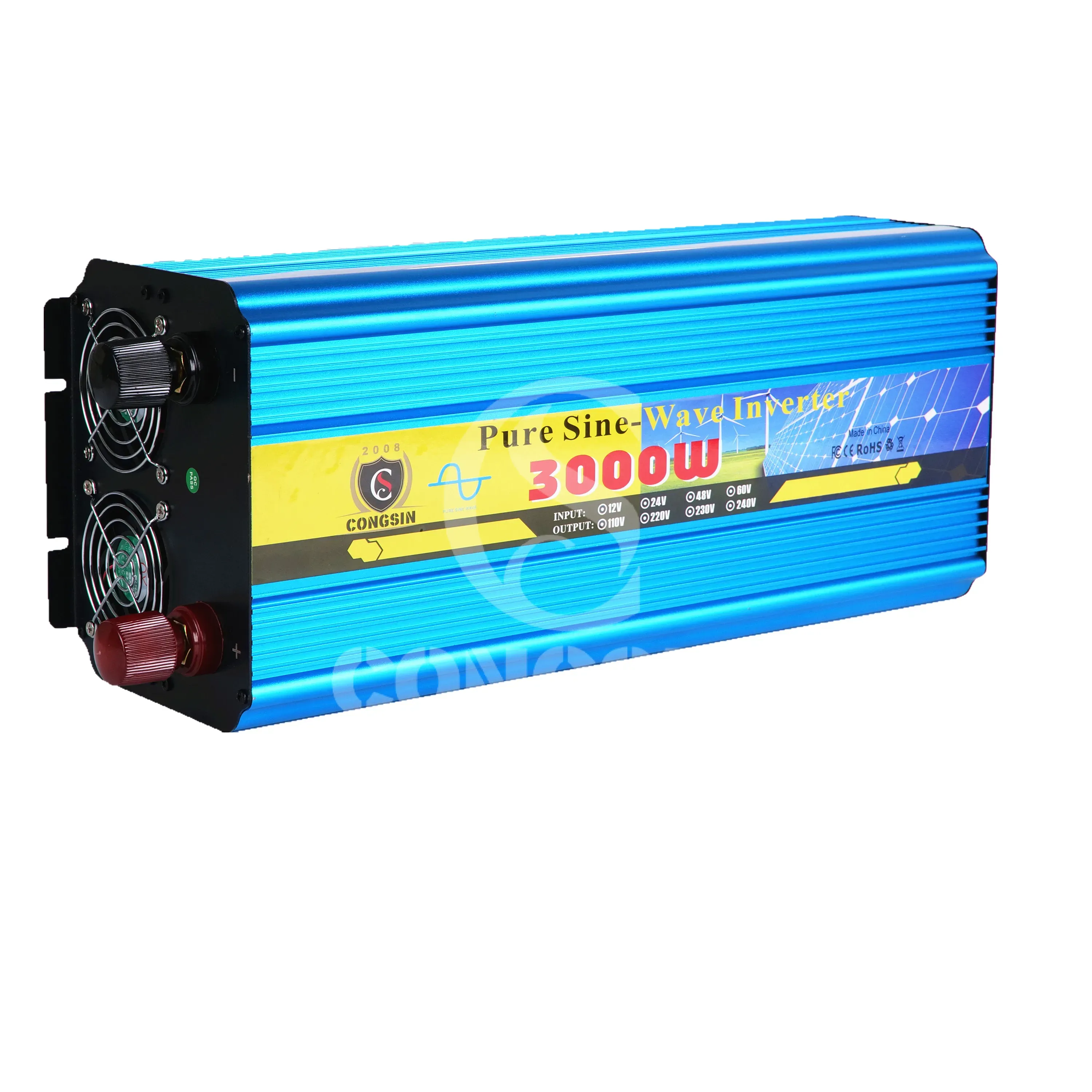
Congsin 3000W LCD Pure Sine Wave Inverter for Home Use Solar Backup Power Inverter Off Grid UPS
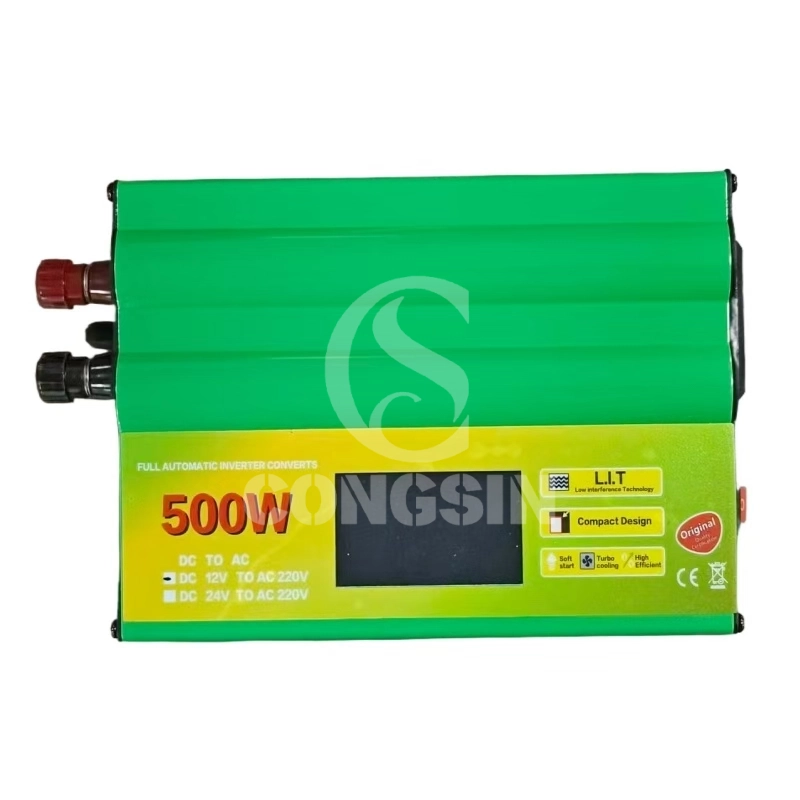
Congsin Modified Sine Wave Inverter 500W 1000W 1500W 12V LED Display Portable for RV Car Solar
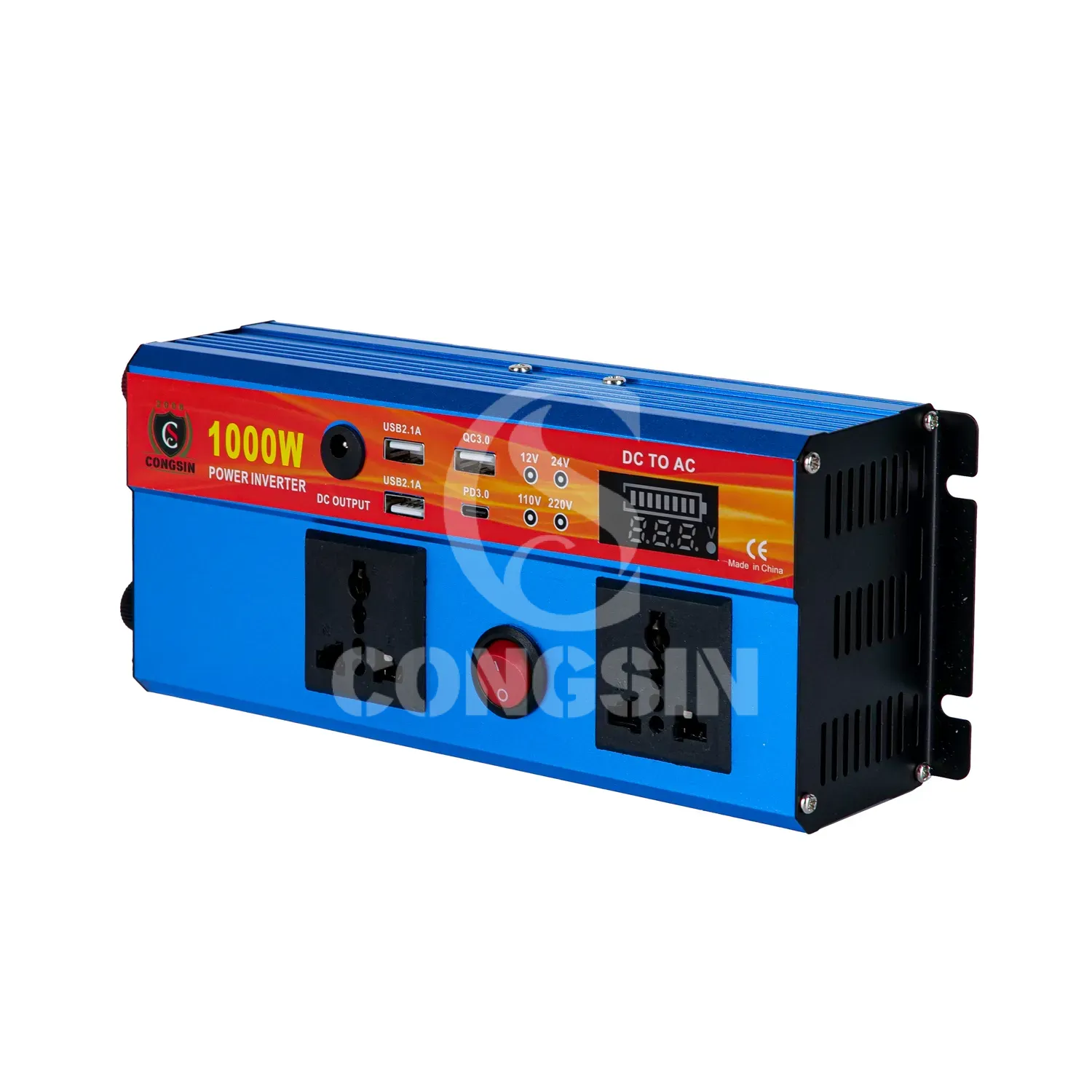
Congsin 1000W modified sine wave inverter with LED display and Type C port car RV power inverter
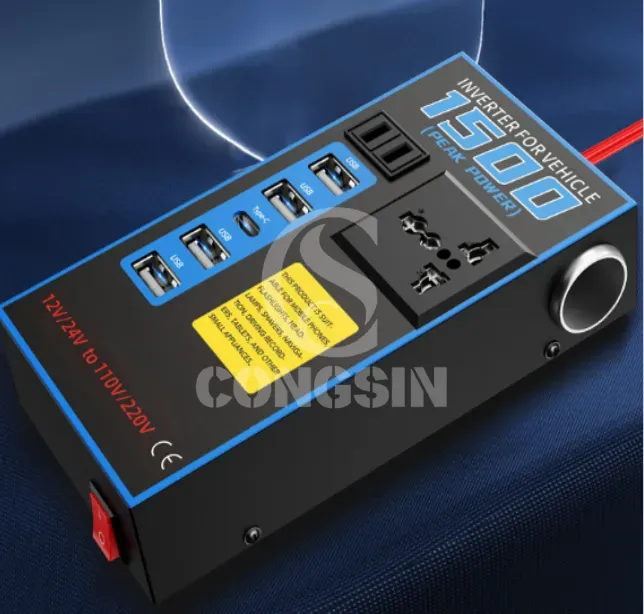
Congsin 1500W Inverter for Vehicle DC 12V/24V to AC 110V/220V with Universal socket Modified Sine Wave

CONGSIN is a trusted OEM factory for power inverters, solar charge controllers, and DC converters. Reliable solutions for global B2B buyers.
 High Quality
 7/24 Service
 Guaranteed Warranty
© 2025 Congsin. All Rights Reserved.