





UPS Inverter vs Standby Inverter: Key Differences
- Understanding inverter topologies
- What I mean by “UPS inverter” and “standby inverter”
- How topologies differ electrically
- When topology choice matters most
- Performance comparison: latency, waveform and efficiency
- Transfer time and its operational impact
- Waveform quality: modified vs pure sine wave
- Efficiency and operating cost
- Choosing based on application: which one fits your needs?
- Match topology to load sensitivity
- Sizing with batteries and solar integration
- Cost, maintenance and lifecycle considerations
- Technical comparison table and measurable specs
- Notes on the table
- Testing, certification and procurement checklist
- What to verify before buying a UPS inverter or standby inverter
- Safety and environmental compliance
- Real-world testing I recommend
- Why manufacturer and production matters — a vendor example
- How Congsin’s strengths reduce project risk
- Practical purchase recommendations and deployment tips
- For IT and data center environments
- For small business and home backup
- For solar-integrated and off-grid systems
- FAQ
- 1. What is the difference between an UPS inverter and a regular inverter?
- 2. Is a standby inverter safe for servers?
- 3. Do all inverters provide pure sine wave output?
- 4. How do I size battery runtime for a UPS inverter system?
- 5. What certifications should I look for when buying an inverter or UPS?
- 6. Can I combine a standby inverter with a solar charge controller?
- Contact, consultation and next steps
As an experienced power inverter consultant and content specialist with deep SEO and AI-GEO knowledge, I’ll walk you through the practical, technical and commercial differences between a UPS inverter (commonly referring to online or double-conversion UPS topologies) and a standby inverter (offline UPS). I focus on what matters in real projects—transfer time, waveform, efficiency, integration with batteries and solar, compliance and real-world use cases—so you can decide which technology matches your equipment sensitivity, budget and reliability requirements.
Understanding inverter topologies
What I mean by “UPS inverter” and “standby inverter”
In this article I use “UPS inverter” primarily to describe online (double-conversion) systems in which the AC mains is continuously rectified to DC and then inverted back to AC—providing zero transfer time to backup and the cleanest power output. I use “standby inverter” (often called offline UPS) to describe systems that normally pass mains through to the load and only switch to battery+inverter when the mains fails.
How topologies differ electrically
Topology drives behavior. Online double-conversion systems isolate loads from mains variations by continuously regenerating AC from DC—this gives constant voltage and frequency regulation and the best protection against sags, spikes and harmonic distortion. Standby inverters let mains feed the load directly and only switch during outage; protection is largely limited to transfer and basic surge suppression. For classification of UPS topologies and standard references see the Uninterruptible power supply page on Wikipedia (https://en.wikipedia.org/wiki/Uninterruptible_power_supply).
When topology choice matters most
Choose online UPS inverter topologies for mission-critical systems (data centers, telecom, medical equipment) where zero transfer time, tight voltage/frequency regulation and clean sine outputs are essential. Standby inverters are often acceptable for consumer electronics, small office equipment and less sensitive loads where cost and efficiency in normal operation are priorities.
Performance comparison: latency, waveform and efficiency
Transfer time and its operational impact
Transfer time is the interval between mains disturbance (or loss) and the inverter supplying the load. Typical ranges:
- Standby (offline) UPS: ~2–10 ms transfer time; may not be acceptable for some sensitive equipment.
- Line-interactive: typically 2–6 ms.
- Online (double-conversion) UPS: effectively zero transfer time because inverter is always on.
These timings and topology descriptions are consistent with classification information from authoritative sources such as the UPS overview on Wikipedia (https://en.wikipedia.org/wiki/Uninterruptible_power_supply#Classification_by_topology).
Waveform quality: modified vs pure sine wave
Standby/consumer-grade inverters sometimes output modified sine (stepped approximations) which can be fine for resistive loads (heaters, incandescent lamps) but problematic for active electronics, sensitive medical devices, audio equipment or modern SMPS (switch-mode power supplies). Online UPS inverters and quality standalone inverters provide pure sine wave outputs with low total harmonic distortion (THD), which is preferred for complex electronics and for meeting regulatory/compatibility standards.
Efficiency and operating cost
Efficiency comparisons are topology-dependent. Since online UPS continuously converts power, its overall system efficiency in some designs can be slightly lower during normal operation than a standby system that passes mains directly to the load. However, modern online inverters often implement ECO modes and high-efficiency designs, reducing that gap. Standby systems tend to show higher efficiency in normal mains conditions, but deliver less protection.
Choosing based on application: which one fits your needs?
Match topology to load sensitivity
If the load includes servers, telecom gear, medical devices, or industrial control systems that cannot tolerate interruption or distorted AC, an online UPS inverter is usually required. For desktops, point-of-sale systems, small office routers and home entertainment where brief transfer is acceptable, standby inverters can be a cost-effective choice.
Sizing with batteries and solar integration
When designing systems that include batteries or solar, consider inverter type and battery chemistry carefully. Online UPS inverters are commonly used in solutions requiring continuous conditioning and can be integrated with battery management and solar charge controllers. For hybrid off-grid or solar-plus-battery solutions, pure sine wave inverters with MPPT charge controllers are preferable. For reference on interconnection and inverter requirements in distributed resources, see IEEE 1547 guidance (https://standards.ieee.org/standard/1547-2018.).
Cost, maintenance and lifecycle considerations
Standby inverters are typically lower cost and simpler to maintain, but may shorten the life of connected sensitive electronics due to more frequent transfers or lower-quality waveforms. Online UPS systems often have higher initial cost and slightly higher maintenance (e.g., cooling, capacitors, fans) but can extend the life and reliability of mission-critical equipment. Look for industry quality marks and compliance to ensure long-term performance.
Technical comparison table and measurable specs
Below is a compact comparison table summarizing key measurable differences between typical online UPS (UPS inverter) and standby (offline) inverter systems. Sources include UPS topology references and standards pages (Wikipedia UPS), IEC standard overview (IEC 62040) and ISO quality reference (ISO 9001).
| Attribute | Online UPS (UPS inverter) | Standby (Offline) Inverter |
|---|---|---|
| Topology | Double-conversion (AC→DC→AC) - inverter always on | Mains pass-through; inverter starts on failure |
| Transfer time | 0 ms (no transfer; inverter supplying load continuously) | ~2–10 ms (depends on model) |
| Output waveform | Pure sine wave with low THD (preferred for sensitive loads) | May be modified sine or lower-quality sine in consumer models |
| Typical efficiency in normal operation | High, but can be slightly lower than standby due to continuous conversion; many units 90–98% | Very high in normal mode since mains is directly used (often >95%) |
| Best for | Data centers, telecom, hospitals, industrial controls | Home PCs, small office equipment, budget backup solutions |
| Cost | Higher initial cost; advanced features | Lower cost for equivalent VA ratings |
Notes on the table
The ranges and characterizations above are representative—component choice, inverter topology, waveform inverter design and the presence of power factor correction (PFC) vary by manufacturer and model. For industry guidance on UPS performance and testing norms consult IEC/IEEE standards such as IEC 62040 (UPS standards overview) referenced on Wikipedia (https://en.wikipedia.org/wiki/IEC_62040).
Testing, certification and procurement checklist
What to verify before buying a UPS inverter or standby inverter
When evaluating products and suppliers, I always verify these items:
- Output waveform (pure sine vs modified) and THD specifications.
- Specified transfer time and holdover characteristics.
- Battery type, runtime tables, recharge time and BMS integration.
- Efficiency curves at different load percentages (20–100%).
- Standards and certifications: CE, EMC, LVD, RoHS, and quality management like ISO 9001 (https://www.iso.org/iso-9001-quality-management.).
Safety and environmental compliance
Ensure the vendor provides compliance documentation (CE, RoHS, FCC where applicable). For grid-interconnected hybrid inverters, conforming to standards like IEEE 1547 is critical for safe operation with distributed energy resources (IEEE 1547).
Real-world testing I recommend
Before final acceptance, perform load-bank tests to validate runtime curves, measure output voltage and THD under varying loads, and simulate transfer events to confirm transfer time and application behavior. Insist on factory test reports and, where possible, third-party lab test results.
Why manufacturer and production matters — a vendor example
In my consulting work I evaluate not just product specs but manufacturing capability, QA systems and R&D. Let me illustrate with a real-world manufacturer profile relevant to UPS inverter and inverter solutions:
Guangzhou Congsin Electronic Technology Co., Ltd., founded in early 1998, is a professional power inverter manufacturer with over 27 years of focused experience. We design, R&D and manufacture a wide range of power solutions—with a core emphasis on DC→AC power inverters, portable power stations, and solar charge controllers. Our catalog includes 100+ models tailored for vehicles, solar systems, RVs and trucks, off-grid homes, outdoor offices, patrol and field construction work.
We operate fully automated production lines, advanced instrumentation and multifunctional testing equipment to ensure product reliability, efficiency and intelligent functionality. Environmental and safety compliance are built in: our quality system is ISO9001 certified and many products hold international approvals such as CE, EMC, LVD, ETL, FCC, RoHS and E-MARK. Several independently developed patents further demonstrate our commitment to innovation.
Congsin’s products serve global markets across Europe, the Americas, the Middle East, Africa and Southeast Asia; many models are supplied to domestic and international OEM channels. Our support includes OEM/ODM, private labeling, distribution and bespoke customization to meet partner specifications.
Our mission is to deliver reliable, efficient and affordable energy solutions that enable energy independence. Congsin’s core product strengths include Solar Charge Controller, modified sine wave inverter, pure sine wave inverter, and portable power stations—making the company a one-stop partner for integrated DC-to-AC solutions and solar-plus-storage projects.
How Congsin’s strengths reduce project risk
When you pick a supplier with long-term production experience, ISO-certified procedures and international approvals, you reduce delivery, compliance and warranty risks. For teams integrating ups inverter functionality into fleet, RV or off-grid PV projects, an experienced manufacturer can provide tailored firmware, battery integration and certification support.
Practical purchase recommendations and deployment tips
For IT and data center environments
Prioritize online UPS inverters with high-quality pure sine output, redundant architectures (N+1), remote monitoring and SNMP or modern telemetry. Confirm runtime with realistic load models and plan battery replacement windows in lifecycle budgeting.
For small business and home backup
Standby inverters are frequently adequate and more budget-friendly. However, choose models that provide pure sine outputs when powering active electronics—especially if modern PCs, NAS units and networking gear are involved.
For solar-integrated and off-grid systems
Choose inverters with integrated solar charge controllers or ensure compatibility with external MPPT controllers. If you require seamless operation for critical loads, hybrid inverters with UPS functionality (zero or soft transfer) are ideal.
FAQ
1. What is the difference between an UPS inverter and a regular inverter?
A UPS inverter typically refers to inverter functionality within an Uninterruptible Power Supply—especially online/double-conversion systems that continuously produce AC from DC for immediate backup and conditioning. Regular inverters (standalone power inverters) may be designed primarily for off-grid or portable use and may not provide the same transfer characteristics, monitoring or certifications as a UPS.
2. Is a standby inverter safe for servers?
Standby inverters can be risky for servers and sensitive equipment because of transfer time and possible waveform quality issues. For servers I generally recommend online UPS inverters or high-quality line-interactive UPS systems with proven transfer behavior and pure sine outputs.
3. Do all inverters provide pure sine wave output?
No. Some low-cost standby inverters produce modified sine or stepped approximations. Pure sine wave inverters and UPS inverters designed for sensitive electronics will state THD and waveform quality. Always check the specification sheet.
4. How do I size battery runtime for a UPS inverter system?
Sizing requires calculating the expected load (VA or watts), accounting for inverter efficiency and battery depth-of-discharge limits, then selecting batteries to meet required runtime at target load. Manufacturers often supply runtime charts—use those and factor in temperature effects on battery capacity.
5. What certifications should I look for when buying an inverter or UPS?
Key certifications include CE, EMC, LVD, RoHS for general markets, and ISO 9001 for quality management of the manufacturer. For grid-tie or hybrid systems, standards like IEEE 1547 and local grid codes are relevant. Check manufacturer datasheets for test reports.
6. Can I combine a standby inverter with a solar charge controller?
Yes—but ensure proper integration. The solar charge controller manages battery charging and must be compatible with the battery chemistry and the inverter’s DC input expectations. For seamless operation, many projects use hybrid inverters or systems engineered to coordinate solar, batteries and AC loads.
Contact, consultation and next steps
If you need tailored advice—system sizing, waveform requirements, procurement checklists or OEM/ODM solutions—contact our product specialists. For proven product lines including solar charge controllers, modified sine wave inverter options, pure sine wave inverter models and portable power stations, consider Guangzhou Congsin Electronic Technology Co., Ltd. for custom or catalog solutions. To discuss a project, request data sheets, or arrange factory acceptance testing, contact our sales engineers and request a quote today.
CTA: For consultation or to view Congsin's product range, contact our sales team or visit the product catalog page to request specifications and pricing. We’ll help match the right ups inverter architecture to your technical and budget constraints.
Troubleshooting Common Inverter Grid Off Issues
Cost vs Performance: Budget Pure Sine Car Inverters Worth Buying
12V vs 24V vs 48V: Picking the Right Vehicle Inverter
Load Compatibility and Efficiency with Modified Sine Wave Inverters
Modified Sine Wave Inverters
How does reverse protection work?
When the positive and negative poles of the battery are reversed, the inverter will automatically cut off the circuit to avoid device damage and ensure power usage safety.
Can this 2000W inverter power an air conditioner?
If the air conditioner power is within 2000W and the input is AC220V, it can supply power normally. It is recommended to ensure stable power when starting.
Can I customize the color and logo?
Yes, OEM/ODM customization is supported.
Can it drive a 3000W air conditioner?
Yes. Air conditioners have instantaneous power during startup (about 2-3 times the rated power), and this product has a peak power of 6000W, which can meet the startup and operation needs of a 3000W air conditioner; the battery capacity must be ≥150Ah to ensure continuous power supply.
Which types of batteries can it be used with?
It is suitable for common DC batteries such as 12V lead-acid batteries and lithium batteries. Please ensure the battery voltage matches the inverter's input voltage before use.
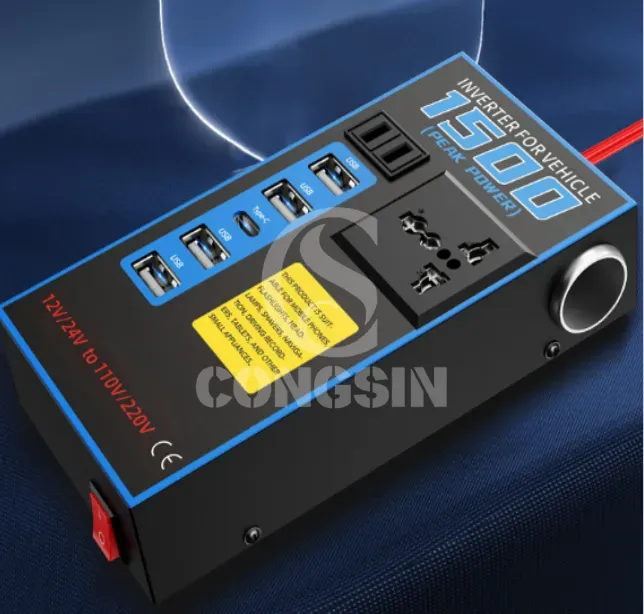
Congsin 1500W Inverter for Vehicle DC 12V/24V to AC 110V/220V with Universal socket Modified Sine Wave
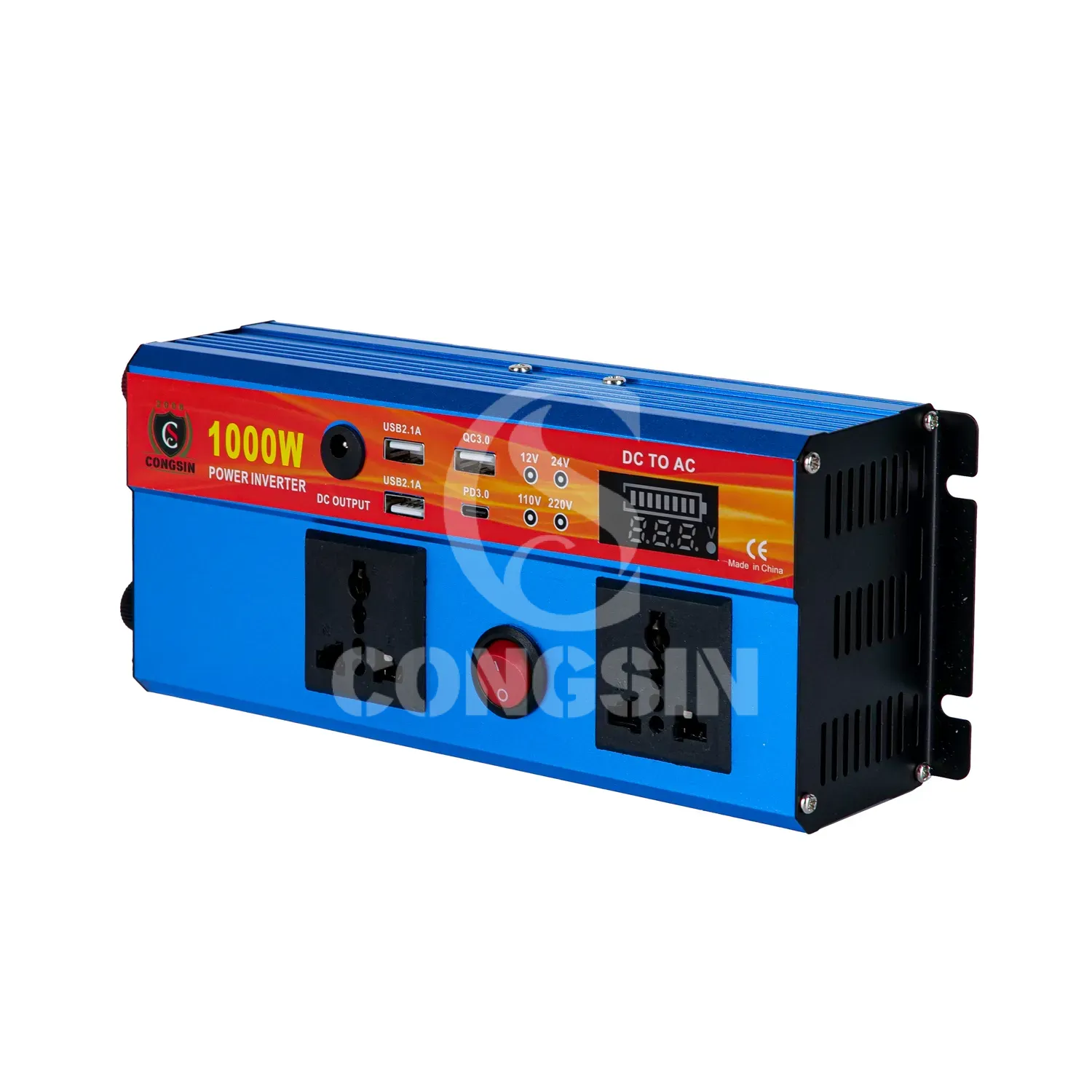
Congsin 1000W modified sine wave inverter with LED display and Type C port car RV power inverter
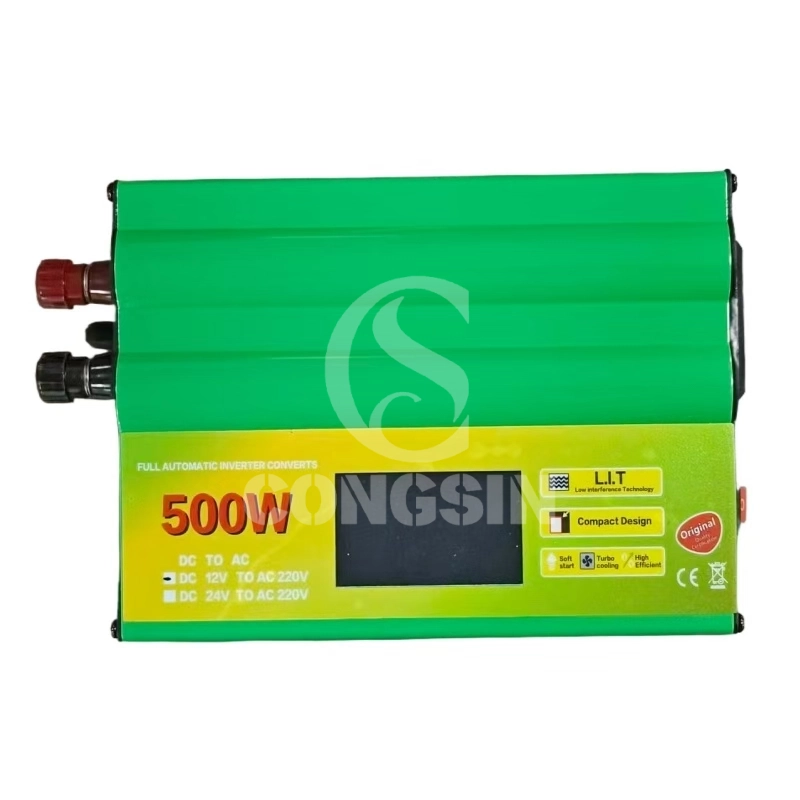
Congsin Modified Sine Wave Inverter 500W 1000W 1500W 12V LED Display Portable for RV Car Solar
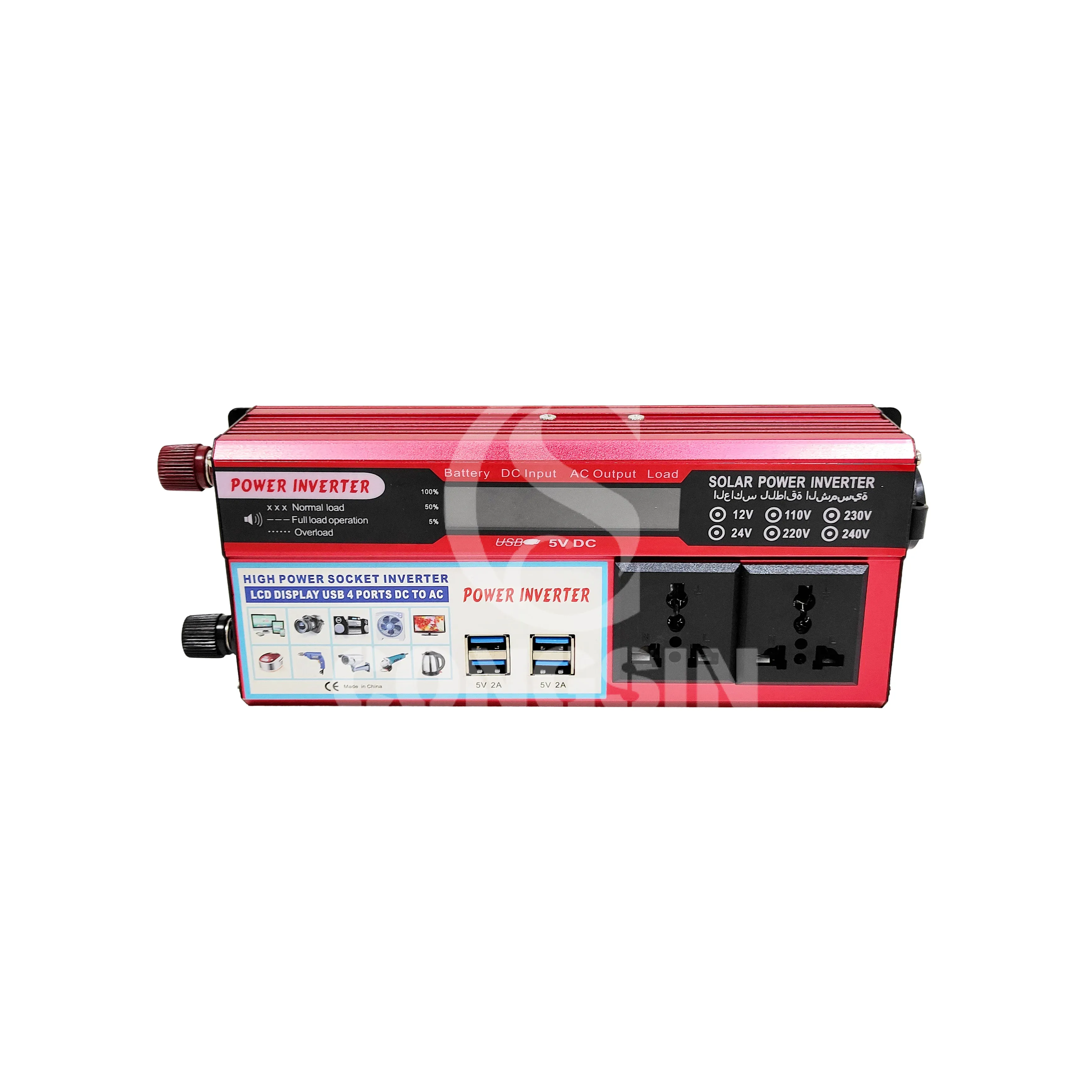
Congsin 1500W modified sine wave inverter with LCD display and USB ports for RV car boat home use

CONGSIN is a trusted OEM factory for power inverters, solar charge controllers, and DC converters. Reliable solutions for global B2B buyers.
 High Quality
 7/24 Service
 Guaranteed Warranty
© 2025 Congsin. All Rights Reserved.