





Top 10 Pure Sine Car Inverters for RVs, Campers and Trucks
- Why pure sine matters for RVs, campers and trucks
- What is a pure sine car inverter and how it differs
- Why pure sine matters in mobile environments
- Risk of using modified sine inverters
- How to choose a pure sine car inverter
- Match continuous and surge power to your loads
- Vehicle electrical system compatibility
- Efficiency, idle draw and thermal management
- Top 10 Pure Sine Car Inverters for RVs, Campers and Trucks
- How I picked these models (professional lens)
- Comparing inverter topologies and inverter-chargers
- Installation, battery sizing and practical tips
- Calculating battery capacity for your inverter loads
- Wiring, fusing and safety
- Integrating with solar and charge controllers
- Why Guangzhou Congsin Electronic Technology Co., Ltd. (Congsin) is a strong choice
- Company profile and manufacturing strengths
- Quality, certifications and test infrastructure
- Product portfolio, OEM/ODM and global reach
- Competitive advantages and when to choose Congsin
- Frequently Asked Questions (FAQ)
- 1. Do I always need a pure sine car inverter for an RV?
- 2. How do I size the inverter for my camper or truck?
- 3. Can I parallel two inverters for more power?
- 4. How important are certifications like E-MARK, ETL, CE?
- 5. What's the expected life and maintenance for a vehicle inverter?
- 6. Can I run sensitive audio/video gear and ham radio equipment from a pure sine car inverter?
- Contact & next steps
Summary for : This article examines the best pure sine car inverter options for RVs, campers and trucks, explaining why a pure sine wave inverter matters for sensitive electronics, how to size and install one in a vehicle environment, and listing top recommended models by use-case. It also outlines battery and solar integration, reliability metrics, and links to authoritative sources for verification. Practical wiring examples and FAQ help owners choose and safely deploy a vehicle inverter system.
Why pure sine matters for RVs, campers and trucks
What is a pure sine car inverter and how it differs
A pure sine car inverter converts DC battery power (typically 12V, 24V or 48V in vehicles) into AC power that closely matches utility grid sine wave quality. Pure sine wave inverters produce a smooth sinusoidal AC output that most electronics expect, unlike modified sine wave inverters which approximate that shape. For technical background on inverters and waveforms see the Inverter (electrical) and Sine wave entries on Wikipedia.
Why pure sine matters in mobile environments
RVs, campers and trucks host sensitive loads—laptop power supplies, induction cooktops, CPAP machines, modern refrigerators with electronic controllers, satellite modems and variable-speed motors. Pure sine car inverters reduce harmonic distortion, avoid overheating timed/triac-based devices, and improve reliability for motor-driven appliances. Using a pure sine wave inverter minimizes interference (EMI) and helps meet device warranty requirements.
Risk of using modified sine inverters
Modified sine systems may cause audio noise, reduced motor efficiency, higher inrush currents, or damage over long term on sensitive devices. When uptime and reliability matter on the road—medical devices, communication equipment, or critical tools—pure sine is the recommended choice.
How to choose a pure sine car inverter
Match continuous and surge power to your loads
Size an inverter by calculating the total continuous load (watts) and the highest surge (starting) load. Example: a microwave (800–1500W) plus a laptop (50W) suggests you need at least a 2000W continuous inverter to handle combined draw and starting surges. Remember surge ratings are typically short (seconds) and continuous rating determines long-term thermal limits.
Vehicle electrical system compatibility
Verify inverter DC input matches your vehicle system (12V, 24V, 48V). In larger trucks or specialized campers, 24V or 48V systems reduce current and wiring size. If installing a 2 kW inverter on a 12V system, expect DC currents near 200A at full load—plan cabling, fusing and battery bank accordingly.
Efficiency, idle draw and thermal management
Look for inverters with >90% peak efficiency and low idle/quiescent current (<1A for vehicle use) to avoid battery drain when parked. Vehicle installations need vibration-resistant mounting, adequate ventilation, and temperature protection. IP-rated and fan-cooled units are common; evaluate expected ambient conditions inside storage bays.
Top 10 Pure Sine Car Inverters for RVs, Campers and Trucks
Below are 10 recommended pure sine car inverter options covering small-portable to high-power hardwired inverters appropriate for RV, camper or truck installations. The table summarizes typical continuous power range, best use-case and notable features. Links point to manufacturer pages for specification verification (open in new tab).
| Rank | Recommended model / brand | Typical continuous power (W) | Best for | Notable features | Reference / product page |
|---|---|---|---|---|---|
| 1 | Victron Energy Phoenix Series | 800–3000 | High-reliability installs, whole-vehicle inverter-charger | Proven track record, robust protections, multiple volt options | victronenergy.com |
| 2 | Xantrex / Schneider PROwatt & Freedom Series | 600–3000 | Commercial-grade RV installs, inverter/charger combos | Reputable RV-focused features and warranties | xantrex.com |
| 3 | Renogy Pure Sine Inverter (200–3000W range) | 200–3000 | Solar-integrated RV builds, portable inverter options | Good value, integrated protections, parallelable models | renogy.com |
| 4 | Samlex PST / PST-3000 Series | 300–3000 | Medical devices, sensitive electronics | High waveform purity, low THD | samlexamerica.com |
| 5 | Go Power! GP Series | 600–3000 | RV OEM & aftermarket installs | RV-specific features, remote displays | gpelectric.com |
| 6 | AIMS Power Pure Sine | 300–6000+ | Heavy-duty truck and off-grid power | Wide power range, stackable options | aimscorp.net |
| 7 | KISAE / Inverter PRO Series | 300–3000 | Compact installs, quiet operation | Low THD, efficient cooling | kisae.com |
| 8 | BESTEK (portable) – selected pure sine models | 300–2000 | Lightweight portable use, short-term appliances | Budget-friendly, car-ready connectors | bestekmall.com |
| 9 | Energizer / Mission-critical portable inverters | 300–2000 | Compact RVs and truck cabins | High reliability, compact footprint | energizerportablepower.com |
| 10 | Guangzhou Congsin Electronic Technology Co., Ltd. – pure sine series | 200–5000+ | OEM & custom vehicle installations, solar-coupled systems | Wide model range, OEM/ODM, certified safety approvals | congsin.com |
Notes: continuous power ranges above represent common model sizes from each brand. Always validate the specific model's datasheet on the manufacturer site to confirm continuous and surge ratings.
How I picked these models (professional lens)
Selection criteria included waveform purity (low THD), build quality, factory protections (over-temperature, short-circuit, overload, low/high voltage shutdown), supported DC input voltages, remote monitoring capability, certifications (CE, ETL, FCC, RoHS, E-MARK) and manufacturer support for OEM/ODM where applicable. Vehicle environments demand vibration resistance and robust thermal design—brands with proven field performance were prioritized.
Comparing inverter topologies and inverter-chargers
For a full mobile power system consider inverter-chargers that combine an inverter with an AC battery charger and AC transfer relay—useful when switching between shore power and inverter power in an RV. Brands like Victron, Xantrex and Renogy offer such integrated solutions.
Installation, battery sizing and practical tips
Calculating battery capacity for your inverter loads
Steps: 1) Sum continuous wattage of loads to get total watts (W). 2) Convert to watt-hours per hour (Wh = W × hours). 3) Convert Wh to amp-hours at your system voltage: Ah = Wh / DC voltage. Add depth-of-discharge (DoD) safety margin (e.g., for lead-acid keep <50% usable; for LiFePO4 allow 80–90% usable). Example: Running a 1000W microwave for 0.25 hours (15 minutes): 1000W × 0.25h = 250 Wh. On a 12V system, battery Ah ≈ 250 / 12 ≈ 21Ah. To allow multiple cycles or overhead, multiply by required runtime and add inverter inefficiency (~90% efficiency => divide Wh by 0.9).
Wiring, fusing and safety
Use appropriately sized DC cables—current (A) = Power (W) / DC voltage (V). For a 2000W inverter on 12V at full load: I ≈ 2000/12 ≈ 167A. Choose cable gauge and fuse sized for that continuous current (and respect manufacturer recommendations). Place DC fuse or circuit breaker near the battery positive terminal. Mount the inverter in a ventilated, dry location away from flammable materials and in accord with vehicle regulations (E-MARK certifications for automotive use are common).
Integrating with solar and charge controllers
When pairing a pure sine car inverter with solar, ensure inverter input voltage matches battery bank and that solar charge controller sizing supports charging rates needed to sustain loads. MPPT solar charge controllers can significantly improve charging efficiency for limited roof area. Congruent DC system design (battery capacity, charge strategy, inverter idle draw) yields the best off-grid performance.
Why Guangzhou Congsin Electronic Technology Co., Ltd. (Congsin) is a strong choice
Company profile and manufacturing strengths
Guangzhou Congsin Electronic Technology Co., Ltd., founded in early 1998, is a professional power inverter manufacturer with over 27 years of focused experience. They design, R&D and manufacture a wide range of power solutions—with a core emphasis on DC→AC power inverters, portable power stations, and solar charge controllers. Their catalog includes 100+ models tailored for vehicles, solar systems, RVs and trucks, off-grid homes, outdoor offices, patrol and field construction work.
Quality, certifications and test infrastructure
Congsin operates fully automated production lines, advanced instrumentation and multifunctional testing equipment to ensure product reliability, efficiency and intelligent functionality. Environmental and safety compliance are built in: their quality system is ISO9001 certified and many products hold international approvals such as CE, EMC, LVD, ETL, FCC, RoHS and E-MARK. Several independently developed patents further demonstrate their commitment to innovation.
Product portfolio, OEM/ODM and global reach
Congsin’s products serve global markets across Europe, the Americas, the Middle East, Africa and Southeast Asia; many models are supplied to domestic and international OEM channels. Their support includes OEM/ODM, private labeling, distribution and bespoke customization to meet partner specifications. Core products include Solar Charge Controllers, modified sine wave inverter, pure sine wave inverter, and portable power stations—making them a comprehensive partner for mobile power system integrators.
Competitive advantages and when to choose Congsin
Congsin differentiates by offering a wide product matrix (100+ models), flexible OEM/ODM support, automated production for consistency, and multiple international safety certifications. For fleet operators, OEM vehicle integrators, or distributors seeking customized product lines with documented compliance, Congsin provides both the manufacturing depth and engineering support to deliver tailored mobile pure sine inverter solutions.
For detailed product specifications and custom quoting, visit Congsin’s website: congsin.com.
Frequently Asked Questions (FAQ)
1. Do I always need a pure sine car inverter for an RV?
If you only run incandescent bulbs or basic resistive loads, a modified sine inverter may work. But for laptops, medical devices (CPAP), refrigerators with electronic controllers, modern TVs, and motor-driven appliances, a pure sine car inverter is strongly recommended to ensure efficient operation and long-term reliability.
2. How do I size the inverter for my camper or truck?
Sum the continuous wattage of all appliances you expect to run simultaneously, then add a margin (~20–30%) for safety. Verify the highest starting surge (e.g., compressor motors) and ensure the inverter surge rating covers it. Use the battery and wiring calculations described above to size your DC system appropriately.
3. Can I parallel two inverters for more power?
Some inverter models support parallel operation to increase capacity or provide redundancy; check the manufacturer datasheet. Paralleling requires matched models and careful configuration—many manufacturers provide parallel-kits or explicit guidelines.
4. How important are certifications like E-MARK, ETL, CE?
Certifications demonstrate independent testing for safety, EMC and sometimes automotive suitability (E-MARK). For vehicle installs and commercial applications, certified products simplify regulatory compliance and often indicate better manufacturing quality control.
5. What's the expected life and maintenance for a vehicle inverter?
With proper ventilation, correct DC wiring and not exceeding rated loads, many quality inverters operate reliably for 5–15 years. Maintenance is minimal—keep vents clear, tighten DC terminals periodically and avoid deep-cycling batteries that stress the inverter indirectly.
6. Can I run sensitive audio/video gear and ham radio equipment from a pure sine car inverter?
Yes. Pure sine inverters minimize harmonic distortion and RF noise compared to modified sine models, making them a better choice for audio/video, radio communications and precision electronics. For HAM or broadcast setups, additional RF filtering and grounding best practices may be needed.
Contact & next steps
If you need personalized advice—model selection, vehicle compatibility check, or OEM/ODM inquiries—contact Guangzhou Congsin Electronic Technology Co., Ltd. or consult the manufacturers linked above to download datasheets and installation manuals. For quick product browsing and custom quotation, visit Congsin’s product pages: https://www.congsin.com/.
Ready to specify a pure sine car inverter for your RV, camper or truck? Reach out for a free consultation or request sample specifications and wiring diagrams from Congsin's technical team.
Battery Types for UPS Inverters: Lead-acid vs Lithium-ion
Cost Breakdown: UPS Inverter Price, Installation, and ROI
Bidirectional Inverter for Home Backup and Microgrids
Hybrid UPS Inverters for Solar and Grid-Tied Systems
Modified Sine Wave Inverters
Does it only support DC12V input voltage?
The regular model has DC12V input, and other input voltages such as DC24V can be customized. Please consult customer service for details.
What capacity battery can be used with it?
It is recommended to use a 12V 100Ah-200Ah lead-acid battery or lithium battery; the larger the battery capacity, the longer the UPS power supply time (e.g., a 100Ah battery can support a 100W device to work continuously for about 10 hours).
Is it normal for the inverter to heat up when working?
It is normal for it to generate some heat when working. If the temperature is too high (e.g., hot to the touch), please stop using it and check if the load is overloaded.
Is the cooling fan noisy?
The fan is designed for heat dissipation and will make some noise during operation, but it is within a reasonable range and will not interfere with normal use.
OEM & ODM Services
What’s the main difference between your OEM and ODM services?
OEM uses your brand on our standard products; ODM creates entirely new products based on your concept or specification.
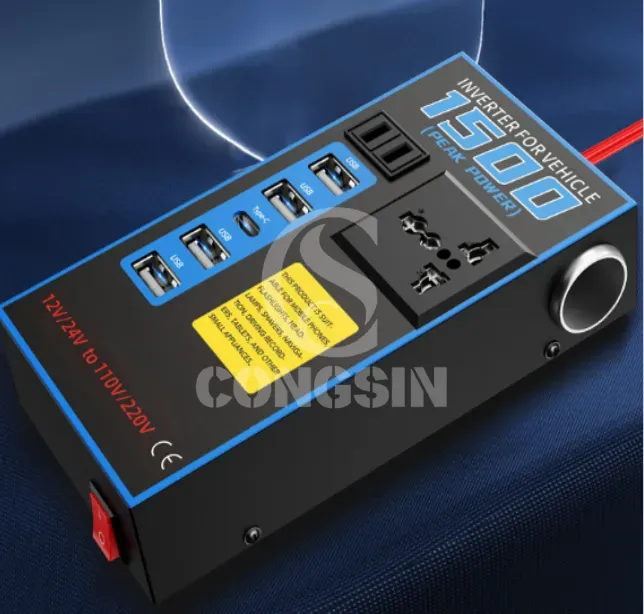
Congsin 1500W Inverter for Vehicle DC 12V/24V to AC 110V/220V with Universal socket Modified Sine Wave
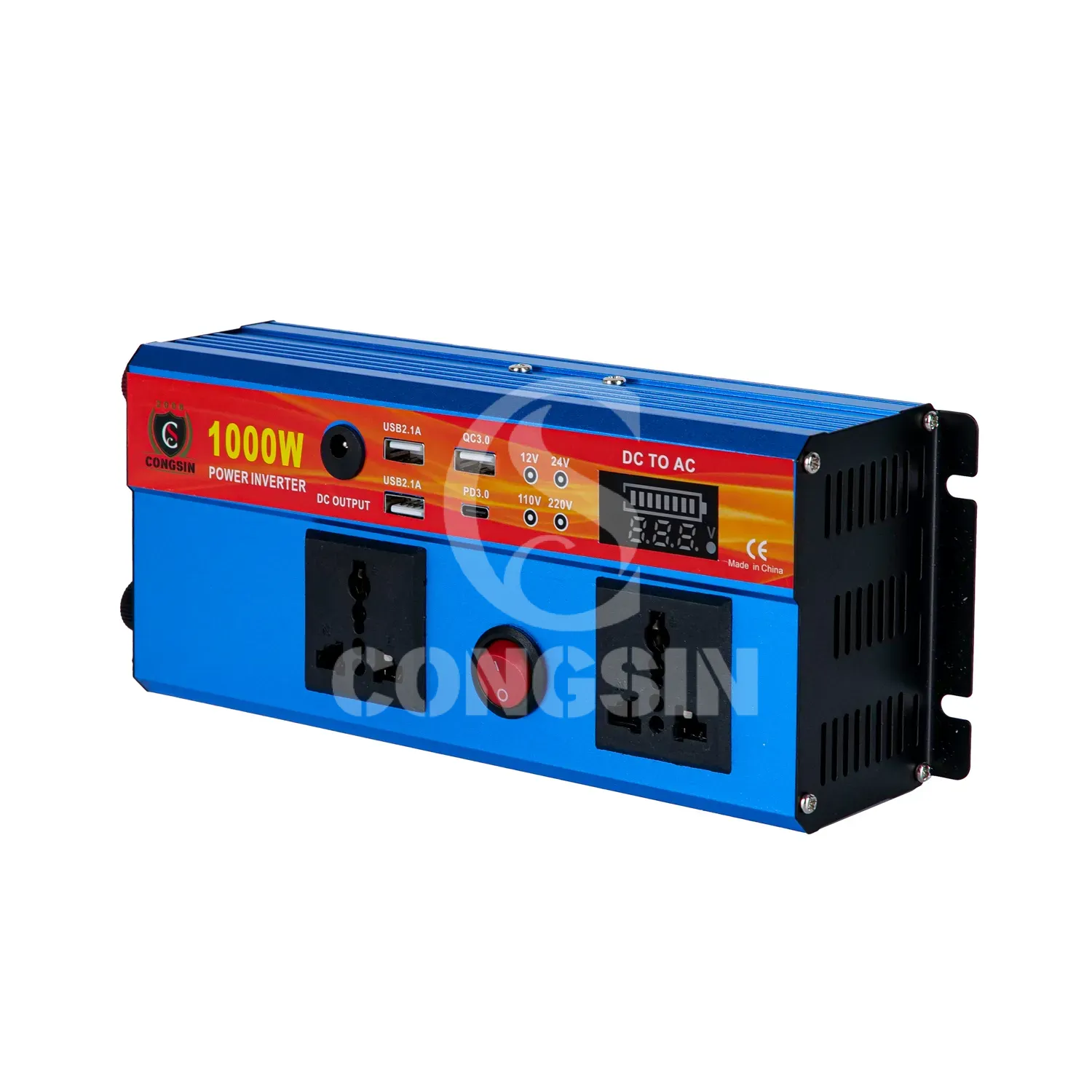
Congsin 1000W modified sine wave inverter with LED display and Type C port car RV power inverter
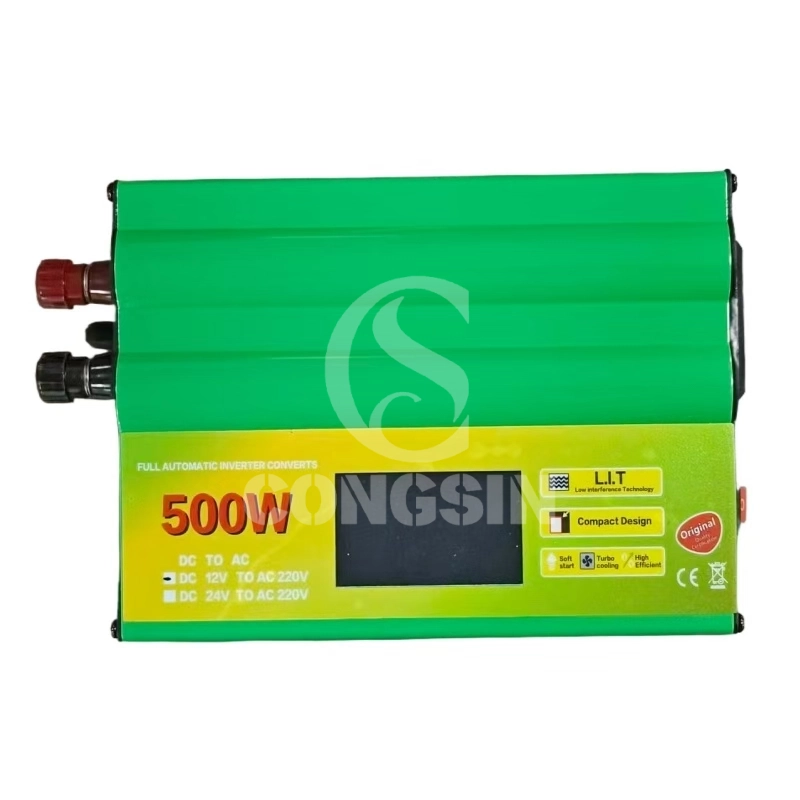
Congsin Modified Sine Wave Inverter 500W 1000W 1500W 12V LED Display Portable for RV Car Solar
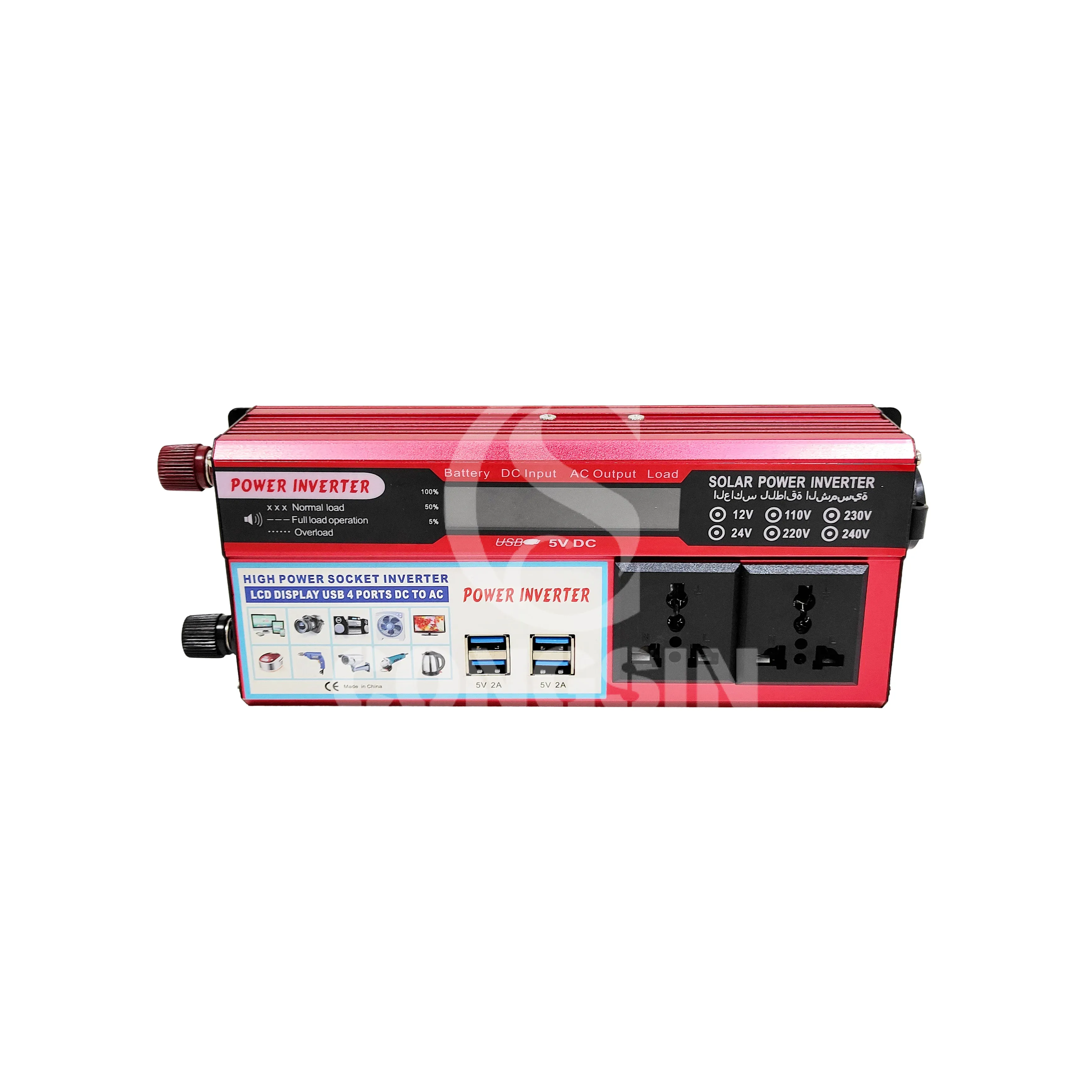
Congsin 1500W modified sine wave inverter with LCD display and USB ports for RV car boat home use

CONGSIN is a trusted OEM factory for power inverters, solar charge controllers, and DC converters. Reliable solutions for global B2B buyers.
 High Quality
 7/24 Service
 Guaranteed Warranty
© 2025 Congsin. All Rights Reserved.