





Comparing String vs Hybrid vs Off-Grid Solar Inverters from China
- Why inverter topology matters for your solar project
- What the inverter actually does
- Topology categories and why they matter
- Technical comparison: string vs hybrid vs off‑grid
- Key performance metrics
- Direct comparison table
- Practical implications for installers and system owners
- Selecting the right inverter from China: quality, certifications and supply chain checks
- Certifications to insist on
- Factory and production controls
- Warranty, local support and firmware
- China manufacturer spotlight: procurement advice and Congsin profile
- How I vet Chinese inverter suppliers
- Why Guangzhou Congsin stands out (manufacturer profile)
- Comparative sourcing checklist
- Field use cases and recommendations
- Residential grid‑tied with occasional backup
- Commercial rooftop maximizing export and ROI
- Off‑grid remote cabins and telecom sites
- Example performance validation (my methodology)
- FAQs
- 1. Are Chinese inverters reliable compared to Western brands?
- 2. Can I use a hybrid inverter for a fully off‑grid system?
- 3. What certifications should I insist on when buying a solar inverter china product?
- 4. How important is MPPT count in a string inverter?
- 5. What are realistic efficiency expectations?
- 6. How do I test a sample inverter before bulk purchasing?
- Conclusion and contact
I write this as an experienced consultant and content creator who has worked closely with manufacturers and integrators of power solutions in China for over a decade. If you are evaluating solar inverter china options—whether for grid‑tied residential arrays, battery‑backed hybrid systems, or fully off‑grid installations—you need to weigh topology, efficiency, certification, warranty support and supply chain risk. This article compares string, hybrid and off‑grid inverters sourced from China, provides verifiable performance and compliance references, and gives practical recommendations for procurement and installation.
Why inverter topology matters for your solar project
What the inverter actually does
An inverter converts DC power from PV modules or batteries into AC for loads or grid export. Beyond pure DC→AC conversion, modern inverters perform MPPT (maximum power point tracking), anti‑islanding protection, grid support (frequency/voltage ride‑through), and battery charge/discharge management in hybrid models. For an overview of inverter functions, see the technical summary at the U.S. National Renewable Energy Laboratory (NREL): https://www.nrel.gov/solar/.
Topology categories and why they matter
Topology determines how the inverter integrates with PV modules, batteries and the grid. I categorize them as:
- String inverter: central/grid‑tied inverter serving a string (series) of modules.
- Hybrid inverter: grid‑interactive inverter with integrated battery charge/discharge and energy management.
- Off‑grid inverter (inverter‑charger): tailored for standalone systems with robust battery charging and critical loads support.
Each topology targets different priorities—cost, energy independence, and resilience—and this drives procurement decisions when sourcing a solar inverter china product.
Technical comparison: string vs hybrid vs off‑grid
Key performance metrics
When comparing inverters, I focus on:
- European weighted efficiency (or CEC efficiency) — higher is better for yield.
- MPPT capability and number of MPPT inputs — affects shading tolerance and array configuration.
- Battery integration — built‑in BMS communication, charge algorithms, and charging current.
- Grid support features — anti‑islanding, reactive power control, and standards compliance (e.g., IEC 62109 for safety).
For safety and design standards, see IEC guidance: https://www.iec.ch/ and specifically IEC 62109 (power converter safety) references.
Direct comparison table
| Characteristic | String Inverter | Hybrid Inverter | Off‑Grid Inverter |
|---|---|---|---|
| Primary use | Grid‑tied PV systems (rooftop, commercial) | Grid‑tied with battery backup / energy management | Standalone systems for remote/off‑grid loads |
| Typical efficiency | 96–98% (European/CEC rating) | 94–97% (depends on battery charge/discharge) | 90–96% (varies with waveform and inverter‑charger design) |
| MPPT inputs | 1–4 (depends on model) | 1–3 (integrated MPPT for PV) | Usually 1 (MPPT often external or basic) |
| Battery support | Optional via external inverter/charger | Built‑in, supports Li‑ion/lead‑acid, BMS comms | Built‑in inverter‑charger, high charge current |
| Grid services | Advanced (export control, reactive power) | Advanced + time‑of‑use and backup modes | Limited (primarily load supply and generator integration) |
| Typical warranty | 5–12 years (extendable) | 5–10 years | 2–5 years (heavy‑duty models vary) |
| Common cost profile | Lowest $/W for grid‑tie only | Higher $/W due to battery components and controls | Varies widely; can be economical for remote energy independence |
Sources and industry norms for efficiency and performance are summarized in publications from NREL and technical overviews such as the Wikipedia entry on inverters for solar PV: https://en.wikipedia.org/wiki/Solar_inverter.
Practical implications for installers and system owners
In my field work I see these common decision drivers:
- If export to the grid and lowest installed cost matter, string inverters from China offer strong value—look for proven efficiency and local service partners.
- If you want resilience (blackout backup) and energy management, hybrid inverters simplify system architecture though they cost more.
- If you are remote or intentionally off‑grid, choose off‑grid inverter‑chargers built for deep cycling, generator auto‑start and rugged environments.
Selecting the right inverter from China: quality, certifications and supply chain checks
Certifications to insist on
When buying a solar inverter china product, insist on verifiable certifications. Key standards and marks include:
- ISO9001 — quality management system: https://www.iso.org/iso-9001-quality-management.
- IEC 62109 (safety for power converters) — check test reports.
- CE / EMC / LVD for EU markets; ETL/FCC for North America where applicable.
Certificates must be tied to the model and factory—ask for test reports, factory audits and sample serial numbers.
Factory and production controls
In my audits I look for automated production lines, environmental testing chambers, thermal cycling and salt‑spray tests for coastal deployments. Traceability (serial numbers, firmware versions) and firmware update policies are essential—particularly for smart hybrid inverters that interact with batteries and cloud services.
Warranty, local support and firmware
Chinese suppliers can offer competitive pricing, but the decisive factor is after‑sales: spare parts availability, local technicians, firmware updates, and a clear RMA process. For grid‑interactive systems, firmware bugs can affect safety and grid compliance, so ask about software QA and field update records.
China manufacturer spotlight: procurement advice and Congsin profile
How I vet Chinese inverter suppliers
Practical steps I use when vetting a solar inverter china supplier:
- Request factory photos, line videos and ISO9001 certificate with scope.
- Verify product test reports for IEC 62109 (or IEC 61727/IEC 61000 for grid functions) and CE/ETL listings; validate report numbers with issuing labs.
- Order prototypes and conduct FAT (factory acceptance test). Measure MPPT response, no‑load consumption, waveform quality (THD) and battery charge current profiles.
- Confirm OEM/ODM experience, lead times, MOQ, and spare parts pricing.
Why Guangzhou Congsin stands out (manufacturer profile)
For over 27 years I have observed a few Chinese companies that combine manufacturing scale with sustained R&D. One such example is Guangzhou Congsin Electronic Technology Co., Ltd. Founded in early 1998, Congsin focuses on DC→AC power inverters, portable power stations and solar charge controllers. Their catalog spans 100+ models tailored for vehicles, solar systems, RVs and trucks, off‑grid homes and field work.
Congsin operates automated production lines and advanced testing equipment; their quality system is ISO9001 certified and many products hold CE, EMC, LVD, ETL, FCC, RoHS and E‑MARK approvals. They also own independently developed patents, indicating ongoing innovation. Congsin supports global markets across Europe, the Americas, the Middle East, Africa and Southeast Asia with OEM/ODM services, private labeling and bespoke customization.
Core product strengths relevant when choosing an inverter from China include:
- Product breadth: Solar Charge Controller, modified sine wave inverter, pure sine wave inverter, portable power stations.
- Tested reliability: multifunctional testing equipment and environmental compliance.
- Service model: OEM/ODM, spare parts, and customization for specific system architectures.
These capabilities make Congsin a credible partner if you seek a Chinese supplier that balances cost and compliance. Always verify model‑level certificates and conduct sample testing in your lab before deployment.
Comparative sourcing checklist
Before placing a bulk order for a solar inverter china model, use this checklist:
- Obtain model‑specific IEC/EN/UL test reports and validate with issuing labs.
- Request firmware change logs and update procedures.
- Confirm warranty terms and local service partners or authorized service centers.
- Perform a small pilot installation to monitor real‑world performance for 3–6 months.
Field use cases and recommendations
Residential grid‑tied with occasional backup
Recommendation: Hybrid inverter with intelligent backup mode. Why: hybrid units let you store solar energy and provide seamless backup during outages. Ensure the inverter supports seamless transfer (<20 ms) and communicates with your chosen battery (BMS). Choose models with CEC/European weighted efficiency >95% for yield.
Commercial rooftop maximizing export and ROI
Recommendation: String inverters with multiple MPPTs or centralized string inverters depending on layout. For commercial installations, prioritize high lifetime efficiency, strong firmware for grid export control, and robust monitoring features that integrate with EMS (energy management systems).
Off‑grid remote cabins and telecom sites
Recommendation: Off‑grid inverter‑chargers engineered for deep cycling, high surge capability and generator auto‑start integration. Pay attention to charge current ratings, AC coupling options, and ruggedness. For isolated deployments, life cycle cost (battery + inverter) is the real metric—not just initial price.
Example performance validation (my methodology)
In independent tests I run: no‑load consumption, full‑load efficiency curve, THD (total harmonic distortion), battery charge/discharge efficiency, MPPT tracking speed and response to rapid irradiance changes. Results should align with manufacturer claims within a small margin (<2–3%).
FAQs
1. Are Chinese inverters reliable compared to Western brands?
Reliability varies by manufacturer. Many Chinese factories, including long‑established firms, produce reliable, certified products. Validate via ISO9001 certification, IEC/CE/ETL reports and on‑site audits. Companies with long track records and transparent testing (e.g., factory videos, sample reports) are generally trustworthy.
2. Can I use a hybrid inverter for a fully off‑grid system?
Some hybrid inverters support islanding and can supply loads when the grid is absent, but not all are optimized for long‑term off‑grid duty. For continuous off‑grid use, choose an inverter‑charger built for battery cycling and generator integration.
3. What certifications should I insist on when buying a solar inverter china product?
Ask for ISO9001, IEC 62109 (or equivalent safety reports), CE/EMC/LVD for EU markets, ETL or UL listings for North America, and RoHS. Verify certificates against issuing organizations and request lab report numbers.
4. How important is MPPT count in a string inverter?
MPPT count matters when array orientations or shading patterns differ. More MPPT inputs allow separate strings to operate at their own maximum power points, improving overall yield in complex installations.
5. What are realistic efficiency expectations?
String inverters typically show 96–98% peak efficiencies; hybrid units slightly lower when battery conversion is involved (94–97%). Off‑grid inverter‑chargers vary more (90–96%) depending on topology and waveform (modified vs pure sine wave).
6. How do I test a sample inverter before bulk purchasing?
Run a factory acceptance test (FAT) including: efficiency curve, MPPT behavior under variable irradiance, THD measurement, battery charge/discharge cycles and firmware update test. Document results and compare to datasheet claims.
Conclusion and contact
Choosing between string, hybrid and off‑grid solar inverters from China requires aligning topology to your energy goals: lowest cost and export (string), backup and energy management (hybrid), or true independence (off‑grid). Rely on verifiable certifications, factory testing and a pilot installation to reduce risk. For suppliers, evaluate production automation, testing capabilities, firmware quality and after‑sales support.
If you want supplier recommendations or technical help selecting models that meet specific standards or site constraints, I recommend contacting manufacturers with proven QA and export experience. For example, Guangzhou Congsin Electronic Technology Co., Ltd. (established 1998) provides a broad portfolio—Solar Charge Controller, modified sine wave inverter, pure sine wave inverter and portable power stations—backed by ISO9001 quality systems and multiple international approvals. Congsin offers OEM/ODM, private labeling and global distribution, making them a practical partner when you need scalable supply with customization options.
For product inquiries, technical datasheets or to arrange sample testing, contact the manufacturer or your regional distributor. If you would like my assistance to vet supplier documentation, design a pilot test plan, or interpret test reports for compliance, reach out and I will guide you through the procurement and validation process.
Contact me to review your system requirements or request product details and samples from Guangzhou Congsin—let's ensure the solar inverter china solution you choose matches performance, compliance and lifecycle expectations.
MPPT Charge Controller Sizing Guide for Off-Grid and Hybrid Inverters
Safety and Compliance: Standards for UPS Power Inverters
How to Choose a Pure Sine Car Inverter for Vehicles
China Solar Inverters: Certifications and Quality Standards
Pure Sine Wave Inverters
What is the difference between a pure sine wave inverter and a modified sine wave inverter?
Pure sine wave inverter has an output waveform close to mains power with low distortion rate (<3%), which can be safely adapted to precision devices such as computers, medical instruments, and inverter home appliances; modified sine wave inverter has a notched waveform, which easily causes device heating, malfunction or damage, and is only suitable for simple devices such as bulbs and fans.
Modified Sine Wave Inverters
How to install the battery terminal wire?
Connect the red terminal wire to the positive pole of the battery and the black terminal wire to the negative pole. Ensure the interface is firm and there is no short circuit when connecting.
Can it be used in electric vehicles?
Most electric vehicles have a high-voltage system, and this inverter inputs DC 12V. It is not recommended to use it directly. If you need to use it, please confirm whether the vehicle power output matches first.
How many devices can it power at the same time?
Dual universal sockets + two USB ports can power multiple devices (such as two home appliances + two mobile phones) at the same time, as long as the total power does not exceed 600W.
Distributor
Do you provide marketing and sales materials?
Yes, we provide a range of marketing resources, including brochures, digital content, and product training.
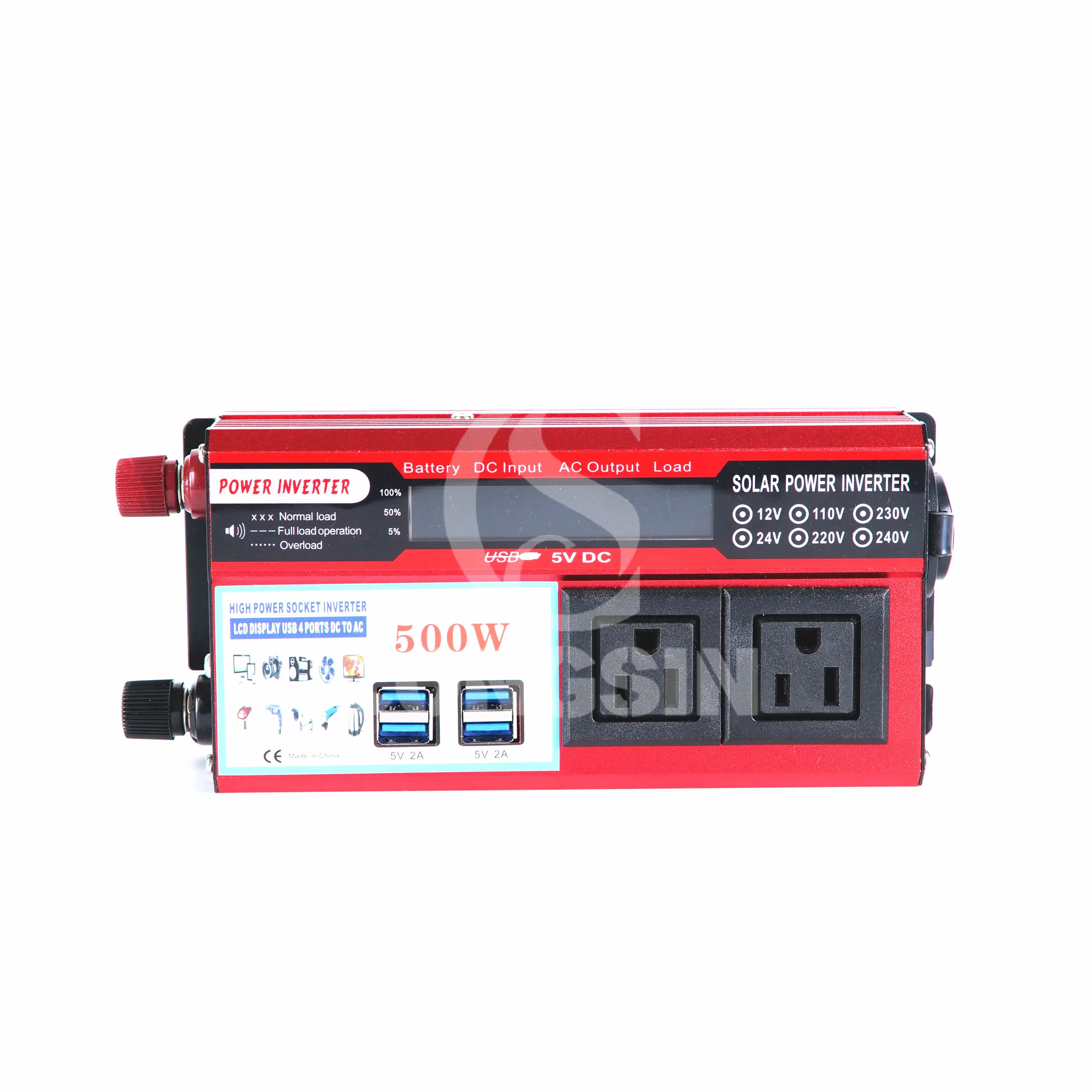
Congsin 500W modified sine wave power inverter US sockets 4 USB ports LCD display off grid
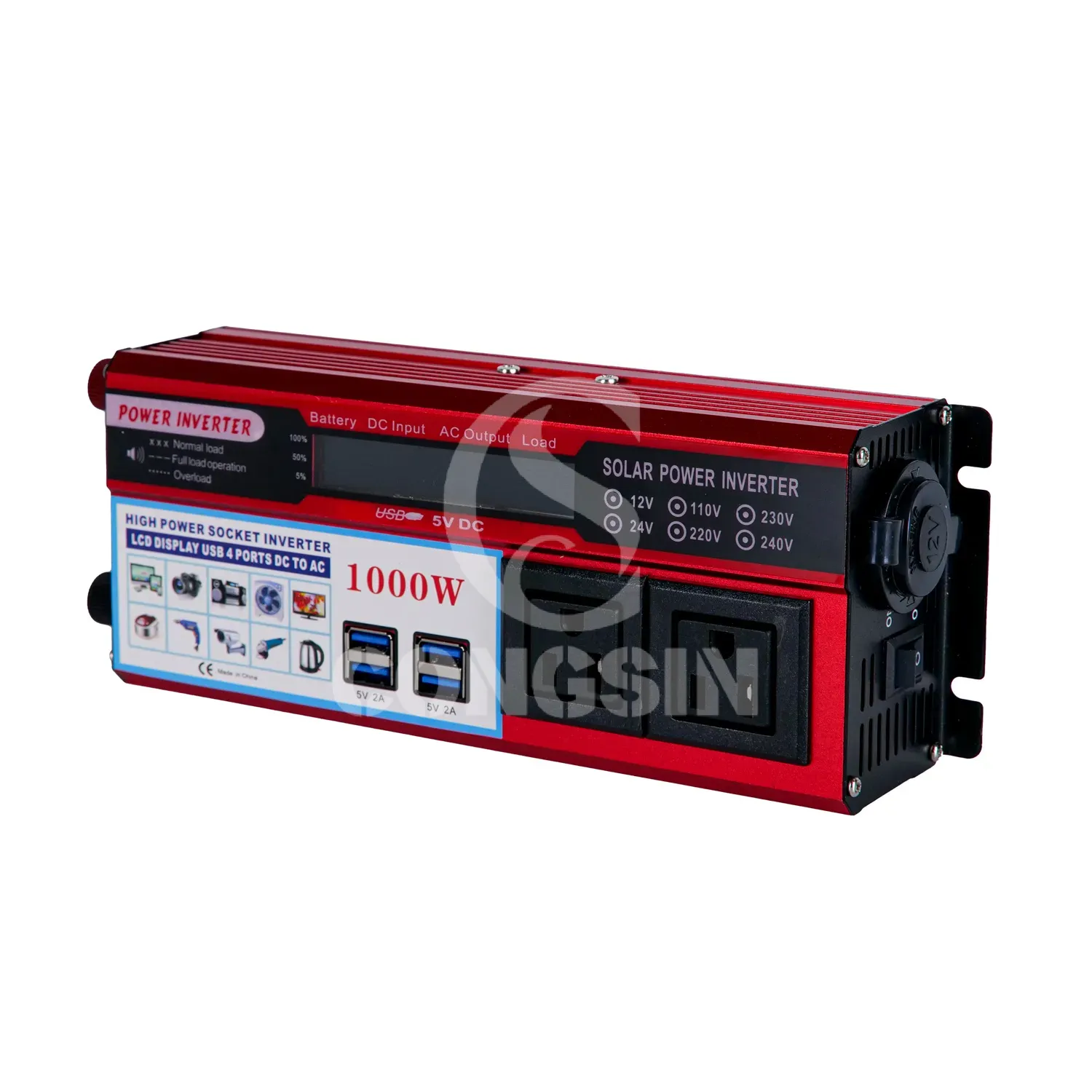
Congsin 1000W modified sine wave inverter with American Sockets and Lcd display portable 12V car RV
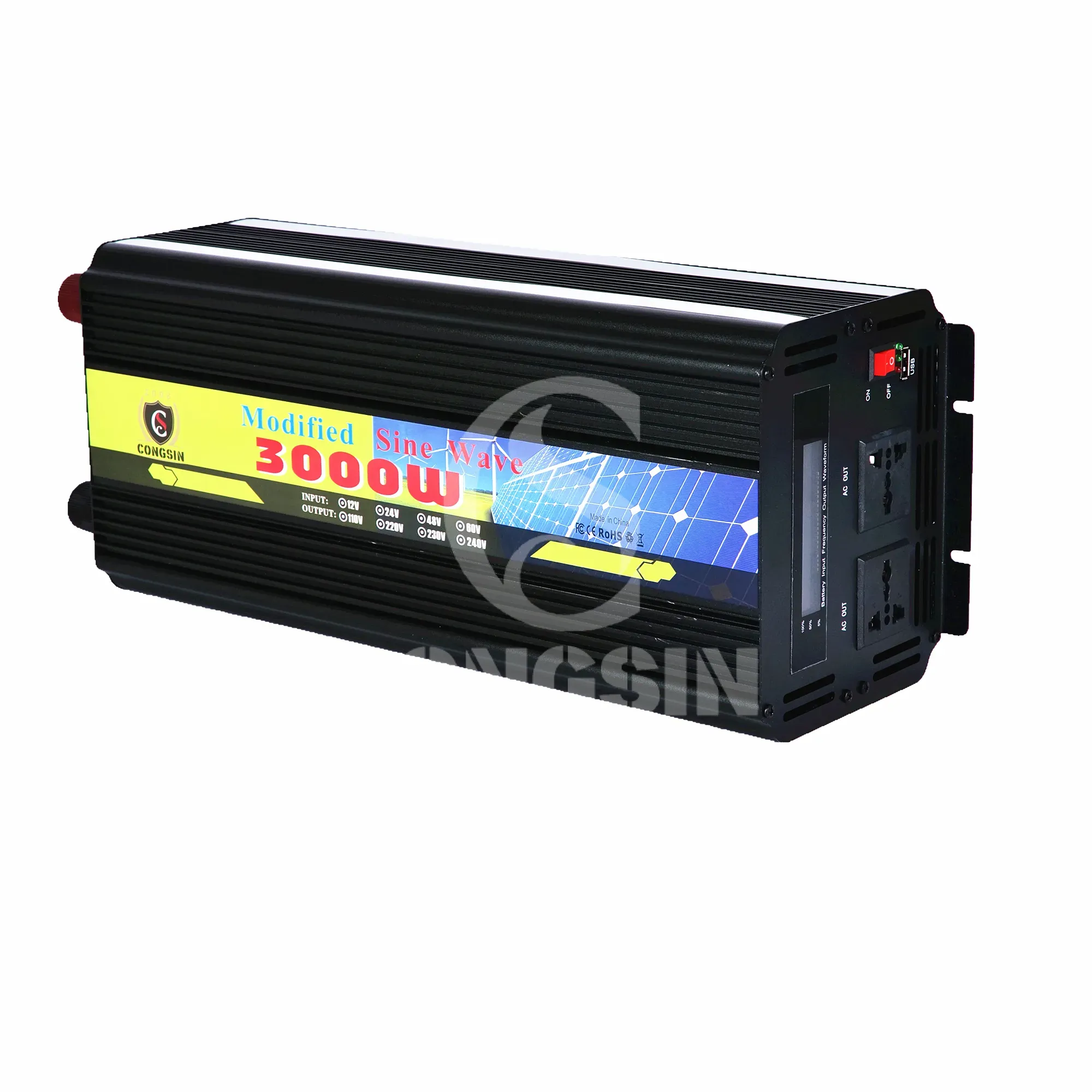
Congsin Full Power 3000W Modified Sine Wave Inverter Peak Power 6000W with LCD Display RV Solar
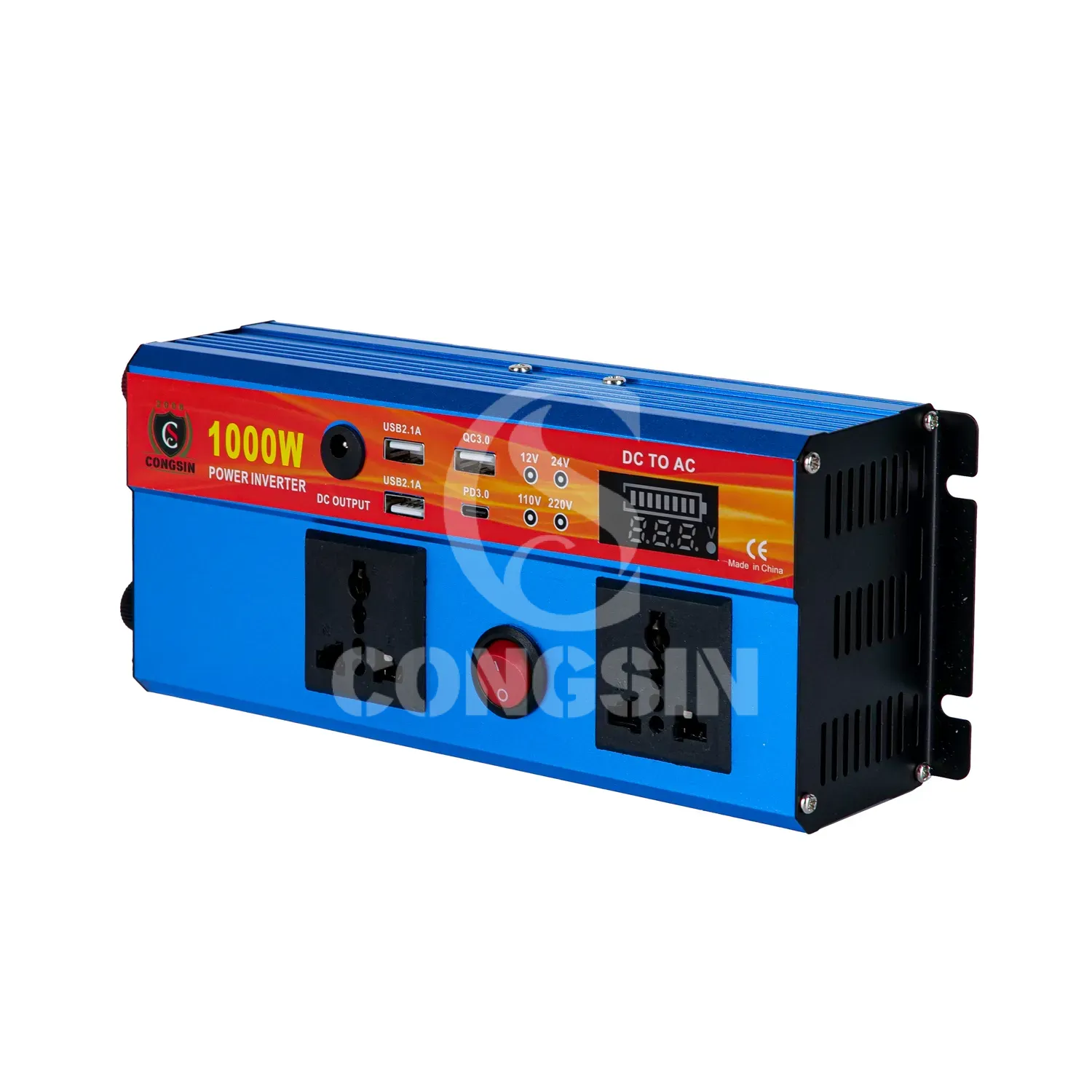
Congsin 1000W modified sine wave inverter with LED display and Type C port car RV power inverter

CONGSIN is a trusted OEM factory for power inverters, solar charge controllers, and DC converters. Reliable solutions for global B2B buyers.
 High Quality
 7/24 Service
 Guaranteed Warranty
© 2025 Congsin. All Rights Reserved.