





Sizing a 24V Off-Grid Inverter: Match Loads and Battery Bank
- Why 24V systems are chosen for off-grid applications
- Advantages of 24V over 12V or 48V
- When 24V is not optimal
- Understanding and quantifying your loads
- Make a detailed load inventory
- Differentiate continuous vs surge (peak) power
- Selecting the right 24V off-grid inverter
- Pure sine wave vs modified sine wave
- Derating and safety margins
- Battery bank sizing and matching with inverter
- Step-by-step battery sizing method
- Worked example
- Parallel vs series battery arrangements for 24V
- Installation details, protections and practical considerations
- Wire sizing, fusing and DC disconnects
- Cooling, ventilation and mounting
- Standards, certifications and quality indicators
- Comparisons and selection checklist
- Quick selection checklist
- Example inverter sizing outputs
- Manufacturer note: Guangzhou Congsin Electronic Technology Co., Ltd.
- Frequently Asked Questions (FAQ)
- 1. How do I know what size 24V inverter I need?
- 2. How many amp-hours do I need for a 24V battery bank?
- 3. Can I use a modified sine wave inverter for all appliances?
- 4. How does inverter efficiency affect battery sizing?
- 5. What safety protections should I include?
- 6. How should I wire batteries to form a 24V bank?
- Contact and next steps
Accurate sizing of a 24V off-grid inverter requires a step-by-step match between expected AC loads and the DC battery bank while accounting for inverter efficiency, surge requirements and usable battery capacity. This article explains how to inventory loads, choose between modified and pure sine wave inverters, calculate battery amp-hours for required autonomy, and select inverter ratings and protections so your 24v off grid inverter performs reliably in off-grid homes, RVs and mobile applications. Authoritative references and a worked example are provided to make the design verifiable and implementable.
Why 24V systems are chosen for off-grid applications
Advantages of 24V over 12V or 48V
24V systems are a common compromise for many off-grid installations: they reduce DC current by half compared to 12V for the same power, which lowers conductor sizes and I2R losses, but avoid some of the higher complexity and safety considerations of 48V systems. For mid-sized loads—typical in small off-grid homes, larger RVs and mobile offices—24V offers a practical balance between cost and efficiency.
When 24V is not optimal
If your system consistently exceeds several kilowatts or requires long cable runs where conductor size becomes prohibitive, a 48V architecture may be preferable. Conversely, very small systems (a few hundred watts) can remain on 12V to simplify integration with vehicle batteries.
Understanding and quantifying your loads
Make a detailed load inventory
Start by listing every AC appliance you plan to run from the 24v off grid inverter. For each device record:
- Rated power in watts (W).
- Whether the power draw is continuous or intermittent.
- Motor or compressor loads that have high starting (surge) currents.
- Estimated daily operating hours.
Reliable manufacturer nameplate values are preferred; when unknown use a measured value with a clamp meter or a plug-in power meter.
Differentiate continuous vs surge (peak) power
Many devices such as refrigerators, pumps and power tools require significantly higher current at startup. Inverter sizing must consider continuous wattage plus the maximum surge. Most quality inverters specify both continuous rating and short-term peak capacity (usually 2–5 seconds). Choose an inverter whose surge capability covers the largest motor start load in your inventory.
Selecting the right 24V off-grid inverter
Pure sine wave vs modified sine wave
Pure sine wave inverters replicate utility power waveform and are recommended for sensitive electronics, variable speed motors, audio/video equipment and most modern appliances. Modified sine wave units are cheaper but can cause excessive heating, reduced efficiency or malfunction in sensitive devices.
| Feature | Pure Sine Wave | Modified Sine Wave |
|---|---|---|
| Compatibility | All appliances, sensitive electronics | Simple resistive loads, some motors (with reduced performance) |
| Efficiency | Typically 90–96% | Often similar peak efficiency but poorer waveform quality |
| Cost | Higher | Lower |
Source reference for inverter basics: Inverter (electrical) - Wikipedia.
Derating and safety margins
Design for at least 20–30% headroom above the calculated continuous load. Example: if total continuous demand is 1200 W, choose an inverter rated at least 1500 W continuous. For motor-heavy systems, confirm the inverter's peak surge rating meets the highest start-up wattage. Also consider ambient temperature derating—many inverters reduce continuous power output above certain temperatures.
Battery bank sizing and matching with inverter
Step-by-step battery sizing method
1) Calculate daily energy consumption (Wh/day): multiply each appliance wattage by hours used and sum.
2) Account for inverter efficiency (η_inv). If inverter efficiency is 90%, divide required AC Wh by 0.9 to get DC Wh required from the battery.
3) Decide usable depth-of-discharge (DoD). For lead-acid batteries a practical usable DoD is often 50%; for Lithium (LiFePO4) you can use 80–90% usable capacity.
4) Determine days of autonomy (D). Multiply daily DC Wh by D to allow for cloudy days or limited charging.
5) Calculate battery capacity in amp-hours (Ah) for 24V: Battery Ah = (Daily AC Wh × D) / (System Voltage × η_inv × DoD)
Worked example
Assumptions: daily AC load = 2400 Wh; inverter efficiency η_inv = 92% (0.92); desired autonomy = 2 days; battery chemistry Lead-acid usable DoD = 50% (0.5); system voltage = 24V.
DC Wh required per day = 2400 / 0.92 = 2609 Wh
Total DC Wh for 2 days = 2609 × 2 = 5218 Wh
Battery Ah @24V = 5218 / 24 / 0.5 = 434.8 Ah → round up to a standard bank size, e.g., 450 Ah at 24V
| Item | Value |
|---|---|
| Daily AC Load | 2400 Wh |
| Inverter Efficiency | 92% |
| Autonomy | 2 days |
| Usable DoD | 50% |
| Resulting Battery Capacity | ≈ 435 Ah @ 24V (choose 450 Ah) |
Note: for lithium batteries with 90% usable DoD, same scenario yields: 5218 / 24 / 0.9 = 241 Ah (round to 250 Ah). This shows the cost/weight trade-off between chemistries.
Reference on battery types and DoD: Battery (electricity) - Wikipedia and practical guidance at Battery University.
Parallel vs series battery arrangements for 24V
To build 24V from commonly available 12V cells, connect two 12V batteries in series to make 24V. To increase Ah, add additional parallel strings of 24V pairs. Always use matched batteries (same age, capacity and internal resistance) and install balancing and fusing. Mixing old and new batteries or mismatched capacities causes premature failure and uneven charging.
Installation details, protections and practical considerations
Wire sizing, fusing and DC disconnects
Because DC currents can be substantial even at 24V, calculate cable size based on the maximum continuous current (I = P / V) plus safety margin. Use short cable runs where possible and place appropriate battery fuses within 150mm of the battery positive terminal as per many installation best practices. For a 3000 W inverter at 24V, expected continuous current = 3000 / 24 = 125 A; choose cabling and fuse ratings accordingly. For exact conductor sizes and standards consult local codes (e.g., NEC in the USA).
Cooling, ventilation and mounting
Install the inverter in a ventilated location, away from direct exposure to weather, and ensure adequate clearance per manufacturer instructions. High ambient temperatures reduce inverter output—check the spec sheet for temperature derating curves.
Standards, certifications and quality indicators
Choose inverters and battery components with recognized certifications like CE, EMC, LVD, ETL/UL, FCC and RoHS where relevant. Certification suggests the product has undergone independent testing for safety and electromagnetic compatibility. For organizational standards such as ISO9001 (quality management), see ISO 9001 - Wikipedia.
Comparisons and selection checklist
Quick selection checklist
- Inventory every load (W and hours)
- Sum continuous watts and identify largest motor/compressor surge
- Choose inverter continuous rating ≥ summed continuous × 1.2–1.3
- Ensure inverter peak surge covers highest start load
- Calculate battery Ah using system voltage (24V), efficiency and DoD
- Select battery chemistry (lead-acid vs lithium) balancing cost, weight and DoD
- Size cables and protective fuses for maximum DC current
Example inverter sizing outputs
| Typical Load Set | Continuous W | Recommended Inverter Continuous Rating | Required Surge Capability |
|---|---|---|---|
| Small cabin (lights, fridge, laptop) | 800 W | 1000–1200 W | 1500 W |
| RV with AC unit (small) | 2500 W | 3000–3500 W | 6000–8000 W (motor start) |
| Workshop (tools, compressor) | 3000–4000 W | 4000–5000 W | up to 10,000 W |
Manufacturer note: Guangzhou Congsin Electronic Technology Co., Ltd.
Guangzhou Congsin Electronic Technology Co., Ltd., founded in early 1998, is a professional power inverter manufacturer with over 27 years of focused experience. We design, R&D and manufacture a wide range of power solutions—with a core emphasis on DC→AC power inverters, portable power stations, and solar charge controllers. Our catalog includes 100+ models tailored for vehicles, solar systems, RVs and trucks, off-grid homes, outdoor offices, patrol and field construction work.
We operate fully automated production lines, advanced instrumentation and multifunctional testing equipment to ensure product reliability, efficiency and intelligent functionality. Environmental and safety compliance are built in: our quality system is ISO9001 certified and many products hold international approvals such as CE, EMC, LVD, ETL, FCC, RoHS and E-MARK. Several independently developed patents further demonstrate our commitment to innovation.
Congsin’s products serve global markets across Europe, the Americas, the Middle East, Africa and Southeast Asia; many models are supplied to domestic and international OEM channels. Our support includes OEM/ODM, private labeling, distribution and bespoke customization to meet partner specifications.
In short, Congsin's strengths are long-standing manufacturing experience in DC→AC inverters, a wide product portfolio including solar charge controllers, modified sine wave inverter and pure sine wave inverter models, and portable power stations. These capabilities, combined with automated production and multiple international approvals, make Congsin a competitive choice for reliable off-grid energy solutions.
Frequently Asked Questions (FAQ)
1. How do I know what size 24V inverter I need?
Calculate total continuous wattage of all AC loads and add a 20–30% safety margin. Confirm the inverter’s surge rating covers the highest motor start load. Example: 1200 W continuous → choose ~1500 W inverter; if a fridge with 2000 W start is present, ensure the inverter peak ≥2000 W.
2. How many amp-hours do I need for a 24V battery bank?
Use the formula: Battery Ah = (Daily AC Wh × Days of Autonomy) / (24V × Inverter Efficiency × Usable DoD). Plug in your numbers and round up to a commercially available capacity. See worked example above.
3. Can I use a modified sine wave inverter for all appliances?
Modified sine wave inverters are fine for simple resistive loads (incandescent lights, heaters), but can cause problems with sensitive electronics, some motors and audio/video equipment. For broad compatibility and reliability, choose a pure sine wave inverter.
4. How does inverter efficiency affect battery sizing?
Lower inverter efficiency increases the DC energy you must draw from the battery to supply the same AC load. For example a 90% efficient inverter requires ~11% more battery energy than a 100% ideal inverter. Always divide AC Wh by inverter efficiency to find DC Wh requirement.
5. What safety protections should I include?
Essential protections include: appropriately rated DC fuse/breaker at the battery, inverter AC output breaker, proper grounding, battery management system (BMS) for lithium packs, ventilation and temperature protections. Follow manufacturer installation instructions and local electrical codes.
6. How should I wire batteries to form a 24V bank?
Place two identical 12V batteries in series to form 24V. To increase capacity, create parallel strings of series pairs—but ensure all strings are identical in age and capacity and install balancing/monitoring to prevent unequal charging.
Contact and next steps
If you need assistance selecting a 24v off grid inverter or designing a matched battery bank (including OEM/ODM customization), Guangzhou Congsin Electronic Technology Co., Ltd. offers a broad product range and engineering support. Contact our technical sales team to review your load list and receive a tailored equipment and wiring specification. View product ranges and request quotations to evaluate compatible inverters, solar charge controllers and portable power stations.
Get started: Contact Congsin for product datasheets, testing reports and certificate copies, or to request a custom system design and quote.
Troubleshooting Common Inverter Grid Off Issues
Case Studies: High Frequency Inverter Success in Solar Microgrids
Safety and Compliance: Standards for UPS Power Inverters
Energy Efficient 24V Pure Sine Inverters to Reduce Costs
Modified Sine Wave Inverters
Is it normal for the inverter to heat up when working?
It is normal for it to generate some heat when working. If the temperature is too high (e.g., hot to the touch), please stop using it and check if the load is overloaded.
Can I customize the color and logo?
Yes, OEM/ODM customization is supported.
Can 4 USB ports charge 4 mobile phones at the same time?
Yes, the total current of 6.8A can support simultaneous fast charging of multiple devices, and the charging efficiency is guaranteed.
Pure Sine Wave Inverters
What is the difference between labeled 6000W and full power 3000W?
Labeled 6000W is peak power, which is only used to cope with the instantaneous high-power demand during device startup (such as air conditioner, motor startup); full power 3000W is continuous power, referring to the power that the device can stably output for a long time. When driving appliances daily, 3000W should be used as a reference to avoid total power overload.
What is the reason for the inverter automatically shutting down during operation?
It is likely that the protection mechanism is triggered: 1. Load overload (total power of connected devices exceeds 1000W); 2. Abnormal input voltage (battery voltage <10.8V or >14.5V); 3. Device overtemperature (excessively high ambient temperature or cooling fan failure). It is recommended to disconnect some loads, check the battery voltage or clean the heat dissipation port before trying again.
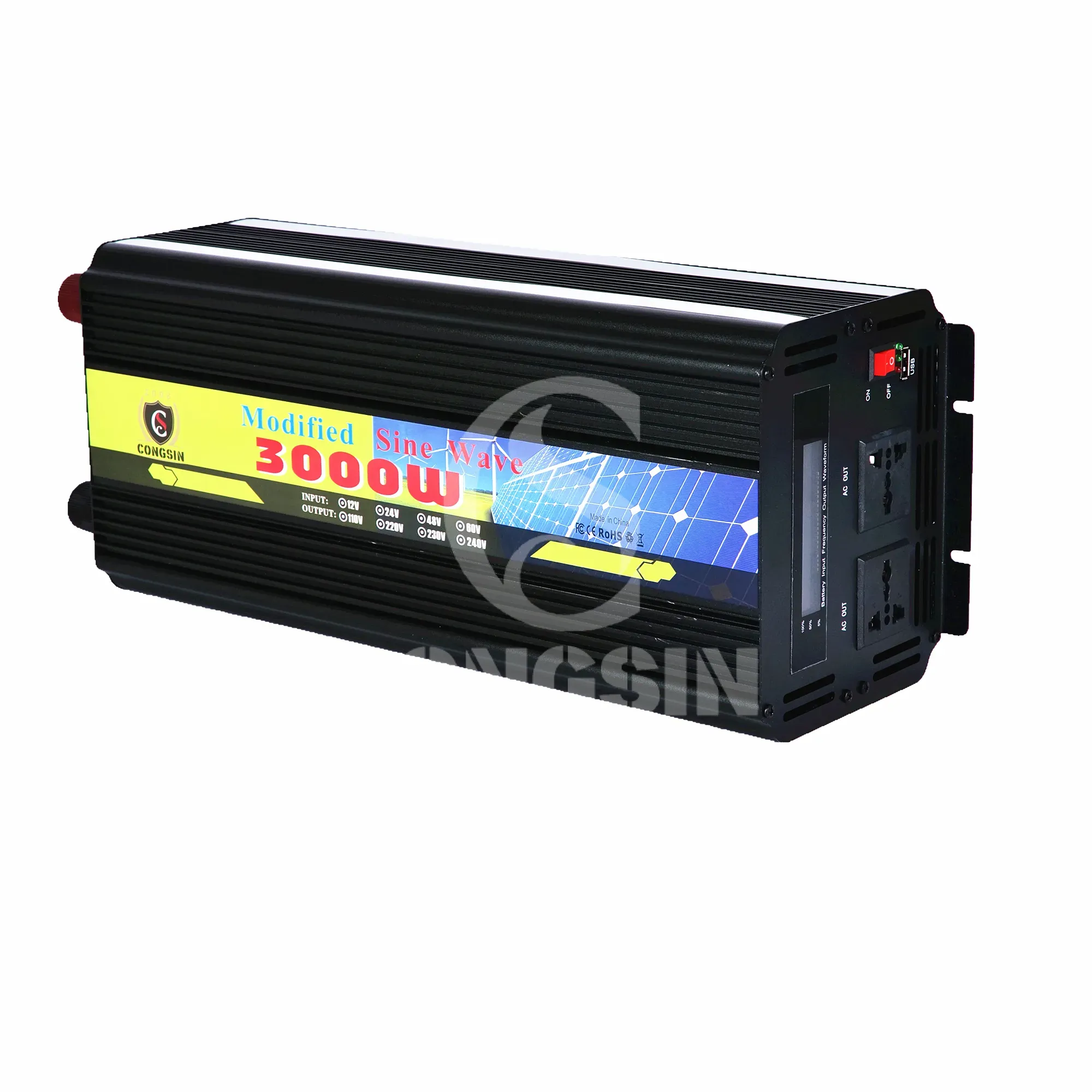
Congsin Full Power 3000W Modified Sine Wave Inverter Peak Power 6000W with LCD Display RV Solar
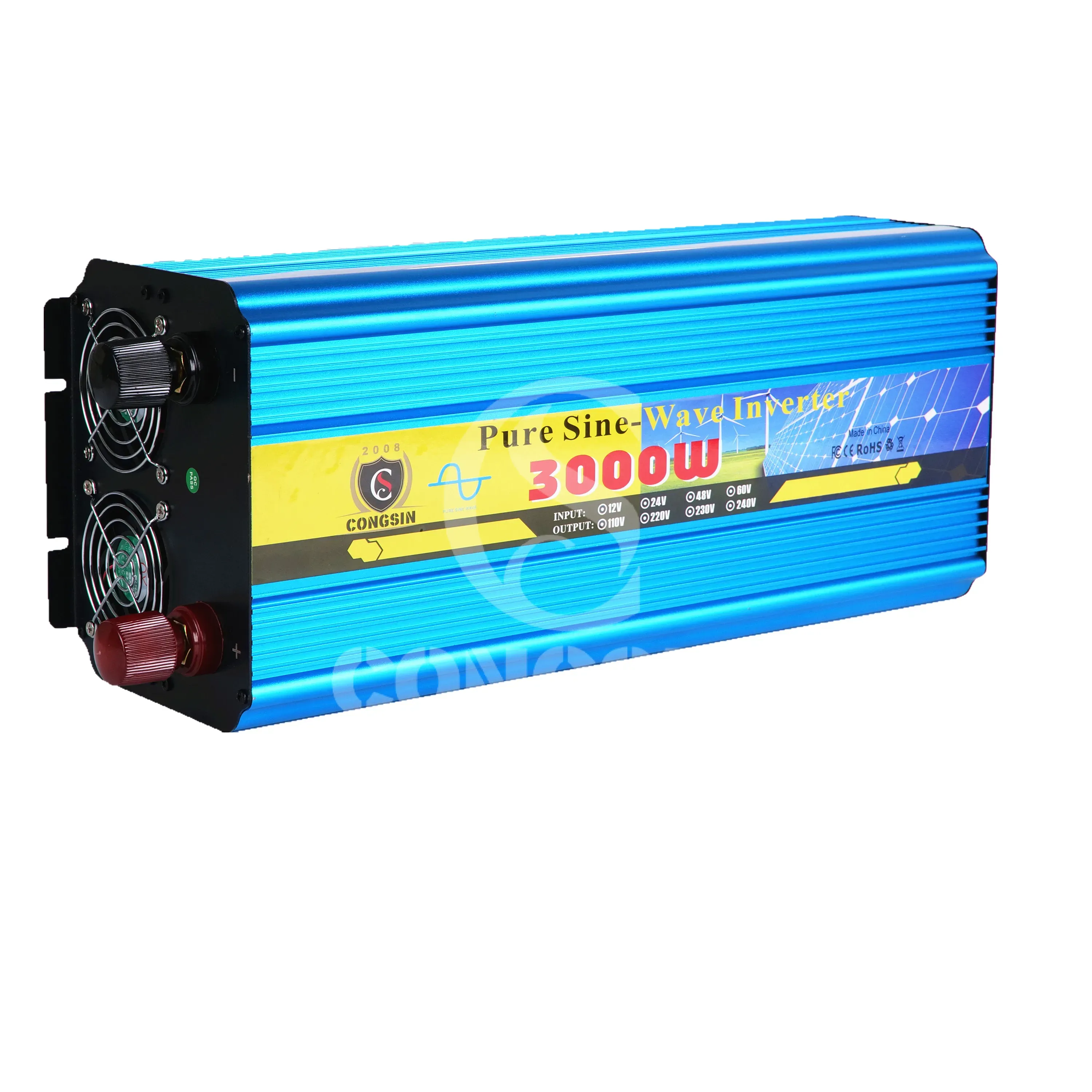
Congsin 3000W LCD Pure Sine Wave Inverter for Home Use Solar Backup Power Inverter Off Grid UPS
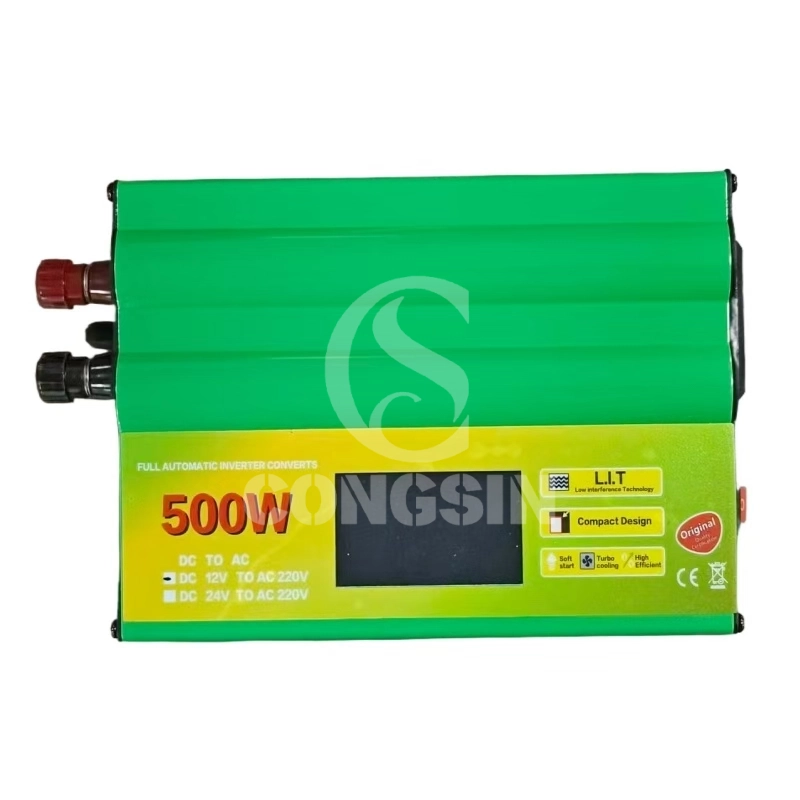
Congsin Modified Sine Wave Inverter 500W 1000W 1500W 12V LED Display Portable for RV Car Solar
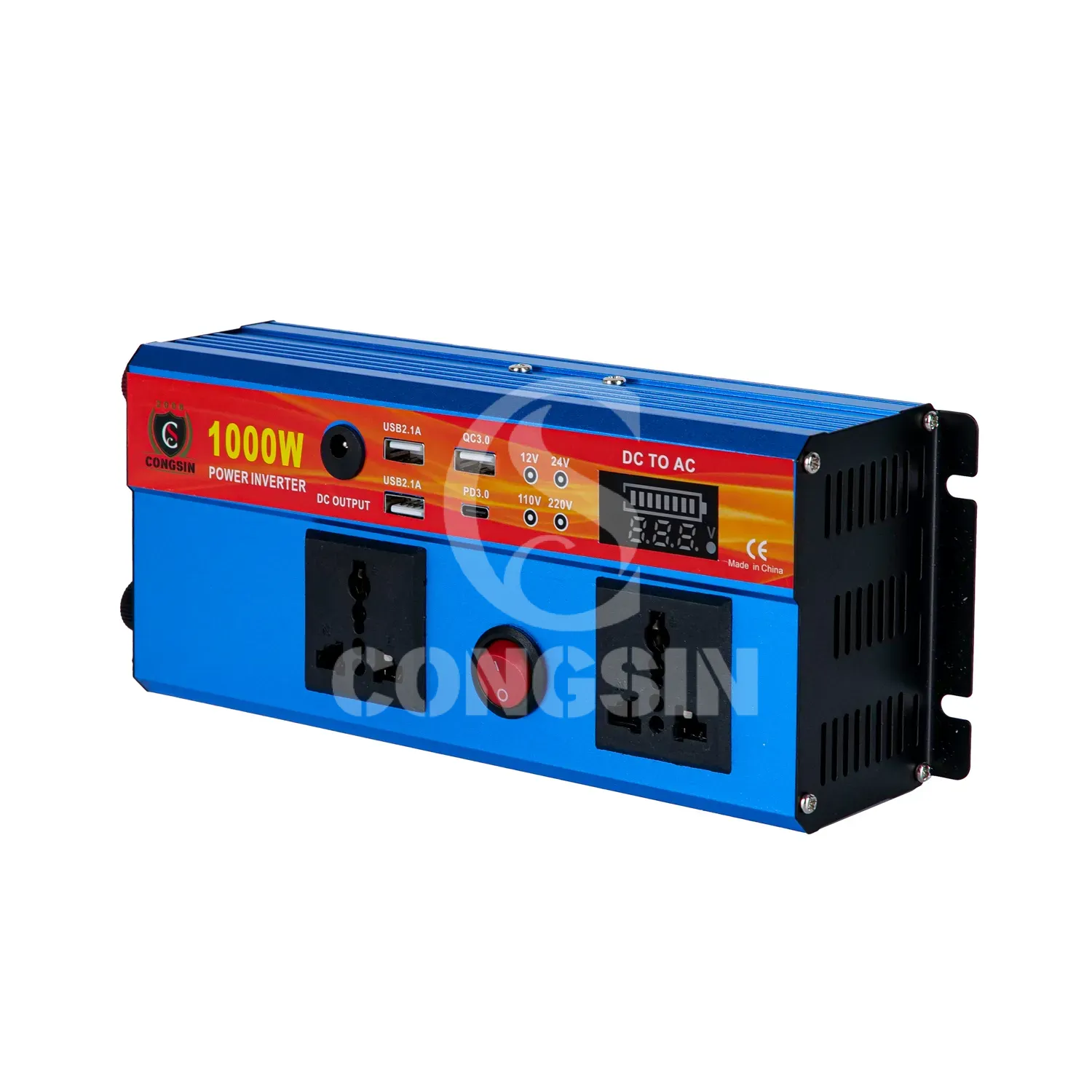
Congsin 1000W modified sine wave inverter with LED display and Type C port car RV power inverter

CONGSIN is a trusted OEM factory for power inverters, solar charge controllers, and DC converters. Reliable solutions for global B2B buyers.
 High Quality
 7/24 Service
 Guaranteed Warranty
© 2025 Congsin. All Rights Reserved.