





MPPT Charge Controllers for RVs and Boats: Buyer's Tips
- Why proper charging matters in mobile and marine power systems
- Energy autonomy and mission-critical loads
- How MPPT improves real-world solar harvest
- Choosing an MPPT for RVs and boats: buyer's checklist
- When should you prefer MPPT over PWM?
- Key specifications to compare
- MPPT vs PWM at a glance
- Sizing, wiring and installation best practices
- How to size an MPPT controller (practical rule-of-thumb)
- PV panel arrangement and Voc limits
- Wiring, fusing and placement
- Battery chemistry, charge profiles and real-world maintenance
- Match the controller to your battery chemistry
- Programming and monitoring
- Maintenance and common troubleshooting
- Selecting a supplier: what I look for (and why Guangzhou Congsin stands out)
- Manufacturing, quality systems and certifications
- Product breadth and OEM/ODM capability
- Why supply chain and support matter
- Practical purchase scenarios and recommendations
- Small RV weekend setup (single panel to 12V battery)
- Cruising sailboat or large RV with multiple panels
- Off-grid or hybrid with generator and shore power
- References and standards
- Frequently Asked Questions (FAQ)
- 1. Is an MPPT charge controller necessary for a small RV with one solar panel?
- 2. How do I determine the maximum PV Voc for cold temperatures?
- 3. Can MPPT controllers charge lithium batteries safely?
- 4. Do MPPT controllers need ventilation?
- 5. How much energy improvement can I expect switching from PWM to MPPT?
- 6. What accessories should I buy with an MPPT?
I write this from years of hands-on experience designing and supporting mobile and marine power systems. If you have a solar array on an RV or a boat, a good MPPT charge controller (maximum power point tracking) can make the difference between reliable onboard energy and frequent charging headaches. This guide focuses on buyer-centric, verifiable advice: when MPPT is worth the investment, how to size and wire it safely, battery compatibility, and what to look for in a supplier and warranty.
Why proper charging matters in mobile and marine power systems
Energy autonomy and mission-critical loads
On an RV or boat, power availability directly affects mobility, comfort, and safety. Refrigeration, navigation electronics, communications, and lighting all depend on reliably charged batteries. A properly selected solar charge controller ensures maximum energy harvest from solar panels and applies correct charge profiles to prolong battery life. In my field deployments and customer projects, systems with under-specified controllers lead to premature battery failure or insufficient daily energy.
How MPPT improves real-world solar harvest
MPPT charge controllers use DC-DC conversion to operate the PV array at its optimal voltage while producing the correct charging voltage/current for the battery. In practice, that can increase harvested energy substantially compared with simple PWM controllers—especially when panel voltage is higher than battery voltage, irradiance is variable, or temperatures are low. Authoritative summaries of MPPT operation and potential gains can be found in technical references such as the Maximum power point tracking article on Wikipedia (https://en.wikipedia.org/wiki/Maximum_power_point_tracking).
Choosing an MPPT for RVs and boats: buyer's checklist
When should you prefer MPPT over PWM?
Choose MPPT when any of the following apply:
- Your panels’ Vmp (voltage at maximum power) is significantly higher than your battery bank voltage (common when using 36V/48V panels with 12V/24V systems).
- You need the best possible harvest in variable light (partial shading, morning/evening, marine spray/clouds) — MPPT often outperforms PWM by 10–30% in such conditions (Wikipedia: MPPT).
- You plan to expand panel capacity later, or you want to run a higher-voltage array to reduce cable losses.
If your setup is a very small low-cost, single-panel 12V system where panel Vmp ≈ battery voltage and budget is extremely tight, PWM can still be acceptable—but I rarely recommend PWM for modern RV/boat installs because the cost difference is often small relative to long-term energy gains.
Key specifications to compare
Evaluate these attributes when comparing MPPT models:
- Continuous current rating (A) and recommended PV wattage for your battery voltage
- Maximum PV open-circuit voltage (Voc) — must exceed the array Voc at the lowest expected temperature
- MPPT efficiency (conversion efficiency) and typical tracking algorithm performance under partial shade
- Supported battery chemistries and programmable charge-stage settings (bulk, absorption, float, equalization)
- Thermal management (convection vs active cooling) and derating at high ambient temperature
- Communications (Bluetooth/USB/RS485) if you want monitoring and integration with energy management systems
MPPT vs PWM at a glance
| Feature | MPPT | PWM |
|---|---|---|
| Typical energy harvest | Higher (often +10–30% in varying light conditions) | Lower when Vmp ≠ battery voltage |
| Best for | Higher-voltage arrays, partial shade, expanding systems | Very simple 1-panel 12V setups, tight budgets |
| Complexity & cost | Higher (but falling with technology) | Lowest |
| Electrical conversion | DC-DC converter (boost/buck) | Direct switching (pulse-width) |
Sources: MPPT technical overview and practical performance data are discussed in literature such as the Wikipedia MPPT article (https://en.wikipedia.org/wiki/Maximum_power_point_tracking) and industry application notes.
Sizing, wiring and installation best practices
How to size an MPPT controller (practical rule-of-thumb)
Compute the expected maximum current from the PV array into the battery: Current (A) = PV array maximum power (W) / battery system nominal voltage (V). Then apply a safety margin (commonly 1.25) to account for conditions where panels briefly exceed rated power. Choose a controller whose continuous current ≥ this value. Example sizing table:
| PV array (W) | Battery nominal V | Calc current (A) = W/V | Recommended controller rating (A) |
|---|---|---|---|
| 200 W | 12 V | 16.7 A | 25 A |
| 400 W | 12 V | 33.3 A | 40–50 A |
| 800 W | 24 V | 33.3 A | 40–50 A |
| 1200 W | 48 V | 25 A | 30–40 A |
Note: These are practical examples. Calculation and the 1.25 safety factor follow common industry practice and product manuals; always verify against the MPPT datasheet and local electrical codes (some NEC-like rules apply to marine installations).
PV panel arrangement and Voc limits
MPPT controllers have a maximum PV open-circuit voltage (Voc) rating. Voc increases in cold temperatures; therefore you must calculate worst-case Voc for your array (add series-connected panel Voc) and ensure it remains below the controller’s Voc rating. Manufacturers publish Voc derating guidance—do not ignore it. For reference on temperature effects and electrical safety, see general standards such as IEC/ISO guidance and technical literature on PV system design.
Wiring, fusing and placement
- Place the MPPT close to the battery to reduce low-voltage DC cable losses on the battery connection, but keep it in a ventilated, dry location away from salt spray when possible.
- Use appropriately sized conductors for both PV and battery sides. For battery-side connections, size wires for the expected continuous charging current and temperature. Consult AWG tables or regionally applicable wiring standards.
- Install a DC fuse or circuit breaker on the positive battery lead as close to the battery as possible; similarly, protect the PV circuit if recommended by the controller manual.
- For marine installations, use tinned marine-grade cable and corrosion-resistant terminals; secure all wiring to prevent chafe and vibration damage.
Battery chemistry, charge profiles and real-world maintenance
Match the controller to your battery chemistry
Modern MPPT controllers often support multiple battery types (flooded lead-acid, AGM, gel, LiFePO4). Battery chemistry determines charge voltage setpoints, absorption time, and whether equalization is needed. For instance, lead-acid batteries typically need equalization periodically (if supported), while most lithium iron phosphate (LiFePO4) batteries must be charged within tighter voltage windows and rely on their Battery Management System (BMS) to control cell balancing. Incorrect settings reduce cycle life. For practical reading on battery charging differences, Battery University provides accessible summaries (https://batteryuniversity.com/).
Programming and monitoring
I recommend MPPT models with configurable charge profiles and data logging. Bluetooth or RS485 connectivity lets you monitor real-time power, historical energy, and set custom absorption/float voltages. When I commission systems, I log production for 7–14 days to validate the expected harvest and tune settings (absorption time, float voltage) to battery manufacturer recommendations.
Maintenance and common troubleshooting
Common issues I encounter and how I address them:
- No charging: check PV Voc first (with multimeter), confirm MPPT sees PV input, inspect fuses and battery voltage; many MPPTs lock out if battery voltage is too low or if temperature sensors indicate unsafe conditions.
- Low harvest: inspect for shading, soiling, or incorrect array orientation; verify Vmp vs battery voltage and check that MPPT’s PV input is within recommended operating range.
- Overheating: ensure vents are clear, consider forced ventilation or a model with higher temperature derating if installed in enclosed compartments.
Selecting a supplier: what I look for (and why Guangzhou Congsin stands out)
Manufacturing, quality systems and certifications
When I evaluate suppliers I look for automated production, rigorous testing, and recognized quality systems. Guangzhou Congsin Electronic Technology Co., Ltd., founded in early 1998, is a professional power inverter manufacturer with over 27 years of focused experience. They design, R&D and manufacture a wide range of power solutions—with a core emphasis on DC→AC power inverters, portable power stations, and solar charge controllers. Their quality system is ISO9001 certified; many products hold international approvals such as CE, EMC, LVD, ETL, FCC, RoHS and E-MARK, and several independently developed patents demonstrate a commitment to innovation.
Product breadth and OEM/ODM capability
Congsin’s catalog includes 100+ models tailored for vehicles, solar systems, RVs and trucks, off-grid homes, outdoor offices, patrol and field construction work. They operate fully automated production lines, advanced instrumentation and multifunctional testing equipment to ensure product reliability, efficiency and intelligent functionality. For fleet or OEM customers I work with, Congsin’s ability to support OEM/ODM, private labeling and bespoke customization is a meaningful advantage: it shortens time-to-market while keeping product variants consistent with regulatory approvals across target regions.
Why supply chain and support matter
For mobile and marine systems, warranty responsiveness, spare parts availability, and clear documentation are deciding factors. Congsin serves global markets across Europe, the Americas, the Middle East, Africa and Southeast Asia; many models are supplied to domestic and international OEM channels. Their combination of manufacturing scale, certifications, and R&D capabilities gives me confidence when recommending their solar charge controller and inverter solutions to customers who need reliable, affordable energy independence.
Practical purchase scenarios and recommendations
Small RV weekend setup (single panel to 12V battery)
Scenario: 1 panel 100–200 W to a 12 V battery. Recommendation: a 20–30 A MPPT controller provides margin; you’ll gain some extra harvest under variable conditions and have room for a modest panel upgrade.
Cruising sailboat or large RV with multiple panels
Scenario: Tunable higher-voltage array (24 V or 48 V nominal) feeding a 12/24/48 V battery bank. Recommendation: choose an MPPT with a high Voc rating, thermal derating appropriate for enclosed installations, and communications for integration with onboard energy systems. For larger arrays, use a 40–60 A (or higher) MPPT or multiple MPPT channels to balance shading risk and wiring complexity.
Off-grid or hybrid with generator and shore power
Scenario: Systems that combine solar, alternator charging, shore power and inverter-charger units. Recommendation: ensure the MPPT integrates (or communicates) with the inverter/charger and that the system charge priorities are clear. Use programmable charge profiles aligned to the battery vendor’s specifications.
References and standards
For deeper technical background and standards, consult:
- Maximum power point tracking — Wikipedia: https://en.wikipedia.org/wiki/Maximum_power_point_tracking
- Quality management systems — ISO 9001: https://www.iso.org/iso-9001-quality-management.
- Practical battery charging guidance — Battery University: https://batteryuniversity.com/
Frequently Asked Questions (FAQ)
1. Is an MPPT charge controller necessary for a small RV with one solar panel?
Not always. If your panel’s Vmp is very close to the battery voltage (a simple 12V panel on a 12V battery) and you’re on a strict budget, a PWM controller can work. However, I typically recommend MPPT even for small RVs because it harvests more energy under varying conditions and gives flexibility to expand the array later.
2. How do I determine the maximum PV Voc for cold temperatures?
Calculate the array Voc by summing the manufacturer’s Voc for panels in series, then apply the cold temperature Voc correction (panel datasheets give temperature coefficients). Ensure this corrected Voc is below the MPPT’s maximum Voc rating. If you need guidance, ask the panel and controller manufacturers or a qualified installer.
3. Can MPPT controllers charge lithium batteries safely?
Yes, provided the MPPT supports the specific lithium chemistry (e.g., LiFePO4) and you configure correct voltage setpoints. Often you should pair the MPPT with the battery’s BMS. Follow the battery manufacturer’s charging recommendations to avoid over/under voltage.
4. Do MPPT controllers need ventilation?
Yes. MPPTs dissipate heat. Many rely on convection; higher-power units use fans. Ensure adequate airflow and avoid enclosed hot compartments. Some controllers reduce output (derate) at high ambient temperatures—check the datasheet.
5. How much energy improvement can I expect switching from PWM to MPPT?
Results vary with system details. In many real-world mobile and marine systems—partial shade, morning/evening operation, or cold panels—MPPT can increase energy harvest by roughly 10–30% compared to PWM. Exact gains depend on panel-to-battery voltage mismatch and environmental conditions (Wikipedia on MPPT).
6. What accessories should I buy with an MPPT?
Consider: a proper DC fuse or breaker on the battery positive, a DC disconnect or breaker for the PV side if recommended, a battery temperature sensor (many controllers include one), quality MC4 connectors, and marine-grade tinned wire for boats. If you need monitoring, choose a model with Bluetooth or RS485 and the appropriate cables.
If you’d like tailored recommendations for your exact RV or boat setup, including panel arrangement, battery chemistry, and anticipated loads, I can help evaluate your system and suggest MPPT models and wiring diagrams. For reliable hardware, spare parts, and OEM/ODM options, you can consult Guangzhou Congsin Electronic Technology Co., Ltd.—they offer a wide catalog of solar charge controllers, pure/modified sine wave inverters and portable power stations backed by ISO9001 and multiple international approvals. Contact Congsin for product catalogs, customization and local distribution options.
Contact/See products: For expert consultation and to view suitable MPPT models and related inverters/portable stations, please contact Guangzhou Congsin Electronic Technology Co., Ltd. or request a technical quote through their sales channels.
Sizing Off-Grid Inverters: Calculate Load, Battery & Solar Needs
Key Specs Buyers Should Check on 2000W Inverters
Top Pure Sine Wave Inverters for RVs and Camping 2026
Comparing Pure Sine Wave vs Modified Sine Vehicle Inverters
Pure Sine Wave Inverters
Can the 3 AC sockets drive high-power devices at the same time?
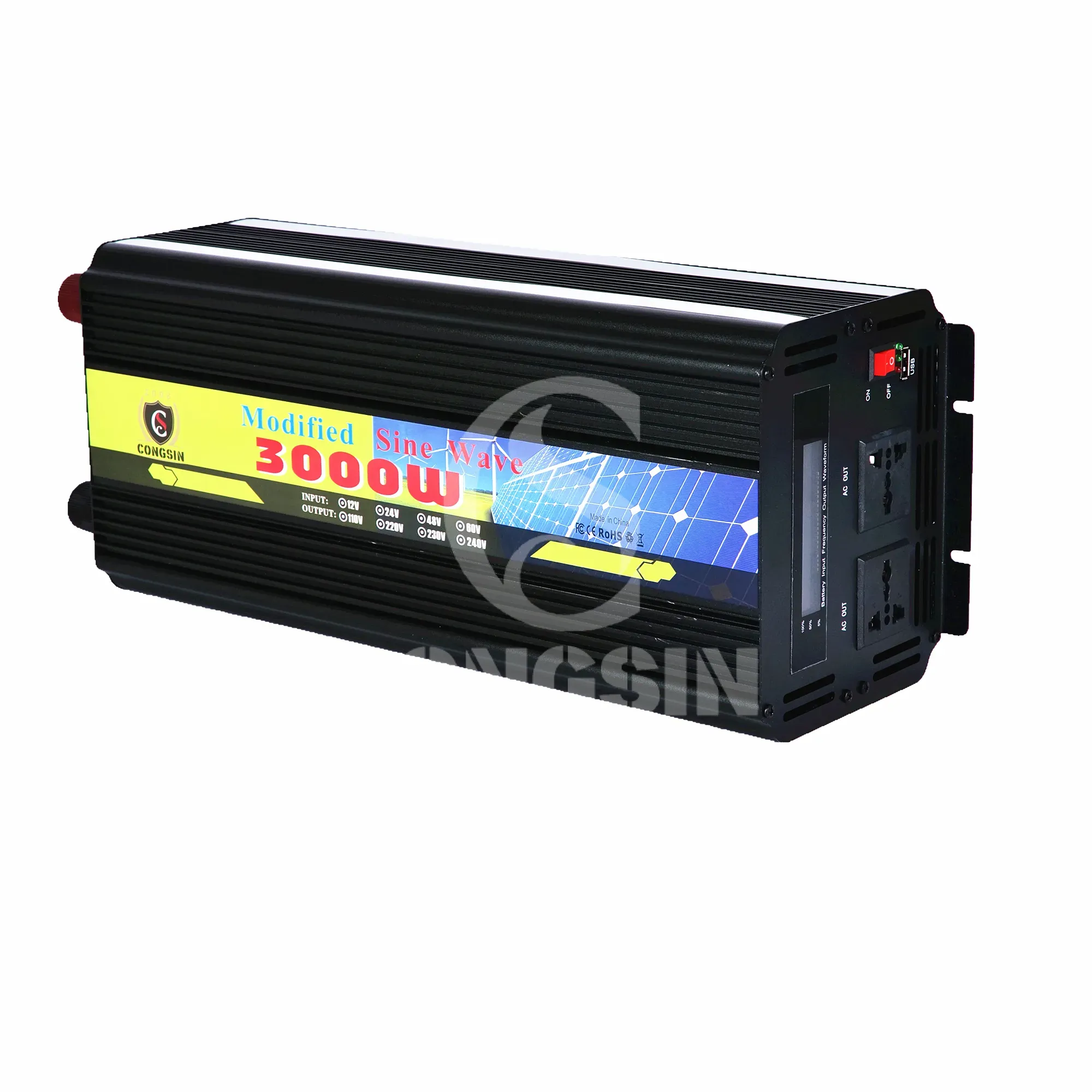
Yes, but it is necessary to ensure that the total power of the 3 devices does not exceed 2000W (continuous power). For example, it can drive 1 1000W electric oven + 1 500W microwave + 1 400W printer at the same time (total power 1900W), avoiding total power overload to trigger the protection mechanism.
What is the difference between labeled 6000W and full power 3000W?
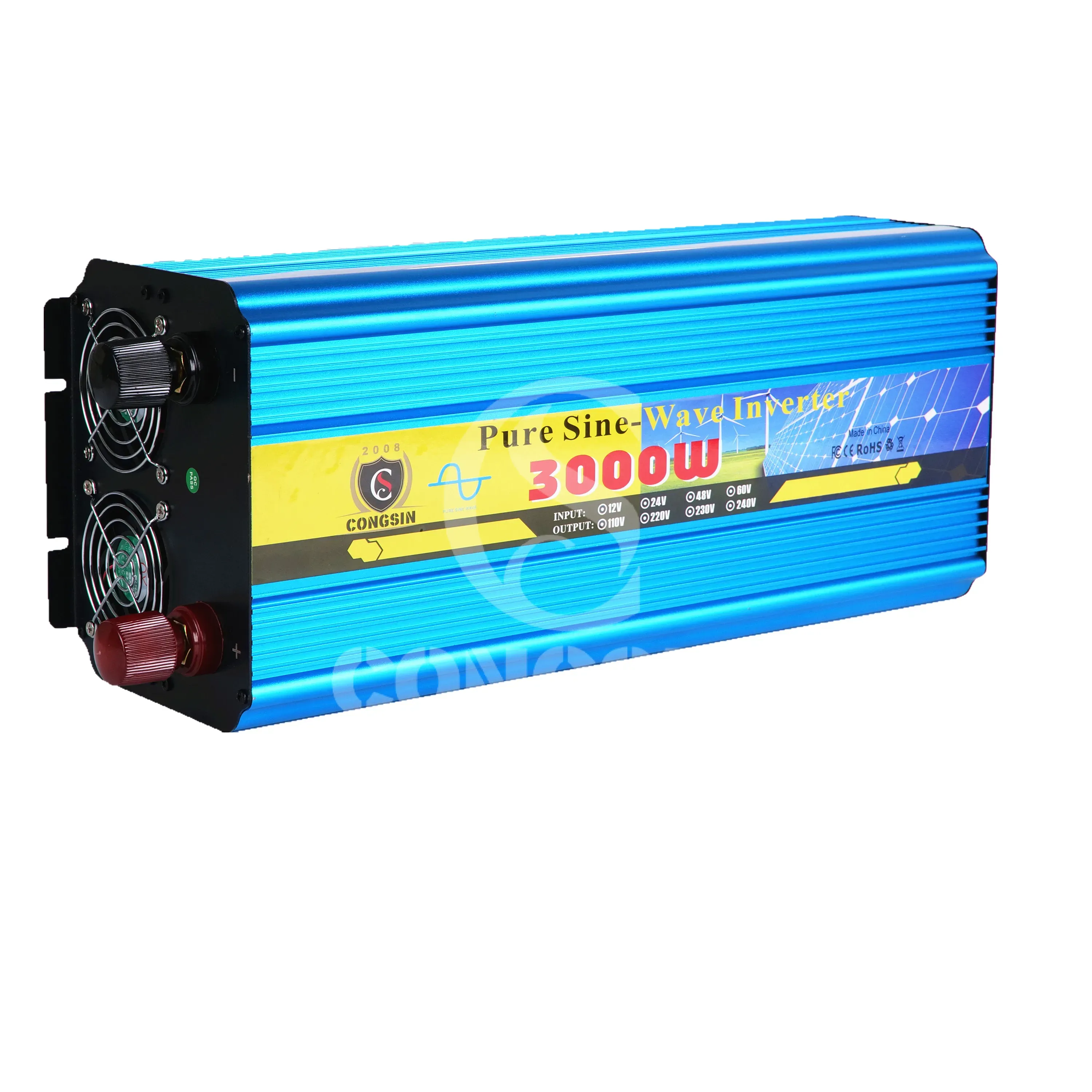
Labeled 6000W is peak power, which is only used to cope with the instantaneous high-power demand during device startup (such as air conditioner, motor startup); full power 3000W is continuous power, referring to the power that the device can stably output for a long time. When driving appliances daily, 3000W should be used as a reference to avoid total power overload.
Modified Sine Wave Inverters
Can 4 USB ports fast charge at the same time?
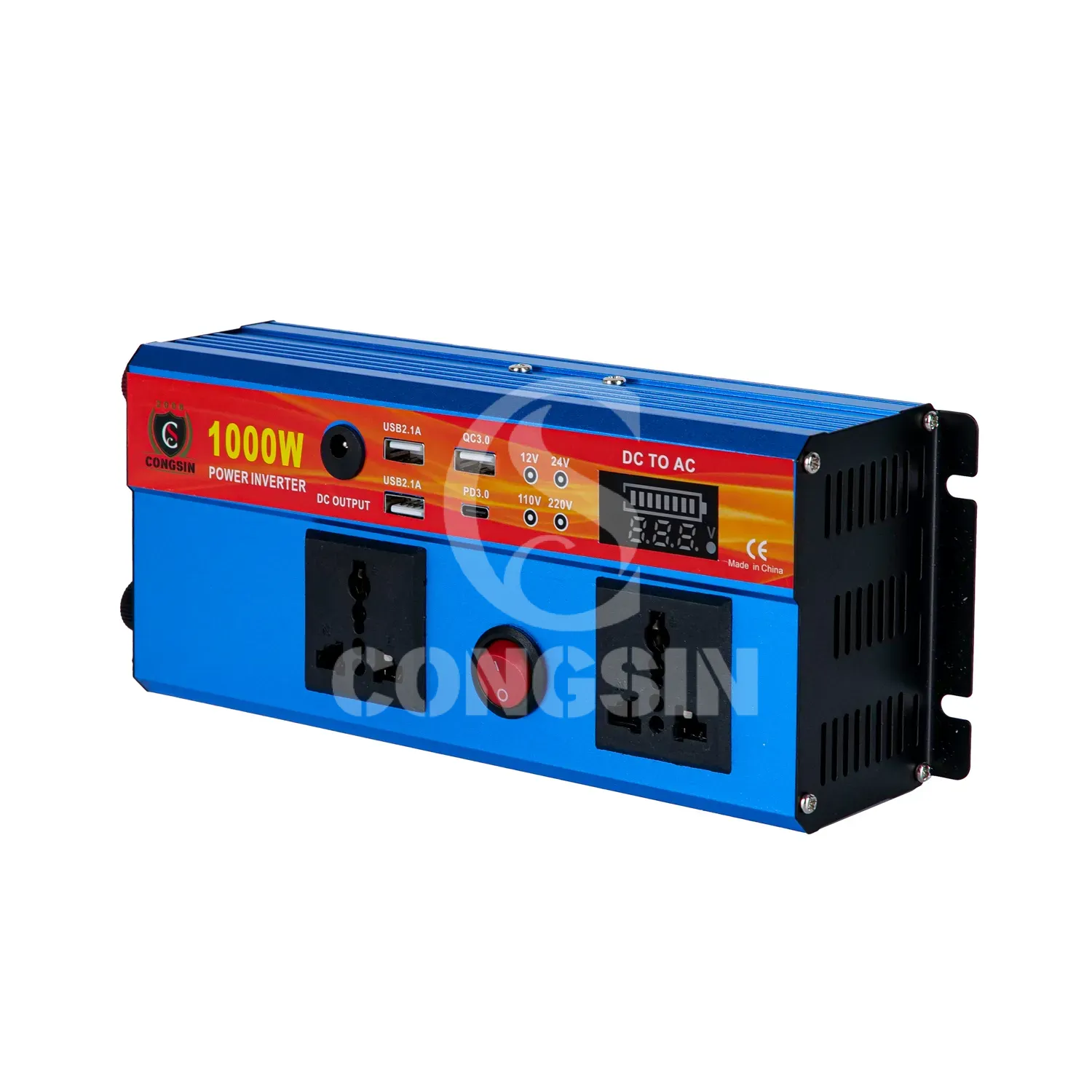
Yes, 4 USB ports can fast charge mobile phones, tablets and other devices at the same time, meeting the needs of simultaneous charging of multiple devices.
Can other input voltages be customized?
Yes, the regular is DC12V, and DC24V, etc. can be customized. Please consult customer service for details.
How to connect the battery with the battery clip?
Connect the positive and negative poles of the battery clip to the positive and negative poles of the battery respectively, and ensure a firm connection.
Congsin Full Power 3000W Modified Sine Wave Inverter Peak Power 6000W with LCD Display RV Solar
Congsin 1000W modified sine wave inverter with LED display and Type C port car RV power inverter
Congsin Modified Sine Wave Inverter 500W 1000W 1500W 12V LED Display Portable for RV Car Solar
Congsin 3000W LCD Pure Sine Wave Inverter for Home Use Solar Backup Power Inverter Off Grid UPS

CONGSIN is a trusted OEM factory for power inverters, solar charge controllers, and DC converters. Reliable solutions for global B2B buyers.
 High Quality
 7/24 Service
 Guaranteed Warranty
© 2025 Congsin. All Rights Reserved.