





Modified Sine Wave Inverter Buyer Guide for OEMs
- Why OEMs Still Consider Modified Sine Wave Power Inverters
- What a modified sine wave is and where it fits
- Primary s OEMs care about
- Technical Fundamentals and Load Compatibility
- Electrical characteristics and performance metrics
- Load compatibility: what works and what doesn't
- Design, Testing and Certification Requirements for OEMs
- Essential electrical and thermal testing
- Regulation and safety compliance
- Manufacturing, Customization and Commercialization Considerations
- Mechanical and thermal design choices that matter
- Supply chain, MOQ and customization (OEM/ODM)
- Comparative Analysis: Modified vs Pure Sine Wave for OEM Product Lines
- High-level cost and performance trade-offs
- Supplier Spotlight: Guangzhou Congsin Electronic Technology Co., Ltd. — OEM Partner Profile
- Company overview and relevance to OEM sourcing
- Manufacturing capabilities, certifications and OEM services
- Why a procurement team might choose Congsin for modified sine wave offerings
- Buying Checklist and Recommended Technical Specifications
- Essential checklist for RFQs
- Sample OEM spec (starter template)
- FAQs
- 1. Can a modified sine wave power inverter run my laptop or phone charger?
- 2. Are modified sine wave inverters less reliable than pure sine wave inverters?
- 3. What overload or surge capability should OEMs request?
- 4. When is a modified sine wave inverter the best commercial choice?
- 5. What documentation should I get from suppliers before approval?
- Contact and Next Steps
- References and Further Reading
Why OEMs Still Consider Modified Sine Wave Power Inverters
What a modified sine wave is and where it fits
A modified sine wave power inverter approximates a true sine wave by using stepped voltage levels (typically two or three steps) to recreate AC from DC. For many budget-sensitive, non-critical applications such as basic lighting, simple resistive loads, battery-powered tools and some consumer electronics, a modified sine wave inverter provides an economical DC→AC solution. For OEM procurement teams, the central appeal is lower cost per watt, simpler circuitry, smaller component count, and often higher peak surge capability for specific motor-start applications.
Primary s OEMs care about
OEM decision-makers evaluate modified sine wave power inverter solutions against criteria: unit cost, BOM simplicity, supply chain stability, certification footprint (CE/EMC/LVD/ETL/FCC/RoHS), OEM/ODM customization, minimum order quantities (MOQ), lead time, warranty and after-sales support. Embedding the keyword modified sine wave power inverter into RFQs, technical specifications and supplier scorecards ensures consistent sourcing signals across procurement and engineering teams.
Technical Fundamentals and Load Compatibility
Electrical characteristics and performance metrics
Key specs to specify in technical RFQs include continuous power rating (W), peak/surge power (W), DC input voltage range (e.g., 12/24/48 V), output nominal voltage and frequency (e.g., 230VAC/50Hz or 120VAC/60Hz), total harmonic distortion (THD), no-load current draw, idle losses, and efficiency at multiple load points (25%, 50%, 75%, 100%). For modified sine wave power inverter designs, explicitly require characterization of crest factor and waveform steps, because these influence compatibility with inductive loads and electronic power supplies.
Load compatibility: what works and what doesn't
Not all loads are tolerant of modified sine wave output. Use this table to guide OEM product positioning and user guidance documentation.
| Load Type | Compatibility with Modified Sine Wave | OEM Guidance |
|---|---|---|
| Resistive loads (incandescent heaters, simple toasters) | Good | Suitable; efficiency similar to pure sine wave |
| Simple motors (drill motors, pumps) | Often acceptable for small motors; increased heating | Specify testing at expected startup torque and provide derating guidance |
| Transformers and magnetic ballasts | Risk of hum, excessive heat, or reduced lifetime | Recommend pure sine wave or isolation/protection measures |
| Electronic devices with SMPS (laptops, LED drivers) | Mixed — many work but may show increased EMI/heat | Mandate vendor testing with representative SMPS models |
| Medical devices, precision instruments | Not recommended | Require pure sine wave with tight THD specs and certifications |
| Microwave ovens and induction cookers | Often incompatible (control and magnetron issues) | Use pure sine wave; note high surge current requirements |
Design, Testing and Certification Requirements for OEMs
Essential electrical and thermal testing
For OEMs specifying a modified sine wave power inverter, require suppliers to provide test reports for: continuous and surge output, efficiency curves, thermal rise and temperature derating, overload/short-circuit protection behavior, no-load power consumption, input undervoltage/overvoltage cutoffs, and EMC emissions/immunity reports. Thermal and long-duration endurance testing (e.g., 1,000-hour runs at 70% load) are recommended for applications exposed to continuous duty cycles.
Regulation and safety compliance
Certifications underpin commercial acceptance across markets. Typical marks to specify include CE (EU), EMC, LVD, FCC (US emissions), ETL/UL (safety), RoHS (restricted substances), and E‑MARK (vehicle use). Request supplier documentation and certificate numbers; verify on issuing bodies when needed. For quality management, require ISO 9001 compliance as part of supplier pre-qualification.
Manufacturing, Customization and Commercialization Considerations
Mechanical and thermal design choices that matter
OEMs must evaluate enclosure materials, ingress protection (IP) rating, cooling strategy (passive vs forced), mounting options (panel, DIN, rack, chassis), and connector choices (Anderson, M6 studs, IEC). For automotive or mobile OEMs, vibration and shock testing per relevant standards is essential. Specify operating temperature ranges and humidity tolerances in supplier contracts and include accelerated stress testing where product uptime is mission-critical.
Supply chain, MOQ and customization (OEM/ODM)
From a procurement lens, include unit price, MOQ, lead times, revision control process for firmware/hardware updates, and private-labeling options in RFQs. Ask about automated production line capacity, capacity to scale for seasonal demand, and available customization routes: firmware tuning (e.g., soft-start algorithm), connector/branding, packaging, and bespoke mechanical footprints. For many OEMs, the ability to perform small-batch pilot runs (hundreds of units) before full-scale production is a crucial capability.
Comparative Analysis: Modified vs Pure Sine Wave for OEM Product Lines
High-level cost and performance trade-offs
This table summarizes practical differences that influence OEM product strategy.
| Feature | Modified Sine Wave | Pure Sine Wave |
|---|---|---|
| Manufacturing cost | Lower | Higher (more complex circuitry) |
| Compatibility | Good for resistive/some motor loads; limited for sensitive electronics | High — compatible with nearly all loads |
| THD and EMI | Higher THD; greater EMI risk | Low THD; cleaner signal |
| Use cases | Basic consumer devices, budget solar kits, vehicle accessories | Medical, telecom, audio/video, precision instrumentation |
Supplier Spotlight: Guangzhou Congsin Electronic Technology Co., Ltd. — OEM Partner Profile
Company overview and relevance to OEM sourcing
Guangzhou Congsin Electronic Technology Co., Ltd., founded in early 1998, is a professional power inverter manufacturer with over 27 years of focused experience. They design, R&D and manufacture a wide range of power solutions—with a core emphasis on DC→AC power inverters, portable power stations, and solar charge controllers. Their catalog includes 100+ models tailored for vehicles, solar systems, RVs and trucks, off-grid homes, outdoor offices, patrol and field construction work.
Manufacturing capabilities, certifications and OEM services
Congsin operates fully automated production lines, advanced instrumentation and multifunctional testing equipment to ensure product reliability, efficiency and intelligent functionality. Environmental and safety compliance are built in: their quality system is ISO9001 certified and many products hold international approvals such as CE, EMC, LVD, ETL, FCC, RoHS and E‑MARK. Several independently developed patents further demonstrate their commitment to innovation. Their products serve global markets across Europe, the Americas, the Middle East, Africa and Southeast Asia; many models are supplied to domestic and international OEM channels. Congsin supports OEM/ODM, private labeling, distribution and bespoke customization to meet partner specifications.
Why a procurement team might choose Congsin for modified sine wave offerings
For OEMs seeking a competitive modified sine wave power inverter product line, Congsin's long-term production experience, broad catalog, automated capacity and certification profile reduce supplier risk. Typical strengths to highlight in supplier evaluations are: mature product lines (including both modified and pure sine options), accessible OEM/ODM services, global compliance documentation, and an established export footprint to relevant markets. Congsin's core product areas—Solar Charge Controller, modified sine wave inverter, pure sine wave inverter, portable power stations—align well with typical energy independence product bundles and value-priced OEM lines.
Buying Checklist and Recommended Technical Specifications
Essential checklist for RFQs
- Define continuous and surge power requirements and typical load profiles.
- Mandate efficiency curves, THD measurements and EMI test reports at multiple load points.
- Request thermal maps and long-duration endurance reports for intended operating conditions.
- Specify mechanical, IP rating and connector requirements for installation environments.
- Require certificates: ISO9001, CE/EMC/LVD, RoHS, and local market safety approvals as needed.
- Clarify MOQ, lead time, pricing tiers, and warranty terms.
Sample OEM spec (starter template)
12VDC input modified sine wave power inverter, 1000W continuous, 2000W surge for 10s, 230VAC ±5% @ 50Hz ±0.5%, efficiency >85% @ 50% load, THD <30% (measured), idle power <0.8W, operating -20°C to +50°C, IP20, CE/EMC test reports, 2-year standard warranty, private-label packaging option, MOQ 500 units, pilot run 100 units.
FAQs
1. Can a modified sine wave power inverter run my laptop or phone charger?
Most laptop and phone chargers contain switch-mode power supplies (SMPS) that will operate on a modified sine wave, but they may run hotter or produce more EMI. For guaranteed compatibility, test representative charger models or choose a pure sine wave inverter for critical or sensitive electronics.
2. Are modified sine wave inverters less reliable than pure sine wave inverters?
Reliability depends on design, component quality and thermal management rather than waveform alone. Well-designed modified sine wave inverters from experienced manufacturers can be highly reliable; however, for certain loads the waveform can cause increased stress on the load, which may affect overall system reliability.
3. What overload or surge capability should OEMs request?
Specify a surge rating that covers typical motor start currents and inrush events. A common OEM spec is 2× continuous power for 5–10 seconds; for heavy inductive loads specify higher surges and test actual motor-start profiles.
4. When is a modified sine wave inverter the best commercial choice?
When cost is a primary constraint, loads are mostly resistive or simple motors, and the product positioning tolerates limited compatibility with some electronics. Examples include entry-level solar kits, basic vehicle accessories, and budget portable power systems.
5. What documentation should I get from suppliers before approval?
At minimum: full spec sheet, efficiency/THD curves, EMC/safety certificates, factory quality certificates (ISO9001), thermal and endurance test reports, BOM summary, warranty terms and sample availability for pilot testing.
Contact and Next Steps
If you are evaluating modified sine wave power inverter solutions for OEM deployment and want a reliable supplier partner with OEM/ODM capabilities, request a datasheet, pilot sample and factory audit package from a vetted manufacturer such as Guangzhou Congsin Electronic Technology Co., Ltd. — they can provide tailored solutions including Solar Charge Controller, modified sine wave inverter, pure sine wave inverter and portable power stations. Contact your Congsin representative to discuss MOQ, lead time, customization and pricing or to request a test sample and compliance documentation.
References and Further Reading
- Inverter (electrical), Wikipedia. https://en.wikipedia.org/wiki/Inverter_(electrical). Accessed 2026-01-12.
- Modified sine wave, Wikipedia. https://en.wikipedia.org/wiki/Modified_sine_wave. Accessed 2026-01-12.
- ISO 9001 — Quality management systems, International Organization for Standardization. https://www.iso.org/iso-9001-quality-management.. Accessed 2026-01-12.
- Guidance on power inverters and compatibility, Battery University (technical articles on inverters and power electronics). https://batteryuniversity.com/ (search: inverter). Accessed 2026-01-12.
- Electromagnetic compatibility (EMC) basics, European Commission and standard bodies (overview portals). https://ec.europa.eu/growth/single-market/european-standards/harmonised-standards_en. Accessed 2026-01-12.
Best Pure Sine Inverters for Powering Sensitive Vehicle Electronics
UPS vs Standby Inverter: Which Backup Power Fits Your Needs?
Certifications & Safety Standards for Inverter Grid Off Units
Affordable High-Efficiency Solar Inverters for Homes
Modified Sine Wave Inverters
How to install the battery terminal wire?
Connect the red terminal wire to the positive pole of the battery and the black terminal wire to the negative pole. Ensure the interface is firm and there is no short circuit when connecting.
Can it be used with a car cigarette lighter socket?
Yes, it supports both battery clip and cigarette lighter connection.
What devices can it power?
Suitable for fans, lights, TVs, laptops, and small electric tools.
Is it a pure sine wave or a modified sine wave? What's the difference?
This is a modified sine wave inverter, suitable for most conventional home appliances and electronic devices; pure sine wave is suitable for precision devices with extremely high power requirements. This modified sine wave is more cost-effective at 2000W, meeting the needs of most scenarios.
Pure Sine Wave Inverters
Will reversing the positive and negative poles damage the device when connecting the battery?
The device has a built-in reverse connection protection function, which will automatically cut off the circuit when the positive and negative poles are reversed to avoid damage caused by reverse current inflow; just adjust the connection order of the positive and negative poles of the battery clip and re-power on to use normally.
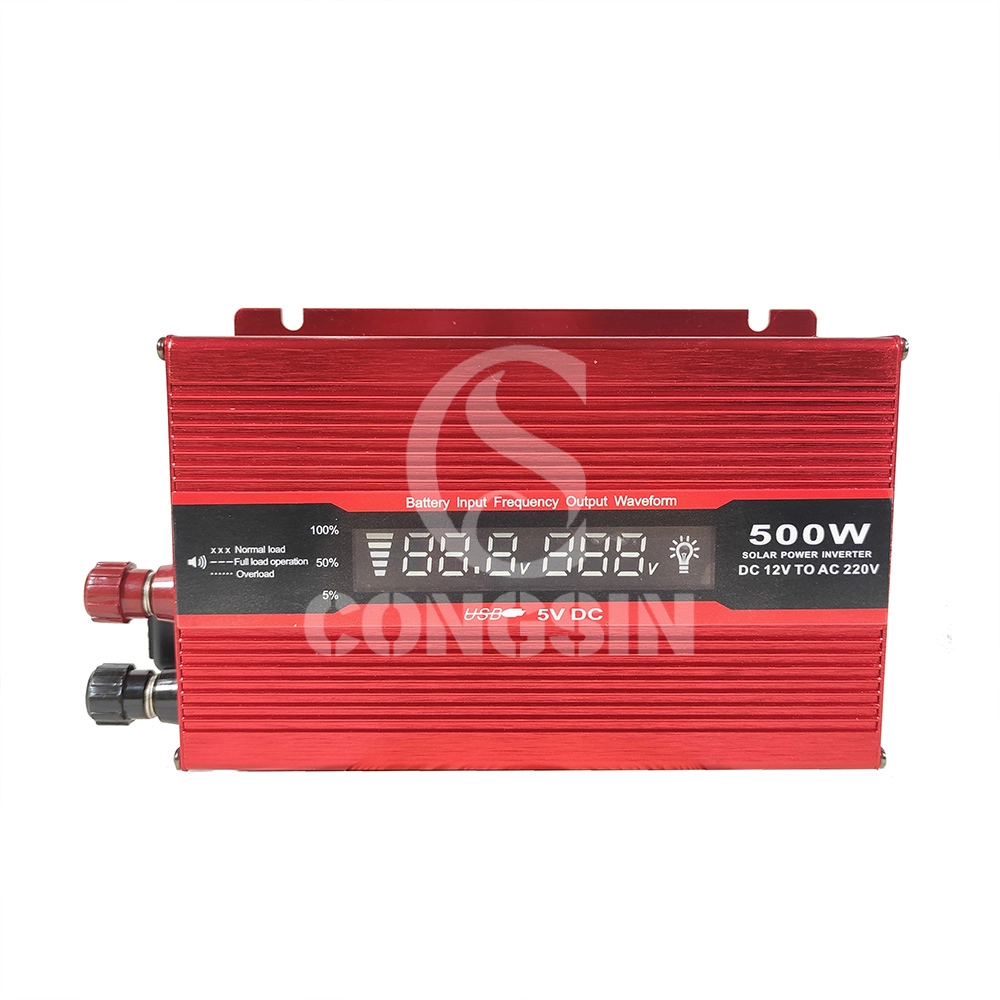
500W Modified Sine Wave Inverter (Rated 360W Peak 720W) DC12V to AC220V Inverter with LED Display Universal Socket
This 500W modified sine wave inverter has a rated power of 360W and a peak power of 720W, with DC12V input and AC220V output. Equipped with 1 USB port, universal socket, LED display, external fuse design, and battery clip, it has an exquisite appearance and stable performance. It can provide reliable AC power conversion for mobile phones, small home appliances, electronic devices, etc. in scenarios such as vehicle, outdoor, and home emergency, meeting the power needs of various devices.
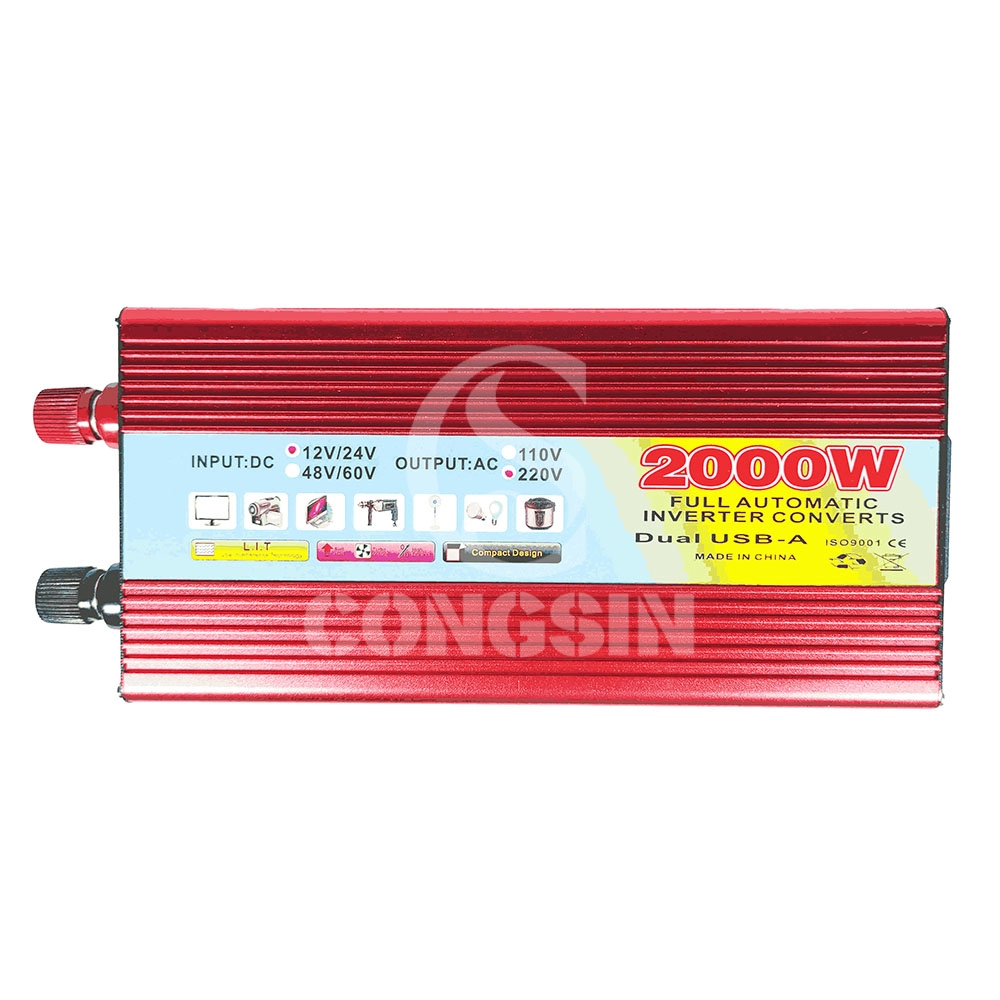
2000W Dual Input Modified Sine Wave Power Inverter (12V/24V or 48V/60V)
This 2000W modified sine wave inverter features a dual-input voltage design (12V/24V or 48V/60V), making it compatible with various DC systems. Compact, efficient, and versatile, it delivers a stable AC 220V output for home, vehicle, and solar power applications.
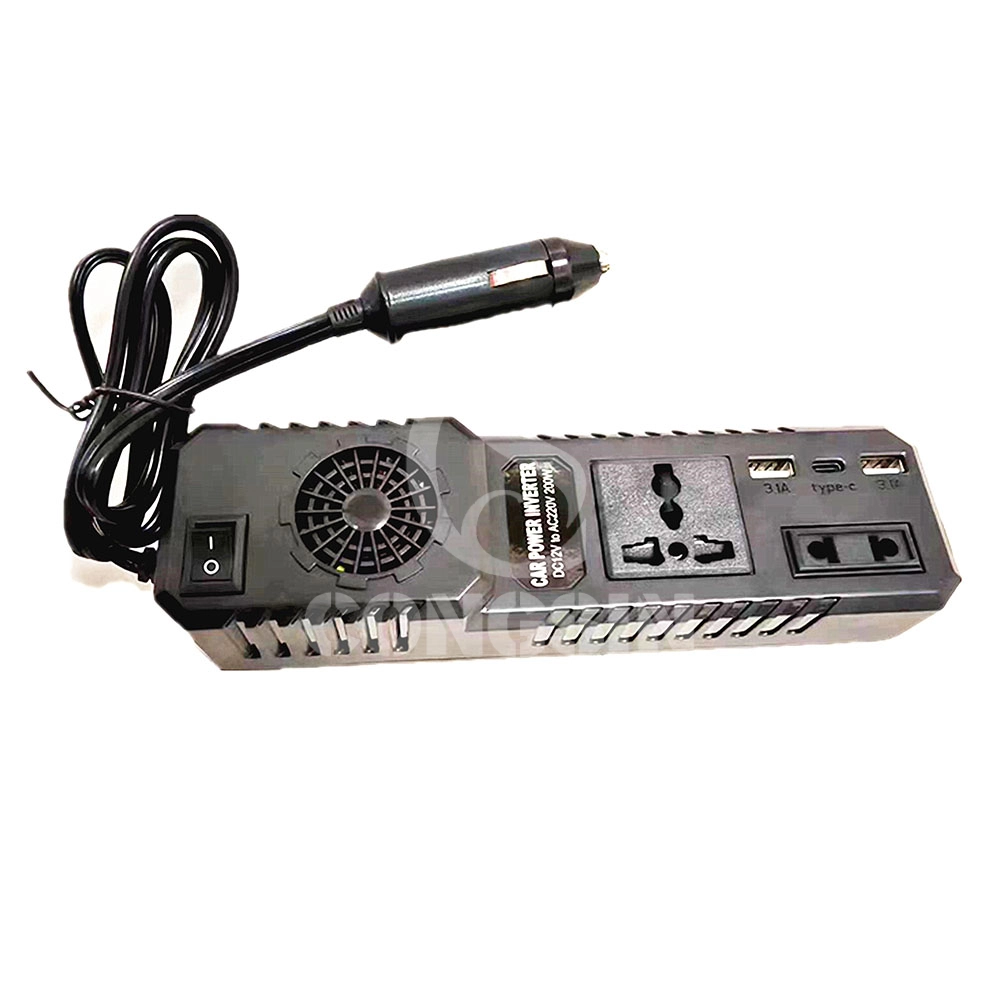
200W Modified Sine Wave Car Power Inverter, Dual Input DC12V/24V to AC220V with Type-C & Dual USB Ports
This 200W Modified Sine Wave Car Power Inverter is a compact and practical power conversion device designed for vehicle use. It supports dual input (DC12V/24V) and outputs AC220V, compatible with various electronic devices. Equipped with a Type-C port and dual 3.1A USB outputs, it can charge laptops, phones, cameras, drones, and other small electronics simultaneously—perfect for outdoor travel, emergency backup, and mobile work scenarios.
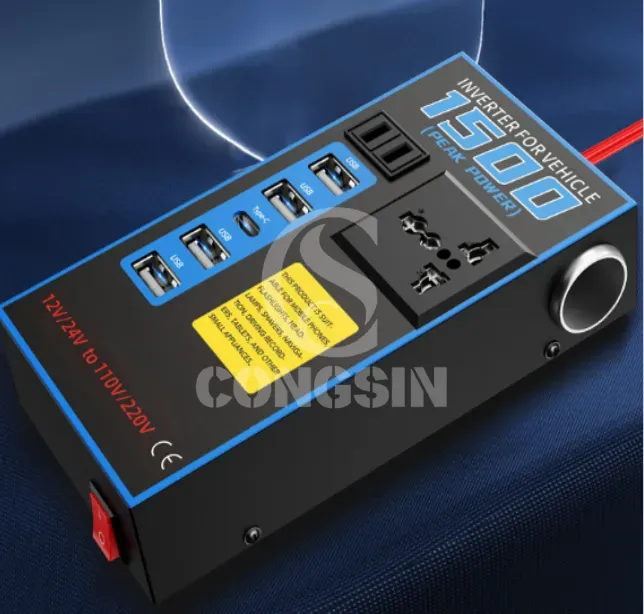
Congsin 1500W Inverter for Vehicle DC 12V/24V to AC 110V/220V with Universal socket Modified Sine Wave

CONGSIN is a trusted OEM factory for power inverters, solar charge controllers, and DC converters. Reliable solutions for global B2B buyers.
 High Quality
 7/24 Service
 Guaranteed Warranty
© 2025 Congsin. All Rights Reserved.