





Maximizing Efficiency of Your 2000W Modified Sine Wave Inverter
- Understanding the device and realistic expectations
- What a 2000 watt modified sine wave inverter actually delivers
- Real-world continuous vs. peak ratings
- Key efficiency concepts
- Practical steps to maximize efficiency
- 1) Match loads and avoid small, inefficient draws
- 2) Optimize input wiring and battery configuration
- 3) Thermal management and placement
- Component-level and operational optimizations
- 4) Power factor and resistive vs. inductive loads
- 5) Use smart load management and sequencing
- 6) Firmware, settings, and quality of components
- Comparing modified and pure sine solutions — trade-offs and numbers
- When a modified sine inverter is the right choice
- When you should prefer a pure sine inverter
- Quick comparison table
- Design, safety and standards — measurable ways to ensure long-term efficiency
- Follow standards and approvals
- Monitoring, data logging and maintenance
- Real-life measurement example
- Manufacturer selection and why it matters — Guangzhou Congsin example
- Competitive edge and technical strengths
- When to ask the manufacturer
- Maintenance checklist and troubleshooting quick guide
- Routine checks
- Common failures and fixes
- When to upgrade to pure sine
- FAQ
- 1. Will a 2000 watt modified sine wave inverter run a refrigerator?
- 2. How do I calculate battery capacity for running a 2000W inverter?
- 3. Does a modified sine inverter damage electronics?
- 4. How much does wiring affect efficiency?
- 5. Can firmware updates improve inverter efficiency?
As a consultant and engineer with years of hands-on experience testing DC→AC converters and power systems, I often see owners of a 2000 watt modified sine wave inverter seeking straightforward ways to improve performance, reduce losses, and avoid compatibility issues. This guide synthesizes measurement-backed practices, industry standards and product-level tips to help you maximize efficiency, prolong service life, and choose the right applications for a modified sine inverter. I reference trusted sources such as the inverter overview on Wikipedia and inverter type comparisons on EnergySage to ground recommendations in commonly accepted engineering knowledge.
Understanding the device and realistic expectations
What a 2000 watt modified sine wave inverter actually delivers
A 2000 watt modified sine wave inverter is rated to supply up to 2000 W of continuous AC power under ideal condition. In practice, continuous output depends on ambient temperature, ventilation, inverter design and the waveform-related losses caused by the stepped/modified waveform. Unlike pure sine wave inverters that closely reproduce utility AC, modified sine wave inverters approximate a sine using stepped pulses which affects certain loads and efficiency. For general reference on inverter technology, see the inverter article on Wikipedia.
Real-world continuous vs. peak ratings
Manufacturers often specify a continuous rating (2000 W here) and a short-duration surge capability for motor starts or capacitive loads. Expect the continuous rating to be achievable only within a specified temperature and input voltage range. When planning use, apply a 10–20% derating to account for thermal stress, altitude and real wiring losses unless the product datasheet explicitly details conditions that ensure full power delivery.
Key efficiency concepts
Efficiency is the ratio of AC output power to DC input power. For modified sine wave inverters, efficiency varies with load: they generally reach peak efficiency at 30–75% of rated load. At very low loads (<5% of rating) standby and quiescent losses become significant relative to output, reducing overall efficiency. EnergySage's inverter comparisons explain how waveform and design influence performance and appliance compatibility (EnergySage).
Practical steps to maximize efficiency
1) Match loads and avoid small, inefficient draws
Because modified sine wave inverters have fixed quiescent consumption plus waveform related losses, they are inefficient at very low power draws. Consolidate small loads (lights, chargers, fans) into sleep/combined circuits or use a smaller dedicated inverter for tiny loads. As a rule of thumb, operate the inverter at 20–80% of its rated capacity for best efficiency and thermal performance.
2) Optimize input wiring and battery configuration
Minimize voltage drop between battery and inverter. Use appropriately sized cables (see table below) and keep cable length as short as practical. Higher DC voltages reduce current for a given power and decrease I2R losses; if you can use a 24V/48V system designed for your inverter, expect lower losses compared with a 12V setup for the same power.
3) Thermal management and placement
Heat reduces inverter efficiency and accelerates wear on capacitors and semiconductors. Ensure unobstructed airflow, mount the inverter away from direct sunlight, and maintain at least the manufacturer-recommended clearance. For continuous high-load operation, consider forced ventilation or an external heatsink to maintain optimal operating temperature.
Component-level and operational optimizations
4) Power factor and resistive vs. inductive loads
Modified sine wave inverters perform best with resistive loads (heaters, incandescent bulbs). Inductive and motor loads (motors, compressors, some pumps) can draw higher currents and create poor power factor, reducing effective efficiency and increasing heat. When powering motors, account for start-up surges and consider soft-start devices or a pure sine wave inverter if sensitive motor-driven equipment is mission-critical.
5) Use smart load management and sequencing
Stagger the start-up of large loads to avoid combined surge that exceeds inverter capacity. Use duty-cycling for non-time-critical loads (e.g., some pumps, fans). Adding a simple priority switch panel or automatic load-shedding controller can keep operation within efficient regions and prevent overheating and nuisance shutdowns.
6) Firmware, settings, and quality of components
Higher-quality modified sine inverters often include adaptive control algorithms that optimize switching frequency and minimize switching losses. Where available, enable economy or ECO modes for low-load conditions, and ensure firmware is up-to-date if the product supports updates. Selecting an inverter from a manufacturer with robust R&D, automated testing and ISO-quality processes tends to translate into better real-world efficiency and longevity.
Comparing modified and pure sine solutions — trade-offs and numbers
When a modified sine inverter is the right choice
Modified sine wave inverters are cost-effective and acceptable for resistive heating, many incandescent/LED lights (check electronics compatibility), basic power tools, and resistive cooking devices. If budget is constrained and loads are predominantly resistive or non-sensitive electronics, a 2000 watt modified sine wave inverter is often a pragmatic choice.
When you should prefer a pure sine inverter
If you plan to power sensitive electronics (computers, variable-speed motors, medical devices, some battery chargers), appliances with electronic controls, or certain audio/video equipment, a pure sine wave inverter is the safer option. Pure sine inverters typically produce fewer compatibility issues and tend to have slightly higher efficiency at typical loads, with smoother waveforms that reduce harmonic distortion .
Quick comparison table
| Characteristic | 2000W Modified Sine Wave Inverter | 2000W Pure Sine Wave Inverter |
|---|---|---|
| Typical peak efficiency | 85%–92% (varies by model & load) | 90%–96% (varies by model & load) |
| Compatibility with sensitive electronics | Limited; may cause noise, overheating, charger issues | High; safe for most electronics and motors |
| Cost | Lower upfront cost | Higher upfront cost |
| Typical use cases | Tools, resistive loads, basic lighting, low-cost mobile setups | Full-spectrum use: sensitive audio, medical, IT equipment, variable-speed motors |
Sources: inverter technology overview and type comparisons on Wikipedia and EnergySage.
Design, safety and standards — measurable ways to ensure long-term efficiency
Follow standards and approvals
Quality manufacturers build products to recognized standards and obtain approvals such as CE, EMC, LVD, ETL, FCC and RoHS. These certifications and compliance processes reduce the risk of latent defects that can reduce efficiency over time. For example, ISO 9001 is a recognized framework for quality management—see ISO 9001 for details.
Monitoring, data logging and maintenance
Where possible, install voltage/current monitoring to log inverter input/output power, ambient temperature and event faults. Trend analysis of these logs helps detect rising internal losses (an early sign of component aging). Periodic maintenance—cleaning cooling fins, checking cable terminations, and replacing depleted batteries—preserves efficiency.
Real-life measurement example
To estimate inverter efficiency in your setup, measure DC input voltage (Vdc) and input current (Idc) as well as AC output voltage (Vac) and output current (Iac). Use these simple formulas:
- DC input power = Vdc × Idc
- AC output power = Vac × Iac × power factor (if known)
- Efficiency (%) = (AC output power / DC input power) × 100
Example: If DC input = 13.2 V × 150 A = 1980 W, and AC output measured = 1800 W, efficiency = 1800 / 1980 × 100 = 90.9%.
Manufacturer selection and why it matters — Guangzhou Congsin example
Choosing a manufacturer with proven design, production automation, and test protocols directly impacts long-term efficiency and reliability. Guangzhou Congsin Electronic Technology Co., Ltd., founded in early 1998, is a professional power inverter manufacturer with over 27 years of focused experience. We design, R&D and manufacture a wide range of power solutions—with a core emphasis on DC→AC power inverters, portable power stations, and solar charge controllers. Our catalog includes 100+ models tailored for vehicles, solar systems, RVs and trucks, off-grid homes, outdoor offices, patrol and field construction work.
We operate fully automated production lines, advanced instrumentation and multifunctional testing equipment to ensure product reliability, efficiency and intelligent functionality. Environmental and safety compliance are built in: our quality system is ISO9001 certified and many products hold international approvals such as CE, EMC, LVD, ETL, FCC, RoHS and E-MARK. Several independently developed patents further demonstrate our commitment to innovation.
Congsin’s products serve global markets across Europe, the Americas, the Middle East, Africa and Southeast Asia; many models are supplied to domestic and international OEM channels. Our support includes OEM/ODM, private labeling, distribution and bespoke customization to meet partner specifications.
Our mission is to deliver reliable, efficient and affordable energy solutions that enable energy independence. Congsin specializes in Solar Charge Controller, modified sine wave inverter, pure sine wave inverter, portable power stations. Choosing a supplier like Congsin helps ensure you receive inverters designed with automated testing, quality controls and documentation that make it easier to reach the real-world efficiencies described above.
Competitive edge and technical strengths
Congsin leverages long-term R&D focus on DC→AC conversion to optimize thermal design, switching topology and control algorithms. Automated production minimizes unit-to-unit variance, and multifunctional testing equipment validates efficiency curves across a range of loads and temperatures. For buyers, this means tighter conformity to datasheet efficiencies and longer service life—particularly important when operating a 2000 watt modified sine wave inverter near its rated capacity.
When to ask the manufacturer
Before purchase, ask for: efficiency curves vs. load, surge capability and duration, thermal derating curve, THD measurements, and a list of certifications. Request test reports (if available) and speak to OEM/ODM customization options if you need tailored input voltage ranges or integrated monitoring.
Maintenance checklist and troubleshooting quick guide
Routine checks
- Inspect and tighten DC cable connections quarterly.
- Clean cooling fans and heat-sink fins every 6 months (more often in dusty environments).
- Verify firmware and settings annually.
- Check battery health and specific gravity/voltage under load.
Common failures and fixes
- Overheating: improve ventilation, reduce continuous load, check fan operation.
- Frequent low-voltage shutdowns: check battery charge state and cable losses; increase battery capacity or reduce load.
- Audible noise/radio interference: re-locate inverter away from antennas and sensitive audio gear; consider a pure sine model if interference persists.
When to upgrade to pure sine
If you repeatedly need to power sensitive electronics, frequent motor starts, medical equipment, or notice interference and inefficiencies despite following optimization steps above, migrating to a pure sine inverter is often more cost-effective in the medium term due to reduced equipment replacement and lower operational issues.
FAQ
1. Will a 2000 watt modified sine wave inverter run a refrigerator?
Often yes, for many refrigerators it will run, but the starting surge current of the compressor can exceed the inverter's surge rating. Check the refrigerator compressor start current (often 2–6× running current). If the surge capability of the inverter is insufficient, use a soft-start device or choose a higher-surge or pure sine inverter.
2. How do I calculate battery capacity for running a 2000W inverter?
Estimate energy needed in watt-hours (Wh). For example, running 1000 W for 2 hours = 2000 Wh. For a 12V battery bank, required amp-hours (Ah) = Wh / 12V = 2000 / 12 ≈ 167 Ah, then increase for inverter efficiency and depth-of-discharge (DOD). For lead-acid, use 50% DOD; for Li-ion, use 80–90% DOD. Include inverter inefficiency (divide required Wh by inverter efficiency).
3. Does a modified sine inverter damage electronics?
Some electronics—especially those with sensitive switching power supplies, timers, or audio equipment—can behave poorly or suffer heating with modified sine wave input. Always consult appliance manuals; if in doubt, use or test with a UPS/pure sine or contact the manufacturer.
4. How much does wiring affect efficiency?
Significantly. Poorly sized or long cables add I2R losses which directly reduce inverter efficiency. Use short, heavy-gauge cables sized for the current and keep DC connections tight and corrosion-free.
5. Can firmware updates improve inverter efficiency?
Yes, for inverters with digital control, firmware updates can optimize switching timing and protection thresholds, sometimes improving efficiency and transient response. Check with the manufacturer for available updates and change logs.
If you need tailored advice for your system, specific load list analysis, or an OEM/ODM solution for a 2000 watt modified sine wave inverter, contact our engineering team to review load charts and produce a customized specification. To see Congsin’s product range and request datasheets or sample testing reports, visit our product pages or reach out directly for consultation and quotes.
Contact & product inquiry: For consultation, customization or to view product offerings (Solar Charge Controller, modified sine wave inverter, pure sine wave inverter, portable power stations), please contact Guangzhou Congsin Electronic Technology Co., Ltd. Our team can provide efficiency curves, test reports and OEM/ODM options to match your requirements.
References: Inverter overview and technology notes—Wikipedia; inverter types and comparisons—EnergySage; ISO 9001—ISO; CE marking—European Commission.
UPS Inverter vs Online UPS: Best Option for Data Centers
How to Size a 2000W Inverter for Home Backup and Appliances
Best Pure Sine Inverters for Powering Sensitive Vehicle Electronics
Improving Efficiency: Batteries and Pure Sine Wave Inverters
Pure Sine Wave Inverters
What capacity battery is needed to drive a 1000W electric kettle?
It is recommended to match with a 12V 100Ah or larger capacity battery. When a 1000W electric kettle is working, the power consumption per hour is about 83Ah (1000W÷12V≈83A), and a 100Ah battery can support continuous work for about 1 hour (actual battery life is affected by battery aging).
Is the remote control standard?
It’s optional and available upon request.
Can this inverter drive a 3P air conditioner and a refrigerator at the same time?
Yes. The rated power of a 3P air conditioner is about 2200W-2500W, and an ordinary double-door refrigerator is about 150W-300W, with a total power of about 2350W-2800W, which does not exceed the 3000W continuous power; and the peak 6000W can cope with the instantaneous startup impact of the air conditioner. When using, ensure the battery capacity is ≥200Ah (12V) to ensure battery life.
Modified Sine Wave Inverters
What is the difference between modified sine wave and pure sine wave?
Modified sine wave is suitable for most ordinary home appliances and electronic devices; pure sine wave is suitable for devices with extremely high power requirements (such as precision instruments). This modified sine wave is more cost-effective and meets the needs of most daily scenarios.
What is the function of the independent control switch?
The independent control switches for DC and AC can respectively control the on and off of DC and AC circuits, facilitating the separate management of power supply for different types of devices and improving power usage safety and flexibility.
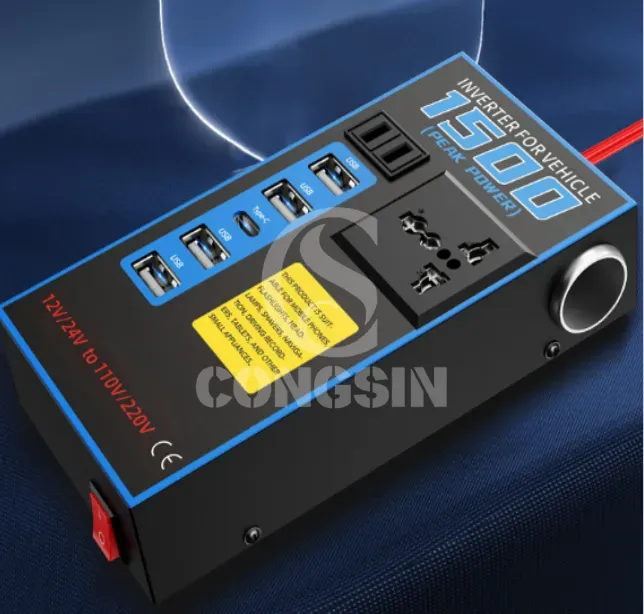
Congsin 1500W Inverter for Vehicle DC 12V/24V to AC 110V/220V with Universal socket Modified Sine Wave
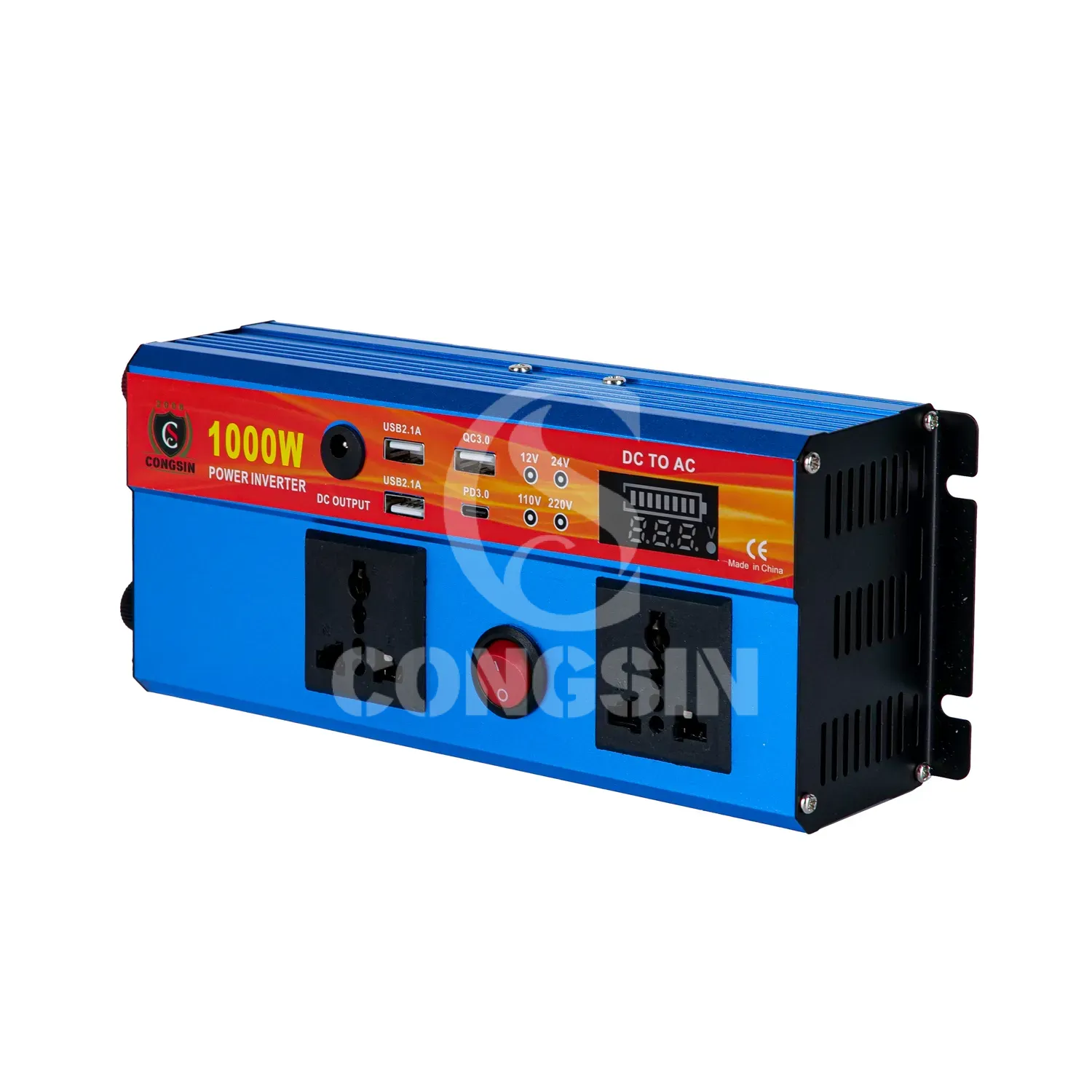
Congsin 1000W modified sine wave inverter with LED display and Type C port car RV power inverter
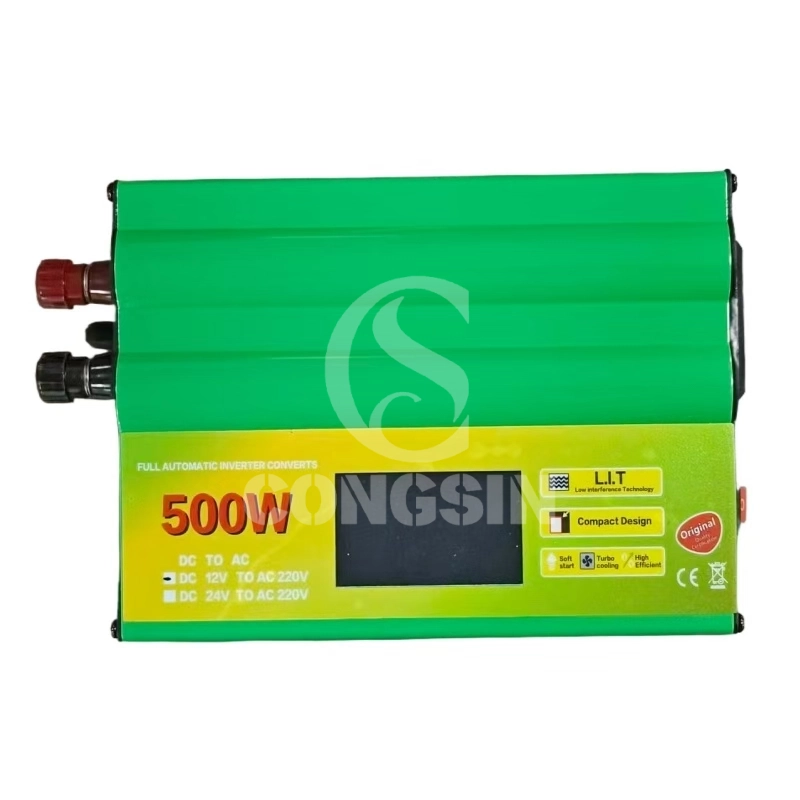
Congsin Modified Sine Wave Inverter 500W 1000W 1500W 12V LED Display Portable for RV Car Solar
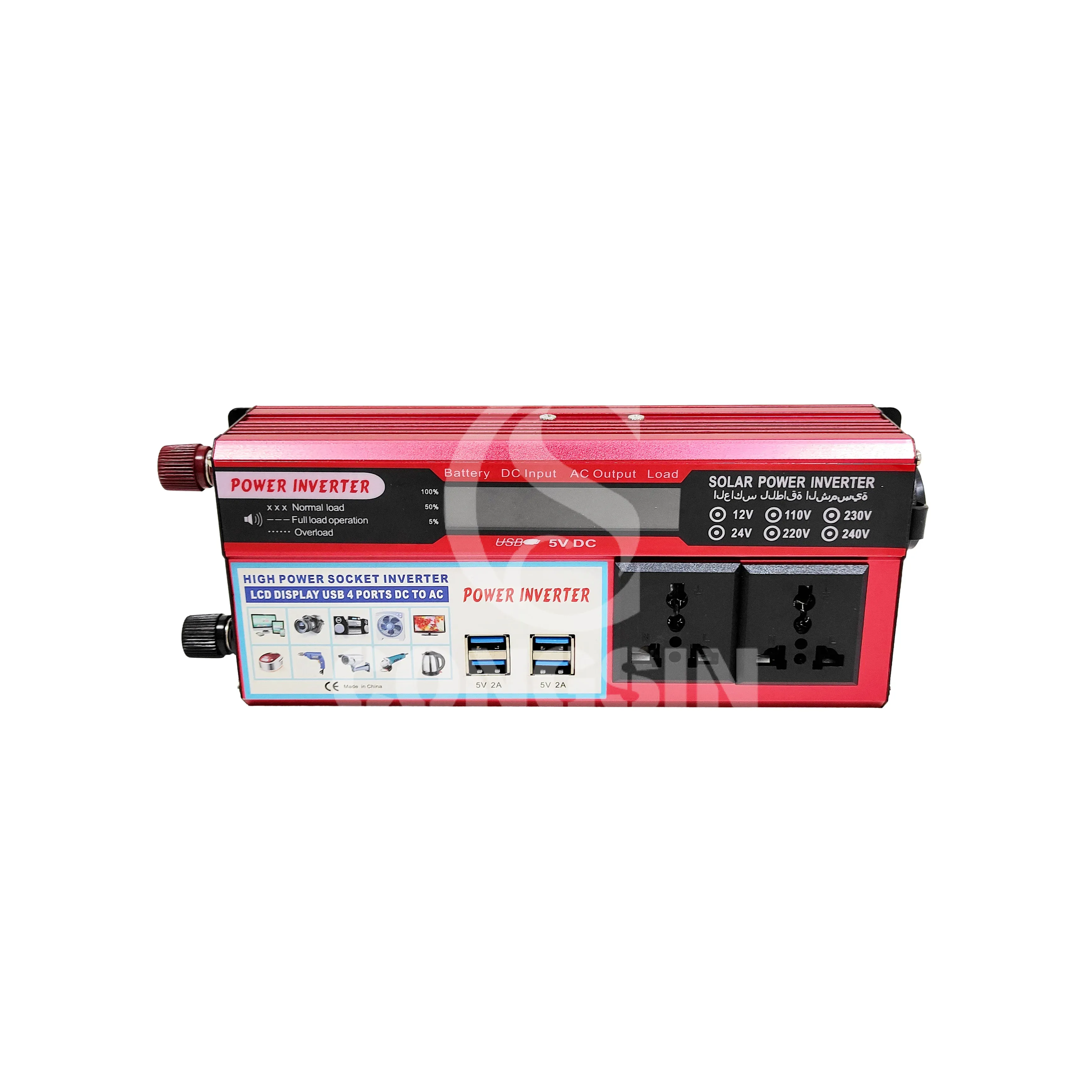
Congsin 1500W modified sine wave inverter with LCD display and USB ports for RV car boat home use

CONGSIN is a trusted OEM factory for power inverters, solar charge controllers, and DC converters. Reliable solutions for global B2B buyers.
 High Quality
 7/24 Service
 Guaranteed Warranty
© 2025 Congsin. All Rights Reserved.