





How High Frequency Inverters Improve Power Density and Efficiency
- Why power density matters in modern power systems
- Market and application drivers
- How higher frequency enables smaller magnetics
- Trade-off between size and losses
- How high frequency inverters work and why they are more efficient
- Switching frequency and converter topology
- Semiconductor advances: MOSFETs, SiC and GaN
- Soft-switching and synchronous rectification
- Practical design considerations: EMI, thermal management and reliability
- EMI and filtering strategies
- Thermal design for high power density
- Reliability and long-term efficiency
- Comparing low-frequency and high-frequency inverter approaches
- Table: qualitative and numerical comparison
- When HF does not make sense
- Key metrics to evaluate vendor claims
- Implementation examples and selection guidance
- Example: portable power station inverter
- Example: solar microinverter and vehicle inverters
- Selection checklist
- Guangzhou Congsin Electronic Technology Co., Ltd. — Capabilities and product fit
- Why choose Congsin for high frequency inverter solutions?
- FAQ — Frequently Asked Questions
- 1. What is a high frequency inverter?
- 2. How much more efficient are HF inverters compared to traditional designs?
- 3. Do high frequency inverters create more EMI?
- 4. Are GaN and SiC necessary for HF inverters?
- 5. How should I compare inverter datasheets?
- 6. Can high frequency inverters be retrofitted into existing systems?
- Contact and product inquiry
This article examines how a high frequency inverter raises power density and efficiency in modern DC→AC conversion systems. It summarizes the physical principles (magnetics scaling with frequency, switching loss trade-offs), the role of advanced semiconductors (GaN, SiC), and topology choices (resonant, synchronous rectification, SMPS-style stages). The goal is practical: help engineers and procurement managers evaluate HF inverter benefits, mitigate EMI and thermal issues, and choose the right product for vehicle, solar or portable power applications.
Why power density matters in modern power systems
Market and application drivers
Power density—the delivered power per unit volume or mass—is critical in EVs, aircraft, portable power stations, RVs and compact off-grid homes. Users want smaller, lighter inverters for the same output power to improve system integration, reduce costs (shipping, mounting), and increase usable payload. The semantic keywords used here include high frequency inverter, power density, portable power stations and DC-AC conversion to reflect typical .
How higher frequency enables smaller magnetics
A dominant limiter of inverter size is the magnetics (transformer/inductor). The required core cross-section for a magnetic component is inversely related to operating frequency for a given flux density swing. Raising switching frequency from tens of kHz to hundreds of kHz or MHz reduces the required core volume, enabling significant reductions in transformer/inductor size and therefore a higher power density. This is a foundational principle of switched-mode power supplies (SMPS) and high frequency inverter design (Switched-mode power supply — Wikipedia).
Trade-off between size and losses
Higher switching frequency does increase switching losses and EMI if implemented naively. The key to improved overall efficiency and power density is using modern device technologies and topologies that limit switching losses (for example, soft-switching resonant converters and GaN MOSFETs). Semantic variations such as HF inverter, high switching frequency inverter, resonant inverter are used throughout to reflect real queries and manufacturer terminology.
How high frequency inverters work and why they are more efficient
Switching frequency and converter topology
High frequency inverters typically operate switching devices (MOSFETs, GaN, SiC) at frequencies from tens of kHz to several MHz. Topologies used in HF inverters include full-bridge with high-frequency transformers, resonant converters (LLC, series resonant), and multi-stage architectures that combine a high-frequency DC–DC stage with a high-efficiency H-bridge for AC output. These topologies allow reduced magnetics and, with proper design, improved overall conversion efficiency. See a general overview at Power electronics — Wikipedia.
Semiconductor advances: MOSFETs, SiC and GaN
Switching losses are proportional to switching frequency and the device's dynamic characteristics. Wide-bandgap semiconductors (SiC, GaN) have lower switching losses and faster transition times compared with silicon MOSFETs or IGBTs, enabling higher switching frequencies with acceptable losses. GaN inverter and SiC inverter are common semantic keywords reflecting this trend. Using GaN can reduce conduction and switching losses, shrinking heat-sinking requirements and enabling higher power density.
Soft-switching and synchronous rectification
Soft-switching techniques (zero-voltage switching, ZVS; zero-current switching, ZCS) reduce switching transition losses and EMI, allowing HF inverters to run faster without proportionally higher losses. Synchronous rectification replaces diode rectifiers with actively switched devices to cut conduction losses at the output stage. Combining soft-switching resonant topologies with synchronous rectification yields high efficiency (>95% in many designs) while maintaining high power density.
Practical design considerations: EMI, thermal management and reliability
EMI and filtering strategies
High frequency switching generates higher spectral content that can complicate EMI compliance. Common mitigation techniques include spread-spectrum switching, careful PCB layout, common-mode chokes, and low-pass filters on both AC and DC interfaces. Design must balance filter size (which affects power density) with conducted and radiated emissions limits (e.g., CISPR and FCC/CE standards). The term EMI mitigation appears frequently in procurement searches for HF inverter systems.
Thermal design for high power density
As power density increases, heat flux density rises. Efficient cooling—through optimized heat sinks, forced-air or liquid cooling, and thermal interface materials—is critical. Because GaN and SiC reduce switching losses, they enable smaller thermal systems, but reliability requires accurate junction temperature management and thermal cycling analysis over expected duty cycles (vehicle vibration, outdoor temperature swings).
Reliability and long-term efficiency
Long-term efficiency is impacted by thermal stress, component aging (capacitors, magnetics), and software/hardware control quality. Conservative derating, high-quality electrolytic or polymer capacitors, and robust firmware for protections (over/under-voltage, thermal foldback) help ensure HF inverter systems deliver capacity and efficiency throughout their service life.
Comparing low-frequency and high-frequency inverter approaches
Table: qualitative and numerical comparison
Below is a compact comparison of conventional low-frequency inverters vs. high frequency inverters. Numbers are representative ranges from industry reports and power electronics literature; consult vendor datasheets for specific model performance.
| Characteristic | Low-frequency inverter (50/60 Hz transformer-based) | High-frequency inverter (kHz–MHz switching) |
|---|---|---|
| Switching frequency | 50–60 Hz (line frequency) or few kHz in older SMPS | 20 kHz–2 MHz (typical ranges) |
| Transformer/inductor size | Large, heavy cores | Much smaller (volume often scales roughly inversely with frequency) |
| Typical efficiency | 85%–95% (depends on topology and power) | 90%–98% (modern designs with GaN/SiC and soft-switching) |
| EMI challenges | Lower high-frequency content, easier filtering | Higher RF content, requires careful EMI control |
| Power density | Lower (bulkier) | Higher (compact, lighter) |
| Typical applications | Large UPS, legacy systems | Portable stations, EV inverters, solar microinverters, aircraft, telecom |
Sources and principles summarized from general power electronics literature and overview material on inverters (Inverter (electrical) — Wikipedia).
When HF does not make sense
Not every application benefits from maximum switching frequency. Very high-power grid-tied central inverters sometimes prefer lower switching frequency with large magnetics for cost or proven reliability. Additionally, if EMI constraints, certification cycles or harsh environments make high-frequency control and filtering complex, a conservative lower-frequency design can be preferable. This pragmatic view is important for procurement teams comparing total cost of ownership.
Key metrics to evaluate vendor claims
When selecting HF inverter products, insist on datasheet metrics and test reports for: efficiency vs. load curve, thermal derating curves, EMI/EMC test results, MTBF estimates, and certification listings. Look for products with ISO9001 and third-party approvals (CE, EMC, LVD, ETL, FCC, RoHS) to reduce certification risk.
Implementation examples and selection guidance
Example: portable power station inverter
A portable power station optimized for power density typically uses a two-stage approach: a high-frequency DC–DC stage that steps battery voltage to an intermediate bus using resonant or quasi-resonant converters, followed by a high-efficiency H-bridge that synthesizes AC output with PWM or filtered sine wave modulation. Using GaN switches in the DC–DC stage and synchronous rectification in the output stage can push continuous AC efficiency above 95% while keeping enclosure volume small.
Example: solar microinverter and vehicle inverters
Solar microinverters and vehicle inverters demand compactness and efficiency under variable input conditions. HF inverter topologies enable lightweight designs that fit onto solar panels or inside vehicle compartments. Important semantic phrases include solar inverter, vehicle inverter and microinverter—terms customers search when comparing compact inverter solutions.
Selection checklist
- Confirm required continuous power and peak surge capability.
- Review efficiency vs. load curve (not just peak efficiency).
- Check EMI/EMC reports and expected installation filtering needs.
- Inspect thermal design and serviceability for expected ambient range.
- Prefer vendors with ISO9001 and international approvals to shorten certification cycles.
Guangzhou Congsin Electronic Technology Co., Ltd. — Capabilities and product fit
Guangzhou Congsin Electronic Technology Co., Ltd., founded in early 1998, is a professional power inverter manufacturer with over 27 years of focused experience. We design, R&D and manufacture a wide range of power solutions—with a core emphasis on DC→AC power inverters, portable power stations, and solar charge controllers. Our catalog includes 100+ models tailored for vehicles, solar systems, RVs and trucks, off-grid homes, outdoor offices, patrol and field construction work.
We operate fully automated production lines, advanced instrumentation and multifunctional testing equipment to ensure product reliability, efficiency and intelligent functionality. Environmental and safety compliance are built in: our quality system is ISO9001 certified and many products hold international approvals such as CE, EMC, LVD, ETL, FCC, RoHS and E-MARK. Several independently developed patents further demonstrate our commitment to innovation.
Congsin’s products serve global markets across Europe, the Americas, the Middle East, Africa and Southeast Asia; many models are supplied to domestic and international OEM channels. Our support includes OEM/ODM, private labeling, distribution and bespoke customization to meet partner specifications.
Our mission is to deliver reliable, efficient and affordable energy solutions that enable energy independence. Congsin specializes in Solar Charge Controller, modified sine wave inverter, pure sine wave inverter and portable power stations. By combining high-frequency design techniques, modern semiconductor choices (including options for wide-bandgap devices), and quality manufacturing, Congsin delivers compact, high-efficiency inverter solutions suitable for demanding mobile and off-grid applications.
Why choose Congsin for high frequency inverter solutions?
- Proven manufacturing maturity (27+ years) and automated production to ensure consistent quality.
- Broad product range (100+ models) enabling rapid OEM/ODM customization.
- Compliance with international safety and EMC standards to simplify market entry.
- Technical capability to implement HF design techniques (resonant topologies, synchronous rectification, advanced thermal solutions) that improve power density and efficiency.
FAQ — Frequently Asked Questions
1. What is a high frequency inverter?
A high frequency inverter uses switching devices operating at frequencies much higher than the mains (typically kHz to MHz) and corresponding topologies (SMPS-style converters, resonant inverters) to achieve smaller magnetics, higher power density and, with proper design, higher overall efficiency. See Inverter (electrical) for fundamentals.
2. How much more efficient are HF inverters compared to traditional designs?
Modern HF inverters can achieve 90%–98% efficiency depending on topology, semiconductor choice and load conditions. Efficiency gains are most pronounced at medium to high loads when soft-switching and synchronous rectification are used. Exact numbers depend on the specific product and should be validated against vendor test reports.
3. Do high frequency inverters create more EMI?
Yes, higher switching frequencies produce more high-frequency spectral content. However, with proper layout, filtering, spread-spectrum techniques and shielding, HF inverters can meet regulatory EMI limits. Expect to allocate PCB area and design effort for EMI control when choosing HF solutions.
4. Are GaN and SiC necessary for HF inverters?
They are not strictly necessary but are highly beneficial. Wide-bandgap semiconductors (GaN, SiC) have lower switching and conduction losses at high frequencies than silicon devices, enabling higher switching frequencies and smaller thermal designs with equal or better efficiency.
5. How should I compare inverter datasheets?
Compare continuous and peak power ratings, efficiency curve across load range, thermal derating, certification list (CE, EMC, FCC), EMI test results, MTBF/expected lifetime, and mechanical dimensions to assess real power density. Request certified test reports for claims of efficiency and EMI compliance.
6. Can high frequency inverters be retrofitted into existing systems?
Often yes, but you must evaluate input/output filtering, grounding schemes, mechanical mounting, cooling requirements, and EMC impacts. In some regulated installations, re-certification or re-testing may be required after retrofit.
Contact and product inquiry
If you need compact, efficient DC→AC solutions—portable power stations, pure sine wave inverters, modified sine wave inverters, or solar charge controllers—contact Guangzhou Congsin Electronic Technology Co., Ltd. for OEM/ODM options, technical support and samples. For product catalogs, customization or technical consultation, reach out to Congsin's sales team to discuss specifications, certifications and lead times.
Relevant technical references: Inverter (electrical) — Wikipedia, Switched-mode power supply — Wikipedia, Power electronics — Wikipedia.
Best 1000W Car Inverters 2026: Top Models Compared
Top 5 portable power station Company List and Products Compared
How to Choose the Best Inverter for Your Car Battery
Top 10 12 volt inverter for car Manufacturers and Supplier Brands
Modified Sine Wave Inverters
How to install the battery terminal wire?
Connect the red terminal wire to the positive pole of the battery and the black terminal wire to the negative pole. Ensure the interface is firm and there is no short circuit when connecting.
Can it be used with a car cigarette lighter socket?
Yes, it supports both battery clip and cigarette lighter connection.
What is the benefit of the UPS function? A2:
It automatically switches to battery power when AC fails.
What devices can this inverter support?
It can power laptops, phones, cameras, and other small appliances.
Pure Sine Wave Inverters
What is the difference between a pure sine wave inverter and a modified sine wave inverter?
Pure sine wave inverter has an output waveform close to mains power with low distortion rate (<3%), which can be safely adapted to precision devices such as computers, medical instruments, and inverter home appliances; modified sine wave inverter has a notched waveform, which easily causes device heating, malfunction or damage, and is only suitable for simple devices such as bulbs and fans.
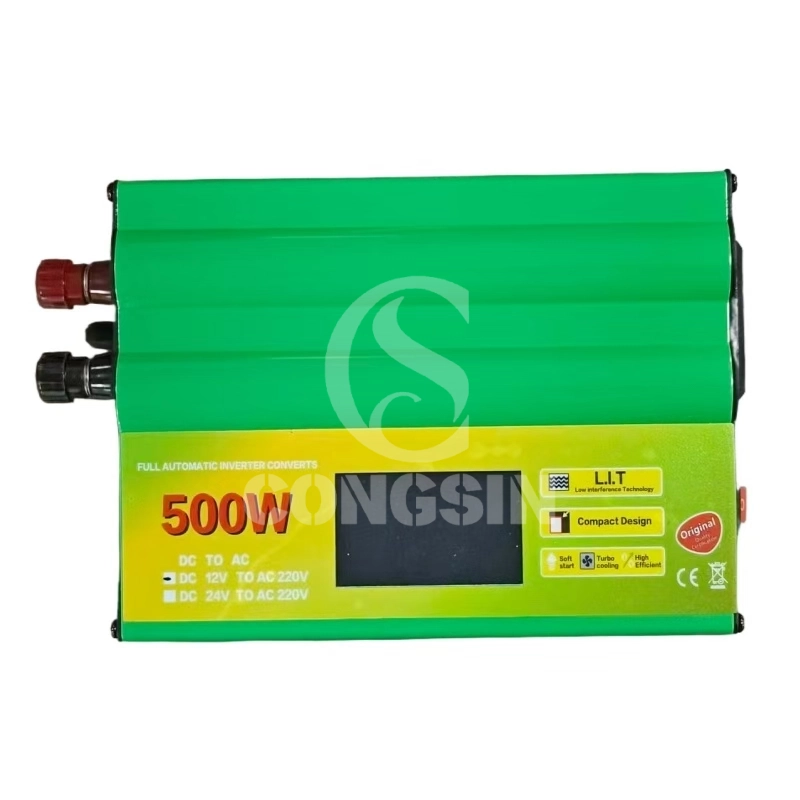
Congsin Modified Sine Wave Inverter 500W 1000W 1500W 12V LED Display Portable for RV Car Solar
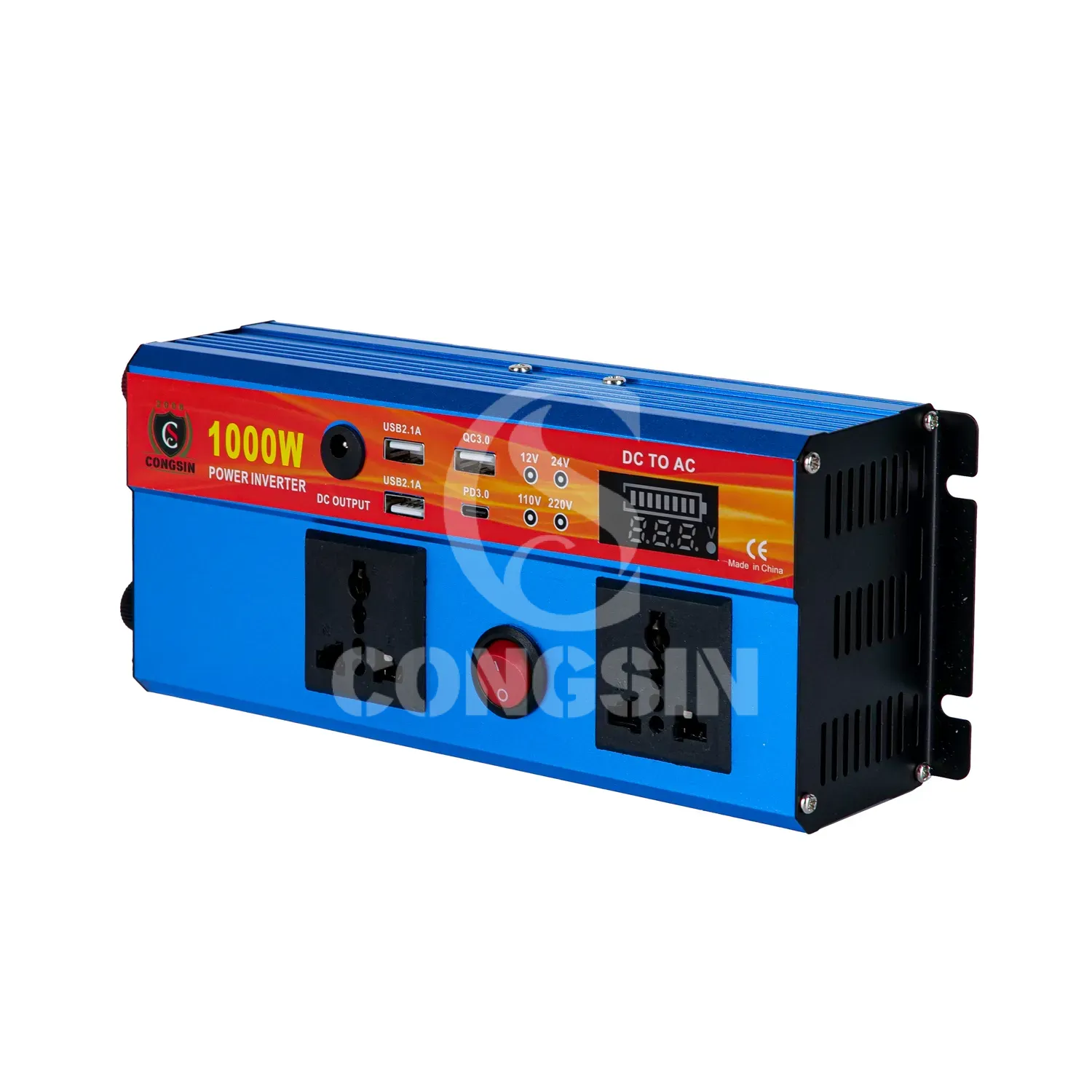
Congsin 1000W modified sine wave inverter with LED display and Type C port car RV power inverter
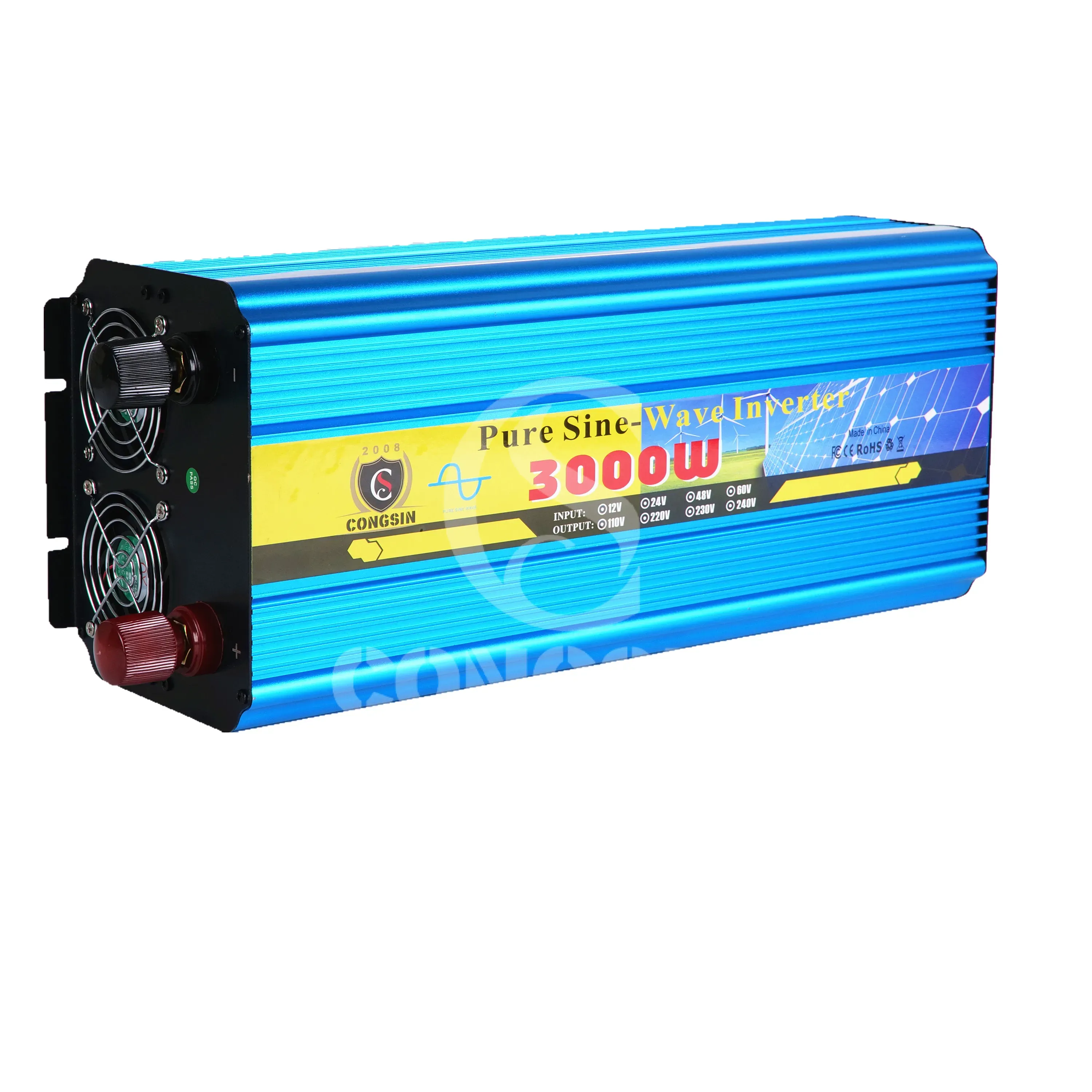
Congsin 3000W LCD Pure Sine Wave Inverter for Home Use Solar Backup Power Inverter Off Grid UPS
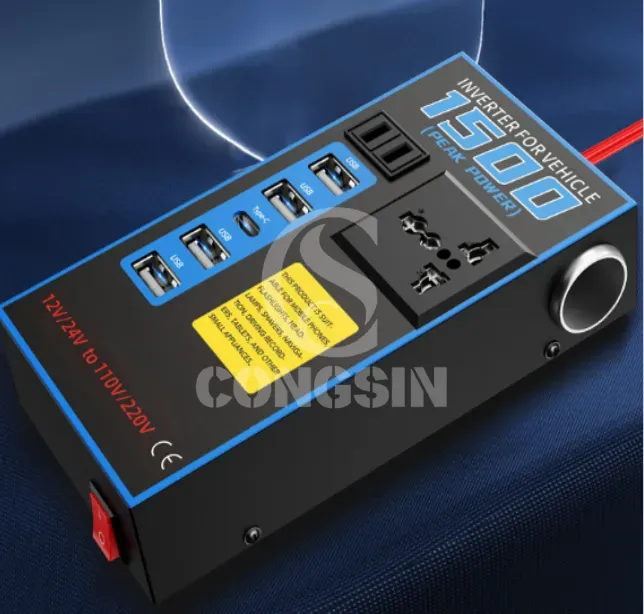
Congsin 1500W Inverter for Vehicle DC 12V/24V to AC 110V/220V with Universal socket Modified Sine Wave

CONGSIN is a trusted OEM factory for power inverters, solar charge controllers, and DC converters. Reliable solutions for global B2B buyers.
 High Quality
 7/24 Service
 Guaranteed Warranty
© 2025 Congsin. All Rights Reserved.