





Cost Savings Analysis: High Frequency Inverter vs Traditional
- Why inverter choice materially affects operating costs
- Energy losses translate directly to recurring cost
- Upfront cost vs lifetime cost: the trade-offs
- Technical differences: high-frequency vs traditional low-frequency inverters
- Switching topology, transformer strategy and physical size
- Performance characteristics: efficiency, THD and surge ability
- Cost savings analysis: lifecycle comparison and case study
- Methodology and assumptions
- Results: energy losses, annual cost and 10-year TCO
- Maintenance, reliability and non-energy economic factors
- Maintenance schedules and failure modes
- Operational context: off-grid, solar, mobile and grid-tie
- Choosing the right inverter: practical selection and ROI checklist
- Application-driven checklist
- Estimating ROI for your installation
- Guangzhou Congsin Electronic Technology Co., Ltd. — Manufacturer profile and relevance
- Frequently Asked Questions (FAQ)
- 1. What is a high frequency power inverter and how does it differ from a traditional inverter?
- 2. Will a high frequency inverter always save money over time?
- 3. Are high frequency inverters as reliable as low-frequency transformer inverters?
- 4. How should I size an inverter for a solar or off-grid system to maximize ROI?
- 5. Do high frequency inverters produce more electrical noise or interference?
- 6. Can I retrofit a high frequency inverter into an existing system built around a low-frequency inverter?
- Contact and next steps
High frequency power inverter technology reduces size, weight and often improves efficiency compared with traditional low-frequency transformer-based inverters. For buyers—solar integrators, RV owners, off-grid households and OEMs—the economic question is not just sticker price but total cost of ownership (TCO): initial purchase, installation, energy losses, maintenance and replacement over the product lifetime. This article provides a technical comparison, a verifiable cost-analysis case study, practical selection guidance and FAQs to help decision-makers choose the right inverter for their application.
Why inverter choice materially affects operating costs
Energy losses translate directly to recurring cost
Inverters convert DC to AC. Conversion is not perfect: some energy is lost as heat. Efficiency differences between inverter types therefore produce recurring energy cost differences. Modern high frequency power inverter designs commonly target conversion efficiencies in the mid-90% range; many top-tier units exceed 95% under rated conditions. Traditional low-frequency (LF) transformer-based inverters typically have lower efficiency at light-to-medium loads and are heavier due to large low-frequency transformers. For background on inverter basics and typical efficiencies see the technical overview on Wikipedia (Inverter (electrical)).
Upfront cost vs lifetime cost: the trade-offs
Buying decisions often focus on upfront price. However, lower initial cost can be offset by higher lifetime operating costs through greater energy loss, heavier installation requirements and higher maintenance (e.g., transformer wear, fan replacement). High frequency power inverter designs typically enable smaller magnetics and mechanical packaging, reducing shipping and installation expenses for mobile and distributed applications.
Technical differences: high-frequency vs traditional low-frequency inverters
Switching topology, transformer strategy and physical size
High frequency power inverter designs use high-speed semiconductor switching and high-frequency transformers or isolation stages. Switching frequencies are commonly tens of kilohertz to several hundred kilohertz, allowing much smaller magnetics and a significantly reduced transformer mass compared with 50/60 Hz transformers used in traditional LF inverters. This size/weight advantage is why HF inverters dominate portable, vehicle and many solar applications.
Performance characteristics: efficiency, THD and surge ability
Key performance criteria that affect costs and usability include:
- Efficiency: A higher conversion efficiency reduces wasted energy and operating cost.
- Total Harmonic Distortion (THD): Pure-sine HF designs can achieve low THD suitable for sensitive electronics.
- Surge capability: Some LF transformer inverters have robust surge handling due to magnetic mass; HF designs can be engineered for similar surge but may require higher-spec semiconductors and thermal design.
Design choices influence both capital cost and operating expenses—HF inverters often carry advantages in efficiency and integration but must be properly specified for surge and continuous loads.
Cost savings analysis: lifecycle comparison and case study
Methodology and assumptions
We compare a representative high frequency power inverter (HF) vs a traditional low-frequency transformer inverter (LF) across a 10-year lifecycle. To keep the analysis verifiable, assumptions are explicit and conservative:
- AC load served: 2.0 kW continuous for 5 hours/day (10 kWh/day)
- Annual AC energy: 10 kWh/day × 365 = 3,650 kWh/year
- Electricity price (grid or fuel-equivalent rate): $0.15/kWh (U.S. average retail ~ reference: U.S. Energy Information Administration) (EIA)
- Round-trip system losses aside from inverter are held constant; analysis focuses on inverter conversion losses
- Baseline inverter efficiencies: HF = 96% (typical modern high-quality HF inverters), LF = 92% (typical older transformer designs or cost-oriented LF units)
- Initial price delta: HF initial price $400; LF initial price $300 (example retail-class prices; adjust to your market)
- Maintenance & replacement: LF transformer may require higher mechanical maintenance; we include a conservative $30/yr extra maintenance for LF vs HF
- Analysis horizon: 10 years
Results: energy losses, annual cost and 10-year TCO
We calculate annual wasted energy due to inverter inefficiency as: Wasted = AC_energy × (1/efficiency - 1)
| Parameter | High-Frequency (96%) | Low-Frequency (92%) |
|---|---|---|
| Annual AC energy delivered (kWh) | 3,650 | |
| Input energy required (kWh) | 3,802 (3,650 / 0.96) | 3,967 (3,650 / 0.92) |
| Annual wasted energy (kWh) | 152 | 317 |
| Annual wasted energy cost (@ $0.15/kWh) | $22.80 | $47.55 |
| Annual maintenance cost (assumed) | $20 | $50 |
| Annual total operating cost (energy + maintenance) | $42.80 | $97.55 |
| Initial purchase price | $400 | $300 |
| 10-year total cost (initial + 10 × annual operating) | $828 (400 + 10 × 42.8) | $1,275.50 (300 + 10 × 97.55) |
| 10-year savings using HF vs LF | $447.50 (LF TCO − HF TCO) | |
Interpretation: With these conservative assumptions, the high frequency power inverter yields a lifecycle cost benefit of roughly $448 over 10 years, primarily from lower conversion losses and lower maintenance assumptions. Savings scale with load and electricity/fuel price: higher annual energy throughput or higher kWh costs increase HF advantage.
Note on sources and verifiability: baseline efficiency numbers and performance characteristics are consistent with industry technical references such as the inverter overview on Wikipedia (Inverter (electrical)) and utility/solar inverter performance reports. Electricity price used is representative of U.S. averages; check local utility or International Energy Agency data for local pricing (IEA / EIA).
Maintenance, reliability and non-energy economic factors
Maintenance schedules and failure modes
Traditional LF inverters with large low-frequency transformers can be very robust, but their mechanical size and cooling demands can mean heavier fans and more moving parts in some designs. High frequency power inverter designs minimize large magnetics but rely more on semiconductors and thermal management; if designed and manufactured properly they can achieve equal or better MTBF (mean time between failures). Look for inverter manufacturers that publish reliability testing, burn-in procedures and test data.
Operational context: off-grid, solar, mobile and grid-tie
Application matters:
- Solar + battery systems: Higher inverter efficiency reduces battery cycling and can lower battery capacity requirements—translating to system cost savings.
- Vehicle/RV/Marine: HF inverters' weight and packaging advantages make them the common choice.
- Off-grid with generator: Lower inverter losses reduce fuel consumption for the same AC load.
- Grid-tied large installations: LF inverters have mostly been superseded by HF switch-mode designs at utility scale.
Choosing the right inverter: practical selection and ROI checklist
Application-driven checklist
When evaluating high frequency power inverter models, check the following:
- Efficiency curve across typical load range (not just peak efficiency).
- THD and true/pure sine output if powering sensitive electronics.
- Surge capability and thermal derating for your environment.
- Certifications (CE, EMC, LVD, ETL, FCC, RoHS, E-MARK) and quality system (ISO9001).
- Warranty length and availability of service/OEM support or spare parts.
Estimating ROI for your installation
To estimate payback:
- Estimate annual AC energy consumption (kWh).
- Choose realistic efficiency figures for candidate inverters at expected load.
- Calculate annual wasted energy and multiply by local $/kWh.
- Include installation, shipping and maintenance differentials.
- Compute simple payback and 3–10 year TCO to compare choices.
For solar and off-grid systems, also quantify the avoided battery cycles or fuel saved—these are important indirect savings that can make HF inverters more attractive.
Guangzhou Congsin Electronic Technology Co., Ltd. — Manufacturer profile and relevance
Guangzhou Congsin Electronic Technology Co., Ltd., founded in early 1998, is a professional power inverter manufacturer with over 27 years of focused experience. The company designs, R&D and manufactures a wide range of power solutions—with a core emphasis on DC→AC power inverters, portable power stations, and solar charge controllers. Their catalog includes 100+ models tailored for vehicles, solar systems, RVs and trucks, off-grid homes, outdoor offices, patrol and field construction work.
Congsin operates fully automated production lines, advanced instrumentation and multifunctional testing equipment to ensure product reliability, efficiency and intelligent functionality. Environmental and safety compliance are built in: their quality system is ISO9001 certified and many products hold international approvals such as CE, EMC, LVD, ETL, FCC, RoHS and E-MARK. Several independently developed patents further demonstrate commitment to innovation.
Competitive strengths and differentiation:
- Deep experience across vehicle, solar and off-grid segments enabling application-specific models.
- Extensive model range (100+ SKUs) covering modified sine wave inverter, pure sine wave inverter, portable power stations and solar charge controllers.
- Manufacturing scale with automated lines supporting consistent quality and OEM/ODM flexibility.
- International approvals and patent portfolio supporting export to Europe, the Americas, Middle East, Africa and Southeast Asia.
For buyers seeking high frequency power inverter solutions, Congsin offers devices optimized for portability, automotive integration and solar hybrid systems—where HF inverter advantages (size, weight, efficiency) directly translate into system-level benefits. Their business support includes OEM/ODM, private labeling, distribution and bespoke customization to meet partner specifications.
Frequently Asked Questions (FAQ)
1. What is a high frequency power inverter and how does it differ from a traditional inverter?
A high frequency power inverter uses semiconductor switches at high switching frequencies (tens to hundreds of kHz) and small high-frequency magnetics to perform DC→AC conversion. Traditional inverters use large 50/60 Hz transformers (low-frequency), resulting in heavier, bulkier designs. HF inverters are typically smaller, lighter and can be more efficient under many operating points. Background: Inverter (electrical).
2. Will a high frequency inverter always save money over time?
Not always. Savings depend on real-world factors: annual energy throughput, local kWh cost or fuel cost, initial price delta, maintenance and replacement costs. For applications with high continuous loads, high electricity/fuel prices, or where weight/space matter (RVs, vehicles, portable stations), HF inverters usually produce a clear lifecycle advantage. The case study in this article shows a conservative example where HF saves several hundred dollars over 10 years.
3. Are high frequency inverters as reliable as low-frequency transformer inverters?
Reliability depends on design, component quality and manufacturing/testing processes. Well-designed HF inverters can match or exceed LF reliability while providing better thermal performance and lower weight. Look for manufacturers with ISO9001, documented testing and international safety approvals (CE, ETL, etc.).
4. How should I size an inverter for a solar or off-grid system to maximize ROI?
Size to match expected continuous and peak surges. Use the inverter’s efficiency curve at expected loads to estimate wasted energy. In solar/battery systems, higher inverter efficiency can reduce battery cycling, potentially allowing smaller battery capacity or fewer recharge cycles—factor those savings into your ROI model.
5. Do high frequency inverters produce more electrical noise or interference?
HF switching can produce conducted and radiated EMI; however, modern HF inverter designs include filtering and shielding to meet EMC standards. Verify EMC/EMI certifications on product datasheets and check for compliance markings (EMC, FCC) if interference is a concern.
6. Can I retrofit a high frequency inverter into an existing system built around a low-frequency inverter?
Often yes, but check mechanical mounting, cooling capacity, surge tolerances, grounding and any regulatory requirements for the installation. In some cases, system-level changes (e.g., different input isolation, communication interfaces) may be required.
Contact and next steps
If you are evaluating high frequency power inverter options for vehicles, solar systems, RVs, off-grid homes or portable power solutions, contact Guangzhou Congsin Electronic Technology Co., Ltd. for detailed product specifications, OEM/ODM programs and project-level costing. Explore Congsin’s offerings (solar charge controller, modified sine wave inverter, pure sine wave inverter, portable power stations) and request test data or sample units to validate performance in your use case.
For product inquiries, customization or technical consultation, please reach out to Congsin through their official channels to get a tailored quote and technical support.
Top 10 power inverter Manufacturers and Supplier Brands in 2026
Sourcing Reliable Modified Sine Wave Inverter Manufacturers
Affordable High-Efficiency Solar Inverters for Homes
240V Car Inverter Buying Guide: Choose the Right Model
Modified Sine Wave Inverters
What is the working principle of the UPS function?
When the external power supply is normal, the inverter powers the device and charges the battery; when the external power supply is interrupted, it automatically switches to battery power to ensure uninterrupted operation of the device.
What is the difference between modified sine wave and pure sine wave?
Modified sine wave is suitable for most ordinary home appliances and electronic devices; pure sine wave is suitable for devices with extremely high power requirements (such as precision instruments). This modified sine wave is more cost-effective and meets the needs of most daily scenarios.
Does it support inductive loads?
Modified sine wave inverters are suitable for resistive loads; for inductive loads, pure sine wave models are recommended.
What is the benefit of the UPS function? A2:
It automatically switches to battery power when AC fails.
OEM & ODM Services
What’s the main difference between your OEM and ODM services?
OEM uses your brand on our standard products; ODM creates entirely new products based on your concept or specification.
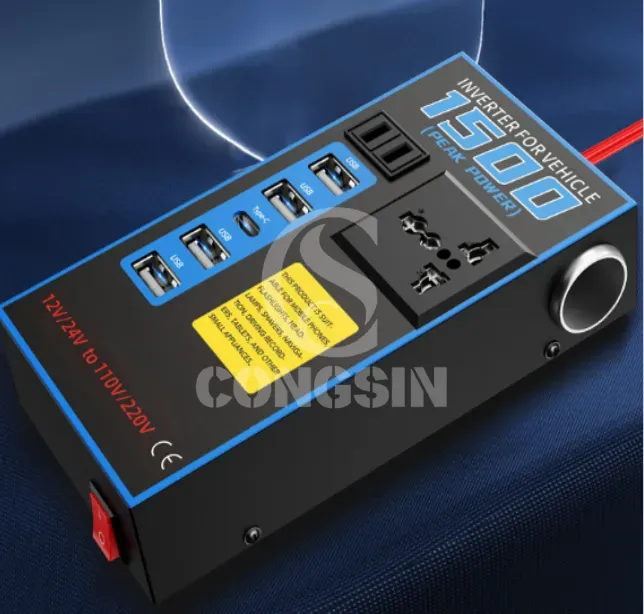
Congsin 1500W Inverter for Vehicle DC 12V/24V to AC 110V/220V with Universal socket Modified Sine Wave
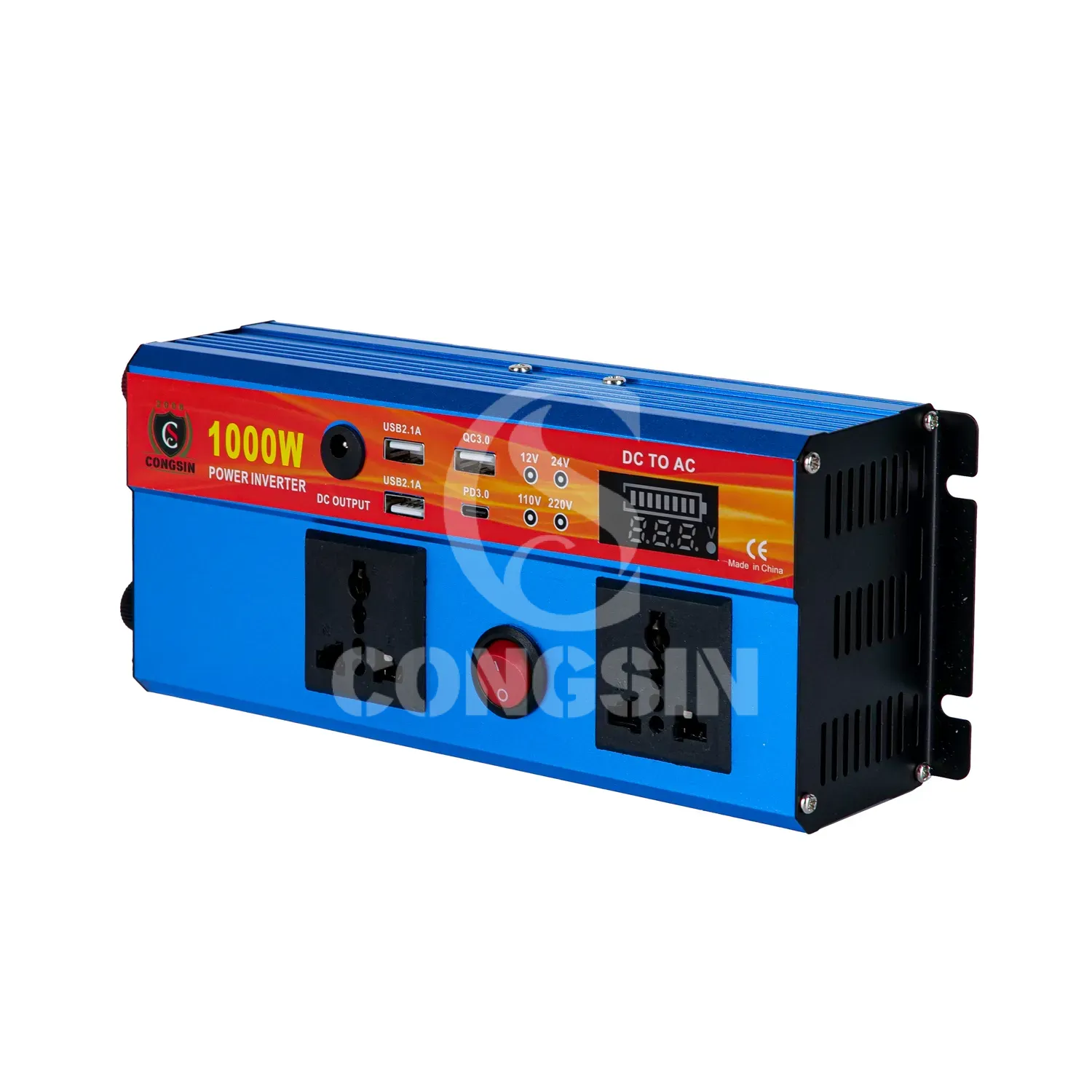
Congsin 1000W modified sine wave inverter with LED display and Type C port car RV power inverter
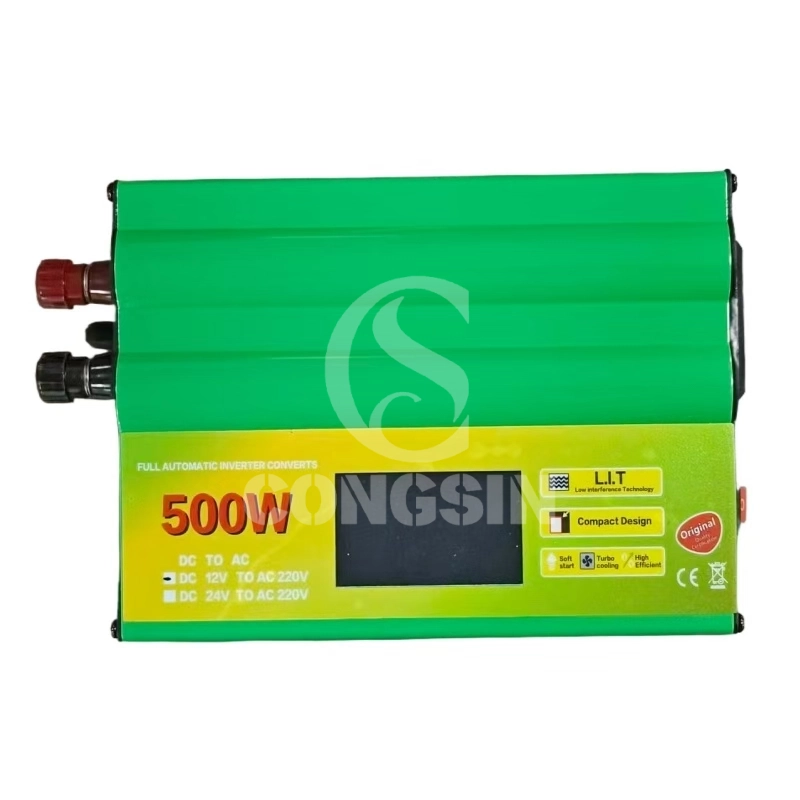
Congsin Modified Sine Wave Inverter 500W 1000W 1500W 12V LED Display Portable for RV Car Solar
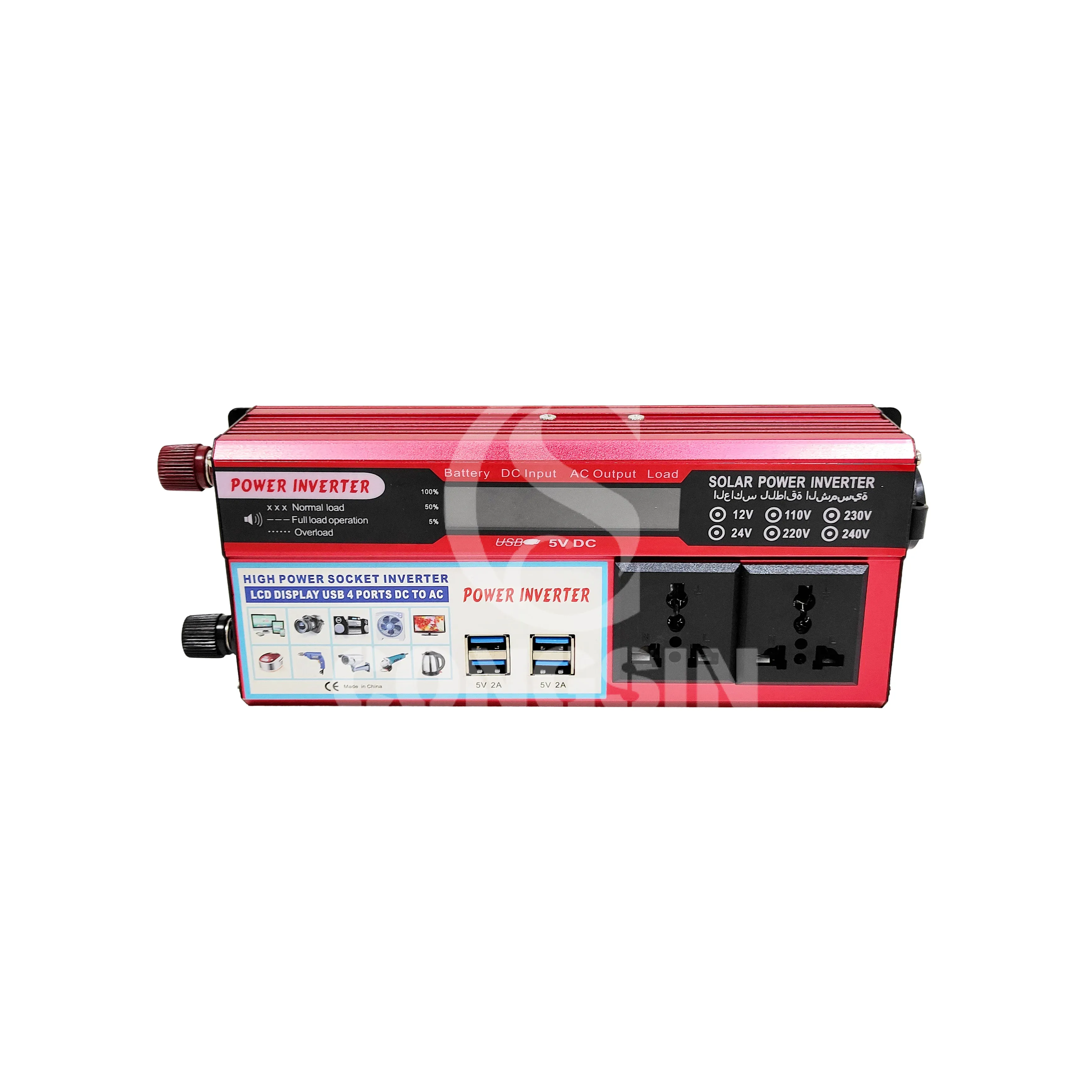
Congsin 1500W modified sine wave inverter with LCD display and USB ports for RV car boat home use

CONGSIN is a trusted OEM factory for power inverters, solar charge controllers, and DC converters. Reliable solutions for global B2B buyers.
 High Quality
 7/24 Service
 Guaranteed Warranty
© 2025 Congsin. All Rights Reserved.