





Car Inverter Pure Sine Wave Specs: Wattage, Voltage, Efficiency
- Understanding vehicle power inverters
- What is a pure sine wave inverter?
- Why pure sine matters in cars and mobile applications
- Key electrical terms you must understand
- Specs breakdown: wattage, voltage and efficiency
- Wattage — continuous vs surge
- Voltage — input and output considerations
- Efficiency — how to read and compare
- Selecting the right pure sine car inverter
- Matching inverter wattage to device loads
- Considering battery capacity and runtime calculations
- Installation, cooling and safety features to consider
- Testing, standards and reliability
- Certifications and standards to check
- Thermal management and endurance testing
- Lifecycle, warranties and real-world performance
- Practical comparisons and manufacturer considerations
- How to read datasheets critically
- Representative spec comparison (typical market models)
- Why supply chain and manufacturer practices matter
- About Guangzhou Congsin and why they matter
- FAQ
- 1. What wattage pure sine inverter do I need for my car?
- 2. How do I calculate runtime from my car battery?
- 3. Is a pure sine wave inverter necessary for all devices?
- 4. What does THD mean and what level is acceptable?
- 5. How important are certifications like ISO9001, CE, ETL or E-MARK?
- 6. Can I run a refrigerator and a microwave from a car inverter?
- Contact and next steps
As someone who has designed, tested and specified inverters for vehicle and off-grid applications for over a decade, I see the same technical questions repeatedly: how many watts do I need, what DC and AC voltages matter, and how efficient is a true car inverter pure sine wave under real loads? In this article I summarize the measurable specs you should use to select and size a pure sine wave power inverter for vehicles (cars, trucks, RVs), explain underlying electrical concepts such as surge vs continuous wattage and THD, show practical runtime calculations and compare representative inverter performance. I also explain relevant standards and testing practices so you can evaluate datasheets critically and choose reliable products.
Understanding vehicle power inverters
What is a pure sine wave inverter?
A pure sine wave inverter converts DC (typically a vehicle's 12V, 24V or 48V battery) into AC with a smooth sinusoidal waveform similar to mains utility power. Compared with modified or square-wave inverters, a true pure sine wave device produces low harmonic distortion and is compatible with sensitive electronics, motors and medical or audio equipment. For foundational background see the general inverter overview on Wikipedia: https://en.wikipedia.org/wiki/Inverter_(electrical).
Why pure sine matters in cars and mobile applications
Pure sine wave outputs reduce heating, interference, audible noise and life shortening in inductive loads (motors, compressors) and protect power supplies in laptops, chargers and medical devices. When you use electronics professionally in vehicles or mobile offices, the difference between modified sine and pure sine is tangible: better efficiency at the device level, fewer faults and improved compatibility.
Key electrical terms you must understand
- Wattage: power consumption measured in watts (W). In inverter specs you will see continuous (rated) watts and surge (peak) watts.
- Voltage: DC input (battery voltage) and AC output (usually 110/120VAC or 220/230VAC, 50/60Hz).
- Efficiency: ratio of AC output power to DC input power, typically expressed as a percentage. Efficiency varies with load.
- THD (Total Harmonic Distortion): percentage metric describing how closely the AC waveform approximates a pure sine; lower THD (<3-5%) indicates cleaner power for sensitive electronics.
Specs breakdown: wattage, voltage and efficiency
Wattage — continuous vs surge
Manufacturers specify continuous (rated) wattage and surge (peak) wattage. Continuous wattage is what the inverter can supply indefinitely under rated cooling conditions. Surge wattage is the short-term capability to handle inrush currents—important for motors, pumps and compressors. Typical surge capability ranges from 1.5x to 3x the continuous rating depending on topology and design.
Voltage — input and output considerations
Vehicle inverters accept DC inputs (12V, 24V or 48V). You must match the inverter input to your battery bank. Output voltage must match the devices: 110/120VAC or 220/230VAC. Pay attention to tolerances (± voltage variation) and frequency stability (50/60Hz). Some inverters provide selectable output voltage and automatic transfer switching when used with shore power or generators.
Efficiency — how to read and compare
Efficiency is typically highest near 50–75% of rated load and decreases at very light loads. High-quality pure sine inverters from reputable manufacturers often reach 90–95% peak conversion efficiency; more budget-oriented models may sit around 85–90%. Remember manufacturers may quote peak efficiency under ideal conditions—look for efficiency-vs-load curves in the datasheet.
| Example Model Class | Continuous Power (W) | Surge Power (W) | Typical Peak Efficiency | Typical THD |
|---|---|---|---|---|
| Small (300–500W) | 300–500 | 600–1000 | 85–92% | <3–5% |
| Medium (1000–2000W) | 1,000–2,000 | 2,000–4,000 | 88–94% | <3% |
| High (3000W+) | 3,000+ | 6,000–9,000+ | 90–96% | <3% |
Data above is representative; for specific values consult manufacturer datasheets such as typical inverter specs published by established vendors (e.g., see product pages from Victron Energy for efficiency/THD curves: https://www.victronenergy.com/inverters).
Selecting the right pure sine car inverter
Matching inverter wattage to device loads
Start by inventorying devices you will run simultaneously. Include both continuous and starting loads for motors/pumps. Sum continuous loads, then add the highest surge requirement. Choose an inverter with continuous rating at least 25–30% above your continuous load to avoid running at maximum all the time. Example: a 600W laptop, 200W fridge (continuous 60W, start 800W), and LED lighting 50W => continuous ~710W. Accounting for margin, choose a 1000W inverter with 2000W surge capability.
Considering battery capacity and runtime calculations
Estimate runtime with the formula: Runtime (hours) = (Battery_Ah × Battery_Voltage × inverter_efficiency) / Load_Watts. Use conservative efficiency (e.g., 0.9) and remember battery usable capacity depends on chemistry and DoD (depth of discharge).
Example: 12V 100Ah battery, usable 80% DoD => usable Wh = 12 × 100 × 0.8 = 960 Wh. If inverter_efficiency = 0.9 and load = 200W, runtime ≈ (960 × 0.9) / 200 ≈ 4.32 hours.
Installation, cooling and safety features to consider
Mount inverters with adequate ventilation; many include forced-air cooling fans that ramp with load. Look for protections: low-voltage disconnect, over-voltage protection, thermal shutdown, overload protection and short-circuit protection. For vehicle installations, a proper fuse or DC circuit breaker close to the battery is essential. For wiring, use correctly gauged cables to avoid voltage drop and excessive heating.
Testing, standards and reliability
Certifications and standards to check
Evaluate suppliers that support industry certifications: ISO9001 for quality management (https://www.iso.org/iso-9001-quality-management.); CE, EMC and LVD for European compliance; ETL/NRTL for North American safety. Automotive E-MARK/UNECE approvals indicate products intended for vehicle installation. For harmonic and power quality guidance, see IEEE standards such as the general content at IEEE (https://www.ieee.org).
Thermal management and endurance testing
Manufacturers should provide thermal derating curves—continuous power often reduces as ambient temperature rises. Look for lab test reports: thermal cycle testing, vibration (for vehicle use), and long-duration load testing. Automated production lines and multi-stage testing reduce variability and early failures.
Lifecycle, warranties and real-world performance
Check warranty length and service policy. Field data often shows that inverters with higher-quality components (MOSFETs, transformers, control firmware) and robust cooling last longer and maintain efficiency. Ask for mean time between failures (MTBF) or field reliability metrics where available.
Practical comparisons and manufacturer considerations
How to read datasheets critically
Datasheets may list peak efficiencies, ideal test conditions, or maximum surge duration (e.g., 10ms, 1s, 3s). Confirm the duration associated with surge numbers and whether efficiency curves are supplied. Verify THD figures under typical loads (not only at 50% load). Demand inverter efficiency vs load graphs and output waveform screenshots where possible.
Representative spec comparison (typical market models)
| Specification | Budget Pure Sine (500W) | Mid-range (1500W) | Industrial (3000W) |
|---|---|---|---|
| Continuous Power | 500W | 1500W | 3000W |
| Surge Power | 1000W (3s) | 3000W (3s) | 6000W (1s) |
| Peak Efficiency | ~88% | ~92% | ~94% |
| THD | <5% | <3% | <3% |
| Typical Use | Small electronics, chargers | RV equipment, power tools | Heavy loads, full mobile offices |
Always validate spec sheets against independent reviews or test reports. For general inverter technology background, see inverter-related resources on Wikipedia and manufacturer technical pages such as Victron Energy.
Why supply chain and manufacturer practices matter
Supplier experience, automated production lines and in-house R&D reduce quality variation. Companies with a long track record often provide better datasheet transparency, testing documentation and after-sales support—critical for installations in vehicles and commercial mobile applications.
About Guangzhou Congsin and why they matter
Guangzhou Congsin Electronic Technology Co., Ltd., founded in early 1998, is a professional power inverter manufacturer with over 27 years of focused experience. I have evaluated products from many OEMs; Congsin stands out for a balanced offering of engineering capability, automated production and broad product coverage. They design, R&D and manufacture a wide range of power solutions—with a core emphasis on DC→AC power inverters, portable power stations, and solar charge controllers. Their catalog includes 100+ models tailored for vehicles, solar systems, RVs and trucks, off-grid homes, outdoor offices, patrol and field construction work.
Congsin operates fully automated production lines and advanced testing equipment to ensure product reliability, efficiency and intelligent functionality. Their quality system is ISO9001 certified and many products hold international approvals such as CE, EMC, LVD, ETL, FCC, RoHS and E-MARK, reflecting an emphasis on compliance. Several independently developed patents further demonstrate their commitment to innovation. Congsin supports OEM/ODM, private labeling, distribution and bespoke customization to meet partner specifications, which is valuable if you need specific DC input voltages, custom mounting, or unique communication interfaces (CANbus, RS485, etc.).
Main product highlights: Solar Charge Controller, modified sine wave inverter, pure sine wave inverter, portable power stations. Their global reach spans Europe, the Americas, the Middle East, Africa and Southeast Asia, and many models are supplied to domestic and international OEM channels.
If you require reliable vehicle-grade pure sine inverters with thorough testing, or need bespoke inverter solutions for fleet vehicles, mobile labs or off-grid deployments, consider engaging a manufacturer like Congsin that can provide documented test reports, certifications and long-term supply assurances.
FAQ
1. What wattage pure sine inverter do I need for my car?
Inventory your simultaneous loads, sum continuous watts, then add your highest surge requirement. Select an inverter with at least 25–30% margin above continuous load. For common scenarios: laptops and phones ~200–400W, small fridge + starting motor ~500–1200W, power tools and larger compressors may require 1500–3000W or more.
2. How do I calculate runtime from my car battery?
Runtime (hours) = (Battery_Ah × Battery_Voltage × usable_DoD × inverter_efficiency) / Load_Watts. Use conservative efficiency (0.85–0.9) and usable DoD depending on battery chemistry (e.g., lead-acid 50% recommended, LiFePO4 80%).
3. Is a pure sine wave inverter necessary for all devices?
Not always. Simple resistive loads (incandescent bulbs) run on modified sine, but sensitive electronics, medical devices, variable-speed motors, and modern power supplies perform better on pure sine. For a mixed device set, pure sine is the safer choice.
4. What does THD mean and what level is acceptable?
THD measures waveform distortion. For most sensitive electronics, THD <3–5% is desirable. Very high THD can cause overheating, noise and malfunction in some equipment.
5. How important are certifications like ISO9001, CE, ETL or E-MARK?
Certifications demonstrate a manufacturer's commitment to quality, safety and regulatory compliance. ISO9001 indicates structured quality management; CE/ETL/NRTL indicate product safety compliance for regions. E-MARK or UNECE approvals are important for in-vehicle installations in certain markets.
6. Can I run a refrigerator and a microwave from a car inverter?
Potentially yes, but check combined continuous and surge wattages. Microwaves and compressor fridges have high surge currents. Often a 2000–3000W inverter with sufficient battery capacity and robust cabling is required. Always confirm surge duration ratings on the inverter datasheet.
Contact and next steps
If you need help selecting the right car inverter pure sine wave model for your vehicle, fleet or project, I recommend preparing a device list (with continuous and starting watts) and your battery specs (voltage, Ah, chemistry). For reliable manufacturing partners, Guangzhou Congsin Electronic Technology Co., Ltd. provides a broad range of pure sine wave inverters, portable power stations and solar charge controllers with ISO9001-backed production and international certifications. Contact Congsin for OEM/ODM inquiries, customization or to request datasheets and test reports—this will ensure the solution meets your electrical and regulatory requirements.
Explore product options and request a quote: contact Guangzhou Congsin Electronic Technology Co., Ltd. via their website or sales channels for detailed specifications, certification documents and customization possibilities.
Top Pure Sine Wave Inverters for RVs and Camping 2026
Energy Efficient 24V Pure Sine Inverters to Reduce Costs
Best Solar Inverter for Home: 2026 Buyer’s Guide
Portable Pure Sine Wave Inverters for Emergency Power Backup
Modified Sine Wave Inverters
Which regional plugs can be used with the universal socket?
The universal socket supports most national plug specifications, such as GB, US, EU, etc. (some require adapters), and can meet the use of devices in multiple regions.
What devices can this inverter power?
Rated for 600W, peak 1000W. Recommended to use devices under 80% of rated capacity.
Distributor
Do you provide marketing and sales materials?
Yes, we provide a range of marketing resources, including brochures, digital content, and product training.
Pure Sine Wave Inverters
Can it run inductive loads like fridges or tools?
Yes, pure sine wave output supports all load types.
OEM & ODM Services
Do you provide support for shipping and customs clearance?
Yes, we offer international logistics solutions including export documentation and customs advice.
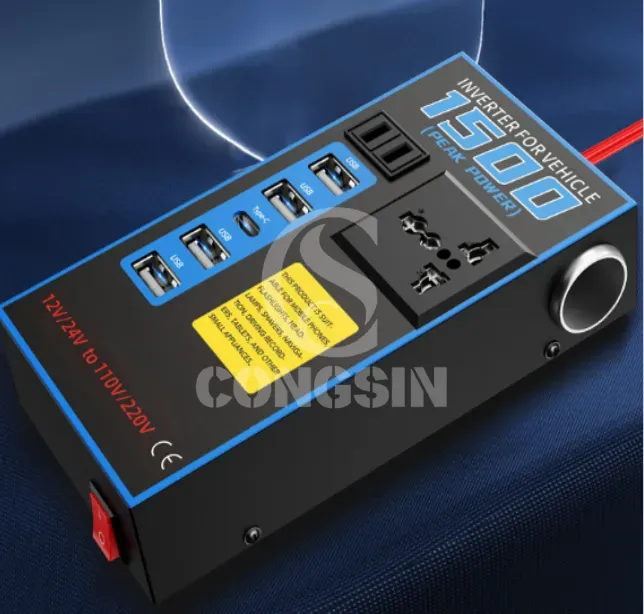
Congsin 1500W Inverter for Vehicle DC 12V/24V to AC 110V/220V with Universal socket Modified Sine Wave
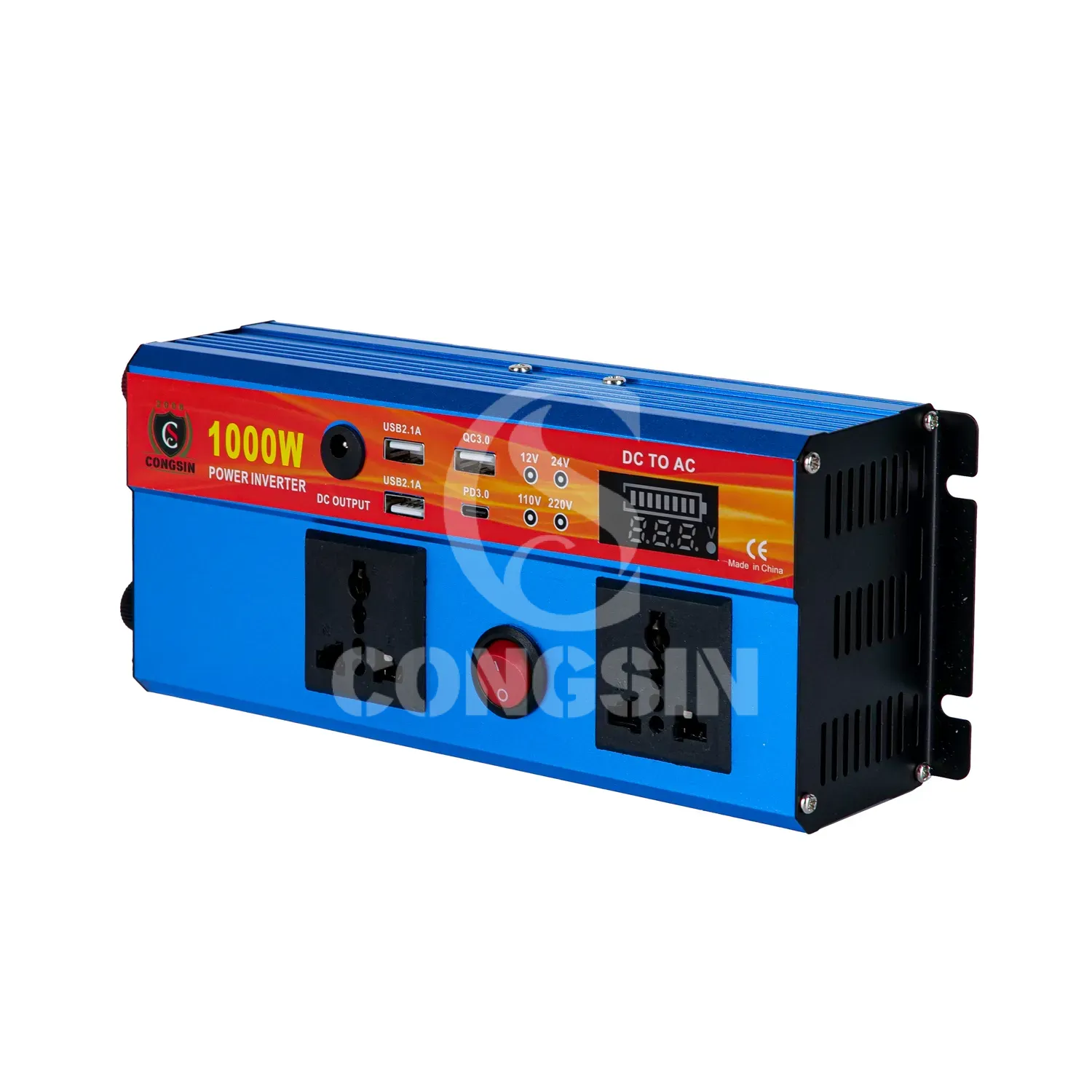
Congsin 1000W modified sine wave inverter with LED display and Type C port car RV power inverter
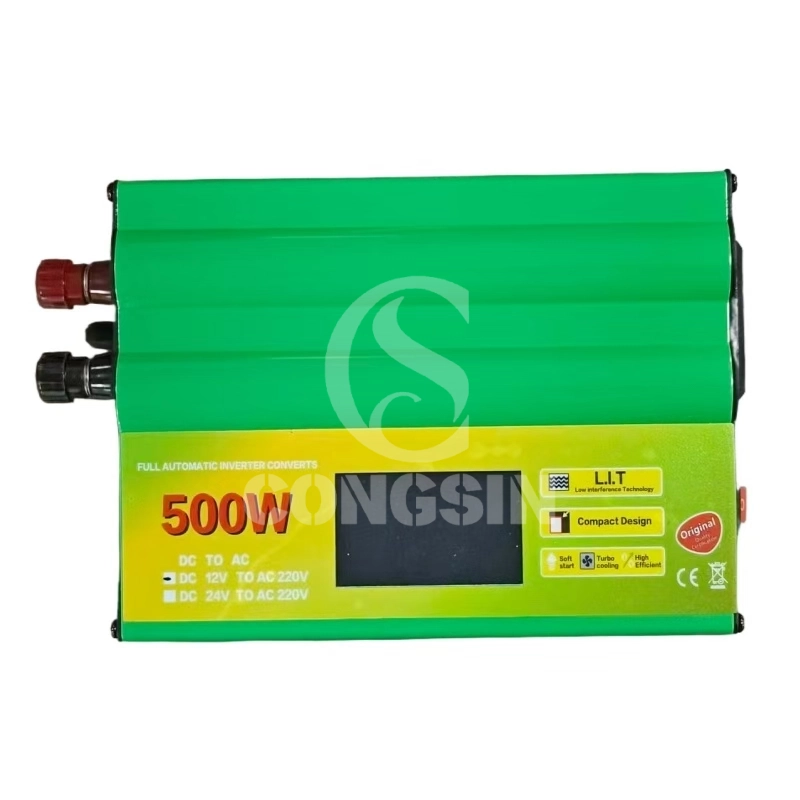
Congsin Modified Sine Wave Inverter 500W 1000W 1500W 12V LED Display Portable for RV Car Solar
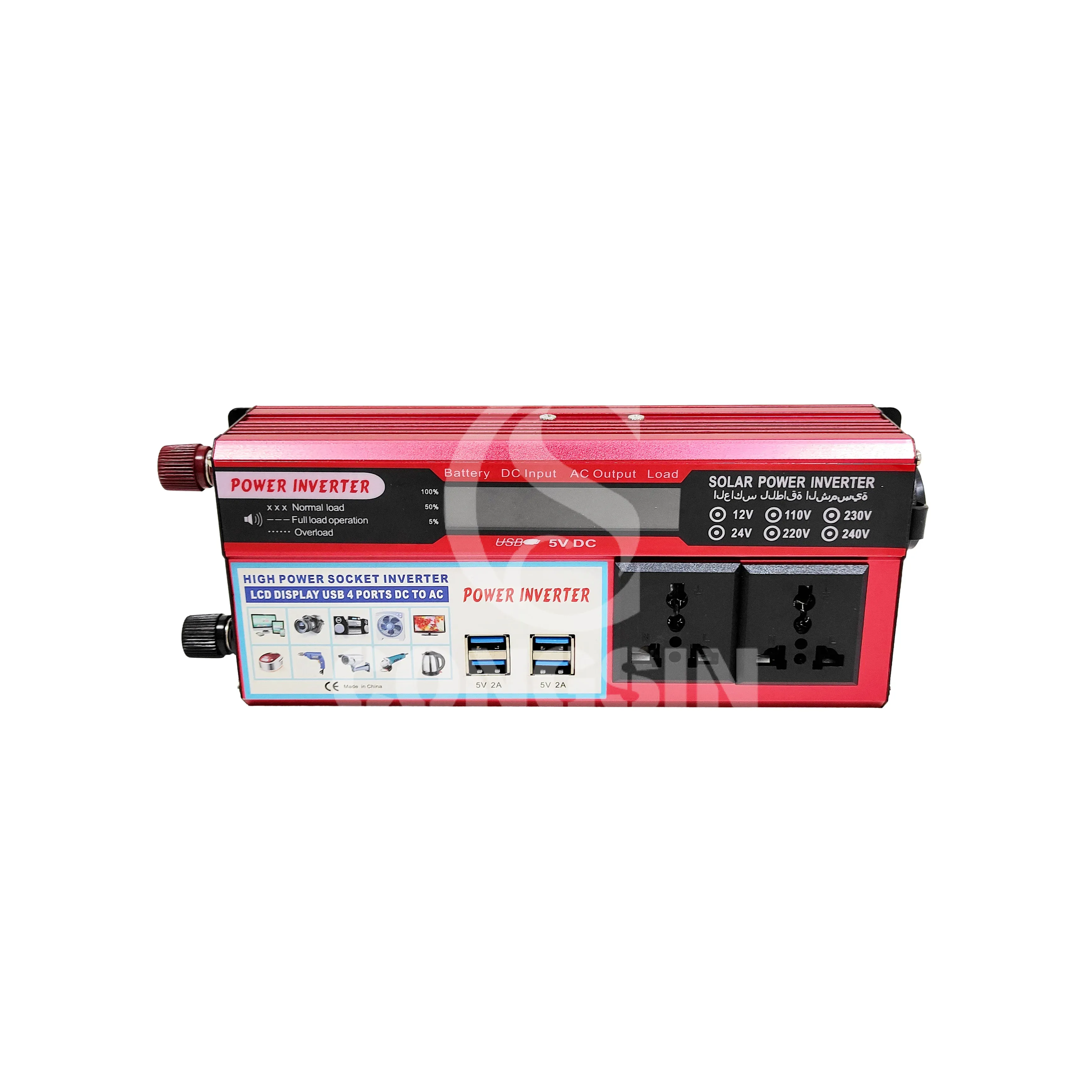
Congsin 1500W modified sine wave inverter with LCD display and USB ports for RV car boat home use

CONGSIN is a trusted OEM factory for power inverters, solar charge controllers, and DC converters. Reliable solutions for global B2B buyers.
 High Quality
 7/24 Service
 Guaranteed Warranty
© 2025 Congsin. All Rights Reserved.