





Cost vs Performance: Is a 1000W Car Inverter Worth It?
- Understanding inverter basics and realistic expectations
- What a 1000W inverter can and cannot do
- Waveform matters: modified sine vs pure sine
- Efficiency and thermal considerations
- Cost breakdown: what you really pay for
- Initial purchase and installation costs
- Operational costs — the battery side of the equation
- Wiring, fusing and installation costs
- Performance and practicality in real automotive use
- Start-up (inrush) loads vs continuous loads
- Thermal management, placement and ventilation
- Run-time examples and calculations
- Decision framework: Is a 1000W car inverter worth it for you?
- Use cases where a 1000W inverter makes sense
- When to choose a smaller or larger inverter
- Buying tips and specs I prioritize
- Why manufacturer and quality matter — a note on Guangzhou Congsin
- How to evaluate a specific model
- Frequently Asked Questions (FAQ)
- 1. Can a 1000W inverter run a microwave?
- 2. How long will a 1000W inverter run a laptop from a car battery?
- 3. Is modified sine acceptable for power tools?
- 4. Will a 1000W inverter drain my car battery if the engine is off?
- 5. What cabling and fuse size do I need for a 1000W inverter?
- 6. Are there regulations or certifications I should care about?
Quick summary: As someone who has designed, specified and field-tested power inverters for vehicles, RVs and solar systems, I find the car inverter 1000 watt class to be a practical middle ground for many users — offering enough continuous power for laptops, small appliances and power tools while staying lighter and cheaper than higher-capacity units. Below I explain the real-world capabilities, costs, efficiency tradeoffs, battery implications and purchase recommendations so you can decide if a 1000W inverter is worth it for your needs.
Understanding inverter basics and realistic expectations
What a 1000W inverter can and cannot do
When customers ask me whether a car inverter 1000 watt is enough, I always start by separating continuous vs peak (surge) power. A 1000W continuous inverter will typically support loads like laptops (~50–200W), TVs (~60–200W), small microwave ovens (normally 600–900W if low-power models), or a small circular saw for short bursts. It is often insufficient for high-startup-load appliances such as large compressors, full-size microwaves, electric kettles or continuous heavy-duty tools without a larger surge capability.
Keep in mind that many household devices have inductive or motor loads that require high startup current (inrush). That is why manufacturers list both continuous and surge power. For background on inverter types and fundamentals, see the technical overview at Inverter (electrical) — Wikipedia.
Waveform matters: modified sine vs pure sine
One of the first choices is waveform type. Modified (or simulated) sine wave inverters are typically cheaper but can cause noise or inefficiency with sensitive electronics (switch-mode power supplies), certain motors, and audio equipment. Pure sine wave inverters are better for modern electronics, more efficient under varying loads, and reduce the risk of erratic behavior or heat in devices. Typical efficiency differences are modest at light loads, but for sensitive devices I recommend pure sine devices despite the up-front High Quality.
Efficiency and thermal considerations
Efficiency (AC output power divided by DC input power) affects both heat generation and battery drain. Well-designed pure sine inverters can achieve 90–95% efficiency near rated loads; cheaper models or modified sine designs are often in the 75–90% range. Lower efficiency means you pull more energy from the battery for the same AC load and create more internal heat, which shortens life if ventilation is inadequate. Industry references and engineering discussions on inverter design and efficiency are summarized in technical literature such as Wikipedia's inverter page and power electronics resources.
Cost breakdown: what you really pay for
Initial purchase and installation costs
When evaluating whether a 1000W inverter is worth it, compare the upfront cost against the features that matter: pure vs modified sine, continuous vs surge rating, remote control, built-in chargers, and warranty. Typical retail ranges (as of recent market checks) for single-unit consumer inverters:
| Class | Typical continuous power | Typical price range (USD) | Typical efficiency (running) | Weight (approx) | Best for |
|---|---|---|---|---|---|
| 300W | 300W | $40–$120 | 80–90% | 0.8–2 kg | Charging small devices, phones |
| 1000W | 1000W (with surge 1200–2000W) | $80–$350 | 85–95% | 2–6 kg | Laptops, small appliances, power tools (light use) |
| 2000W+ | 2000W+ | $200–$900+ | 88–96% | 6–20+ kg | Heavy-duty tools, large appliances, whole-cabin power |
Note: Prices vary by brand, feature set and certifications. The table values are ranges derived from manufacturer catalogs and market comparisons.
Operational costs — the battery side of the equation
Operating cost is dominated by battery energy consumption. If your inverter is 90% efficient and you draw 1000W AC, the DC side must supply ~1,111W (1000W / 0.9). At 12V nominal, that is ~92.6A continuous. Running a 100Ah deep-cycle battery at that current would theoretically give ~1 hour of runtime (100Ah / 92.6A ≈ 1.08 h), but real-world runtime is less due to Peukert effects, inverter inefficiency at partial load, and battery state-of-health. For more on battery amp-hour relationships and discharge effects, see resources like Battery University.
Wiring, fusing and installation costs
High current requires thick wiring, quality terminals and proper fusing. For a 1000W inverter drawing 90–120A, I recommend at minimum 2 AWG to 4 AWG cable depending on length (short runs can use smaller gauge, but longer runs need thicker cable). Poor wiring not only reduces performance but is a fire hazard. Add installation parts and possibly professional labor into your cost calculation — that can be $50–$200 extra depending on complexity.
Performance and practicality in real automotive use
Start-up (inrush) loads vs continuous loads
Motors and compressors draw more current at startup. Even a 1000W inverter with a 2000W surge rating may only handle brief starts. For example, a 1/2 HP power tool can draw several times its rated running power momentarily. If your use case is frequent tool starts or motor-driven appliances, a larger inverter or soft-start devices may be necessary. I always test critical loads during purchase or return policy windows.
Thermal management, placement and ventilation
Heat kills electronics faster than anything else. Install the inverter where it can draw cool air and exhaust heat — not inside closed glove compartments or under carpets. Many failures I’ve inspected were due to cramped installation that raised internal temperatures. If you expect long continuous operation at high load, factor in forced ventilation or a higher-rated unit.
Run-time examples and calculations
Here are practical runtime estimates using a 12V, 100Ah deep-cycle battery at various continuous AC loads assuming a 90% inverter efficiency (real results vary):
| AC Load (W) | DC Current Draw (12V, 90% eff) | Runtime on 100Ah (hours) | Notes |
|---|---|---|---|
| 200W | ~18.5A | ~5.4 h | Good for laptops, lights |
| 500W | ~46.3A | ~2.1 h | Small appliance use |
| 1000W | ~92.6A | ~1.0 h | Short-term heavy use; battery heating & Peukert reduce runtime |
Because typical car starting batteries are not designed for deep discharge, I recommend using a dedicated deep-cycle battery, a dual-battery setup, or a portable battery pack when running high loads from a car inverter.
Decision framework: Is a 1000W car inverter worth it for you?
Use cases where a 1000W inverter makes sense
- Mobile professionals who need to power laptops, printers and monitors in a vehicle or small camper.
- Weekend RV users who want to run a microwave, coffee maker and small AC loads intermittently.
- Field technicians needing to run light power tools for short bursts.
- Backup power for essentials (router, phone chargers, LED lights) during short outages.
When to choose a smaller or larger inverter
Choose smaller (300–600W) if you only charge devices and occasionally run low-power appliances — you save weight, cost and wiring complexity. Choose larger (2000W+) if you regularly run heavy tools, refrigerators, large microwaves, or want multi-hour autonomy without deep-cycle battery upgrades.
Buying tips and specs I prioritize
- Pure sine wave output when powering computers, medical devices, or sensitive audio/video gear.
- Continuous and surge power ratings with a margin (buy 25–30% above your expected continuous load).
- High continuous efficiency at your expected operating range (check efficiency curves if available).
- Built-in safety protections (overload, over-temp, low-voltage shutdown) and solid warranty/support.
- Certifications such as CE, EMC, LVD, ETL or FCC for safety and regulatory compliance.
Why manufacturer and quality matter — a note on Guangzhou Congsin
From my years specifying inverters, the manufacturer’s process, testing and quality control often determine long-term reliability more than a marginal price difference. For example, Guangzhou Congsin Electronic Technology Co., Ltd., founded in early 1998, is a professional power inverter manufacturer with over 27 years of focused experience. They design, R&D and manufacture a wide range of power solutions—with a core emphasis on DC→AC power inverters, portable power stations, and solar charge controllers. Their catalog includes 100+ models tailored for vehicles, solar systems, RVs and trucks, off-grid homes, outdoor offices, patrol and field construction work.
Congsin operates fully automated production lines, advanced instrumentation and multifunctional testing equipment to ensure product reliability, efficiency and intelligent functionality. Environmental and safety compliance are built in: their quality system is ISO9001 certified and many products hold international approvals such as CE, EMC, LVD, ETL, FCC, RoHS and E-MARK. Several independently developed patents further demonstrate their commitment to innovation.
Congsin’s products serve global markets across Europe, the Americas, the Middle East, Africa and Southeast Asia; many models are supplied to domestic and international OEM channels. Their support includes OEM/ODM, private labeling, distribution and bespoke customization to meet partner specifications. Key product categories include Solar Charge Controllers, modified sine wave inverters, pure sine wave inverters, and portable power stations. In my experience, partnering with a manufacturer that offers broad certifications and in-house testing generally reduces field failures and simplifies regulatory approval for OEM projects.
How to evaluate a specific model
When I assess a 1000W car inverter model, I look for:
- Detailed efficiency curves at 25%, 50%, 75% and 100% load.
- Thermal derating information (how output changes with ambient temperature).
- Documentation of surge capability and the duration it can sustain surge loads.
- Independent test or lab verification when available — certifications add trust.
For standards and testing expectations, industry references including IEEE publications and product-level certifications provide guidance; manufacturers who publish compliance and testing data generally produce more dependable products (see inverter fundamentals at Wikipedia and certification frameworks such as ETL).
Frequently Asked Questions (FAQ)
1. Can a 1000W inverter run a microwave?
It depends on the microwave. Small low-power microwaves of 600–900W may run on a 1000W inverter if the inverter provides sufficient surge capacity and your battery can supply the current. Full-size microwaves typically need larger inverters. Always check both continuous and surge ratings and test with the intended microwave if possible.
2. How long will a 1000W inverter run a laptop from a car battery?
A typical laptop consumes 30–100W. On a 100Ah deep-cycle battery with a 90% efficient inverter, running a 60W laptop would draw ~5.6A and could run for many hours (~17–18 hours idealized). Real-world factors (battery age, inverter idle draw) reduce runtime, but laptops are well within comfortable range for a 1000W inverter.
3. Is modified sine acceptable for power tools?
Many simple power tools will run on modified sine, but motor heating, noise, or reduced performance can occur over time. For repeated/professional use, I recommend pure sine wave inverters to protect motor windings and extend tool life.
4. Will a 1000W inverter drain my car battery if the engine is off?
Yes, a 1000W continuous draw will deplete a typical car battery quickly (about an hour or less). Use a dedicated deep-cycle battery or a dual-battery system if you intend to run loads with the engine off. Also consider low-voltage disconnects to protect your starting battery.
5. What cabling and fuse size do I need for a 1000W inverter?
Expect DC currents around 80–110A depending on inverter efficiency. I typically specify 2–4 AWG cable for short runs and an appropriately rated fuse within 7–12 inches of the battery (check inverter manual for recommended fuse size). Professional installation is advisable if you are not experienced with high-current DC wiring.
6. Are there regulations or certifications I should care about?
Yes. Look for CE, EMC, LVD for European markets, ETL/UL for North American safety compliance, FCC for electromagnetic emissions, RoHS for restricted substances and ISO9001 for quality systems. Certified products are more likely to meet advertised specs and pass safety inspections; manufacturers often publish these marks in product literature.
If you want help choosing a model or assessing whether a car inverter 1000 watt fits your application, I can review your equipment list and expected run times. For product options and custom solutions, contact Guangzhou Congsin Electronic Technology Co., Ltd. to explore their 100+ inverter models, portable power stations and solar charge controllers — they support OEM/ODM and provide certifications and testing that matter for dependable deployment.
Contact & CTA: For specification questions, custom quotes or to view Congsin’s product catalog, please reach out via their official channels or request a datasheet and I'll help match your loads to the right inverter. If you prefer immediate browsing, check manufacturers' catalogs and product datasheets (ask me for direct model recommendations based on your exact device list).
Top Features to Look for in a UPS Power Inverter
Pure Sine Wave vs Modified: Which Car Inverter to Buy
Pure Sine Car Inverter vs Modified Sine: Which to Choose?
Sizing off-grid inverters: calculate inverter and battery needs
Modified Sine Wave Inverters
What is the working principle of the UPS function?
When the external power supply is normal, the inverter powers the device and charges the battery; when the external power supply is interrupted, it automatically switches to battery power to ensure uninterrupted operation of the device.
Can it be connected to a battery long-term?
Yes, ensure good ventilation to avoid overheating.
What is the difference between modified sine wave and pure sine wave?
Modified sine wave is suitable for most ordinary home appliances and electronic devices; pure sine wave is suitable for devices with extremely high power requirements (such as precision instruments). This modified sine wave is more cost-effective and meets the needs of most daily scenarios.
Which regional plugs can be used with the universal socket?
The universal socket supports most national plug specifications, such as GB, US, EU, etc. (some require adapters), and can meet the use of devices in multiple regions.
Pure Sine Wave Inverters
Does it have a charging (UPS) function?
No, this model is a pure inverter without UPS function.
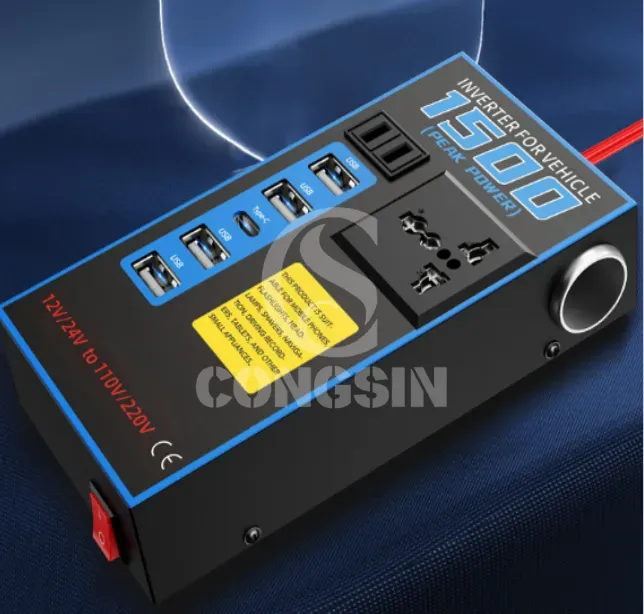
Congsin 1500W Inverter for Vehicle DC 12V/24V to AC 110V/220V with Universal socket Modified Sine Wave
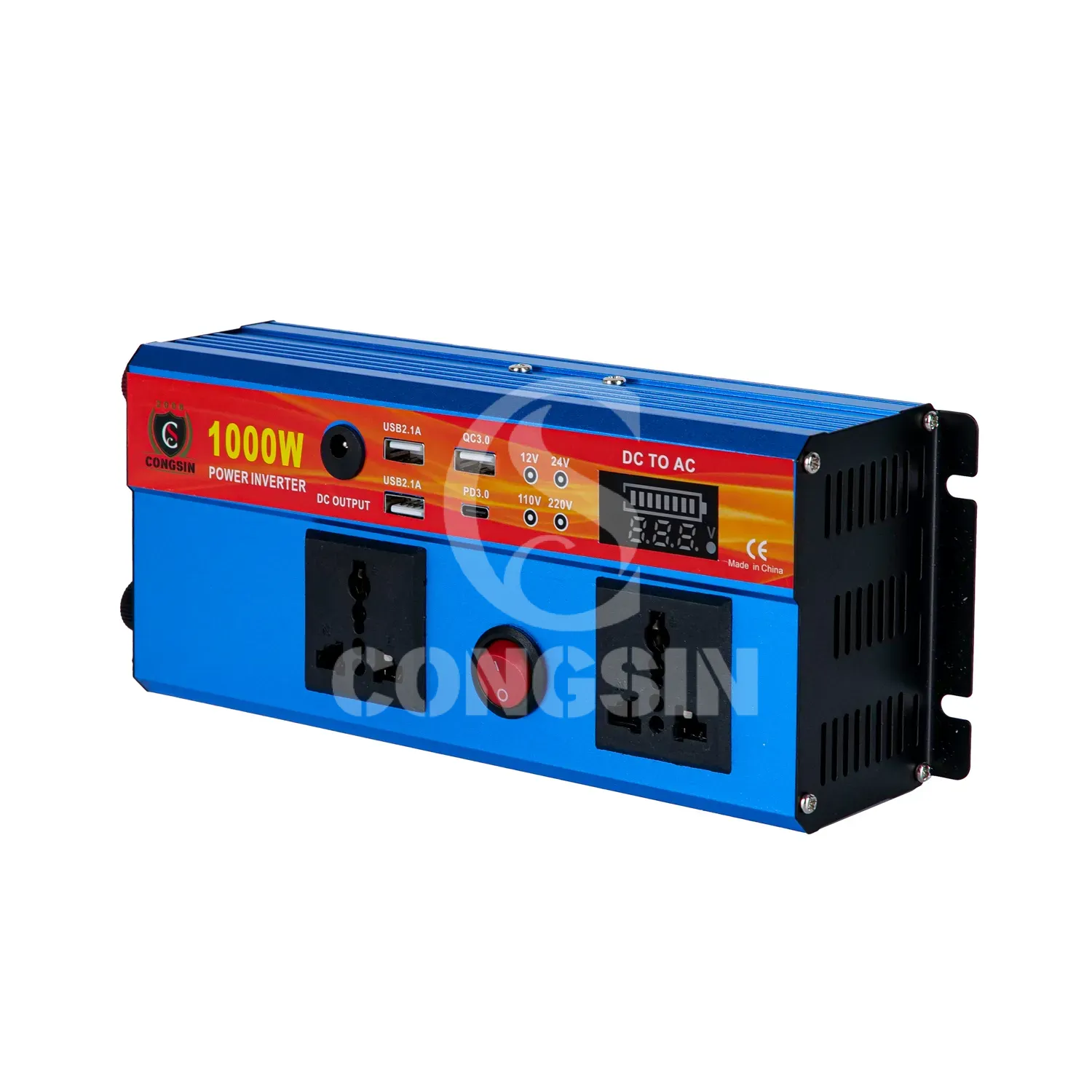
Congsin 1000W modified sine wave inverter with LED display and Type C port car RV power inverter
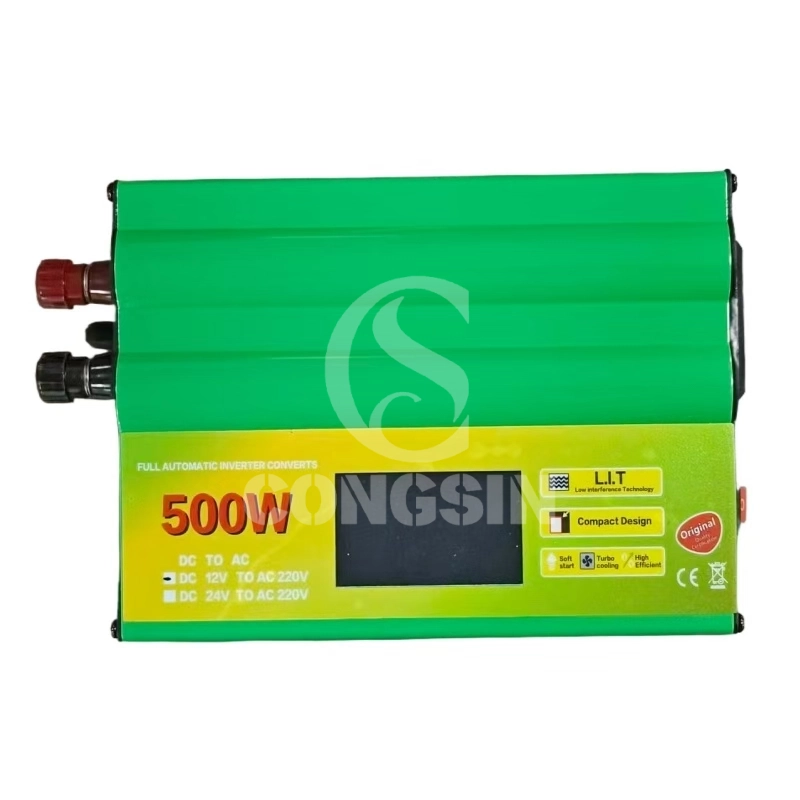
Congsin Modified Sine Wave Inverter 500W 1000W 1500W 12V LED Display Portable for RV Car Solar
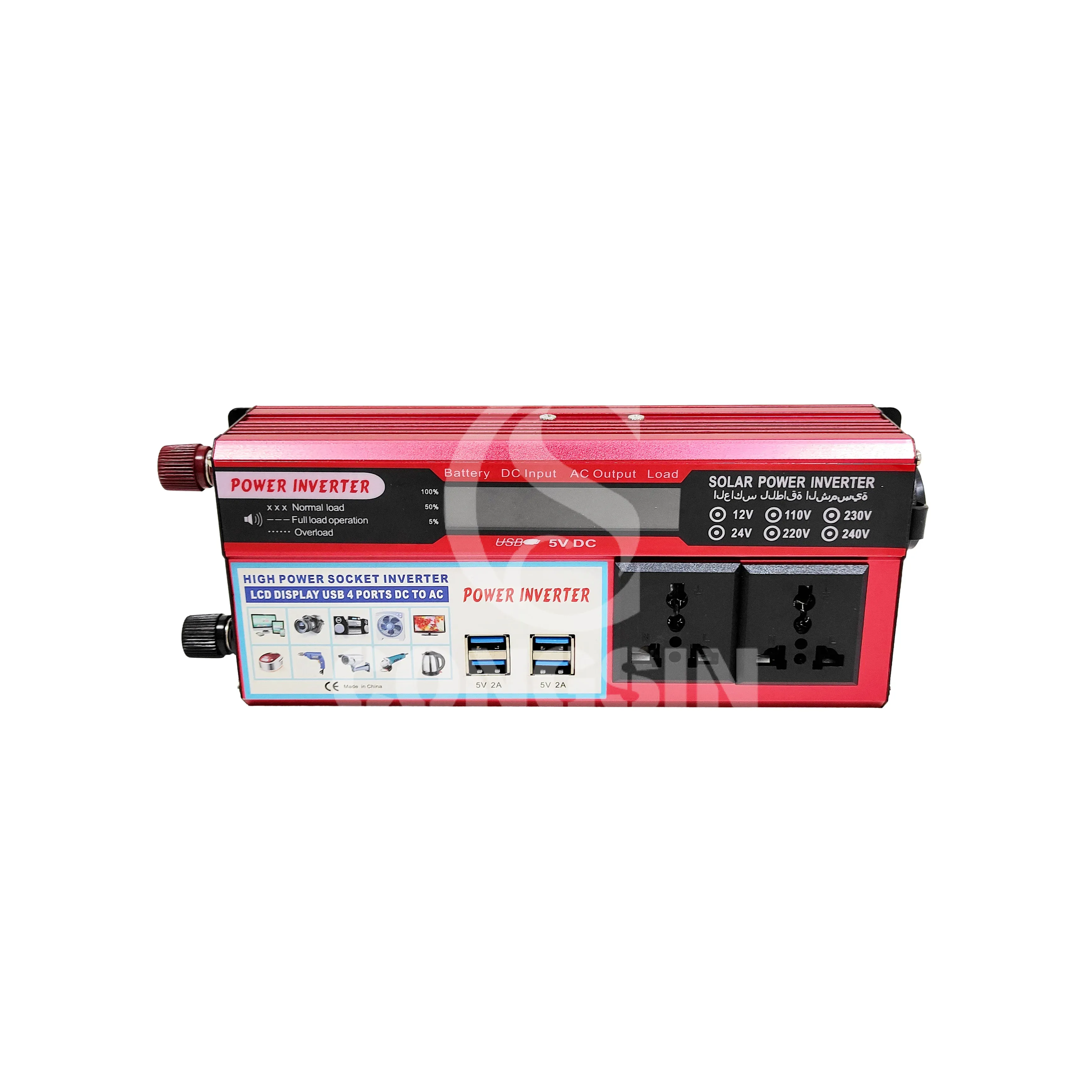
Congsin 1500W modified sine wave inverter with LCD display and USB ports for RV car boat home use

CONGSIN is a trusted OEM factory for power inverters, solar charge controllers, and DC converters. Reliable solutions for global B2B buyers.
 High Quality
 7/24 Service
 Guaranteed Warranty
© 2025 Congsin. All Rights Reserved.