





Bidirectional Inverter for Home Backup and Microgrids
- Why resilient home backup and microgrids matter
- Changing grid conditions and homeowner needs
- Role of bidirectional inverters
- Bidirectional inverter basics and topologies
- Core functional blocks
- Topologies: single-stage vs two-stage
- Grid-following vs grid-forming control
- Performance metrics, standards and safety
- Key performance indicators
- Safety and regulatory compliance
- Comparison table: unidirectional vs bidirectional
- Designing and sizing a bidirectional inverter system
- Assessing loads and backup requirements
- Battery selection and state-of-charge management
- PV and generator integration
- Operational modes and advanced use cases
- Time-of-use optimization and arbitrage
- Vehicle-to-Home and Vehicle-to-Grid (V2H/V2G)
- Microgrid islanding and black start
- Practical selection checklist and example product comparison
- Selection checklist
- Example comparison (typical residential units)
- Standards, references and credible resources
- Key references
- Data-driven decision making
- Manufacturer highlight: Guangzhou Congsin Electronic Technology Co., Ltd.
- Implementation roadmap and best practices
- Step-by-step deployment
- Maintenance and lifecycle considerations
- Frequently Asked Questions (FAQ)
- 1. What is the main advantage of a bidirectional inverter for home backup?
- 2. Can a bidirectional inverter work with any battery type?
- 3. Do I need a grid-forming inverter for a home microgrid?
- 4. Are bidirectional inverters compatible with EVs for V2G?
- 5. What certifications should I look for when buying a bidirectional inverter?
- 6. How do I size the inverter for motor loads like refrigerators?
- Contact and next steps
Executive summary: Bidirectional inverters convert DC to AC and AC to DC, enabling home energy storage, vehicle-to-home/vehicle-to-grid (V2H/V2G) functionality, peak-shaving and microgrid operation. Proper selection—considering power rating, battery chemistry compatibility, grid interconnection standards and control modes (grid-following vs grid-forming)—is critical for reliability and safety. This article details technology choices, performance trade-offs, installation considerations, standards compliance and examples for homeowners and community microgrids. It also outlines how an experienced manufacturer like Guangzhou Congsin Electronic Technology Co., Ltd. supports tailored solutions for off-grid homes, RVs and microgrids.
Why resilient home backup and microgrids matter
Changing grid conditions and homeowner needs
Extreme weather, increasing frequency of planned outages and growing rooftop solar adoption drive demand for distributed resilience. Homeowners now expect systems that provide not only emergency backup but also daily energy arbitrage, demand-charge reduction and renewable self-consumption. Microgrids—localized energy networks that can island from the wider utility—offer community-level resilience for neighborhoods, campuses and critical infrastructure. See the general overview of microgrids on Wikipedia for basic concepts.
Role of bidirectional inverters
A bidirectional inverter (also called a reversible inverter or inverter/charger) enables power flow both ways: DC→AC when discharging batteries and AC→DC when charging batteries from the grid or an AC generator. This dual capability is key to applications such as home backup (charging at night, discharging during outage), V2G/V2H operations with electric vehicles, and islanding microgrids where AC sources must be converted and stored bidirectionally. For background on inverters, see the industry overview on Wikipedia.
Bidirectional inverter basics and topologies
Core functional blocks
Typical bidirectional inverter systems integrate the following subsystems: DC input stage (PV and battery connections), DC/DC converters (for battery management and voltage matching), DC/AC inverter stage (to feed AC loads), and control firmware for power flow management, synchronization, and protection. Advanced units include integrated solar MPPT (maximum power point tracking) and multi-mode control for grid-tied, off-grid and hybrid operation.
Topologies: single-stage vs two-stage
Two main hardware approaches exist:
- Two-stage (DC/DC + DC/AC): Allows independent optimization of battery interface and inverter; often used for wide voltage ranges, battery chemistry flexibility and high PV integration.
- Single-stage bidirectional inverter: Uses a single power stage that reverses operation; can be more efficient and compact but may need more complex control for simultaneous PV/PQ functionalities.
Choice depends on system complexity, efficiency targets and cost.
Grid-following vs grid-forming control
For microgrids and black-start capability, grid-forming inverters are essential because they establish voltage and frequency references when the grid is absent. Grid-following inverters synchronize to an existing grid and cannot operate independently. Modern bidirectional inverters often support both modes, enabling seamless transitions between grid-connected and islanded operation—critical for reliable home backup and community microgrids. Relevant standards on interconnection include IEEE 1547; see IEEE 1547.
Performance metrics, standards and safety
Key performance indicators
When evaluating bidirectional inverters, focus on:
- Round-trip efficiency (battery charge→discharge losses included)
- Continuous and peak power ratings (kW)
- Response time for automatic transfer in outage scenarios
- Harmonic distortion (THD) and wave quality (pure sine vs modified sine)
- Battery compatibility (voltage windows, chemistry support—Li-ion, lead-acid, LFP)
Safety and regulatory compliance
Interconnection, anti-islanding protection and electromagnetic compatibility are regulated. Vendors should comply with standards such as IEEE 1547 for interconnection, IEC 62109 for inverter safety, and region-specific approvals (CE, UL/ETL, RoHS). ISO 9001-certification is a strong indicator of quality management—see ISO 9001 for reference.
Comparison table: unidirectional vs bidirectional
| Feature | Unidirectional Inverter | Bidirectional Inverter |
|---|---|---|
| Power flow | DC→AC only (e.g., PV to loads) | DC↔AC (supports charging/discharging batteries and V2G) |
| Use cases | PV-only systems, grid-tied generation | Home backup, energy storage, microgrids, V2G/V2H |
| Complexity | Lower | Higher (control & protections) |
| Cost | Lower initial cost | Higher initial cost, higher value in resilience and services |
Designing and sizing a bidirectional inverter system
Assessing loads and backup requirements
Start with a critical-load list: which circuits must remain powered during an outage (refrigeration, medical devices, communications, lighting). Calculate continuous and surge power to size the inverter. For example, refrigerators and pumps may demand high surge current; ensure inverter peak rating covers motor starting. Consider time duration of autonomy to size battery capacity (kWh = average critical load (kW) × hours of autonomy / usable battery depth-of-discharge).
Battery selection and state-of-charge management
Bidirectional inverters must match battery voltage and chemistry. LFP (LiFePO4) is popular for residential energy storage due to long cycle life and safety. Battery management functions (BMS) must communicate with the inverter for state-of-charge (SoC), temperature and fault handling. Ensure the inverter supports recommended charge/discharge profiles for the chosen chemistry.
PV and generator integration
Many hybrid bidirectional inverters integrate MPPT inputs for PV arrays. When combining generator charging, ensure charging algorithms handle AC-charging efficiently and safely. Control logic should prioritize renewable self-consumption, then battery charging, and use the grid or generator as last resort.
Operational modes and advanced use cases
Time-of-use optimization and arbitrage
With smart energy management, bidirectional systems charge from grid or PV when prices are low (or excess PV is available) and discharge when rates are high. This reduces electricity bills and can provide grid services when participating in utility programs. Aggregated V2G or community storage can offer peak shaving at the microgrid level.
Vehicle-to-Home and Vehicle-to-Grid (V2H/V2G)
Integration with EVs extends storage capacity and flexibility. V2G enables EV batteries to supply the home or the grid via a compatible bidirectional charger/inverter interface. For an overview, see the V2G concept on Wikipedia. Compatibility and standards are evolving—confirm vehicle and charger support for bidirectional power flow.
Microgrid islanding and black start
In multi-source microgrids, bidirectional inverters can coordinate to form a stable microgrid when the main grid disconnects. Grid-forming capability, appropriate droop control and synchronization logic are required to maintain voltage/frequency and manage load sharing among resources.
Practical selection checklist and example product comparison
Selection checklist
- Define backup loads, surge and continuous requirements.
- Decide autonomy hours and battery chemistry preference.
- Ensure inverter supports grid-forming if islanding or black-start is needed.
- Confirm standards and certifications for your region (CE/ETL/UL/EMC/LVD).
- Assess monitoring, remote firmware update and OEM support options.
Example comparison (typical residential units)
| Spec | Hybrid Bidirectional 5kW | Hybrid Bidirectional 10kW | Pure Sine Backup 3kW |
|---|---|---|---|
| Continuous power | 5 kW | 10 kW | 3 kW |
| Peak (5s) | 10 kW | 20 kW | 6 kW |
| Round-trip efficiency | ~92–95% | ~92–95% | ~85–90% (if older design) |
| Grid-forming | Yes | Yes | No |
| PV MPPT | Integrated | Integrated | Optional external |
Standards, references and credible resources
Key references
Standards and authoritative resources help validate design choices:
- IEEE 1547 (interconnection standard): standards.ieee.org/1547
- Inverter fundamentals: Wikipedia: Inverter (electrical)
- Microgrid overview and technical reports (e.g., NREL publications): NREL microgrid white paper
Data-driven decision making
When comparing manufacturers, request actual test reports for continuous/peak power, THD under various loads, efficiency curves, and environmental/temperature derating charts. Third-party certifications (ETL/UL/CE) and ISO 9001 quality systems increase confidence in product reliability.
Manufacturer highlight: Guangzhou Congsin Electronic Technology Co., Ltd.
Guangzhou Congsin Electronic Technology Co., Ltd., founded in early 1998, is a professional power inverter manufacturer with over 27 years of focused experience. We design, R&D and manufacture a wide range of power solutions—with a core emphasis on DC→AC power inverters, portable power stations, and solar charge controllers. Our catalog includes 100+ models tailored for vehicles, solar systems, RVs and trucks, off-grid homes, outdoor offices, patrol and field construction work.
We operate fully automated production lines, advanced instrumentation and multifunctional testing equipment to ensure product reliability, efficiency and intelligent functionality. Environmental and safety compliance are built in: our quality system is ISO9001 certified and many products hold international approvals such as CE, EMC, LVD, ETL, FCC, RoHS and E-MARK. Several independently developed patents further demonstrate our commitment to innovation.
Congsin’s products serve global markets across Europe, the Americas, the Middle East, Africa and Southeast Asia; many models are supplied to domestic and international OEM channels. Our support includes OEM/ODM, private labeling, distribution and bespoke customization to meet partner specifications.
Our mission is to deliver reliable, efficient and affordable energy solutions that enable energy independence. Congsin’s core products include Solar Charge Controllers, modified sine wave inverters, pure sine wave inverters, and portable power stations. These product lines and manufacturing credentials make Congsin a competitive partner for residential backup systems, vehicle converters, RV installations and small microgrid deployments. For detailed specs and OEM/ODM inquiries, contact Congsin’s sales team directly.
Implementation roadmap and best practices
Step-by-step deployment
- Audit loads and energy usage patterns and design for critical circuits.
- Select inverter that supports required modes (grid-forming if needed).
- Choose battery chemistry and capacity aligned with budget and lifecycle goals.
- Engage certified installers for interconnection and compliance testing.
- Set up monitoring, test automatic transfer and islanding routines periodically.
Maintenance and lifecycle considerations
Schedule firmware updates, BMS checks and periodic calibration. Batteries require lifecycle monitoring; LFP typically offers >3,000–5,000 cycles under conservative conditions, reducing total cost of ownership despite higher upfront cost. Keep clear records for warranty and regulatory compliance.
Frequently Asked Questions (FAQ)
1. What is the main advantage of a bidirectional inverter for home backup?
It enables both charging and discharging of battery storage and can manage power flows from PV, EVs and the grid—providing flexible backup, self-consumption optimization, and potential revenue streams through V2G or demand-response programs.
2. Can a bidirectional inverter work with any battery type?
Not always. While many inverters support lead-acid and common lithium chemistries, confirm voltage window, charge/discharge algorithms and BMS communication compatibility (CAN/RS485) with your chosen battery—especially for Li-ion and LFP packs.
3. Do I need a grid-forming inverter for a home microgrid?
Yes, if you require the system to create voltage/frequency reference and run independently of the utility (islanding) or perform black start. Grid-following inverters cannot operate independently and rely on an existing AC reference.
4. Are bidirectional inverters compatible with EVs for V2G?
Compatibility depends on the EV and charger supporting bidirectional standards (e.g., ISO 15118 in some implementations). Confirm vehicle, charger and inverter compatibility before assuming V2G functionality.
5. What certifications should I look for when buying a bidirectional inverter?
Key certifications: safety and EMC (IEC 62109, CE, UL or ETL), interconnection compliance (region-specific implementations of IEEE 1547), and quality management (ISO 9001). Additional approvals like RoHS and E-MARK may be required for automotive applications.
6. How do I size the inverter for motor loads like refrigerators?
Check the motor's starting current (inrush). Choose an inverter with sufficient surge capacity (typically 2–6× continuous rating) to handle startup. Some inverters allow configurable soft-start settings to reduce required surge capability.
Contact and next steps
If you are planning a home backup system or a small microgrid, start with a load audit and a conversation about use cases (backup, daily arbitrage, V2G). For reliable bidirectional inverter products, OEM customization and global certifications, consider Guangzhou Congsin Electronic Technology Co., Ltd. For product catalogs, technical datasheets and OEM/ODM inquiries, contact Congsin’s sales team to discuss system design, certifications and lead times.
Contact Guangzhou Congsin today to request specifications, performance test reports and assistance selecting the right bidirectional inverter or portable power station for your home or microgrid project.
Pure Sine Car Inverter vs Modified Sine: Which to Choose?
High Frequency Inverter Safety Standards and Compliance Guide
Affordable High-Efficiency Solar Inverters for Homes
Bidirectional Inverter vs Hybrid Inverter: Buyer Guide
Modified Sine Wave Inverters
What devices can this inverter support?
It can power laptops, phones, cameras, and other small appliances.
Can it be connected to a battery long-term?
Yes, ensure good ventilation to avoid overheating.
Can 4 USB ports fast charge at the same time?
Yes, 4 USB ports can fast charge mobile phones, tablets and other devices at the same time, meeting the needs of simultaneous charging of multiple devices.
Products
Can I customize the logo?
Yes, OEM/ODM service is available.
Pure Sine Wave Inverters
Will reversing the positive and negative poles damage the device when connecting the battery?
The device has a built-in reverse connection protection function, which will automatically cut off the circuit when the positive and negative poles are reversed to avoid damage caused by reverse current inflow; just adjust the connection order of the positive and negative poles of the battery clip and re-power on to use normally.
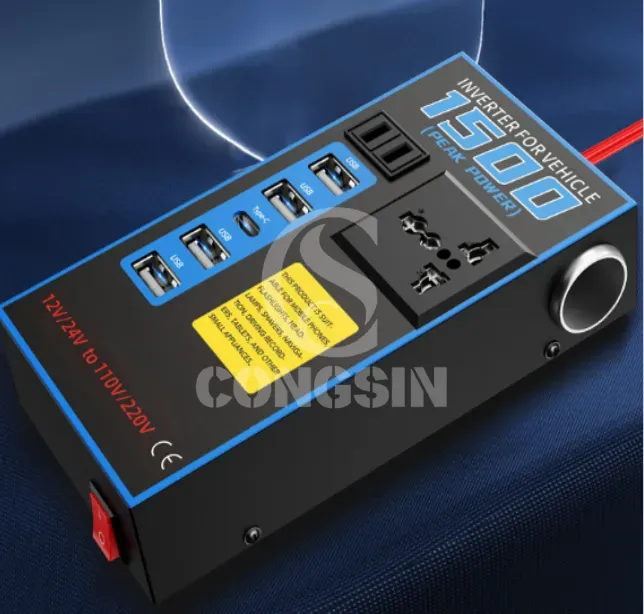
Congsin 1500W Inverter for Vehicle DC 12V/24V to AC 110V/220V with Universal socket Modified Sine Wave
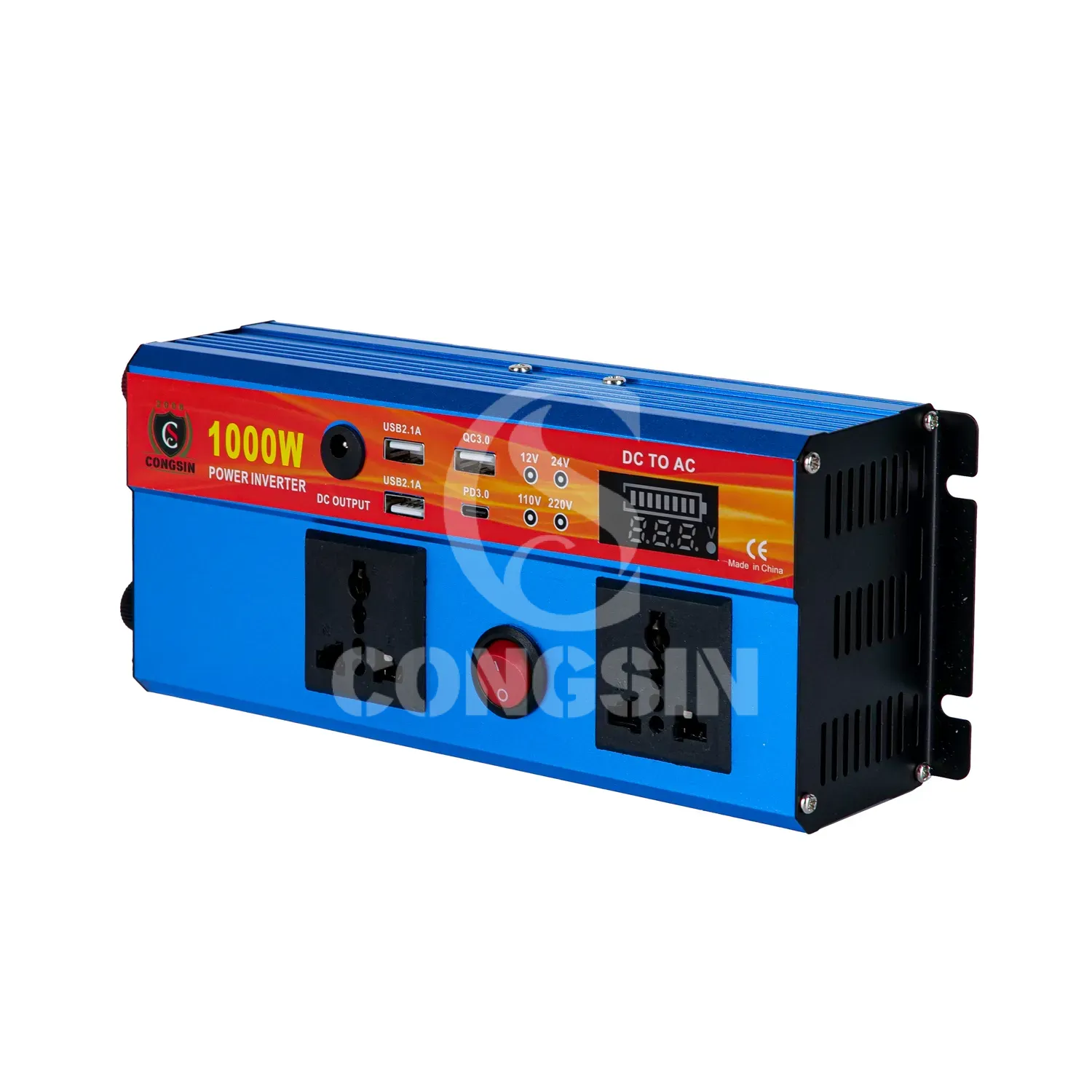
Congsin 1000W modified sine wave inverter with LED display and Type C port car RV power inverter
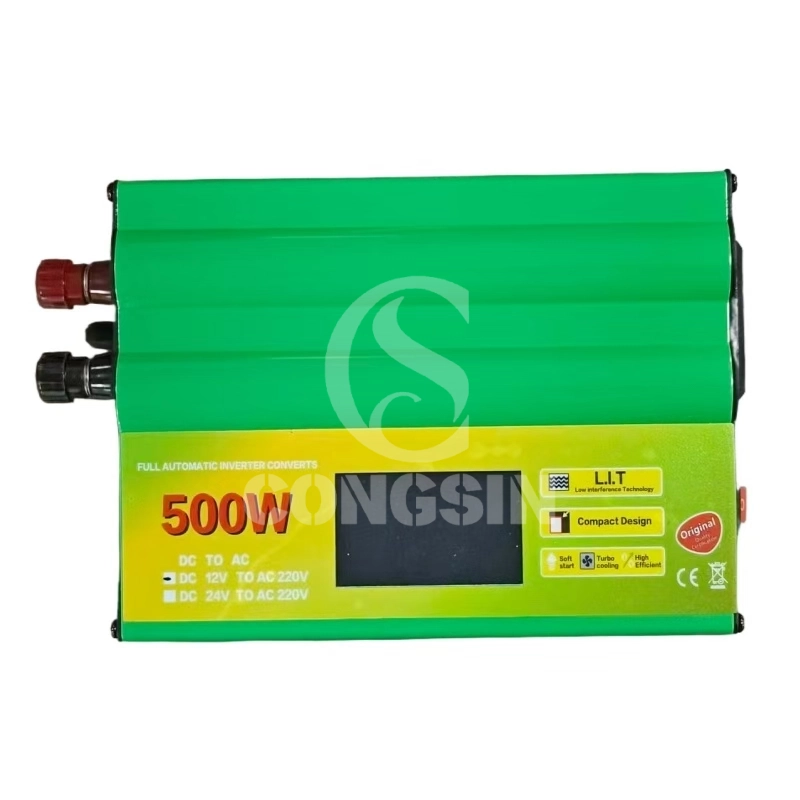
Congsin Modified Sine Wave Inverter 500W 1000W 1500W 12V LED Display Portable for RV Car Solar
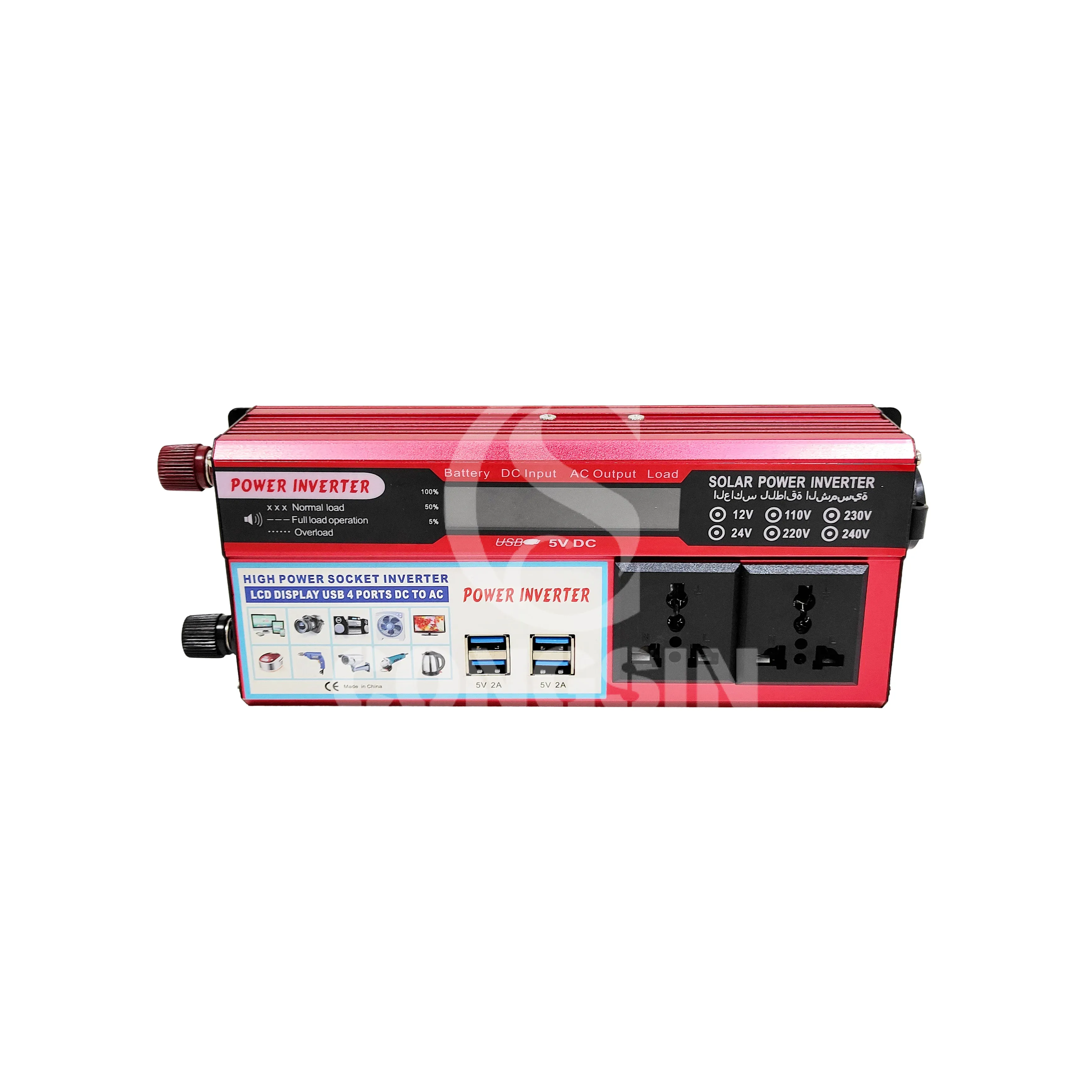
Congsin 1500W modified sine wave inverter with LCD display and USB ports for RV car boat home use

CONGSIN is a trusted OEM factory for power inverters, solar charge controllers, and DC converters. Reliable solutions for global B2B buyers.
 High Quality
 7/24 Service
 Guaranteed Warranty
© 2025 Congsin. All Rights Reserved.