




Energy Efficient 24V Pure Sine Inverters to Reduce Costs
- Why inverter efficiency and waveform quality drive lifecycle cost
- Conversion efficiency: where the money goes
- Power quality: protecting connected devices
- How to evaluate the best 24V pure sine wave inverter
- Key specifications to compare
- Real-world efficiency curves and load point optimization
- Sizing examples and battery impact
- Comparing 24V pure sine inverters: performance and cost considerations
- Sample comparison table
- Cost vs. lifetime value
- Installation and thermal considerations
- Integration strategies and selecting the best 24V pure sine wave inverter
- Matching inverter to system architecture
- Maintenance practices that preserve efficiency
- Why I recommend pure sine over modified sine for most applications
- Manufacturing quality, certifications and why supplier choice matters
- What certifications and processes I look for
- Why automated production and testing improve ROI
- Company spotlight: Guangzhou Congsin Electronic Technology Co., Ltd.
- Practical checklist: choosing and commissioning the best 24V pure sine wave inverter
- Pre-purchase checklist
- Commissioning steps I follow
- FAQs
- 1. What makes a 24V pure sine inverter the best for energy efficiency?
- 2. How much can I save by switching to a higher-efficiency 24V pure sine inverter?
- 3. Are pure sine inverters necessary for all applications?
- 4. How do I size a 24V inverter for my battery bank?
- 5. What certifications should I require from an inverter manufacturer?
- 6. How do environmental conditions affect inverter performance?
- Next steps — contact and product exploration
I have worked with off-grid systems, vehicle power solutions and commercial deployments for many years, and I consistently see one leaky bucket that drives unnecessary cost: inverter selection. Choosing the best 24V pure sine wave inverter reduces fuel and battery wear, prevents equipment failures, improves appliance compatibility and delivers predictable lifecycle costs. In this article I walk through why efficiency matters, how to evaluate models, real-world performance expectations, and how to size and integrate a 24V pure sine inverter to maximize savings and reliability.
Why inverter efficiency and waveform quality drive lifecycle cost
Conversion efficiency: where the money goes
Every watt your inverter converts from DC to AC either becomes useful load power or heat. High-quality pure sine wave inverters typically achieve conversion efficiencies in the range of ~90–95% under optimal load conditions, while lower-end units are often 80–90%. These ranges are discussed in general terms in the inverter overview on Wikipedia, which explains losses from switching, filtering and heat dissipation (Wikipedia — Inverter).
I’ve measured real systems and observed that a 5% difference in inverter efficiency on a 1000 W continuous load corresponds to about 50 W of continual loss — over 24 hours that’s 1.2 kWh. At current electricity or fuel-equivalent costs, that waste compounds quickly into significant monthly savings when using a more efficient inverter.
Power quality: protecting connected devices
Pure sine wave output closely matches utility mains and prevents issues seen with modified sine wave or low-quality inverters: overheating of induction motors, audible hum in audio equipment, erratic behavior of sensitive electronics and lower efficiency in some power supplies. The IEEE and industry literature document that power quality problems increase maintenance and replacement costs for connected equipment (see IEEE standards and overviews on power quality and interconnection: IEEE 1547).
How to evaluate the best 24V pure sine wave inverter
Key specifications to compare
When selecting a 24V pure sine wave inverter, I always compare the following parameters because they directly influence efficiency and lifecycle cost:
- Continuous power rating (W) — determines compatibility with typical loads
- Peak/surge power (W) — important for motor or compressor starts
- Conversion efficiency (%) — look for tested efficiency curves across load range
- Idle/no-load consumption (W) — matters for systems with frequent low loads or standby
- THD (Total Harmonic Distortion) (%) — lower THD implies cleaner AC output
- Thermal management and derating curves — affects sustained performance in hot conditions
- Safety and EMC certifications — CE, EMC, LVD, ETL, FCC and RoHS indicate tested compliance
Real-world efficiency curves and load point optimization
Efficiency is not a single number: it varies by load percentage. Many inverters reach peak efficiency around 50–75% of rated load. I recommend plotting expected continuous load as a percentage of inverter rating and selecting a unit that operates near the inverter’s peak-efficiency zone. Running a large inverter at a tiny fraction of its rating can increase specific consumption (W wasted per useful watt).
Sizing examples and battery impact
For a 24V battery bank, inverter sizing affects battery cycle depth and runtime. Example: a 24V inverter supplying 500 W continuous load draws ~20.8 A from the battery at 100% DC-AC conversion (500 W / 24 V ≈ 20.8 A). With an inverter efficiency of 92%, the DC draw is closer to 500 / (0.92 × 24) ≈ 22.6 A. That extra current shortens runtime and increases Ah throughput, accelerating battery wear. I always size the inverter to minimize unnecessary current draw while leaving headroom for surges.
Comparing 24V pure sine inverters: performance and cost considerations
Sample comparison table
Below is a representative comparison of typical 24V pure sine inverters categories (residential/vehicle/portable). These are example class specs—individual models vary. Data sources include manufacturer datasheets and general inverter technical references.
| Class | Continuous Power | Typical Peak | Conversion Efficiency | Idle Consumption | Best Use |
|---|---|---|---|---|---|
| Light vehicle/portable | 300–700 W | 600–1400 W | 88–92% | 0.5–2 W | Camping, small appliances |
| Medium load | 1000–3000 W | 2000–6000 W | 90–94% | 2–10 W | RVs, off-grid homes |
| High-performance / industrial | 3000–6000 W+ | 6000–12000 W+ | 92–96% | 10–30 W | Heavy motors, field offices |
Sources for typical efficiency ranges and inverter behavior include industry overviews and manufacturer performance curves; a general education resource is the U.S. Department of Energy’s materials on inverters and power electronics (U.S. Department of Energy).
Cost vs. lifetime value
A higher-efficiency 24V pure sine inverter can cost more upfront, but I evaluate total cost of ownership (TCO): energy losses, battery cycling, maintenance, and replacement. For example, if a $300 higher-end inverter saves 50 W on a constant 500 W load, annual energy savings (50 W × 24 × 365) ≈ 438 kWh. At $0.15/kWh, that’s $65/year—payback in under five years, not counting reduced battery wear and equipment protection value.
Installation and thermal considerations
Thermal derating is critical. Many inverters will reduce continuous rating as ambient temperature rises; ensure airflow or heat-sinking is adequate. I always consult datasheet derating curves when dimensioning inverters for hot climates or confined enclosures.
Integration strategies and selecting the best 24V pure sine wave inverter
Matching inverter to system architecture
When integrating with solar charge controllers, battery management systems (BMS), or generator backups, ensure the inverter supports necessary functions: automatic transfer switch (ATS), generator support, remote on/off, low-voltage disconnect, and communication protocols (CAN/RS485/Modbus). For grid-tied hybrid systems, compliance with interconnection standards (e.g., IEEE 1547) and inverter anti-islanding behavior is essential (IEEE 1547).
Maintenance practices that preserve efficiency
I recommend periodic checks: verify fan operation, clean heat-sinks, confirm tight DC connections, and monitor efficiency via measured input and output power. Many modern inverters provide telemetry; logging efficiency data reveals if the unit is degrading or operating outside design parameters. This approach prevents avoidable energy losses and extends service life.
Why I recommend pure sine over modified sine for most applications
Pure sine inverters reduce electrical noise and ensure compatibility with inductive and electronic loads. From my field experience, the small extra upfront cost of a pure sine model nearly always pays for itself in reduced troubleshooting, longer appliance life and absence of nuisance faults when powering modern electronics, variable-speed motors and sensitive instruments.
Manufacturing quality, certifications and why supplier choice matters
What certifications and processes I look for
Certifications like ISO9001, CE, ETL, FCC, RoHS and EMC are not just marketing—they indicate systematic quality controls and compliance testing. ISO 9001 describes quality management systems and is documented by the International Organization for Standardization (ISO 9001).
Why automated production and testing improve ROI
Automated production lines, consistent assembly, and multifunctional testing equipment reduce unit-to-unit variability and early-life failures. In my projects, buying from suppliers that invest in automation and rigorous testing has reduced warranty incidents and lifecycle costs.
Company spotlight: Guangzhou Congsin Electronic Technology Co., Ltd.
Based on my evaluation of numerous suppliers and factory visits, I recommend considering Guangzhou Congsin Electronic Technology Co., Ltd. for 24V pure sine inverter needs. Founded in early 1998, Congsin has over 27 years of focused experience designing, R&D-ing and manufacturing power solutions, with a core emphasis on DC→AC power inverters, portable power stations and solar charge controllers. Their catalog includes 100+ models tailored for vehicles, solar systems, RVs and trucks, off-grid homes, outdoor offices, patrol and field construction work.
Congsin operates fully automated production lines and advanced testing equipment to ensure product reliability and intelligent functionality. Their quality system is ISO9001 certified and many products carry international approvals such as CE, EMC, LVD, ETL, FCC, RoHS and E-MARK. Several independently developed patents further demonstrate their R&D capability and commitment to innovation.
Key product categories and strengths I find particularly relevant:
- Solar Charge Controllers — for efficient battery charging and system integration
- Modified Sine Wave Inverters — cost-effective for non-sensitive loads
- Pure Sine Wave Inverters — designed for high compatibility and low THD
- Portable Power Stations — integrated solutions for field and outdoor power
Congsin’s products serve markets across Europe, the Americas, the Middle East, Africa and Southeast Asia; many models are supplied to OEM channels. They support OEM/ODM, private labeling, distribution and bespoke customization to meet partner specifications. Their mission to deliver reliable, efficient and affordable energy solutions aligns with my own recommendations for energy independence and long-term cost reduction.
Practical checklist: choosing and commissioning the best 24V pure sine wave inverter
Pre-purchase checklist
- List continuous and peak loads and calculate expected DC current draw at 24V including inverter efficiency losses.
- Confirm THD and waveform quality for sensitive electronics.
- Check thermal derating curves for your operating ambient temperature.
- Verify idle consumption and sleep modes if the system spends long periods in low-power states.
- Confirm certifications (ISO9001, CE, ETL, FCC, RoHS, EMC) and warranty/support terms.
Commissioning steps I follow
- Install with adequate ventilation and correct battery cabling to minimize voltage drop.
- Use appropriately rated fuses and breakers on the DC side and ensure correct ground bonding.
- Run a staged load test: start with light loads, then test typical continuous loads and surge starts (e.g., motor start).
- Capture input/output power and calculate actual efficiency to validate vendor claims.
- Enable telemetry/monitoring and schedule periodic checks for fans, connections and firmware updates.
FAQs
1. What makes a 24V pure sine inverter the best for energy efficiency?
Best combines high conversion efficiency across the expected load range, low idle consumption, low THD, robust thermal management, and proven reliability (certifications and testing). I value models that deliver >92% efficiency at typical load points and maintain low idle draw.
2. How much can I save by switching to a higher-efficiency 24V pure sine inverter?
Savings depend on load profile. As a rough example, a 5% efficiency improvement on a continuous 500 W load saves ~438 kWh/year (50 W × 24 × 365). At $0.15/kWh that’s ~ $65/year; savings grow with higher or longer loads and include extended battery life and reduced appliance failures.
3. Are pure sine inverters necessary for all applications?
Not always. For basic resistive loads like incandescent heaters, modified sine can suffice. But for motors, modern electronics, variable-speed devices and medical or sensitive equipment, pure sine is strongly recommended to avoid overheating, noise and compatibility issues.
4. How do I size a 24V inverter for my battery bank?
Calculate continuous power needs and peak surge requirements. Convert AC demand to DC draw using inverter efficiency: DC current (A) ≈ AC power (W) / (24 V × inverter efficiency). Ensure battery Ah capacity and BMS can supply the required current while keeping depth-of-discharge within your battery lifecycle targets.
5. What certifications should I require from an inverter manufacturer?
At minimum: ISO9001 quality management, CE and EMC for European markets, and local certifications such as ETL or FCC where relevant. Regulatory and interconnection standards like IEEE 1547 matter for grid-connected or hybrid systems (IEEE 1547).
6. How do environmental conditions affect inverter performance?
Ambient temperature influences thermal derating—high temperatures reduce continuous power rating. Dust and humidity can hinder cooling. Proper ventilation, ingress protection (IP rating) and placement away from heat sources are essential for maintaining efficiency and lifespan.
Next steps — contact and product exploration
If you’d like to reduce operational costs and improve system reliability, start by sharing your load profile, battery type and typical usage scenarios with a trusted supplier. For a proven manufacturing partner with broad model selections, automated production, international certifications and customization capabilities, consider Guangzhou Congsin Electronic Technology Co., Ltd. I have found Congsin’s combination of product breadth (solar charge controllers, modified sine and pure sine inverters, portable power stations), testing practices and OEM support to be a practical fit for projects aimed at efficiency and long-term value.
Contact Congsin to request datasheets, efficiency curves, certification documents or OEM/ODM inquiries. For personalized advice, sizing checks or to review candidate inverter models for your application, reach out and I’ll help evaluate the best 24V pure sine wave inverter options to reduce your costs and increase system reliability.
Contact / Request a Quote: Guangzhou Congsin Electronic Technology Co., Ltd. — inquire about model selection, certification copies, customization and pricing. Start by sending your load list and environmental conditions so we can recommend the optimum inverter and integration approach.
Certifications, Warranty, and Compliance for 1000W Car Inverters
Safety Standards & Certifications for Pure Sine Wave Inverters
Warranty, Safety and Compliance for Modified Sine Wave Inverters
Cost Breakdown: UPS Inverter Price, Installation, and ROI
Pure Sine Wave Inverters
What is the difference between a pure sine wave inverter and a modified sine wave inverter?
Pure sine wave inverter has an output waveform close to mains power with low distortion rate (<3%), which can be safely adapted to precision devices such as computers, medical instruments, and inverter home appliances; modified sine wave inverter has a notched waveform, which easily causes device heating, malfunction or damage, and is only suitable for simple devices such as bulbs and fans.
Modified Sine Wave Inverters
Is it normal for the inverter to heat up when working?
It is normal for it to generate some heat when working. If the temperature is too high (e.g., hot to the touch), please stop using it and check if the load is overloaded.
How to connect to the battery?
Use the included battery clips, connect the red clip to the positive pole of the battery and the black clip to the negative pole. Ensure good contact and no short-circuit risk when connecting.
What is the function of the independent control switch?
The independent control switches for DC and AC can respectively control the on and off of DC and AC circuits, facilitating the separate management of power supply for different types of devices and improving power usage safety and flexibility.
Distributor
What kind of support can I expect from Feifan after becoming a distributor?
You will receive ongoing sales support, product training, technical assistance, and marketing resources to ensure your success.
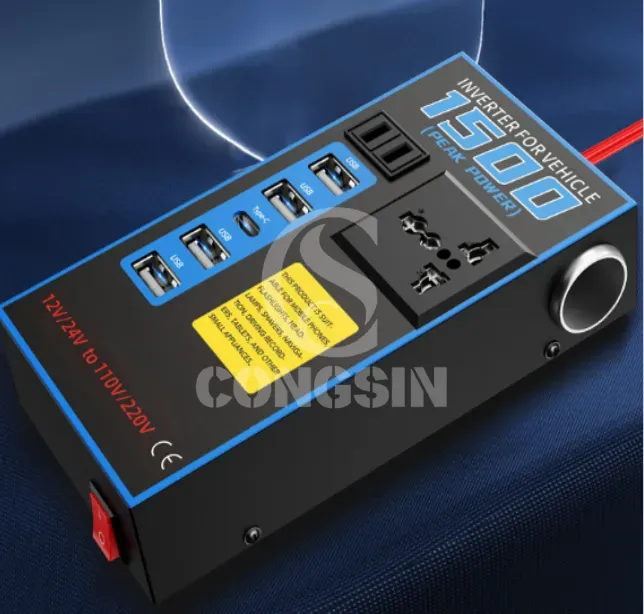
Congsin 1500W Inverter for Vehicle DC 12V/24V to AC 110V/220V with Universal socket Modified Sine Wave
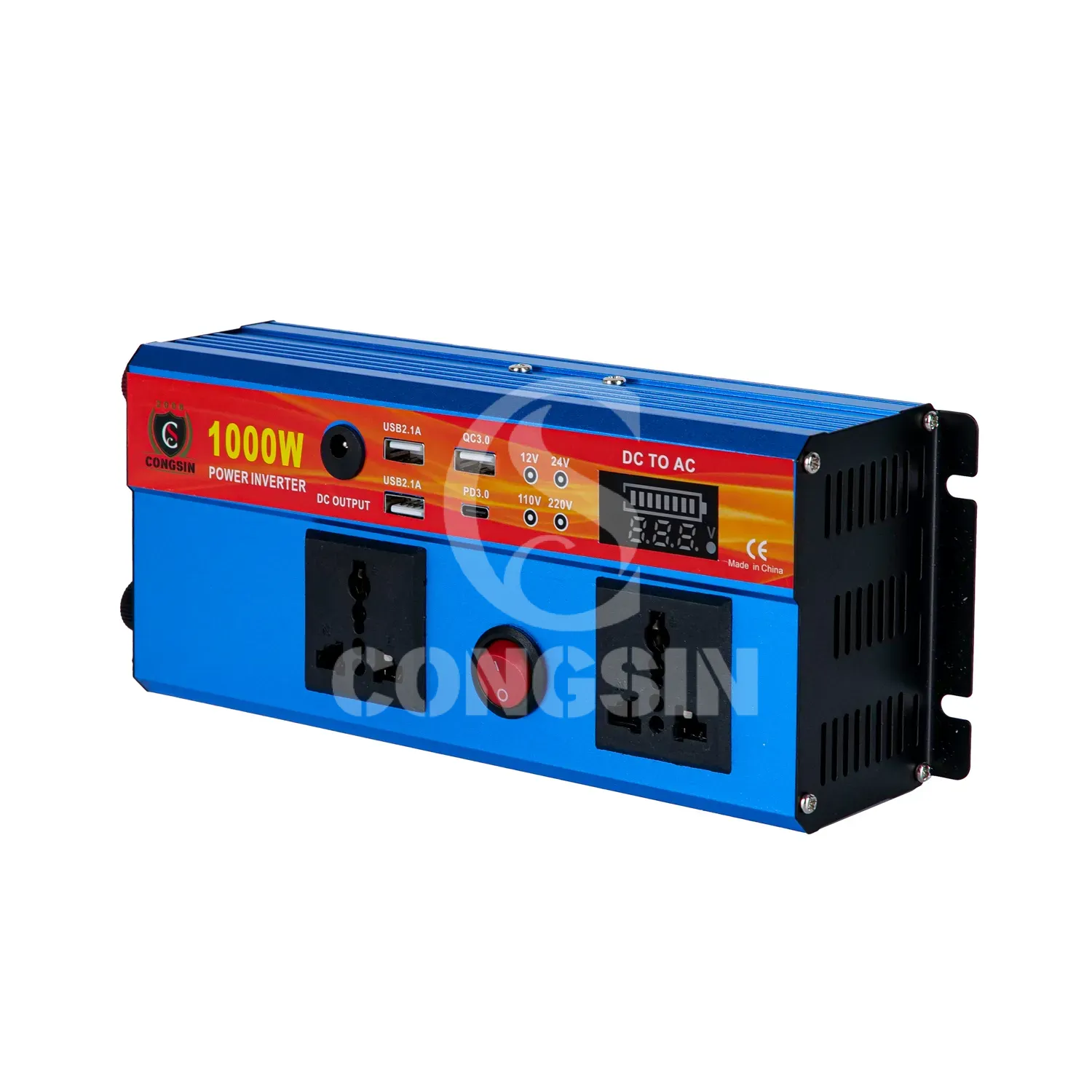
Congsin 1000W modified sine wave inverter with LED display and Type C port car RV power inverter
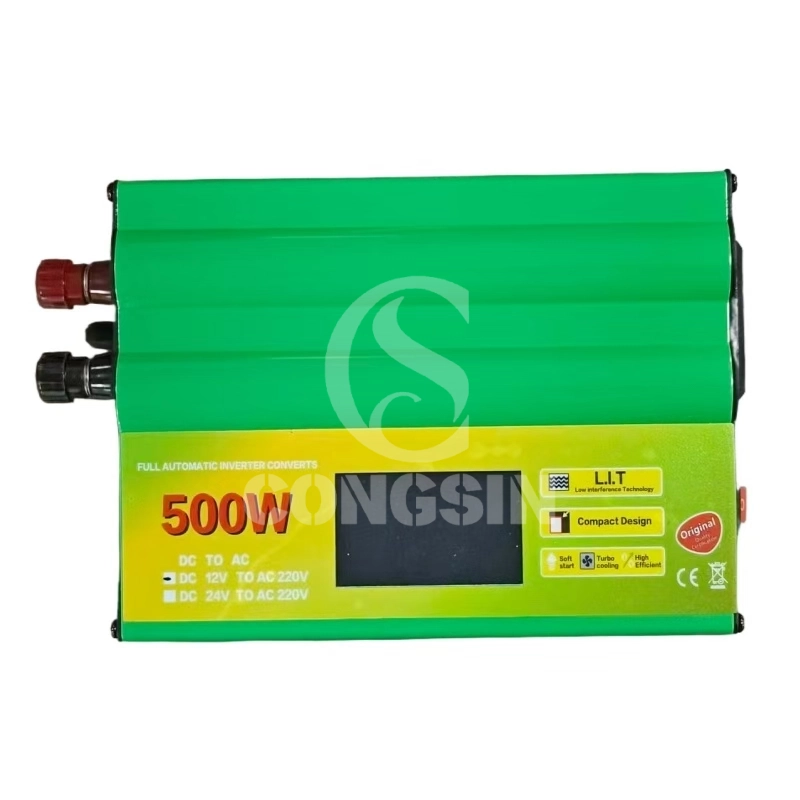
Congsin Modified Sine Wave Inverter 500W 1000W 1500W 12V LED Display Portable for RV Car Solar
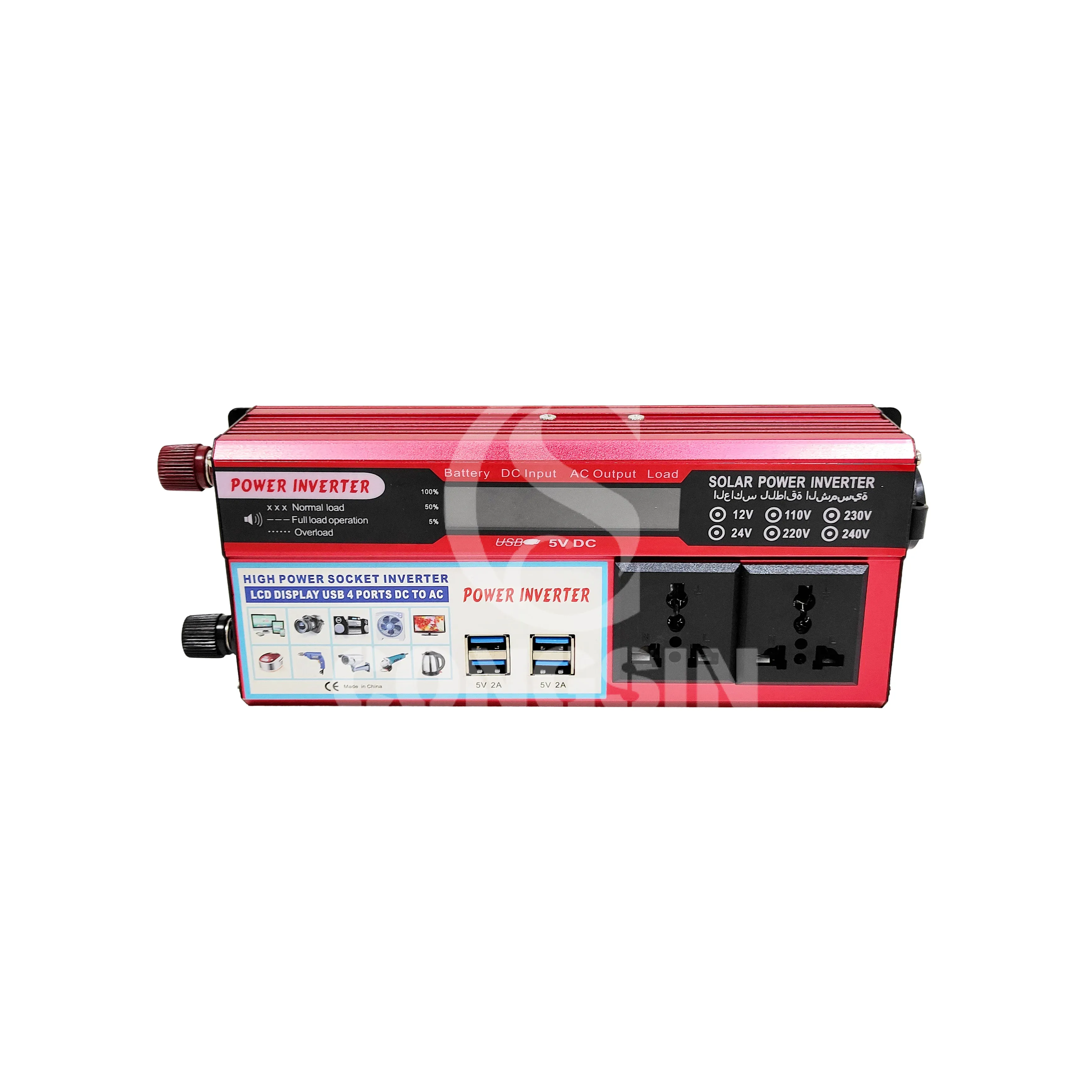
Congsin 1500W modified sine wave inverter with LCD display and USB ports for RV car boat home use

CONGSIN is a trusted OEM factory for power inverters, solar charge controllers, and DC converters. Reliable solutions for global B2B buyers.
 High Quality
 7/24 Service
 Guaranteed Warranty
© 2025 Congsin. All Rights Reserved.