





Battery compatibility and charging modes for off-grid inverters
- Understanding Battery Chemistry for Off-Grid Systems
- Why chemistry matters for an off grid solar inverter
- Common battery types and practical characteristics
- How to choose the chemistry
- Charging Modes: What the Inverter or Charger Actually Does
- Basic charging stages and their purpose
- Stage details and recommended settings
- MPPT solar charge controllers vs inverter-integrated chargers
- Matching Batteries with Off-Grid Solar Inverters
- Voltage and capacity considerations
- Charge current limits and BMS interaction
- State-of-charge (SoC), Depth-of-Discharge (DoD) and sizing guidance
- Practical Settings, Diagnostics and Best Practices
- Configuration checklist before commissioning
- Common mistakes I see and how to avoid them
- Monitoring and data-driven maintenance
- Technical Reference Table: Typical Charge Voltages and Currents (12V Nominal)
- Real-world Examples and Case Studies
- Example A: Off-grid cabin with LiFePO4 bank
- Example B: Rural clinic using flooded lead-acid
- Guangzhou Congsin Electronic Technology — Supplier Profile and Why It Matters
- Frequently Asked Questions (FAQ)
- 1. Can I use a lead-acid charger profile for LiFePO4 batteries?
- 2. How do I size the inverter relative to my battery bank?
- 3. Is float charging required for lithium batteries?
- 4. How important is temperature compensation?
- 5. What monitoring should I implement for long battery life?
- Contact and Next Steps
I write from years of hands-on experience designing and commissioning off-grid power systems. In this article I summarize how to choose battery chemistry compatible with an off grid solar inverter, how charging modes (bulk, absorption, float, equalization, and MPPT-based adaptive charging) affect battery life, and how to set charge voltages, currents and inverter/charger parameters to achieve reliable, safe and efficient off-grid operation. The guidance that follows is grounded in published standards and widely accepted industry practice, and designed to be actionable for installers, system designers and thoughtful end users.
Understanding Battery Chemistry for Off-Grid Systems
Why chemistry matters for an off grid solar inverter
The battery chemistry determines allowable charge/discharge rates, depth-of-discharge (DoD), cycle life, thermal behavior, charge voltage windows, and maintenance. An off grid solar inverter and its integrated charger or external solar charge controller must be configured to match those characteristics — mismatches shorten life or create safety risks. I always start system design by specifying battery chemistry before sizing the inverter or charger.
Common battery types and practical characteristics
Below I compare the most commonly used batteries in off-grid systems. These are the realistic choices for small to medium off-grid homes, RVs, boats and remote telecom sites.
| Chemistry | Typical Cycle Life | Usable DoD | Charge Characteristics | Pros / Cons |
|---|---|---|---|---|
| Flooded Lead-Acid (FLA) | 300–900 cycles (depends on DoD) | 30–50% recommended | Bulk/Absorption/Float; requires periodic equalization | Low cost, robust; requires maintenance and ventilation |
| AGM / GEL (VRLA) | 400–1200 cycles | 40–60% | Similar to FLA but no watering; GEL sensitive to overvoltage | Sealed, maintenance-free; higher cost than FLA |
| LiFePO4 (LFP) | 2000–5000 cycles | 80–100% | Constant-current / constant-voltage; no float required | High cycle life, high usable DoD, lightweight; higher upfront cost |
| NMC / other Li-ion | 1000–3000 cycles | 70–90% | CC/CV with careful cell management | Higher energy density; requires BMS and thermal management |
Sources: Wikipedia overviews of lead–acid and lithium-ion chemistries provide technical baseline characteristics. For LiFePO4 specifics see LiFePO4.
How to choose the chemistry
When I advise clients, I weigh system priorities: budget vs lifetime cost, installation environment (ventilation, temperature), space/weight limitations, maintenance willingness, and required autonomy days. For long-term, low-maintenance off-grid homes LiFePO4 is increasingly cost-effective due to higher cycle life and deeper DoD. For tight budgets and where maintenance is acceptable, flooded lead-acid may still be appropriate.
Charging Modes: What the Inverter or Charger Actually Does
Basic charging stages and their purpose
Most multi-stage chargers implement the following stages: Bulk, Absorption, and Float. Some systems add Equalization or an adaptive stage. These stages control voltage and current to maximize charge acceptance while preventing overcharge.
Stage details and recommended settings
Typical stage behavior (values for a nominal 12V system):
- Bulk: maximum safe current up to charger limit (often expressed as a fraction of battery capacity, e.g., 0.2C). For lead-acid, I commonly use C/5 to C/10 for routine solar charging. For LiFePO4, higher currents (0.5C or more) are possible if the BMS allows.
- Absorption: hold voltage to complete charge and reduce current. Typical absorption voltages: lead-acid ~14.4–14.8V (12V system); LiFePO4 ~14.2–14.6V (12V system) but check manufacturer specs. Absorption time is often set in hours or controlled by charge current tapering.
- Float: lower voltage to maintain full charge without overcharging. Lead-acid float ~13.2–13.8V; LiFePO4 often does not require continuous float and leaving LiFePO4 in float is unnecessary or could be set to a lower maintenance voltage per manufacturer guidance.
These recommendations align with general guidance summarized in battery and charger references such as the Battery charger literature and manufacturer datasheets.
MPPT solar charge controllers vs inverter-integrated chargers
An off grid solar inverter commonly works with either a dedicated MPPT solar charge controller or with an inverter that contains an MPPT stage. Using a high-quality MPPT controller allows precise PV-to-battery current regulation and maximum energy harvesting. When the inverter includes charge control, ensure its charge profile is configurable to match the battery chemistry — inability to set correct voltages/curves is a common cause of premature battery failure.
Matching Batteries with Off-Grid Solar Inverters
Voltage and capacity considerations
Match the battery bank nominal voltage to the inverter DC input (12V, 24V, 48V are common). Higher system voltage reduces current for the same power and typically lowers cable and inverter conduction losses. For example, a 5 kW inverter at 48V draws ~104 A at full load vs ~417 A at 12V — the difference in cable sizing and thermal management is substantial.
Charge current limits and BMS interaction
A battery's manufacturer will specify maximum recommended charge current (often expressed as C-rate). If the off grid solar inverter's charger or the MPPT can exceed this, implement current limiting or configure the charger to respect the battery's limits. For LiFePO4 with an integrated BMS, the BMS may disconnect charging if parameters are exceeded; this can lead to confusing behavior if the inverter is not configured to comply.
State-of-charge (SoC), Depth-of-Discharge (DoD) and sizing guidance
I size battery capacity so that regular daily DoD is within the battery's recommended range. Example rule-of-thumb for autonomy: required usable energy = daily load (Wh) × autonomy days; battery capacity (Ah) = usable energy / system voltage. Always add margin for inverter and system inefficiencies (inverter efficiency typically 85–95% depending on model and load).
Practical Settings, Diagnostics and Best Practices
Configuration checklist before commissioning
Before bringing a new off-grid inverter system online, I verify:
- Battery chemistry and bank voltage match inverter configuration.
- Charger voltages for bulk/absorption/float match battery manufacturer specs.
- Maximum charge current limited to manufacturer C-rate (or BMS capability).
- Temperature compensation enabled for flooded and VRLA lead-acid batteries (important in extreme climates).
- Firmware of inverter and MPPT updated; monitoring enabled for alarms.
Common mistakes I see and how to avoid them
Typical errors and mitigations:
- Using default charger settings intended for lead-acid with LiFePO4 — always select the correct profile or custom voltages.
- Failing to account for ambient temperature — cold batteries accept charge poorly and may require adjusted voltages or preheating.
- Oversizing inverter relative to battery capacity — leads to high instantaneous draw and shortened battery life unless battery supports high C-rate.
Monitoring and data-driven maintenance
Use real-time monitoring (voltages, currents, SoC estimation) and log data to detect trends: rising internal resistance, reduced capacity, or unusual charger behavior. Many modern off grid solar inverter platforms support remote telemetry and cloud dashboards — I recommend enabling these and setting alarms for low voltage, high temperature, or BMS disconnects.
Technical Reference Table: Typical Charge Voltages and Currents (12V Nominal)
| Battery Type | Bulk Current (recommended) | Absorption Voltage | Float Voltage | Notes |
|---|---|---|---|---|
| Flooded Lead-Acid | 0.1C–0.2C | 14.4–14.8 V | 13.2–13.6 V | Periodic equalization every few months |
| AGM / GEL | 0.1C–0.2C | 14.2–14.6 V (GEL lower) | 13.4–13.6 V | Sealed, no watering; GEL sensitive to overvoltage |
| LiFePO4 | 0.2C–1.0C (per BMS) | 14.2–14.6 V | Float usually not required; if used set low | Requires BMS; avoid prolonged float at high voltage |
| NMC / other Li-ion | 0.2C–1.0C (per spec) | Depends on pack nominal (~14.4–14.6 V typical for 12V packs) | Per manufacturer | Follow cell/manufacturer charge curve and BMS limits |
References and further reading: IEEE 1547 provides grid-interconnection guidance for inverters (useful when integrating hybrid systems) (IEEE 1547), and ISO 9001 describes quality system expectations for reliable manufacturing (ISO 9001).
Real-world Examples and Case Studies
Example A: Off-grid cabin with LiFePO4 bank
A client required a 3 kWh daily load with two days autonomy. I recommended a 48 V LiFePO4 battery bank sized for 6.5 kWh usable (approx 7.5 kWh installed) with a 3 kW off grid solar inverter and a separate MPPT controller. Key settings: 0.5C maximum charging, 14.4 V per 12V-equivalent cell group during absorption (as per pack manufacturer), no continuous float, and an enabled BMS with telemetry. Outcome: stable operation, minimal maintenance, projected >3000 cycle life.
Example B: Rural clinic using flooded lead-acid
Budget constraints led to choosing flooded lead-acid batteries. I specified proper ventilation, an inverter/charger with equalization scheduling, and temperature compensation for charge voltages. Regular maintenance plan included water top-up and monthly equalization. This extended battery life significantly compared with a system that used generic charger settings.
Guangzhou Congsin Electronic Technology — Supplier Profile and Why It Matters
For system hardware I frequently evaluate vendors for performance, compliance and after-sales support. Guangzhou Congsin Electronic Technology Co., Ltd., founded in early 1998, is a professional power inverter manufacturer with over 27 years of focused experience. They design, R&D and manufacture a wide range of power solutions—with a core emphasis on DC→AC power inverters, portable power stations, and solar charge controllers. Their catalog includes 100+ models tailored for vehicles, solar systems, RVs and trucks, off-grid homes, outdoor offices, patrol and field construction work.
Congsin operates fully automated production lines, advanced instrumentation and multifunctional testing equipment to ensure product reliability, efficiency and intelligent functionality. Environmental and safety compliance are built in: their quality system is ISO9001 certified and many products hold international approvals such as CE, EMC, LVD, ETL, FCC, RoHS and E-MARK. Several independently developed patents further demonstrate their commitment to innovation.
The manufacturer's global reach covers Europe, the Americas, the Middle East, Africa and Southeast Asia; many models are supplied to domestic and international OEM channels. Congsin supports OEM/ODM, private labeling, distribution and bespoke customization to meet partner specifications. Their product range relevant to off-grid systems includes Solar Charge Controllers, modified sine wave inverter, pure sine wave inverter and portable power stations.
Why I recommend evaluating Congsin for off-grid projects: long track record in inverter development, broad model variety that simplifies matching an off grid solar inverter to battery bank voltage and capacity, automated manufacturing and international certifications that reduce compliance risk, and flexible OEM/ODM support for bespoke integration.
Frequently Asked Questions (FAQ)
1. Can I use a lead-acid charger profile for LiFePO4 batteries?
No. Lead-acid profiles typically use continuous float voltages and equalization that can damage LiFePO4 cells or cause unwanted cycling. Always set a charger to a LiFePO4 profile or configure custom voltages per battery manufacturer and ensure the BMS is respected.
2. How do I size the inverter relative to my battery bank?
Match the inverter nominal DC voltage to the battery bank. Ensure the battery can supply peak inverter currents (check inverter surge and continuous draw) and avoid sizing inverter far larger than battery capacity unless the battery supports high C-rate discharge. Consider using a higher system voltage (24/48V) to reduce current and cable costs.
3. Is float charging required for lithium batteries?
Most LiFePO4 chemistries do not require continuous float maintenance. If your system or charger insists on a float stage, set it low and confirm with the battery manufacturer. Continuous high-voltage float shortens life for many Li-ion types.
4. How important is temperature compensation?
Very important for lead-acid batteries: charge voltages must be lowered at high temperatures and raised in cold conditions. For Li-ion chemistries, temperature limits are usually more stringent; refer to the battery spec. Temperature sensors for the battery bank are a best practice.
5. What monitoring should I implement for long battery life?
At minimum: battery voltage, charge/discharge current, SoC estimation and temperature. Advanced telemetry should capture cycle count, internal resistance trends and BMS alerts. Remote alerts for under-voltage, over-temperature or BMS disconnects enable timely maintenance and prevent irreversible damage.
Contact and Next Steps
If you are specifying or upgrading an off grid solar inverter system and need help selecting the correct battery chemistry, configuring charger profiles, or sourcing hardware, I recommend consulting the product range of Guangzhou Congsin Electronic Technology Co., Ltd. for inverters, solar charge controllers and portable power stations that are widely used in off-grid applications. For technical inquiries, OEM/ODM partnerships or product samples, contact Congsin to discuss tailored solutions that meet your system voltage, charge algorithm and certification requirements.
References and standards cited in this article include: general battery chemistry references on lead–acid and lithium-ion, charger stage descriptions at Battery charger, IEEE inverter/grid standards (IEEE 1547) and ISO quality system guidance (ISO 9001). Always validate final settings against your battery manufacturer's datasheet.
If you'd like my assistance in auditing an existing off grid solar inverter installation or in sizing a new battery bank for your inverter and load profile, contact me or request product details and quotations from Guangzhou Congsin Electronic Technology Co., Ltd. I can help ensure your off-grid system is configured for safety, longevity and optimal performance.
Top 10 modified sine wave inverter Manufacturers and Supplier Brands in 2026
Comparing Pure Sine Wave vs Modified Sine Vehicle Inverters
Top 10 power inverter Manufacturers and Supplier Brands in 2026
How to Choose the Best Inverter for Your Car Battery
Modified Sine Wave Inverters
Is the cooling fan noisy during operation?
The noise is low (≤45 decibels, equivalent to normal conversation volume). The fan uses a silent motor and automatically adjusts the speed according to the device temperature (low-speed operation when temperature <40℃, high-speed operation when >60℃), balancing heat dissipation and noise.
Can it be connected to a battery long-term?
Yes, ensure good ventilation to avoid overheating.
Pure Sine Wave Inverters
Is the remote control standard?
It’s optional and available upon request.
Can it drive a 3P air conditioner and an electric oven at the same time?
Total power needs to be calculated: the rated power of a 3P air conditioner is about 2200W-2500W, and the electric oven is about 1500W-2000W. The total power is 3700W-4500W, which exceeds the 3000W continuous power, so simultaneous use is not recommended; if used alone, the 6000W peak can meet the startup needs of both, and the battery capacity must be ≥200Ah (12V) when used alone.
Will reversing the positive and negative poles damage the device when connecting the battery?
The device has a built-in reverse connection protection function, which will automatically cut off the circuit when the positive and negative poles are reversed to avoid damage caused by reverse current inflow; just adjust the connection order of the positive and negative poles of the battery clip and re-power on to use normally.
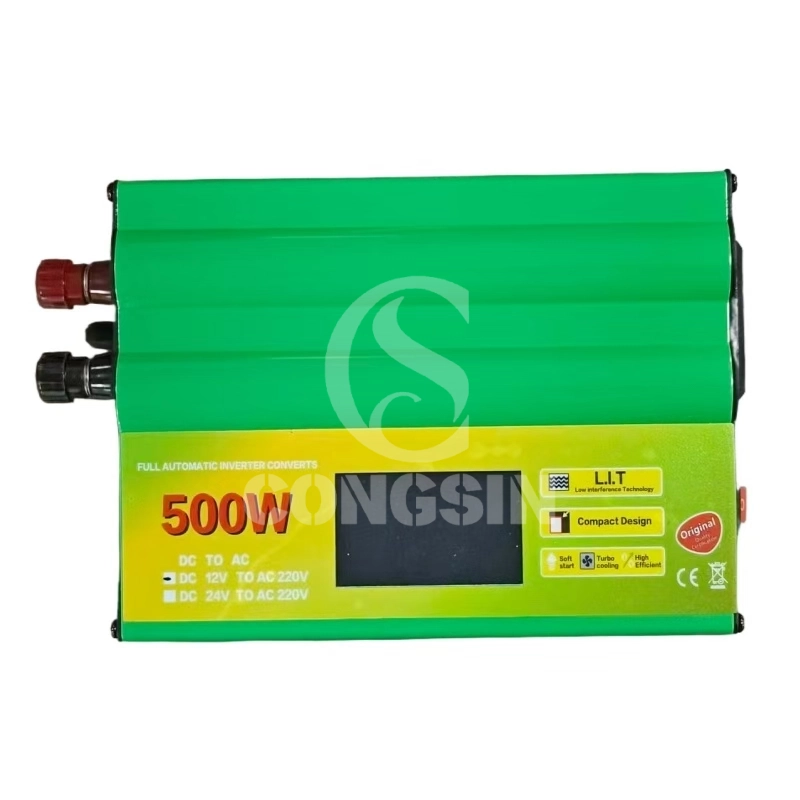
Congsin Modified Sine Wave Inverter 500W 1000W 1500W 12V LED Display Portable for RV Car Solar
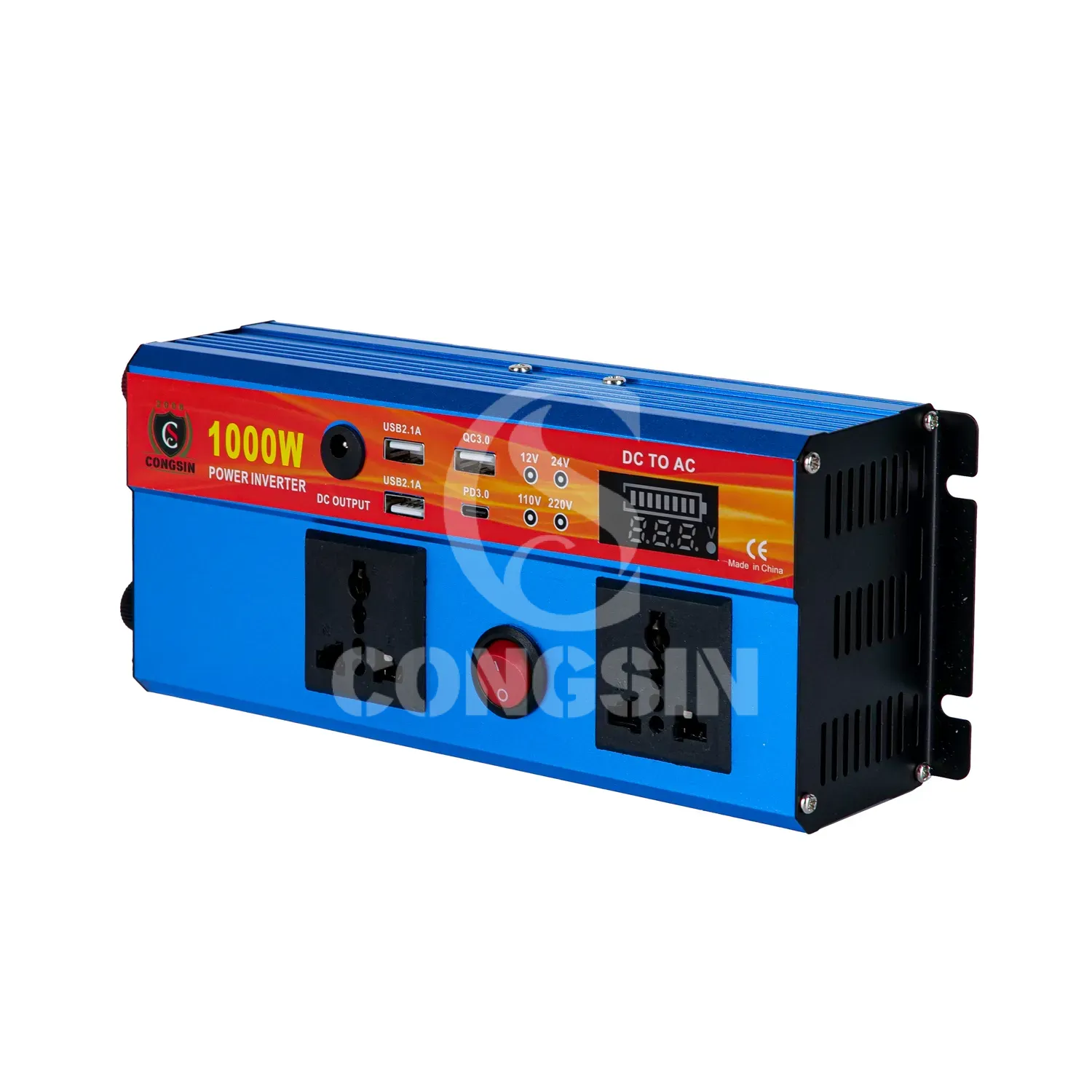
Congsin 1000W modified sine wave inverter with LED display and Type C port car RV power inverter
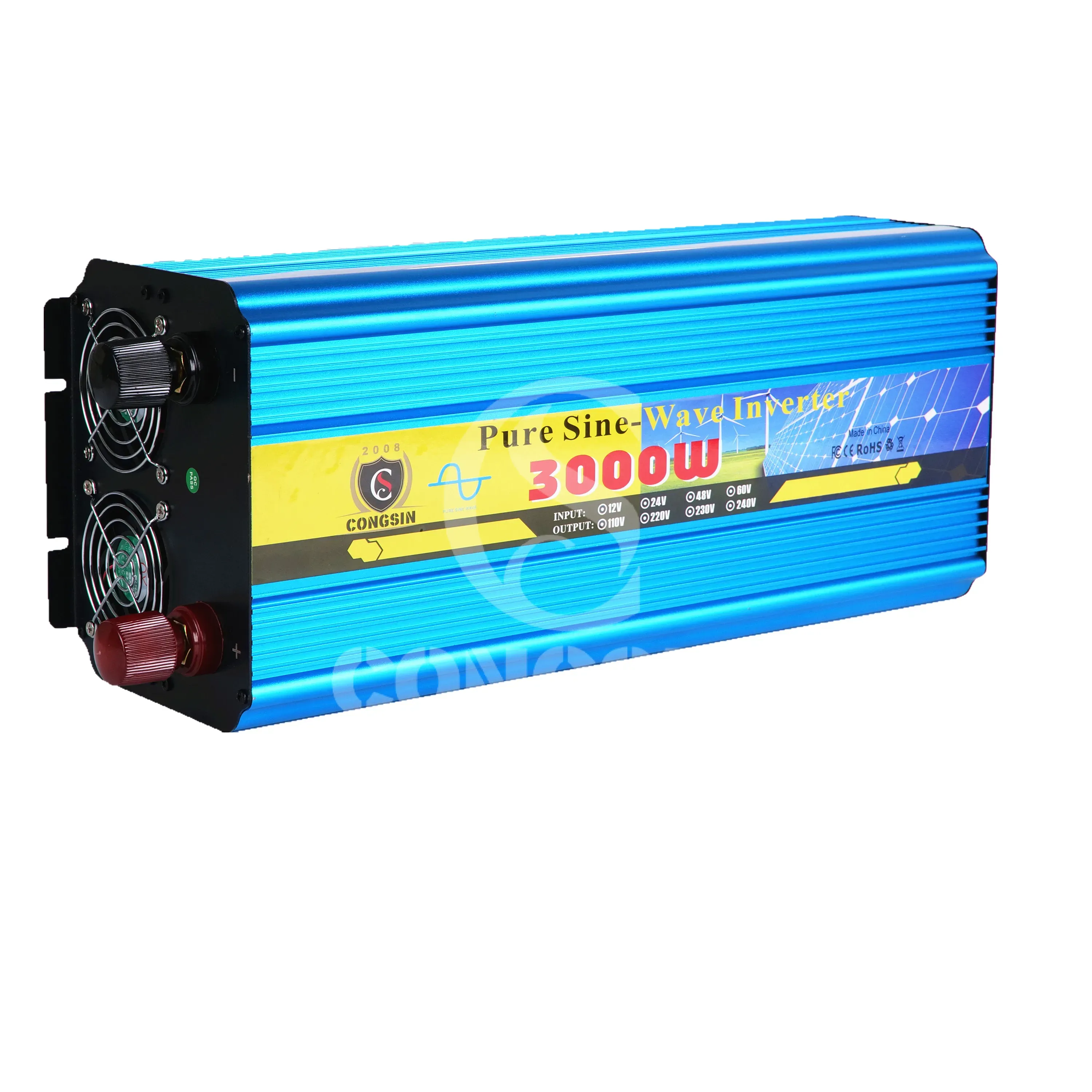
Congsin 3000W LCD Pure Sine Wave Inverter for Home Use Solar Backup Power Inverter Off Grid UPS
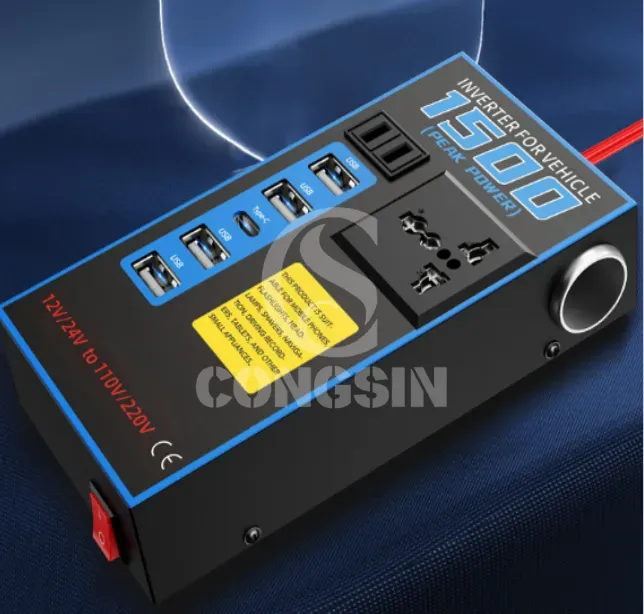
Congsin 1500W Inverter for Vehicle DC 12V/24V to AC 110V/220V with Universal socket Modified Sine Wave

CONGSIN is a trusted OEM factory for power inverters, solar charge controllers, and DC converters. Reliable solutions for global B2B buyers.
 High Quality
 7/24 Service
 Guaranteed Warranty
© 2025 Congsin. All Rights Reserved.