





What Certifications and Standards Are Required for Exporting Inverters?
What Certifications and Standards Are Required for Exporting Inverters? The global inverter market is booming, driven by the accelerating transition to renewable energy. From Europe’s stringent grid codes to Southeast Asia’s emerging solar initiatives, every market has its own set of mandatory certifications and technical standards. For inverter manufacturers and exporters, understanding these requirements isn’t just a regulatory obligation—it’s the key to unlocking global opportunities and building trust with international buyers. Navigating the complex landscape of inverter certifications can be daunting. Miss a critical standard, and your products could be rejected at customs, delayed in market entry, or even banned from sale. But with the right partner and compliant products, you can streamline your export process and tap into high-growth markets worldwide. In this guide, we’ll break down the essential certifications and standards for major export destinations, and highlight how our CSINVERTER products are fully equipped to meet these global requirements. Key Certifications & Standards by Major Export Markets Different regions have unique regulatory frameworks tailored to their grid characteristics, safety priorities, and environmental goals. Below are the most critical certifications you need to know for exporting inverters to top global markets. 1. Europe: CE Certification & Stringent Grid Codes Europe is one of the largest and most regulated inverter markets. To enter the EU, your products must first obtain the CE mark, which signifies compliance with several key directives: - Low Voltage Directive (LVD) 2014/35/EU: Applies to inverters operating at 50-1000V AC or 75-1500V DC, ensuring electrical safety and protection against electric shock, fire, and mechanical hazards. - Electromagnetic Compatibility (EMC) Directive 2014/30/EU: Requires inverters to limit electromagnetic interference (EMI) and be immune to external interference. Compliance with standards like EN 61000-6-3 is mandatory to avoid disrupting other electrical devices. - Ecodesign Directive (ErP) 2009/125/EC: Focuses on energy efficiency and environmental performance. Inverters must meet strict efficiency criteria to reduce energy waste and carbon footprints. Beyond CE, individual EU countries have additional grid connection standards that are among the world’s most rigorous: - Germany: VDE-AR-N 4110 (medium voltage) and VDE-AR-N 4120 (high voltage) are the gold standards for grid integration. These standards impose strict requirements on low/high voltage ride-through (LVRT/HVRT) and reactive power response time, making them a benchmark for inverter reliability. - Spain: The NTS 631 standard governs grid connection for power generation modules. It requires inverters to pass rigorous testing on frequency/voltage control and fault穿越, and even mandates submission of DIgSILENT models for validation. Certification from bodies like CERE is essential for market entry. - Italy: EN 50693:2019 is key for environmental product declarations (EPD), which are increasingly required for large-scale solar projects to demonstrate sustainability credentials. 2. North America: UL & CSA Certifications The U.S. and Canada have separate but harmonized certification systems focused on safety and grid compatibility: - United States: UL 1741 is the primary standard for grid-tied inverters, covering safety requirements for connection to the utility grid. Additionally, compliance with the Energy Policy Act (EPACT) is mandatory for energy efficiency, ensuring inverters meet minimum efficiency levels set by the Department of Energy. - Canada: CSA C22.2 No. 107.1 is the equivalent of UL 1741, governing safety and performance for inverters. The Canadian Energy Efficiency Act (EEACT) also enforces efficiency standards aligned with U.S. EPACT, simplifying compliance for cross-border exports. 3. Southeast Asia & Oceania: Regional Grid Standards Emerging markets in Southeast Asia and Oceania have specific standards tailored to their developing grids: - Thailand: The PEA-2016 standard (issued by the Provincial Electricity Authority) requires inverters to pass tests for low voltage ride-through (LVRT) and anti-islanding protection, critical for stabilizing Thailand’s grid during fluctuations. - Australia & New Zealand: The GEMS (Greenhouse and Energy Minimum Standards) Scheme enforces energy efficiency requirements, while AS/NZS 4777 governs grid connection safety and performance. Inverters must demonstrate compatibility with Australia’s variable grid conditions. 4. South America: Country-Specific Technical Standards South American markets have unique certification requirements that vary by nation: - Chile: The NTCO:2016 standard (Technical Standard for Connection and Operation of Small Distributed Power Plants) specifies parameters for inverter operation, including voltage/frequency ranges (90%-110% Un, 49-51 Hz), over/under voltage/frequency protection, and fault recovery capabilities. Compliance is mandatory for connecting to Chile’s medium-voltage grid. 5. Global Baseline: IEC Standards While regional standards vary, most countries recognize IEC (International Electrotechnical Commission) standards as a baseline. Key IEC standards for inverters include: - IEC 61683: Tests for grid-connected photovoltaic inverters, covering safety and performance. - IEC 61000-3-2/3-4: Limits for harmonic emissions, ensuring inverters don’t pollute the grid. - IEC 62116: Safety requirements for grid-tied inverters, widely adopted as a global benchmark. CSINVERTER: Fully Certified for Global Markets At CSINVERTER, we understand that compliance is non-negotiable for global export success. That’s why every our inverter is engineered and tested to meet or exceed the most stringent certifications and standards worldwide. Here’s how we ensure your export journey is smooth and hassle-free: 1. Comprehensive Certification Coverage Our full range of inverters (string, hybrid, and central) holds all critical certifications, including: - CE Mark (LVD, EMC, ErP) for EU markets, with additional compliance to VDE-AR-N 4110/4120 (Germany), NTS 631 (Spain), and EN 50693 (Italy). - UL 1741 (U.S.) and CSA C22.2 (Canada) for North American market entry. - PEA-2016 (Thailand), GEMS (Australia/New Zealand), and NTCO:2016 (Chile) for emerging market expansion. - Full compliance with IEC 61683, IEC 61000-3-2/3-4, and IEC 62116 as global baselines. 2. Rigorous Testing & Quality Assurance We partner with leading global certification bodies (SGS, TÜV SÜD, CTC) to conduct rigorous testing throughout the manufacturing process. From extreme voltage/frequency tests per NTCO:2016 to LVRT/HVRT validation for VDE-AR-N 4120, our inverters are put through the toughest scenarios to ensure reliability in real-world conditions. Our quality control system ensures every unit leaving our factory meets the exact same certification standards, eliminating the risk of non-compliance. 3. Tailored Solutions for Regional Requirements We don’t just meet regional standards—we optimize our products for them. For example: - Our European-focused hybrid inverters include enhanced reactive power control to meet VDE-AR-N 4120’s strict response time requirements. - Inverters for Thailand and Southeast Asia are engineered with robust LVRT capabilities to comply with PEA-2016 and stabilize local grids. - North American models are designed to exceed EPACT efficiency standards, reducing energy costs for end-users and improving market competitiveness. 4. Regulatory Expertise to Support Your Export Beyond certified products, we provide dedicated regulatory support to help you navigate market-specific requirements. Our team of experts can assist with documentation, certification validation, and local compliance queries—whether you’re exporting to Germany, the U.S., Thailand, or Chile. We stay updated on the latest standard revisions (like new NTS 631 updates or VDE amendments) to ensure your products remain compliant as regulations evolve. Why Choose CSINVERTER for Your Global Export Needs? Exporting inverters is challenging—but it doesn’t have to be. With CSINVERTER, you get: - Fully Compliant Products: No more certification headaches or market entry delays. - Global Reliability: Inverters tested to the world’s toughest standards, built for durability in any climate or grid condition. - Expert Support: A team that understands global regulations and is ready to help you expand into new markets. - Competitive Edge: Certified products build trust with buyers, helping you win contracts in high-growth regions. Ready to explore our fully certified inverter range and take your export business global? Click here to browse our product catalog, download certification documents, or request a personalized quote. Let CSINVERTER be your trusted partner in unlocking global inverter markets. FAQs About Inverter Export Certifications Q: Is a single certification enough to export inverters worldwide? A: No. While IEC standards are a global baseline, most regions require additional regional certifications (e.g., CE for EU, UL for U.S., PEA-2016 for Thailand). Working with a manufacturer like CSINVERTER that offers multi-certified products simplifies this process. Q: How often do inverter standards change, and how can I stay compliant? A: Standards are updated regularly to reflect advances in technology and grid stability needs (e.g., Germany’s VDE-AR-N 4120 revisions). Partnering with a manufacturer that prioritizes regulatory updates ensures your products remain compliant without extra effort. Q: Are certified inverters more expensive? Is the investment worth it? A: While certified inverters may have a slightly higher upfront cost, the investment is critical. Non-compliant products risk customs rejection, fines, or reputational damage. Certified products also build trust with buyers, leading to long-term market success. Q: Does CSINVERTER provide certification documentation for export? A: Yes. We provide full certification packages (test reports, certificates from SGS/TÜV SÜD/CTC, and compliance statements) for every market, ensuring smooth customs clearance and market entry.


Modified Sine Wave Inverters
How to install the battery terminal wire?
Connect the red terminal wire to the positive pole of the battery and the black terminal wire to the negative pole. Ensure the interface is firm and there is no short circuit when connecting.
Can this inverter run a refrigerator or power tools?
Recommended load ≤80% of rated power. For inductive loads, use a pure sine wave model.
Can this inverter power a laptop?
If the laptop power is within 150W and the input is AC220V, it can supply power normally.
OEM & ODM Services
Can I order samples before production?
Yes, we offer sample evaluation and prototype testing.
Pure Sine Wave Inverters
What capacity battery is needed to meet long-term use?
It needs to be calculated according to the total power of the device, the formula is "Battery Capacity (Ah) = Total Device Power (W) × Usage Time (h) ÷ Input Voltage (12V)". For example, to drive a 1000W device for 5 hours, the required battery capacity = 1000×5÷12≈417Ah, it is recommended to use 2 200Ah batteries in parallel (total capacity 400Ah, actual usage about 4.8 hours).
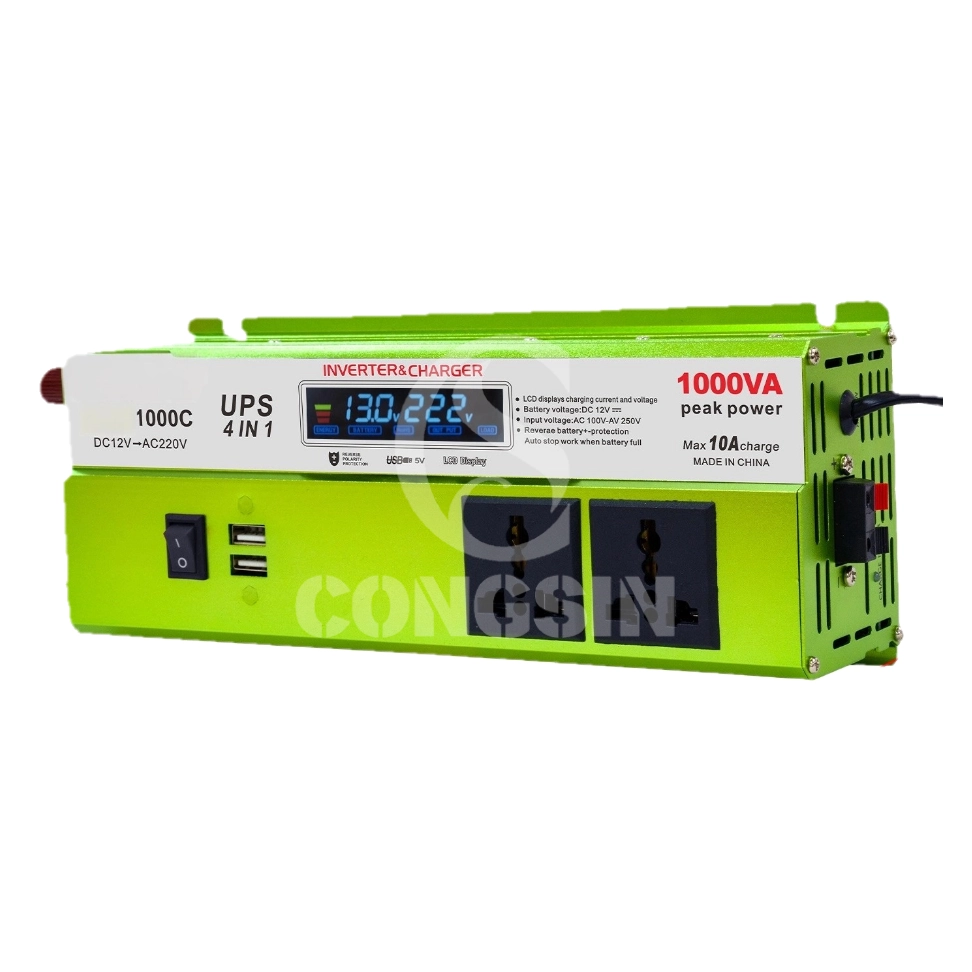
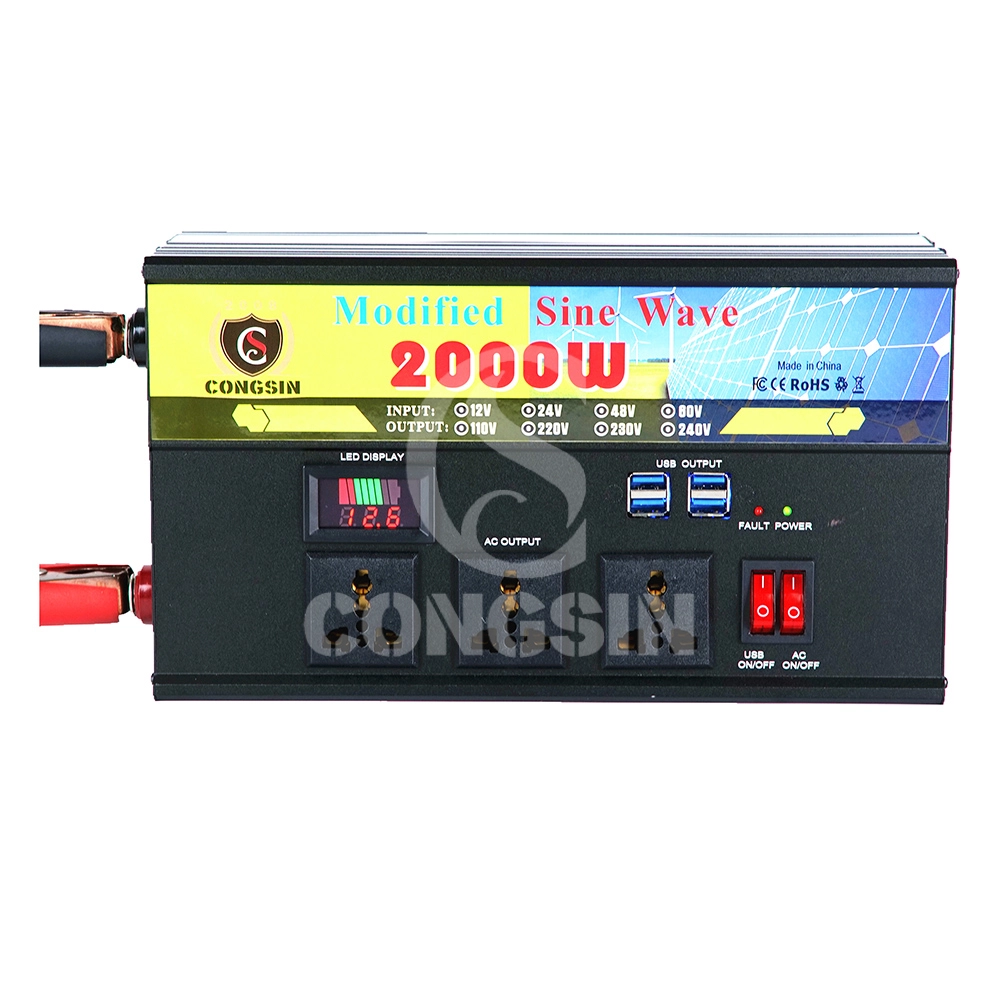
This 2000W full-power modified sine wave inverter is a patented model of our factory, with DC12V input and AC220V output. Equipped with an LED display, three AC output sockets, four USB ports, and independent control switches for DC and AC, it can provide stable power conversion for high-power devices and various electronic devices in multiple scenarios, meeting the power needs of home emergencies, outdoor operations, small commercial equipment and other scenarios.
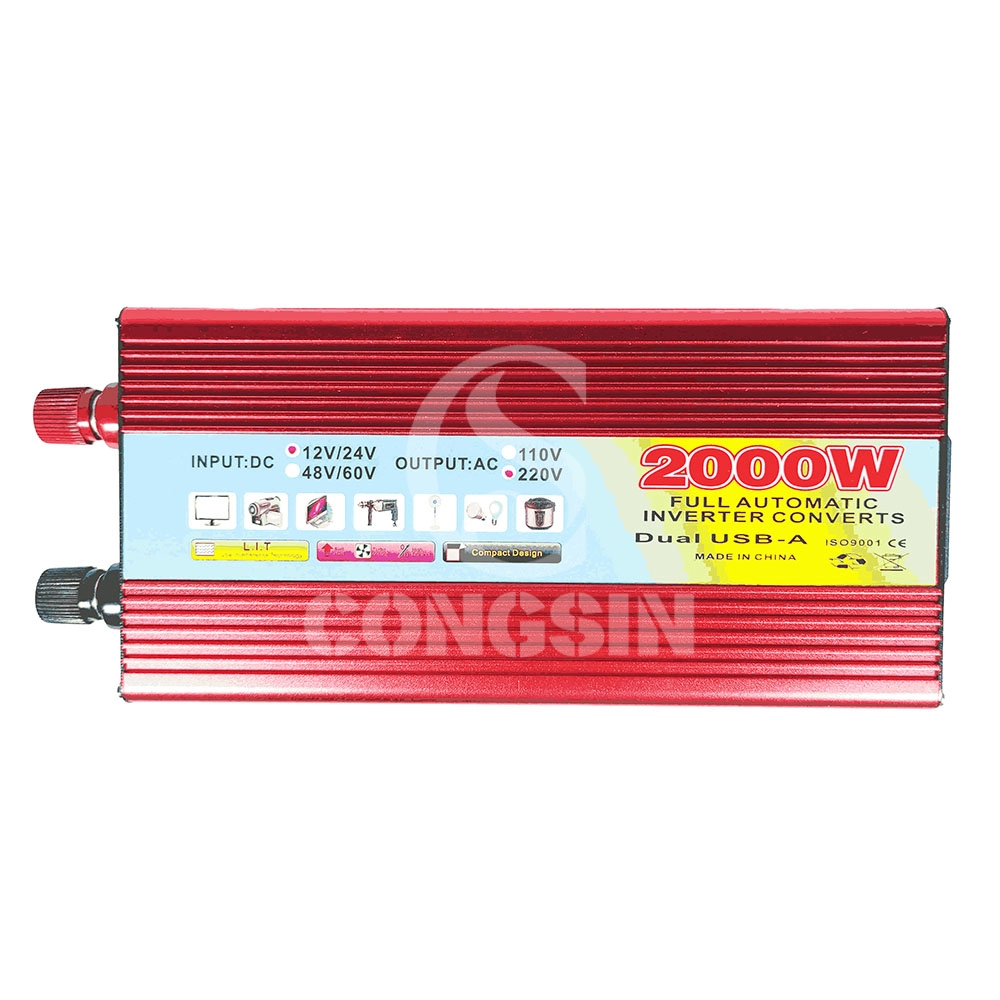
This 2000W modified sine wave inverter features a dual-input voltage design (12V/24V or 48V/60V), making it compatible with various DC systems. Compact, efficient, and versatile, it delivers a stable AC 220V output for home, vehicle, and solar power applications.
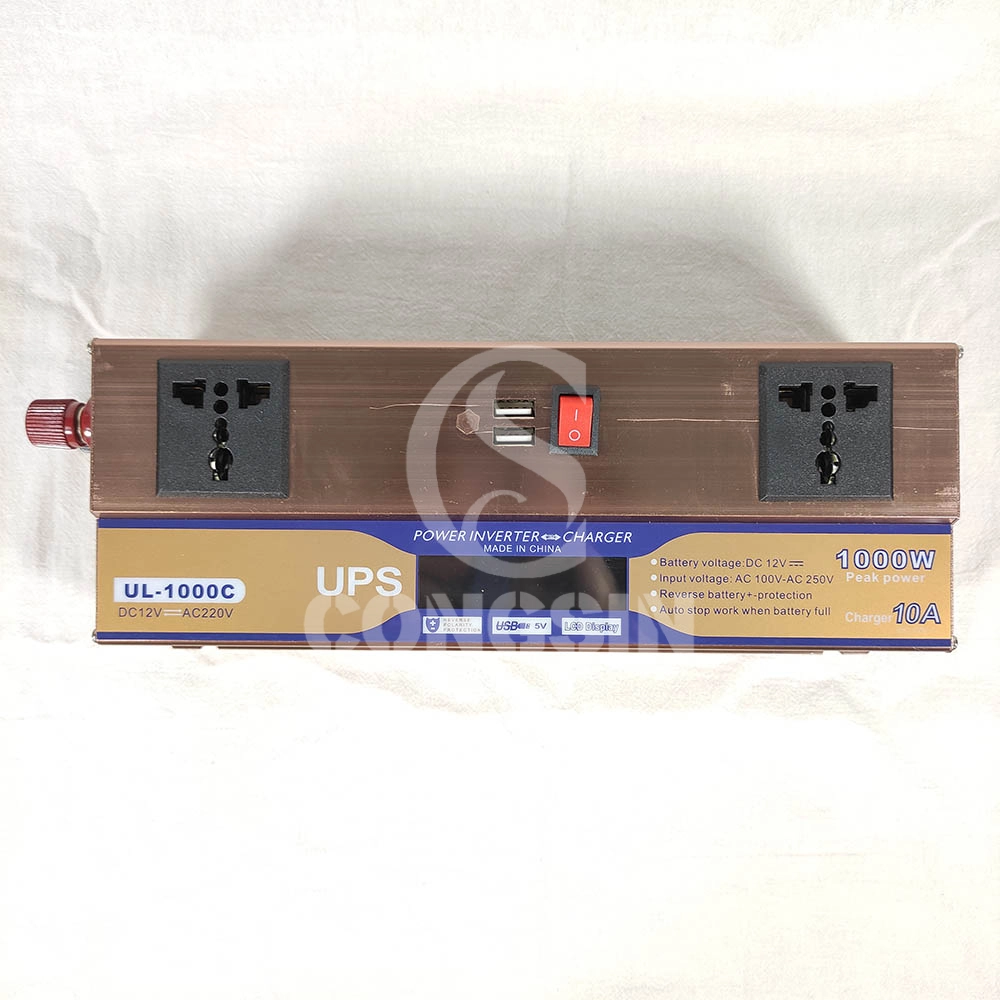
This 1000W modified sine wave inverter has UPS charging function, with DC12V input and AC220V output, and 600W rated power. Equipped with dual universal sockets, two USB ports, an LCD display, and a battery clip, it is professionally designed and has stable performance. It can provide stable AC power conversion and UPS emergency power supply for computers, small home appliances, electronic devices, etc. in home emergency, office, outdoor and other scenarios, meeting the needs of simultaneous power supply and emergency power supply for multiple devices.
Get in Touch with Our Team
You can also communicate with us directly through our online contact form. Please fill in the following information, and our team will contact you as soon as possible after receiving your message.

CONGSIN is a trusted OEM factory for power inverters, solar charge controllers, and DC converters. Reliable solutions for global B2B buyers.
 High Quality
 7/24 Service
 Guaranteed Warranty
© 2025 Congsin. All Rights Reserved.