





Mastering Applications of Vehicle-Mounted Inverters for Stable Outdoor Power: 2026 Ultimate Guide
- Quick Summary: The Future of Stable Mobile Power
- What are the primary applications of vehicle-mounted inverters for outdoor adventures?
- Critical Use Cases: From Remote Work to Off-Grid Survival
- 1. The Digital Nomad Setup
- 2. The Mobile Kitchen
- 3. Emergency & Industry Solutions
- Technical Selection: Pure Sine Wave vs Modified Sine Wave
- Pure Sine Wave (Recommended)
- Modified Sine Wave (Budget Option)
- Installation Safety: The Professional Framework
- Expert Tips: Avoiding Common Mobile Power Failures
- Frequently Asked Questions
- Can I run a coffee maker on a car inverter?
- Will a vehicle-mounted inverter drain my battery?
- What size inverter do I need for camping?
- Is Pure Sine Wave worth the extra cost for outdoor use?
- Can I install an inverter in an Electric Vehicle (EV)?
- How do I calculate the run time of my appliances?
- What is the difference between continuous and surge wattage?
- Do I need an extra battery for a 2000W inverter?
- References
With 28.9% of campers actively working from campsites in recent years, the demand for reliable off-grid mobile workstations has never been higher. Whether you are a digital nomad requiring stable voltage for a server uplink or an overlander running an induction cooktop, the vehicle-mounted inverter is your power plant. This guide explores the 2026 standards for high-wattage vehicle power solutions, backed by 27 years of manufacturing expertise from Guangzhou Congsin Electronic Technology Co., Ltd.
Quick Summary: The Future of Stable Mobile Power
Vehicle-mounted inverters are essential devices that convert 12V or 24V DC battery power into 110V or 220V AC electricity to run standard household and office appliances.
As we approach 2026, the technology behind these converters has shifted toward higher efficiency and smarter integration. The market for DC to AC conversion efficiency is rapidly evolving, with recent data projecting the global electric vehicle power inverter market to grow at a CAGR of 17.3% through 2025. Modern units are no longer just passive boxes; they are intelligent energy managers capable of communicating with Battery Management Systems (BMS) to prevent critical failures.
- Smart Integration: New inverters pair with IoT apps for real-time monitoring.
- Higher Efficiency: Adoption of Silicon Carbide (SiC) components reduces heat waste.
- Hybrid Compatibility: Enhanced support for EV and hybrid auxiliary systems.
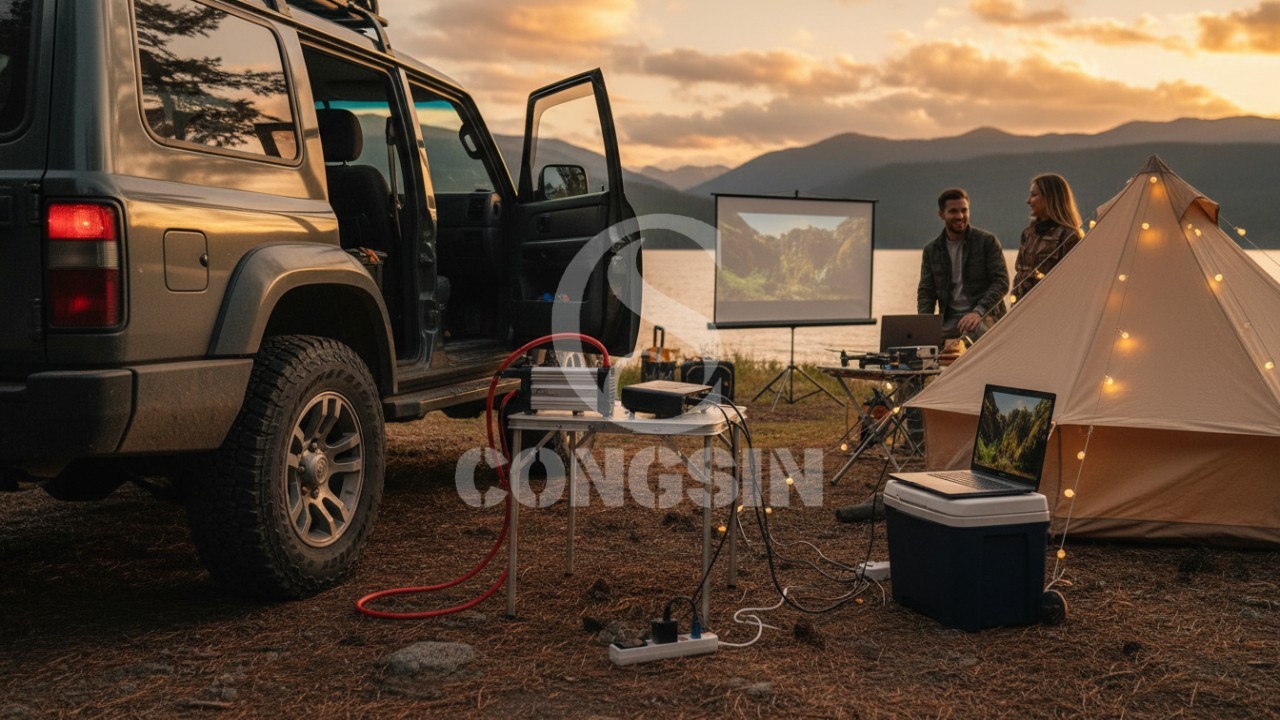
What are the primary applications of vehicle-mounted inverters for outdoor adventures?
The primary applications include powering sensitive electronics like laptops and drones, running high-draw kitchen appliances, supporting medical devices such as CPAP machines, and charging integrated battery stations.
For the modern outdoor enthusiast, the inverter is the bridge between the vehicle's alternator and the comforts of home. Congsin, with its catalog of over 100 specialized models, has observed a distinct shift from simple emergency power usage to full-time off-grid living support.
- Remote Work: Providing stable AC sine waves for sensitive servers, monitors, and Starlink setups.
- Culinary Power: Running 1500W+ loads for induction cooktops, espresso machines, and portable fridges.
- Medical Safety: Ensuring uninterrupted power for CPAP machines and oxygen concentrators.
- Field Maintenance: Powering angle grinders, drills, and compressors for trail repairs.
Critical Use Cases: From Remote Work to Off-Grid Survival
Critical use cases range from maintaining "zero-downtime" internet connectivity for digital nomads to managing surge loads for heavy-duty appliances in remote basecamps.
Understanding the specific power profile of your gear is vital. A laptop might only draw 65W, but a microwave can surge to 3000W for a split second. This distinction dictates whether you need a standard inverter or a high-capacity industrial model.
1. The Digital Nomad Setup
Professionals cannot afford data corruption. Using Pure Sine Wave inverters is non-negotiable here. These units replicate the clean utility grid power, preventing "ghosting" on monitors and buzzing in audio equipment. Congsin's pure sine wave series is specifically engineered for this, ensuring delicate PCBs in expensive tech remain undamaged.
2. The Mobile Kitchen
To run appliances like blenders or microwaves, you must calculate Surge vs. Continuous Wattage.
- Continuous: The power the inverter delivers steadily (e.g., 1500W for a hot plate).
- Surge: The brief peak power needed to start a motor (e.g., 3000W for a compressor fridge).
3. Emergency & Industry Solutions
For patrol vehicles and field construction, reliability is paramount. High-efficiency 2000W models are becoming the 2026 standard for these sectors, often requiring certifications like E-MARK and ETL—standards that Congsin rigorously maintains across its production lines.
Technical Selection: Pure Sine Wave vs Modified Sine Wave
Pure Sine Wave inverters produce clean, smooth electricity identical to grid power, while Modified Sine Wave inverters output a stepped, blocky waveform suitable for simple resistive loads.
Choosing between Pure Sine Wave vs Modified Sine Wave is the most critical decision in your build. Market data indicates a strong shift, with the Pure Sine Wave market projected to grow at a CAGR of 7% as electronics become more sensitive.
Pure Sine Wave (Recommended)
- Best For: Laptops, CPAP machines, variable speed tools, induction cooktops, and audio gear.
- Why: Prevents overheating in AC motors and eliminates static interference.
- Congsin Insight: Essential for compliance with ISO9001 quality standards in professional setups.
Modified Sine Wave (Budget Option)
- Best For: Simple resistive elements like kettles, incandescent lights, and basic brushed motors.
- Why: Cost-effective (often 50% cheaper), but less efficient (approx. 80% efficiency vs 90%+ for Pure Sine).
- Warning: Can damage digital clocks and cause battery chargers to malfunction.
Installation Safety: The Professional Framework
Professional installation requires correct wire gauging to prevent voltage drop, appropriate fuse placement to protect the vehicle, and adequate ventilation to manage thermal buildup.
Improper installation is the leading cause of inverter failure and vehicle fires. Leveraging Congsin’s 27 years of experience in OEM/ODM manufacturing, we recommend following a strict safety protocol.
- Wire Gauging: Use thick, high-quality copper cables (e.g., 0 AWG for 2000W) to minimize resistance. Undersized cables cause voltage drops that trigger low-voltage shutdowns.
- Fuse Protection: Install an ANL or Class T fuse within 12 inches of the battery positive terminal. This protects the car's electrical system from catastrophic shorts.
- Thermal Management: Inverters generate heat. Ensure at least 4 inches of clearance around the cooling fans. Congsin units often feature intelligent temperature-controlled fans to automate this.
- Smart Monitoring: Integrate a shunt-based battery monitor to track Battery Management Systems (BMS) data. This prevents you from draining your LiFePO4 bank below safe limits.
Expert Tips: Avoiding Common Mobile Power Failures
To avoid failures, never overload the 12V cigarette lighter socket, always calculate total amperage draw before installation, and use a Low Voltage Disconnect (LVD) to save your starter battery.
- The 150W Limit: Cigarette lighter sockets are fused at 10-15 amps. Plugging a 500W heater into one will blow the fuse instantly. Always hardwire inverters larger than 300W directly to the battery.
- Engine Idle Rule: High-wattage appliances draw massive current (e.g., 150A at 12V for a microwave). Always idle the engine to let the alternator support the battery, unless you have a massive lithium bank.
- Voltage Drop: If your inverter beeps and shuts down under load, check your ground connection. A loose chassis ground is a common culprit.
Frequently Asked Questions
Can I run a coffee maker on a car inverter?
Yes, but you typically need at least a 1500W to 2000W Pure Sine Wave inverter. Most coffee makers draw huge spikes of power. Direct-to-battery wiring is mandatory for this level of draw to prevent melting standard vehicle wiring.
Will a vehicle-mounted inverter drain my battery?
Yes, if the engine is off, the inverter draws directly from the starter or leisure battery. Even in standby mode, inverters consume 0.5A to 1A. Using a battery monitor or a smart inverter with an auto-off feature can prevent accidental drainage.
What size inverter do I need for camping?
300W is sufficient for laptops and small devices, while 1000W to 2000W is recommended for appliances like fridges and heaters. Always size your inverter 20% higher than your maximum expected load to ensure longevity and cool operation.
Is Pure Sine Wave worth the extra cost for outdoor use?
Absolutely for 2026-era electronics which require clean power for longevity. It prevents 'ghosting' on screens, buzzing in audio equipment, and overheating in power supplies. It is the industry standard for off-grid mobile workstations.
Can I install an inverter in an Electric Vehicle (EV)?
Yes, but it requires tapping into the 12V DC-DC converter system, not the high-voltage traction battery. This is complex; professional installation is highly recommended to avoid voiding the EV warranty or damaging the high-voltage system.
How do I calculate the run time of my appliances?
Divide the battery capacity (Amp-hours) by the hourly amp draw of the appliance. Always account for a 15-20% efficiency loss during DC to AC conversion efficiency. For example, a 100Ah battery gives roughly 50 usable Amp-hours (Lead Acid) or 80-90 (Lithium).
What is the difference between continuous and surge wattage?
Continuous is the power the inverter provides steadily, while surge is the brief peak power needed to start motors. A fridge might run at 100W (continuous) but need 800W (surge) to start the compressor.
Do I need an extra battery for a 2000W inverter?
A dedicated deep-cycle or LiFePO4 battery is recommended for high-load applications. This protects your starter battery from wear and ensures reliable engine ignition, separating your "house" loads from your "vehicle" loads.
References
- Battery Management System Market Size
- Electric Vehicle Power Inverter Market Trends
- Pure Sine Wave Inverters Analysis Report 2025


Modified Sine Wave Inverters
How does reverse protection work?
When the positive and negative poles of the battery are reversed, the inverter will automatically cut off the circuit to avoid device damage and ensure power usage safety.
Which region’s voltage standards does it support?
It defaults to AC 220V output, suitable for regions with 220V voltage standards such as China and Europe; it can also be customized to output AC 110V, suitable for regions with 110V voltage standards such as the United States and Japan.
What is the function of the independent control switch?
The independent control switches for DC and AC can respectively control the on and off of DC and AC circuits, facilitating the separate management of power supply for different types of devices and improving power usage safety and flexibility.
OEM & ODM Services
What certifications do your products comply with?
All products meet CE, RoHS, FCC, and other market-specific compliance standards.
Pure Sine Wave Inverters
Does it have a charging (UPS) function?
No, this model is a pure inverter without UPS function.
Get in Touch with Our Team
You can also communicate with us directly through our online contact form. Please fill in the following information, and our team will contact you as soon as possible after receiving your message.

CONGSIN is a trusted OEM factory for power inverters, solar charge controllers, and DC converters. Reliable solutions for global B2B buyers.
 High Quality
 7/24 Service
 Guaranteed Warranty
© 2025 Congsin. All Rights Reserved.