





Selecting a Pure Sine Wave Inverter Manufacturer: Capability, Testing and Production Readiness
- Quick Answer
- Key Takeaways
- 1. Define the Program Before Comparing Manufacturers
- 2. Verify Engineering and Manufacturing Control
- 3. Evaluate Test Capability Through Traceable Evidence
- 4. Qualify Customization and Change Control
- 5. Verify Sample-to-Production Transfer
- 6. Confirm Supply Continuity and Commercial Fit
- 7. Approve the Pure Sine Wave Inverter Manufacturer With Evidence
- Frequently Asked Questions
- Discuss Your Pure Sine Wave Inverter Manufacturing Requirements
Quick Answer
Selecting a pure sine wave inverter manufacturer for B2B supply requires more than comparing rated power, factory size or quoted price. Qualification should begin with the application and product platform, then determine whether the manufacturer can translate technical requirements into controlled production, provide test evidence linked to the correct product revision, manage customization as an engineering change and transfer an approved sample into repeat production.
The most important evidence should point to the same approved product baseline. A manufacturer may have extensive equipment or broad product coverage, but those capabilities only become relevant when they can be connected to the configuration, test basis and production process of the actual project.
Application Fit → Manufacturing Control → Test Evidence → Customization Control → Production Readiness → Commercial Fit
MOQ, testing scope, certification applicability, production capacity, pricing and lead time should be confirmed for the selected model and project rather than assumed from general company information.
Key Takeaways
- Start manufacturer qualification with product-platform and application fit.
- Connect test evidence to a defined product revision and acceptance basis.
- Treat customization as a controlled engineering change rather than a list of optional features.
- Approve the manufacturing partner only when sample, production and commercial scope reference the same approved baseline.
1. Define the Program Before Comparing Manufacturers
A manufacturing partner cannot be evaluated properly until the buyer defines what the project actually requires. A factory may have strong production resources and broad inverter experience while still being a poor fit for a particular commercial vehicle, system-integration, outdoor-power or distribution program.
Manufacturer comparison should therefore begin with the product direction rather than with a company profile.
Define the Application and Required Product Direction
The first qualification baseline should describe the application, DC system, AC output, expected load profile, installation environment, interface requirements, destination market and relevant documentation needs. This does not require a complete product-development specification at the beginning, but it should be detailed enough to determine whether the manufacturer's existing pure sine wave inverter platform is technically close to the required product.
Buyers can review the available Pure Sine Wave Inverters to understand the current product platform before discussing project-specific adaptation.
Application Requirement → Product Platform → Required Adaptation → Qualification Scope
This sequence prevents a common sourcing problem: comparing manufacturers that are actually quoting different technical solutions. If one supplier can use an existing platform while another requires substantial redesign, the development risk, validation scope and production path are not directly equivalent even if the final commercial descriptions appear similar.
The output of this first stage should be a clear qualification baseline showing what the manufacturer must already support and what still requires technical development.
Classify the Required Development Depth
The next step is to determine how far the proposed project sits from the manufacturer's existing product platform.
A standard-product fit requires little or no technical change. The qualification effort can focus primarily on production control, test evidence and commercial readiness.
A controlled adaptation keeps the core platform but changes defined elements such as branding, labels, connectors, packaging, documentation or selected mechanical details. These changes require revision control and may require additional validation depending on their technical impact.
A deeper engineering development may involve electrical, structural, firmware or interface changes that alter the product definition more substantially. In this case, supplier qualification must also consider engineering control, validation capability and the transition from development into stable production.
This classification is more useful than simply asking whether a factory “supports OEM.” It establishes the amount of technical change that the manufacturing partner must be able to control.
2. Verify Engineering and Manufacturing Control
Once platform fit is established, manufacturer qualification should move from product compatibility to process control.
The key question is whether the manufacturer can translate the approved technical requirement into a stable production definition and preserve that definition across manufacturing runs.
Connect Technical Inputs to Production
Production depends on controlled technical inputs such as specifications, drawings, component references, approved samples, labels, packaging files, test requirements and product revisions. These elements do not need to be reviewed as isolated documents. What matters is whether they remain aligned when the project moves from engineering discussion to sample approval and then into volume production.
Engineering Input → Production Instruction → Inspection Basis → Released Product
A change to a connector, label, component, housing detail or electrical requirement may appear minor when discussed individually. If it is not reflected consistently in the relevant technical and production references, however, different versions can enter the same supply program.
For B2B buyers, this is why engineering control and manufacturing control cannot be evaluated separately. The manufacturing partner needs to show that the product being produced still corresponds to the version that was reviewed and approved.
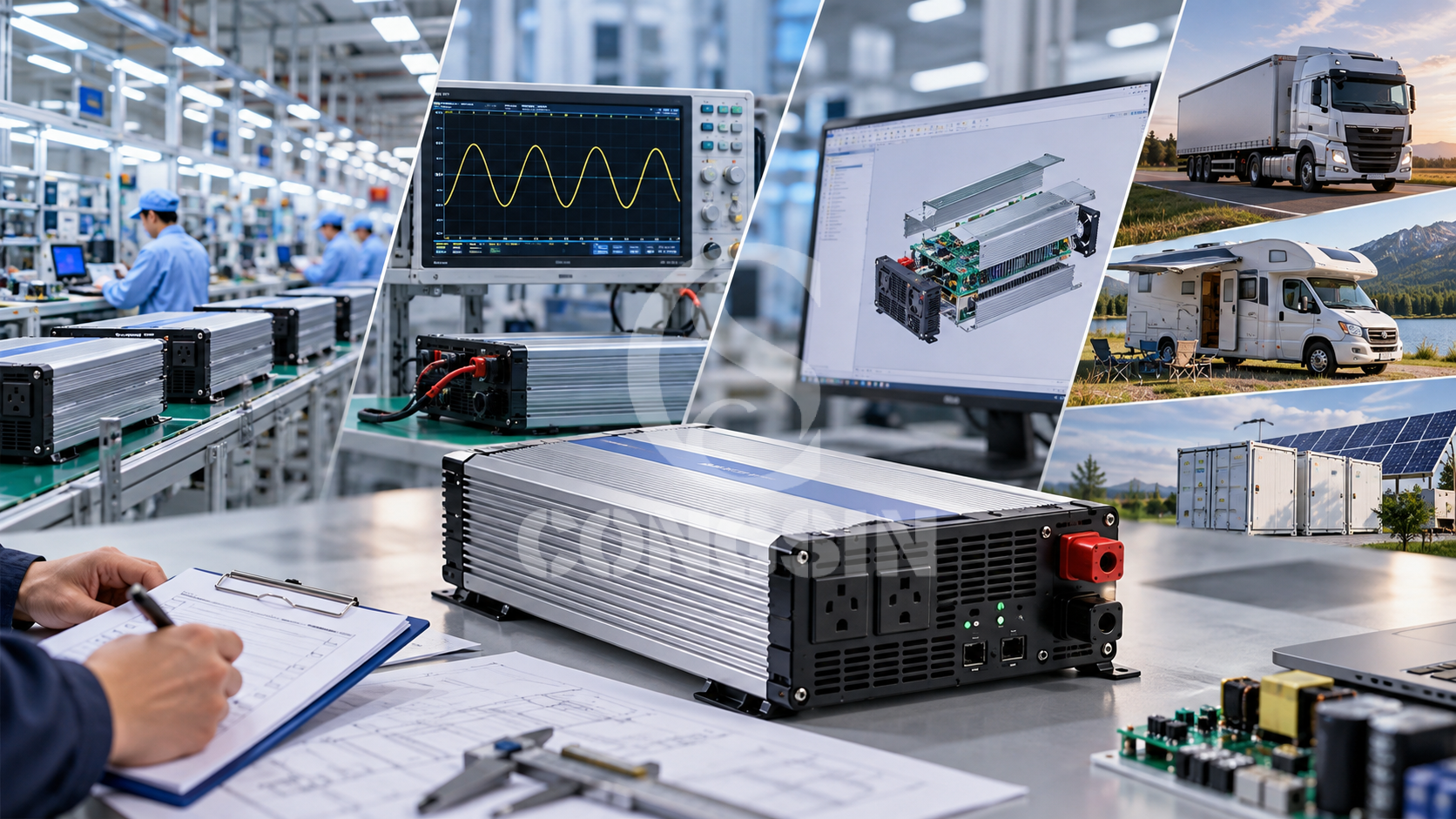
CONGSIN publicly presents automated production and testing resources, but project qualification should still confirm how the relevant model and revision are controlled through production.
Verify Repeatability Across Production Runs
Manufacturing capability becomes commercially valuable when the approved configuration can be repeated.
The qualification review therefore needs to look beyond equipment and determine whether the same product definition can be maintained across later production lots and repeat orders. For a distributor, uncontrolled revisions can create stock, warranty and after-sales problems. For a system integrator, product variation can affect system compatibility. For an OEM or institutional buyer, undocumented changes may create technical or compliance risk.
Repeatability depends on keeping the approved product version identifiable throughout production. The buyer should be able to connect the approved technical baseline to the production process, inspection basis and released product without relying on visual similarity or a commercial model name alone.
This is a stronger indicator of manufacturing readiness than factory size by itself.
3. Evaluate Test Capability Through Traceable Evidence
Testing capability is an important part of evaluating a pure sine wave inverter manufacturer, but the existence of test equipment does not by itself prove that a particular product has been tested under meaningful conditions.
The qualification process should therefore distinguish potential capability from product-specific evidence.
Separate Available Equipment From Product-Specific Evidence
Electrical instruments, load equipment, burn-in capability and multifunctional test systems show what a factory may be able to evaluate. For procurement purposes, however, useful evidence needs to answer a different question: what was tested on the proposed product, under which condition, against which acceptance criteria, and what record connects the result to that product?
Test Claim → Test Condition → Acceptance Criteria → Traceable Record
Depending on the applicable model and quality plan, the evidence may involve functional performance, load behavior, waveform characteristics, protection response or thermal behavior. The purpose of this article is not to prescribe the detailed test sequence. The buyer only needs enough information at the manufacturer-qualification stage to determine whether test claims can be verified.
Detailed incoming inspection, burn-in, load testing and final-release logic is covered separately in the Pure Sine Wave Inverter Quality Control Framework.
Link Test Evidence to the Product Revision
Test evidence is most useful when it follows the actual product revision.
Product Revision → Test Basis → Test Record → Release Decision
If the design changes, earlier test evidence may need to be reviewed. Electrical, thermal, housing or interface changes can alter the validity of previous results, depending on what has changed and which product characteristics are affected.
The appropriate response is not to assume that every change requires a complete retest, nor to assume that previous evidence remains valid automatically. The manufacturer should be able to identify the change, assess its technical impact and determine whether additional verification is required.
That ability is a stronger sign of controlled manufacturing than a broad statement that every inverter is “strictly tested.”
4. Qualify Customization and Change Control
Customization is often marketed as a list of available options, but B2B buyers should evaluate it as a change-control capability.
The important question is not simply whether the manufacturer can modify the product. The qualification review should determine whether the requested change can be evaluated, validated where necessary and incorporated into a clearly identifiable approved revision.
Classify the Change Before Approving It
Customization can be grouped into several levels of technical impact. A branding or documentation change may affect labels, manuals, packaging or artwork while leaving the electrical platform unchanged. A mechanical or interface change may influence fit, assembly, connector selection, thermal behavior or system integration. An electrical or firmware change may affect a wider part of the product definition and may require additional engineering review or validation.
Requested Change → Engineering Impact → Validation Requirement → Approved Revision
This avoids treating all OEM requests as equivalent. It also gives the buyer a more realistic basis for comparing manufacturers, because two suppliers may both say they support customization while applying very different levels of engineering control.
Keep the Customized Version Identifiable
Once a customized configuration is approved, the resulting version should remain identifiable through sample approval and production.
The specification, approved sample, relevant labels or packaging, applicable test basis and production reference should all point to the same revision. The goal is to prevent the buyer from approving one configuration while later production gradually shifts to another.
Customization Request → Approved Revision → Validation Evidence → Production Baseline
CONGSIN's current site information confirms OEM/ODM, private-label and customization support at the company level. The exact scope of electrical, mechanical, firmware, interface or tooling changes still needs to be confirmed for the relevant platform.
Buyers requiring a deeper product-development process can review the OEM/ODM Customization information and the OEM Pure Sine Wave Inverter Development Roadmap. Those pages cover the execution of customization in more detail; the purpose here is only to determine whether the manufacturer has enough control to become a suitable project partner.
5. Verify Sample-to-Production Transfer
A successful sample proves that a manufacturer can build at least one acceptable unit. It does not yet prove that the same version can be reproduced consistently in volume production.
For that reason, sample approval should lead to a controlled production baseline rather than directly to an assumption of supplier qualification.
Approved Requirement → Sample Evidence → Production Baseline → Repeat Order
After the sample is accepted, the manufacturer should be able to convert the approved configuration into a controlled technical and production package. The buyer does not need every internal factory document, but there should be a clear relationship between the approved sample and the version intended for production.
This stage is especially important when development involved multiple changes. Without a defined production baseline, the final sample can become an informal reference while later manufacturing relies on a different revision or incomplete set of assumptions.
Long-term qualification also depends on how changes are managed after approval.
Current Revision → Proposed Change → Impact Review → Validation → New Revision
A component substitution, connector change, documentation update or new feature does not automatically mean the product has become unacceptable. The important question is whether the change is visible, assessed for impact, verified where necessary and incorporated into a newly approved version.
This is one of the clearest differences between a supplier that can deliver an initial sample and a manufacturing partner that can support repeat production.
6. Confirm Supply Continuity and Commercial Fit
Technical qualification must eventually connect to the real purchasing program.
Production capacity, order quantity, forecast, customization level, testing requirements and delivery schedule all influence whether a technically capable manufacturer is commercially suitable for the project.
Capacity is only meaningful when it refers to the actual product, configuration and order profile. A general factory-capacity number does not automatically indicate how much of that capacity is available for a specific customized inverter, especially when additional testing, documentation or production preparation is required.
The buyer should therefore align the target configuration, expected quantities, purchasing pattern and required schedule before comparing production readiness.
Commercial terms should be normalized in the same way.
Technical Scope → Production Scope → Commercial Scope
Price, MOQ, tooling, sample charges, lead time and warranty conditions only become directly comparable when different manufacturers are quoting the same technical and production assumptions.
A lower price can otherwise represent a different configuration, test basis, documentation package or customization scope rather than a genuine commercial advantage.
This stage does not require the article to define acceptable MOQ or lead-time targets. Those values remain project-specific. The objective is simply to ensure that the commercial quotation describes the same product the buyer has technically qualified.
7. Approve the Pure Sine Wave Inverter Manufacturer With Evidence
At the final stage, supplier qualification should consolidate the evidence into one approval decision.
The goal is not to identify the factory with the longest capability list. It is to determine whether the proposed product, manufacturing process, test evidence, customization controls and commercial assumptions all refer to the same approved baseline.
| Qualification Gate | Evidence to Review | Approval Question |
|---|---|---|
| Product fit | Proposed platform and adaptation scope | Does the platform fit the application? |
| Engineering control | Controlled technical inputs | Can requirements become one stable product definition? |
| Production control | Revision-linked production basis | Can the approved version be repeated? |
| Test evidence | Conditions, criteria and records | Are performance claims traceable? |
| Change control | Impact and validation process | Can customization remain controlled? |
| Production transfer | Approved sample and production baseline | Can the sample move into repeat production? |
| Supply continuity | Program-specific capacity and change handling | Can repeat orders remain stable? |
| Commercial fit | Configuration-linked quotation | Do technical and commercial assumptions match? |
A manufacturing partner is qualified when product fit, engineering control, test evidence, customization control and repeat-production capability point to the same approved product baseline.
This is a stronger basis for B2B sourcing than comparing factory size, brochure specifications or quoted price alone.
Broader company-level manufacturing and quality information can be reviewed on the Quality & Reliability page, while available certification information is listed in the Certificates section. Certification applicability and supporting evidence should still be matched to the relevant inverter model and destination market.
Frequently Asked Questions
What should buyers look for in a pure sine wave inverter manufacturer?
Buyers should look for alignment between product-platform fit, engineering control, production repeatability, traceable test evidence, customization management and production readiness. Equipment and price matter, but approval is stronger when these capabilities all relate to the same defined product configuration.
How can buyers verify a manufacturer's testing capability?
Testing capability should be evaluated through product-specific evidence rather than equipment alone. Buyers should confirm the relevant product revision, test condition, acceptance criteria and available record. The exact test scope depends on the proposed model and project requirements.
Does a certificate prove that a manufacturer is suitable?
No. A certificate can provide useful quality-system or product-compliance evidence, but it does not by itself establish suitability for a particular sourcing program. Buyers still need to confirm the applicable product, certification scope, engineering capability, production control and testing evidence.
How should OEM customization be evaluated?
OEM customization should be treated as a controlled engineering change. Buyers should determine how the requested modification affects the approved specification, validation requirement, product revision and production baseline. More technically significant changes generally require a more detailed impact review.
What should be confirmed before volume production?
Before volume production, the buyer should confirm the approved configuration, sample or reference unit, applicable test evidence, production baseline, revision control and commercial scope. Model compatibility, customization feasibility, testing, certification applicability, MOQ, capacity, lead time and commercial terms should be confirmed for the actual project.
Discuss Your Pure Sine Wave Inverter Manufacturing Requirements
For distributors, system integrators, engineering companies, transportation and outdoor partners, and professional or commercial buyers, manufacturer qualification is most effective when the project baseline is defined before volume production.
Share the target application, DC input and AC output, expected continuous and startup load, destination market, proposed product or platform, customization scope, purchasing quantity, sample status and any testing or documentation requirements.
CONGSIN can then discuss the appropriate platform fit, required adaptation, relevant test evidence, customization path, sample and production readiness, and the commercial quotation basis for the project.
Model compatibility, customization feasibility, testing scope, certification applicability, MOQ, capacity, lead time and commercial terms should be confirmed for the actual project.


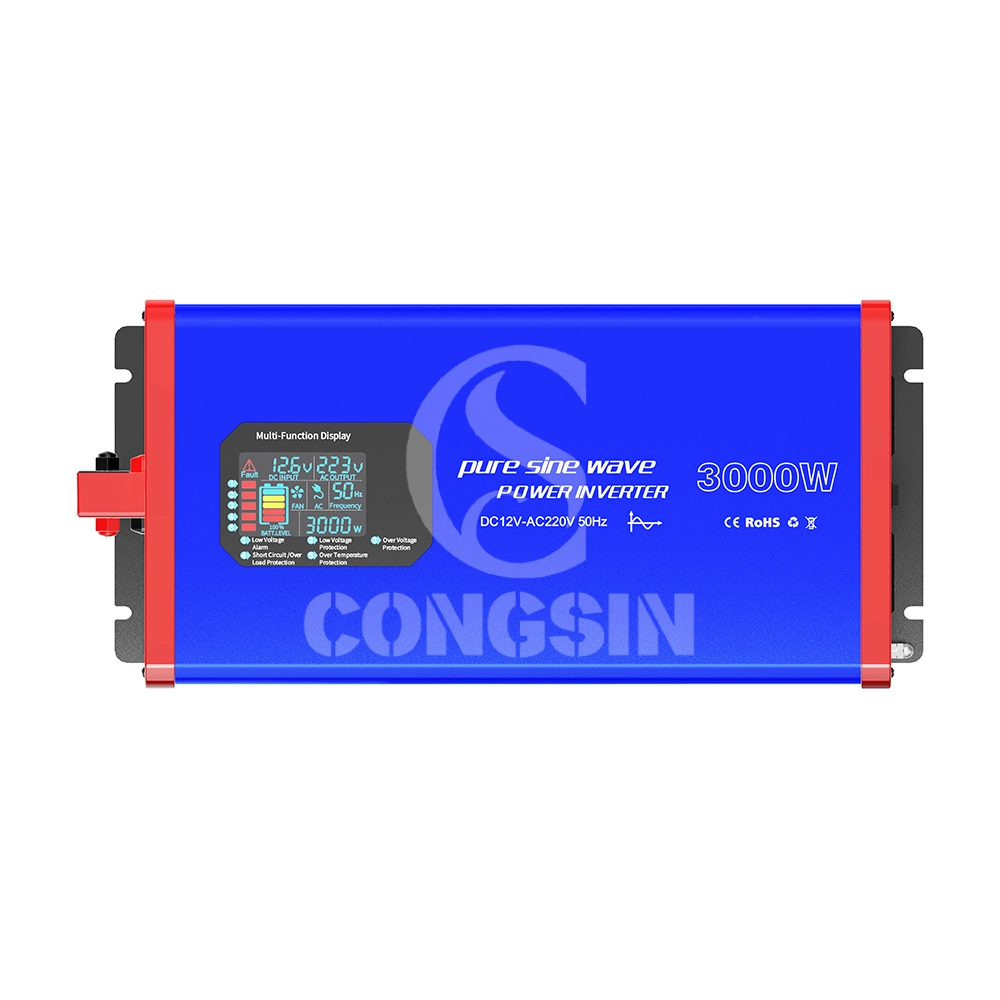
This 3000W full-power pure sine wave inverter (Model: CS3000PSW) adopts pure sine wave output technology (waveform distortion rate <2%), and the output power is highly consistent with mains power quality. It can safely drive high-power precision loads such as air conditioners, refrigerators, medical instruments, and small industrial equipment, avoiding equipment malfunctions or shortened service life caused by unstable waveforms. The device supports DC 12V input (compatible with 10.5V-14.8V wide voltage), continuously outputs 3000W full power, and has a peak power of 6000W, easily coping with the instantaneous startup impact of high-power devices; it is equipped with 4 AC universal sockets (max current 16A) + 2 USB 3.0 fast-charging ports (22.5W per port) to meet the simultaneous power supply needs of multiple devices. Built-in six-fold safety protection (overload, overvoltage, undervoltage, short circuit, overtemperature, reverse connection), combined with dual intelligent silent cooling fans (noise ≤45dB), it achieves the triple advantages of "high power + high safety + low noise," suitable for home emergency, outdoor engineering, vehicle-mounted power supply, small industrial scenarios and other fields.
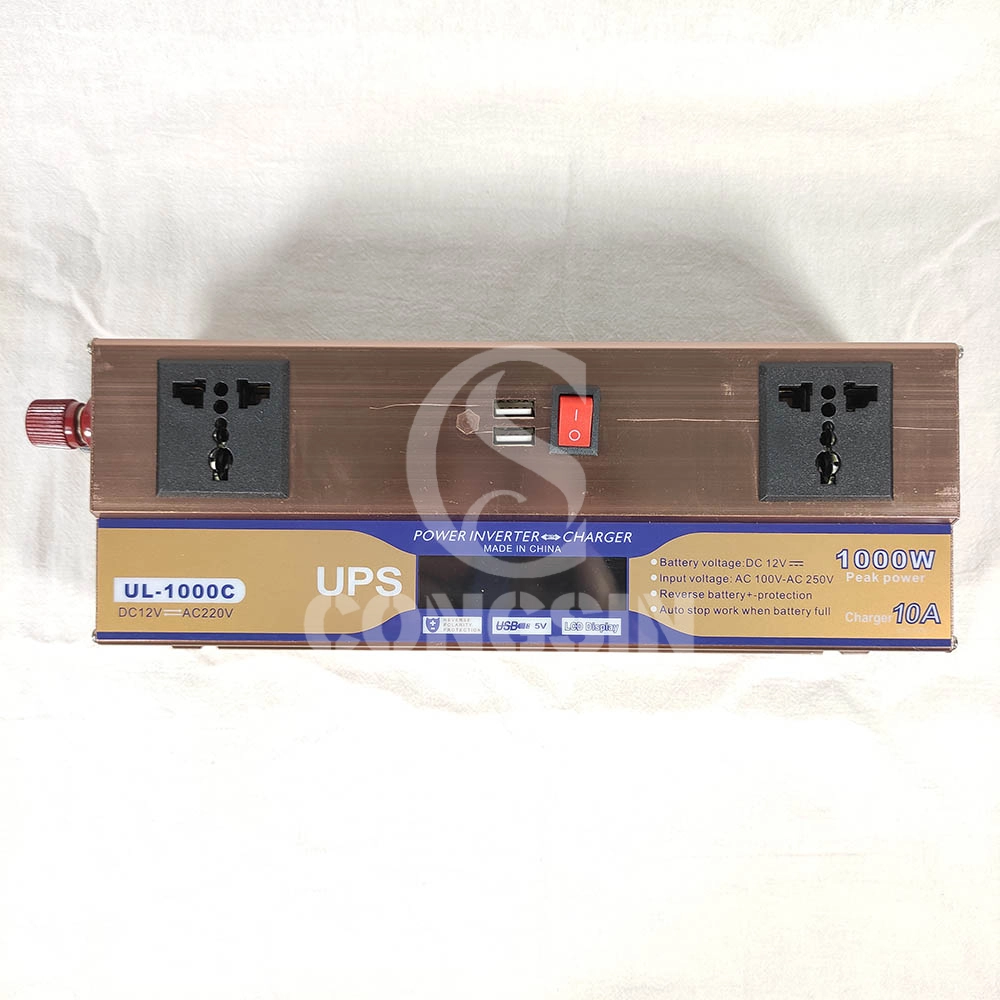
This 1000W modified sine wave inverter has UPS charging function, with DC12V input and AC220V output, and 600W rated power. Equipped with dual universal sockets, two USB ports, an LCD display, and a battery clip, it is professionally designed and has stable performance. It can provide stable AC power conversion and UPS emergency power supply for computers, small home appliances, electronic devices, etc. in home emergency, office, outdoor and other scenarios, meeting the needs of simultaneous power supply and emergency power supply for multiple devices.
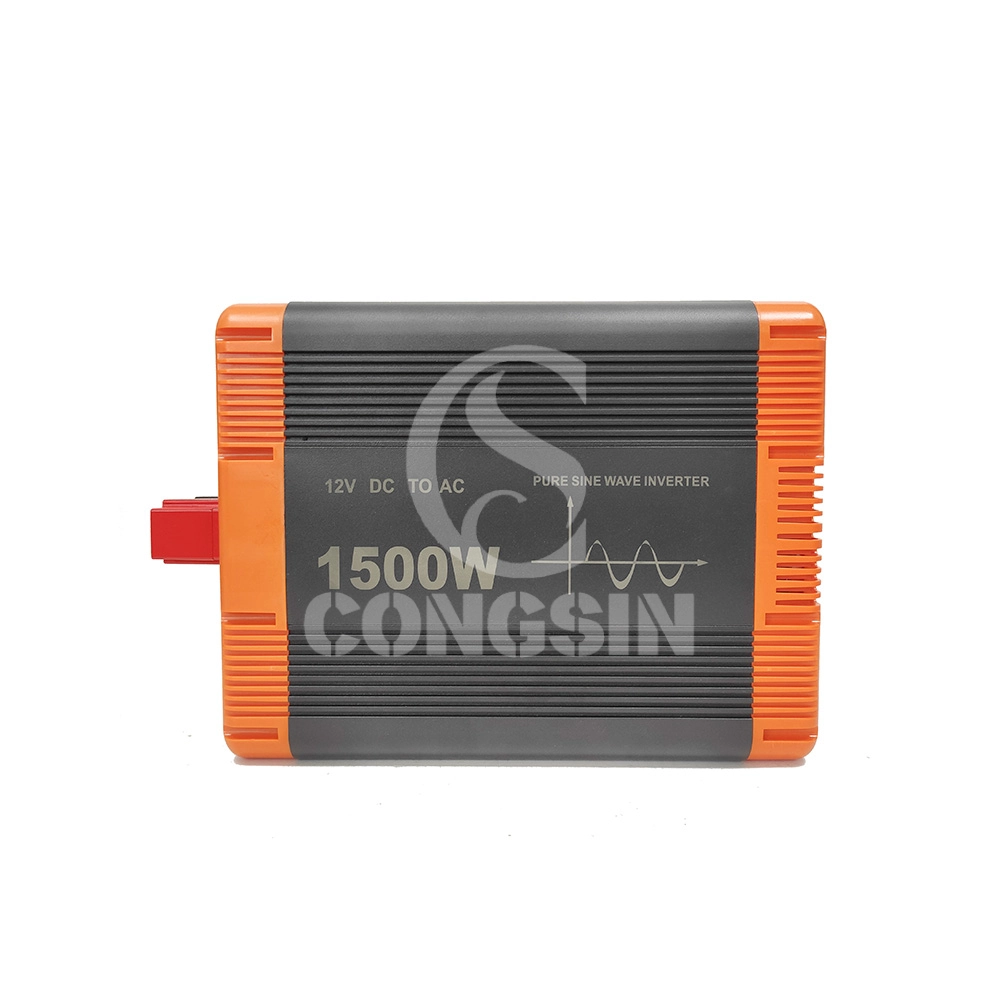
This 1500W pure sine wave inverter converts DC 12V to AC 220V power, with a rated power of 1500W and a peak power of 3000W. Equipped with dual fans, LCD display, QC3.0 and PD Type-C fast charging ports, and remote control capability for stable and intelligent power output.
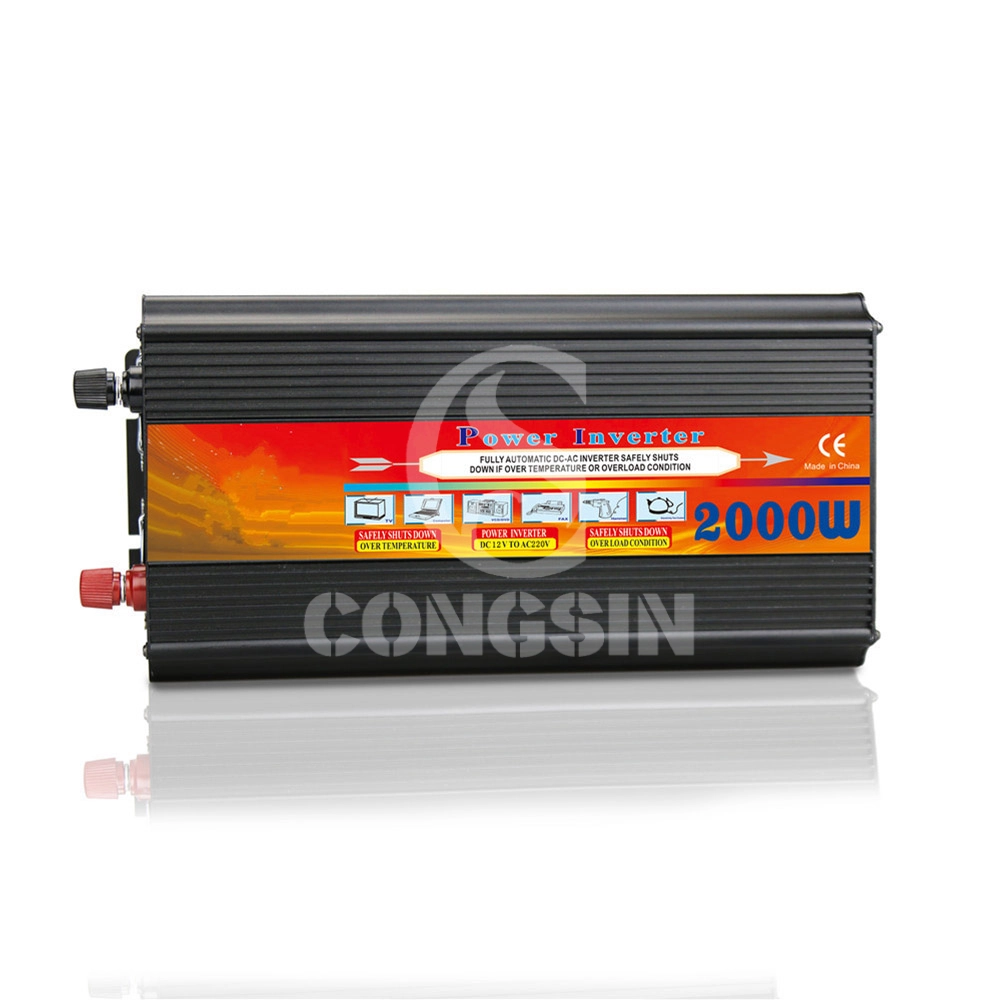
Our CS2000BIG 2000W modified sine wave inverter is a high-power power conversion device that converts DC 12V from batteries into AC 220V electricity. It is designed for heavy-duty use, featuring 2 AC sockets to power multiple high-power devices simultaneously, 2 cooling fans for efficient heat dissipation, and battery terminal wire for stable connection. With its robust construction and large capacity, it is an ideal solution for powering tools, appliances, and equipment in various scenarios, from industrial use to home emergencies.
Get in Touch with Our Team
You can also communicate with us directly through our online contact form. Please fill in the following information, and our team will contact you as soon as possible after receiving your message.

CONGSIN is a trusted OEM factory for power inverters, solar charge controllers, and DC converters. Reliable solutions for global B2B buyers.
 High Quality
 7/24 Service
 Guaranteed Warranty
© 2025 Congsin. All Rights Reserved.
 WeChat
 Scan QR Code
sin cong
teaimei10
Whatsapp: +8618028086791
Scan QR Code