



Pure Sine Wave Inverter Certification: Compliance Evidence by Market
- Quick Answer
- 1. Verify Pure Sine Wave Inverter Certification in Six Steps
- 2. Match the Compliance Route to the Destination Market
- 3. Understand What Each Compliance Document Can — and Cannot — Prove
- 4. Verify the Exact Model and Current Revision
- 5. Reassess Compliance Evidence When the Product Changes
- 6. Give the Supplier Enough Information to Return Useful Compliance Documents
- Frequently Asked Questions
- Request Compliance Documents for Your Inverter Project
Quick Answer
Pure sine wave inverter certification is not one universal certificate covering every market or model. B2B buyers should verify the destination market, exact product function, applicable compliance route, supporting declaration or test evidence, model coverage and current product revision before approving an inverter for import, integration or commercial supply.
The objective is to build a traceable compliance evidence chain rather than collect certification logos. A document becomes useful only when the buyer can connect it to the exact commercial configuration being purchased and confirm that later hardware, firmware, enclosure, interface or OEM changes have not invalidated that relationship.
Exact Product → Destination Market → Applicable Route → Supporting Evidence → Model Coverage → Revision Review → Buyer Approval
This guide is a cross-market compliance-verification Hub. Detailed EU/EEA, U.S./Canadian, vehicle and architecture-specific requirements should be reviewed in the relevant regional or technical guidance rather than treated as one global certification checklist.

1. Verify Pure Sine Wave Inverter Certification in Six Steps
Step 1 — Identify the Exact Product
Start with the actual inverter proposed for commercial supply. Record the exact model number, rated and surge power, DC input, AC output voltage and frequency, socket or terminal configuration, enclosure, communication functions and other relevant interfaces. Hardware or firmware revision should also be identified where those details affect the configuration being reviewed.
This baseline matters because compliance evidence belongs to a defined product configuration. Two products may share the same brand, enclosure or family name while using different power electronics, filtering, firmware or interfaces. Different commercial names can also refer to technically related platforms.
The first approval question is not “Does the supplier have a certificate?” It is “What exact product is this document supposed to cover?”
For a current product platform, buyers can first review the Pure Sine Wave Inverter Product Range and then request documentation for the exact configuration under consideration.
Step 2 — Confirm the Destination Market
Next, define where the product will be imported, sold or integrated. A generic request for CE, FCC, UL, RoHS and other familiar acronyms is not an effective compliance strategy because the applicable route depends on the destination market, product classification and intended function.
A standalone DC-to-AC inverter can face a different review from a radio-enabled inverter, vehicle product, inverter-charger or another multifunction product.
Exact Configuration + Destination Market + Intended Function → Compliance Scope
For multi-market programs, create a separate requirement baseline for each destination rather than assuming that one document package automatically satisfies every region.
Step 3 — Determine the Applicable Compliance Route
“Certification” is useful buyer language, but not every conformity system uses a third-party certificate.
For the EU/EEA, the European Commission explains that CE marking applies where relevant EU legislation requires it. Manufacturers are responsible for identifying applicable requirements, preparing technical documentation and drawing up the EU Declaration of Conformity. Buyers can review the European Commission CE marking guidance for the official framework.
For the United States, FCC equipment authorization can involve Supplier’s Declaration of Conformity or Certification depending on the equipment category. Buyers should therefore determine the correct authorization route before treating “FCC certification” as a universal requirement. The FCC equipment authorization material provides the official regulatory context.
For Canada, applicable ISED and ICES requirements should be reviewed according to the equipment category. Supporting records can include test reports, labeling and user-manual information where applicable. Buyers can consult ISED ICES-Gen General Requirements.
The useful question is not “Which certifications are popular in this industry?” It is “Which conformity route actually applies to this exact product in this destination market?”
Step 4 — Request Supporting Evidence
Once the route is understood, request documents that support that specific conformity basis. Depending on the product and destination market, evidence can include:
- declaration or conformity statement;
- supporting test report;
- authorization, certification or listing record where applicable;
- model or variant list;
- rating label;
- user manual;
- product technical information;
- critical-component information where relevant;
- change-control or revision records.
A company-level quality-system certificate can support supplier qualification but should not be treated as exact-product market-access evidence.
CONGSIN’s public Certificates page identifies document No. TST20220503108-45C as an FCC-related record. Buyers relying on that record should request the underlying declaration and supporting test report to verify the tested model, additional model coverage, applicable standard and current product revision.
Document existence is the beginning of verification, not the end.
Step 5 — Verify Model and Revision Coverage
The next step is to compare the commercial SKU with the configuration represented by the evidence. Useful checks can include the model number, rated and surge power, DC input, AC output voltage and frequency, PCB or hardware revision, plug or socket configuration, enclosure, firmware where relevant, wireless or communication module, critical components, production revision and OEM or private-label identity.
A document that lists one main model and several additional models can legitimately support a model family when the scope or technical basis justifies the relationship. Model-family coverage should be supported by the document scope, underlying test evidence or other controlled technical records rather than inferred from product similarity alone.
Commercial SKU → Current Technical Configuration → Tested Configuration → Evidence Scope
This chain is often more important to a B2B buyer than the certification logo itself.
Step 6 — Review Changes Before Project Approval
Compliance evidence should be reviewed when the product changes in a way that could affect the original basis. This does not mean every modification automatically requires complete recertification. Instead, the change should be classified and its technical impact reviewed.
Changes to PCB design, filtering, power devices, enclosure, connectors, firmware, wireless functions or other critical elements may require reassessment or additional testing depending on the market and conformity route.
Existing Evidence → Product Change → Technical Impact → Compliance Impact → Evidence Review → Updated Baseline
The final project decision should apply to one defined product revision, not an undefined product family.
2. Match the Compliance Route to the Destination Market
The following matrix is an initial routing tool. It does not mean that every inverter automatically requires every item shown.
| Market / Application | Initial Route to Check | Typical Evidence | What Buyers Must Confirm |
|---|---|---|---|
| EU/EEA | Applicable CE-related requirements | EU Declaration of Conformity, technical documentation and supporting test evidence | Applicable legislation, standards, exact model and current revision |
| United States | Applicable FCC equipment-authorization route | SDoC or Certification evidence where applicable, supporting test report and compliance information | Device classification, responsible party, authorization route and model coverage |
| Canada | Applicable ISED / ICES requirements | Test report, compliance label and user-manual records, plus other evidence where applicable | Applicable ICES standard, product category, model identity, labeling and retained evidence |
| Vehicle / Mobile Use | Destination-market and vehicle/application requirements | Relevant EMC, safety, installation and product records | Vehicle use, electrical platform, installation method and applicable market scope |
For EU/EEA projects, use the EU/EEA Pure Sine Wave Inverter Documentation Guide for the deeper CE documentation chain.
For U.S. and Canadian EMC planning, use North American EMC Planning to review classification, evidence responsibility and representative test configuration.
For vehicle programs, use the Car Inverter Compliance Guide.
For architecture-specific compliance questions involving high-frequency inverter designs, refer to the High-Frequency Inverter Compliance Guide.
Need help identifying the documentation route for a specific market? Send the destination country and exact inverter configuration before requesting a generic certificate package.
3. Understand What Each Compliance Document Can — and Cannot — Prove
Different documents answer different compliance questions. A strong evidence file is not simply a folder containing as many certificates as possible.
| Document | What It Can Demonstrate | What It Does Not Automatically Prove |
|---|---|---|
| ISO 9001 certificate | Quality-management system status within the defined certification scope | Exact-product market compliance |
| Declaration of Conformity | Manufacturer or responsible-party declaration against identified requirements | Automatic coverage of every model or later revision |
| Test report | Test results for identified samples and test configurations | That current production is technically unchanged |
| Certificate / approval / listing | Defined product and conformity scope under the applicable scheme | Acceptance in every country or application |
| Model list | Relationship between explicitly named models | Technical equivalence without supporting scope or engineering evidence |
| Product label / manual | Market-facing product identity and required information | That the underlying technical testing is adequate by itself |
ISO 9001 can support evaluation of a supplier’s quality-management system, but it does not replace product-specific market compliance evidence.
Likewise, a test report can show what was tested and under which conditions, but it does not prove that the current production unit is identical to the original sample.
For EU/EEA projects, the official CE framework connects the manufacturer’s responsibility with applicable requirements, technical documentation and the Declaration of Conformity. These records should remain aligned with the actual product as relevant conditions change.
4. Verify the Exact Model and Current Revision
The evidence review only becomes useful when the documents can be mapped to the commercial inverter. At minimum, compare the current product with the information available in the declaration, report, certificate, authorization record or model list.
- model number;
- PCB or hardware revision;
- rated power;
- DC input voltage;
- AC output voltage and frequency;
- plug, socket or terminal version;
- enclosure;
- firmware;
- wireless or communication module;
- critical components where relevant;
- production date or controlled revision;
- private-label or OEM identity.
Not every project requires the same level of technical disclosure. The level of review should reflect the product, market and evidence being relied upon. The important point is traceability.
If a report was created for one model, the buyer should establish why it applies to another. If a private-label SKU maps to a standard manufacturer model, that relationship should be controlled. If the product has changed since testing, the change should be reviewed rather than silently assuming that the original record remains representative.
Similar appearance, shared branding or inclusion in one product family does not by itself establish compliance coverage.
Model-family coverage can be valid, but the relationship should be supported by the document scope, report or controlled engineering basis.
5. Reassess Compliance Evidence When the Product Changes
Product changes should be evaluated according to impact rather than by an automatic “re-certify everything” rule.
| Change Level | Examples | Recommended Review |
|---|---|---|
| Lower impact | Packaging, color or non-technical label layout | Document the change and confirm that the controlled technical configuration is unchanged |
| Medium impact | Plug/socket option, interface, enclosure detail, manual or commercial model naming | Recheck declarations, labels, model mapping and affected evidence |
| Higher impact | PCB, power devices, filtering, electrical architecture, firmware, wireless module or other significant technical changes | Perform a technical compliance-impact assessment and determine whether updated documentation, justification or additional testing is required |
These are project-control categories rather than universal legal classifications. A change that appears minor commercially can still matter technically. An enclosure change can affect EMC or thermal performance. Firmware can be irrelevant to one requirement but significant to another. A new radio function can introduce a different conformity route.
Assess the effect of the change on the evidence basis, then determine whether reassessment or additional testing is required.
Existing evidence should not be discarded automatically, but it should not be carried forward automatically either.
6. Give the Supplier Enough Information to Return Useful Compliance Documents
Many low-quality compliance inquiries begin with “Please send your certificates.” That usually gives the supplier too little information to determine which product, market or evidence package actually matters.
Before Requesting Compliance Documents, Provide:
- exact model number or candidate platform;
- rated and surge power;
- DC input specification;
- AC output voltage and frequency;
- plug or socket version;
- destination country or countries;
- intended application;
- installation environment where relevant;
- required delivery or project timing;
- current hardware revision where available;
- current firmware revision where relevant;
- wireless or communication functions;
- OEM or private-label changes.
Then Request the Evidence Relevant to the Project
- Declaration of Conformity or other conformity statement;
- supporting test report;
- model or variant list;
- product label;
- user manual;
- critical-component information where relevant;
- authorization, certification or listing record where applicable;
- change-control or revision statement.
The objective is not to demand every document the supplier has. It is to answer three questions:
Does the evidence belong to this market?
Does it belong to this model?
Does it still represent the current version?
Those three questions provide a stronger basis for supplier qualification than a generic certificate package.
Frequently Asked Questions
Does every pure sine wave inverter need the same certifications?
No. The applicable requirements depend on the destination market, product classification, functions and intended application. Some markets use manufacturer declarations, technical documentation, test reports, equipment authorization, listings or other conformity mechanisms rather than one universal certificate. Buyers should first define the exact product and market before deciding which documents are required.
What documents should a B2B buyer request for inverter certification verification?
Request the evidence associated with the applicable compliance route. Depending on the project, this can include a declaration, test report, certification or authorization record where applicable, model list, rating label, user manual and relevant technical or change-control information. Quality-system certificates can support supplier qualification but should not be treated as exact-model market-compliance evidence.
How can buyers confirm that a certificate or test report covers the exact inverter model?
Compare the commercial model with the product identity and scope represented in the evidence. Review model numbers, electrical configuration, rated power, hardware revision, enclosure, connectors, firmware or wireless functions where relevant. If several models are covered by one report or record, the relationship should be supported by the document scope or other controlled engineering evidence.
Can one compliance document cover several inverter models or wattage variants?
Potentially. One test program or conformity record can sometimes support multiple models when the scope and engineering relationship justify that coverage. Buyers should not infer coverage merely from a shared brand, enclosure or product-family name. The model relationship should be traceable to the report, declaration, authorization scope or controlled technical justification.
When should inverter compliance evidence be reviewed after a product change?
Review it whenever a change could affect the product identity or technical basis represented by existing evidence. Changes to PCB design, filtering, power electronics, enclosure, firmware, radio functions, connectors or other relevant components may require reassessment, updated documentation, engineering justification or additional testing depending on the applicable market and compliance route.
Request Compliance Documents for Your Inverter Project
A useful compliance-document request begins with the exact product and destination market.
For project review, provide:
- destination market;
- product model;
- input voltage;
- output voltage and frequency;
- rated power;
- intended application;
- required document or compliance route if already known;
- plug or socket configuration;
- relevant interfaces;
- OEM/private-label changes;
- current hardware or firmware revision where available;
- estimated quantity or project scale where relevant.
Where an existing declaration, certificate or test report is being relied upon, also provide the document number and identify the model or revision it is expected to cover.
Request Model-Specific Documents
The final compliance route, document applicability, model-family coverage, responsible-party requirements, test scope and revision status should be confirmed for the actual product and destination market before the documentation is accepted as the project baseline.


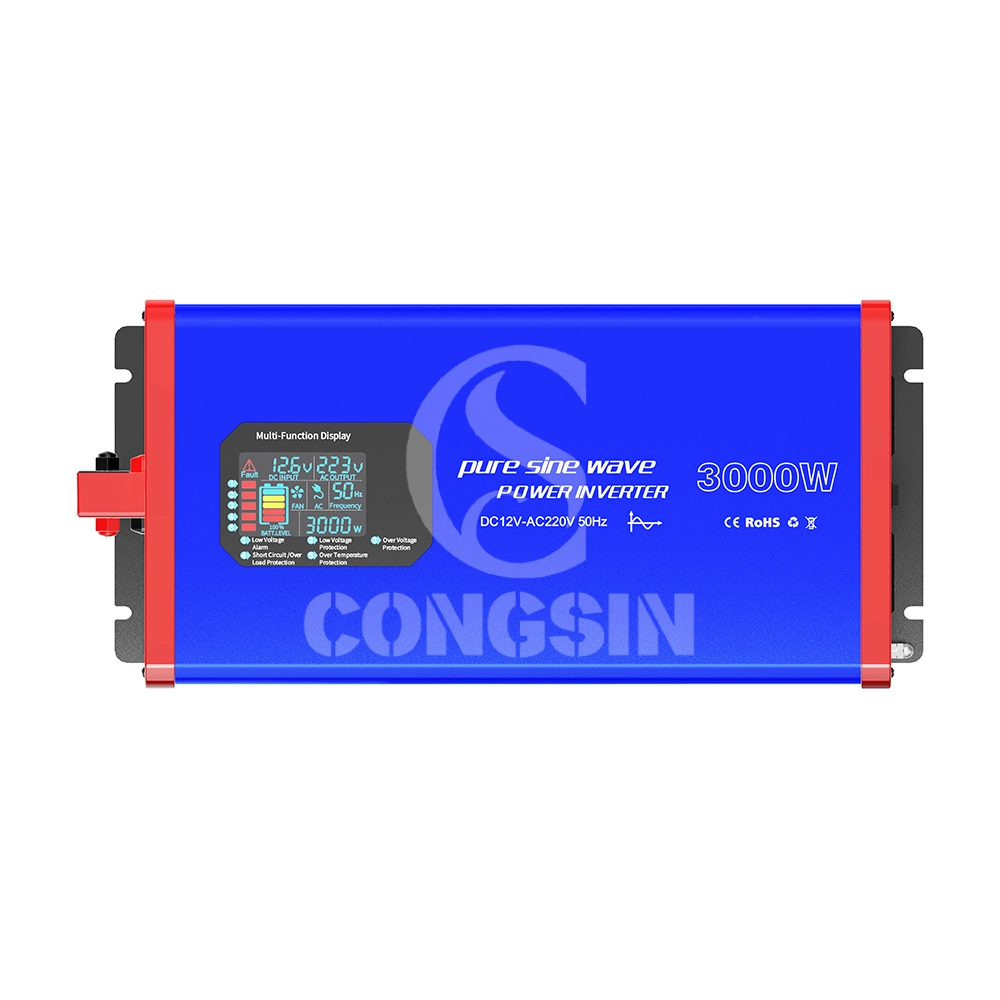
This 3000W full-power pure sine wave inverter (Model: CS3000PSW) adopts pure sine wave output technology (waveform distortion rate <2%), and the output power is highly consistent with mains power quality. It can safely drive high-power precision loads such as air conditioners, refrigerators, medical instruments, and small industrial equipment, avoiding equipment malfunctions or shortened service life caused by unstable waveforms. The device supports DC 12V input (compatible with 10.5V-14.8V wide voltage), continuously outputs 3000W full power, and has a peak power of 6000W, easily coping with the instantaneous startup impact of high-power devices; it is equipped with 4 AC universal sockets (max current 16A) + 2 USB 3.0 fast-charging ports (22.5W per port) to meet the simultaneous power supply needs of multiple devices. Built-in six-fold safety protection (overload, overvoltage, undervoltage, short circuit, overtemperature, reverse connection), combined with dual intelligent silent cooling fans (noise ≤45dB), it achieves the triple advantages of "high power + high safety + low noise," suitable for home emergency, outdoor engineering, vehicle-mounted power supply, small industrial scenarios and other fields.
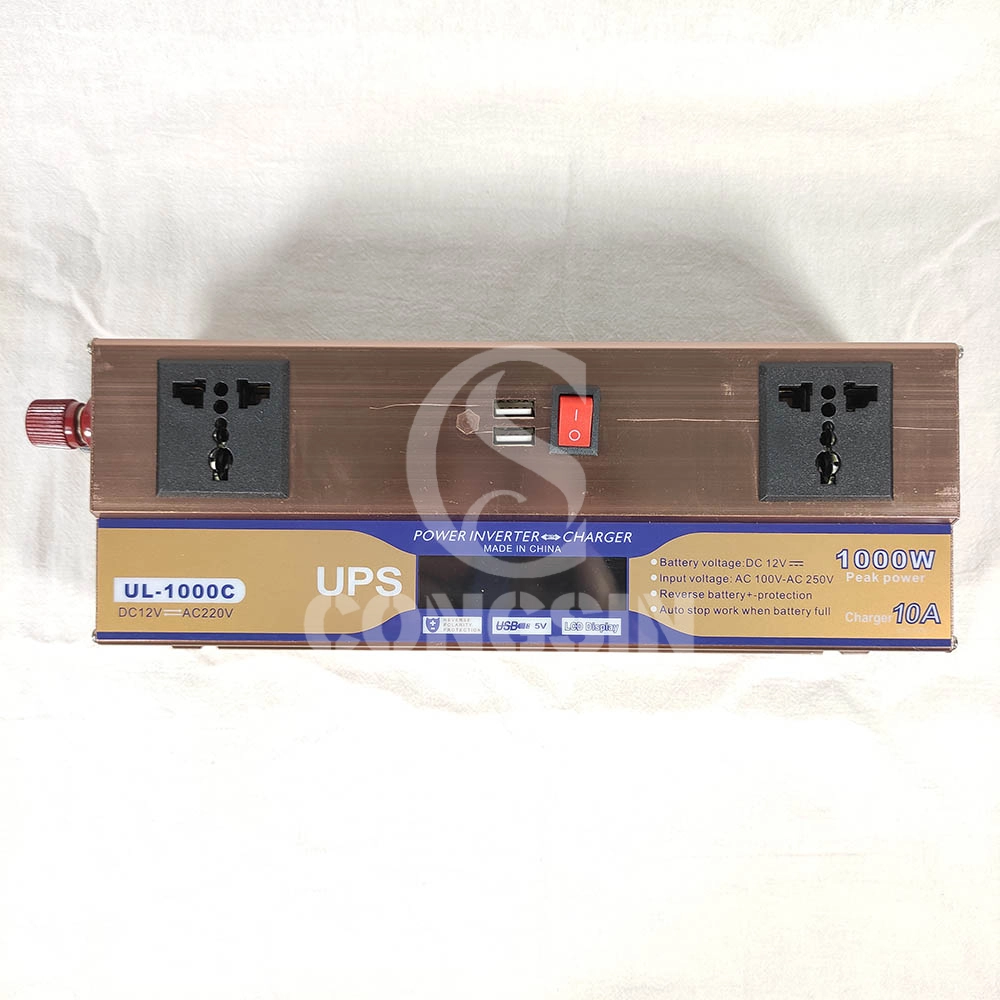
This 1000W modified sine wave inverter has UPS charging function, with DC12V input and AC220V output, and 600W rated power. Equipped with dual universal sockets, two USB ports, an LCD display, and a battery clip, it is professionally designed and has stable performance. It can provide stable AC power conversion and UPS emergency power supply for computers, small home appliances, electronic devices, etc. in home emergency, office, outdoor and other scenarios, meeting the needs of simultaneous power supply and emergency power supply for multiple devices.

This 1500W pure sine wave inverter converts DC 12V to AC 220V power, with a rated power of 1500W and a peak power of 3000W. Equipped with dual fans, LCD display, QC3.0 and PD Type-C fast charging ports, and remote control capability for stable and intelligent power output.

Our CS2000BIG 2000W modified sine wave inverter is a high-power power conversion device that converts DC 12V from batteries into AC 220V electricity. It is designed for heavy-duty use, featuring 2 AC sockets to power multiple high-power devices simultaneously, 2 cooling fans for efficient heat dissipation, and battery terminal wire for stable connection. With its robust construction and large capacity, it is an ideal solution for powering tools, appliances, and equipment in various scenarios, from industrial use to home emergencies.
Get in Touch with Our Team
You can also communicate with us directly through our online contact form. Please fill in the following information, and our team will contact you as soon as possible after receiving your message.

CONGSIN is a trusted OEM factory for power inverters, solar charge controllers, and DC converters. Reliable solutions for global B2B buyers.
 High Quality
 7/24 Service
 Guaranteed Warranty
© 2025 Congsin. All Rights Reserved.
 WeChat
 Scan QR Code
sin cong
teaimei10
Whatsapp: +8618028086791
Scan QR Code