



Inverter Charger vs Standalone Inverter: System Configuration Comparison
- Introduction
- 1. Define Functional Responsibility in Each Architecture
- 2. Compare the Architectures Against Real Project Conditions
- 3. Qualify the Exact Equipment and Lock the System BOM
- 4. Convert the Architecture Decision Into a B2B RFQ
- FAQ
- Request an Inverter-Charger vs Modular System Configuration Review
Quick Answer
An inverter-charger combines DC-to-AC inversion with AC battery charging in one product architecture, while a standalone inverter keeps DC-to-AC conversion independent and relies on separate equipment for charging, solar control, transfer or other functions when the project requires them.
For B2B buyers, the correct choice is not determined by integration alone. It depends on the charging source, installation constraints, transfer requirements, battery architecture, service model, expansion plan, spare strategy and configuration control.
An integrated system can reduce the number of separate functional units. A modular system can separate functional responsibility and allow individual subsystems to be selected or replaced independently. The final architecture should therefore be qualified as a complete system before the exact product or bill of materials is approved.
Introduction
The comparison between an inverter charger and a standalone inverter is often treated as a product-feature question. In a commercial project, it is more accurately a system architecture decision.
Both architectures can convert battery DC power into AC output. The real difference is how other responsibilities—especially AC battery charging, solar charging, transfer, monitoring and service—are distributed through the system.
In this guide, a standalone inverter means an inverter-only device responsible for DC-to-AC conversion. If the project also requires AC battery charging, MPPT solar charging, source transfer or monitoring, those functions are provided separately unless the selected system defines otherwise.
An inverter-charger combines the inverter function with AC battery charging. That definition should not be extended automatically to MPPT solar charging, automatic transfer, UPS operation, BMS communication or remote monitoring. Those are separate functions that must be confirmed for the exact equipment.
AC charging, MPPT solar charging and source transfer are not the same system function.
This page compares inverter-charger and inverter-only system architectures. It does not replace dedicated guidance for MPPT sizing, UPS topology, battery sizing or complete off-grid system design.
Detailed off-grid inverter-charger integration, lithium charging profiles, MPPT design and UPS transfer performance are handled in dedicated supporting guides; this page remains focused on architecture selection, functional ownership and BOM control.
The purpose of this page is therefore to answer a narrower B2B question: How should a commercial buyer choose between an inverter-charger architecture and a standalone inverter with separate power components, then convert that decision into a controlled system BOM and RFQ?
1. Define Functional Responsibility in Each Architecture
Every comparison should start from the common energy path:
Battery → Inverter → AC Loads
In both architectures, the inverter converts battery-side DC power into AC power for the approved loads.
The difference begins when the system needs functions beyond inversion.
In an inverter-charger architecture, the inverter function and AC battery-charging responsibility are concentrated in one product. When an external AC charging source is available, the system may therefore support a second energy path:
AC Source → Integrated Charger → Battery
This can reduce the number of separate devices that must be selected and interconnected when AC battery charging is already part of the project requirement.
A standalone inverter architecture distributes those responsibilities differently. The inverter remains responsible only for DC-to-AC conversion. If the battery must be charged from an AC source, a separate charger can be selected. If PV charging is required, a separate MPPT controller can be used. If source transfer is required, that function can be handled by independently selected equipment or another qualified system architecture.

| Function | Inverter-Charger Architecture | Standalone Architecture |
|---|---|---|
| DC-to-AC conversion | Integrated inverter function | Standalone inverter |
| AC battery charging | Integrated where supported | Separate charger |
| Solar charging | Separate unless specifically integrated | Separate controller where required |
| Transfer / bypass | Must be confirmed for the exact product | Separately defined or selected |
| Monitoring / communication | Confirm exact product support | Can be assigned independently |
| Function ownership | More concentrated | Distributed across components |
The value of the integrated architecture is therefore not that it automatically includes every power-management feature. It is that inversion and AC charging can be managed inside one defined product architecture.
Likewise, the value of a standalone system is not simply that it contains more boxes. It allows functions to be separated so that the inverter, charger, solar controller or transfer equipment can be selected and managed independently.
This affects both engineering and procurement.
When functions are concentrated in one unit, the buyer must qualify the exact integrated product version carefully because one model may carry responsibility for several system functions.
When functions are distributed, the buyer must qualify more electrical and functional interfaces because several devices must operate together as one system.
For example, adding a separate charger does not only add another component. It creates an additional battery-side charging interface that must match the battery requirements. Adding a separate MPPT controller creates another PV-to-battery interface. Adding an independent transfer device creates another operating function that must be coordinated with the inverter and AC source.
The main difference is how functional responsibility is assigned, not simply one box versus several boxes.
For projects beginning from an inverter-only architecture, buyers can review the current CONGSIN pure sine wave inverter range as one product direction before the other system functions are defined.
2. Compare the Architectures Against Real Project Conditions
Once the functional boundary is clear, the next question is how each architecture behaves under real project conditions.
A useful comparison should consider installation, service, expansion, repeatability and configuration control together rather than treating each as an isolated advantage or disadvantage.
Architecture Decision Matrix
| Decision Factor | Inverter-Charger | Standalone + Separate Components |
|---|---|---|
| Device count | Fewer functional units where AC charging is integrated | More independent components |
| Wiring | May reduce external functional interconnections | More interfaces require coordination |
| Installation | Can simplify layout where space and repeatability matter | More freedom to distribute components |
| Service | Integrated replacement strategy | Component-level replacement may be possible |
| Expansion | Defined by the product architecture | Individual functions can change independently |
| Spares | Integrated SKU strategy | Multiple component spares may be required |
| Configuration control | Lock the exact integrated version | Lock the complete BOM and interfaces |
| Typical fit | Stable, repeatable system requirements | Variable or independently managed functions |
Where a project consistently requires both inversion and AC battery charging, an inverter-charger may reduce the number of separate functional units. That can simplify equipment layout and reduce some external connections between the inverter and charger functions.
However, fewer devices do not remove normal installation requirements. Battery wiring, AC input, AC output, protection, isolation, conductor sizing and other installation details still need to follow the actual equipment documentation and project conditions.
A modular system normally exposes more interfaces. The inverter, charger, solar controller and any transfer equipment must be coordinated separately. This can add installation work, but it also creates clearer boundaries between the functions.
An integrated product concentrates several functions inside one unit. If a critical function requires repair, the project may need to consider whether the complete unit must be removed or replaced during service.
A modular architecture may allow one component to be serviced independently while other equipment remains unchanged.
That does not mean modular systems are automatically more reliable. Actual service performance depends on equipment quality, spare availability, field access, technician capability, replacement time and fault-isolation procedures.
How will the architecture be diagnosed, replaced and returned to operation when one function fails?
An integrated inverter-charger has an expansion path defined by the selected product architecture. If future requirements remain stable, this may provide strong configuration control and repeatability.
A modular architecture can allow individual functions to change more independently. A charger can be replaced without necessarily changing the inverter. A solar controller can be selected separately. A transfer function can be redesigned without redefining the complete inverter platform.
The advantage comes with an obligation: the complete BOM and all interfaces must remain controlled.
Integration reduces component count; modularity separates functional ownership.
When Integration Fits the Project
Integration becomes more valuable when AC battery charging is consistently required, installation space matters, the configuration will be repeated, and the buyer prefers fewer separate functional units.
This can be especially relevant for distributor or OEM programs where a defined DC version, AC version, charging requirement and market configuration can be standardized in advance.
But integration is not a goal by itself. If the integrated charger does not match the battery requirement, or if another required system function is missing, the product is still unsuitable regardless of how many components it replaces.
When Functional Separation Fits the Project
Functional separation becomes more valuable when the charging requirement varies, the solar controller must be selected independently, transfer behavior requires independent control, different battery platforms are used, or service teams want component-level replacement.
It can also support projects where one standalone inverter platform is reused across several configurations.
The inverter can remain common while the surrounding architecture changes. That flexibility can be valuable for system integrators and distributors, but the interfaces must be managed carefully because flexibility without configuration control can create inconsistent system combinations.
Selected transportation, RV, mobile and remote battery projects can use the same framework. Limited space may make integration attractive, while component-level service may favor a modular design. The application itself does not determine the architecture.
Decision Guardrails
Integrated ≠ lower total cost. Installation, spares and service also affect cost.
Modular ≠ more reliable. Reliability depends on actual equipment and maintenance.
Inverter-charger ≠ complete backup system. Transfer or UPS behavior still requires confirmation.
Standalone inverter ≠ no charging. External charging can be added.
Architecture should follow functional responsibility, not product labels.
If the project moves into detailed PV, MPPT and battery-interface qualification, the existing CONGSIN guide on inverter–MPPT–battery system architecture can carry that deeper topic instead of duplicating it here.
3. Qualify the Exact Equipment and Lock the System BOM
Selecting the architecture is only the first half of the decision.
The second half is converting the architecture into exact equipment and a controlled bill of materials.
Architecture Decision → Functional Requirement → Product Family → Exact Equipment → Interface Qualification → BOM Lock
The project should not move directly from “integrated” or “standalone” to purchase order.
Electrical and Functional Qualification
The exact equipment should be checked against the complete system requirement.
| Qualification Area | What Must Be Confirmed |
|---|---|
| Inverter | DC voltage, AC version, continuous and relevant temporary load capability |
| AC Charger | Presence, charging current and supported charging behavior |
| Battery | Voltage, chemistry and charge/discharge requirements |
| Transfer | Required behavior and exact product support |
| Solar Charging | External or integrated; exact MPPT limits if relevant |
| Communication | Required interface and support where applicable |
| Protection | Device and system responsibilities |
| Market Version | AC voltage, frequency and regional configuration |
| Documentation | Datasheets and technical approval evidence |
| OEM Definition | Exact agreed customization scope |
The inverter must first match the DC system and AC load.
That means confirming the required DC version, AC output voltage, frequency, continuous load capability and any relevant temporary-load requirement.
A headline wattage alone does not define the complete system.
The charger must also be qualified independently as a function, even when physically integrated with the inverter.
The project should confirm whether AC charging is present, what source is used, what charging current is required and whether the charging behavior matches the intended battery system.
The same rule applies in a modular design. The external charger must still be matched to the battery.
If source transfer is required, the project should identify which device owns that function and what operating behavior is expected.
The term inverter-charger is not evidence that automatic transfer or UPS behavior is included.
If continuity or transfer performance becomes the primary design question, that topic should be qualified separately. The existing UPS inverter charger systems guide can support that deeper investigation.
Solar charging must also remain separate from AC charging.
An inverter-charger may provide AC charging without MPPT solar charging. Another product architecture may combine both. A standalone inverter may use a completely separate MPPT controller.
Where PV charging forms part of the project, the PV operating envelope, MPPT limits and battery charging requirements should be qualified using the exact controller or integrated solar-charging stage.
Communication should only enter the specification when the project actually requires it.
If BMS communication, remote monitoring or another interface is required, the exact support must be confirmed for the proposed equipment. A connector or product-family description is not enough.
Likewise, optional functions that are not required should not complicate the specification.
Configuration and BOM Lock
Once the exact equipment has been approved, the project should lock the final configuration.
Integrated architecture:
Exact Inverter-Charger Model + DC Version + AC Version + Charger Requirement + Battery Interface + Transfer Requirement + Solar-Charging Architecture + Optional Functions + Market Version + Documentation + OEM Definition
Standalone architecture:
Standalone Inverter + AC Charger + Solar Controller + Transfer Device + Battery Interface + Protection + Market Version + Documentation
Not every project will require every item. The point is that every required function must have an identified owner.
A product label such as “inverter charger” is not a complete BOM definition.
Two products may both be called inverter-chargers but differ in DC version, AC output, charging current, transfer behavior, monitoring or battery compatibility.
Similarly, two modular systems may use the same inverter but behave differently because the charger, solar controller or transfer equipment is different.
The configuration lock prevents those differences from being lost during procurement. It also provides a basis for substitution control.
If the supplier later proposes another model or replaces one component, the replacement should be checked against the same approved system requirements before it becomes part of the BOM.
This is particularly important in repeated distributor orders, system-integration projects and OEM/private-label programs.
functions + interfaces + exact equipment + documentation
4. Convert the Architecture Decision Into a B2B RFQ
After the architecture and BOM logic have been defined, the final engineering output should become an RFQ that allows suppliers to return comparable proposals.
A request such as “Need a 2000W inverter charger” or “Need a standalone inverter with charger” is enough to begin a conversation, but not enough to qualify a commercial system.
A useful B2B RFQ should define the functional requirement.
| RFQ Area | Buyer Input |
|---|---|
| Application / Loads | Continuous and relevant temporary AC demand |
| Battery | Voltage, chemistry, capacity and applicable limits |
| AC Charging | Source and required charging function |
| Architecture | Integrated inverter-charger or standalone + separate components |
| Transfer / Backup | Whether source transfer is required |
| Solar | Whether PV charging is part of the system |
| Market | AC voltage, frequency and destination |
| Project | Quantity, OEM/private-label and documentation requirements |
The supplier response should then convert those requirements into a technical proposal.
For an integrated architecture, the response should identify the exact inverter-charger model and confirm which functions are actually included.
For a modular architecture, the response should identify the complete BOM and assign responsibility for each system function.
Exact Model or BOM + Functional Responsibility + Electrical Interfaces + Optional Functions + Market Version + Documentation
If transfer is required, the implementation should be stated. If PV charging is required, the MPPT function or separate controller should be identified. If communication is required, the supported interface should be confirmed.
If the project requires OEM or private-label support, the customization scope should be documented separately from the base electrical specification.
Commercial Configuration Impact
For distributors and trading companies, the architecture affects SKU structure, spare inventory, accessory planning and market versions.
An integrated inverter-charger may allow a repeatable bundle where the charging requirement is stable. A standalone inverter platform may allow multiple product combinations where different customers need different chargers, controllers or transfer arrangements.
For system integrators and engineering companies, the architecture affects interface ownership and commissioning.
An integrated product reduces some external functional boundaries but places more responsibility inside one product. A modular system creates more visible interfaces but lets the integrator define each function independently.
For OEM and private-label projects, the technical architecture should be locked before commercial customization.
The DC version, AC version, charging requirement, transfer requirement, solar architecture, battery interface, optional functions and documentation should be approved before branding or other commercial definitions are finalized.
CONGSIN currently supports OEM/ODM, private labeling, distribution and bespoke customization discussions, but exact product functions and customization scope still need to be confirmed for the proposed configuration.
Where the project requires deeper inverter-charger and battery integration information, the existing off-grid inverter charger integration guide can support that next stage rather than repeating the same material here.
The better architecture is the one whose functions, interfaces and replacement strategy are clearly defined for the project.
FAQ
What is the difference between an inverter charger and a standalone inverter?
An inverter-charger combines DC-to-AC inversion with AC battery charging, while a standalone inverter performs DC-to-AC conversion independently. If a standalone system also requires AC charging, solar charging or transfer functions, those functions can be provided by separate equipment.
When does an inverter charger make more sense than separate components?
An inverter-charger can be suitable when the project consistently requires both inverter output and AC battery charging and benefits from fewer separate functional units, a repeatable configuration or reduced equipment count. The exact product must still match the battery, AC output, charging and optional transfer requirements.
When is a standalone inverter with a separate charger a better architecture?
A standalone inverter with separate components can be useful when charging, solar control, transfer or service requirements need to be selected independently. It can also suit projects where the same inverter platform is used across several different system configurations.
Does an inverter charger automatically include MPPT solar charging?
No. AC battery charging and MPPT solar charging are separate functions. An inverter-charger should not be assumed to include MPPT unless the exact product documentation confirms an integrated solar-charging function.
Does every inverter charger include automatic transfer or UPS functionality?
No. Inversion, AC charging, source transfer and UPS-oriented operation are separate functions. If transfer or continuity behavior is required, that function should be confirmed for the exact product or system architecture.
What should a B2B RFQ include when comparing inverter-charger and standalone inverter systems?
The RFQ should define the AC load, battery system, AC charging source, architecture preference, transfer requirement, solar charging requirement, target market, quantity and OEM or documentation needs. The supplier should return the exact model or BOM, functional responsibilities, electrical interfaces and supporting technical documentation.
Request an Inverter-Charger vs Modular System Configuration Review
Before requesting a quotation, prepare the project’s AC load, battery voltage and chemistry, available charging source, transfer requirement, solar charging requirement, destination market, expected quantity and OEM/private-label needs.


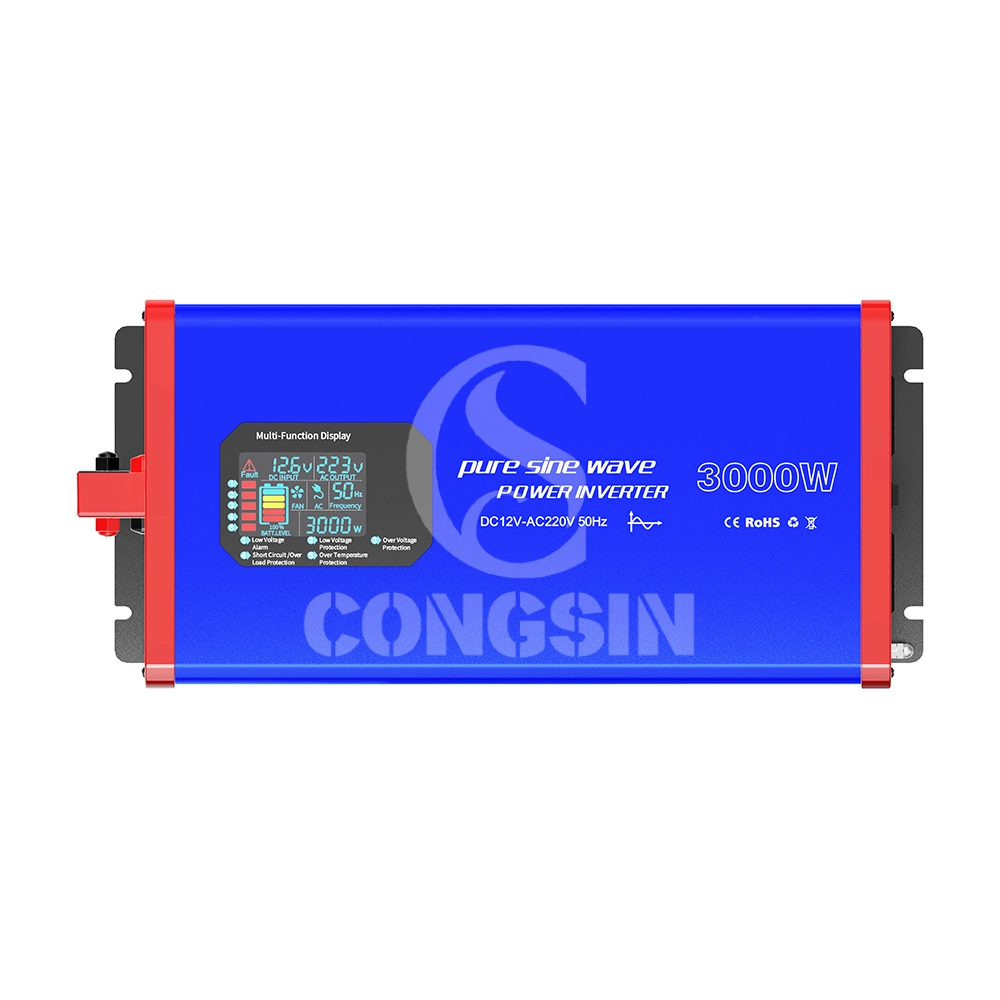
This 3000W full-power pure sine wave inverter (Model: CS3000PSW) adopts pure sine wave output technology (waveform distortion rate <2%), and the output power is highly consistent with mains power quality. It can safely drive high-power precision loads such as air conditioners, refrigerators, medical instruments, and small industrial equipment, avoiding equipment malfunctions or shortened service life caused by unstable waveforms. The device supports DC 12V input (compatible with 10.5V-14.8V wide voltage), continuously outputs 3000W full power, and has a peak power of 6000W, easily coping with the instantaneous startup impact of high-power devices; it is equipped with 4 AC universal sockets (max current 16A) + 2 USB 3.0 fast-charging ports (22.5W per port) to meet the simultaneous power supply needs of multiple devices. Built-in six-fold safety protection (overload, overvoltage, undervoltage, short circuit, overtemperature, reverse connection), combined with dual intelligent silent cooling fans (noise ≤45dB), it achieves the triple advantages of "high power + high safety + low noise," suitable for home emergency, outdoor engineering, vehicle-mounted power supply, small industrial scenarios and other fields.
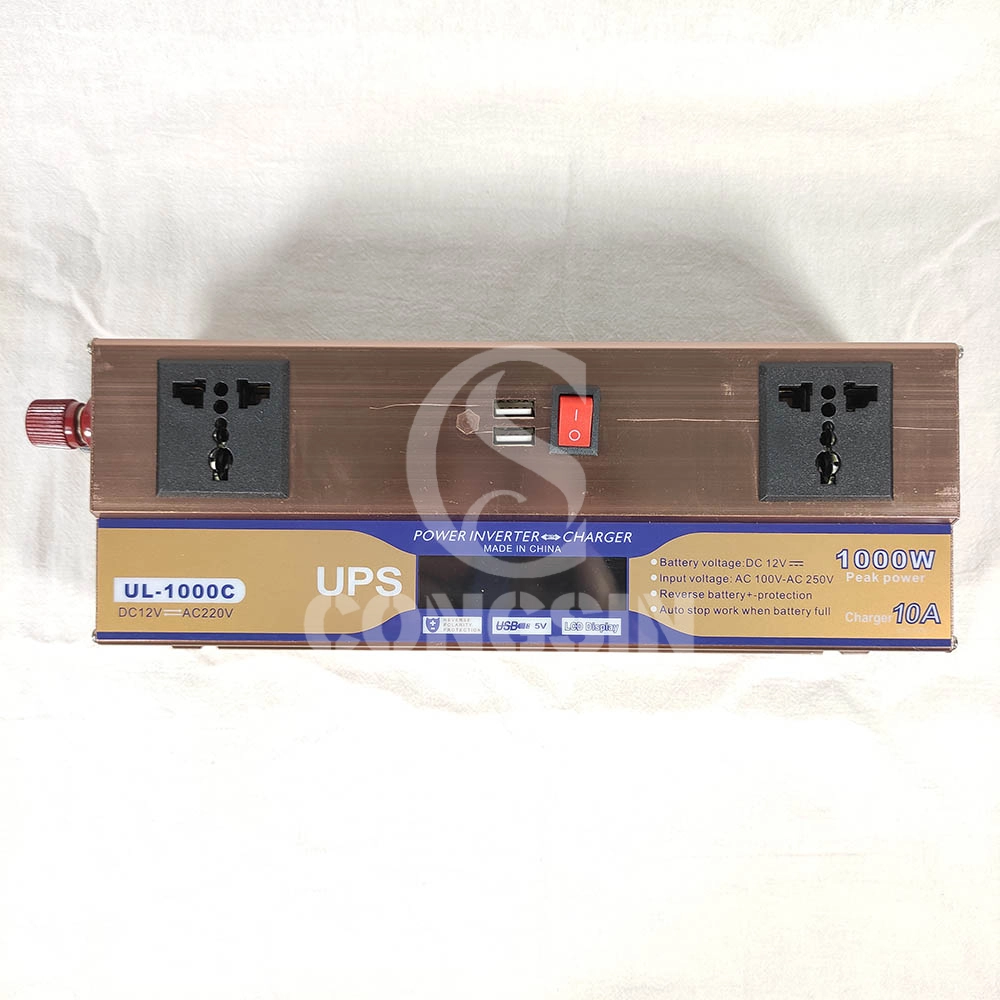
This 1000W modified sine wave inverter has UPS charging function, with DC12V input and AC220V output, and 600W rated power. Equipped with dual universal sockets, two USB ports, an LCD display, and a battery clip, it is professionally designed and has stable performance. It can provide stable AC power conversion and UPS emergency power supply for computers, small home appliances, electronic devices, etc. in home emergency, office, outdoor and other scenarios, meeting the needs of simultaneous power supply and emergency power supply for multiple devices.

This 1500W pure sine wave inverter converts DC 12V to AC 220V power, with a rated power of 1500W and a peak power of 3000W. Equipped with dual fans, LCD display, QC3.0 and PD Type-C fast charging ports, and remote control capability for stable and intelligent power output.

Our CS2000BIG 2000W modified sine wave inverter is a high-power power conversion device that converts DC 12V from batteries into AC 220V electricity. It is designed for heavy-duty use, featuring 2 AC sockets to power multiple high-power devices simultaneously, 2 cooling fans for efficient heat dissipation, and battery terminal wire for stable connection. With its robust construction and large capacity, it is an ideal solution for powering tools, appliances, and equipment in various scenarios, from industrial use to home emergencies.
Get in Touch with Our Team
You can also communicate with us directly through our online contact form. Please fill in the following information, and our team will contact you as soon as possible after receiving your message.

CONGSIN is a trusted OEM factory for power inverters, solar charge controllers, and DC converters. Reliable solutions for global B2B buyers.
 High Quality
 7/24 Service
 Guaranteed Warranty
© 2025 Congsin. All Rights Reserved.
 WeChat
 Scan QR Code
sin cong
teaimei10
Whatsapp: +8618028086791
Scan QR Code