





How Long Will a 200W Solar Panel Charge a 100Ah Battery?
How long does it take a 200W solar panel to charge a 100Ah battery? Learn real-world charging time calculations, factors affecting efficiency, and practical solar charging tips.
- Understanding the Basics: Solar Panel & Battery Capacity
- What Does a 200W Solar Panel Mean?
- What Does a 100Ah Battery Mean?
- Step-by-Step Calculation: Charging Time
- Example 1: 12V 100Ah Battery
- Example 2: 24V 100Ah Battery
- Key Factors That Affect Charging Time
- 1. Sunlight Hours (Peak Sun Hours)
- 2. Solar Charge Controller Efficiency
- 3. Battery Type
- 4. Depth of Discharge (DoD)
- 5. System Losses
- Real-World Charging Scenarios
- RV or Van Setup
- Off-Grid Backup System
- Emergency or Field Use
- How to Charge Faster with a 200W Panel
- FAQs
- Q1: Can a 200W solar panel fully charge a 100Ah battery?
- Q2: How long does it take in cloudy weather?
- Q3: Is a 200W panel enough for off-grid living?
- Q4: Does battery age affect charging time?
- Q5: Should I use PWM or MPPT with a 200W panel?
- Conclusion
When building a solar power system for RVs, off-grid homes, boats, or outdoor workstations, one of the most common questions is:
How long will a 200W solar panel charge a 100Ah battery?
The short answer is: about 4–7 hours of effective sunlight, but the real-world result depends on battery voltage, system efficiency, sunlight conditions, and charging losses.
In this guide, we’ll break down the calculation step by step, explain key influencing factors, and help you estimate realistic charging times for your solar setup.
Understanding the Basics: Solar Panel & Battery Capacity
Before calculating charging time, it’s important to understand what the numbers actually mean.
What Does a 200W Solar Panel Mean?
A 200W solar panel can theoretically produce:
-
200 watts per hour under Standard Test Conditions (STC)
-
STC assumes perfect sunlight (1000W/m²), optimal angle, and ideal temperature
In real-world conditions, output is usually 70–85% of rated power.
What Does a 100Ah Battery Mean?
Battery capacity is measured in amp-hours (Ah).
For common systems:
-
12V 100Ah battery = 1,200Wh (1.2 kWh)
-
24V 100Ah battery = 2,400Wh (2.4 kWh)
Formula:
Battery Energy (Wh) = Voltage (V) × Capacity (Ah)
Step-by-Step Calculation: Charging Time
Example 1: 12V 100Ah Battery
Battery energy
12V × 100Ah = 1,200Wh
Solar panel output (realistic)
200W × 80% efficiency ≈ 160W
Charging time (ideal sunlight)
1,200Wh ÷ 160W ≈ 7.5 hours
➡ Estimated time: 6–8 hours of strong sunlight
Example 2: 24V 100Ah Battery
Battery energy
24V × 100Ah = 2,400Wh
Charging time
2,400Wh ÷ 160W ≈ 15 hours
➡ Estimated time: 14–18 hours, usually spread across 2–3 sunny days
Key Factors That Affect Charging Time
1. Sunlight Hours (Peak Sun Hours)
“Peak sun hours” are not daylight hours — they represent equivalent full-power sunlight.
Typical averages:
-
Tropical regions: 5–6 hours/day
-
Temperate zones: 3–5 hours/day
-
Winter or cloudy areas: 2–3 hours/day
2. Solar Charge Controller Efficiency
-
PWM controllers: 70–80% efficiency
-
MPPT controllers: 95–98% efficiency
➡ Using an MPPT charge controller can reduce charging time by 20–30%.
3. Battery Type
| Battery Type | Charging Efficiency |
|---|---|
| Lead-acid (AGM/GEL) | 80–85% |
| Lithium (LiFePO₄) | 95–98% |
Lithium batteries charge faster and accept higher current for longer periods.
4. Depth of Discharge (DoD)
If your battery is:
-
50% discharged → charging time is roughly half
-
Fully discharged → full calculation applies
5. System Losses
Losses come from:
-
Inverter inefficiency
-
Cable resistance
-
Panel temperature rise
-
Dust and panel angle
Expect 10–20% total system loss in most installations.
Real-World Charging Scenarios
RV or Van Setup
-
200W panel
-
12V 100Ah battery
-
MPPT controller
➡ Fully charged in one sunny day
Off-Grid Backup System
-
200W panel
-
24V 100Ah battery
-
Moderate sunlight
➡ 2–3 days to fully charge
Emergency or Field Use
-
Partial battery depletion
-
Intermittent sunlight
➡ Battery can still reach usable capacity within a few hours
How to Charge Faster with a 200W Panel
To optimize charging time:
-
Use an MPPT charge controller
-
Keep panels clean and properly angled
-
Upgrade to lithium batteries
-
Add parallel solar panels if possible
-
Minimize inverter usage during charging
FAQs
Q1: Can a 200W solar panel fully charge a 100Ah battery?
Yes. A 200W panel can fully charge a 12V 100Ah battery under good sunlight conditions within one day.
Q2: How long does it take in cloudy weather?
Cloudy conditions may reduce output by 40–70%, extending charging time to 2–3 days.
Q3: Is a 200W panel enough for off-grid living?
For light loads, yes. For full off-grid use, multiple panels and higher battery capacity are recommended.
Q4: Does battery age affect charging time?
Yes. Older batteries accept charge more slowly and may never reach full capacity.
Q5: Should I use PWM or MPPT with a 200W panel?
MPPT is strongly recommended for systems over 150W due to higher efficiency and faster charging.
Conclusion
A 200W solar panel typically takes 4–8 hours of effective sunlight to charge a 12V 100Ah battery, and longer for higher-voltage systems. Real-world performance depends on sunlight, controller type, battery chemistry, and system efficiency.
Understanding these variables helps you design a more reliable and efficient solar power system—whether for RVs, backup power, or off-grid applications.


Modified Sine Wave Inverters
What devices can it power?
Suitable for fans, lights, TVs, laptops, and small electric tools.
Is it a pure sine wave or a modified sine wave? What's the difference?
This is a modified sine wave inverter, suitable for most conventional home appliances and electronic devices; pure sine wave is suitable for precision devices with extremely high power requirements. This modified sine wave is more cost-effective at 2000W, meeting the needs of most scenarios.
Which region’s voltage standards does it support?
It defaults to AC 220V output, suitable for regions with 220V voltage standards such as China and Europe; it can also be customized to output AC 110V, suitable for regions with 110V voltage standards such as the United States and Japan.
Pure Sine Wave Inverters
Can this inverter drive a 3P air conditioner and a refrigerator at the same time?
Yes. The rated power of a 3P air conditioner is about 2200W-2500W, and an ordinary double-door refrigerator is about 150W-300W, with a total power of about 2350W-2800W, which does not exceed the 3000W continuous power; and the peak 6000W can cope with the instantaneous startup impact of the air conditioner. When using, ensure the battery capacity is ≥200Ah (12V) to ensure battery life.
Is the remote control standard?
It’s optional and available upon request.
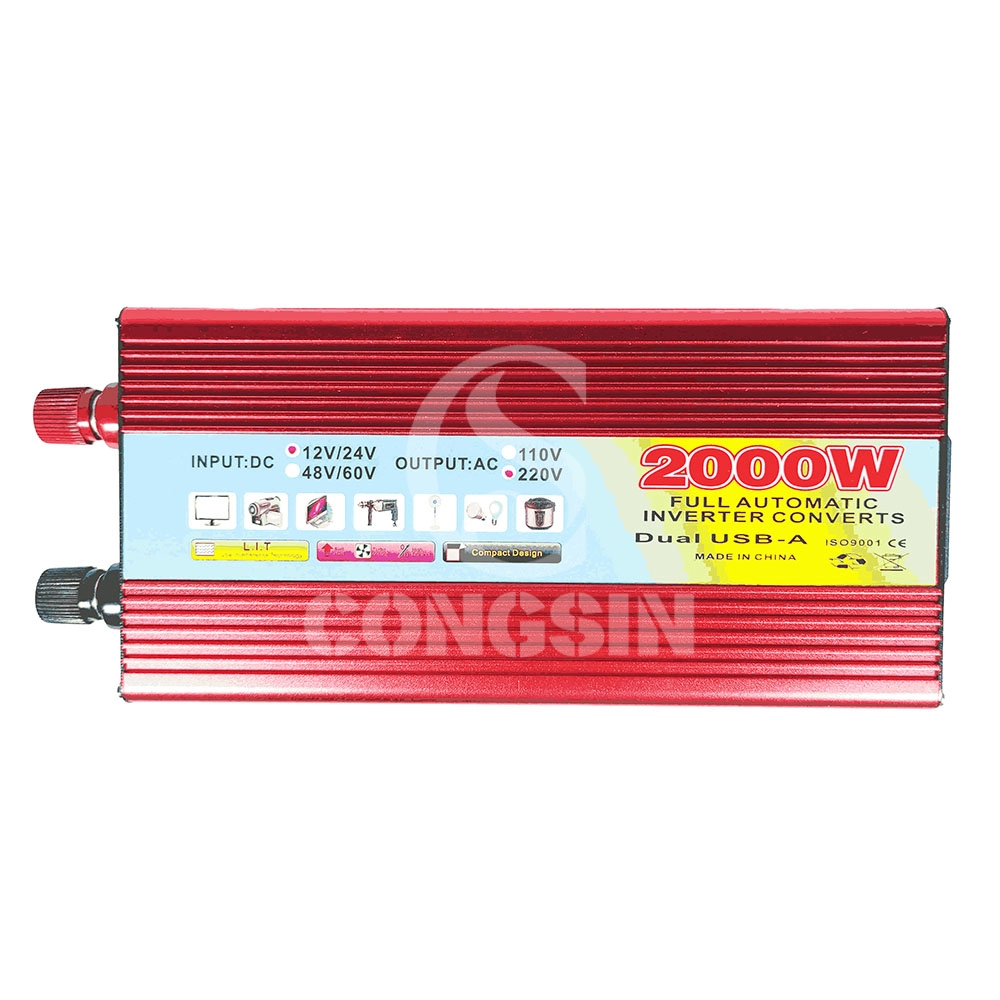
This 2000W modified sine wave inverter features a dual-input voltage design (12V/24V or 48V/60V), making it compatible with various DC systems. Compact, efficient, and versatile, it delivers a stable AC 220V output for home, vehicle, and solar power applications.
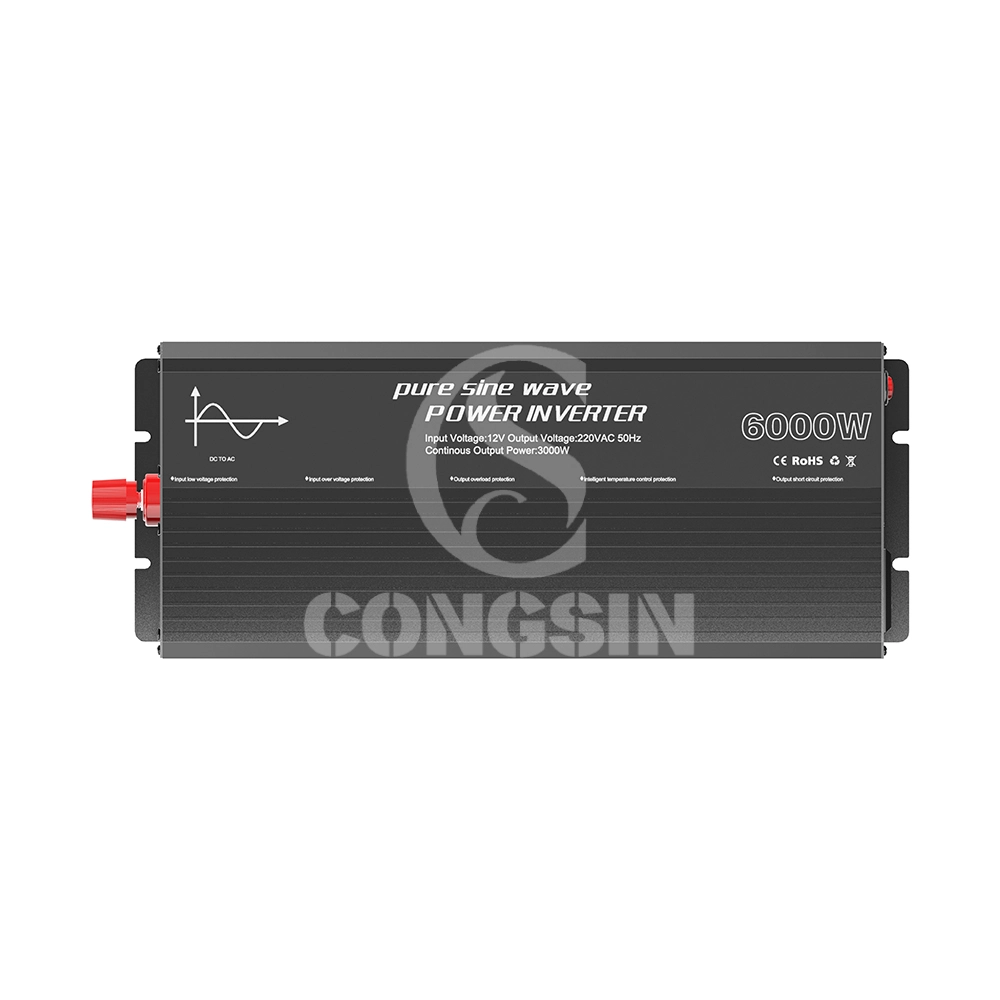
This pure sine wave inverter (Model: CS3000PSW-L6000) features "3000W full continuous power output + labeled 6000W peak power." Adopting pure sine wave output technology (waveform distortion rate <2%), its power quality is close to mains power, which can safely drive high-power precision devices such as air conditioners, refrigerators, electric tools, and medical instruments, avoiding equipment malfunctions caused by unstable waveforms. The device supports DC 12V input (compatible with 10.5V-14.8V wide voltage): 3000W continuous power meets long-term stable power supply, and 6000W peak power easily copes with the instantaneous startup impact of devices. Equipped with 4 AC universal sockets (16A) and 2 USB 3.0 fast-charging ports (22.5W/port), it can supply power to 6 devices simultaneously. Built-in six-fold protection (overload, overvoltage, undervoltage, short circuit, overtemperature, and reverse connection), combined with dual intelligent silent cooling fans (noise ≤45dB), balances high-power performance and safety, making it suitable for home emergencies, outdoor engineering, vehicle-mounted power supplies, small commercial and other scenarios.
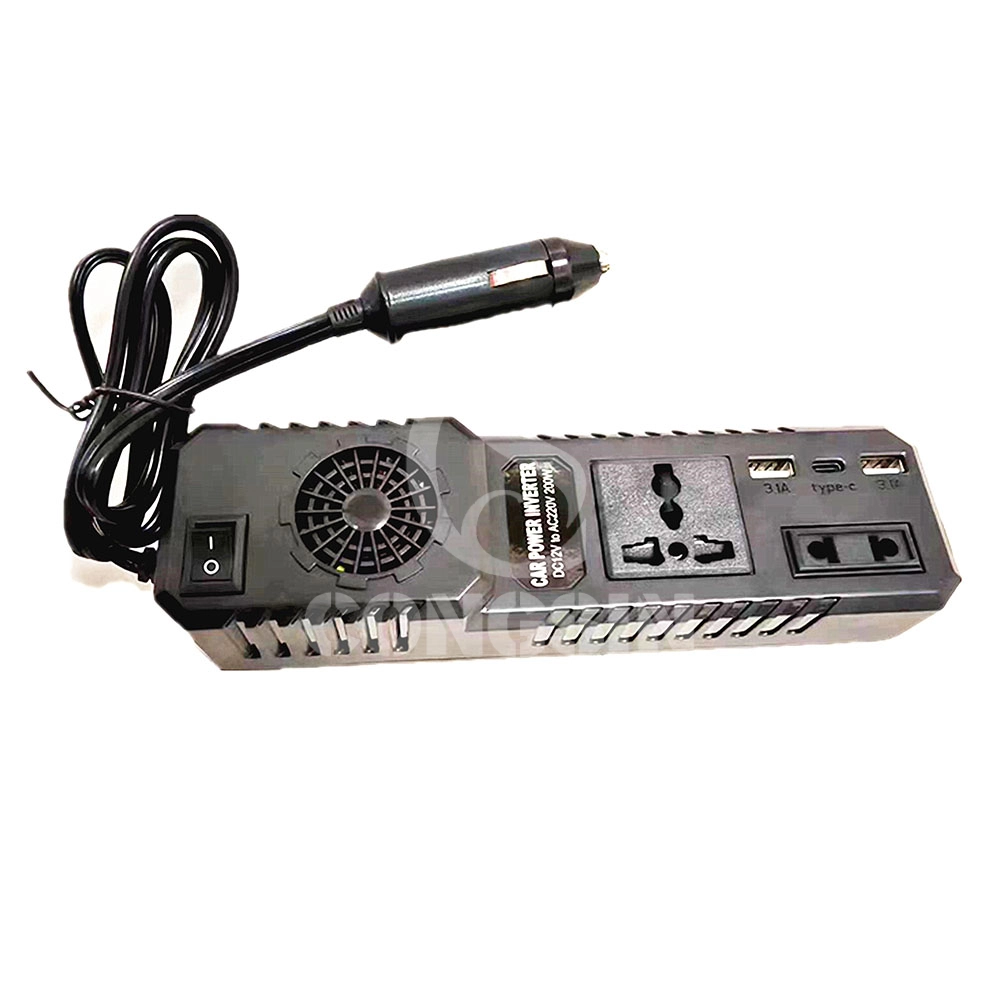
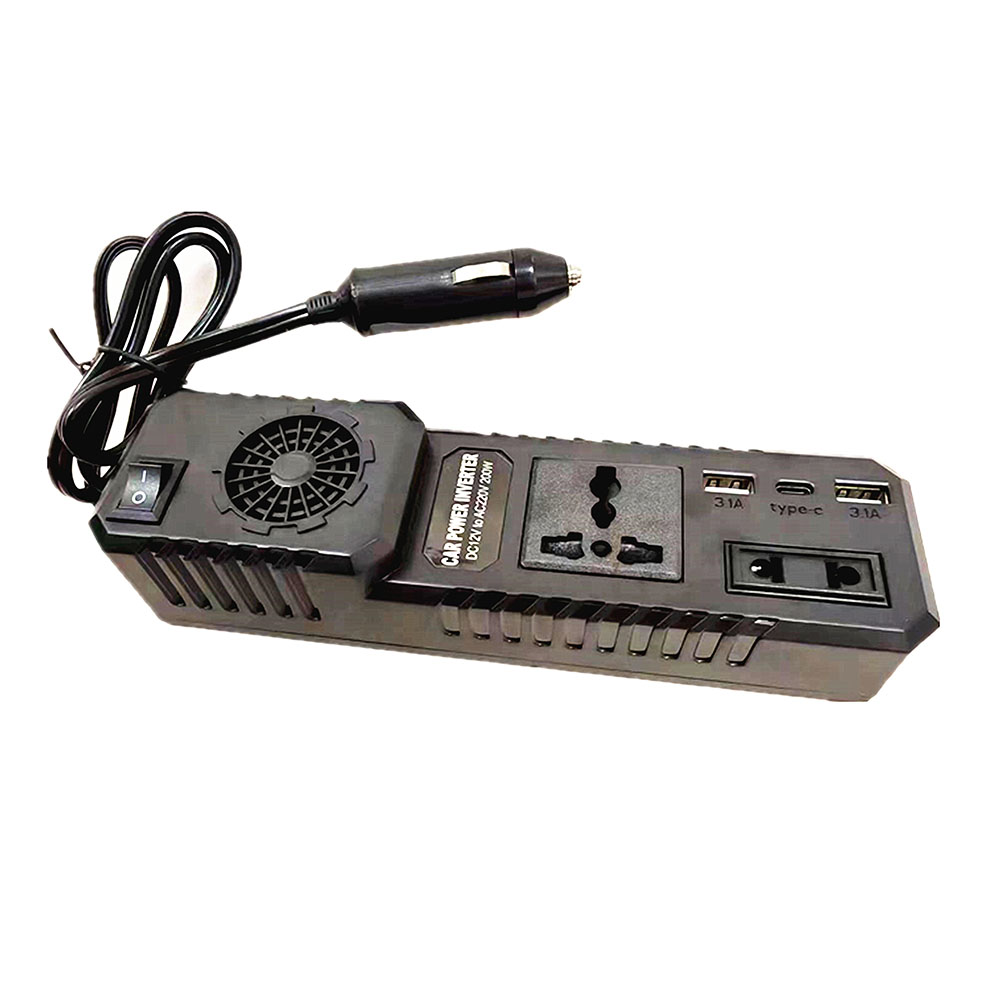
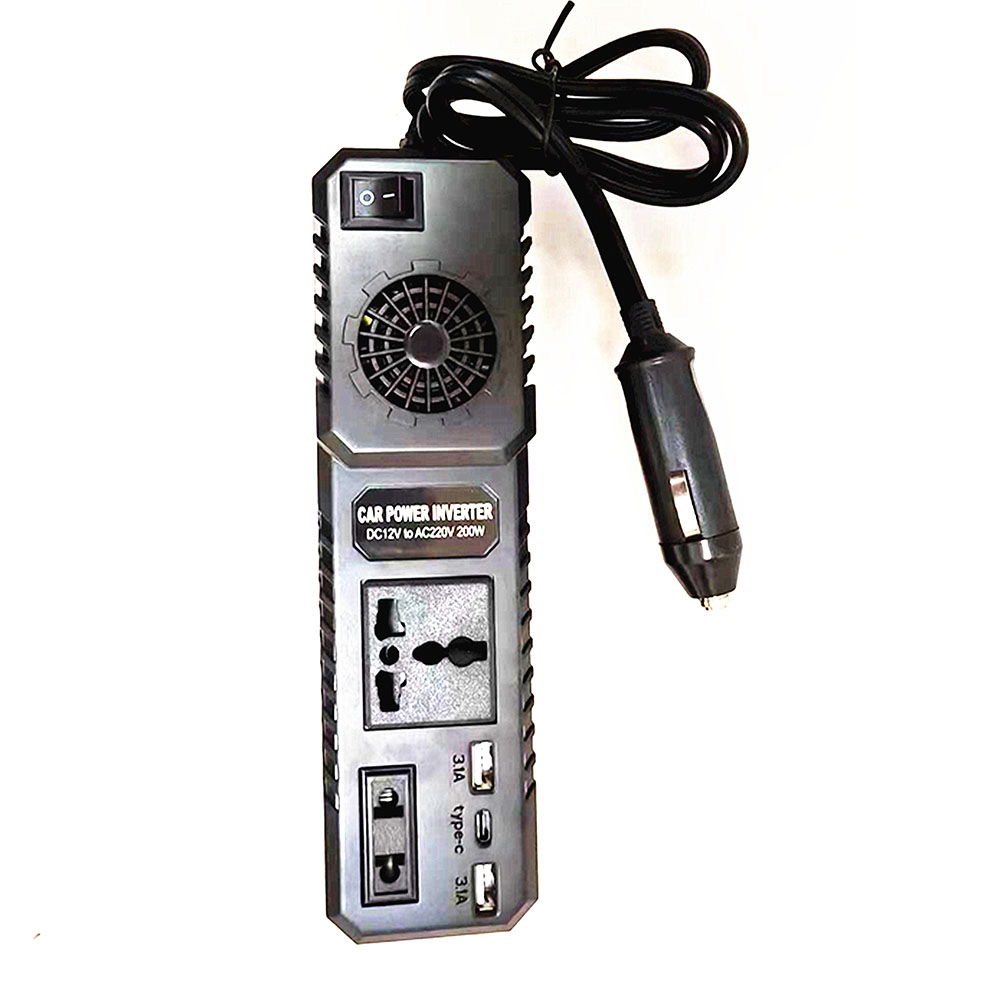
This 200W Modified Sine Wave Car Power Inverter is a compact and practical power conversion device designed for vehicle use. It supports dual input (DC12V/24V) and outputs AC220V, compatible with various electronic devices. Equipped with a Type-C port and dual 3.1A USB outputs, it can charge laptops, phones, cameras, drones, and other small electronics simultaneously—perfect for outdoor travel, emergency backup, and mobile work scenarios.
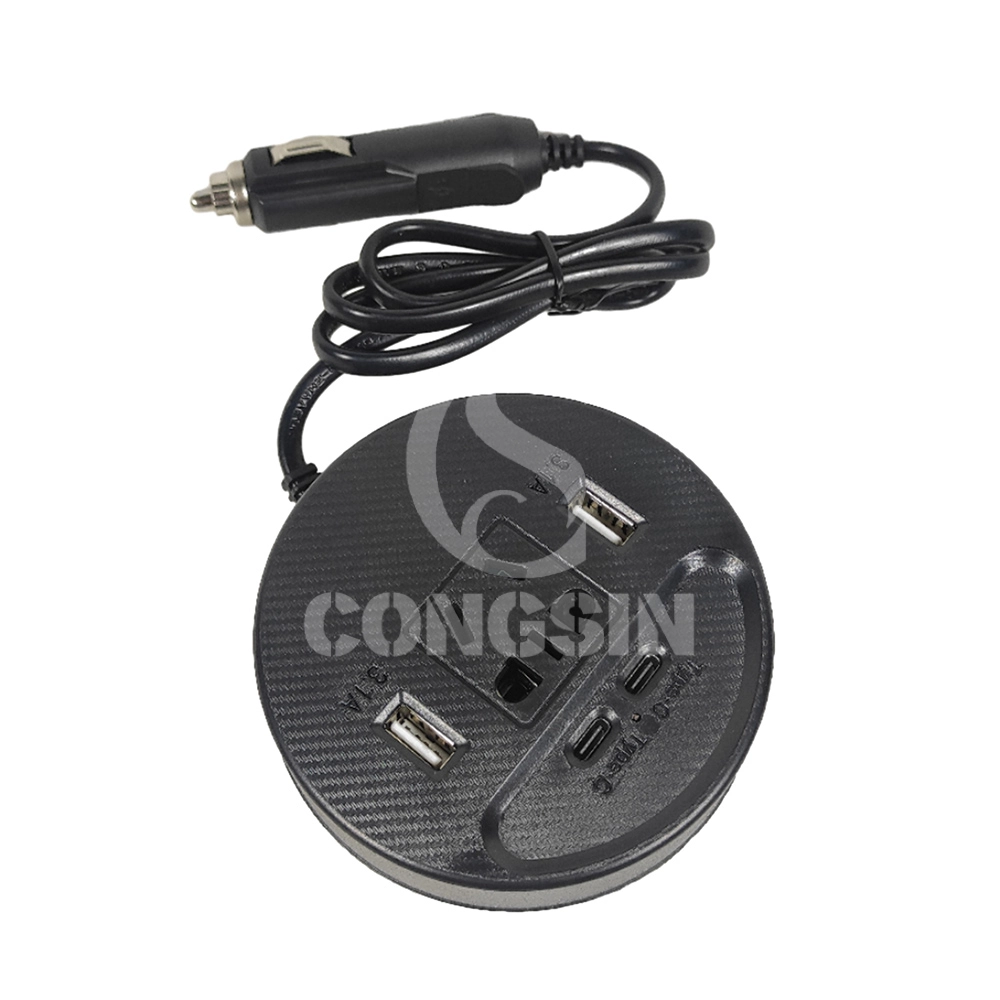
This 150W modified sine wave car inverter supports dual DC12V/24V input and AC220V output. It is equipped with a Type-C port, two 3.1A USB ports, and a national standard socket. It is compact and portable, providing stable AC power conversion in various scenarios such as in the car, meeting the power supply needs of mobile phones, tablets, small home appliances and other devices.
Get in Touch with Our Team
You can also communicate with us directly through our online contact form. Please fill in the following information, and our team will contact you as soon as possible after receiving your message.

CONGSIN is a trusted OEM factory for power inverters, solar charge controllers, and DC converters. Reliable solutions for global B2B buyers.
 High Quality
 7/24 Service
 Guaranteed Warranty
© 2025 Congsin. All Rights Reserved.