





EU/EEA Pure Sine Wave Inverter Documentation: CE Marking, Test Reports and Model Consistency
- Quick Answer
- Key Takeaways
- 1. Define the Exact Product and Responsible Economic Operator
- 2. Determine the Applicable EU Requirements
- 3. Build a Traceable Documentation Chain
- 4. Verify Model and Test-Report Coverage
- 5. Control Production, OEM and Private-Label Changes
- 6. Approve the Market Configuration With One Release Matrix
- Frequently Asked Questions
- Review Your EU/EEA Pure Sine Wave Inverter Documentation Requirements
Quick Answer
A buyer searching for a “CE certified pure sine wave inverter” should not treat a CE logo or a single certificate PDF as sufficient evidence for an EU/EEA purchasing decision. Under the EU CE-marking framework, the manufacturer is responsible for identifying the applicable requirements, completing the relevant conformity assessment, preparing technical documentation and drawing up the EU Declaration of Conformity before affixing the CE marking. For procurement teams, the practical task is therefore to verify whether that conformity basis actually belongs to the exact inverter configuration being purchased. Buyers can review the European Commission’s official CE marking guidance for the underlying framework.
In this guide, “European market” refers primarily to EU/EEA projects using the CE-marking framework. The United Kingdom, Switzerland and other non-EU/EEA markets may have different product-market-access requirements and should be reviewed separately. For an EU/EEA project, the documentation chain should connect the market configuration, applicable legal scope, product identity, responsible economic operator, Declaration of Conformity, test evidence and current production revision before release.
Market Configuration → Exact Product → Economic Operator → Applicable EU Requirements → EU Declaration of Conformity → Test Evidence → Production Revision → Market Release
For distributors, importers, system integrators and private-label buyers, the most important principle is consistency. The company responsible for the product, the model shown in the declaration, the configuration represented in the test evidence and the version entering production should all belong to one traceable product scope.
Key Takeaways
- Treat “CE certified pure sine wave inverter” as common buyer search language rather than proof that an EU authority has approved the product.
- Define the exact inverter and responsible economic operator before evaluating declarations or test reports.
- Assess EMC, electrical-safety, RoHS and radio-related requirements against the actual product configuration rather than copying the scope from another model.
- Approve the EU/EEA market version only when the declaration, supporting evidence, labels and production revision can all be linked to the same product.

Conceptual infographic of EU/EEA documentation review, economic-operator responsibilities and exact-model evidence consistency. It is not a real product label, Declaration of Conformity or test report.
1. Define the Exact Product and Responsible Economic Operator
European documentation verification should begin with a controlled product definition. A manufacturer may offer several inverters under one commercial family while changing DC input, AC output, rated power, sockets, connectors, firmware, enclosure details or optional functions between versions. A document bearing a familiar model-family name can therefore be genuine without necessarily covering the exact configuration being purchased.
The first procurement task is to identify the market version with enough precision that every later document can be checked against it. Depending on the project, this may include the manufacturer’s model, buyer model, hardware revision, DC input range, AC output and frequency, rated and surge power requirements, connector arrangement, intended application, communication functions and destination market. Buyers can use the available Pure Sine Wave Inverters as a product-platform starting point, while model-specific documentation still needs separate verification.
Product Identity → Intended Use → Market Configuration → Compliance Scope
This avoids a common sourcing problem in which a distributor approves documents for one version while the quotation or purchase order actually refers to another. Commercial similarity does not establish technical equivalence, and a common enclosure does not prove that the electrical or compliance basis is identical.
Separate the Commercial Model From the Controlled Product Version
A commercial model name is useful for sales and inventory management, but it is not always precise enough for compliance verification. A single model family may contain multiple power levels, regional sockets or hardware revisions, while an OEM customer may apply a completely different private-label model number to the same base platform.
The procurement team therefore needs a clear mapping between the name used commercially and the product revision represented in the compliance documents. A reliable review links the commercial designation to a controlled configuration, then links that configuration to the declaration, test evidence and production release.
Commercial Model → Controlled Configuration → Documented Revision → Compliance Evidence
This becomes increasingly important after engineering changes. If the model name remains unchanged while the PCB, firmware, connector, enclosure or another technically relevant element changes, earlier evidence should not be reused automatically. The manufacturer should first determine whether the change affects the original conformity basis.
Identify the Responsible Economic Operator
The product definition also needs to identify who is legally responsible at each stage of the EU/EEA supply chain. Depending on the arrangement, relevant roles can include the manufacturer, an authorised representative, an importer and a distributor. These roles are not interchangeable, and a non-EU manufacturer shipping to an EU customer does not remove obligations that may apply to the EU importer or other responsible operators.
For a B2B importer, documentation review should confirm that the manufacturer has carried out the necessary conformity process, prepared the required documentation and supplied the applicable marking and accompanying information. The importer should also understand how the manufacturer can be contacted and how required documentation can be made available if a competent authority requests it. The European Commission provides additional guidance on importer and distributor responsibilities.
Private-label projects require particular care. A company that has a product made for it and places that product on the market under its own name or trademark may assume manufacturer responsibilities under applicable EU product rules. Likewise, an importer or distributor that markets a product under its own name can assume manufacturer responsibilities. The exact obligations depend on the applicable legislation and commercial arrangement, so the procurement file should make the responsibility chain explicit.
Product Identity → Economic Operator Role → Declaration Responsibility → Market Documentation
This allows the buyer to answer a question that a certificate folder alone cannot resolve: not only “Which product does this evidence cover?” but also “Which company is responsible for placing this version on the market?”
2. Determine the Applicable EU Requirements
Once the exact product and responsible parties are defined, the next step is to determine which EU requirements apply to that configuration. The correct approach is product-led rather than document-led: identify the product characteristics first, map them to the applicable legal framework and then determine which technical evidence is needed.
CE marking should not be treated as one standalone certification scheme. Different EU legal acts may apply depending on the product’s voltage characteristics, electromagnetic behaviour, materials, functions and intended use. The manufacturer is responsible for identifying the applicable requirements and reflecting them in the conformity documentation.
For procurement teams, this means that a credible documentation package should be able to explain why each cited legal act or technical standard belongs to the proposed inverter rather than simply displaying a long list of familiar acronyms.
Evaluate EMC and Electrical-Safety Scope Against the Complete Product
Electromagnetic compatibility is a central issue for electronic power-conversion equipment because the product must operate within an electromagnetic environment without creating unacceptable disturbance. The documentation review should therefore establish what EMC framework is being applied to the actual apparatus and which evidence supports that assessment. The current consolidated EMC Directive text also addresses conformity documentation, importer/distributor duties and ongoing production conformity.
Electrical-safety applicability also needs to be assessed against the complete equipment. Under the Low Voltage Directive, the general voltage scope covers electrical equipment designed for use with ratings between 50 and 1,000 V AC and between 75 and 1,500 V DC, subject to the Directive’s exclusions. A buyer should therefore not decide applicability solely from a description such as “12 V inverter,” “24 V inverter” or “48 V inverter.” The official Low Voltage Directive text defines the applicable voltage range.
A pure sine wave inverter converts low-voltage DC input into a higher AC output, so the compliance review needs to consider the complete rated characteristics and intended configuration rather than only the battery-side label. The result should be a documented scope decision for the specific product, not a generic assumption applied across an entire catalogue.
Include RoHS in the Product-Scope Review
RoHS should also have an explicit position in the compliance review for electrical and electronic equipment. The procurement team should determine whether the proposed inverter falls within the applicable scope and, where it does, verify that the relevant declaration and technical documentation address the substance restrictions that apply to the product. The RoHS Directive sets out restrictions for electrical and electronic equipment while also defining its scope and exclusions.
The practical issue is again consistency. A general company statement about RoHS does not by itself establish that a particular model, revision or OEM configuration has been evaluated against the relevant requirements. The buyer should be able to connect the applicable substance-control evidence to the product entering the supply program.
For long-term supply, this connection also matters when components change. A component substitution may affect more than purchasing or electrical performance; it can also affect the evidence used to support restricted-substance compliance. Production change control and compliance review therefore need to remain connected.
Assess RED When Radio Functionality Is Added
Some inverter projects include Wi-Fi, Bluetooth, cellular connectivity or another radio-enabled control module. If the final product configuration includes radio functionality that brings it within the Radio Equipment Directive, the compliance framework needs to be assessed accordingly rather than simply reusing an EMC/LVD-only document package from a non-radio version.
This is especially important for OEM development because communication features are often added late in a project. A base inverter may have one conformity basis while a connected version requires a different assessment structure. The presence of a radio module does not mean that buyers should mechanically add “RED + EMC + LVD” as three independent certificates; the applicable legal framework and interaction between requirements should be determined for the final product. Buyers can refer to the European Commission’s Radio Equipment Directive information when radio functionality is relevant.
Product Function → Applicable EU Requirement → Technical Assessment → Declaration Scope
This approach is more reliable than starting with a certificate list and assuming that every listed item applies to every inverter configuration.
3. Build a Traceable Documentation Chain
After the applicable requirements have been identified, the buyer can evaluate the documentation itself. The objective is not to collect the greatest possible number of PDFs. It is to create a traceable chain in which each document can be linked back to the same product and responsibility structure.
Exact Product → Responsible Manufacturer → Applicable EU Acts → EU Declaration of Conformity → Supporting Evidence → Labels and Instructions
When these elements align, the buyer has a coherent basis for qualification. When they do not align, the problem should be resolved before the model is treated as approved for the intended EU/EEA project.
Use the EU Declaration of Conformity as a Practical Procurement Index
The EU Declaration of Conformity is particularly useful because it brings several important elements together in one controlled document. Depending on the applicable legislation, it identifies the manufacturer and product, cites the relevant Union acts, references standards or other technical specifications where appropriate and records the responsible declaration.
For procurement purposes, it is useful to treat the DoC as a practical document index. This is not a formal legal title for the document; it is a buyer-side review method. Starting from the DoC, the buyer can work outward and ask whether the model identification corresponds to the quotation, whether the cited requirements match the product and whether the supporting evidence relates to the same configuration.
Manufacturer → Product Identification → Applicable Legislation → Technical Basis → Signed Declaration
This also prevents the DoC from being confused with a third-party certificate. A laboratory report or certificate may support part of the technical evidence, but the EU Declaration of Conformity represents the manufacturer’s formal declaration of responsibility for the product it identifies.
Distinguish Buyer Evidence From the Manufacturer’s Full Technical Documentation
B2B buyers need sufficient evidence to make a responsible purchasing decision, but that does not mean every distributor automatically receives the manufacturer’s complete technical file. Technical documentation may contain detailed design information, calculations, risk assessment material, component information, drawings and other commercially sensitive engineering records.
The procurement package may instead contain an agreed set of buyer-facing evidence such as the EU Declaration of Conformity, relevant test reports or report references, product and model coverage, applicable standards, rating-label information, user documentation and other records needed for the project. The level of document sharing can vary according to the buyer’s role, confidentiality arrangements and contractual requirements.
However, the distinction between buyer-facing evidence and the full technical file does not remove regulatory document responsibilities. The responsible manufacturer and relevant EU economic operator must ensure that required documentation can be made available to competent authorities when the applicable legislation requires it.
CONGSIN’s public site includes a Certificates section presenting company-level compliance information. For a B2B European project, available documents should still be checked against the exact inverter model and configuration rather than assumed to apply across the complete product portfolio.
Align Labels, Instructions and Market Documentation With the Same Product
Document consistency also extends to the product-facing information that accompanies the shipment. The model shown on the rating label, the identification used in the Declaration of Conformity and the product referenced in the buyer’s technical file should not contradict one another.
Instructions and safety information may also need to satisfy language or content requirements for the target market under the applicable product rules. A distributor operating across several EU/EEA countries should therefore treat the destination country as a real documentation input rather than assuming that one market-facing document set can be reused unchanged everywhere.
The buyer does not need to turn this into a separate checklist for every document. A stronger approach is to maintain one product baseline and compare every outward-facing document against it. If model identity, economic-operator details, declaration and instructions all point to the same release, the documentation package becomes much easier to audit and maintain.
4. Verify Model and Test-Report Coverage
Test reports are valuable only when their scope is understood. A report showing a successful result for one sample does not automatically establish that every related model, power rating, OEM version or later revision is covered.
The buyer’s task is therefore to connect the report to the current product through a traceable technical relationship.
Report Identity → Tested Configuration → Covered Model → Current Production Revision
This is more useful than simply asking whether a supplier “has CE test reports,” because it distinguishes evidence existence from evidence applicability.
Match the Report to the Tested Configuration
A practical review starts with the report number, laboratory identity, test standard, tested model and configuration represented by the sample. Where the report includes multiple variants, the stated coverage or technical relationship between those models should be understood rather than inferred from similar names.
Electrical ratings matter. Hardware revision can matter. An optional communication module can matter. A connector, PCB or enclosure change may or may not affect the relevant conformity characteristics, but the buyer should know whether the production configuration remains technically represented by the evidence.
Current Product → Tested Configuration → Applicable Report → Declared Compliance
A report date by itself does not make the evidence obsolete. Likewise, a recent report date does not guarantee applicability. What matters is whether the present product remains within the scope supported by that evidence.
Do Not Infer Model-Family Coverage From Similarity
Model-family coverage is one of the most common areas where procurement teams can over-interpret documentation. If a report identifies one inverter model, the fact that several other products use similar enclosures or belong to the same commercial series is not enough to prove that the same evidence covers them.
Broader coverage may be technically justified, but that relationship should be established through the report scope, documented product-family analysis or other controlled engineering evidence. The same rule applies to private-label products. A different brand or model name may still map to the same controlled product, but that mapping should be documented rather than assumed.
Approval Question: Does the evidence identify, include or technically justify the exact product intended for purchase?
If the answer depends on verbal explanation alone, the relationship is not yet strong enough for a formal documentation release. Detailed factory testing such as incoming inspection, functional checks, burn-in and load testing belongs to a separate manufacturing-quality layer. Buyers who need that process view can refer to the Pure Sine Wave Inverter Quality Control Framework. In this European documentation guide, the narrower objective is to determine whether the conformity evidence can be traced to the model being supplied.
5. Control Production, OEM and Private-Label Changes
A documentation package can be correct when a model is first approved and become unreliable later if production changes are not connected to compliance review. Long-term EU/EEA supply therefore requires more than an initial document collection; the manufacturer needs a process for evaluating whether changes affect the established conformity basis.
Current Revision → Proposed Change → Technical Impact → Compliance Impact → Evidence Review → Production Release
Not every change requires complete retesting, but no technically relevant change should be assumed harmless solely because the commercial model name has stayed the same.
Review Changes Before Reusing Existing Evidence
Component substitutions, PCB revisions, firmware changes, new connectors, enclosure modifications and communication features can affect the product in different ways. A replacement component may have no meaningful compliance impact in one design while changing EMC, safety, thermal behaviour or restricted-substance evidence in another.
The appropriate response is an impact review. The manufacturer should identify what changed, determine which product characteristics may be affected and then decide whether the existing technical evidence remains sufficient, requires additional engineering justification or needs new verification.
This approach prevents two opposite errors. The first is unnecessarily repeating every test after every minor production change. The second is continuing to reuse old evidence even when the controlled product has moved beyond the configuration originally evaluated.
For B2B buyers, the existence of a disciplined impact-review process is often more valuable than a static certificate folder because it determines whether the documentation will remain reliable over multiple orders.
Map OEM and Private-Label Versions to the Compliance Basis
OEM/private-label programs add another layer because commercial identity and technical configuration can change at the same time. A project may begin with logo and packaging changes, then expand into connectors, housing, interface, firmware or electrical adaptations.
The correct approach is to classify the change and maintain a documented relationship between the base platform and the released OEM version.
Base Product → OEM Change → Impact Review → Approved Variant → Document Mapping → Production Release
CONGSIN’s public site confirms company-level OEM/ODM and customization capabilities. The precise electrical, mechanical, firmware or interface change scope still needs to be confirmed for the relevant inverter platform. Buyers planning this type of project can review the OEM/ODM Customization information before defining the documentation requirements for the final EU/EEA version.
Private-label buyers should also clarify their legal role. If the product is placed on the market under the buyer’s own name or trademark in circumstances that make the buyer the manufacturer under the applicable EU rules, the documentation and responsibility structure need to reflect that reality. A private-label project cannot be treated only as an artwork change if the commercial arrangement changes who assumes conformity responsibility.
6. Approve the Market Configuration With One Release Matrix
The final stage is to consolidate the technical and legal evidence into one release decision. The purpose is not to produce a large compliance checklist or to collect every available certificate. It is to confirm that the product, economic operator, applicable requirements, declaration, test evidence and production version form one consistent system.
| Release Gate | Evidence to Review | Approval Question |
|---|---|---|
| Product identity | Model, electrical configuration and revision | Is the exact product clearly identified? |
| Economic operator | Manufacturer, importer, authorised representative or private-label responsibility where applicable | Is the responsible entity and its role clear? |
| Applicable EU scope | Product characteristics and relevant legislation | Does the compliance scope match the actual configuration and intended use? |
| Conditional scope | RoHS assessment and RED review where radio functionality is present | Have configuration-dependent requirements been evaluated? |
| EU Declaration of Conformity | Product identity, applicable Union acts, technical basis and responsible declaration | Does the DoC cover the product being released? |
| Test evidence | Report number, tested configuration, standard and documented coverage | Does the evidence support the declared model or justified model family? |
| Labels and instructions | Model identity, CE marking, responsible-party information and market documents | Are the customer-facing documents consistent with the approved product? |
| OEM/private-label version | Base-platform mapping, change scope and responsibility structure | Can the commercial variant be traced to the conformity basis? |
| Production revision | Change history and compliance-impact review | Has the evidence been reviewed against the current production version? |
| Market release | Complete matched documentation set | Can this configuration be approved for the intended EU/EEA project? |
A CE documentation package is credible when the applicable EU scope, responsible economic operator, declaration, supporting evidence, market-facing documents and production revision all refer to the same controlled product.
This is a stronger procurement standard than asking whether the supplier can provide a CE logo or a generic certificate file. It also makes future order reviews easier because the buyer has one defined baseline against which later changes can be assessed.
For distributors and system integrators, this approach reduces the risk of mixing documentation between similar models. For OEM and private-label buyers, it makes the relationship between the base product and the branded market version explicit. For professional and commercial users, it provides a more defensible basis for approving a product before it enters a larger equipment or supply program.
Frequently Asked Questions
What does “CE certified pure sine wave inverter” actually mean?
“CE certified pure sine wave inverter” is common buyer search language, but CE marking is not an approval issued by the EU. The manufacturer is responsible for identifying the applicable EU requirements, completing the relevant conformity assessment, preparing technical documentation, drawing up the EU Declaration of Conformity and affixing CE marking where required. B2B buyers should therefore verify the exact product and documentation scope behind the claim.
Is a CE logo enough to verify an inverter for the EU/EEA market?
No. A CE logo does not by itself show which model, revision or market configuration is supported by the underlying conformity evidence. The buyer should connect the product identity to the applicable EU requirements, responsible economic operator, EU Declaration of Conformity, supporting test evidence, labels and current production version.
What should buyers check in an EU Declaration of Conformity?
The buyer should confirm that the declaration identifies the relevant manufacturer and product, cites the applicable EU legislation and provides the technical references and responsible declaration required for the product. As a practical procurement method, the DoC can be used as an index for checking whether the supporting evidence and commercial product refer to the same controlled configuration.
How can buyers verify whether a test report covers the exact inverter model?
Compare the report number, tested product, electrical configuration, hardware or relevant revision information, test standard and any documented model-family scope with the inverter being ordered. Similar names, common enclosures or membership in the same product series do not automatically prove coverage for another model.
Does a private-label buyer become the manufacturer under EU product rules?
It can. A company that has a product made for it and places it on the market under its own name or trademark may be treated as the manufacturer under applicable EU product rules. Importers or distributors that market a product under their own names can also assume manufacturer responsibilities. The actual role should be confirmed for the specific commercial arrangement and applicable legislation.
When should EU/EEA compliance documentation be reviewed after a product change?
Documentation should be reviewed whenever a change may affect the original conformity basis or the relationship between the evidence and the current production version. Examples include component substitutions, PCB or firmware revisions, enclosure changes, new interfaces and added radio functionality. The required action depends on the technical and regulatory impact of the actual change rather than the model name alone.
Review Your EU/EEA Pure Sine Wave Inverter Documentation Requirements
For distributors, importers, system integrators, transportation and outdoor partners, engineering companies and professional or commercial buyers, documentation review is most effective when the exact market configuration and supply-chain role are defined before sample approval or shipment.
For a project discussion, provide the candidate inverter model or product family, DC input configuration, AC output market, rated and surge power requirements, intended use, target EU/EEA country or countries, OEM/private-label scope, any Wi-Fi, Bluetooth, cellular or other radio functionality, and the buyer’s expected role as importer, distributor, system integrator or brand owner.
Also identify which documents need to be reviewed before sampling, purchase approval or shipment. Depending on the project, these may include the EU Declaration of Conformity, test-report information, model-coverage evidence, labels, instructions or other agreed documentation.
CONGSIN can then discuss the relevant product platform and the documentation information available for the proposed configuration. Company-level compliance information can also be reviewed in the Certificates section.
Applicable EU requirements, economic-operator responsibilities, document availability, model coverage, test-report scope and OEM/private-label documentation relationships should be confirmed for the actual product, destination market and commercial arrangement before they are treated as an approved project baseline.


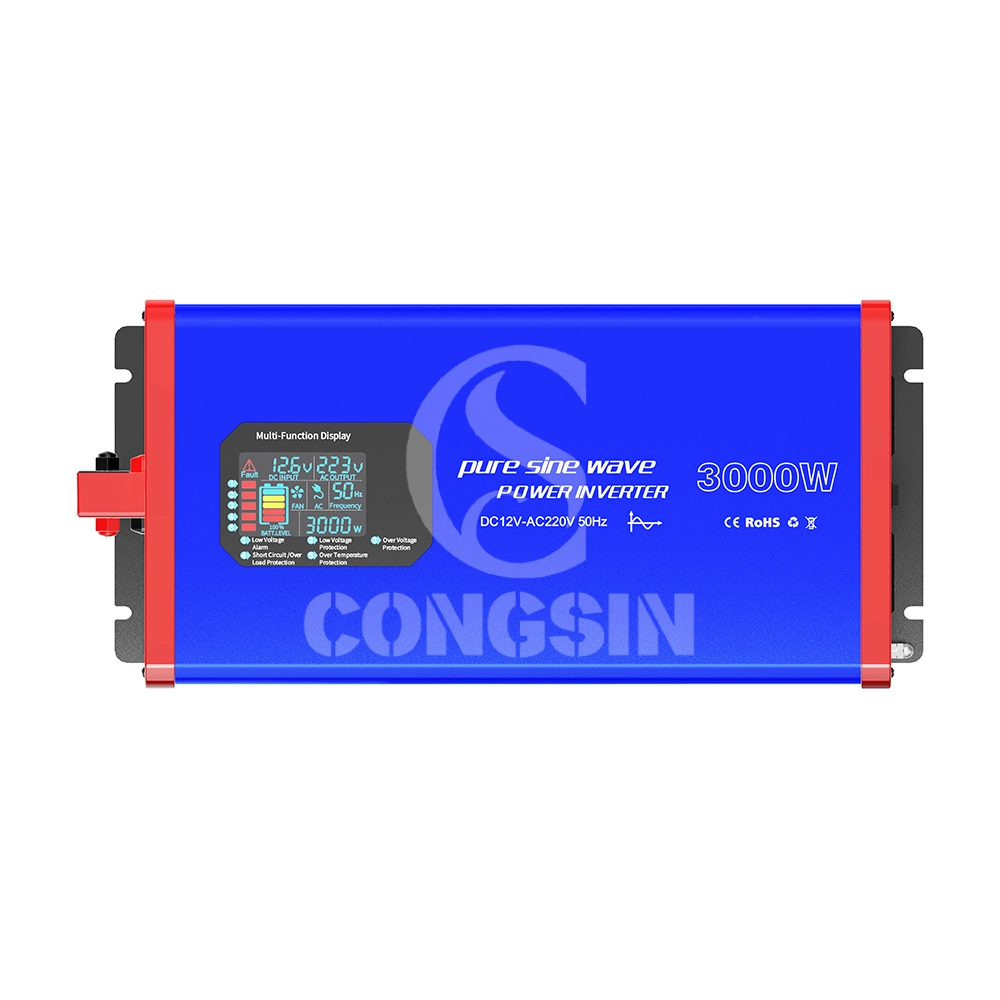
This 3000W full-power pure sine wave inverter (Model: CS3000PSW) adopts pure sine wave output technology (waveform distortion rate <2%), and the output power is highly consistent with mains power quality. It can safely drive high-power precision loads such as air conditioners, refrigerators, medical instruments, and small industrial equipment, avoiding equipment malfunctions or shortened service life caused by unstable waveforms. The device supports DC 12V input (compatible with 10.5V-14.8V wide voltage), continuously outputs 3000W full power, and has a peak power of 6000W, easily coping with the instantaneous startup impact of high-power devices; it is equipped with 4 AC universal sockets (max current 16A) + 2 USB 3.0 fast-charging ports (22.5W per port) to meet the simultaneous power supply needs of multiple devices. Built-in six-fold safety protection (overload, overvoltage, undervoltage, short circuit, overtemperature, reverse connection), combined with dual intelligent silent cooling fans (noise ≤45dB), it achieves the triple advantages of "high power + high safety + low noise," suitable for home emergency, outdoor engineering, vehicle-mounted power supply, small industrial scenarios and other fields.
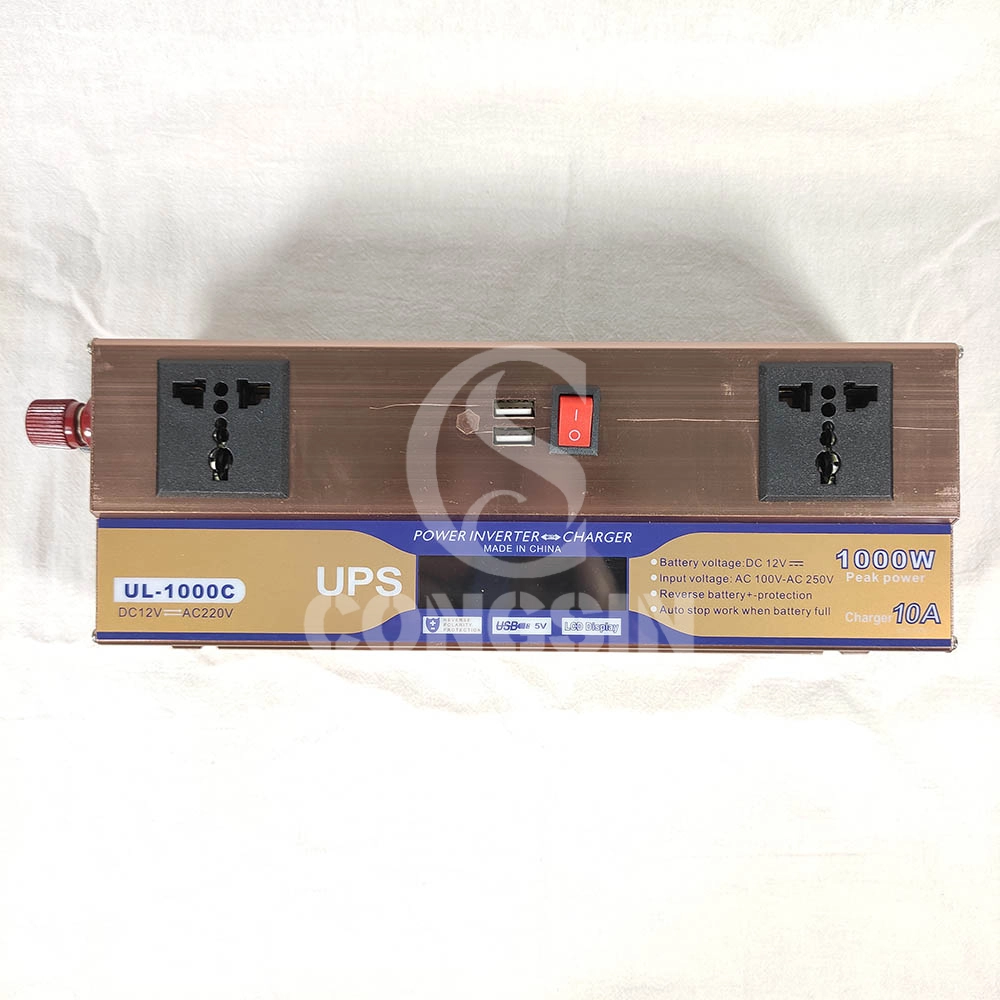
This 1000W modified sine wave inverter has UPS charging function, with DC12V input and AC220V output, and 600W rated power. Equipped with dual universal sockets, two USB ports, an LCD display, and a battery clip, it is professionally designed and has stable performance. It can provide stable AC power conversion and UPS emergency power supply for computers, small home appliances, electronic devices, etc. in home emergency, office, outdoor and other scenarios, meeting the needs of simultaneous power supply and emergency power supply for multiple devices.
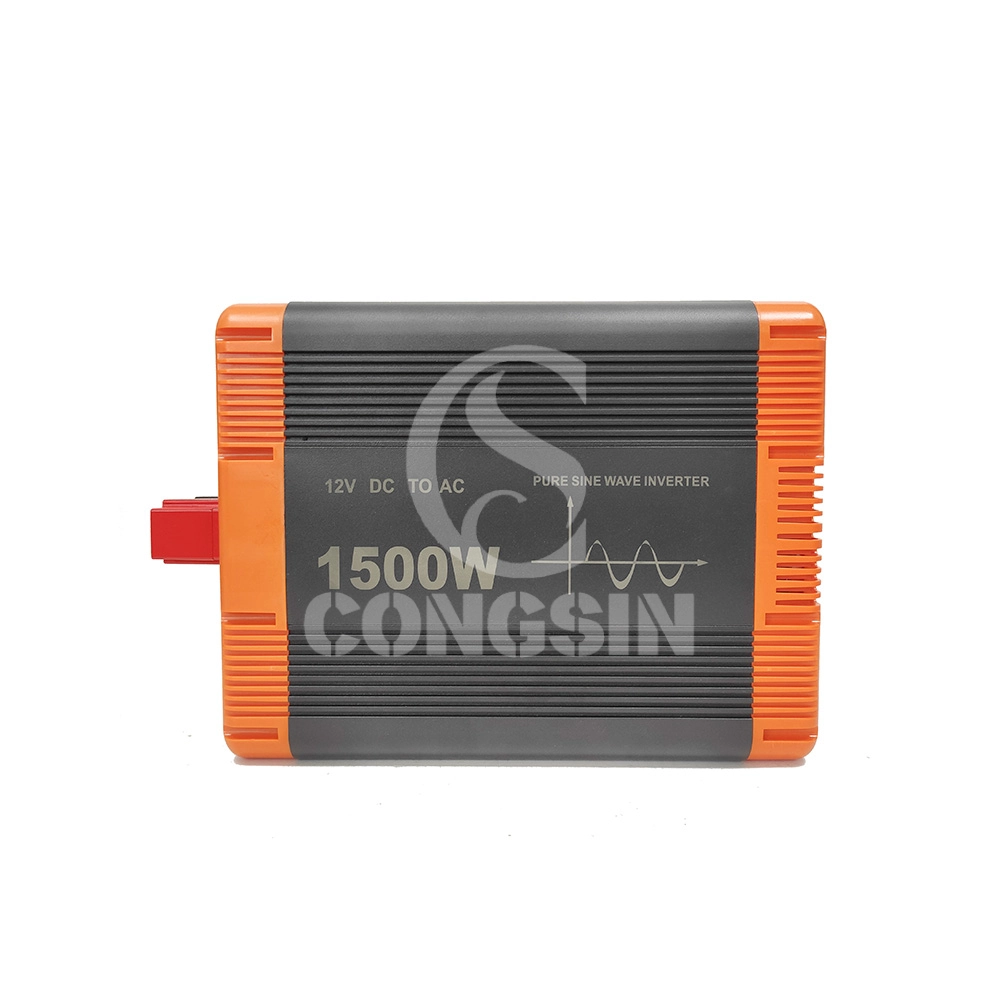
This 1500W pure sine wave inverter converts DC 12V to AC 220V power, with a rated power of 1500W and a peak power of 3000W. Equipped with dual fans, LCD display, QC3.0 and PD Type-C fast charging ports, and remote control capability for stable and intelligent power output.
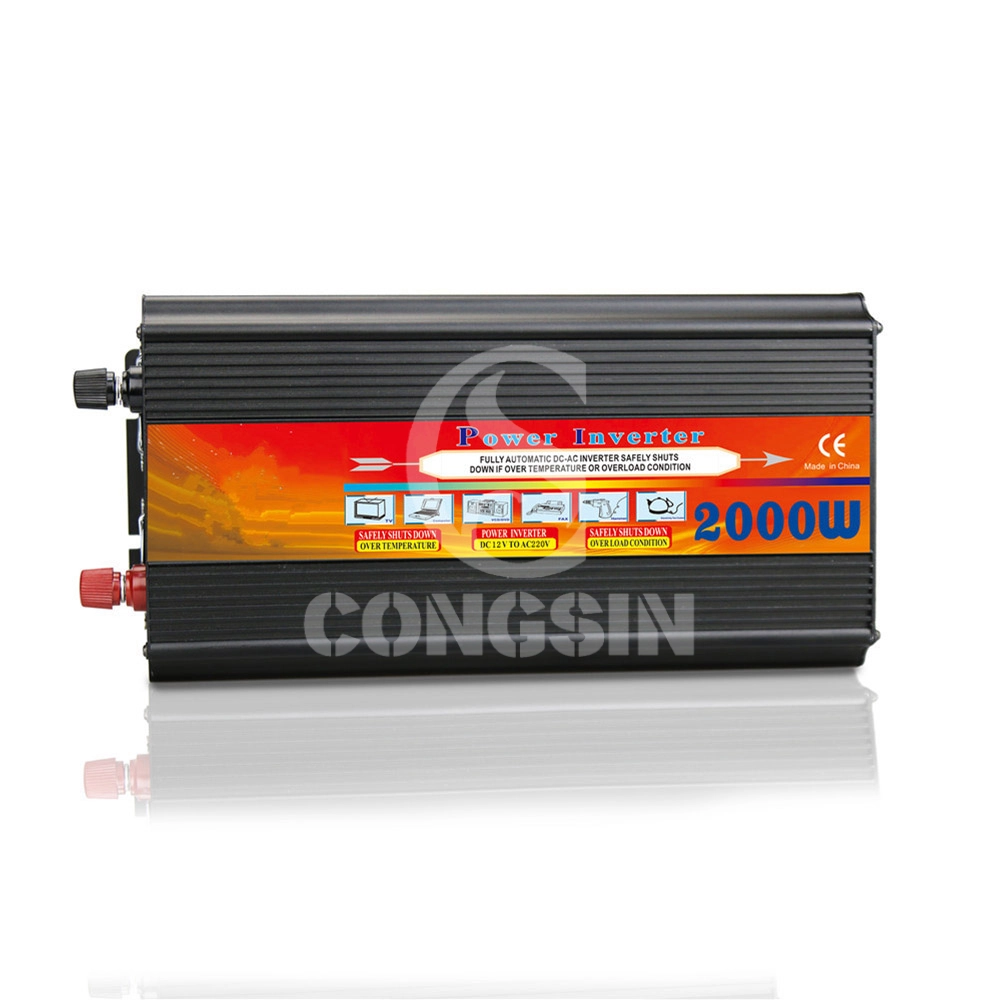
Our CS2000BIG 2000W modified sine wave inverter is a high-power power conversion device that converts DC 12V from batteries into AC 220V electricity. It is designed for heavy-duty use, featuring 2 AC sockets to power multiple high-power devices simultaneously, 2 cooling fans for efficient heat dissipation, and battery terminal wire for stable connection. With its robust construction and large capacity, it is an ideal solution for powering tools, appliances, and equipment in various scenarios, from industrial use to home emergencies.
Get in Touch with Our Team
You can also communicate with us directly through our online contact form. Please fill in the following information, and our team will contact you as soon as possible after receiving your message.

CONGSIN is a trusted OEM factory for power inverters, solar charge controllers, and DC converters. Reliable solutions for global B2B buyers.
 High Quality
 7/24 Service
 Guaranteed Warranty
© 2025 Congsin. All Rights Reserved.
 WeChat
 Scan QR Code
sin cong
teaimei10
Whatsapp: +8618028086791
Scan QR Code