


Best Solar Power Inverter for Home in 2026: Your Ultimate Guide to Energy Independence
Your ultimate guide to the best solar power inverter for home in 2026. Compare home solar inverter types, including hybrid and microinverters, for optimal efficiency.
- Key Takeaways: Your Quick Guide to Home Solar Inverters
- What is a Solar Power Inverter for Home and Why is it Crucial?
- The Role of the Inverter
- Types of Solar Inverters for Residential Use: Which One is Right for You?
- 1. String Inverters (Centralized)
- 2. Microinverters (Distributed)
- 3. Power Optimizers
- 4. Hybrid Inverters (Battery-Ready)
- How to Choose the Best Solar Power Inverter for Your Home
- System Size & Compatibility
- Efficiency Ratings
- Grid-Tied vs. Hybrid Needs
- Warranty & Reliability
- Installation and Maintenance: Maximizing Your Inverter's Lifespan
- Professional Installation
- Monitoring Features
- Maintenance Tips
- Top Features and Innovations in Home Solar Inverters for 2026
- Advanced MPPT Algorithms
- AI-Powered Energy Management
- Vehicle-to-Grid (V2G) Ready
- Conclusion: Powering Your Home with the Right Solar Inverter
- FAQ
- What is the primary function of a solar power inverter in a home system?
- How do I know if I need a grid-tied, off-grid, or hybrid solar inverter?
- What are the key differences between string inverters and microinverters?
- How much does a solar power inverter for home typically cost?
- How long do home solar inverters usually last, and what impacts their lifespan?
- Can a solar inverter provide backup power during a grid outage?
- What is MPPT technology in solar inverters, and why is it important?
- What maintenance is required for a home solar inverter?
- References
Key Takeaways: Your Quick Guide to Home Solar Inverters
- Essential Function: Solar power and inverter systems are inseparable; the inverter converts DC electricity from panels into usable AC power for your home.
- Types Matter: Choose between string, micro, or home solar inverter types like hybrid models based on your roof's shading and your storage needs.
- Selection Criteria: Prioritize efficiency, warranty duration (10-25 years), and smart monitoring capabilities.
- Sizing: Proper sizing prevents system clipping and ensures safety.
- Investment Value: A high-quality inverter maximizes energy harvest and ensures long-term ROI.
-
-
What is a Solar Power Inverter for Home and Why is it Crucial?
Direct Answer: A solar power inverter is the "brain" of a photovoltaic system. It converts direct current (DC) electricity generated by solar panels into alternating current (AC) electricity, which is the standard format used by home appliances and the electrical grid.
According to EnergySage, the solar inverter is arguably the most critical component of your solar energy system. While panels generate the raw power, the inverter processes it for practical use.
The Role of the Inverter
As stated by the Department of Energy, inverters perform three critical functions:
- DC to AC Conversion: Transforming variable DC output into stable 120V/240V AC power.
- Grid Synchronization: For grid-tied systems, the frequency and voltage must match the utility grid perfectly to export excess power safely.
- Maximum Power Point Tracking (MPPT): This technology optimizes the match between the solar array (PV panels) and the battery bank or utility grid. According to Wikipedia, MPPT allows the inverter to sample the output of the PV cells and apply the proper resistance (load) to obtain maximum power for any given environmental condition.
Without a reliable inverter, the relationship between a power inverter and solar panel array is useless for residential needs.
Types of Solar Inverters for Residential Use: Which One is Right for You?
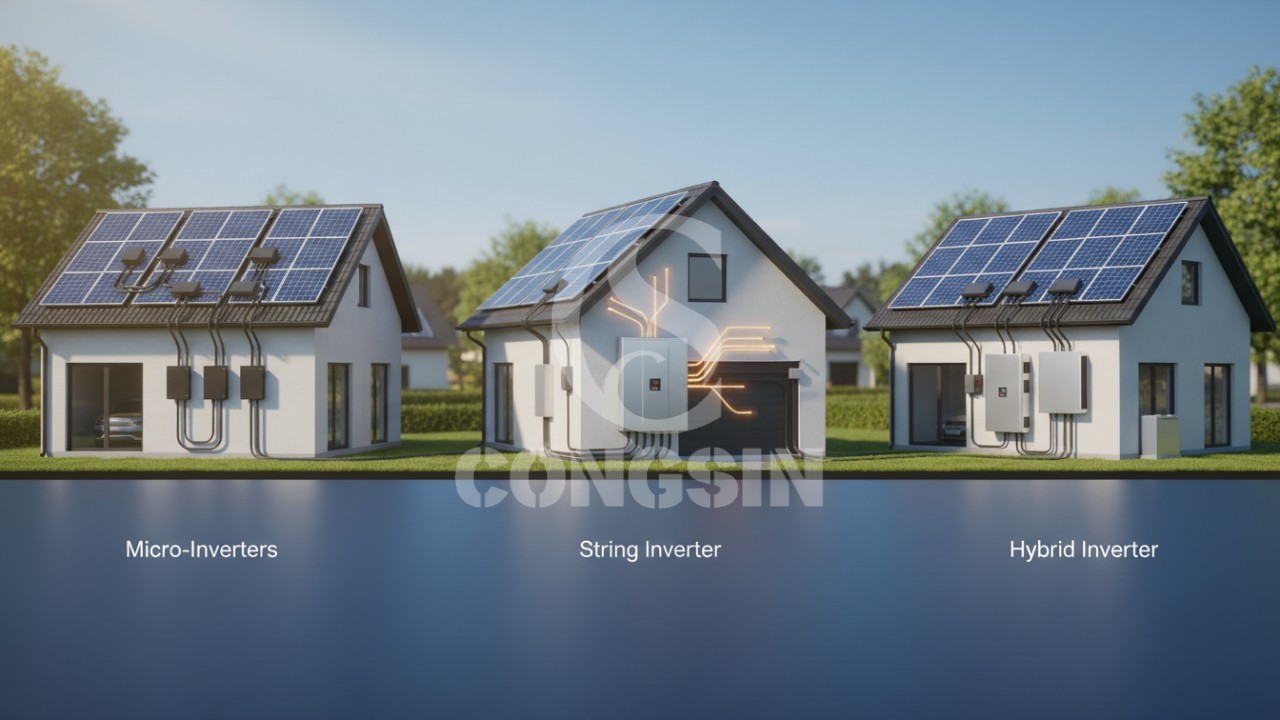
Direct Answer: The three main home solar inverter types are string inverters (best for simple, unshaded roofs), microinverters (best for complex or shaded roofs), and power optimizers (a hybrid cost solution). Additionally, hybrid inverters are essential for battery storage integration.
Understanding these distinct categories is vital for designing an efficient system. According to Aforenergy, selecting the right topology depends heavily on your specific site conditions and budget.
1. String Inverters (Centralized)
Traditionally the most common type, string inverters connect a series of panels (a "string") to a single central unit.
- Pros: Cost-effective and easier to service since the unit is usually on a wall, not the roof.
- Cons: According to EcoFlow, the entire string's performance is often throttled by the lowest-performing panel. If one panel is shaded, the output of the whole string drops.
- Best For: Homes with simple roof lines and consistent, unshaded sunlight.
2. Microinverters (Distributed)
Microinverters are small units attached to each individual solar panel.
- Pros: They allow panels to operate independently. As noted by Enphase, this means shading on one panel does not affect the rest of the array. They also offer superior individual panel monitoring.
- Cons: Higher upfront cost compared to string inverters.
- Best For: Roofs with shading issues, multiple orientations, or homeowners who want granular data.
3. Power Optimizers
These are Module-Level Power Electronics (MLPEs) similar to microinverters but cheaper. They condition the DC power at the panel level before sending it to a central string inverter.
- Function: According to SolarReviews, they mitigate the impact of shading and allow for panel-level monitoring without the full cost of microinverters.
- Best For: A middle-ground solution for partially shaded roofs.
4. Hybrid Inverters (Battery-Ready)
A hybrid inverter for home use is increasingly popular in 2026. These units combine a standard solar inverter and a battery inverter into one.
- Function: They manage power from solar panels, battery storage, and the grid simultaneously. According to PowMr, this versatility makes them ideal for energy independence strategies.
Feature String Inverter Microinverter Hybrid Inverter Cost Low High Medium-High Shade Tolerance Low High Medium (depends on setup) Battery Ready No (usually) No (requires separate unit) Yes Warranty 8-12 Years 20-25 Years 10-15 Years
How to Choose the Best Solar Power Inverter for Your Home
Direct Answer: To choose the best inverter, match the inverter’s capacity (watts) to your solar array size, ensure high CEC efficiency ratings (96%+), and decide if you need a hybrid inverter for home battery backup. Always prioritize a warranty of at least 10-12 years.
System Size & Compatibility
Your inverter must be able to handle the output of your power inverter and solar panel setup.
- Undersizing (Clipping): Often, installers undersize the inverter by 10-20% relative to the panels (DC-to-AC ratio of 1.2) because panels rarely hit peak output. This is efficient.
- Oversizing: Avoiding too small an inverter ensures you don't lose power during peak sun hours.
Efficiency Ratings
Look for "Weighted Efficiency" ratings. This measures how well the inverter converts DC to AC across a range of voltages.
- Benchmark: Modern string inverters often exceed 97% efficiency, while microinverters hover around 96-97%.
Grid-Tied vs. Hybrid Needs
If you plan to add batteries later, buying a hybrid inverter now is "future-proofing." According to energy.gov.au, hybrid inverters simplify the addition of storage, allowing you to store excess solar energy for use at night or during blackouts.
Warranty & Reliability
- String Inverters: Typically 10-12 years.
- Microinverters: Typically 25 years.
- Hybrid Inverters: Typically 10 years.
- Tip: Check if the manufacturer has a local support presence. A long warranty is useless if the company is unreachable.
Installation and Maintenance: Maximizing Your Inverter's Lifespan
Direct Answer: Professional installation is non-negotiable for warranty validity and safety. Maintenance primarily involves ensuring cooling vents are clear of debris and monitoring performance via the manufacturer's app to catch faults early.
Professional Installation
Solar inverters handle high-voltage electricity. Improper wiring can lead to fires or equipment failure. Always use a certified electrician or solar installer.
- Placement: Install inverters in a cool, shaded area (like a garage or north-facing wall) to prevent overheating, which degrades electronics.
Monitoring Features
Modern inverters come with Wi-Fi or 4G connectivity.
- Apps: Platforms from brands like Enphase, SolarEdge, or SMA allow you to see real-time production.
- Fault Detection: According to Ornate Solar, advanced monitoring can alert you to specific panel failures, saving money on diagnostics.
Maintenance Tips
- Visual Check: Once a month, check for physical damage or loose cabling.
- Cleanliness: Ensure heat sinks and fans are not blocked by dust or spiderwebs.
- Display Check: Look for error codes on the unit's LED screen.
Top Features and Innovations in Home Solar Inverters for 2026
Direct Answer: The top innovations for 2026 include AI-driven energy management for time-of-use rate optimization, built-in EV charger integration, and enhanced cybersecurity protocols for smart grid interaction.
Advanced MPPT Algorithms
Newer inverters track the sun's movement more precisely, extracting energy even in low-light conditions (dawn/dusk).
AI-Powered Energy Management
Smart inverters now integrate with home automation. They can "learn" your energy usage patterns and decide whether to send power to your load, charge your battery, or sell to the grid to maximize profit.
Vehicle-to-Grid (V2G) Ready
As EVs become common, inverters are evolving to support bidirectional charging. This allows your car to act as a battery backup for your house.
Conclusion: Powering Your Home with the Right Solar Inverter
The solar power inverter is the cornerstone of any efficient renewable energy system. It bridges the gap between the raw DC energy from the sun and the AC appliances that power your life.
When selecting from the various home solar inverter types, consider your long-term goals. If energy independence is your priority, a hybrid inverter for home usage is likely your best investment. For shaded roofs, microinverters remain the champion. By matching the right power inverter and solar panel technology, you ensure decades of reliable, green energy and significant financial savings.
FAQ
What is the primary function of a solar power inverter in a home system?
The primary function is to convert the direct current (DC) electricity generated by your solar panels into alternating current (AC) electricity. AC is the standard power type used by almost all home appliances and the utility grid, making the inverter essential for making solar energy usable.
How do I know if I need a grid-tied, off-grid, or hybrid solar inverter?
- Grid-tied: Choose this if you want to save money on bills and sell excess power to the utility but don't need backup power.
- Off-grid: Essential if you have no access to the utility grid (remote cabins) and rely 100% on battery storage.
- Hybrid: Select a hybrid inverter for home if you are grid-tied but want battery backup for outages and the ability to store solar power for night use.
What are the key differences between string inverters and microinverters?
String inverters are centralized units that handle the output of multiple panels wired in a series; they are cost-effective but susceptible to shading issues. Microinverters are installed on each panel, allowing independent operation. This optimizes output in shaded conditions and provides granular monitoring but costs more upfront.
How much does a solar power inverter for home typically cost?
Costs vary by technology and capacity. String inverters usually range from $1,000 to $2,500. Microinverter systems can cost $1,000 to $5,000+ depending on the number of panels (approx. $150-$200 per unit). Hybrid inverters are more expensive, typically ranging from $2,000 to $5,000+ excluding batteries.
How long do home solar inverters usually last, and what impacts their lifespan?
String inverters typically last 10-12 years and may need replacement once during the solar system's life. Microinverters often last 20-25 years. Heat, humidity, and poor ventilation are the biggest factors that shorten an inverter's lifespan.
Can a solar inverter provide backup power during a grid outage?
Standard grid-tied inverters cannot; they have an "anti-islanding" safety feature that shuts them down during outages to protect utility workers. Only hybrid inverters (paired with batteries) or specialized sunlight-backup inverters can provide power during a grid failure.
What is MPPT technology in solar inverters, and why is it important?
MPPT (Maximum Power Point Tracking) is a digital algorithm that constantly adjusts the electrical load to ensure solar panels operate at their peak efficiency, regardless of changes in sunlight intensity or temperature. It significantly increases daily energy production.
What maintenance is required for a home solar inverter?
Minimal maintenance is required. Keep the unit clean, ensure air vents are unobstructed for cooling, and check the monitoring app regularly for alerts. A professional inspection every 3-5 years is recommended to check for loose connections.
References
- Department of Energy: Solar Integration Inverters
- EnergySage: What is a Solar Inverter?
- Aforenergy: Types of Solar Inverters
- energy.gov.au: Inverters
- EcoFlow: Microinverters vs String Inverters
- Enphase: Microinverters vs String Inverters
- SolarReviews: What are DC Power Optimizers
- Enphase: Microinverters vs String Inverters
- Ornate Solar: Decoding Power Optimizers
- PowMr: Types of Solar Inverter


Modified Sine Wave Inverters
What capacity battery can be used with it?
It is recommended to use a 12V 100Ah-200Ah lead-acid battery or lithium battery; the larger the battery capacity, the longer the UPS power supply time (e.g., a 100Ah battery can support a 100W device to work continuously for about 10 hours).
Which region’s voltage standards does it support?
It defaults to AC 220V output, suitable for regions with 220V voltage standards such as China and Europe; it can also be customized to output AC 110V, suitable for regions with 110V voltage standards such as the United States and Japan.
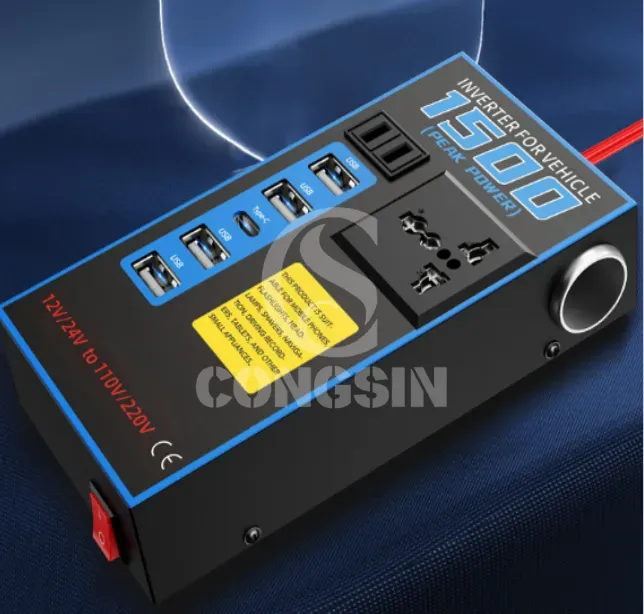
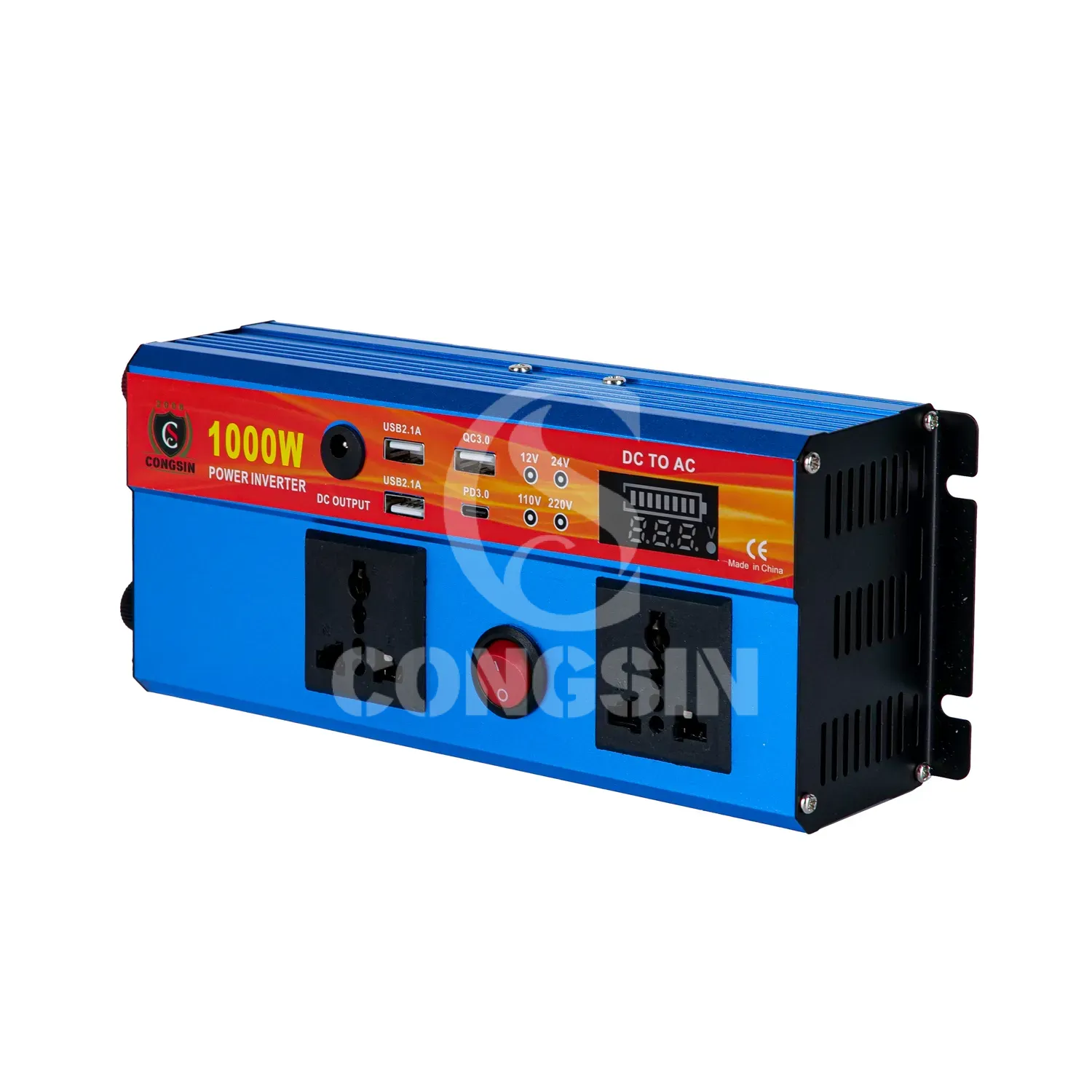
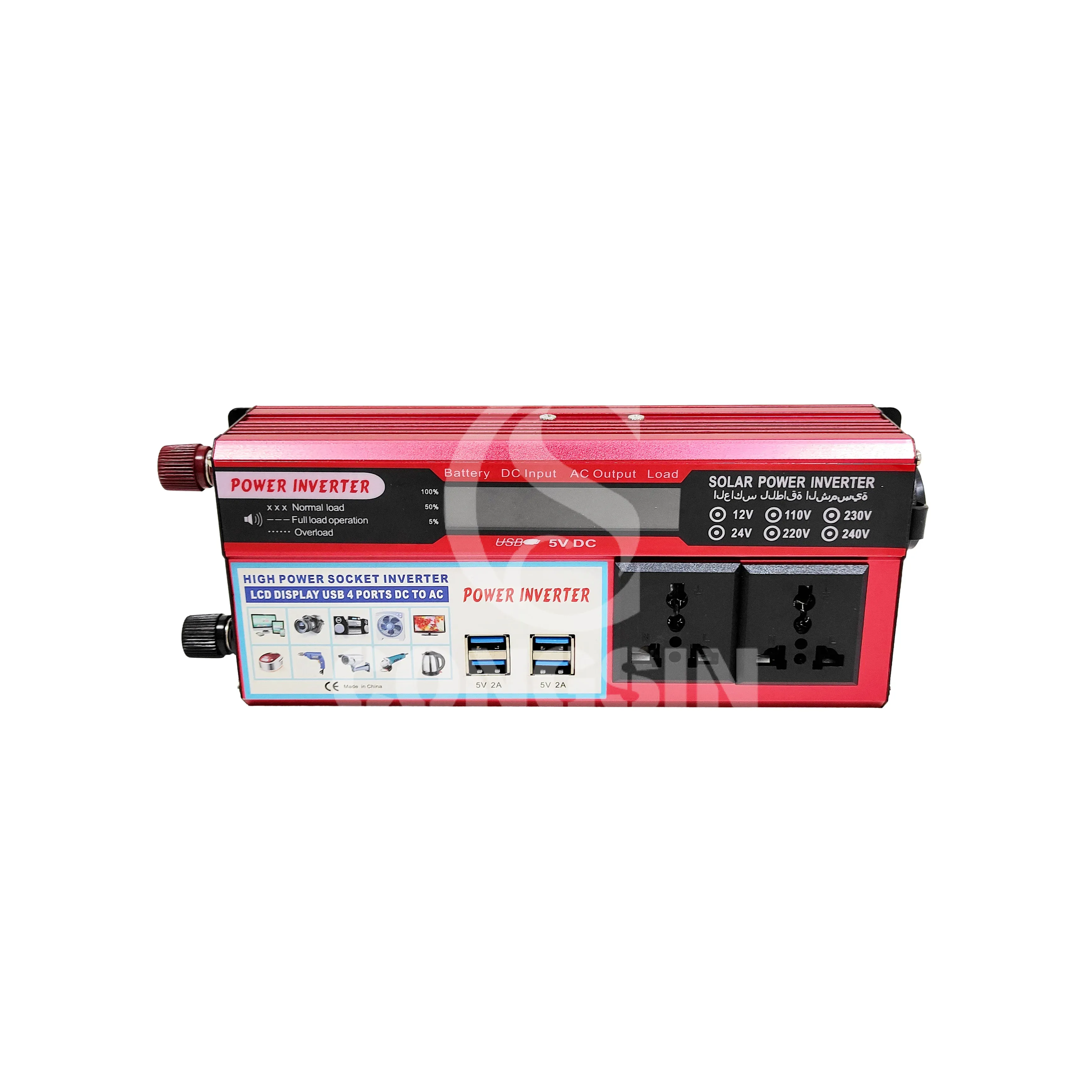
Can 4 USB ports charge 4 mobile phones at the same time?
Yes, the total current of 6.8A can support simultaneous fast charging of multiple devices, and the charging efficiency is guaranteed.
How to connect to the battery?
Use the included battery clips, connect the red clip to the positive pole of the battery and the black clip to the negative pole. Ensure good contact and no short-circuit risk when connecting.
Distributor
How long does it take to become an authorized distributor?
The process typically takes 2-4 weeks, depending on the discussion and agreement finalization.
Get in Touch with Our Team
You can also communicate with us directly through our online contact form. Please fill in the following information, and our team will contact you as soon as possible after receiving your message.
CONGSIN is a trusted OEM factory for power inverters, solar charge controllers, and DC converters. Reliable solutions for global B2B buyers.
 High Quality
 7/24 Service
 Guaranteed Warranty
© 2025 Congsin. All Rights Reserved.