





Best Power Inverter for Car: 2026 Buyer's Guide for Fast Charging & Reliability
A comprehensive 2026 buyer's guide for car power inverters. Discover why experts recommend Pure Sine Wave and GaN technology for safely powering laptops, Starlinks, and appliances on the road.
- Quick Summary: The 2026 Power Inverter Essentials
- What is the best power inverter for a car?
- Why GaN Matters in 2026
- Pure Sine Wave vs. Modified Sine Wave: Which Do You Need?
- The Hidden Dangers of Modified Sine Wave
- Calculating Your Power Needs: Continuous vs Surge Wattage
- How to Size Your Inverter
- Advanced Features for 2026: USB-C Power Delivery 3.1
- Efficiency Gains
- Installation Guide: Cigarette Lighter vs. Direct-to-Battery
- The 150-Watt Threshold
- Hardwiring Best Practices
- EV and Hybrid Considerations: A New Power Frontier
- Tesla's Low-Voltage Warning
- Utilizing "Camp Mode"
- Common Mistakes to Avoid When Buying an Inverter
- The "Idle Draw" Trap
- References
Quick Summary: The 2026 Power Inverter Essentials
- Prioritize Pure Sine Wave: Mandatory for modern electronics like MacBooks, CPAP machines, and gaming consoles to prevent overheating.
- Demands for USB-C PD 3.1: Look for units with 140W+ USB-C ports to charge laptops directly, bypassing inefficient AC bricks.
- The 150W Fuse Rule: Never plug an inverter rated higher than 150W-180W into a cigarette lighter socket; hardwiring is required for higher loads.
- GaN Technology: Select inverters using Gallium Nitride transistors for units that are 25-40% smaller and run significantly cooler.
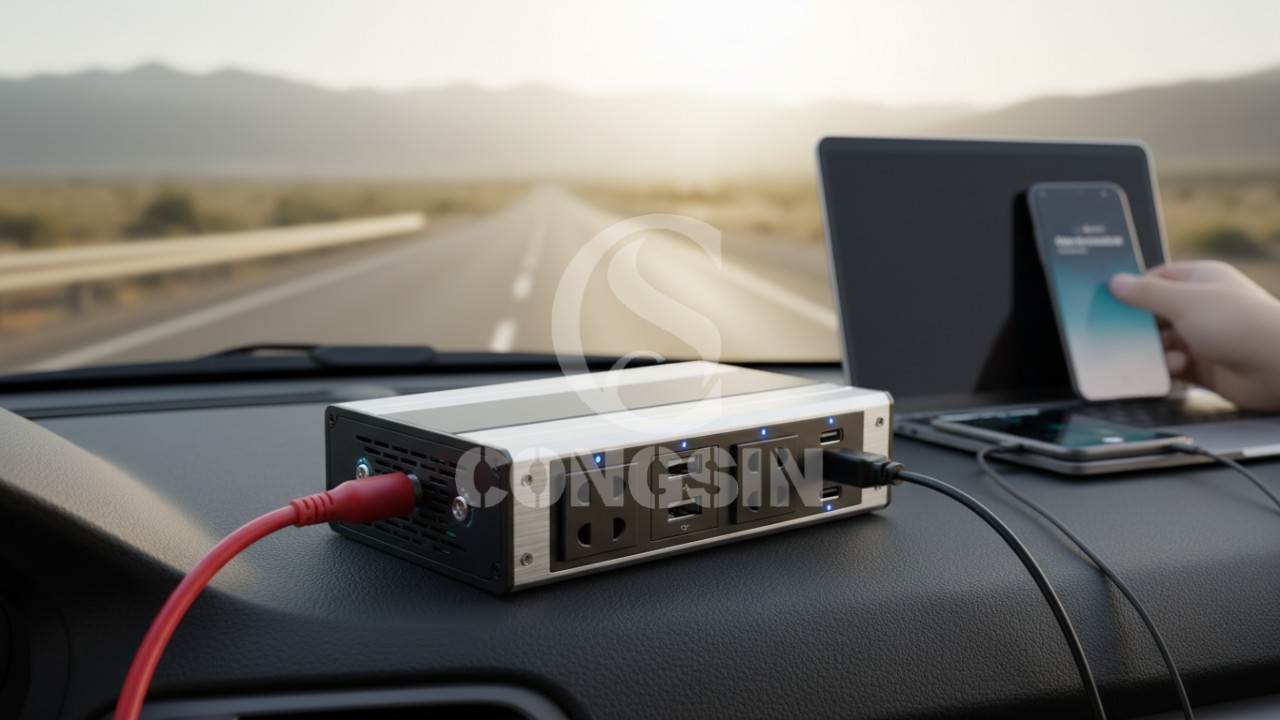
What is the best power inverter for a car?
The best power inverter for a car is a Pure Sine Wave Inverter that safely converts your vehicle's 12V Direct Current (DC) battery power into 110V-120V Alternating Current (AC) while utilizing Gallium Nitride (GaN) components for thermal efficiency. Unlike older bulky models, top-tier 2026 inverters act as compact mobile power stations, allowing you to run sensitive office equipment, medical devices, and tools without electrical interference.
Why GaN Matters in 2026
According to recent semiconductor market analysis, the shift to GaN technology has allowed manufacturers to reduce inverter size by up to 40% while maintaining high power output. This is critical for vehicle interiors where space and airflow are limited. A GaN-based inverter offers:
- Higher Efficiency: Converts power with 97-99% efficiency, wasting less battery energy as heat.
- Compact Form Factor: Fits easily in cup holders or under seats.
- Silent Operation: Reduced heat means cooling fans run less frequently.
Pure Sine Wave vs. Modified Sine Wave: Which Do You Need?
Pure Sine Wave Inverter units produce smooth, consistent electrical oscillation identical to the power supplied by a residential wall outlet, whereas Modified Sine Wave units generate blocky, "staircase-like" signals.
The Hidden Dangers of Modified Sine Wave
While Modified Sine Wave inverters are often 50% cheaper, they are a false economy for modern digital nomads. The "dirty" power they produce can cause:
- Overheating: AC power bricks for laptops may run dangerously hot.
- Visual Artifacts: Lines or flickering on monitors and TV screens.
- Hardware Damage: Motors in fans or CPAP machines may buzz loudly and wear out prematurely.
Expert Recommendation: If you are powering anything more complex than a toaster or a simple fan, a Pure Sine Wave Inverter is non-negotiable.
Calculating Your Power Needs: Continuous vs Surge Wattage
Continuous vs Surge Wattage refers to the distinction between the steady amount of power an inverter can supply indefinitely versus the brief burst of energy it can deliver for a few seconds to start a motor.
How to Size Your Inverter
To avoid blowing fuses or tripping safety shut-offs, you must calculate the total wattage of devices you intend to run simultaneously. Follow the 80% Rule: never plan to run your inverter at more than 80% of its continuous rating for long periods.
- Laptop (65W - 140W): Requires ~200W inverter for safety.
- Starlink Roam (50W - 75W): Requires ~300W Pure Sine inverter.
- Electric Grill or Kettle (1200W - 1500W): Requires 2000W inverter hardwired to the battery.
Advanced Features for 2026: USB-C Power Delivery 3.1
USB-C Power Delivery 3.1 is the latest charging standard capable of delivering up to 240W of power through a single USB-C cable, though 140W is the current common maximum for car inverters.
Efficiency Gains
Traditionally, you would plug a 12V DC to 110V AC Converter into your car, then plug your laptop's AC adapter into that. This double conversion (DC to AC, then AC back to DC) wastes roughly 20-30% of your power as heat.
By using a direct USB-C PD 3.1 port on the inverter:
- You bypass the AC conversion step entirely.
- Charging speed increases dramatically (0% to 50% in 30 minutes for many laptops).
- You eliminate the need to carry bulky "power bricks."
Installation Guide: Cigarette Lighter vs. Direct-to-Battery
The most critical installation rule is that any device drawing more than 150 watts must bypass the dashboard cigarette lighter and connect directly to the vehicle's battery terminals.
The 150-Watt Threshold
Most vehicle 12V accessory sockets are fused at 10 Amps or 15 Amps.
- Formula: 12 Volts x 15 Amps = 180 Watts (Theoretical Max).
- Reality: Voltage drop and wiring resistance usually cap safe output at 150W.
Hardwiring Best Practices
For 500W, 1000W, or 2000W installations:
- Use ANL Fuses: Place a fuse on the positive cable within 12 inches of the battery.
- Thick Gauge Wire: Use 4 AWG or 0 AWG cables to prevent fire hazards.
- Short Cables: Keep the DC cables (battery to inverter) as short as possible (under 6 feet) to maintain voltage.
EV and Hybrid Considerations: A New Power Frontier
Electric Vehicles (EVs) like the Tesla Model Y or Ford F-150 Lightning have specific 12V/16V DC-DC converter limits that differ significantly from traditional alternators.
Tesla's Low-Voltage Warning
Newer Tesla models utilize a 16V Lithium-Ion low-voltage battery instead of the traditional 12V Lead-Acid. Many standard 12V DC to 110V AC Converter units have over-voltage protection that trips at 15V, meaning they will not work in newer Teslas. You must verify the input voltage range of your inverter is compatible (e.g., 11V-17V).
Utilizing "Camp Mode"
In most modern EVs, the 12V outlets power down when the driver leaves the seat to conserve energy. To keep your inverter running for a fridge or laptop while parked, you must engage "Camp Mode" or "Utility Mode," which keeps the high-voltage battery engaged to replenish the low-voltage system.
Common Mistakes to Avoid When Buying an Inverter
Battery Discharge Protection is a vital safety feature that automatically shuts off the inverter when your car battery voltage drops below a certain threshold (usually 10.5V or 11V) to ensure the car can still start.
The "Idle Draw" Trap
Even when nothing is plugged in, an inverter consumes power (0.5A - 2A) to maintain its electronics.
- Mistake: Leaving the inverter switched "ON" overnight.
- Result: A dead car battery the next morning.
- Solution: Always turn the inverter off physically or use a model with a remote switch when not in use.
References


Pure Sine Wave Inverters
What capacity battery is needed to meet long-term use?
It needs to be calculated according to the total power of the device, the formula is "Battery Capacity (Ah) = Total Device Power (W) × Usage Time (h) ÷ Input Voltage (12V)". For example, to drive a 1000W device for 5 hours, the required battery capacity = 1000×5÷12≈417Ah, it is recommended to use 2 200Ah batteries in parallel (total capacity 400Ah, actual usage about 4.8 hours).
What is the reason for the inverter automatically shutting down during operation?
It is likely that the protection mechanism is triggered: 1. Load overload (total power of connected devices exceeds 1000W); 2. Abnormal input voltage (battery voltage <10.8V or >14.5V); 3. Device overtemperature (excessively high ambient temperature or cooling fan failure). It is recommended to disconnect some loads, check the battery voltage or clean the heat dissipation port before trying again.
Will reversing the positive and negative poles damage the device when connecting the battery?
The device has a built-in reverse connection protection function, which will automatically cut off the circuit when the positive and negative poles are reversed to avoid damage caused by reverse current inflow; just adjust the connection order of the positive and negative poles of the battery clip and re-power on to use normally.
Modified Sine Wave Inverters
What is the benefit of the UPS function? A2:
It automatically switches to battery power when AC fails.
What is the working principle of the UPS function?
When the external power supply is normal, the inverter powers the device and charges the battery; when the external power supply is interrupted, it automatically switches to battery power to ensure uninterrupted operation of the device.
Get in Touch with Our Team
You can also communicate with us directly through our online contact form. Please fill in the following information, and our team will contact you as soon as possible after receiving your message.

CONGSIN is a trusted OEM factory for power inverters, solar charge controllers, and DC converters. Reliable solutions for global B2B buyers.
 High Quality
 7/24 Service
 Guaranteed Warranty
© 2025 Congsin. All Rights Reserved.