





How long will a UPS power inverter keep systems running?
- Key Considerations for Purchasing a UPS Power Inverter
- 1. What is the difference between an inverter and a UPS system?
- 2. How long will a UPS power inverter keep systems running?
- 3. What factors influence UPS runtime?
- 4. How do battery types affect UPS duration?
- 5. How can I calculate UPS backup time?
- 6. How do environmental factors impact UPS battery life and runtime?
- 7. How does power factor influence the efficiency and runtime of a UPS?
- 8. What is the difference between VA rating and wattage in UPS systems?
- Conclusion: Why Choose Congsin for Your UPS Needs?
When selecting a UPS (Uninterruptible Power Supply) power inverter, it's crucial to understand various factors that influence its performance and suitability for your needs. Below are some common questions and their answers to guide your decision-making process.
Key Considerations for Purchasing a UPS Power Inverter
1. What is the difference between an inverter and a UPS system?
An inverter converts DC power from batteries into AC power for immediate use, typically without built-in batteries. In contrast, a UPS system includes both the battery and charger in a single unit, providing seamless power backup during outages. Additionally, UPS systems often offer communication features to alert connected equipment about power status changes.
2. How long will a UPS power inverter keep systems running?
The runtime of a UPS power inverter depends on several factors:
Load Size: Larger loads reduce runtime. For example, a 1000VA UPS may last up to 60 minutes under a 100W load but only 3–5 minutes under a 600W load.
Battery Capacity: Higher capacity batteries extend runtime. For instance, a 24V 300Ah battery theoretically provides 19.2 hours at a 300W load, though real-world conditions may reduce this duration.
Inverter Efficiency: Typically ranging from 85% to 95%, affecting the actual usable power.
3. What factors influence UPS runtime?
Key factors include:
Battery Age: Batteries lose capacity over time, typically reducing by 10–20% per year. Regular maintenance and timely replacement are essential.
Temperature: Optimal operation occurs at 20–25°C (68–77°F). Higher temperatures can halve battery life for every 10°C increase.
Load Variations: Dynamic loads can affect runtime, with peak loads temporarily reducing available runtime.
4. How do battery types affect UPS duration?
Common battery types include:
Sealed Lead-Acid (SLA): Cost-effective but have a shorter lifespan and lower energy density.
Lithium-Ion: Higher upfront cost but longer lifespan, faster charging, and higher energy density.
The choice impacts both runtime and total cost of ownership.
5. How can I calculate UPS backup time?
Use the formula:
Runtime (hours) = Battery Capacity (Wh) / Load (W)
For example, a 100Ah battery at 12V provides 1,200Wh. At a 300W load:
1,200Wh / 300W = 4 hours
This is a simplified calculation; actual runtime may vary due to factors like inverter efficiency and battery age.
6. How do environmental factors impact UPS battery life and runtime?
Environmental conditions such as temperature, humidity, and ventilation significantly affect battery performance and lifespan. Maintaining a stable, cool, and dry environment can enhance battery longevity and reliability.
7. How does power factor influence the efficiency and runtime of a UPS?
Power factor (PF) measures the efficiency of power usage. A PF of 1 indicates perfect efficiency. UPS systems are rated at specific PFs (e.g., 0.85), and operating at a lower PF can reduce runtime and efficiency.
8. What is the difference between VA rating and wattage in UPS systems?
VA (Volt-Ampere) rating indicates the apparent power capacity, while wattage represents the real power capacity. The power factor (PF) relates them:
Wattage = VA × PF
For example, a 1,000VA UPS with a PF of 0.85 provides 850W of real power.
Understanding these distinctions ensures you select a UPS system that meets your specific power requirements.
Conclusion: Why Choose Congsin for Your UPS Needs?
Congsin offers a range of high-quality UPS power inverters designed to provide reliable and efficient power backup solutions. With advanced technology, robust construction, and exceptional customer support, Congsin ensures your systems remain operational during power interruptions.
By considering the factors outlined above and choosing Congsin, you can make an informed decision that aligns with your power backup needs.
For more information on our products and services, visit our website or contact our sales team.
Note: The information provided is based on current industry standards and may vary depending on specific models and configurations.
Sources:


Modified Sine Wave Inverters
Which regional plugs are supported by the universal socket?
The universal socket is compatible with most national plug specifications, such as GB, US, EU, etc. (some require adapters), and can meet the use of devices in different regions.
What power appliance can this inverter run?
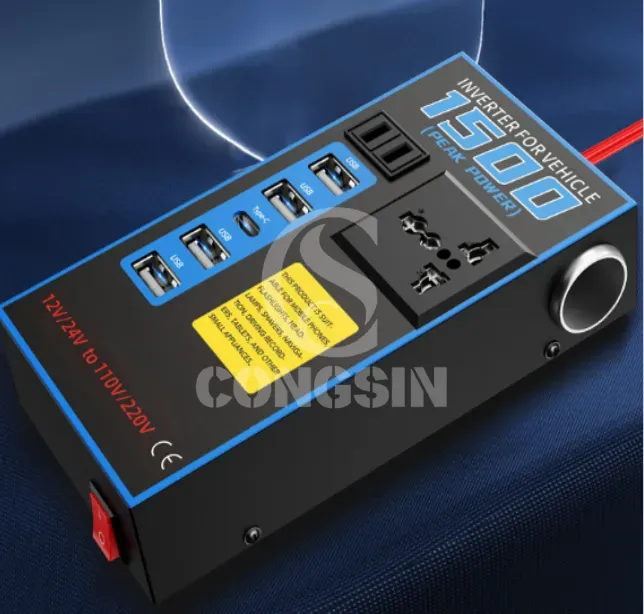
It has a continuous power of 800W, so it can run appliances within 800W; the peak power is 1500W, supporting the instantaneous startup of appliances within 1500W.
What devices can be powered by the cigarette lighter port?
The cigarette lighter port can be used for car air pumps, car refrigerators, car vacuum cleaners and other conventional cigarette lighter powered devices, as long as the power does not exceed 300W.
Can 4 USB ports charge 4 mobile phones at the same time?
Yes, the total current of 6.8A can support simultaneous fast charging of multiple devices, and the charging efficiency is guaranteed.
Distributor
Do you provide marketing and sales materials?
Yes, we provide a range of marketing resources, including brochures, digital content, and product training.
Get in Touch with Our Team
You can also communicate with us directly through our online contact form. Please fill in the following information, and our team will contact you as soon as possible after receiving your message.

CONGSIN is a trusted OEM factory for power inverters, solar charge controllers, and DC converters. Reliable solutions for global B2B buyers.
 High Quality
 7/24 Service
 Guaranteed Warranty
© 2025 Congsin. All Rights Reserved.