





Pure Sine Car Inverter Guide: Sizing, Safety, and Pure vs. Modified Explained
- Introduction
- What is the difference between a pure sine wave and a modified sine wave car inverter?
- What size pure sine wave inverter do I need for my car?
- Can I plug a pure sine wave inverter into my car's cigarette lighter?
- Will a pure sine wave car inverter drain my car battery?
- What appliances require a pure sine wave car inverter?
- How long will a pure sine wave inverter run on a fully charged car battery?
- How do I choose the right voltage for my pure sine car inverter?
- Is a pure sine wave car inverter safe for sensitive electronics like laptops?
- Conclusion
- Call to Action
Introduction
Imagine being miles away from civilization, yet having the power to run your laptop, CPAP machine, or mini-fridge flawlessly right from your vehicle. That is the exact freedom a pure sine car inverter provides for road trippers, van-lifers, and remote workers alike. It opens up a world of possibilities, bringing the conveniences of grid-tied living into the wild.
An automotive power inverter bridges the critical gap between your car's 12-volt battery and your standard household electronics. By seamlessly converting the battery's energy into usable electricity, these dynamic devices essentially turn your daily driver or recreational vehicle into a mobile, high-capacity power station.
However, not all power inverters are built equally. Choosing the wrong type or size can result in damaged electronics, blown fuses, or a completely dead car battery leaving you stranded. In this comprehensive guide, we will explore the essential differences between pure and modified sine waves, discuss optimal sizing calculations, and answer your most pressing questions to ensure safe, reliable power on the go.
What is the difference between a pure sine wave and a modified sine wave car inverter?
The primary distinction between these two types of inverters lies in the electrical waveform they produce. A pure sine wave (often referred to as a true sine wave) creates a smooth, naturally oscillating electrical current; in mathematical and physical terms, it is a continuous periodic wave that represents the purest form of oscillation Wikipedia. This perfectly mimics the high-quality power supplied by your local utility grid.
According to Wikipedia, a power inverter simply converts direct current (DC) into alternating current (AC), but the quality of that AC output is strictly dictated by the inverter's internal circuitry. A modified sine wave inverter produces a "blocky" or stair-step waveform. Instead of transitioning smoothly between positive and negative voltages, the current sharply jumps, creating a choppier and less refined electrical output.
Ultimately, this fundamental difference dictates what you can safely plug into the unit. Pure sine car inverters provide stable, clean power that is mandatory for sensitive microprocessors, variable-speed motors, and critical medical devices. Modified versions, while significantly cheaper to manufacture, are strictly best reserved for simple, non-sensitive items like older incandescent light bulbs or basic resistive heaters that do not rely on precise electrical timing.
Furthermore, a pure sine car inverter operates with greater overall efficiency when paired with modern electronics. Devices powered by a clean sine wave will run cooler and use less energy to perform the exact same task compared to when they are powered by a modified sine wave, which is a crucial advantage when your only energy reservoir is your vehicle's finite battery capacity.
What size pure sine wave inverter do I need for my car?
Sizing your pure sine wave inverter correctly requires calculating the total wattage of the devices you intend to run simultaneously. Every electronic device has a specific power requirement, usually listed on its power brick or manufacturer label. To find your ideal inverter size, you must first add up the running watts of all the appliances you plan to plug in at the exact same time.
Once you have your total running wattage, you must factor in the continuous power rating and the peak surge wattage. Many devices, particularly those with electric motors or compressors like mini-fridges and power tools, require an initial burst of energy to start up—sometimes up to three times their normal running wattage. Your chosen inverter must have a surge capacity high enough to handle this brief, high-demand spike without tripping its internal overload protection.
As a general rule of thumb, it is highly recommended to build in a 20% to 30% safety margin. For example, if your laptop and portable monitor consume 200 watts continuously, purchasing a 300-watt pure sine car inverter is much safer than buying a 200-watt model. This headroom prevents the inverter from constantly running at maximum capacity, which reduces heat generation and significantly extends the lifespan of the device.
Finally, keep in mind the physical limitations of your vehicle's electrical system. Small inverters (under 300 watts) are generally safe to use inside the cabin, but larger units (1000+ watts) require heavy-duty wiring connected directly to the vehicle's battery. Choosing a massive inverter does no good if your car's alternator cannot keep up with the electrical demand.
Can I plug a pure sine wave inverter into my car's cigarette lighter?
Yes, you can plug a pure sine wave inverter into your car's 12-volt accessory port (traditionally known as the cigarette lighter), but there are strict electrical limitations to keep in mind. The wiring connected to these accessory ports is relatively thin and is usually protected by a modest 10-amp to 15-amp fuse located inside your vehicle's main fuse box.
Because of this strict fused limit, a cigarette lighter port can safely supply a maximum of 120 to 150 watts of continuous power. If you attempt to draw more power than this—for instance, by plugging in a high-draw gaming laptop, a coffee maker, or a blender—you will instantly blow the vehicle's fuse, cutting off power to the port entirely. Therefore, using the cigarette lighter is strictly suitable for small electronic devices.
For larger pure sine car inverters ranging from 400 watts to 3000 watts, direct battery connection is absolutely mandatory. These high-capacity units come with thick, heavy-gauge cables that must be securely bolted to the positive and negative terminals of your car battery. This direct connection bypasses the fragile cabin wiring, safely delivering the massive electrical current required for heavy loads.
If you plan on a mixed-use scenario, look for an automotive power inverter that comes with both a cigarette lighter adapter and alligator clips for the battery. This allows you to use the convenient cabin port for charging your phone or tablet while driving, but gives you the option to pop the hood and connect directly to the battery when you need to power a microwave at your campsite.
Will a pure sine wave car inverter drain my car battery?
Yes, any power inverter will aggressively drain your car battery if it is actively drawing power while the vehicle's engine is turned off. When the engine is not running, the inverter relies entirely on the stored energy inside the lead-acid battery. Because standard car batteries are designed to provide short, massive bursts of power to start the engine—not to act as deep-cycle storage—they can be drained astonishingly fast.
If the engine is running, the scenario changes completely. Your vehicle's alternator continuously generates electrical energy, recharging the battery and supplying fresh power to the inverter. As long as the total wattage drawn by your inverter does not exceed the alternator's maximum output capacity, your battery will remain safely charged while you power your electronics on the road.
To prevent waking up to a completely dead battery while parked, it is crucial to monitor your usage and utilize inverters with built-in low-voltage disconnect (LVD) safety features. A high-quality pure sine car inverter will automatically sound an alarm and shut itself off when it detects the battery voltage dropping below a critical threshold (usually around 10.5 volts), preserving just enough juice to start your engine.
For frequent campers or van-lifers who rely heavily on an inverter when the engine is off, upgrading your electrical system is highly recommended. To avoid arriving at a dead vehicle, follow these best practices:
- Use Low-Voltage Disconnects: Ensure your inverter automatically shuts down before critical depletion.
- Unplug When Unused: Inverters consume parasitic standby power even when idle.
- Install an Auxiliary Battery: Use a dedicated deep-cycle battery (like lithium iron phosphate) for heavy camping loads, completely isolating your starter battery.
What appliances require a pure sine wave car inverter?
Certain electronics and household appliances absolutely require the smooth, continuous power delivery of a pure sine wave to function safely and properly. At the absolute top of this list are vital medical devices, such as CPAP machines and oxygen concentrators. The sensitive microprocessors and motors within these devices can malfunction, overheat, or fail completely if subjected to the jagged power delivery of a modified sine wave.
Similarly, modern devices with variable-speed motors or advanced electronic controls demand a true sine wave to operate efficiently. This includes newer refrigerators with linear compressors, variable-speed power tools, laser printers, and smart microwaves. Using a cheaper modified inverter on these appliances almost always results in loud buzzing noises, excess heat generation, and ultimately, premature hardware failure.
Audiovisual equipment and telecommunications gear also strongly fall into the category of electronics that require clean power. High-end stereos, professional photography lighting, musical instrument amplifiers, and broadcast equipment will pick up harmonic distortion from modified sine waves. This distortion manifests as annoying audio hums or visual static on screens, completely ruining the performance of the equipment.
Finally, certain categories of appliances will flat out refuse to work or suffer severe damage without a pure sine car inverter. These include:
- Medical Equipment: CPAP machines, monitors, and oxygen concentrators.
- Variable-Speed Motors: Modern refrigerators, washing machines, and sensitive power tools.
- Heating Elements with SCRs: Pellet stoves, digital bread makers, and lighting dimmers.
How long will a pure sine wave inverter run on a fully charged car battery?
The runtime of a pure sine car inverter connected to a fully charged battery is dependent on two main variables: the total capacity of your battery (measured in amp-hours or Ah) and the total wattage of the devices you are currently powering. Standard vehicle starter batteries typically hold around 40 to 60 amp-hours of energy, though only about half of that is safely usable without permanently damaging the battery chemistry.
To calculate a rough estimate of your runtime, you can use a simple power conversion formula. First, divide the wattage of your device by 10 (which roughly accounts for the 12-volt system and standard inverter inefficiency) to find the estimated continuous amperage draw. For example, a 100-watt television will draw roughly 10 amps per hour from a 12V battery. If your battery has 30 safely usable amp-hours, your television will run for approximately three hours before the battery is depleted.
It is incredibly important to note that pure sine wave inverters themselves consume a small amount of power just by being turned on, even if nothing is actively plugged into them. This "no-load draw" can range from 0.5 to 2 amps per hour depending on the size and internal efficiency of the unit. Therefore, if you carelessly leave a large inverter switched on overnight without the engine running, it can easily drain the battery flat by morning.
Because of these harsh mathematical limitations, running high-draw appliances like microwaves, hair dryers, or electric kettles off a standard car battery will result in very short runtimes—often just a few minutes. If you require extended runtimes for significant electrical loads, you will absolutely need to add a dedicated bank of high-capacity deep-cycle batteries to your vehicle.
How do I choose the right voltage for my pure sine car inverter?
Choosing the correct input voltage for your pure sine car inverter is a straightforward process dictated entirely by the underlying electrical architecture of your vehicle. The vast majority of standard passenger cars, SUVs, and light trucks operate on a 12-volt direct current (DC) electrical system. Therefore, if you are installing the unit in a typical daily driver, you must specifically purchase a 12-volt pure sine wave inverter.
However, if you are outfitting a heavy-duty commercial truck, a large transit bus, or certain heavy agricultural equipment, your vehicle likely utilizes a 24-volt DC system. In these specific cases, a 24-volt inverter is strictly required. Attempting to connect a 12V inverter to a 24V battery bank will result in immediate catastrophic failure, blown fuses, and severe potential fire hazards.
The U.S. Department of Energy notes that an inverter's fundamental job is regulating the flow of electrical power from a specific DC source into usable AC electricity. Matching the exact input voltage of your battery source is the absolute foundational step in this power regulation process, ensuring the device can perform its primary function without destroying itself.
On the output side, the voltage choice depends entirely on where you live and what region your specific appliances were designed for. In North America, you will need an inverter that outputs 110V to 120V AC at 60Hz. If you are traveling in Europe, Asia, or Africa with local appliances, you will require an inverter that outputs 220V to 240V AC at 50Hz. Always triple-check both the input and output voltage specifications before making a final purchase.
Is a pure sine wave car inverter safe for sensitive electronics like laptops?
Yes, a pure sine car inverter is incredibly safe and, in fact, the universally recommended choice for charging and operating sensitive electronics like laptops, smartphones, and tablets. The seamless, continuously oscillating waveform produced by these inverters flawlessly mimics the electricity supplied by standard residential wall outlets, meaning your laptop's delicate power adapter receives the exact type of energy it was explicitly engineered to handle.
Sensitive microprocessors rely on stable voltage and highly predictable electrical frequencies to operate without crashing or accumulating unseen physical heat damage. When powered by a lower-quality modified sine wave, a laptop's charging brick often has to work much harder to filter out the jagged electrical "noise." This excess filtering strain causes the charger to run dangerously hot and can dramatically reduce the lifespan of the internal charging components.
A pure sine wave ensures that the power flows efficiently and cleanly, completely eliminating the inherent risk of harmonic distortion that can scramble sensitive data or fry delicate computer motherboards. You can confidently plug in expensive Apple MacBooks, high-end gaming laptops, and specialized photography equipment knowing the power delivery is exceptionally smooth and entirely risk-free.
Furthermore, many modern premium pure sine wave inverters come equipped with built-in safety mechanisms that add another vital layer of protection for your electronics. Features such as over-voltage protection, short-circuit prevention, and thermal automatic shutdowns ensure that even if a random power surge originates from the car's alternator, your expensive laptop will remain completely shielded from the devastating electrical spike.
Conclusion
Equipping your vehicle with a pure sine car inverter is one of the absolute best functional upgrades you can make for road trips, remote work, and emergency disaster preparedness. By providing clean, highly stable, and reliable AC power, these devices allow you to seamlessly run everything from sensitive laptops to crucial medical devices without the lingering fear of hardware damage or electrical inefficiency.
Understanding the strict differences between pure and modified sine waves, properly calculating your required continuous power rating and peak surge wattage, and heavily respecting the physical limits of your vehicle's battery are all critical steps for a successful mobile power setup. When sized and installed correctly, a high-quality inverter essentially turns your car into an off-grid power sanctuary.
Whether you are passively charging drone batteries through your cabin’s cigarette lighter or running a microwave off a direct-to-battery heavy-duty connection, always prioritize electrical safety and never leave high-draw units running indefinitely on a parked engine. Armed with the expert knowledge from this guide, you are now fully prepared to choose the perfect inverter for your mobile lifestyle.
Call to Action
If you need personalized assistance selecting the perfect pure sine car inverter for your specific vehicle and power needs, please contact our team of mobile power experts today for a free consultation.


Modified Sine Wave Inverters
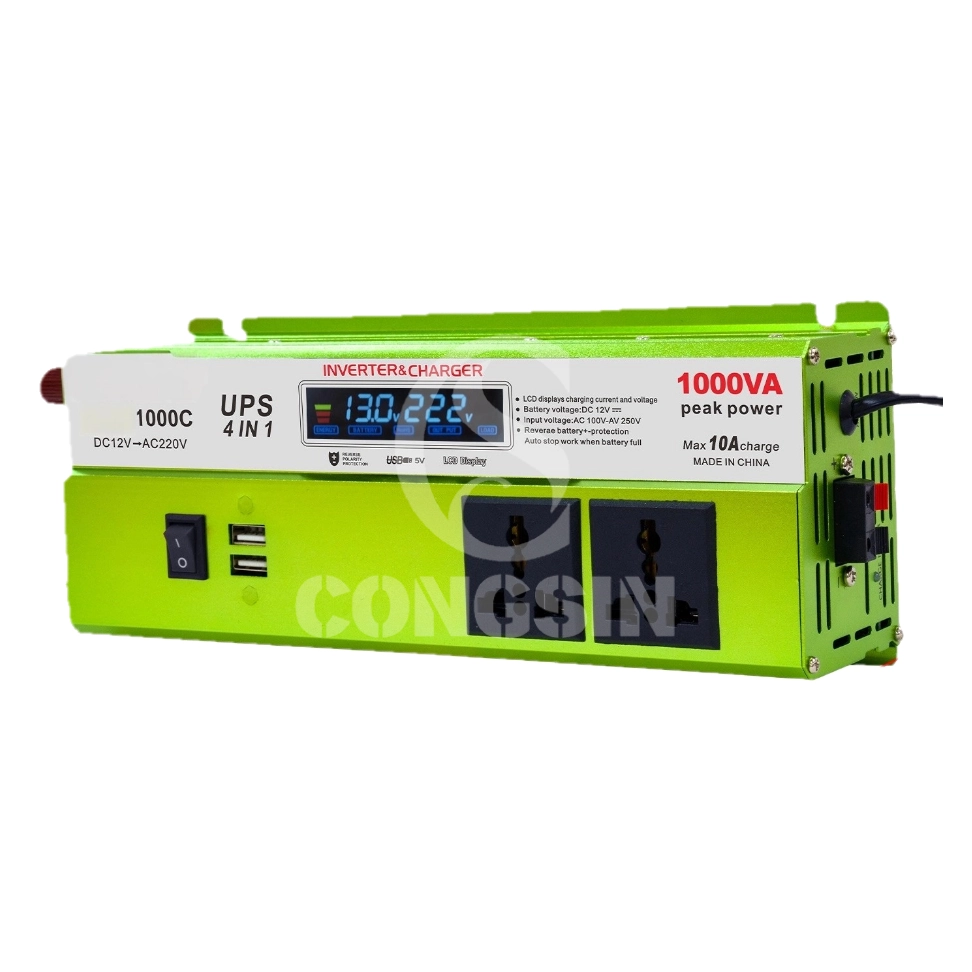
What is the working principle of the UPS function?
When the external power supply is normal, the inverter powers the device and charges the battery; when the external power supply is interrupted, it automatically switches to battery power to ensure uninterrupted operation of the device.
Can this inverter run a refrigerator or power tools?
Recommended load ≤80% of rated power. For inductive loads, use a pure sine wave model.
What devices can be powered by the cigarette lighter port?
The cigarette lighter port can be used for car air pumps, car refrigerators, car vacuum cleaners and other conventional cigarette lighter powered devices, as long as the power does not exceed 300W.
What devices can be powered by this inverter?
Suitable for TVs, fans, computers, and small tools.
What is the difference between modified sine wave and pure sine wave?
Modified sine wave is suitable for most ordinary home appliances and electronic devices; pure sine wave is suitable for devices with extremely high power requirements (such as precision instruments). This modified sine wave is more cost-effective and meets the needs of most daily scenarios.
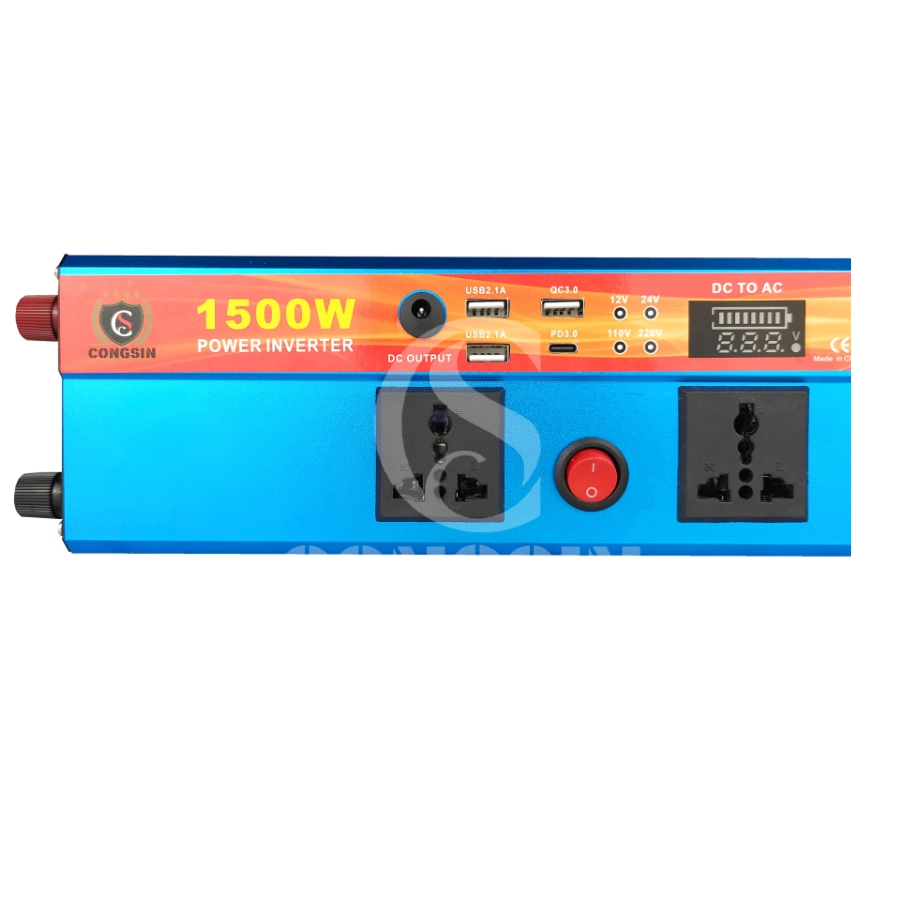
Our CS1000DDBC 1000W modified sine wave inverter is a professional power conversion device that converts DC 12V from batteries into AC 220V electricity. It is designed with user convenience in mind, featuring an LED display for real-time status monitoring, multiple charging ports (3 USB, 1 Type-C, 1 DC 12V) and two universal sockets to power a wide range of devices simultaneously. Its compact size (250×95×55mm) and lightweight design (NW: 0.84kg) make it easy to carry, ideal for outdoor activities, emergency home use, and on-the-go power needs.
Get in Touch with Our Team
You can also communicate with us directly through our online contact form. Please fill in the following information, and our team will contact you as soon as possible after receiving your message.

CONGSIN is a trusted OEM factory for power inverters, solar charge controllers, and DC converters. Reliable solutions for global B2B buyers.
 High Quality
 7/24 Service
 Guaranteed Warranty
© 2025 Congsin. All Rights Reserved.