





Car Battery to Power Inverter: How Long It Lasts and What Size You Need
- Introduction
- Can I use a regular car battery to power an inverter?
- How long will a car battery run a power inverter?
- What size power inverter can a 12V car battery handle?
- How do you safely connect a power inverter to a car battery?
- Will using a power inverter drain my car battery?
- Is it better to use a deep cycle battery or a standard car battery for an inverter?
- Can you run a power inverter while the car engine is turned off?
- What household appliances can a car battery inverter power?
- Conclusion
- Call to Action
Introduction
Turning your vehicle into a mobile power station is an incredible convenience for road trips, camping, and emergency power outages. The core of this capability involves using a car battery to power inverter units, which magically convert your vehicle's 12V direct current (DC) into the 120V alternating current (AC) used by standard household appliances. While the concept is straightforward, executing it safely requires a solid understanding of battery chemistry and electrical loads.
Whether you want to charge a laptop off-grid or run a mini-fridge during a blackout, knowing the limitations of your vehicle's electrical system is crucial. This comprehensive guide will walk you through the essential facts, from calculating exact runtimes to choosing between starting and deep cycle batteries. We will answer the most common questions about safely wiring and sizing your inverter to ensure you never end up stranded with a dead battery.
Can I use a regular car battery to power an inverter?
Yes, you can successfully use a standard vehicle battery as the foundation for your 12V inverter system. Standard car batteries are specifically designed to provide the initial 12V DC power that an inverter needs to operate. By connecting an inverter to your vehicle's battery, you can easily power smaller AC devices without needing a separate, dedicated battery bank.
However, it is important to understand how these starting batteries are engineered. A regular car battery is built as a "sprinter"—it is designed to deliver a massive, short burst of high amperage to engage the starter motor and crank the engine. Once the engine is running, the alternator immediately takes over to supply power and recharge the battery back to 100% capacity.
If you decide to use this setup, it is highly recommended to only run light loads or to keep the vehicle's engine running while the inverter is active. Pulling a continuous power output from a regular car battery without the alternator running will quickly drain it, potentially causing permanent damage to the battery's internal lead plates.
How long will a car battery run a power inverter?
The runtime of your setup depends heavily on the total capacity of your battery and the wattage of the devices you are attempting to power. Battery capacity is measured in Ampere-hours (Ah), and a typical car battery holds roughly 50Ah to 70Ah of total energy. To determine how long your devices will stay powered, you must calculate the total available watt-hours.
To find the exact duration, you need to use a reliable battery runtime calculation. The standard formula involves multiplying your battery's voltage (12V) by its Amp-hour rating to find the total Watt-hours (Wh). For example, a 60Ah battery multiplied by 12V yields 720 Watt-hours of total theoretical energy. You then divide this number by the wattage of the appliance you are running.
For instance, if you are running a 100W laptop charger on that 720Wh battery, the raw math suggests 7.2 hours of runtime. However, a regular starting battery should never be discharged below 50% capacity if you still want to start your car, effectively cutting your usable runtime in half to just 3.6 hours.
Furthermore, you must account for inverter efficiency. Most power inverters are only about 85% to 90% efficient, losing the remaining energy as heat during the DC to AC conversion process. Factoring in this efficiency loss and a safe depth of discharge, that same 100W load might realistically only run safely for about 2.5 to 3 hours on a standard car battery before risking a no-start scenario.
What size power inverter can a 12V car battery handle?
Determining the correct size for your 12V inverter system depends entirely on how you plan to connect it to the vehicle. The limiting factor is rarely the battery itself, but rather the wiring, fuses, and the vehicle's alternator. Proper sizing ensures that you do not overload the vehicle's electrical circuits.
If you are plugging directly into the vehicle's 12V accessory port (cigarette lighter), you are strictly limited to smaller inverters. These circuits are typically fused at 10 to 15 amps, meaning the maximum safe inverter size is between 150W and 200W. Attempting to draw more power through the accessory port will instantly blow the vehicle's internal fuse.
For larger units requiring a continuous power output of 1000W or more, you must wire the inverter directly to the car battery using heavy-duty copper cables. A healthy 12V car battery can physically handle the surge of a 1000W to 2000W inverter for a brief period. However, sustaining this load requires massive current—a 1000W inverter pulls over 80 amps from a 12V battery.
It is also crucial to consider your vehicle's alternator capacity if you plan to run the engine. Most standard vehicle alternators produce between 100 and 150 amps. If your inverter continuously draws more amps than the alternator can generate, you will slowly drain the battery even with the engine running, eventually leading to a system shutdown.
How do you safely connect a power inverter to a car battery?
Safety should be your top priority during any power inverter installation. Dealing with high-current 12V DC power requires respect and precision, as poor connections can lead to excessive heat, melted wires, or even electrical fires. Start by ensuring the vehicle is turned off and the keys are removed from the ignition.
Begin by selecting heavy-duty copper cables properly gauged for your inverter's maximum wattage. Thicker cables reduce electrical resistance, preventing the wires from overheating under heavy loads. The red cable connects to the positive terminal of the inverter and the battery, while the black cable connects to the negative terminal and a solid chassis ground.
When performing your power inverter installation, always install an inline fuse on the positive wire as close to the battery terminal as possible, as recommended by TopBull. This fuse acts as a critical fail-safe; if a short circuit occurs anywhere along the cable run, the fuse will blow immediately, protecting the battery from exploding and the car from catching fire.
Finally, ensure all connections are bolted tightly using a wrench. Loose connections increase electrical resistance, causing voltage drops and dangerous heat buildup. Once the cables and fuses are securely fastened, you can safely turn the inverter on and begin plugging in your AC devices.
Will using a power inverter drain my car battery?
Yes, drawing AC power from your inverter will absolutely drain your car battery. An inverter does not create electricity; it merely transforms the DC energy stored in your battery into AC energy. Every watt of power your household appliance consumes is actively pulled from the battery's finite chemical reserves.
When the engine is running, the vehicle's alternator acts as a generator, constantly replenishing the battery as the inverter draws from it. As long as your inverter's power draw is lower than the alternator's charging output, your battery will not drain. However, the moment you turn the engine off, the battery is completely on its own.
According to Battery Stuff, a standard car battery will typically only run an inverter for 30 to 60 minutes before it lacks the power needed to start the vehicle. Because starting batteries have a low reserve capacity, they deplete incredibly fast when subjected to the steady draw of a power inverter.
To mitigate the risk of a completely dead battery, many modern inverters come equipped with a low-voltage alarm or automatic shut-off feature. These safeguards are designed to cut power to your appliances when the battery voltage drops to around 10.5V, theoretically leaving just enough juice to start the engine, though you should never intentionally drain it this low.
Is it better to use a deep cycle battery or a standard car battery for an inverter?
For frequent or heavy inverter use, a deep cycle marine battery is vastly superior to a standard car battery. The two types of batteries have fundamentally different internal architectures, making them suited for entirely different jobs. Using the right battery for your application ensures longevity and reliable power.
Starting batteries feature thin, highly porous plates designed to deliver massive amperage for a few seconds. According to Tech Battery Solutions, deep cycling a standard starting battery will rapidly destroy its plates because they are only designed to be discharged by 2 to 4% during typical engine starts. Repeatedly draining a standard battery with an inverter will ruin it within a few dozen cycles.
Conversely, deep cycle batteries are constructed with thicker, solid lead plates that are built for continuous power output. They are engineered to be discharged down to 50% (or even 80% for lithium variants) over extended periods and recharged hundreds or thousands of times without suffering degradation. This makes them the perfect companion for an off-grid inverter setup.
Many mobile power enthusiasts opt for a dual-battery system to get the best of both worlds. They keep the standard starting battery dedicated solely to the engine, and wire a separate deep cycle marine battery in the trunk or truck bed to run the power inverter. An isolator switch allows the vehicle's alternator to charge both batteries while driving, without risking a dead starting battery.
Can you run a power inverter while the car engine is turned off?
You certainly can operate an inverter with the engine off, but doing so comes with strict limitations. When the engine is off, the alternator is not generating electricity, meaning your appliances are relying 100% on the stored energy inside the battery. This is perfectly fine for brief periods or very light electrical loads.
While this is a silent and environmentally friendly way to generate AC power without burning gasoline or inhaling exhaust fumes, the clock is always ticking. A standard car battery simply does not have the deep reserves needed to run heavy appliances like microwaves or power tools for more than a few minutes without the engine running.
You should closely monitor your battery's voltage if you choose to do this. A fully charged 12V battery rests at about 12.6V. If you run your inverter and notice the resting voltage dipping below 12.0V, you have discharged the battery to roughly 50%. Going any lower risks permanent sulfation of the battery plates and leaving you stranded.
As a best practice, limit engine-off inverter usage to small electronics like laptops, phone chargers, or LED lights. If you absolutely must run a heavier load, get into the habit of starting your vehicle every 30 to 45 minutes and letting it idle for about 10 to 15 minutes to allow the alternator to top up the battery.
What household appliances can a car battery inverter power?
The appliances you can run depend entirely on the wattage rating of your inverter and the capacity of your battery bank. As long as the device's continuous wattage and peak surge wattage fall below the inverter's maximum rating, you can run almost anything from a car battery to power inverter setup.
Small inverters (150W to 300W) are perfect for basic electronics. You can comfortably power laptop chargers, tablet adapters, CPAP machines, and LED string lights. These low-draw items put very little strain on the battery and can often be safely powered via the vehicle's interior accessory port.
Mid-sized inverters (500W to 1000W) open up significantly more possibilities. When wired directly to the battery, these units can easily handle small televisions, gaming consoles, blenders, and portable fans. However, running devices in this power bracket for more than a few minutes usually requires the vehicle's engine to be running to prevent rapid discharge.
Large inverters (2000W and above) can handle heavy-duty household appliances like microwaves, coffee makers, hair dryers, and electric power tools. Powering these high-draw devices from a single 12V car battery is incredibly taxing and practically requires a deep cycle marine battery bank and commercial-grade wiring to prevent catastrophic voltage drops.
Conclusion
Using a car battery to power inverter setups provides incredible flexibility, transforming your vehicle into a highly capable off-grid generator. Whether you are dealing with a power outage at home or working remotely from a campsite, understanding the math behind battery capacity and inverter efficiency is key to a successful setup.
By understanding your battery's limitations, prioritizing safety through proper fuses and thick wiring, and choosing the right battery chemistry for your specific needs, you can safely run a wide variety of household appliances anywhere. Always remember to monitor your voltage and avoid deeply discharging your primary starting battery to ensure you can always start your engine and get home safely.
Call to Action
If you need expert assistance in selecting the perfect inverter or designing a custom dual-battery system for your vehicle, contact us today for a professional consultation!


Modified Sine Wave Inverters
Is it a pure sine wave or a modified sine wave? What's the difference?
This is a modified sine wave inverter, suitable for most conventional home appliances and electronic devices; pure sine wave is suitable for precision devices with extremely high power requirements. This modified sine wave is more cost-effective at 2000W, meeting the needs of most scenarios.
Does it only support DC12V input voltage?
The regular model has DC12V input, and other input voltages such as DC24V can be customized. Please consult customer service for details.
How to connect to the battery?
Use the included battery clips, connect the red clip to the positive pole of the battery and the black clip to the negative pole. Ensure good contact and no short-circuit risk when connecting.
Can it be used with a car cigarette lighter socket?
Yes, it supports both battery clip and cigarette lighter connection.
Pure Sine Wave Inverters
Can the 3 AC sockets drive high-power devices at the same time?
Yes, but it is necessary to ensure that the total power of the 3 devices does not exceed 2000W (continuous power). For example, it can drive 1 1000W electric oven + 1 500W microwave + 1 400W printer at the same time (total power 1900W), avoiding total power overload to trigger the protection mechanism.
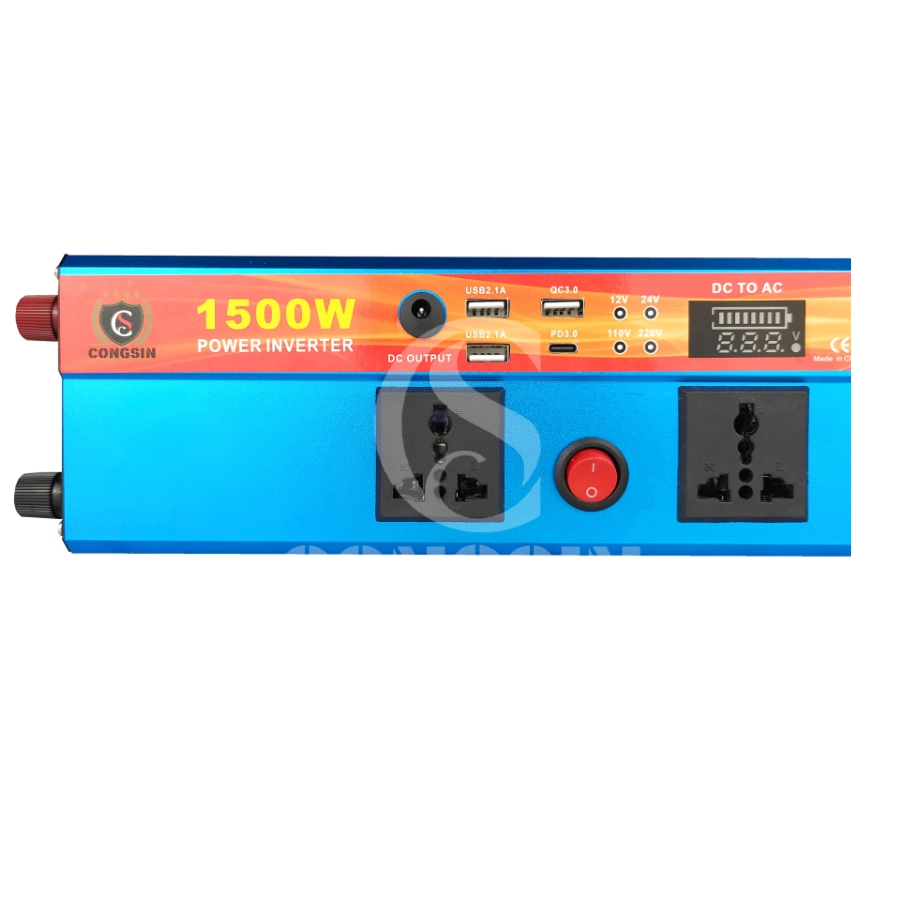
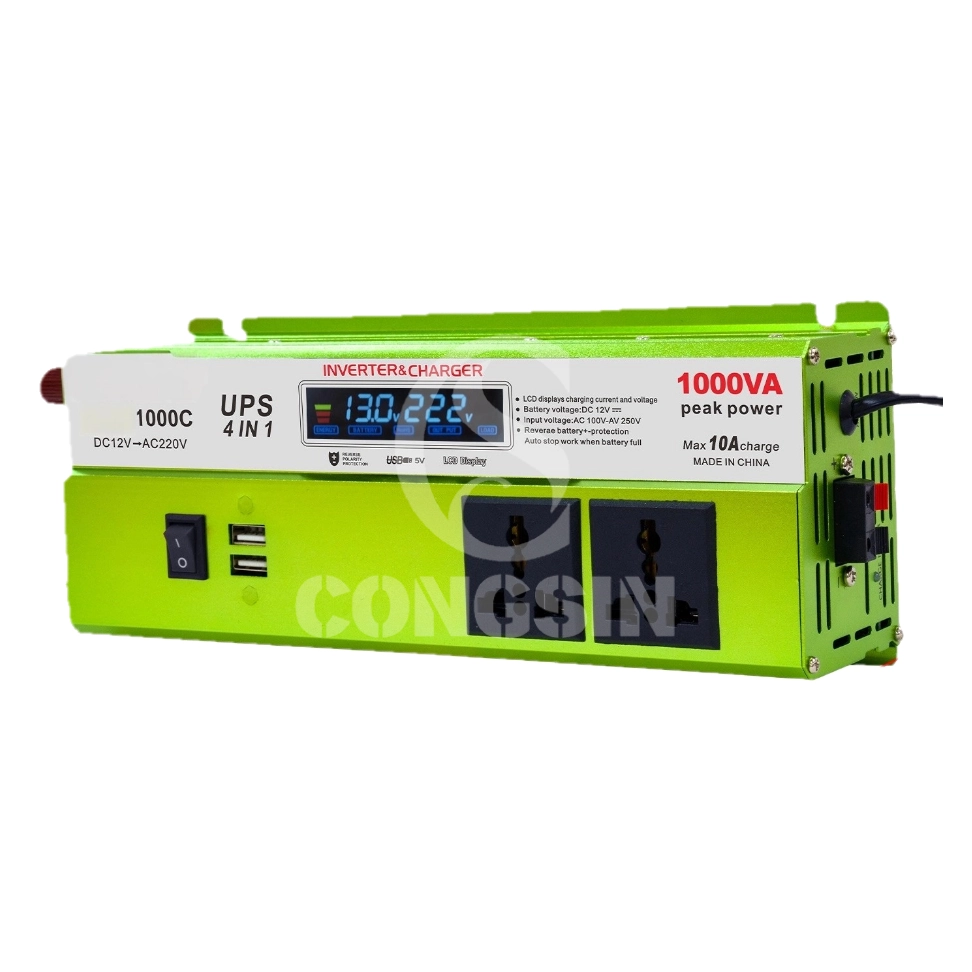
Our CS1000DDBC 1000W modified sine wave inverter is a professional power conversion device that converts DC 12V from batteries into AC 220V electricity. It is designed with user convenience in mind, featuring an LED display for real-time status monitoring, multiple charging ports (3 USB, 1 Type-C, 1 DC 12V) and two universal sockets to power a wide range of devices simultaneously. Its compact size (250×95×55mm) and lightweight design (NW: 0.84kg) make it easy to carry, ideal for outdoor activities, emergency home use, and on-the-go power needs.
Get in Touch with Our Team
You can also communicate with us directly through our online contact form. Please fill in the following information, and our team will contact you as soon as possible after receiving your message.

CONGSIN is a trusted OEM factory for power inverters, solar charge controllers, and DC converters. Reliable solutions for global B2B buyers.
 High Quality
 7/24 Service
 Guaranteed Warranty
© 2025 Congsin. All Rights Reserved.