





Which Bidirectional Battery Inverter Is Best for Solar + Grid Backup?
- 1. What is a bidirectional battery inverter, and how does it function in solar and grid backup systems?
- 2. How do I determine the appropriate capacity for a bidirectional battery inverter to meet my home's energy needs?
- 3. What are the key differences between AC-coupled and DC-coupled bidirectional inverters, and which is more suitable for my system?
- 4. How do bidirectional inverters contribute to grid stability and support during peak demand periods?
- 5. What are the maintenance requirements for bidirectional battery inverters, and how can I ensure their longevity?
- 6. Are there any incentives or rebates available for installing bidirectional battery inverters in residential solar systems?
1. What is a bidirectional battery inverter, and how does it function in solar and grid backup systems?
A bidirectional battery inverter is a crucial component in energy storage systems, enabling the conversion of direct current (DC) from batteries into alternating current (AC) for household appliances and vice versa. This functionality allows for efficient energy storage and retrieval, facilitating seamless integration between solar panels, battery storage, and the electrical grid. In solar and grid backup systems, the inverter manages the flow of electricity, ensuring that excess solar energy charges the batteries, stored energy powers the home during outages, and surplus energy is fed back into the grid when appropriate.
2. How do I determine the appropriate capacity for a bidirectional battery inverter to meet my home's energy needs?
Determining the right inverter capacity involves assessing your household's average energy consumption and identifying critical appliances that require backup power. Begin by calculating your daily energy usage in kilowatt-hours (kWh) and consider the starting and running wattages of essential devices. For instance, a refrigerator may require 1,200 watts to start and 200 watts to run. Multiply the running wattage by the number of hours each appliance operates daily to estimate total energy consumption. Ensure the selected inverter can handle the combined wattage of all critical appliances, including surge demands during startup. It's advisable to consult with a professional to accurately size the inverter and battery system for optimal performance.
3. What are the key differences between AC-coupled and DC-coupled bidirectional inverters, and which is more suitable for my system?
AC-coupled inverters are typically added to existing solar systems to integrate battery storage. They convert AC power from the grid or solar panels into DC to charge batteries and DC from batteries into AC for household use. This setup is ideal for retrofitting storage to existing solar arrays. DC-coupled inverters, on the other hand, integrate solar charge controllers and battery management into a single unit, converting DC from solar panels directly to DC for battery storage and then to AC for household use. This configuration offers higher efficiency and is well-suited for new installations where solar panels and batteries are selected together. The choice between AC-coupled and DC-coupled inverters depends on your system's existing components and whether you're building a new system or upgrading an existing one.
4. How do bidirectional inverters contribute to grid stability and support during peak demand periods?
Bidirectional inverters play a significant role in grid stability by providing services such as frequency regulation and peak shaving. During periods of high electricity demand, these inverters can discharge stored energy back into the grid, alleviating stress on the power infrastructure and maintaining a stable frequency. This capability is particularly beneficial in regions with high renewable energy penetration, where generation can be intermittent. By supplying stored energy during peak times, bidirectional inverters help balance supply and demand, ensuring a reliable power supply.
5. What are the maintenance requirements for bidirectional battery inverters, and how can I ensure their longevity?
Maintaining a bidirectional battery inverter involves regular inspections and adherence to manufacturer guidelines. Key maintenance tasks include:
Cleaning: Periodically remove dust and debris from the inverter's vents and cooling fans to prevent overheating.
Firmware Updates: Regularly check for and install firmware updates to ensure the inverter operates with the latest features and security patches.
Battery Maintenance: Monitor battery health and perform necessary maintenance, such as balancing and capacity testing, to prolong battery life.
System Monitoring: Utilize monitoring software to track system performance and identify potential issues promptly.
By following these maintenance practices, you can enhance the reliability and lifespan of your bidirectional battery inverter, ensuring consistent performance over time.
6. Are there any incentives or rebates available for installing bidirectional battery inverters in residential solar systems?
Incentives and rebates for installing bidirectional battery inverters vary by region and are subject to change. In the United States, federal tax credits may be available for energy storage systems that are installed in conjunction with solar panels. Additionally, some states and local utilities offer their own incentives, such as rebates or performance-based incentives, to encourage the adoption of energy storage technologies. It's essential to research current programs in your area and consult with a local solar installer to understand the specific incentives applicable to your situation.
In conclusion, selecting the right bidirectional battery inverter is pivotal for optimizing your solar and grid backup system's performance. By considering factors such as inverter capacity, system configuration, grid support capabilities, maintenance requirements, and available incentives, you can make an informed decision that aligns with your energy needs and sustainability goals. For personalized assistance and a detailed quote, please contact us at info@csinverter.com or visit our website at www.csinverter.com.


Modified Sine Wave Inverters
Can it be connected to a battery long-term?
Yes, ensure good ventilation to avoid overheating.
Is the dual input automatically recognized or manually switched?
Automatically recognize DC12V/24V input, no manual switching required.
Can the peak 720W supply power continuously?
The peak power is the instantaneous maximum power, and the continuous power supply is 360W. Ensure that the device power does not exceed the rated value when using.
Which plug types are supported by the universal socket?
The universal socket is compatible with most national plug specifications, such as GB, US, EU, etc., and can meet the use of devices in different regions (some require adapters).
OEM & ODM Services
What’s the main difference between your OEM and ODM services?
OEM uses your brand on our standard products; ODM creates entirely new products based on your concept or specification.
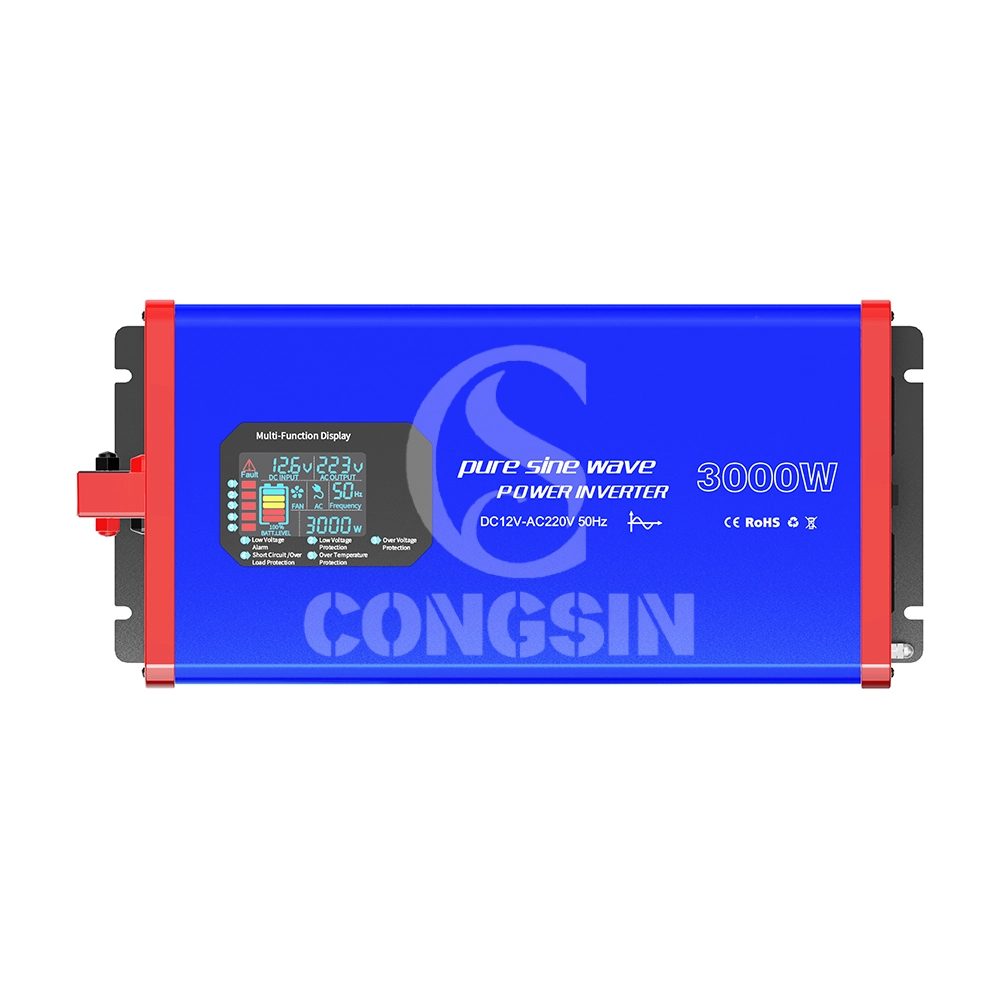
This 3000W full-power pure sine wave inverter (Model: CS3000PSW) adopts pure sine wave output technology (waveform distortion rate <2%), and the output power is highly consistent with mains power quality. It can safely drive high-power precision loads such as air conditioners, refrigerators, medical instruments, and small industrial equipment, avoiding equipment malfunctions or shortened service life caused by unstable waveforms. The device supports DC 12V input (compatible with 10.5V-14.8V wide voltage), continuously outputs 3000W full power, and has a peak power of 6000W, easily coping with the instantaneous startup impact of high-power devices; it is equipped with 4 AC universal sockets (max current 16A) + 2 USB 3.0 fast-charging ports (22.5W per port) to meet the simultaneous power supply needs of multiple devices. Built-in six-fold safety protection (overload, overvoltage, undervoltage, short circuit, overtemperature, reverse connection), combined with dual intelligent silent cooling fans (noise ≤45dB), it achieves the triple advantages of "high power + high safety + low noise," suitable for home emergency, outdoor engineering, vehicle-mounted power supply, small industrial scenarios and other fields.
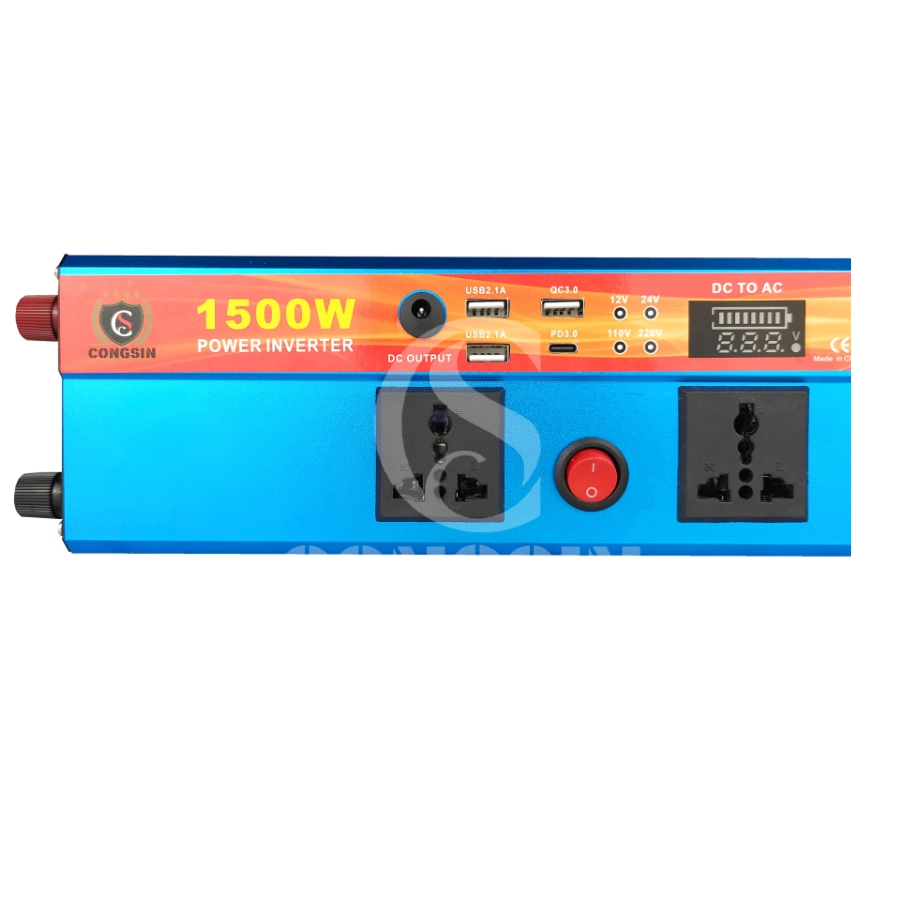
Our CS1000DDBC 1000W modified sine wave inverter is a professional power conversion device that converts DC 12V from batteries into AC 220V electricity. It is designed with user convenience in mind, featuring an LED display for real-time status monitoring, multiple charging ports (3 USB, 1 Type-C, 1 DC 12V) and two universal sockets to power a wide range of devices simultaneously. Its compact size (250×95×55mm) and lightweight design (NW: 0.84kg) make it easy to carry, ideal for outdoor activities, emergency home use, and on-the-go power needs.
Get in Touch with Our Team
You can also communicate with us directly through our online contact form. Please fill in the following information, and our team will contact you as soon as possible after receiving your message.

CONGSIN is a trusted OEM factory for power inverters, solar charge controllers, and DC converters. Reliable solutions for global B2B buyers.
 High Quality
 7/24 Service
 Guaranteed Warranty
© 2025 Congsin. All Rights Reserved.