





Maintenance Best Practices to Extend UPS Power Inverter Life
- Understanding UPS and Power Inverter Fundamentals
- What a UPS power inverter does and why maintenance matters
- Key components that determine inverter longevity
- Routine Maintenance Procedures
- Visual inspection and housekeeping (weekly–monthly)
- Battery maintenance: inspection, testing and replacement strategy
- Capacitors, fans and consumables (annual or as recommended)
- Monitoring, Testing and Diagnostics
- Implement continuous monitoring and alarms
- Planned load tests and transfer tests
- Firmware, calibration and self-test routines
- Design, Environmental and Operational Best Practices
- Site environment: temperature, humidity and ventilation
- Electrical design: derating, harmonics and surge protection
- Maintenance scheduling, documentation and spare parts strategy
- Comparative Data: Battery Chemistries and Lifetimes
- Maintenance Schedule: Typical Checklist
- Advanced Measures and Lifecycle Management
- Predictive maintenance using analytics
- Upgrades and retrofits: moving to modern inverters
- Standards and compliance to consider
- About Guangzhou Congsin Electronic Technology Co., Ltd.
- Frequently Asked Questions (FAQ)
- 1. How often should I replace UPS batteries?
- 2. Does ambient temperature really affect inverter life?
- 3. Are firmware updates necessary for inverters?
- 4. What is the difference between modified sine wave and pure sine wave inverters?
- 5. How can predictive maintenance reduce costs?
- 6. Can I perform maintenance in-house or should I use certified service providers?
UPS power inverter systems are mission-critical components that provide clean AC power during outages and protect sensitive equipment from power events. Proper maintenance extends inverter life, improves reliability, reduces downtime and lowers total cost of ownership. This article synthesizes industry-standard practices, manufacturer guidance and data-backed techniques—covering battery care, thermal management, firmware updates, component replacement, monitoring and record-keeping—to help facility managers, integrators and end users maximize uptime and asset longevity.
Understanding UPS and Power Inverter Fundamentals
What a UPS power inverter does and why maintenance matters
A UPS (uninterruptible power supply) integrates batteries, an inverter (DC→AC conversion), charging circuitry and control logic to provide continuous, conditioned AC power during mains disturbances. The inverter is a key power-conversion element that runs continuously in on-line or periodically during transfers. Failures arise from battery degradation, thermal stress, capacitor aging, connector corrosion and firmware/hardware faults. Preventive maintenance targets these root causes to reduce failure risk and improve mean time between failures (MTBF). For a technical overview, see the UPS article on Wikipedia (source).
Key components that determine inverter longevity
Primary elements affecting lifespan are batteries (type & maintenance), power semiconductors (IGBTs/MOSFETs), electrolytic capacitors, cooling fans and PCB assemblies. Each has distinct failure modes: electrolytic capacitors dry out over years, power semiconductors suffer thermal cycling stress, fans accumulate dust and bearings wear, and batteries lose capacity with cycles and temperature. See the electrolytic capacitor lifetime discussion on Wikipedia (source).
Routine Maintenance Procedures
Visual inspection and housekeeping (weekly–monthly)
Regular visual checks catch early signs of trouble. Inspect for corrosion at terminals, loose connections, bulging capacitors, liquid leaks and dust accumulation on heatsinks and fans. Clean dust with low-pressure compressed air and anti-static brushes; avoid aggressive solvents. Tighten accessible power and grounding connections to manufacturer torque specifications—loose connections increase contact resistance and heat.
Battery maintenance: inspection, testing and replacement strategy
Batteries are the most common cause of UPS failure. For valve-regulated lead-acid (VRLA) and flooded lead-acid cells, check electrolyte levels (if serviceable), terminal torque and specific gravity where applicable. Measure battery voltage, internal resistance (or conductance) and perform periodic capacity/discharge tests. Replace battery strings when capacity drops below 80% of rated capacity or when internal resistance rises significantly. For guidance on battery charging and temperature effects, refer to Battery University (source).
Capacitors, fans and consumables (annual or as recommended)
Electrolytic capacitors and cooling fans are typical wear items. Capacitor lifetimes are strongly temperature-dependent; high ambient temperature accelerates electrolyte loss. Follow manufacturer replacement intervals—commonly 5–10 years for electrolytic capacitors in harsh environments. Replace fans proactively if bearing noise or speed reduction is observed; ensure filters are clean to maintain airflow.
Monitoring, Testing and Diagnostics
Implement continuous monitoring and alarms
Modern UPS systems provide SNMP, Modbus or vendor-specific telemetry. Monitor input voltage quality, output load, battery state-of-charge (SOC), internal temperatures and event logs. Configure threshold-based alarms for battery health, high temperature and internal faults. Historical trending of battery internal resistance and discharge capacity is one of the best predictors of impending battery failure.
Planned load tests and transfer tests
Perform scheduled load bank tests and transfer tests to verify inverter operation under real conditions. A recommended practice is a full discharge capacity test annually for critical systems and partial (e.g., 20–30%) load tests quarterly. Always follow safety procedures and notify affected stakeholders before planned tests.
Firmware, calibration and self-test routines
Keep inverter firmware and battery management system (BMS) firmware up to date to benefit from bug fixes and optimized charge algorithms. Calibrate sensors periodically when the manufacturer recommends. Run built-in self-tests after maintenance to verify post-service health.
Design, Environmental and Operational Best Practices
Site environment: temperature, humidity and ventilation
Temperature is a dominant factor in component life—every 10 °C rise can significantly reduce battery and capacitor life. Aim for controlled environments: typical recommended ambient temperatures for UPS battery rooms are 20–25 °C (68–77 °F) for longest battery life, with relative humidity 30–60% and adequate ventilation. Use HVAC redundancy for critical installations.
Electrical design: derating, harmonics and surge protection
Derate inverters and ensure they operate below maximum continuous load to reduce thermal stress. Use line conditioning and surge protection on both input and output sides; minimize harmonic distortion from non-linear loads by selecting appropriate inverter topologies and use of filters. For grid-tied or solar-integrated systems, coordinate inverter settings with charge controllers and MPPT regulators to avoid conflicting control behaviors.
Maintenance scheduling, documentation and spare parts strategy
Document all maintenance actions, test results and firmware versions. Maintain a spare parts inventory for common wear items (fans, capacitors, fuses, battery replacement modules) and critical components. Develop a maintenance calendar tying checks to run-hours and calendar intervals. A formal preventive maintenance plan reduces mean time to repair (MTTR) and improves availability.
Comparative Data: Battery Chemistries and Lifetimes
Choosing the correct battery chemistry has major impact on maintenance frequency and lifetime. The table below summarizes practical differences relevant to UPS applications.
| Chemistry | Typical Cycle Life | Temperature Sensitivity | Maintenance Needs | Typical Use Cases |
|---|---|---|---|---|
| VRLA (Sealed Lead-Acid) | 200–1200 cycles (varies by depth-of-discharge) | High sensitivity; life decreases sharply above ~25–30 °C | Periodic voltage/internal resistance checks; replace every 3–7 years | Common UPS stationary installations |
| Flooded Lead-Acid | 500–1500 cycles with good maintenance | High sensitivity; requires controlled environment | Electrolyte level checks, watering, specific gravity tests | Large data centers, industrial backup systems |
| LiFePO4 (Lithium Iron Phosphate) | 2000–5000+ cycles | Better high-temp performance; less degradation per °C | Battery management system (BMS) monitoring; firmware updates | High-cycle applications, modular UPS and portable power stations |
Sources: general battery lifecycle data and thermal effects summarized from Battery University (source) and manufacturer datasheets.
Maintenance Schedule: Typical Checklist
| Interval | Tasks |
|---|---|
| Weekly | Visual inspection, alarm log check, ambient conditions check |
| Monthly | Clean fans/filters, check battery voltage and connections, check event logs |
| Quarterly | Partial load test, detailed battery conductance test, firmware review |
| Annually | Full discharge test, internal inspection, replace consumables as needed |
| Every 3–5 years | Replace batteries (varies with chemistry and environment); inspect capacitors |
Note: Follow manufacturer recommendations and local codes. Vendors such as APC, Eaton and Schneider provide detailed preventive maintenance guides specific to their models (refer to vendor manuals for model-specific intervals).
Advanced Measures and Lifecycle Management
Predictive maintenance using analytics
Leverage trend analytics on battery conductance, temperature, runtime and inverter load to predict failures before they occur. Predictive maintenance reduces unplanned downtime and optimizes replacement timing—avoiding both premature disposal and catastrophic failure.
Upgrades and retrofits: moving to modern inverters
When replacing aging units, consider new-generation pure sine wave inverters, higher-efficiency topologies and integrated telemetry for remote management. For solar- or vehicle-integrated solutions, ensure compatibility with solar charge controllers and DC sources. Modern inverter portfolios include pure sine wave inverters, modified sine wave inverters and portable power stations tailored for different loads and environments.
Standards and compliance to consider
Follow relevant standards such as IEC/EN 62040 for UPS specifications and ISO 9001 for quality management systems. ISO overview: ISO 9001. Adhering to standards ensures consistent safety and performance expectations across installations.
About Guangzhou Congsin Electronic Technology Co., Ltd.
Guangzhou Congsin Electronic Technology Co., Ltd., founded in early 1998, is a professional power inverter manufacturer with over 27 years of focused experience. We design, R&D and manufacture a wide range of power solutions—with a core emphasis on DC→AC power inverters, portable power stations, and solar charge controllers. Our catalog includes 100+ models tailored for vehicles, solar systems, RVs and trucks, off-grid homes, outdoor offices, patrol and field construction work.
We operate fully automated production lines, advanced instrumentation and multifunctional testing equipment to ensure product reliability, efficiency and intelligent functionality. Environmental and safety compliance are built in: our quality system is ISO9001 certified and many products hold international approvals such as CE, EMC, LVD, ETL, FCC, RoHS and E-MARK. Several independently developed patents further demonstrate our commitment to innovation.
Congsin’s products serve global markets across Europe, the Americas, the Middle East, Africa and Southeast Asia; many models are supplied to domestic and international OEM channels. Our support includes OEM/ODM, private labeling, distribution and bespoke customization to meet partner specifications. Our mission is to deliver reliable, efficient and affordable energy solutions that enable energy independence.
Core product highlights: Solar Charge Controllers, modified sine wave inverter, pure sine wave inverter, portable power stations. Congsin differentiates by long manufacturing heritage, extensive model range for diverse applications, strong automated quality control and a broad portfolio of international certifications—making the company a competitive partner for OEM and distribution channels.
Frequently Asked Questions (FAQ)
1. How often should I replace UPS batteries?
Replacement intervals depend on chemistry and environment. VRLA batteries typically need replacement every 3–7 years under normal conditions, whereas LiFePO4 batteries often last 8–15 years or more depending on cycle depth and temperature. Use conductance and capacity tests to decide replacement timing.
2. Does ambient temperature really affect inverter life?
Yes. Elevated ambient temperature accelerates aging in batteries and electrolytic capacitors. Aim for 20–25 °C where practical; every 10 °C rise can substantially shorten component lifetimes. See thermal effects references at Battery University (source).
3. Are firmware updates necessary for inverters?
Firmware updates often include control improvements, bug fixes and charge algorithm optimizations—especially for systems with battery management features. Test updates in a controlled environment and follow vendor instructions.
4. What is the difference between modified sine wave and pure sine wave inverters?
Pure sine wave inverters output a smooth AC waveform compatible with sensitive electronics (servers, medical equipment), while modified sine wave inverters produce a stepped waveform that may be acceptable for resistive loads but can cause issues with some electronics and motors. For critical UPS applications, pure sine wave inverters are recommended.
5. How can predictive maintenance reduce costs?
Predictive maintenance uses telemetry and trend analysis to replace parts just-in-time—reducing unnecessary early replacements and preventing catastrophic failures. It converts reactive repairs into planned maintenance with lower labor and downtime costs.
6. Can I perform maintenance in-house or should I use certified service providers?
Routine visual inspections and basic cleaning are often handled in-house with proper safety training. Critical actions—battery replacement, internal electronics servicing, high-voltage work—should be performed by certified technicians familiar with UPS safety practices and manufacturer procedures.
Need expert advice or tailored UPS power inverter solutions? Contact Guangzhou Congsin Electronic Technology Co., Ltd. for OEM/ODM options, technical support and a full catalog of DC→AC inverters, pure and modified sine wave models, portable power stations and solar charge controllers. Visit our website or request a product datasheet to evaluate models for vehicles, solar off-grid systems, RVs and industrial applications. For inquiries and custom solutions, email our sales team or request a consultation.
Top Pure Sine Wave Inverter Models for Commercial Use 2026
Bidirectional Inverter Buyer's Guide: Choose the Right Model
Grid-Tied vs Off-Grid Inverters: Best Options for Homes
Energy Efficient 24V Pure Sine Inverters to Reduce Costs
Distributor
Do you provide marketing and sales materials?
Yes, we provide a range of marketing resources, including brochures, digital content, and product training.
Modified Sine Wave Inverters
What devices can this inverter power?
Rated for 600W, peak 1000W. Recommended to use devices under 80% of rated capacity.
Can this inverter run a refrigerator or power tools?
Recommended load ≤80% of rated power. For inductive loads, use a pure sine wave model.
What is the working principle of the UPS function?
When the external power supply is normal, the inverter powers the device and charges the battery; when the external power supply is interrupted, it automatically switches to battery power to ensure uninterrupted operation of the device.
Is it compatible with both 12V and 24V vehicles?
Yes, it supports DC12V/24V dual input.
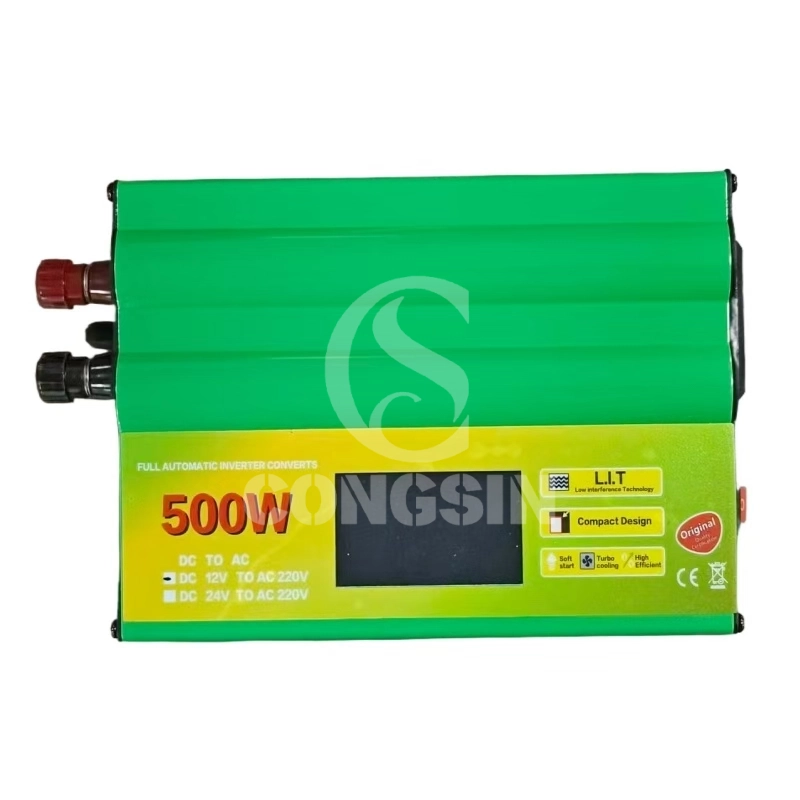
Congsin Modified Sine Wave Inverter 500W 1000W 1500W 12V LED Display Portable for RV Car Solar
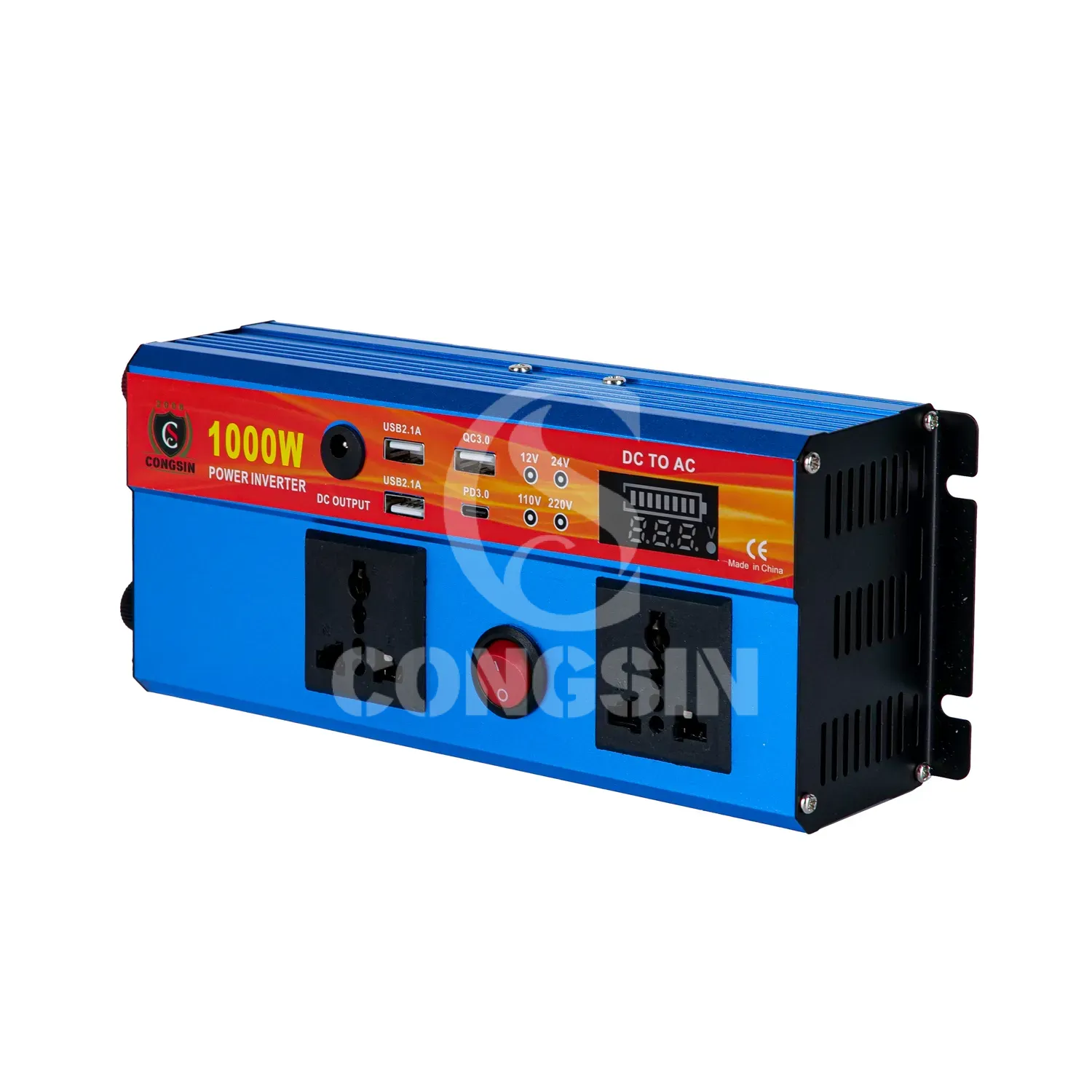
Congsin 1000W modified sine wave inverter with LED display and Type C port car RV power inverter
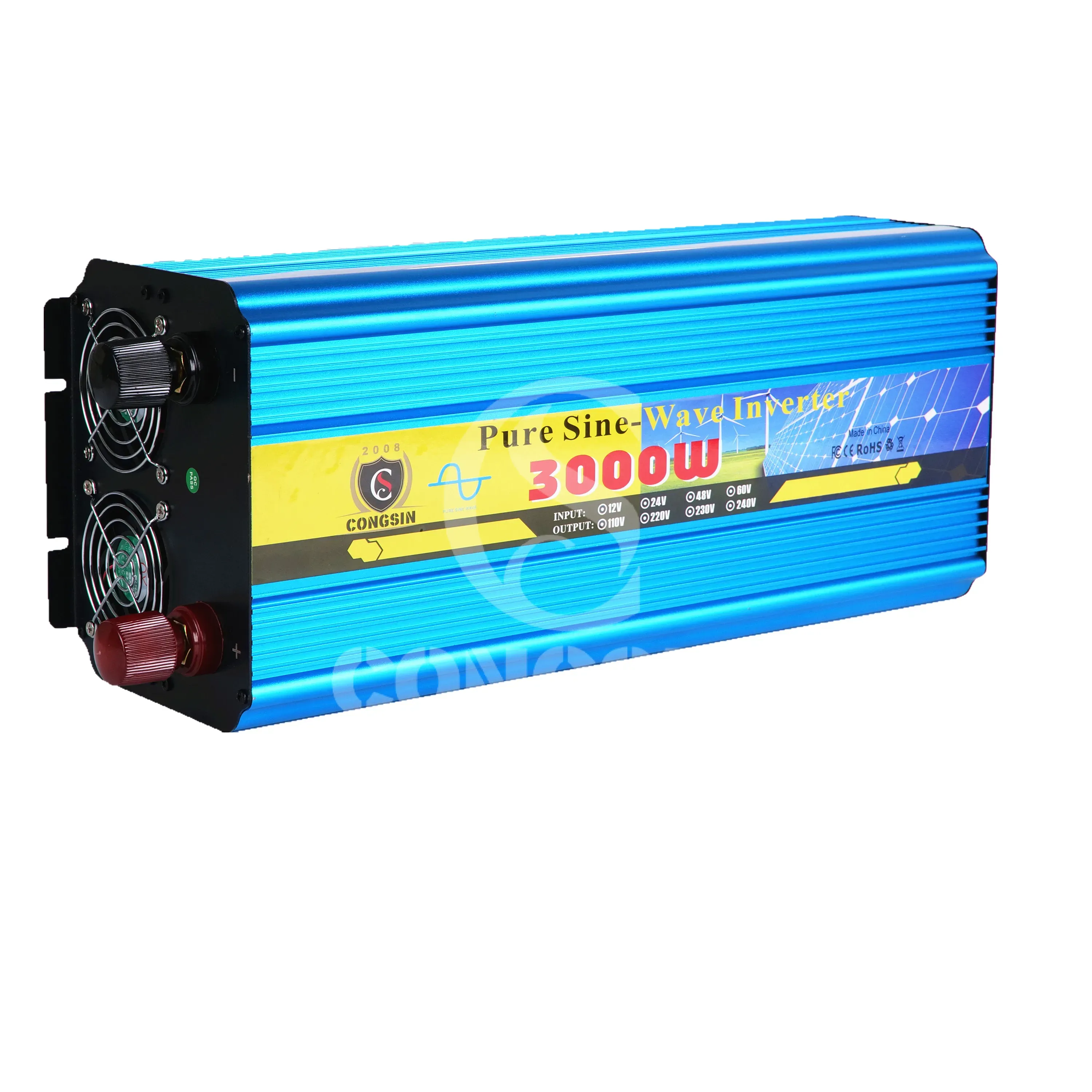
Congsin 3000W LCD Pure Sine Wave Inverter for Home Use Solar Backup Power Inverter Off Grid UPS
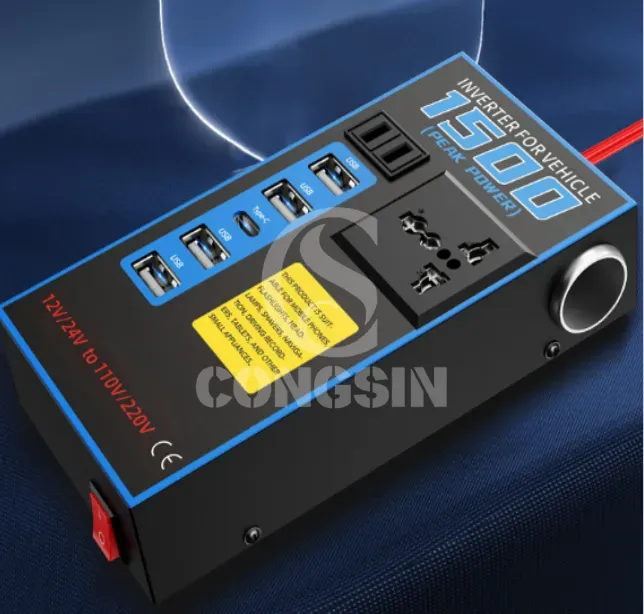
Congsin 1500W Inverter for Vehicle DC 12V/24V to AC 110V/220V with Universal socket Modified Sine Wave

CONGSIN is a trusted OEM factory for power inverters, solar charge controllers, and DC converters. Reliable solutions for global B2B buyers.
 High Quality
 7/24 Service
 Guaranteed Warranty
© 2025 Congsin. All Rights Reserved.