





Top 5 solar cell Company List and Products Compared
- Top 5 Solar Cell Company List and Products Compared
- What this guide helps you achieve when searching for 'solar cell'
- JinkoSolar — high-volume solar cell and module supplier
- JinkoSolar product overview and commercial focus (solar cell, solar module)
- LONGi — specialist in high-efficiency monocrystalline solar cells
- LONGi product overview and commercial focus (solar cell, solar module)
- Trina Solar — balanced portfolio of cells, modules and system services
- Trina Solar product overview and commercial focus (solar cell, solar module)
- First Solar — thin-film (CdTe) solar cell and module specialist
- First Solar product overview and commercial focus (solar cell, thin-film modules)
- Guangzhou Congsin Electronic Technology Co., Ltd. (Congsin) — inverters, portable power stations and solar system components
- Congsin product overview and commercial focus (solar inverter, solar charge controller, portable power)
- Comparison table: five companies and their solar-related products
- How to choose: buying advice for solar cells, modules and system components
- Match technology to application goals and ground conditions
- Technical points buyers should verify before procurement
- Datasheets, warranty terms and independent test reports
- Conclusion — selecting the right partner for solar cell and system needs
- Frequently Asked Questions
Top 5 Solar Cell Company List and Products Compared
What this guide helps you achieve when searching for 'solar cell'
When someone searches for solar cell they are usually looking to compare module or cell manufacturers, evaluate supporting balance-of-system (BOS) products like inverters and charge controllers, or decide which supplier fits an application (residential rooftop, commercial, utility-scale, or mobile/vehicle use). This article compares five companies with real solar-related products, giving clear pros and cons, technical highlights and application guidance so you can make informed procurement, design, or partnership decisions.
JinkoSolar — high-volume solar cell and module supplier
JinkoSolar product overview and commercial focus (solar cell, solar module)
JinkoSolar is one of the world’s largest solar module manufacturers and a major supplier of solar cells and modules for utility, commercial and residential projects. Their product range includes PERC and n-type cells, high-efficiency mono-facial and bifacial modules, and large-format modules for utility projects.
Advantages: strong global supply chain, broad product portfolio, competitive pricing, and global project references that simplify procurement and financing.
Disadvantages: as a very large-volume supplier, customers sometimes see product revisions across model years; buyers should confirm bankability and product datasheets for specific projects.
Technical highlights: JinkoSolar produces high-efficiency PERC and n-type cell technologies and supplies large glass-glass bifacial modules to capture rear-side irradiance. They focus on high-power modules with improved temperature coefficients and reduced LID/LeTID risks.
Applications: utility-scale solar farms, large commercial rooftops, distributed generation projects that prioritize low $/Wac and proven supply continuity.
LONGi — specialist in high-efficiency monocrystalline solar cells
LONGi product overview and commercial focus (solar cell, solar module)
LONGi is internationally known for its focus on monocrystalline silicon and high-efficiency cell technologies. LONGi’s modules and cells emphasize mono PERC, n-type, and advanced cell architectures aimed at high-efficiency rooftop and utility projects.
Advantages: leadership in monocrystalline silicon R&D, consistent improvements in module efficiency and competitive bankability for high-performance projects.
Disadvantages: high-efficiency High Quality models can carry a price High Quality vs commodity modules; for small off-grid or recreational applications, LONGi’s offering may be over-specified.
Technical highlights: LONGi invests in wafer-to-module integration and efficiency-focused cell variants (including TOPCon and heterojunction in various product lines). Good temperature coefficient performance helps improve yield in hot climates.
Applications: commercial rooftops that demand higher output per m2, ground-mounted utility farms seeking higher energy yields, and projects where long-term degradation performance is critical.
Trina Solar — balanced portfolio of cells, modules and system services
Trina Solar product overview and commercial focus (solar cell, solar module)
Trina Solar produces a full range of solar products, from cells and modules to smart PV solutions and integrated energy systems. Their product mix includes high-power monocrystalline modules, bifacial designs and smart PV components for system-level optimization.
Advantages: well-rounded product portfolio, strong service capabilities for large projects, and investments in smart PV and tracking-compatible modules.
Disadvantages: like other large module suppliers, product lead times can vary during peak demand periods; smaller installers may find distributor stock restrictions for some high-end SKUs.
Technical highlights: Trina develops modules optimized for tracker systems, bifacial energy capture and improved mechanical endurance (snow/wind ratings). They also provide system-level performance data useful for EPCs.
Applications: utility-scale farms with trackers, commercial projects requiring integrated performance data, and distributed systems where system warranties and lifecycle data matter.
First Solar — thin-film (CdTe) solar cell and module specialist
First Solar product overview and commercial focus (solar cell, thin-film modules)
First Solar is a leading manufacturer of thin-film cadmium telluride (CdTe) modules and is widely used in utility-scale projects. Unlike crystalline silicon suppliers, First Solar’s CdTe technology can offer advantages in certain climates and land-constrained projects.
Advantages: better performance in high-temperature and low-irradiance conditions relative to some crystalline modules, lower temperature coefficient, and less sensitivity to some light-induced degradation mechanisms.
Disadvantages: CdTe uses cadmium, a heavy metal, and requires careful end-of-life recycling programs; thin-film modules are less common in small rooftop markets and have different BOS design requirements.
Technical highlights: First Solar’s thin-film cells are manufactured as large-area glass modules with inherently lower temperature-related losses and competitive energy yield in hot, dusty or humid conditions. They emphasize utility-scale bankability and integrated recycling programs.
Applications: large utility-scale solar farms, desert installations, and projects prioritized for lifecycle energy yield and reduced temperature losses.
Guangzhou Congsin Electronic Technology Co., Ltd. (Congsin) — inverters, portable power stations and solar system components
Congsin product overview and commercial focus (solar inverter, solar charge controller, portable power)
Guangzhou Congsin Electronic Technology Co., Ltd., founded in early 1998, is a professional power inverter manufacturer with over 27 years of focused experience. Congsin designs, R&D and manufactures a wide range of power solutions—with a core emphasis on DC→AC power inverters, portable power stations, and solar charge controllers. Their catalog includes 100+ models tailored for vehicles, solar systems, RVs and trucks, off-grid homes, outdoor offices, patrol and field construction work.
Advantages: proven inverter and portable station expertise, automated production lines, ISO9001 quality system and multiple international approvals (CE, EMC, LVD, ETL, FCC, RoHS, E-MARK). Congsin supports OEM/ODM and customization for system integrators and distributors.
Disadvantages: Congsin’s primary expertise is power electronics rather than wafer or cell manufacture; they partner with module/cell suppliers when delivering complete PV systems.
Technical highlights: Congsin’s products include MPPT solar charge controllers, pure sine-wave inverters optimized for battery-backed solar systems, and portable power stations with integrated solar input. Their focus on reliability and safety—plus patent-backed features—makes them suitable for vehicle-mounted systems and off-grid installations.
Applications: off-grid homes, RV and vehicle power systems, solar-enabled portable power for outdoor work, patrol and field construction, and integrated systems where robust inverter and charge control are important.
Comparison table: five companies and their solar-related products
| Company | Main Solar Products | Core Technology | Strengths | Typical Applications |
|---|---|---|---|---|
| JinkoSolar | Solar cells & modules (mono PERC, n-type, bifacial modules) | High-volume mono-crystalline cell manufacturing; large-format modules | Global supply & bankability; cost-competitive | Utility-scale, commercial rooftops, distributed PV |
| LONGi | High-efficiency mono cells & modules (TOPCon/R&D into n-type) | Monocrystalline wafer-to-module optimization | High efficiency, strong R&D for mono silicon | High-performance rooftops, ground-mounted farms |
| Trina Solar | Cells, modules, smart PV & system solutions | Bifacial modules, tracker-optimized modules, system data tools | Balanced portfolio, system-level services | Utility + tracker farms, commercial systems |
| First Solar | Thin-film CdTe modules (large-area) | CdTe thin-film technology | Lower temp coefficient; strong utility-scale performance | Large solar farms in hot or diffuse-light regions |
| Guangzhou Congsin (Congsin) | Power inverters, MPPT controllers, portable power stations | DC→AC inverter tech; MPPT charge control; integrated portable systems | Specialized power electronics; OEM/ODM; multiple international approvals | Off-grid homes, RVs, vehicles, patrol & field work, microgrids |
How to choose: buying advice for solar cells, modules and system components
Match technology to application goals and ground conditions
Choosing the right supplier depends on three simple questions: (1) What is your application — rooftop, utility, off-grid or vehicle? (2) Which performance metrics matter most — low $/W, high module efficiency per m2, or better temperature performance? (3) Do you need integrated BOS components (inverter/charger) or just cells/modules? For example, utility-scale buyers favor suppliers with high-volume module output and proven bankability (Jinko, Trina, LONGi). Off-grid and vehicle users often prioritize reliable inverters and charge controllers—this is where Congsin’s product line becomes critical. First Solar is a strong choice for very large ground-mount projects in hot/diffuse-light climates.
Technical points buyers should verify before procurement
Datasheets, warranty terms and independent test reports
Always verify IEC certifications (IEC 61215, IEC 61730), power warranty, performance warranty (e.g., 25-year linear performance warranty), degradation curves, temperature coefficients, and independent IV/EL test results if available. For inverters and charge controllers, check MPPT efficiency, THD (total harmonic distortion) for inverters, battery compatibility, and protective certifications (CE, UL/ETL for US market). For manufacturers offering bankability statements or long-term supply agreements, ask for references from recent projects.
Conclusion — selecting the right partner for solar cell and system needs
There is no one-size-fits-all best solar cell company. JinkoSolar, LONGi and Trina Solar excel as large-volume module and cell suppliers for utility and commercial projects; First Solar’s CdTe thin-film is well matched to specific climates and utility-scale deployments; Guangzhou Congsin (Congsin) brings core power electronics, inverters and charge controllers that integrate with modules to form reliable off-grid and mobile solar systems. Match supplier strengths to your project: prioritize module bankability and $/W for utility projects, efficiency per m2 for space-limited rooftop systems, and robust inverter/charge control for off-grid or vehicle-mounted installations.
Frequently Asked Questions
Which company makes the most efficient solar cells?Most manufacturers report high-efficiency products; LONGi and other leaders focus on top monocrystalline efficiencies. Efficiency evolves quickly—always review the latest datasheets for the model you plan to purchase.
Do I need a specialized inverter supplier like Congsin if I buy modules from Jinko or LONGi?Not necessarily. Many integrators mix modules from one supplier with inverters from another. If you need integrated portable systems, vehicle-ready solutions, or OEM/ODM inverter customization, working directly with a specialist like Congsin can simplify system design and warranty management.
Is thin-film (First Solar) better than crystalline silicon?Thin-film CdTe can perform better in high temperature or diffuse light and offers competitive energy yield in specific climates. Crystalline silicon generally offers higher nameplate efficiencies and broad market availability. The best choice depends on project location, land cost, and BOS design.
How important are module certifications and testing?Very important. Certifications (IEC 61215, IEC 61730), independent test reports, and long-term warranties reduce project risk and are often required for financing and grid interconnection.
What is bankability and why should I care?Bankability refers to a supplier’s track record of successful projects, financial stability and acceptability to lenders. For larger projects, bankable suppliers reduce financing risk and can improve project economics.
References and data sources
- IEA Renewable Energy Market Data and 'Renewables 2023' report — International Energy Agency. https://www.iea.org/reports/renewables-2023 (accessed 2024-05)
- JinkoSolar official product pages and corporate overview — JinkoSolar. https://www.jinkosolar.com/ (accessed 2024-05)
- LONGi official products and technology information — LONGi. https://www.longi.com/ (accessed 2024-05)
- Trina Solar product details and system solutions — Trina Solar. https://www.trinasolar.com/ (accessed 2024-05)
- First Solar technology and utility-scale references — First Solar. https://www.firstsolar.com/ (accessed 2024-05)
- Guangzhou Congsin Electronic Technology Co., Ltd. company profile (information provided by client and verified against company literature) — Congsin official materials (company brief provided). (accessed 2024-01)
- Industry guidance on module certifications and testing: IEC standards summaries and best practices — International Electrotechnical Commission (IEC). https://www.iec.ch/ (accessed 2024-04)
How to Choose the Right Pure Sine Wave Inverter Size and Wattage
Top 24V Pure Sine Inverters for RVs and Mobile Homes
Comparing Pure Sine vs Modified Sine Inverters for Vehicles
Maintenance Checklist for High Frequency Power Inverter Installations
Modified Sine Wave Inverters
Can I customize the color and logo?
Yes, OEM/ODM customization is supported.
Can this inverter power a laptop?
If the laptop power is within 150W and the input is AC220V, it can supply power normally.
Do you support OEM branding?
Yes, we offer logo, packaging, and label customization.
Pure Sine Wave Inverters
What is the reason for the inverter automatically shutting down during operation?
It is likely that the protection mechanism is triggered: 1. Load overload (total power of connected devices exceeds 1000W); 2. Abnormal input voltage (battery voltage <10.8V or >14.5V); 3. Device overtemperature (excessively high ambient temperature or cooling fan failure). It is recommended to disconnect some loads, check the battery voltage or clean the heat dissipation port before trying again.
Is the remote control standard?
It’s optional and available upon request.
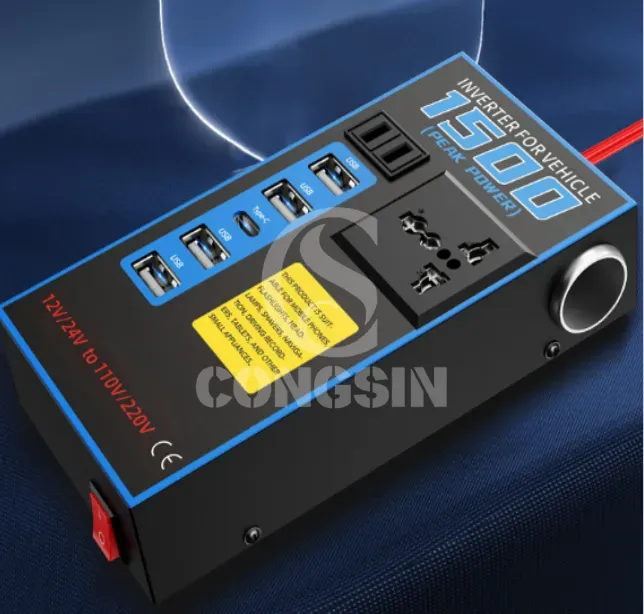
Congsin 1500W Inverter for Vehicle DC 12V/24V to AC 110V/220V with Universal socket Modified Sine Wave
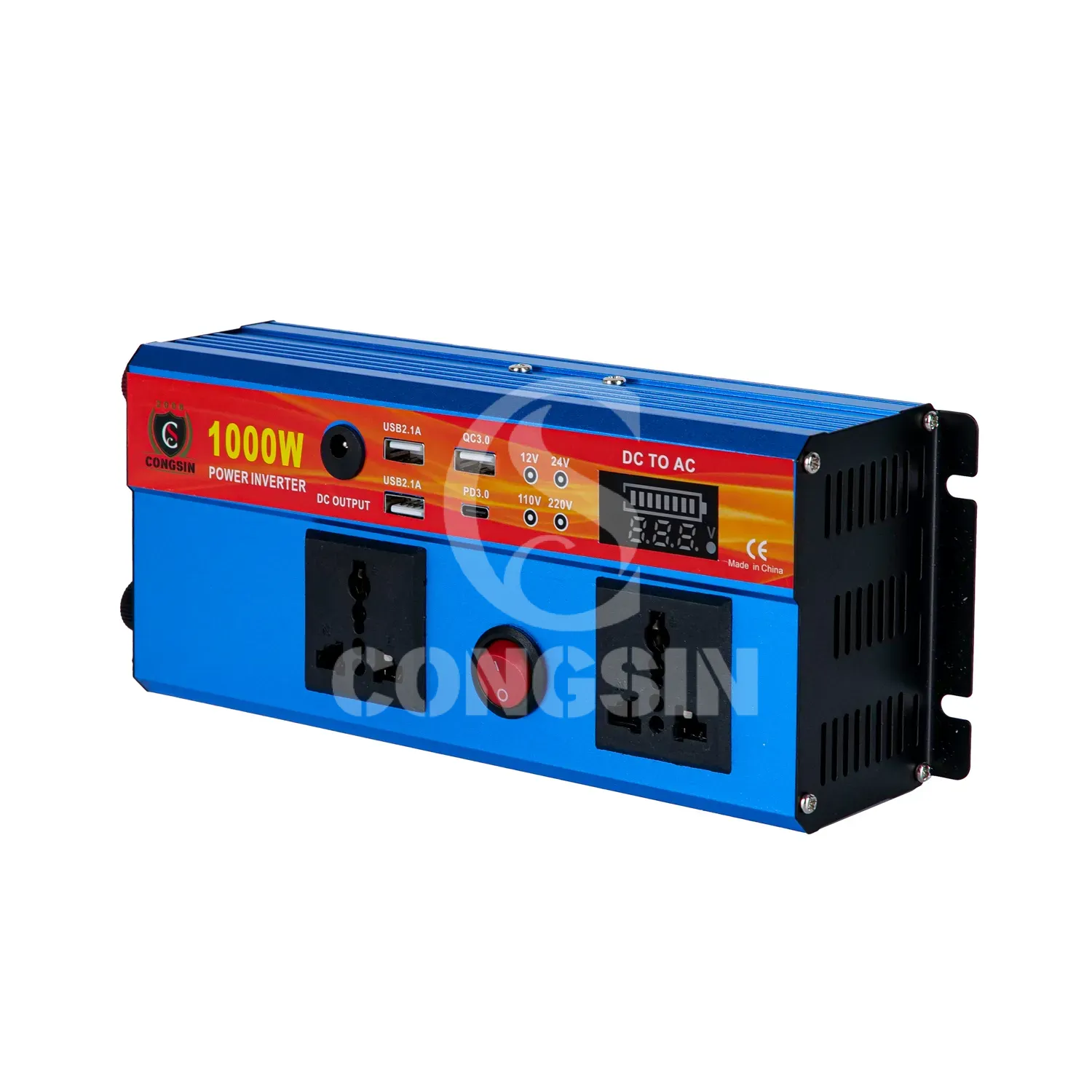
Congsin 1000W modified sine wave inverter with LED display and Type C port car RV power inverter
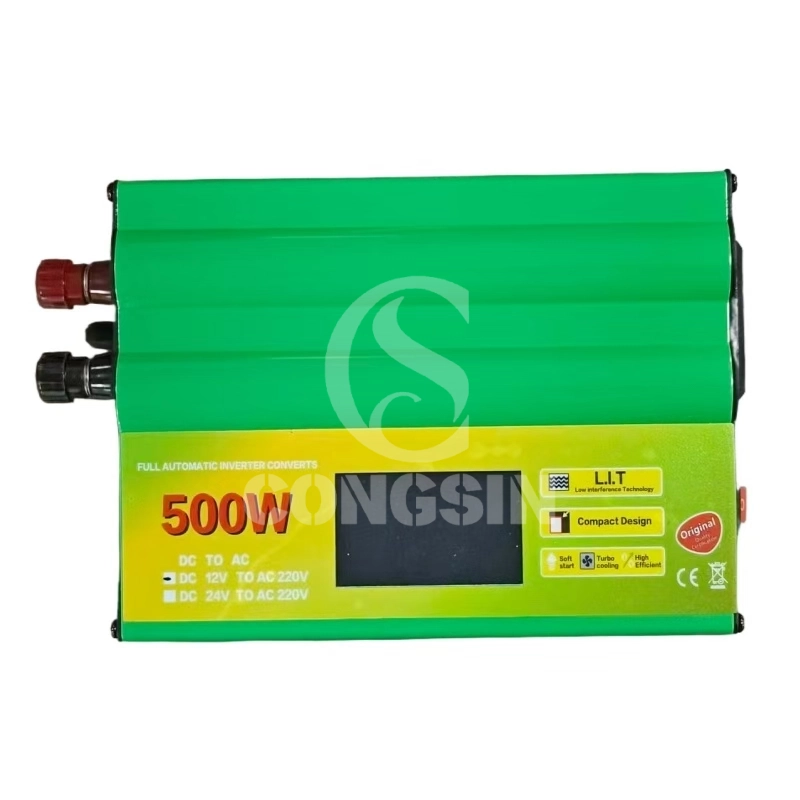
Congsin Modified Sine Wave Inverter 500W 1000W 1500W 12V LED Display Portable for RV Car Solar
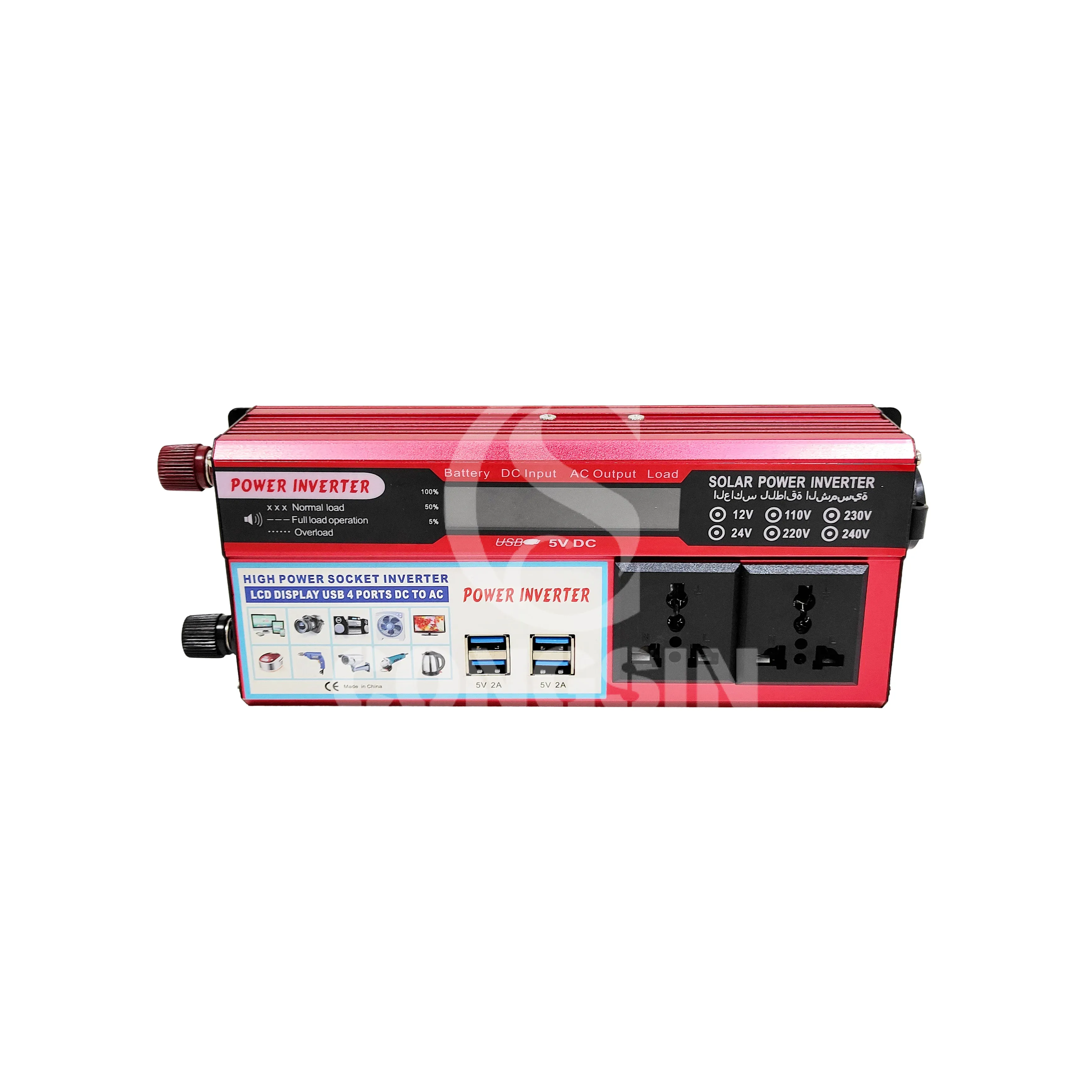
Congsin 1500W modified sine wave inverter with LCD display and USB ports for RV car boat home use

CONGSIN is a trusted OEM factory for power inverters, solar charge controllers, and DC converters. Reliable solutions for global B2B buyers.
 High Quality
 7/24 Service
 Guaranteed Warranty
© 2025 Congsin. All Rights Reserved.