





Top 10 Car Battery Inverters for Road Trips and Camping
- Choosing the Right Inverter for Your Car Battery (What I Look For)
- Key performance factors: continuous watts, surge watts, and waveform
- Efficiency, no-load draw, and thermal design
- Safety, mounting and connectivity
- Top 10 Car Battery Inverters for Road Trips and Camping
- How I rank these choices
- When to choose pure sine vs modified sine
- Real-world Battery Runtime and Installation Tips
- Estimating runtime from a car battery (worked example)
- Practical runtime table (100Ah 12V battery, 50% DoD)
- Installation and safety checklist
- Why I Recommend Guangzhou Congsin — Company Capabilities and Product Fit
- Who Congsin is and why manufacturing pedigree matters
- Product breadth and compliance
- Where Congsin fits in the camping / vehicle market
- Competitive differences I value
- FAQ — Common Questions About Inverters with Car Batteries
- 1. Can I run a CPAP off a car battery using an inverter?
- 2. Will a modified sine inverter damage my laptop or phone charger?
- 3. How do I size an inverter for a car fridge?
- 4. Is it safe to use my vehicle’s starting battery for long inverter use?
- 5. How much power will a 100Ah battery give me with an inverter?
- 6. Can I connect the inverter directly to the car’s cigarette lighter?
- Next Steps & Contact
I spend a lot of time on the road and in the field testing power solutions. When you’re running lights, a fridge, a CPAP or charging multiple devices away from shore power, an inverter with car battery is the bridge between 12V DC in your vehicle and the 120/230V AC appliances you rely on. This guide explains how I evaluate car battery inverters for road trips and camping, gives my top 10 recommendations by use case, compares expected runtimes and efficiencies with verifiable calculations, and shows why partnering with an experienced manufacturer like Guangzhou Congsin can matter when you need reliability in the wilderness.
Choosing the Right Inverter for Your Car Battery (What I Look For)
Key performance factors: continuous watts, surge watts, and waveform
When I pick an inverter for a car battery setup I start with three core specs: continuous power (what you can run indefinitely), surge power (startup for motors/compressors), and waveform (pure sine vs modified). Continuous wattage tells you the practical limits for devices like a mini-fridge or laptop charger. Surge wattage covers short bursts — important for compressors, microwaves and some power tools. Pure sine inverters reproduce a clean AC waveform suitable for sensitive electronics (CPAPs, laptops, modern phone chargers), whereas modified sine works for resistive loads and many older devices but can cause noise, heating or compatibility issues in sensitive equipment.
Efficiency, no-load draw, and thermal design
Efficiency affects how much DC energy is wasted as heat. Higher efficiency means less battery drain for the same AC load. No-load (idle) draw is critical for long, low-power camping usage — an inverter with a 1–2W idle draw will preserve battery better than one with 10–15W. I also check thermal design: a well-ventilated, thermostatic fan and robust heat sinks keep the unit running reliably in hot climates.
Safety, mounting and connectivity
Look for over/under-voltage protection, short-circuit and overload protection, and proper grounding. For car battery installations, solid DC cable connections and appropriately sized fuses or breakers are mandatory. If you plan to hard-mount the inverter in an RV or truck, ensure the footprint, cooling direction and vibration resistance match the vehicle environment.
Top 10 Car Battery Inverters for Road Trips and Camping
Below I list my top 10 inverter recommendations organized by the most common road-trip and camping needs. These are chosen for real-world reliability, compatibility with car batteries, and typical use-case performance.
| Rank / Use Case | Representative Type / Example | Continuous Watts (typical) | Waveform | Best For |
|---|---|---|---|---|
| 1. Small electronics & phones | Compact 200–300W inverter (e.g., BESTEK-style) | 200–300W | Modified or small pure sine | Phones, laptops, small lights |
| 2. CPAP users (quiet, clean power) | 500–1000W pure sine inverter | 500–1000W | Pure sine | CPAP machines, medical devices |
| 3. Portable fridge/cooler | 300–1000W pure sine (higher surge) | 300–1000W | Pure sine | 12V refrigerator compressors |
| 4. Heavy-duty / multiple devices | 1500–3000W pure sine inverter (e.g., Victron/Xantrex class) | 1500–3000W | Pure sine | Multiple appliances, microwave, power tools |
| 5. Lightweight & portable | Inverter built into portable power station (Jackery/Goal Zero style) | 300–1500W | Pure sine | Quick setup, trunk-to-campsite |
| 6. Inverter/charger combos for RVs | Integrated inverter/charger units | 1000–3000W | Pure sine | RVs, permanent installs |
| 7. Budget camping (basic power) | 400–1000W modified sine | 400–1000W | Modified sine | Simple lighting, fans, basic tools |
| 8. Solar-ready inverters | Inverter compatible with DC solar charge controllers | 500–3000W | Pure sine | Solar + car battery hybrid systems |
| 9. High-surge start motors | Units with >2x surge rating | 1000–3000W | Pure sine | Compressors, pumps, power tools |
| 10. OEM/custom vehicle installs | Custom-rated inverters (OEM/ODM) | Varies | Pure or modified | Fleet, patrol, construction vehicles |
Note: specific model recommendations should be matched to your battery capacity and intended loads. For technical background on inverters see the Wikipedia overview on inverters: https://en.wikipedia.org/wiki/Inverter_(electrical).
How I rank these choices
My ranking prioritizes: compatibility with common 12V car batteries, real-world efficiency under mixed loads, surge handling for motor-driven devices, and user safety features (thermal and electrical protections). Products that are solar-ready or offer integrated battery management get higher scores for camping setups where recharge options are limited.
When to choose pure sine vs modified sine
I recommend pure sine if you’re running sensitive electronics (CPAP, laptops, modern LED drivers) or variable-frequency motor controllers. Modified sine can be acceptable for incandescent or resistive loads, some older chargers and lights, but it’s a compromise — many device manufacturers specify pure sine for warranty compliance.
Real-world Battery Runtime and Installation Tips
Estimating runtime from a car battery (worked example)
To plan a trip you need to convert battery amp-hours to usable AC energy. A simple, verifiable calculation works like this:
- 12V car battery of 100Ah = 12V × 100Ah = 1200 Wh (watt-hours) total theoretical energy (see Ampere-hour definition: https://en.wikipedia.org/wiki/Ampere_hour).
- Recommended usable depth-of-discharge (DoD) for a typical lead-acid car battery is often limited to 50% to preserve battery life, so usable energy = 1200 × 0.5 = 600 Wh.
- If your inverter is 85% efficient, the AC energy you can draw = 600 Wh × 0.85 = 510 Wh.
- For a 300W AC load, runtime ≈ 510 Wh / 300 W ≈ 1.7 hours.
This method is conservative and realistic for planning. For lithium chemistry batteries or deep-cycle batteries you can often use higher DoD but always follow manufacturer guidance.
Practical runtime table (100Ah 12V battery, 50% DoD)
| AC Load | AC Watts | Inverter Efficiency (assumed) | Estimated Runtime (hours) |
|---|---|---|---|
| Phone charging (2 phones, 20W total) | 20 W | 90% | ~27 hours |
| Laptop (50W) | 50 W | 90% | ~10.2 hours |
| Portable fridge (60W average, compressor cycling) | 60 W | 85% | ~6.8 hours (continuous-equivalent) |
| CPAP (60–90W) | 80 W | 90% | ~6.8 hours |
| Microwave (700W) | 700 W | 85% | ~0.6 hours (~36 minutes) |
These estimates assume realistic inverter efficiencies and a conservative battery DoD. Real runtime will vary with battery health, ambient temperature and actual compressor duty cycles. For further reading on battery behavior see the lead–acid battery overview: https://en.wikipedia.org/wiki/Lead-acid_battery.
Installation and safety checklist
From my field experience, follow this checklist when connecting an inverter to a car battery:
- Use appropriately sized DC cables — undersized cables waste energy and can overheat. Refer to cable gauge charts for current rating.
- Install a fuse or circuit breaker close to the battery positive terminal sized to protect the cable and inverter input.
- Keep positive and negative battery connections short and secure; avoid running cables near sharp edges or high-heat surfaces.
- Consider a remote shutoff switch and ventilated mounting location to manage heat; avoid enclosed spaces where hydrogen could accumulate during battery charging.
- Follow vehicle manufacturer guidelines if hard-wiring; some vehicles have sensitive electrical systems — consult a professional when in doubt.
Why I Recommend Guangzhou Congsin — Company Capabilities and Product Fit
Who Congsin is and why manufacturing pedigree matters
Guangzhou Congsin Electronic Technology Co., Ltd., founded in early 1998, has over 27 years of focused experience designing and manufacturing DC→AC power inverters, portable power stations, and solar charge controllers. In my evaluation, a manufacturer’s track record, automated production lines, and testing capability reduce field failures and improve long-term reliability — critical when your inverter must perform reliably on remote trips.
Product breadth and compliance
Congsin’s catalog includes 100+ models tailored for vehicles, solar systems, RVs and trucks, off-grid homes, outdoor offices, patrol and field construction work. They operate fully automated production lines and advanced testing equipment to ensure product reliability and intelligent functionality. Their quality system is ISO 9001 certified (https://www.iso.org/iso-9001-quality-management.), and many products hold international approvals such as CE, EMC, LVD, ETL, FCC, RoHS and E-MARK. Several independently developed patents further support their innovation claims.
Where Congsin fits in the camping / vehicle market
Congsin provides pure sine wave inverters, modified sine inverters, portable power stations and solar charge controllers — all relevant to a car-battery-based camping setup. Their strengths are manufacturing scale, compliance testing, and OEM/ODM capabilities, which is important for fleet customers or gear suppliers who need tailored solutions. If you want a reliable inverter with car battery compatibility and the option for custom labeling or integration with a vehicle system, a partner like Congsin is a practical choice.
Competitive differences I value
Compared to smaller shops or consumer brands, Congsin’s combination of automated production, international approvals, and a broad model range reduces surprises in quality and compliance. Their global distribution experience (Europe, Americas, Middle East, Africa, Southeast Asia) means they understand diverse regulatory needs and can support aftermarket service and spares — a meaningful advantage for repeat travelers and commercial vehicle fleets.
FAQ — Common Questions About Inverters with Car Batteries
1. Can I run a CPAP off a car battery using an inverter?
Yes — but choose a pure sine inverter sized above the CPAP’s listed wattage and account for inverter efficiency. For long runs use a deep-cycle battery or portable power station and follow the runtime calculation I showed earlier. If the CPAP has a DC input option, using a DC-DC solution is often more efficient.
2. Will a modified sine inverter damage my laptop or phone charger?
Most phone chargers and many laptop adapters tolerate modified sine, but some modern chargers and precision power supplies may generate excess heat or fail to charge optimally. For sensitive electronics I recommend pure sine inverters to ensure compatibility and avoid mysterious issues.
3. How do I size an inverter for a car fridge?
Find the fridge’s running watts and its compressor startup surge. Size the inverter continuous rating above the running watts and ensure the stated surge rating covers the compressor start (often 2–3× running current). Consider a fridge’s duty cycle — it doesn’t run continuously — and use that in runtime planning.
4. Is it safe to use my vehicle’s starting battery for long inverter use?
Not usually. Starting batteries are designed for short, high-current bursts and are not built for deep discharges. For camping or prolonged inverter use, a separate deep-cycle battery (or a dual-battery system) is recommended to avoid damaging the vehicle’s starting battery.
5. How much power will a 100Ah battery give me with an inverter?
As an example: a 12V 100Ah battery equals ~1200 Wh total. With a 50% DoD you’d have ~600 Wh usable. Accounting for a typical inverter efficiency of 85–90%, usable AC energy drops to ~510–540 Wh. Divide by your AC load to estimate runtime — see the worked example above.
6. Can I connect the inverter directly to the car’s cigarette lighter?
Only for very low-power inverters that explicitly support cigarette-lighter connections (usually <150W). Larger inverters need direct battery connection with heavy-gauge cabling and proper fusing to handle current safely.
Next Steps & Contact
If you’d like help selecting an inverter with car battery compatibility for a specific road-trip or camping scenario (CPAP runtime, fridge sizing, or a solar-hybrid setup), I can run the calculations and recommend models matched to your battery and load profile. For OEM/ODM or bulk supply inquiries, Guangzhou Congsin offers over 100 models and customization options, backed by automated production and international certifications.
Contact us to discuss product specs, custom labeling, or to request datasheets and test reports. Visit Guangzhou Congsin’s product pages or get in touch with their sales team for quotes and technical support.
Bidirectional Inverter Pricing, ROI and Cost Savings
Bidirectional Inverter vs Traditional Inverter: Key Differences
Safety Standards and Certifications for UPS Inverters
Hybrid UPS Inverters for Solar and Grid-Tied Systems
Pure Sine Wave Inverters
What is the reason for the inverter automatically shutting down during operation?
It is likely that the protection mechanism is triggered: 1. Load overload (total power of connected devices exceeds 1000W); 2. Abnormal input voltage (battery voltage <10.8V or >14.5V); 3. Device overtemperature (excessively high ambient temperature or cooling fan failure). It is recommended to disconnect some loads, check the battery voltage or clean the heat dissipation port before trying again.
Can it be used in RVs or trucks?
Yes. The device input voltage is DC 12V, which matches the battery voltage of RVs and trucks. It can be connected via battery clips or cigarette lighter interface (need to confirm that the maximum current of the cigarette lighter is ≥10A) to supply power to car refrigerators, parking air conditioners, laptops, etc.
Modified Sine Wave Inverters
Which country’s voltage standards does it support?
It defaults to AC 220V output, suitable for regions with 220V voltage standards such as China and Europe; it can also be customized to output AC 110V, suitable for regions with 110V voltage standards such as the United States and Japan.
Which region’s voltage standards does it support?
It defaults to AC 220V output, suitable for regions with 220V voltage standards such as China and Europe; it can also be customized to output AC 110V, suitable for regions with 110V voltage standards such as the United States and Japan.
How to connect to the battery?
Use the included battery clips, connect the red clip to the positive pole of the battery and the black clip to the negative pole. Ensure good contact and no short-circuit risk when connecting.
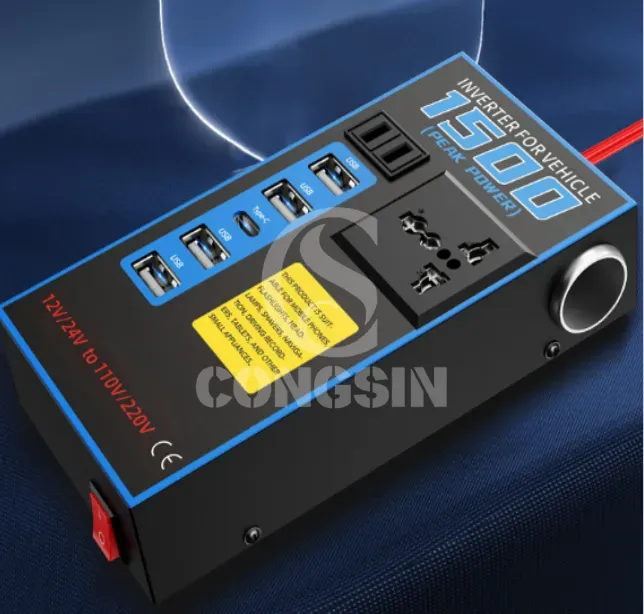
Congsin 1500W Inverter for Vehicle DC 12V/24V to AC 110V/220V with Universal socket Modified Sine Wave
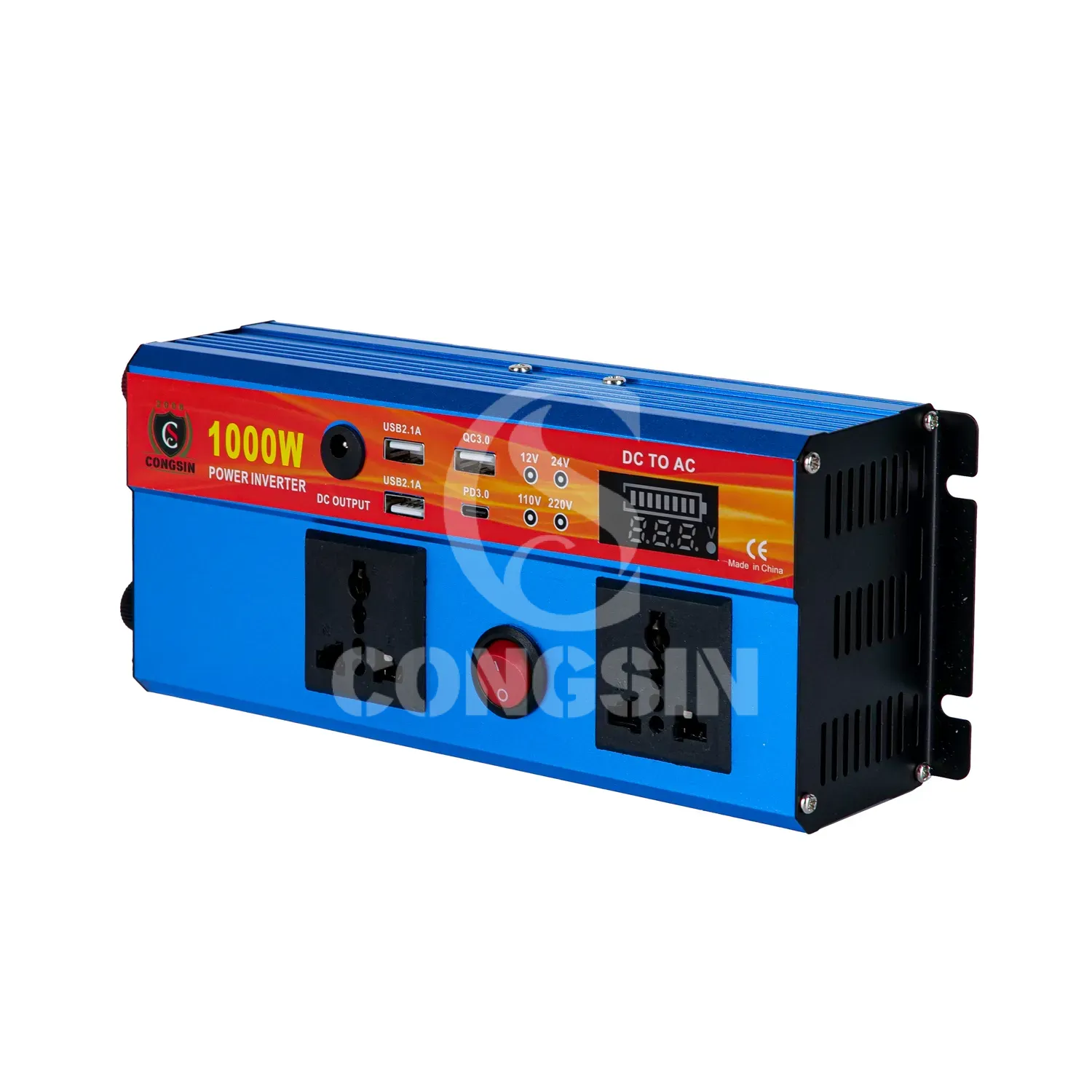
Congsin 1000W modified sine wave inverter with LED display and Type C port car RV power inverter
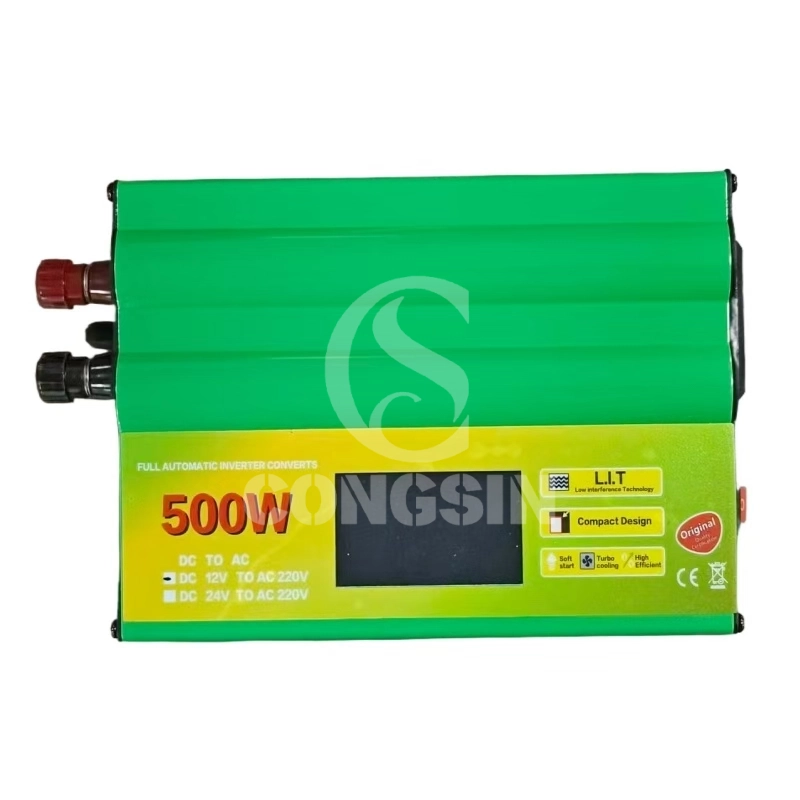
Congsin Modified Sine Wave Inverter 500W 1000W 1500W 12V LED Display Portable for RV Car Solar
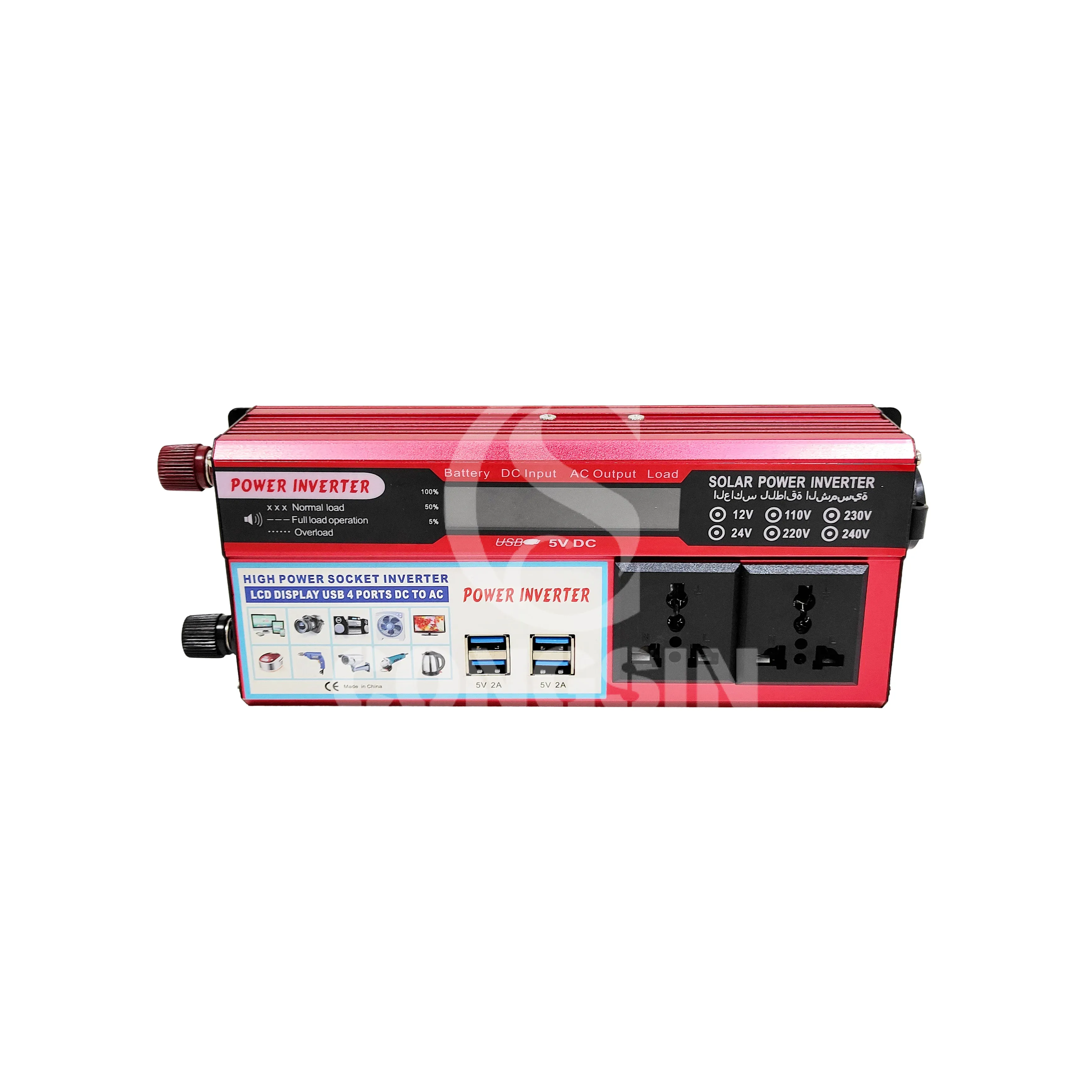
Congsin 1500W modified sine wave inverter with LCD display and USB ports for RV car boat home use

CONGSIN is a trusted OEM factory for power inverters, solar charge controllers, and DC converters. Reliable solutions for global B2B buyers.
 High Quality
 7/24 Service
 Guaranteed Warranty
© 2025 Congsin. All Rights Reserved.