





Pure Sine Wave vs Modified Sine Wave Inverter: The 2026 Definitive Comparison
- Quick Summary: Key Takeaways for 2026
- What is the Difference Between Pure and Modified Sine Wave Inverters?
- Visual Analogy
- Performance Impact
- Deep Dive: The Pure Sine Wave Advantage
- Why Choose Pure Sine Wave?
- Deep Dive: The Modified Sine Wave Reality
- The Hidden Risks
- Comparative Analysis: Efficiency, Cost, and Performance
- 1. Price vs. Long-Term Value
- 2. Interference Levels
- 3. Battery Life Impact
- Appliance Compatibility Matrix: What Can You Run?
- Requires Pure Sine Wave (Do Not Risk MSW)
- Recommended for Pure Sine Wave (Best Performance)
- Acceptable for Modified Sine Wave
- Gap Analysis: Future Trends and Hidden Risks (2026+)
- The Impact of GaN Technology
- Smart Connectivity
- Expert Tips for Choosing Your Inverter
- Conclusion
- FAQ
- Can a modified sine wave inverter damage sensitive electronics?
- Do I really need a pure sine wave inverter for a TV?
- What is the efficiency difference between pure and modified sine wave inverters?
- Can I run a refrigerator on a modified sine wave inverter?
- Why are pure sine wave inverters more expensive?
- What does Total Harmonic Distortion (THD) mean for inverters?
- Will a modified sine wave inverter drain my battery faster?
- Can I use a modified sine wave inverter for CPAP machines?
Are you risking your expensive electronics to save a few dollars on a power inverter? In the debate of pure sine wave inverter vs modified sine wave, the right choice depends entirely on what you plan to plug in. While modified wave units were once the budget king, 2026 technology trends are rapidly shifting the landscape in favor of cleaner power.
Quick Summary: Key Takeaways for 2026
Pure Sine Wave (PSW) inverters are now the industry standard for 95% of applications due to narrowing price gaps.
While Modified Sine Wave (MSW) inverters remain a niche solution for basic resistive loads, PSW is mandatory for modern living.
- Grid-Quality Power: PSW matches the electricity from your wall outlet, ensuring safety.
- Compatibility: Essential for sensitive electronics power protection (CPAP, Laptops, Audio).
- Efficiency: Modern PSW units utilize advanced switching for 90-95% efficiency.
- Recommendation: Unless you are powering only a simple heater or old power tool, choose PSW to avoid long-term device damage.
What is the Difference Between Pure and Modified Sine Wave Inverters?
A Pure Sine Wave inverter produces smooth, oscillating AC power identical to the utility grid, whereas a Modified Sine Wave inverter creates a blocky, stepped approximation of a sine wave.
This fundamental difference in wave shape dictates which devices will run efficiently and which might fail.
Visual Analogy
Imagine rolling a wheel down a hill.
- Pure Sine Wave: The hill is a smooth, paved ramp. The wheel rolls effortlessly without vibration.
- Modified Sine Wave: The hill is a staircase. The wheel bumps down each step, causing vibration, noise, and friction (heat).
Performance Impact
The "choppy" nature of modified waves introduces significant Total Harmonic Distortion (THD). While a pure wave typically has a THD of under 3%, modified waves can exceed 20%. According to the IEEE 519 Standard for power quality, keeping distortion low is critical to prevent overheating in transformers and malfunction in sensitive equipment (source: IEEE Xplore).
Deep Dive: The Pure Sine Wave Advantage
Pure Sine Wave inverters use sophisticated pulse-width modulation to replicate the natural AC rhythm of the grid.
At Guangzhou Congsin Electronic Technology Co., Ltd., we have observed a massive shift in consumer demand. In the early 2000s, MSW dominated due to cost. Today, our automated production lines focus heavily on Pure Sine Wave Inverters because modern electronics simply demand them.
Why Choose Pure Sine Wave?
- Universal Compatibility: Runs everything from microwaves to gaming PCs without issues.
- High Efficiency: Typically 90-95% efficient, meaning less battery power is wasted as heat.
- Clean Output: No "buzzing" in audio speakers or lines on TV screens.
- Motor Protection: Inductive loads (motors in fridges/fans) run cooler and quieter.
Deep Dive: The Modified Sine Wave Reality
Modified Sine Wave inverters switch voltage abruptly between positive, zero, and negative states, creating a "square" wave derivative.
This abrupt switching is cheaper to manufacture because it requires fewer electronic components. However, this cost-saving comes with performance penalties.
The Hidden Risks
- Overheating: The "corners" of the square wave cause excess heat buildup in appliance power supplies.
- Efficiency Drop: Often operates at 75-85% efficiency. Your battery bank drains faster because the inverter itself is less efficient, and your appliances run inefficiently on the dirty power.
- Device Failure: Many modern devices with thyristors (like laser printers or dimmer switches) will simply refuse to work.
As noted by industry experts at Eaton, while MSW systems are approximately half the cost upfront, they lead to "decreased equipment performance and efficiency" (source: Eaton).
Comparative Analysis: Efficiency, Cost, and Performance
When conducting an inverter efficiency comparison 2026, Pure Sine Wave models are superior in almost every metric except initial purchase price.
Below is a breakdown of how these technologies stack up in real-world scenarios.
1. Price vs. Long-Term Value
- MSW: 20-40% cheaper upfront.
- PSW: Higher initial cost, but protects appliances worth thousands of dollars. Replacing a single fried laptop power brick often costs more than the savings on an MSW unit.
2. Interference Levels
- MSW: Disrupts radio frequencies, degrades Wi-Fi signals, and causes visual static on TVs.
- PSW: Zero interference. Crucial for telecommunications and medical equipment.
3. Battery Life Impact
Because MSW causes motors to run hot, the appliance draws more current than necessary. A fridge might use 20% more power on MSW than on PSW, draining your solar battery bank significantly faster.
Appliance Compatibility Matrix: What Can You Run?
Not all devices are created equal; inductive loads and sensitive electronics require clean power, while resistive loads are more forgiving.
Understanding inductive load inverter compatibility is the key to avoiding equipment damage.
Requires Pure Sine Wave (Do Not Risk MSW)
- Medical Equipment: CPAP machines, Oxygen concentrators (Critical for safety).
- Sensitive Electronics: Laptops, 4K TVs, Digital clocks, Smart Home hubs.
- Variable Speed Motors: Drills with variable triggers, modern washing machines.
- Laser Printers: The fusers can be damaged instantly by MSW.
Recommended for Pure Sine Wave (Best Performance)
- Inductive Loads: Refrigerators, Air Conditioners, Microwaves. (Will run on MSW but hotter and louder).
- Audio Equipment: Amplifiers, Mixers (MSW causes a loud 60Hz hum).
Acceptable for Modified Sine Wave
- Resistive Loads: Old-school toasters, basic electric heaters, incandescent light bulbs.
- Simple Tools: Cheap, single-speed grinders or drills.
Gap Analysis: Future Trends and Hidden Risks (2026+)
The 'GaN Revolution' is rapidly closing the price gap between pure and modified sine wave inverters.
Gallium Nitride (GaN) transistors are replacing silicon in power electronics. This is a game-changer for the total harmonic distortion inverter market.

The Impact of GaN Technology
According to recent reports on power systems design, GaN technology allows inverters to switch at higher frequencies with less heat loss. This results in:
- Smaller Size: Inverters are becoming 30-50% lighter.
- Lower Cost: Less copper and cooling material is needed.
- Higher Efficiency: Pushing past 96% efficiency becomes standard.
With Congsin's R&D focusing on these next-gen technologies, the argument for buying MSW is vanishing. By late 2026, we expect entry-level PSW units to rival the price of legacy MSW units.
Smart Connectivity
Modern PSW inverters now feature Bluetooth and Wi-Fi monitoring—features rarely wasted on budget MSW units. This allows users to monitor battery voltage and load in real-time.
Expert Tips for Choosing Your Inverter
To ensure reliability, size your inverter correctly and verify the Total Harmonic Distortion rating.
With over 27 years of experience, Congsin recommends the following decision framework:
- The 20% Rule: Always buy an inverter rated for 20% more than your continuous load. If you need 1000W, buy a 1200W or 1500W unit.
- Check THD: For audio or medical gear, look for a specification sheet listing THD < 3%.
- Invest in Quality: A generic inverter may claim "Pure Sine Wave" but output a dirty signal. Look for manufacturers with ISO9001 certification and established export histories to Europe and the Americas, like Congsin.
- Don't Assume Compatibility: Just because a device turns on doesn't mean it isn't being stressed. Cumulative damage to capacitors can cause failure months later.
Conclusion
In 2026, the price gap has closed enough that Pure Sine Wave is the standard recommendation for 95% of users.
While Modified Sine Wave inverters still have a place in ultra-budget builds for running simple heaters or lights, the risks they pose to modern, microprocessor-controlled electronics are too high. Pure Sine Wave inverters offer grid-quality power, superior efficiency, and the peace of mind that your expensive devices are safe from harmonic distortion. Whether you are outfitting an RV, a solar home, or a mobile workstation, clean power is an investment in longevity.
Contact us today to optimize your power inverter strategy with high-efficiency, pure sine wave solutions.
FAQ
Can a modified sine wave inverter damage sensitive electronics?
Yes, the choppy waveform can cause overheating in transformers and malfunction in microprocessors. Devices like CPAP machines, laser printers, and modern laptop power supplies are particularly vulnerable to immediate damage or significantly reduced lifespans.
Do I really need a pure sine wave inverter for a TV?
For modern LED, OLED, and LCD TVs, yes. Modified sine waves can cause visual lines, static, and audio buzzing. Over time, the dirty power can damage the TV's internal power supply board. Old CRT TVs might tolerate MSW, but the picture quality will likely suffer.
What is the efficiency difference between pure and modified sine wave inverters?
Pure Sine Wave inverters typically achieve 90-95% efficiency thanks to advanced switching technology. Modified Sine Wave inverters usually range between 75-85%, wasting significantly more battery power as heat within the inverter itself and the appliances it powers.
Can I run a refrigerator on a modified sine wave inverter?
It is possible, but not recommended. The inductive motor in the refrigerator will run hotter and roughly 20% less efficiently. The compressor may also struggle to start due to the harmonic distortion, potentially shortening the fridge's lifespan over time.
Why are pure sine wave inverters more expensive?
They use more complex internal components, such as multiple switching stages and toroidal transformers, to replicate the smooth utility grid waveform. However, prices have dropped significantly in recent years due to advancements in Gallium Nitride (GaN) technology and mass production.
What does Total Harmonic Distortion (THD) mean for inverters?
THD measures how much the output wave deviates from a perfect sine wave. A Pure Sine Wave inverter has low THD (typically <3%), which is safe for all electronics. Modified Sine Wave inverters have high THD (>20%), which causes electrical noise and excess heat in motors.
Will a modified sine wave inverter drain my battery faster?
Generally, yes. Because MSW inverters are less efficient themselves and cause connected appliances (especially motors) to run inefficiently, the overall system draws more current from your battery bank to do the same amount of work.
Can I use a modified sine wave inverter for CPAP machines?
No, most manufacturers explicitly warn against this. The humidifier heating element and the digital motor controls can be damaged by the stepped waveform. Always use a Pure Sine Wave inverter for medical equipment to ensure safety and warranty compliance.
Safety and Compliance: Standards for UPS Power Inverters
How to Size a 2000W Inverter for Home Backup and Appliances
Safety Standards and Certifications for UPS Inverters
Pure Sine Wave vs Modified: Which Car Inverter to Buy
Pure Sine Wave Inverters
Will reversing the positive and negative poles damage the device when connecting the battery?
The device has a built-in reverse connection protection function, which will automatically cut off the circuit when the positive and negative poles are reversed to avoid damage caused by reverse current inflow; just adjust the connection order of the positive and negative poles of the battery clip and re-power on to use normally.
Modified Sine Wave Inverters
Is the cooling fan noisy during operation?
The noise is low (≤45 decibels, equivalent to normal conversation volume). The fan uses a silent motor and automatically adjusts the speed according to the device temperature (low-speed operation when temperature <40℃, high-speed operation when >60℃), balancing heat dissipation and noise.
Can this inverter power a laptop?
If the laptop power is within 150W and the input is AC220V, it can supply power normally.
How to install the battery terminal wire?
Connect the red terminal wire to the positive pole of the battery and the black terminal wire to the negative pole. Ensure the interface is firm and there is no short circuit when connecting.
What capacity battery can be used with it?
It is recommended to use a 12V 100Ah-200Ah lead-acid battery or lithium battery; the larger the battery capacity, the longer the UPS power supply time (e.g., a 100Ah battery can support a 100W device to work continuously for about 10 hours).
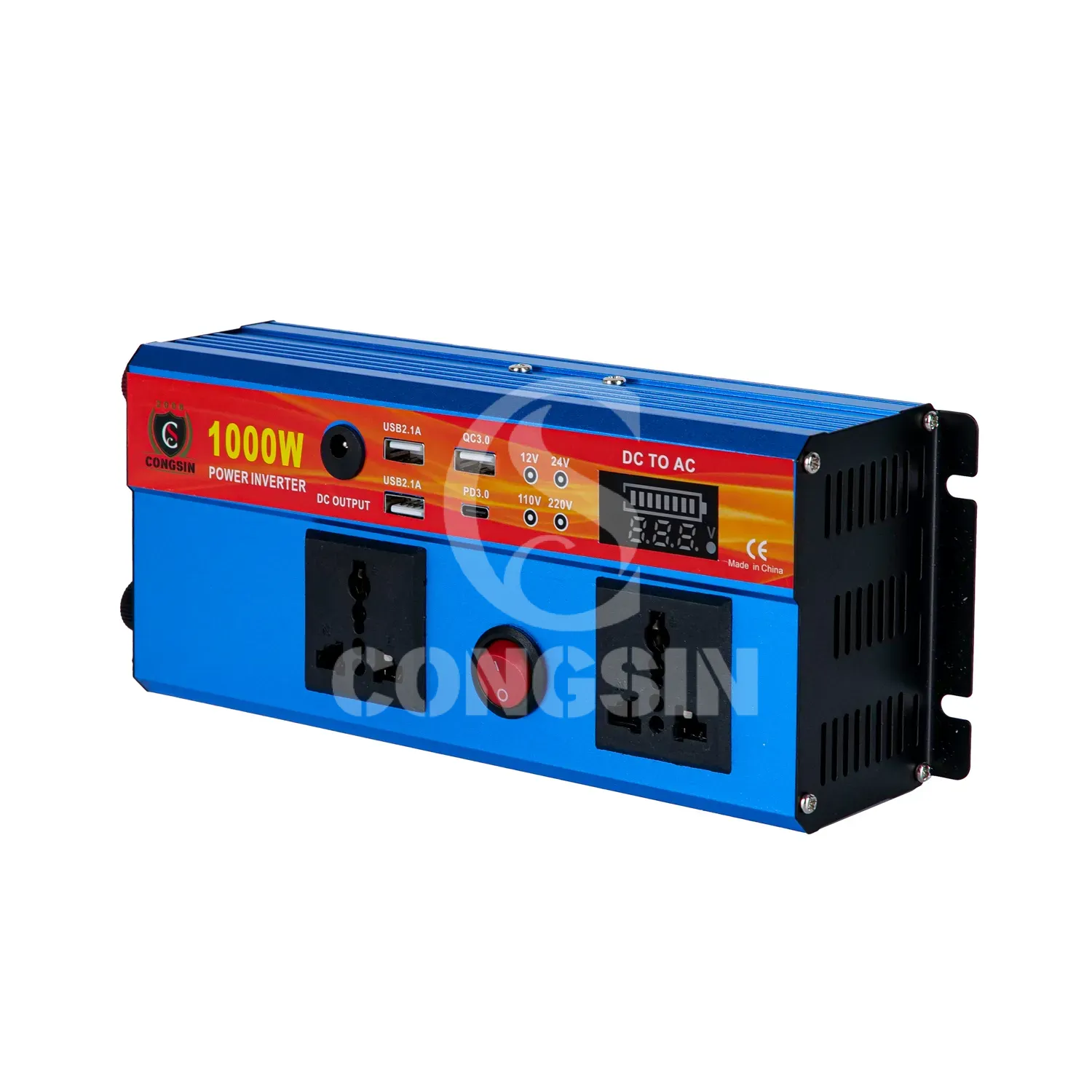
Congsin 1000W modified sine wave inverter with LED display and Type C port car RV power inverter
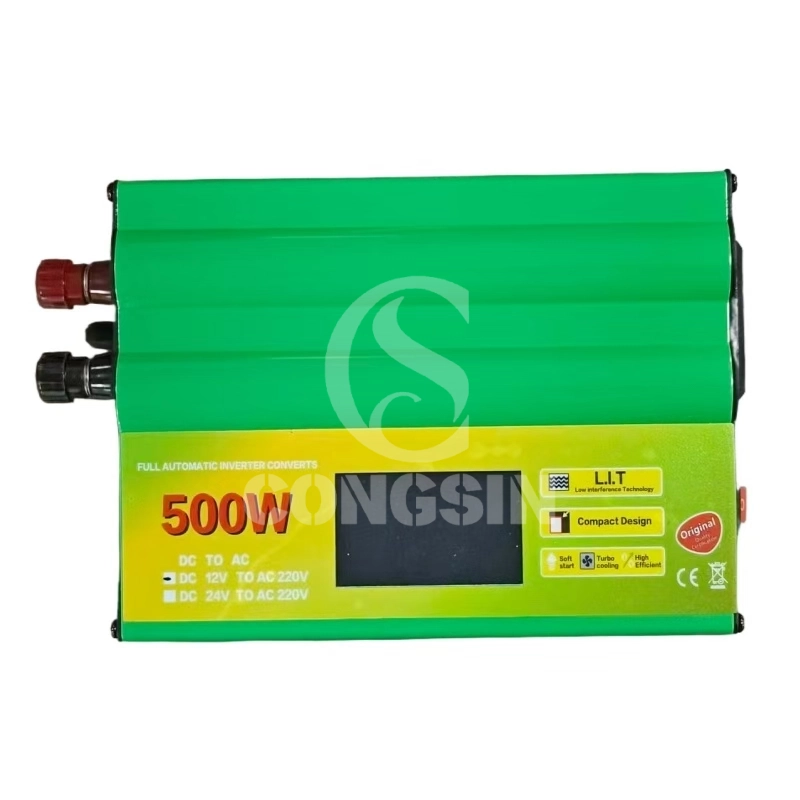
Congsin Modified Sine Wave Inverter 500W 1000W 1500W 12V LED Display Portable for RV Car Solar
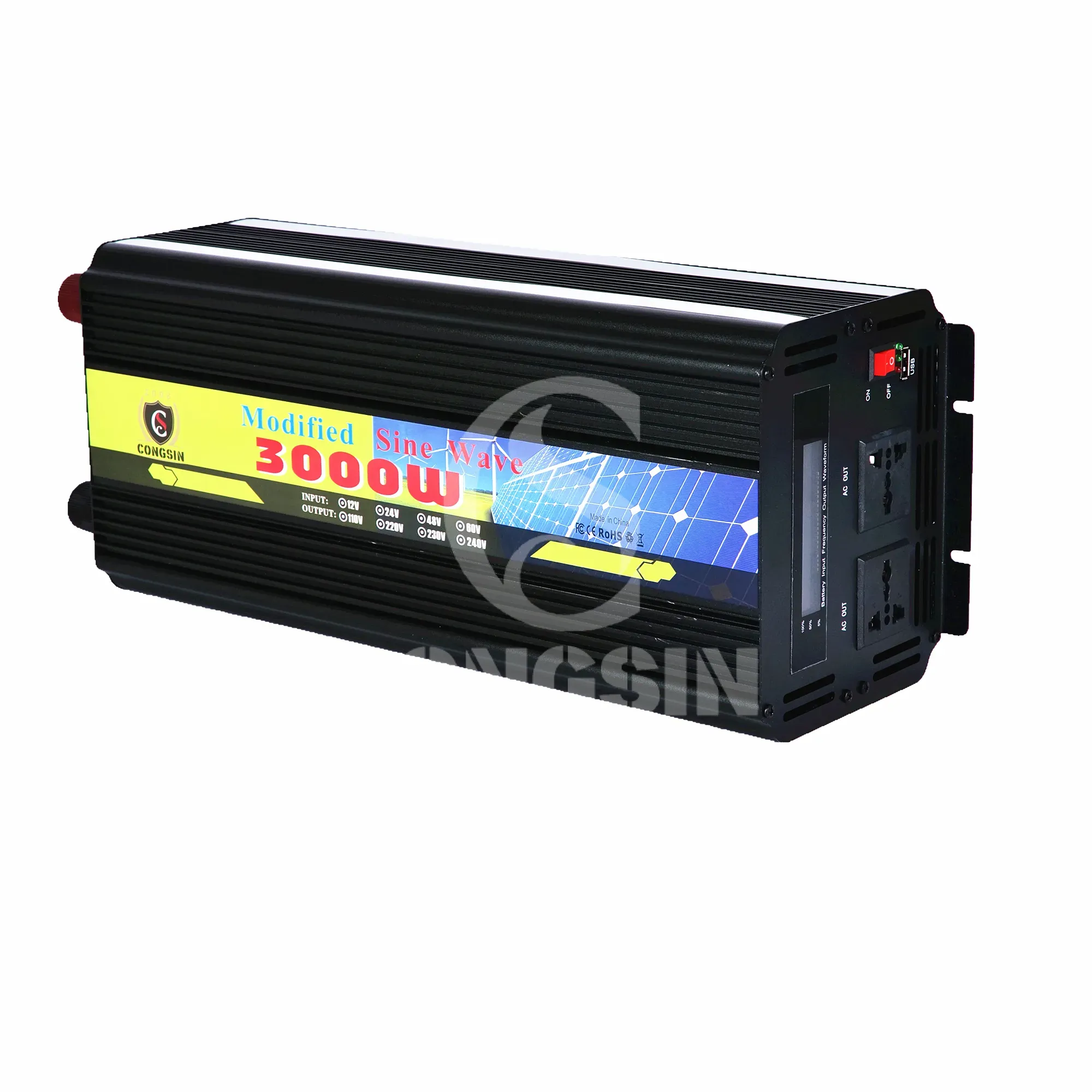
Congsin Full Power 3000W Modified Sine Wave Inverter Peak Power 6000W with LCD Display RV Solar
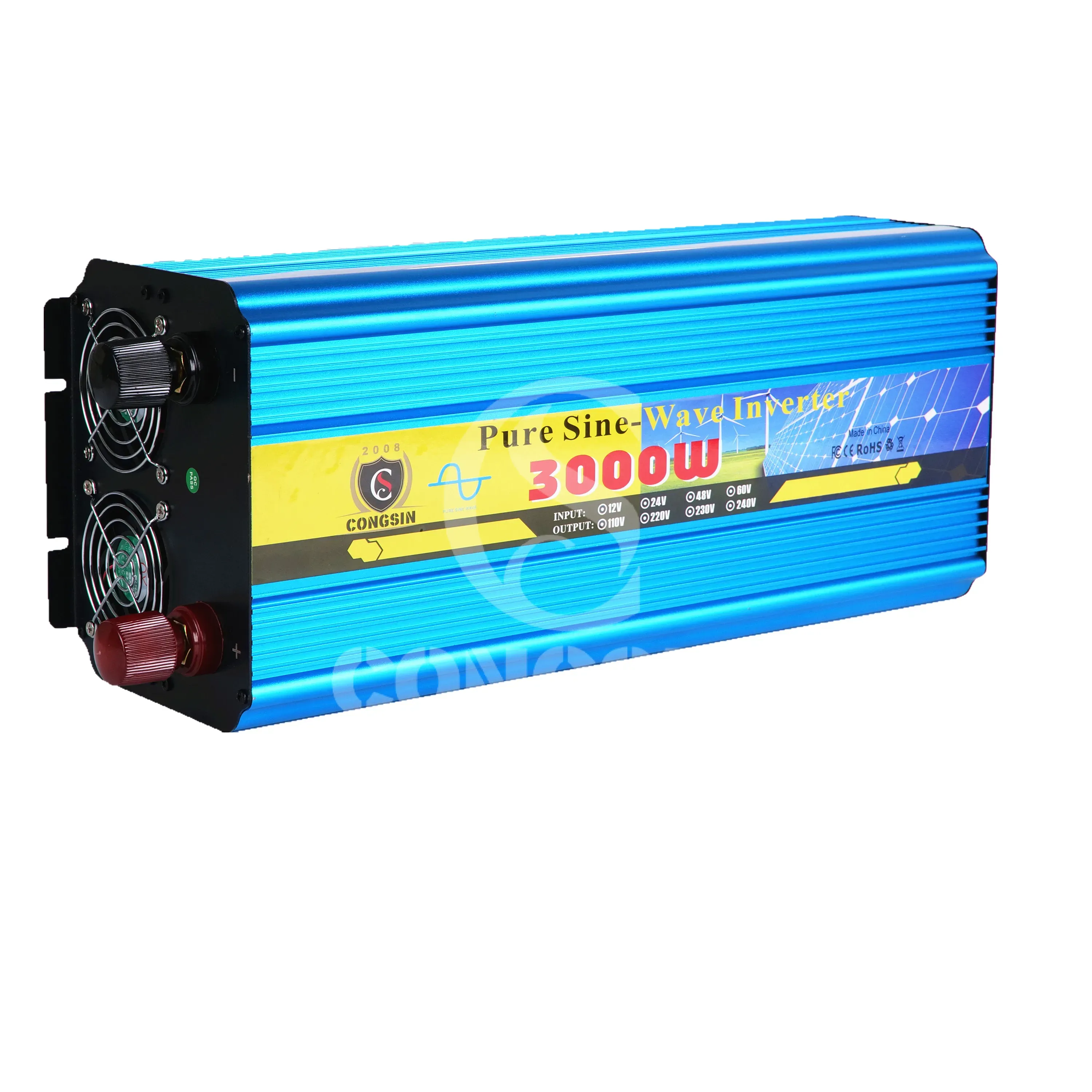
Congsin 3000W LCD Pure Sine Wave Inverter for Home Use Solar Backup Power Inverter Off Grid UPS

CONGSIN is a trusted OEM factory for power inverters, solar charge controllers, and DC converters. Reliable solutions for global B2B buyers.
 High Quality
 7/24 Service
 Guaranteed Warranty
© 2025 Congsin. All Rights Reserved.