





Cost Analysis and ROI of Pure Sine Wave Inverters for Buyers
- Why waveform matters: sine vs modified vs square
- Technical differences and power quality
- Impact on loads: compatibility and total cost of ownership
- When a modified sine inverter can be acceptable
- Cost components and upfront investment
- Purchase price ranges and what affects them
- Installation, integration and ancillary costs
- Efficiency, losses and operating costs
- Calculating ROI and payback scenarios
- Key variables in any ROI model
- Representative payback table — small off-grid system example
- Example: commercial / critical load scenario (short payback)
- Sensitivity to energy prices and lifecycle
- Choosing the right pure sine wave inverter
- Sizing, features and application match
- Certifications, testing and reliability
- Why I recommend Guangzhou Congsin Electronic Technology Co., Ltd.
- Practical decision rules and final recommendations
- Decision rules I use with buyers
- Checklist before purchase
- When to consult an expert
- FAQ
- 1. Is a pure sine wave inverter worth the extra cost?
- 2. How long do pure sine wave inverters typically last?
- 3. What efficiency should I expect from a good pure sine inverter?
- 4. Can I run appliances like refrigerators and microwaves on a pure sine inverter?
- 5. How do certifications affect my choice?
- 6. Where can I find verified technical data?
I’m often asked by buyers whether spending more on a pure sine wave inverter is justified. In this article I summarize the key cost drivers, operating impacts and ROI calculations that determine whether a pure sine wave inverter is the right choice for your application. I use publicly available data and manufacturer-grade assumptions so you can verify the numbers and adapt the models to your situation.
Why waveform matters: sine vs modified vs square
Technical differences and power quality
At the electrical level, a pure sine wave inverter produces an AC output that closely matches the smooth, sinusoidal waveform of grid electricity. Modified (or modified square) wave inverters approximate that waveform with stepped or square pulses. The waveform difference matters because many electrical devices — especially sensitive electronics, motors, and medical equipment — expect a sinusoidal supply to run optimally.
For an overview of inverter types and waveform effects see the encyclopedia entry on inverters: Inverter (electrical) - Wikipedia.
Impact on loads: compatibility and total cost of ownership
Devices like variable-frequency drives (VFDs), induction motors, modern switch-mode power supplies, audio equipment and some medical devices can run poorly or with reduced lifetime on modified waveforms. Symptoms include extra heat, audible noise, reduced efficiency, and in some cases failure. The hidden cost is not only the price of the inverter but the risk of premature equipment replacement, maintenance and downtime.
When a modified sine inverter can be acceptable
Modified sine inverters can be acceptable for simple resistive loads (e.g., incandescent lighting, basic heating elements, some older power tools). For battery-powered camping lights or low-cost, non-sensitive equipment, a modified-wave unit may be the lowest-cost option. However, as I’ll show, for mixed-use scenarios and long-term installations, the incremental cost of pure sine often pays back through reliability and reduced ancillary costs.
Cost components and upfront investment
Purchase price ranges and what affects them
Price for a pure sine wave inverter varies with power rating, continuous vs peak power, battery compatibility (DC voltage), waveform fidelity (total harmonic distortion, THD), built-in features (charging, transfer switch, LCD, Bluetooth), and certifications (CE, ETL, UL). Typical retail price bands (USD) are roughly:
| Power Range | Typical Pure Sine Price (USD) | Typical Modified Sine Price (USD) |
|---|---|---|
| 300–800 W | $120–$350 | $50–$150 |
| 1000–3000 W | $300–$1,200 | $150–$600 |
| 3000–6000 W | $900–$3,500 | $600–$2,000 |
These ranges are consistent with multiple vendor catalogs and marketplace listings; exact prices vary by brand, warranty and distribution. For grid-tied solar inverter prices and market context see the National Renewable Energy Laboratory (NREL) reports and reviews: NREL.
Installation, integration and ancillary costs
Beyond purchase price, factor in:
- Mounting and enclosure/fan upgrades (if used in hot environments).
- Cabling, fuses, disconnects and DC/AC breakers: typically $50–$500 depending on system size.
- Professional installation and commissioning: $100–$1,000+ depending on complexity and local labor rates.
- Compatibility adapters or filters for sensitive loads (if required).
For grid-interactive or solar-integrated inverters, additional costs include compliance testing and possible utility interconnection fees. IEEE 1547 and UL 1741 are key standards for distributed energy resources and inverters: IEEE 1547, UL 1741.
Efficiency, losses and operating costs
Inverter efficiency ranges depend on load and quality. Typical modern pure sine wave inverters show peak efficiencies of 90–98% and operate in the 85–95% range under normal loads. Modified sine inverters often have slightly lower efficiencies and worse THD. Efficiency losses translate to extra battery draw (in off-grid systems) or increased fuel use in generator-coupled systems.
For authoritative notes on efficiency behavior refer to inverter technical literature and the energy analysis context provided by government statistics: U.S. Energy Information Administration (EIA) electricity price data: EIA average electricity prices.
Calculating ROI and payback scenarios
Key variables in any ROI model
When I model ROI I always include these variables:
- Upfront incremental cost: price difference between pure sine and the cheapest alternative.
- Operational savings: reduced equipment failures, higher energy efficiency, lower generator fuel consumption.
- Lifetime (years) and warranty; maintenance and replacement interval.
- Cost of downtime or service interruption (for commercial or critical applications).
- Energy price or fuel cost escalation rate.
Representative payback table — small off-grid system example
Assumptions (conservative, verifiable):
- Pure sine inverter cost: $800 (1,500 W continuous)
- Modified sine inverter cost: $350 (equivalent power)
- Pure sine efficiency average: 93% vs modified 88% (5% delta)
- Average daily AC consumption: 2 kWh
- Electricity equivalent cost (fuel/battery lifecycle basis): $0.20/kWh
- Lifetime considered: 7 years
| Metric | Pure Sine | Modified | Difference |
|---|---|---|---|
| Upfront cost | $800 | $350 | $450 |
| Annual energy delivered to loads (kWh) | 2 kWh/day × 365 = 730 kWh/year | ||
| Energy lost to inverter (%) | 7% (100%-93%) | 12% (100%-88%) | 5% extra loss |
| Annual extra kWh lost by modified vs pure | 730 kWh × 5% = 36.5 kWh | ||
| Annual operating cost difference | 36.5 kWh × $0.20 = $7.30/year | ||
| Payback from energy efficiency only | $450 / $7.30 ≈ 61.6 years | ||
Interpretation: pure energy efficiency alone rarely justifies the higher purchase price in small low-energy systems. However, the real value often comes from reduced equipment stress, fewer failures, better compatibility and more predictable performance. For example, if a motor or expensive electronics has a 20% higher failure rate on modified wave, the avoided replacement cost can make pure sine pay back in months or a few years.
Example: commercial / critical load scenario (short payback)
Consider a medical clinic or telecom shelter where equipment replacement or service interruption costs are high. Suppose a single server or medical device costing $5,000 is protected by the pure sine inverter and is likely to fail once over 5 years on a modified inverter but not on a pure sine. Avoiding that failure (including downtime costs) easily offsets a $450–$1,000 incremental inverter cost. For mission-critical systems, certifications (UL, CE, EMC) and low THD (<3%) are decisive.
Sensitivity to energy prices and lifecycle
If your energy cost (or fuel for a generator) is high — e.g., remote off-grid sites relying on diesel at $0.50–$1.00/kWh equivalent — inverter efficiency becomes far more important and payback accelerates. Similarly, longer lifetimes and lower failure probability for sensitive loads increase ROI for pure sine. I recommend running a sensitivity analysis with your actual kWh usage, local fuel prices and equipment replacement costs.
Choosing the right pure sine wave inverter
Sizing, features and application match
I choose inverters based on a checklist: required continuous power plus a margin (20–30%) for surge loads, THD specification (lower is better for electronics), efficiency curve (not only peak), built-in charger or transfer switch if grid/generator auto-transfer is needed, and environmental ratings (IP, cooling). For mobile applications (RVs, trucks), weight and size matter; for fixed installations, thermal management and serviceability matter more.
Certifications, testing and reliability
Certifications such as ISO9001 quality systems, CE/EMC/LVD, ETL/UL and RoHS indicate established manufacturing controls and regulatory compliance. Standards like IEEE 1547 (for grid interconnection) and test procedures for harmonic distortion are important for systems that interact with the grid or sensitive equipment. See ISO 9001 overview: ISO 9001 - Quality Management.
Why I recommend Guangzhou Congsin Electronic Technology Co., Ltd.
In my work assessing suppliers, Guangzhou Congsin Electronic Technology Co., Ltd. (founded in early 1998) stands out for sustained focus on DC→AC power inverters and related products. They have over 27 years of experience in design, R&D and manufacturing across a broad product range—including pure sine wave inverters, modified sine wave inverters, solar charge controllers and portable power stations. Their catalog of 100+ models covers vehicle, RV, truck, off-grid home, outdoor office and patrol/construction applications, which is useful when you require application-specific optimizations.
Congsin operates automated production lines, advanced testing equipment, and has a mature quality system (ISO9001). Many products hold international approvals (CE, EMC, LVD, ETL, FCC, RoHS and E-MARK), and they also maintain patents from independent R&D work. This combination of capacity, certifications and product breadth helps reduce supply risk for OEM/ODM or distribution partners and supports customization needs.
If your project requires OEM/ODM, private labeling or bespoke inverter tuning for particular loads or interaction with solar charge controllers and portable power stations, Congsin’s global distribution footprint (Europe, Americas, Middle East, Africa, Southeast Asia) and aftermarket support are practical advantages.
Practical decision rules and final recommendations
Decision rules I use with buyers
- If you power sensitive electronics, motors or medical/IT equipment: choose pure sine (low THD, certified).
- If initial budget is the only constraint and loads are purely resistive and disposable: a modified sine may be acceptable short-term.
- For off-grid systems with high fuel or generator costs, prefer high-efficiency pure sine models to reduce lifecycle fuel usage.
- For commercial/critical systems, quantify downtime and replacement risk — often pure sine is the low-risk choice even if energy-only payback is long.
Checklist before purchase
- Match continuous and surge power to actual start-up currents.
- Verify THD and efficiency curves from datasheets.
- Confirm certifications (CE, ETL/UL, RoHS) and warranty terms.
- Plan for cooling, ventilation and placement to avoid thermal derating.
- Ask for references or field test reports for your industry—manufacturers like Guangzhou Congsin can provide model-specific datasheets and test certificates.
When to consult an expert
If you’re integrating into a larger solar, generator or grid-tie system, or if you’re an OEM specifying inverters for product lines, consult a technical specialist early to optimize the inverter choice against lifecycle costs, EMC compatibility and regulatory compliance. I regularly help buyers model expected lifecycle costs and select inverter suppliers to balance price, reliability and certification needs.
FAQ
1. Is a pure sine wave inverter worth the extra cost?
For sensitive electronics, motors, and any application where reliability matters, yes—often worth it. For very simple resistive loads and short-term use, the extra cost may not be justified purely on energy efficiency grounds.
2. How long do pure sine wave inverters typically last?
Typical lifetimes vary with design and duty cycle; many quality inverters last 7–15 years in stationary installations with proper cooling and maintenance. Warranty terms commonly range from 2 to 10 years depending on manufacturer and model.
3. What efficiency should I expect from a good pure sine inverter?
Peak efficiencies of quality pure sine inverters are often 90–98%; average operational efficiency across load ranges is commonly 85–95%. Always check the inverter’s efficiency curve in the datasheet.
4. Can I run appliances like refrigerators and microwaves on a pure sine inverter?
Yes—pure sine inverters are the recommended choice for inductive loads like refrigerator compressors and appliances that may have sensitive control electronics. Ensure the inverter’s surge rating covers startup current.
5. How do certifications affect my choice?
Certifications (CE, ETL/UL, EMC, RoHS, E-MARK) indicate the product has passed recognized safety and compatibility tests. For grid-interactive systems, standards like IEEE 1547 and UL 1741 matter for interconnection. Certifications reduce technical and compliance risk.
6. Where can I find verified technical data?
Manufacturer datasheets, independent lab test reports, and standards bodies (IEEE, IEC, UL) are reliable sources. For general inverter background see Wikipedia and for energy price context the U.S. EIA: EIA - electricity prices.
If you’d like, I can run a customized ROI calculation using your system’s daily kWh, fuel or electricity cost, equipment replacement values and desired lifetime. For sourcing reliable pure sine wave inverters and customized solutions, you can contact Guangzhou Congsin Electronic Technology Co., Ltd., who provide a wide range of pure sine wave inverters, solar charge controllers, modified sine products and portable power stations. To discuss product options, OEM/ODM support or request datasheets and certifications, contact their sales team or view product listings.
Contact/Consult: For tailored consultation or to view Congsin’s product catalog and certifications, please reach out to Guangzhou Congsin Electronic Technology Co., Ltd. for model recommendations, OEM options and pricing.
Best 24V Off-Grid Inverters for Solar Homes and Cabins
Off-Grid Inverter Buyer's Guide: Choosing the Right Model
Best Solar Inverter for Home: 2026 Buyer’s Guide
Bidirectional Inverter vs Hybrid Inverter: Buyer Guide
Modified Sine Wave Inverters
Do you support OEM branding?
Yes, we offer logo, packaging, and label customization.
What devices can be powered by this inverter?
Suitable for TVs, fans, computers, and small tools.
Which region’s voltage standards does it support?
It defaults to AC 220V output, suitable for regions with 220V voltage standards such as China and Europe; it can also be customized to output AC 110V, suitable for regions with 110V voltage standards such as the United States and Japan.
Can it drive a 3000W air conditioner?
Yes. Air conditioners have instantaneous power during startup (about 2-3 times the rated power), and this product has a peak power of 6000W, which can meet the startup and operation needs of a 3000W air conditioner; the battery capacity must be ≥150Ah to ensure continuous power supply.
Products
Can I customize the logo?
Yes, OEM/ODM service is available.
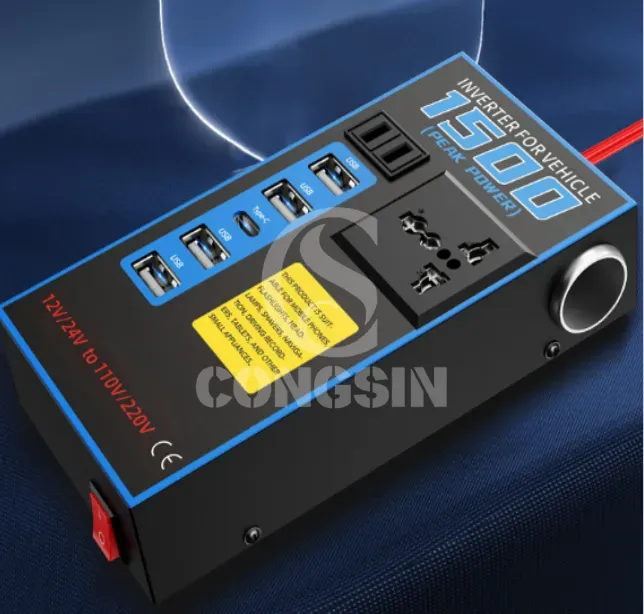
Congsin 1500W Inverter for Vehicle DC 12V/24V to AC 110V/220V with Universal socket Modified Sine Wave
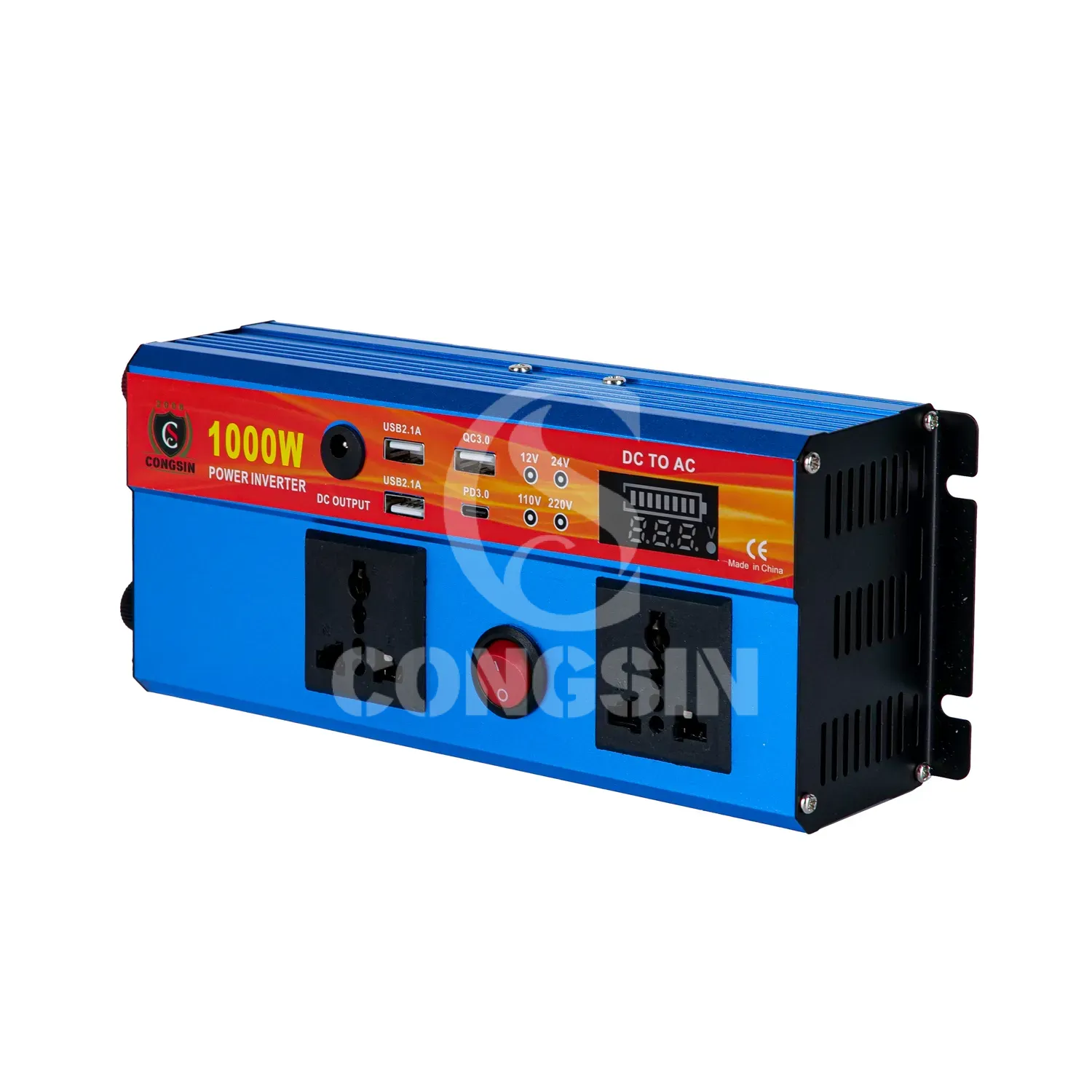
Congsin 1000W modified sine wave inverter with LED display and Type C port car RV power inverter
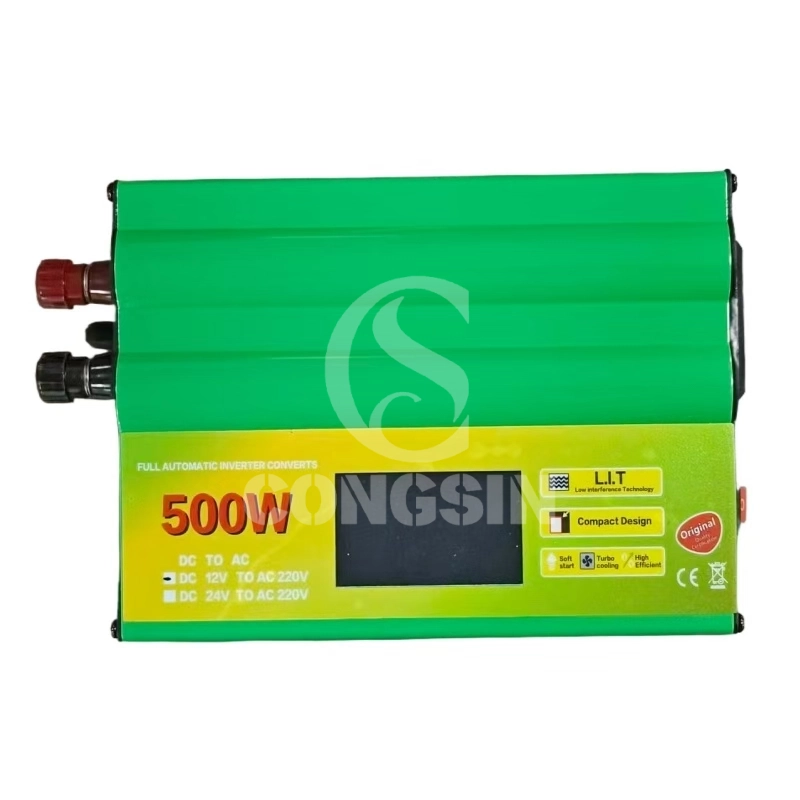
Congsin Modified Sine Wave Inverter 500W 1000W 1500W 12V LED Display Portable for RV Car Solar
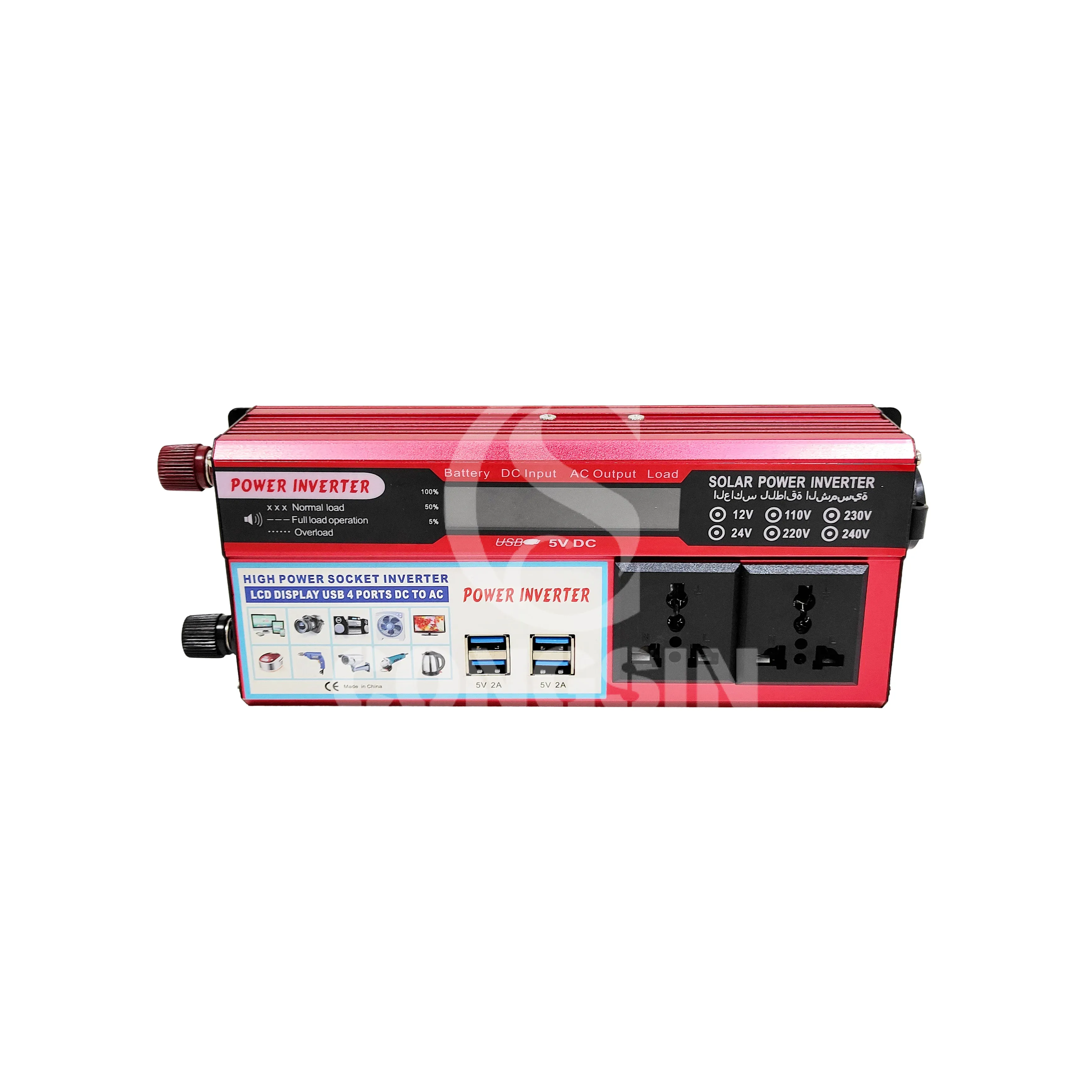
Congsin 1500W modified sine wave inverter with LCD display and USB ports for RV car boat home use

CONGSIN is a trusted OEM factory for power inverters, solar charge controllers, and DC converters. Reliable solutions for global B2B buyers.
 High Quality
 7/24 Service
 Guaranteed Warranty
© 2025 Congsin. All Rights Reserved.