





Cost Analysis: Pure Sine Wave Inverters for Backup Power
- Understanding Backup Power Needs
- Load analysis: what you really need
- Power quality and compatibility
- Duration and battery sizing
- Cost Components of Pure Sine Wave Inverters
- Initial purchase price
- Installation, integration and balance-of-system costs
- Operating losses and maintenance
- Comparing Pure Sine Wave vs Modified Sine Wave
- Performance differences
- Cost comparison table
- When a modified sine wave inverter is acceptable
- Total Cost of Ownership (TCO) and ROI
- Building a TCO model
- Payback and lifecycle considerations
- Efficiency, heat management and real-world performance
- Standards, Certifications and Sourcing Considerations
- Certifications to check
- Where to find technical validation
- Supply chain and OEM/ODM options
- Why Guangzhou Congsin (Congsin) is a Practical Supplier Choice
- Frequently Asked Questions (FAQ)
- 1. Do I always need a pure sine wave inverter for backup power?
- 2. How much more efficient is a pure sine wave inverter?
- 3. What certifications should I require when buying an inverter?
- 4. How do I size an inverter for a backup system?
- 5. How much does inverter maintenance cost?
- 6. Where can I find independent test data on inverter performance?
I am an experienced consultant in power inverters and backup energy systems. In this article I provide a clear, verifiable cost analysis of pure sine wave inverters for backup power, helping facility managers, homeowners, RV owners and integrators decide when the High Quality for a true sine output is justified. I cover purchase and installation costs, operating losses, lifecycle costs and provide comparison tables, references to standards and authoritative sources, and practical examples to guide procurement and design decisions.
Understanding Backup Power Needs
Load analysis: what you really need
Before choosing a pure sine wave inverter, I always start with a detailed load audit. Itemize critical loads (refrigeration, medical equipment, sensitive electronics, HVAC compressors, pumps, communication gear) and non-critical loads. Many loads have inrush currents and sensitivity to voltage waveform quality; for these, a pure sine wave inverter is commonly required. Use the appliance nameplate and measure starting currents where possible; typical starting amps for motors can be 3–7× running current. A conservative design uses the greater of measured surge or manufacturer-specified values.
Power quality and compatibility
Pure sine wave output closely matches grid voltage and minimizes total harmonic distortion (THD), reducing the risk of overheating, EMI, or malfunction in audio/visual equipment, variable-frequency drives (VFDs) and medical devices. Industry references show that high THD can affect sensitive loads; see the inverter overview on Wikipedia for technical background. When uptime and equipment longevity matter, waveform quality is not just convenience—it's risk mitigation.
Duration and battery sizing
Decide desired autonomy (hours of runtime) and battery chemistry. Runtime = (Battery usable Wh × inverter efficiency) / Load W. Inverter efficiency varies with load and model; high-quality pure sine wave inverters often maintain 90–96% efficiency in typical operating ranges. For off-grid solar and prolonged outages, inverter inverter efficiency directly impacts battery bank sizing and therefore total system cost.
Cost Components of Pure Sine Wave Inverters
Initial purchase price
Retail pricing for pure sine wave inverters spans widely depending on continuous and surge ratings, features (built-in charger, transfer switch, inverter/charger, waveform fidelity), and brand. As of market observations, typical price ranges are:
- Small portable units (300–2000 W): $100–$800
- Home/solar-grade inverters (3–5 kW): $700–$3,000
- Large inverter/chargers (5–15 kW+): $2,000–$10,000+
These are market ranges; I recommend requesting quotes with warranty and certification details. Models with better thermal design and lower THD tend to sit at the higher end but often yield lower lifecycle costs.
Installation, integration and balance-of-system costs
Installation costs include AC/DC wiring, transfer switches or manual changeover, breakers, fuses, mechanical enclosures, ventilation, and possibly permitting and inspection fees. If you're integrating with a solar array, costs also include charge controllers, DC combiner boxes, and monitoring systems. For home backup, permit and electrician labor can add $500–$3,000 depending on complexity.
Operating losses and maintenance
Operating cost drivers are inverter efficiency (losses become heat), cooling, periodic firmware updates, and eventual component replacement. A 95% efficient inverter dissipates 5% of load as heat; if running 2 kW for 4 hours daily, energy loss is 400 Wh/day ≈ 0.4 kWh/day. Over a year that's ~146 kWh; at $0.15/kWh it's $21.90. Real-world systems also incur battery replacement and maintenance costs that often exceed inverter operating losses over long timescales.
Comparing Pure Sine Wave vs Modified Sine Wave
Performance differences
Pure sine wave inverters produce low THD (<3% typical for good units) and consistent voltage frequency and amplitude, protecting sensitive electronics. Modified sine wave inverters are cheaper but can cause humming, reduced motor torque, increased heating in AC motors, and compatibility issues with some chargers and medical devices. For small resistive loads (incandescent lighting) or simple tools, modified sine may be acceptable; for computers, refrigerators with electronic controls, and audio systems, pure sine is preferable.
Cost comparison table
| Item | Modified Sine (typical) | Pure Sine (typical) |
|---|---|---|
| Initial unit cost (3 kW) | $300–$700 | $700–$2,000 |
| THD | High (>10–20%) | Low (<3–5%) |
| Compatibility | Limited (motors, timers, some chargers risky) | Wide (sensitive electronics, medical, pumps) |
| Efficiency (typical) | 80–90% | 90–96% |
| Recommended use | Basic tools, incandescent lights | Whole-home backup, RVs, solar, critical loads |
Source: market pricing and technical specs aggregated from manufacturer datasheets and technical notes; see general inverter technical overview on Wikipedia.
When a modified sine wave inverter is acceptable
If budget is tight and loads are strictly resistive (e.g., simple space heaters, incandescent bulbs, certain basic tools), modified sine can be a short-term solution. However, many modern devices use switch-mode power supplies that operate more efficiently and with fewer issues on a pure sine wave. I typically advise clients to weigh the cost delta against potential damage or poor performance of sensitive equipment.
Total Cost of Ownership (TCO) and ROI
Building a TCO model
A basic five-year TCO includes: initial unit cost, installation, expected energy losses (inverter inefficiency), maintenance, and prorated replacement/repair. Below I present a simplified example for a 3 kW inverter serving a 2 kW critical load for 5 years, running on backup cycles totaling 200 hours/year (realistic for occasional outages or use in hybrid solar systems).
| Item | Modified Sine | Pure Sine | Assumptions / Notes |
|---|---|---|---|
| Unit cost | $500 | $1,400 | Retail estimated for 3 kW |
| Installation | $800 | $1,000 | Transfer switch and electrician |
| Efficiency | 88% | 94% | Average operating efficiency |
| Energy loss cost (5 yrs) | $66 | $33 | 2 kW × 200 h/yr = 400 kWh/yr; loss = (1-eff) × energy × $0.15/kWh |
| Maintenance & repairs (5 yrs) | $200 | $300 | Estimated warranty extension/repairs |
| Total 5-year cost | $1,566 | $2,733 | Sum of above items |
Interpretation: The pure sine option costs more upfront (~$1,167 more in this example) but delivers better compatibility and lower long-term operational losses. If protecting expensive or mission-critical electronics, the incremental cost can be justified by preventing equipment damage and downtime. For further reading about lifecycle cost analysis methods, consult ISO management system guidance such as ISO 9001 principles.
Payback and lifecycle considerations
Payback on the incremental cost of a pure sine inverter is rarely via energy savings alone; it's usually via avoided costs—reduced downtime, equipment replacement, and improved operational reliability. For commercial sites, assign a dollar value to prevented downtime and equipment longevity to quantify ROI. For homes, consider peace of mind and reduced risk to appliances and medical devices.
Efficiency, heat management and real-world performance
Inverter efficiency curves are load-dependent—most inverters reach peak efficiency near 50–75% of rated load. Oversizing or undersizing an inverter can reduce seasonal efficiency and increase losses. Proper ventilation and thermal design reduce derating and extend lifespan. Look for independent efficiency and THD test data in product datasheets or third-party tests when comparing models.
Standards, Certifications and Sourcing Considerations
Certifications to check
For safety and market acceptance, verify certifications like CE, EMC, LVD, ETL, FCC, RoHS and vehicle-specific approvals such as E-MARK for automotive inverters. These are commonly listed on datasheets and indicate compliance with regional standards. For corporate quality assurance, ISO 9001 certification is a positive indicator; see ISO 9001.
Where to find technical validation
Look for test reports showing THD, efficiency curves, surge capability, and inverter/charger transfer times. Independent lab reports or third-party certification bodies provide higher confidence than manufacturer claims alone. For background on inverter technology and waveform effects, the general inverter article on Wikipedia is a useful starting point; for deeper standards, consult IEEE and IEC documents when designing grid-interactive systems (e.g., IEEE 1547 series for interconnection).
Supply chain and OEM/ODM options
When procuring at scale for fleets, off-grid communities or OEM products, evaluate manufacturers that offer customizable solutions, reliable lead times, automated production quality and after-sales support. Transparent warranty terms and available spare parts inventory matter for lifecycle cost control.
Why Guangzhou Congsin (Congsin) is a Practical Supplier Choice
As someone who has audited manufacturing lines and evaluated OEM partnerships, I find Guangzhou Congsin Electronic Technology Co., Ltd. noteworthy. Founded in early 1998, Congsin has over 27 years focused experience designing, R&D and manufacturing DC→AC power inverters, portable power stations, and solar charge controllers. Their catalog includes 100+ models for vehicles, solar systems, RVs, trucks, off-grid homes and outdoor work.
Congsin operates fully automated production lines, advanced instrumentation and multifunctional testing equipment to ensure product reliability and intelligent functionality. Their quality system is ISO9001 certified and many products carry international approvals (CE, EMC, LVD, ETL, FCC, RoHS, E-MARK), which simplifies global market entry. Several independently developed patents reflect in-house innovation and product differentiation.
Key product categories: Solar Charge Controllers, modified sine wave inverters, pure sine wave inverters, and portable power stations. For organizations seeking OEM/ODM, private labeling, distribution or bespoke customization, Congsin offers technical support and manufacturing scale—advantages that lower procurement risk and enhance integration potential.
In my experience, partnering with a manufacturer that combines a wide product range, testing infrastructure and international approvals can reduce the non-recurring engineering burden and accelerate deployment of reliable backup systems.
Frequently Asked Questions (FAQ)
1. Do I always need a pure sine wave inverter for backup power?
No. If your loads are strictly resistive (heaters, incandescent bulbs) and you have no sensitive electronics or motors with electronic controls, a modified sine wave inverter can work. However, for most modern homes, RVs and commercial installations with electronics, refrigeration or medical equipment, I recommend pure sine wave inverters due to compatibility and safety.
2. How much more efficient is a pure sine wave inverter?
Efficiency differences depend on models: high-quality pure sine inverters typically operate around 90–96% efficiency under normal loads, while modified sine models often range 80–90%. Efficiency should be evaluated at your expected operating load, not just peak advertised values.
3. What certifications should I require when buying an inverter?
Ask for CE/EMC/LVD for European markets, ETL or UL for North America where applicable, FCC for emissions, RoHS for hazardous substances, and E-MARK for vehicle approval if using automotive applications. Company-level ISO 9001 indicates quality management practices.
4. How do I size an inverter for a backup system?
Sum the continuous loads and identify the largest starting surge. Choose an inverter with continuous rating above your continuous load and surge capacity that exceeds the highest starting current. Factor in future growth and inverter efficiency; sizing at 60–80% of inverter rated continuous load often yields best efficiency and longevity.
5. How much does inverter maintenance cost?
Direct maintenance is usually low—periodic inspection, firmware updates and ensuring ventilation—but replacement or repairs can be significant depending on warranty. Over a 5–10 year period, expect small routine costs and occasional repairs; include those in your TCO.
6. Where can I find independent test data on inverter performance?
Look for third-party lab reports, certification test results, or independent reviewers. Manufacturer datasheets should include efficiency and THD curves. For technical context and basic theory, resources like Wikipedia or IEEE/IEC standards references are helpful; for grid-interconnection requirements consult IEEE Standards.
If you want a tailored cost model for your specific loads and runtime expectations, or to review inverter options and certifications, contact us to discuss your application and required specifications.
Contact & Product Inquiry: For product catalogs, custom OEM/ODM options, and detailed quotes on pure sine wave inverters, portable power stations and solar charge controllers, contact Guangzhou Congsin Electronic Technology Co., Ltd. Their long track record, automated production, international certifications and product breadth make them a practical partner for backup power projects.
Reach out to request a tailored quotation or system design review—send your load list, desired autonomy and site constraints to explore optimal inverter options.
12V vs 24V vs 48V: Picking the Right Vehicle Inverter
Top 10 modified sine wave inverter Manufacturers and Supplier Brands in 2026
How to Choose a Reliable 1000 Watt Car Inverter for Camping
UPS vs Standby Inverter: Which Backup Power Fits Your Needs?
Pure Sine Wave Inverters
What is the reason for the inverter automatically shutting down during operation?
It is likely that the protection mechanism is triggered: 1. Load overload (total power of connected devices exceeds 1000W); 2. Abnormal input voltage (battery voltage <10.8V or >14.5V); 3. Device overtemperature (excessively high ambient temperature or cooling fan failure). It is recommended to disconnect some loads, check the battery voltage or clean the heat dissipation port before trying again.
Modified Sine Wave Inverters
What power range of devices can it supply?
It supports devices within 360W in UPS mode and within 500W in regular mode. Ensure the device power does not exceed the corresponding limit.
Can it be connected to a battery long-term?
Yes, ensure good ventilation to avoid overheating.
What devices can it power?
Suitable for fans, lights, TVs, laptops, and small electric tools.
Products
Can this inverter run a refrigerator or power tools?
Recommended load ≤80% of rated power. For inductive loads, use a pure sine wave model.
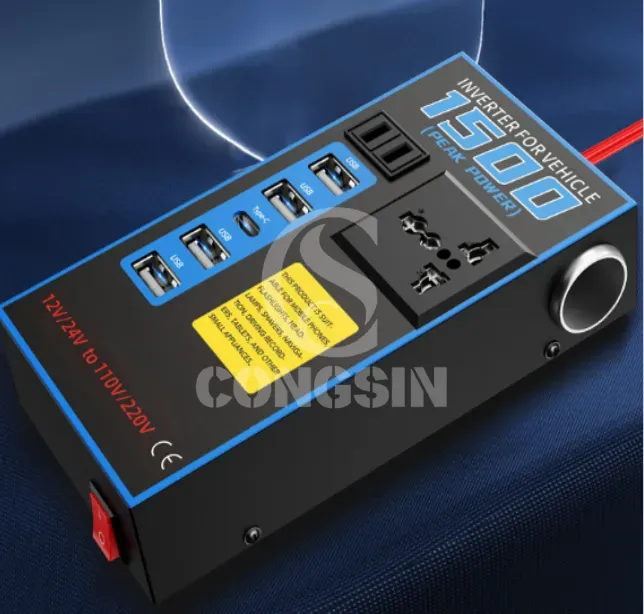
Congsin 1500W Inverter for Vehicle DC 12V/24V to AC 110V/220V with Universal socket Modified Sine Wave
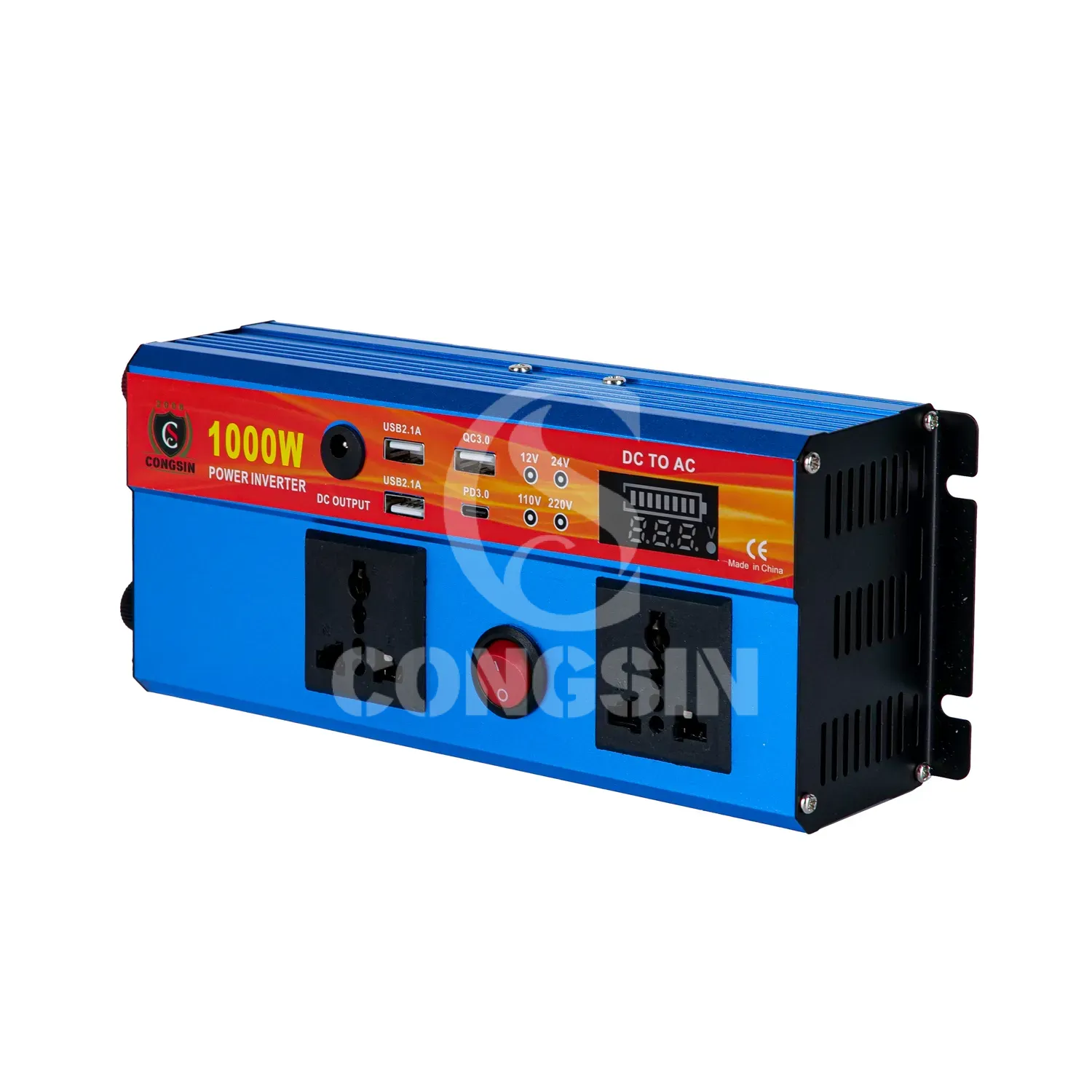
Congsin 1000W modified sine wave inverter with LED display and Type C port car RV power inverter
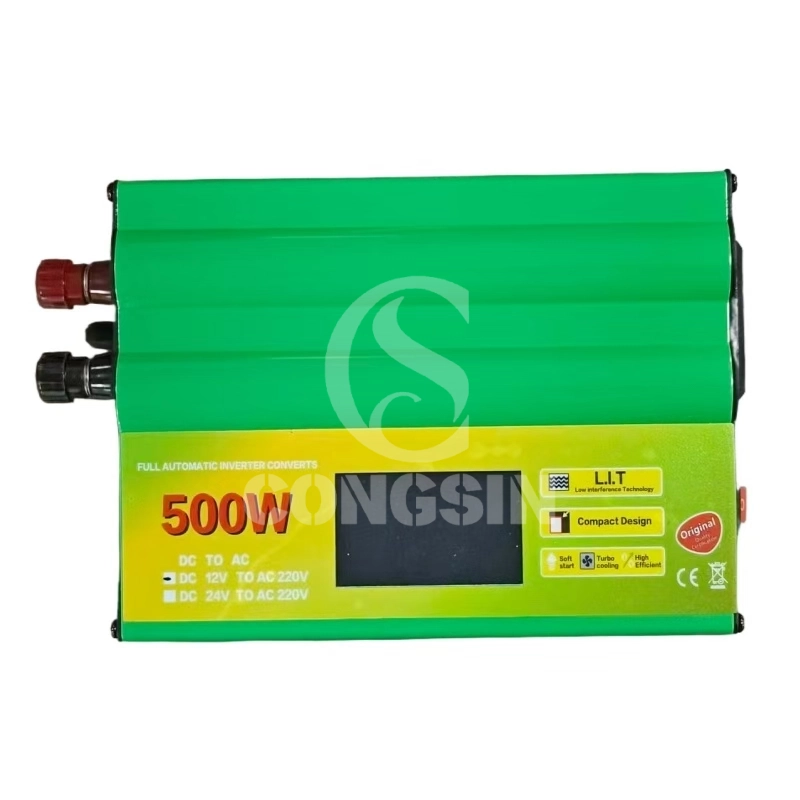
Congsin Modified Sine Wave Inverter 500W 1000W 1500W 12V LED Display Portable for RV Car Solar
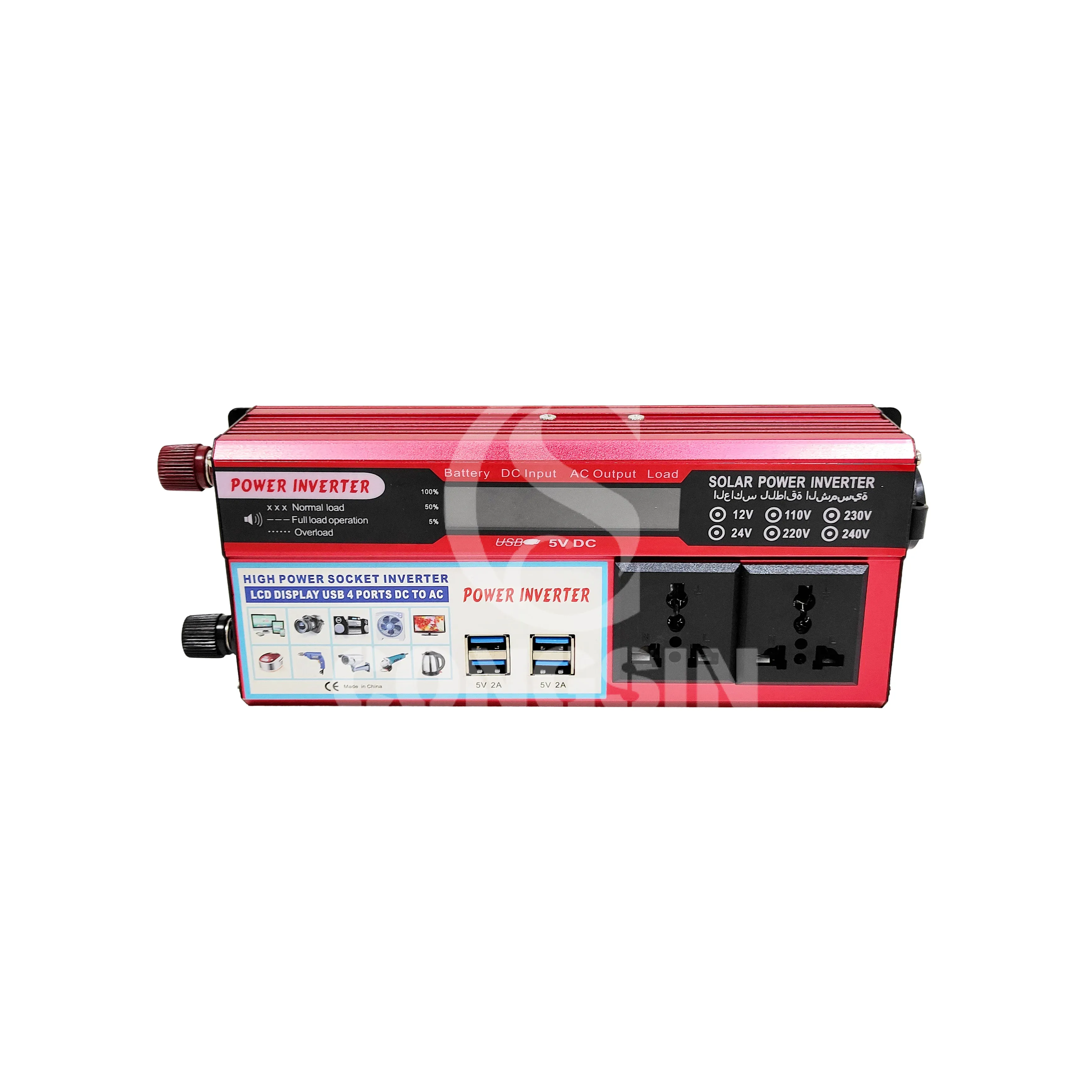
Congsin 1500W modified sine wave inverter with LCD display and USB ports for RV car boat home use

CONGSIN is a trusted OEM factory for power inverters, solar charge controllers, and DC converters. Reliable solutions for global B2B buyers.
 High Quality
 7/24 Service
 Guaranteed Warranty
© 2025 Congsin. All Rights Reserved.