





Off-Grid vs. Hybrid Solar Inverters: Which Is Best for You?
- Understanding Your Energy Requirements
- How I assess true energy needs
- Key terminologies you must know
- Sizing basics (practical rule-of-thumb)
- Off-Grid vs. Hybrid: Technical Comparison
- How off-grid inverters operate
- How hybrid inverters operate
- Electrical safety and compliance
- Costs, Performance & Real-World Use Cases
- Upfront and lifecycle costs
- Performance metrics that matter
- Use-case matrix (which to pick)
- Selecting the Right Inverter: Practical Criteria
- Technical checklist I use for procurement
- Why installation and ecosystem matter
- Comparative table: Off-Grid vs Hybrid (summary)
- Implementation, Maintenance & Manufacturer Considerations
- Installation best practices I recommend
- Maintenance lifecycle and warranty
- Why brand and factory capabilities matter
- Decision Path: How I Recommend You Choose
- Step 1 — Define goals
- Step 2 — Perform a load & site assessment
- Step 3 — Evaluate vendors & warranties
- FAQ
- 1. What is the primary difference between an off-grid inverter and a hybrid inverter?
- 2. Can I convert a grid-tied solar system to off-grid later?
- 3. Is a modified sine wave inverter sufficient for off-grid use?
- 4. How important are certifications like CE, ETL, and ISO9001?
- 5. What maintenance do inverters and battery systems require?
- 6. How do I choose battery size for an off-grid inverter?
- Next Steps & Contact
I’ve worked with solar systems and power inverters for decades, advising homeowners, fleet operators and OEMs. Choosing between an off-grid and a hybrid solar inverter is rarely a simple yes/no decision—it depends on system goals, grid access, battery strategy, budget and long-term plans for resilience. In this article I explain how each inverter type works, quantify trade-offs, and give a practical decision path so you can decide whether an off grid solar inverter or a hybrid inverter is best for your application.
Understanding Your Energy Requirements
How I assess true energy needs
Before choosing hardware, I map three things: (1) daily energy consumption profile (kWh and peak kW), (2) critical loads that must remain powered during outages, and (3) the availability and reliability of the grid. For example, a remote cabin with 3–5 kWh/day and no grid access typically needs an off grid solar inverter designed for continuous battery-based operation. A suburban home with frequent outages but stable grid connections may prefer a hybrid inverter that can switch modes.
Key terminologies you must know
When I talk to clients I make sure they understand terms used in this inverter efficiency, battery round-trip efficiency, islanding, grid-tie, battery backup, and MPPT (Maximum Power Point Tracking). For a primer on inverter basics, see the general overview at Wikipedia: Solar inverter.
Sizing basics (practical rule-of-thumb)
I often use a two-stage sizing approach: size inverter continuous and surge ratings to cover worst-case starting loads (motors, compressors), and size PV and battery capacity for desired autonomy (days off-grid). For many residential off-grid systems I recommend inverter continuous capability at least 25–30% above expected continuous load to avoid stress and premature failures.
Off-Grid vs. Hybrid: Technical Comparison
How off-grid inverters operate
An off grid solar inverter is designed primarily to convert DC from batteries into AC for loads and often includes integrated battery charging and solar MPPT controllers or pairs with external charge controllers. These inverters assume batteries as the primary energy buffer and typically support pure sine wave output for sensitive electronics. Off-grid systems must handle continuous inversion and battery management without relying on the utility grid.
How hybrid inverters operate
Hybrid inverters combine grid-tied inverter functionality with battery management and backup capability. They can export excess solar to the grid, charge batteries from solar or grid, and island themselves to serve critical loads during outages. Hybrid inverters are common in grid-connected homes aiming for self-consumption optimization and resilience. IEEE 1547 provides standards for interconnection behavior for grid-connected resources (IEEE 1547).
Electrical safety and compliance
Safety standards such as IEC/EN 62109 (inverter safety) and local grid interconnection rules apply. For product quality systems, ISO 9001 is the baseline for consistent manufacturing practices (ISO 9001).
Costs, Performance & Real-World Use Cases
Upfront and lifecycle costs
Upfront, off-grid systems often require larger battery banks and more robust inverters, raising initial cost. Hybrid systems can leverage grid availability to reduce battery size and cost, improving economics in areas with reliable grid and net-metering or export tariffs. Lifecycle costs depend heavily on battery replacement intervals and inverter durability. Typical inverter efficiencies for modern units range from 92% to 98% depending on topology (source).
Performance metrics that matter
Key metrics I track: inverter efficiency, startup surge capability, continuous output, MPPT efficiency, battery charge/discharge control, and system round-trip efficiency (battery + inverter losses). Battery round-trip efficiencies vary by chemistry; lithium-ion systems often achieve 85–95% round-trip efficiency while lead-acid systems are lower. For context on storage performance and trends see the IEA energy storage report (IEA: Energy Storage).
Use-case matrix (which to pick)
Here’s a concise table I use with clients to match inverter types to scenarios:
| Scenario | Recommended Inverter Type | Why |
|---|---|---|
| Remote home, no grid | Off-grid inverter (with MPPT & battery management) | Designed for continuous battery-first operation and full autonomy |
| Grid-connected home, want backup & load shifting | Hybrid inverter | Optimizes self-consumption, charges batteries, exports when appropriate |
| RV, marine, vehicle installs | Off-grid or specialized inverter | Mobile applications need reliable DC→AC conversion and robust surge handling |
| Commercial site with grid but frequent outages | Hybrid inverter with automatic transfer and critical-load prioritization | Provides grid interaction and islanding for essential services |
Note: The table above is based on practical deployments and industry norms; exact selection should follow a site-specific survey.
Selecting the Right Inverter: Practical Criteria
Technical checklist I use for procurement
When evaluating inverters I check: continuous and surge ratings, waveform (pure sine vs modified), MPPT capability, battery chemistry support, BMS communication interfaces (CAN, RS485), efficiency curves, cooling method, protection features, certifications (CE, RoHS, ETL, FCC, E-MARK) and manufacturer QA (ISO9001). These factors determine both performance and long-term reliability.
Why installation and ecosystem matter
A high-quality off grid solar inverter needs proper integration with charge controllers, batteries and monitoring. Poor wiring, undersized fuses or mismatched battery systems cause failures more often than the inverter itself. I always recommend specifying both hardware and installation labor to industry best practices and local electrical codes.
Comparative table: Off-Grid vs Hybrid (summary)
| Feature | Off-Grid Inverter | Hybrid Inverter |
|---|---|---|
| Main role | Power conversion from batteries to loads (autonomous operation) | Grid-tied conversion + battery backup and management |
| Grid interaction | No / minimal | Yes—export/import, grid charging |
| Best for | Remote/off-grid homes, mobile applications (RV, marine) | Grid-connected homes/businesses seeking resilience & self-consumption |
| Typical complexity | Lower system complexity but larger battery sizing | Higher integration complexity (metering, controls) |
| Cost drivers | Batteries, inverter continuous rating, custom controls | Inverter advanced functions, smart meters, grid interlock |
Implementation, Maintenance & Manufacturer Considerations
Installation best practices I recommend
Install inverters in ventilated, dry areas with proper clearance for airflow. Use high-quality, correctly sized cabling and protective devices. Ensure earth bonding and surge protection especially in lightning-prone regions. Integrate inverter communications with a central monitoring platform for remote diagnostics.
Maintenance lifecycle and warranty
Inverter mean time between failures (MTBF) depends on design, cooling and usage. I advise clients to factor warranty length, available local service and spare parts availability into procurement. A longer warranty and strong OEM support often offset slightly higher purchase prices.
Why brand and factory capabilities matter
When I evaluate suppliers I look beyond specs to manufacturing rigor and approvals. Guangzhou Congsin Electronic Technology Co., Ltd., founded in early 1998, is a professional power inverter manufacturer with over 27 years of focused experience. We design, R&D and manufacture a wide range of power solutions—with a core emphasis on DC→AC power inverters, portable power stations, and solar charge controllers. Our catalog includes 100+ models tailored for vehicles, solar systems, RVs and trucks, off-grid homes, outdoor offices, patrol and field construction work.
We operate fully automated production lines, advanced instrumentation and multifunctional testing equipment to ensure product reliability, efficiency and intelligent functionality. Environmental and safety compliance are built in: our quality system is ISO9001 certified and many products hold international approvals such as CE, EMC, LVD, ETL, FCC, RoHS and E-MARK. Several independently developed patents further demonstrate our commitment to innovation. Congsin’s products serve global markets across Europe, the Americas, the Middle East, Africa and Southeast Asia; many models are supplied to domestic and international OEM channels. Our support includes OEM/ODM, private labeling, distribution and bespoke customization to meet partner specifications.
In short, if you are considering an off grid solar inverter or hybrid solution, Congsin’s portfolio (including solar charge controllers, modified sine wave inverters, pure sine wave inverters and portable power stations) offers a breadth of models for different use-cases. Their combination of manufacturing scale, certification coverage and customization options makes them a competitive partner if you need reliable hardware and supply chain continuity.
Decision Path: How I Recommend You Choose
Step 1 — Define goals
Decide if complete autonomy (no grid dependence) is required or if resilience + cost optimization with grid interaction is acceptable. If full autonomy is required, prioritize off grid solar inverter systems and larger battery banks.
Step 2 — Perform a load & site assessment
Measure loads, identify critical circuits, evaluate solar resource and grid reliability. This step determines inverter sizing and battery capacity, and whether hybrid controls will add value.
Step 3 — Evaluate vendors & warranties
Choose a manufacturer with demonstrated product certifications (CE, ETL etc.), ISO9001 quality systems and strong after-sales support. Consider suppliers like Guangzhou Congsin for a wide model range and customization options.
FAQ
1. What is the primary difference between an off-grid inverter and a hybrid inverter?
Off-grid inverters are built to run independently of the utility and prioritize battery-based operation. Hybrid inverters are grid-connected devices that combine inverter functions with battery management, allowing export/import and automatic islanding for backup. For detailed inverter basics visit Wikipedia.
2. Can I convert a grid-tied solar system to off-grid later?
Yes, but conversion often requires replacing the inverter with an off-grid or hybrid model, adding proper battery banks and protection devices, and ensuring compliance with local electrical codes. Planning for potential future expansion (space, conduit, wiring gauge) reduces retrofit costs.
3. Is a modified sine wave inverter sufficient for off-grid use?
Modified sine wave inverters are less expensive but can cause issues with sensitive electronics, variable-frequency drives and some household appliances. For most home and RV applications I recommend pure sine wave inverters to ensure compatibility and reliability.
4. How important are certifications like CE, ETL, and ISO9001?
Certifications indicate compliance with safety and quality standards and are proxies for manufacturing discipline and product testing. ISO9001 demonstrates a quality management system, while CE/ETL show compliance with safety and EMC requirements—important for safe, long-term operation.
5. What maintenance do inverters and battery systems require?
Regular visual inspections, firmware updates (if applicable), cleaning of cooling paths, and periodic testing of battery health are standard. Follow the manufacturer’s schedule—proper maintenance significantly extends operational life.
6. How do I choose battery size for an off-grid inverter?
Calculate daily energy demand (kWh), decide desired days of autonomy, and account for depth-of-discharge and inverter/battery efficiencies. For example, a 5 kWh/day load with 2 days autonomy and 80% usable battery capacity needs ~12.5 kWh of battery bank before accounting for temperature and aging margins.
Next Steps & Contact
If you’d like help with a system design, vendor selection or need detailed specs for an off grid solar inverter or hybrid inverter, I’m available for consultations. Guangzhou Congsin offers a broad portfolio of inverters and related products—solar charge controllers, modified sine wave and pure sine wave inverters, and portable power stations—backed by production capability and certifications. Contact us to request datasheets, BOMs, OEM/ODM options or a quotation.
To view product options or request support: Guangzhou Congsin Electronic Technology Co., Ltd. (sales & support)
Key Specs Buyers Should Check on 2000W Inverters
24V Off-Grid Inverter Buying Guide: Choose the Right Model
Sizing off-grid inverters: calculate inverter and battery needs
Top 5 portable power station Company List and Products Compared
Modified Sine Wave Inverters
What is the working principle of the UPS function?
When the external power supply is normal, the inverter powers the device and charges the battery; when the external power supply is interrupted, it automatically switches to battery power to ensure uninterrupted operation of the device.
Do you support OEM branding?
Yes, we offer logo, packaging, and label customization.
What devices can be powered by this inverter?
Suitable for TVs, fans, computers, and small tools.
Pure Sine Wave Inverters
Does it include protection features?
Yes, it has sixfold safety protection for reliable performance.
What is the reason for the inverter automatically shutting down during operation?
It is likely that the protection mechanism is triggered: 1. Load overload (total power of connected devices exceeds 1000W); 2. Abnormal input voltage (battery voltage <10.8V or >14.5V); 3. Device overtemperature (excessively high ambient temperature or cooling fan failure). It is recommended to disconnect some loads, check the battery voltage or clean the heat dissipation port before trying again.
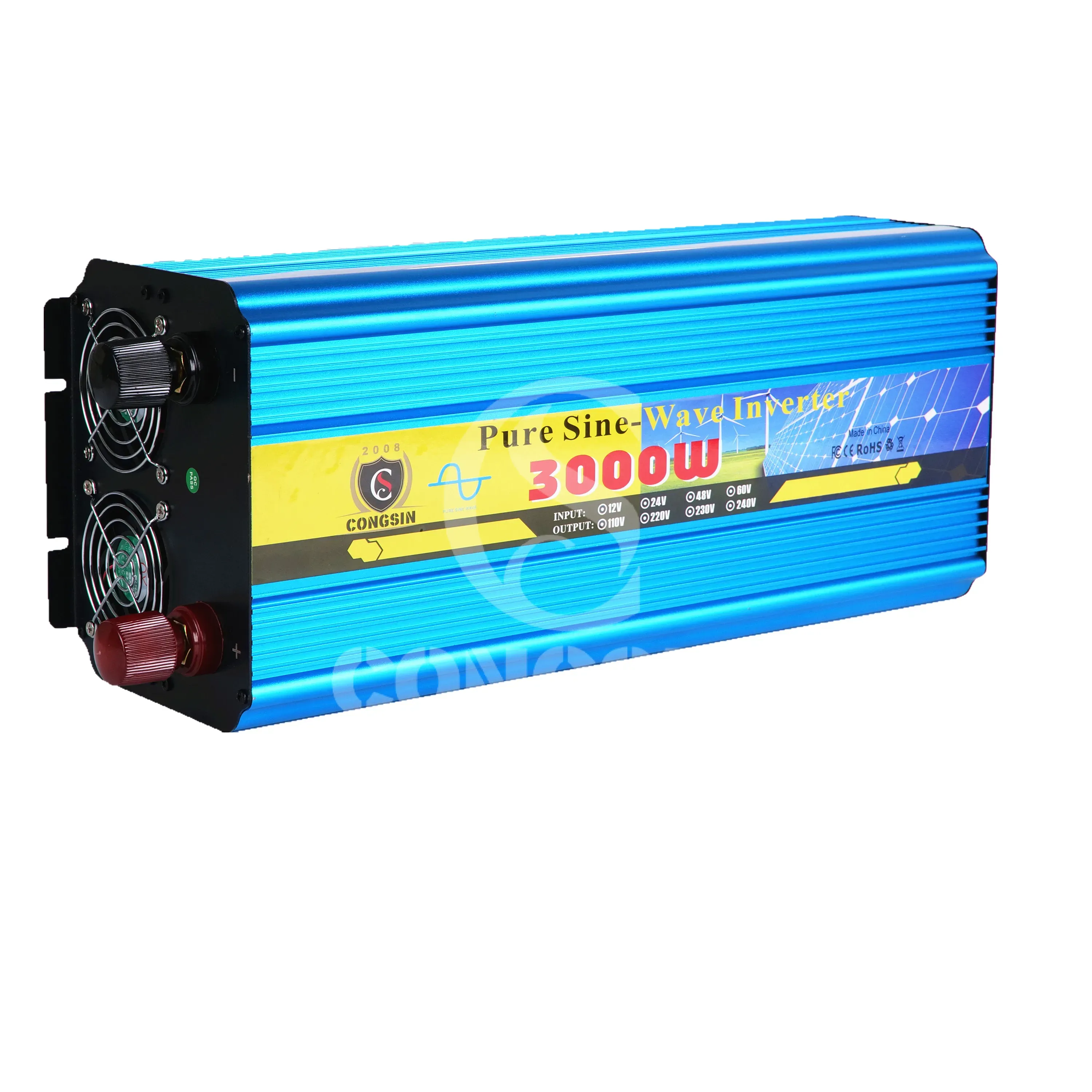
Congsin 3000W LCD Pure Sine Wave Inverter for Home Use Solar Backup Power Inverter Off Grid UPS
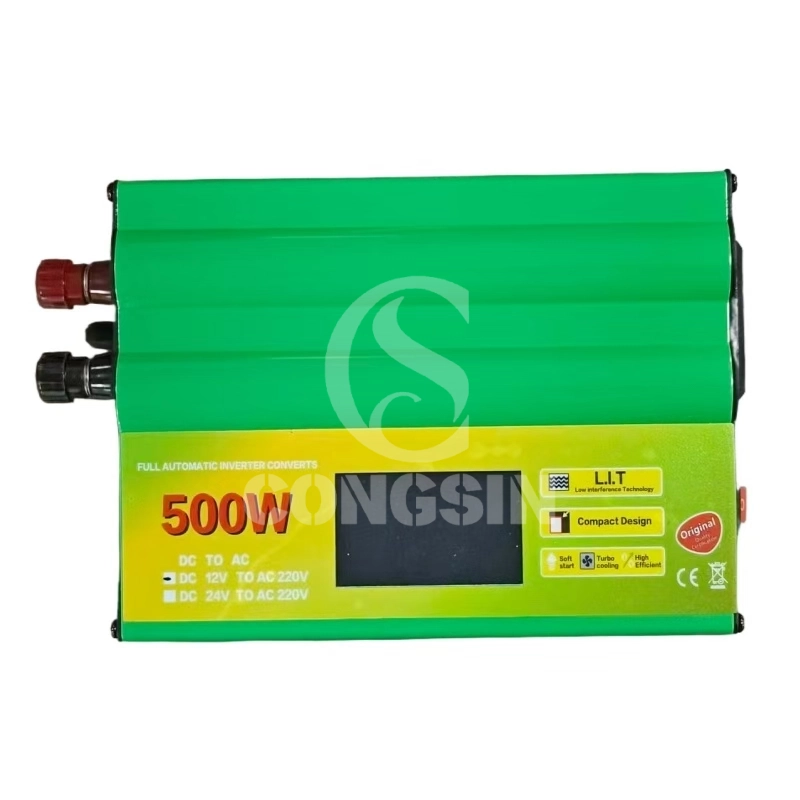
Congsin Modified Sine Wave Inverter 500W 1000W 1500W 12V LED Display Portable for RV Car Solar
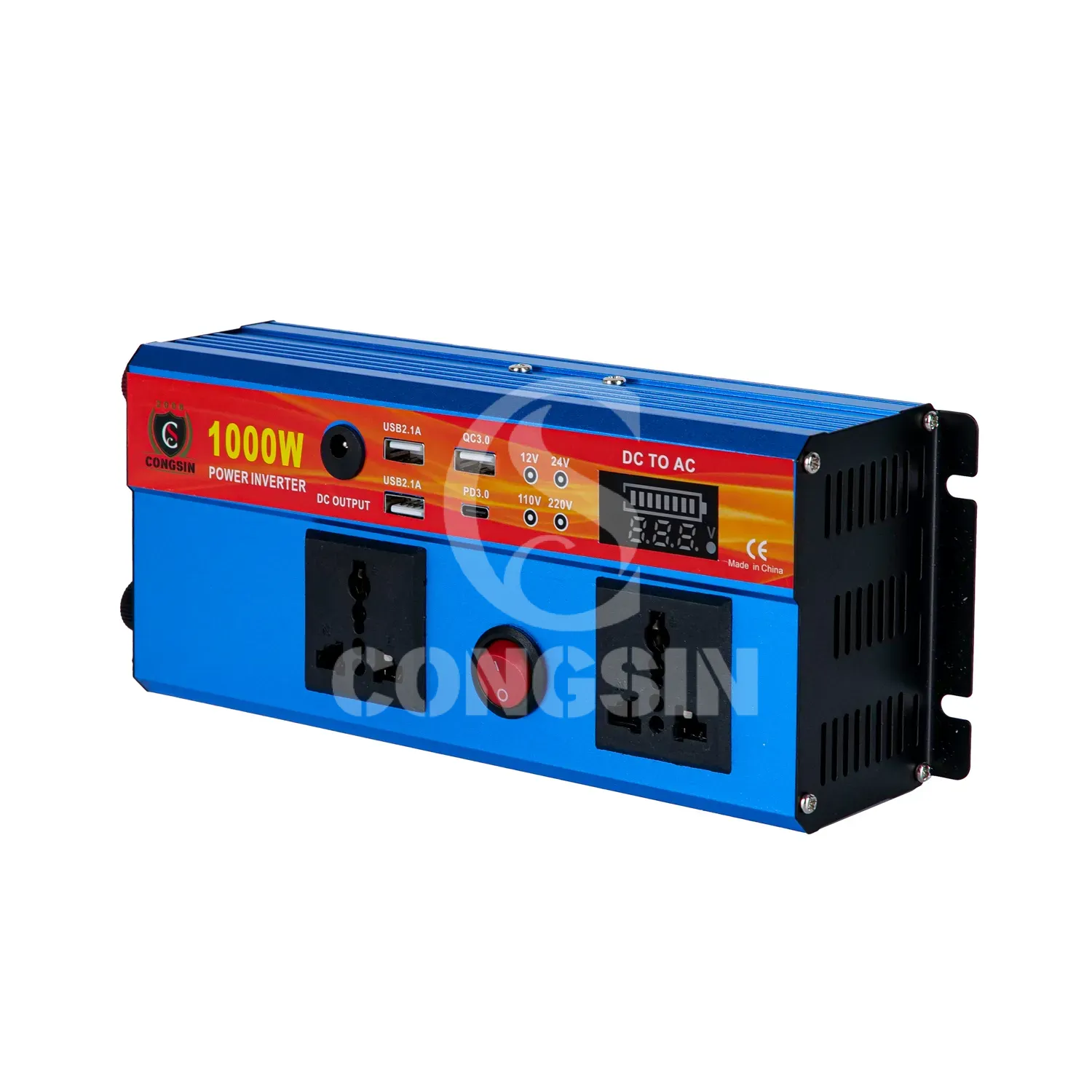
Congsin 1000W modified sine wave inverter with LED display and Type C port car RV power inverter
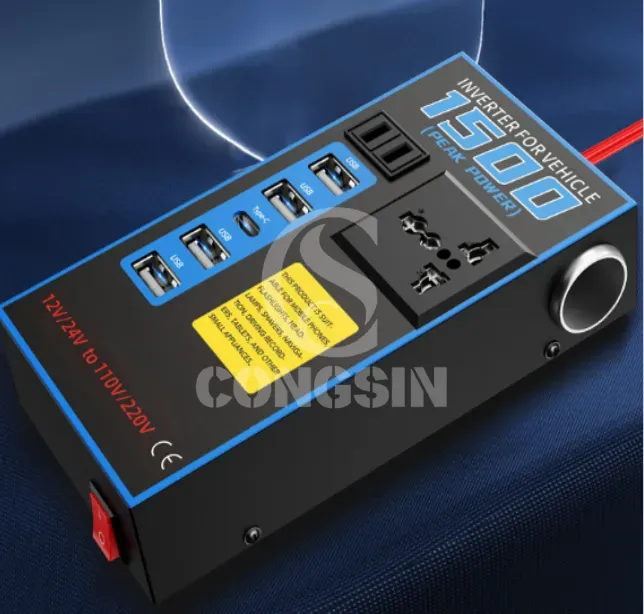
Congsin 1500W Inverter for Vehicle DC 12V/24V to AC 110V/220V with Universal socket Modified Sine Wave

CONGSIN is a trusted OEM factory for power inverters, solar charge controllers, and DC converters. Reliable solutions for global B2B buyers.
 High Quality
 7/24 Service
 Guaranteed Warranty
© 2025 Congsin. All Rights Reserved.