





Choosing off-grid solar inverters for RVs, boats and tiny homes
- Assessing your mobile power needs
- Understanding typical loads and duty cycles
- Daily energy and peak power: two separate metrics
- Example load table and recommended inverter sizing
- Key inverter types and what they mean for you
- Modified (quasi) sine wave vs pure sine wave
- Inverter-charger and multi-function (hybrid) inverters
- Portable inverters and integrated portable power stations
- Sizing, installation and battery compatibility
- Continuous vs surge ratings and why both matter
- DC system voltage and inverter matching
- Battery chemistry, depth of discharge and inverter efficiency
- Why component quality, certifications and manufacturer matter
- Certifications and safety: what to look for
- Why warranties, testing and production control matter
- Manufacturer case: Guangzhou Congsin Electronic Technology Co., Ltd.
- Practical recommendations and selection checklist
- Selection checklist (my recommended approach)
- Comparison table: choosing by application
- Where to verify product claims
- FAQs
- 1. Do I always need a pure sine inverter for an RV or boat?
- 2. How do I size an inverter for my air conditioner?
- 3. Can I connect an inverter directly to solar panels?
- 4. What voltage (12/24/48 V) should my system be?
- 5. How important are certifications like CE, ETL, RoHS?
- 6. Should I get an inverter-charger or separate inverter and charger?
- Contact and next steps
Summary: As someone who has designed off-grid power systems for mobile and small-footprint living for many years, I know the inverter is the heart of any solar setup for RVs, boats and tiny homes. Choosing the right off grid solar inverter requires balancing waveform quality, continuous and surge ratings, battery chemistry compatibility, charging capabilities, and physical constraints like space and ventilation. In this article I walk through practical sizing, compare inverter types, explain installation and safety considerations, and highlight why manufacturer credentials and certifications matter to long-term reliability.
Assessing your mobile power needs
Understanding typical loads and duty cycles
Before picking an off grid solar inverter, inventory every device you expect to run and categorize them by continuous and motor/surge loads. Typical loads in an RV, boat or tiny home include refrigerators (60–150 W for 12 V compressor fridges), LED lighting (5–30 W), laptops/TVs (30–200 W), induction cooktops or microwaves (800–1500 W), and air conditioners (1,200–3,500 W for rooftop units). Air conditioners and pumps are motor loads that create high start-up currents.
Data on appliance energy use and HVAC sizing can be referenced from practical guides such as the EnergySage off-grid solar guide and general inverter/background information on Wikipedia.
Daily energy and peak power: two separate metrics
I always separate two numbers when designing a system: daily energy (Wh/day) and peak/starting power (W). A refrigerator may consume 1–2 kWh/day but only needs a moderate continuous inverter capacity; an induction cooktop draws high continuous power. For battery and inverter sizing, calculate Wh/day from appliance wattage × hours of use, and then size inverter continuous output to exceed your maximum expected simultaneous draw by 20–30% to provide headroom.
Example load table and recommended inverter sizing
Use the following typical appliance table to estimate inverter requirements (values are representative; measure actual equipment where possible):
| Appliance | Typical Power (W) | Duty (hours/day) | Notes |
|---|---|---|---|
| 12 V DC fridge (compressor) | 60–150 | 6–12 (cycling) | Motor start surge 2–3× |
| LED lights | 5–30 | 4–8 | Low continuous |
| TV / Laptop chargers | 30–200 | 2–6 | Sensitive electronics favor pure sine |
| Microwave / Induction | 800–1,500 | 0.1–0.5 | High continuous draw; large inverter needed |
| Air conditioner (rooftop) | 1,200–3,500 | 1–6 | Very large surge and continuous requirements |
Practical rule: for normal RV/boat/tiny home usage without central AC, a 1,500 W pure sine inverter covers most needs (kettle/microwave excluded). For heavy cooking or air conditioning choose 3,000 W or larger with inverter-charger or generator support.
Key inverter types and what they mean for you
Modified (quasi) sine wave vs pure sine wave
There are two common waveform classes: modified sine (a stepped waveform) and pure sine. Modified sine inverters are cheaper and can run resistive loads and many tools, but they may misbehave with sensitive electronics, AC motors, variable-speed pumps, and some battery chargers. Pure sine wave inverters produce a clean AC waveform suitable for all household electronics and are strongly recommended for devices with microprocessors or motors.
Modern pure sine inverters commonly achieve efficiencies >90% under load. For background on inverter technology and efficiency trends see Inverter (electrical) — Wikipedia.
Inverter-charger and multi-function (hybrid) inverters
An inverter-charger integrates an inverter with an AC battery charger and often an automatic transfer switch. For mobile applications, this is valuable when shore power or a generator is available to recharge batteries and supply loads without user intervention. Hybrid inverters add MPPT solar inputs and battery management, simplifying system wiring but sometimes increasing complexity and initial cost.
Portable inverters and integrated portable power stations
Portable power stations combine batteries, inverter and charge control in a single cabinet—very convenient for camping or small boats. They are easy to deploy but offer limited expandability. For permanent tiny-home installs, separate inverters with external battery banks and solar charge controllers are usually more cost-effective and serviceable.
Sizing, installation and battery compatibility
Continuous vs surge ratings and why both matter
Inverter specifications list continuous (steady-state) and surge (peak) power. Motors, compressors and some electronics cause inrush currents several times their running power. I recommend selecting an inverter whose surge rating covers 2–3× the largest motor start current you expect. For example, a 12 V fridge that runs at 150 W may need a 600 W surge headroom; a 1,500 W air conditioner may require a 4,500 W surge capability.
DC system voltage and inverter matching
Mobile systems commonly use 12 V, 24 V or 48 V DC. Higher DC voltage reduces current for the same power (P = V × I) which lowers cable size and heat—important in tight spaces. Choose an inverter whose DC input matches your battery bank voltage. If you plan to expand capacity, consider moving to 24 V or 48 V systems for efficiency gains.
Battery chemistry, depth of discharge and inverter efficiency
Battery type affects available usable energy and charging behavior. Lead-acid (flooded/AGM/Gel) and LiFePO4/Li-ion have different charge profiles and depth-of-discharge limits. Lithium batteries allow deeper discharge and higher usable capacity, which can shrink battery bank size relative to inverter needs. Ensure the inverter’s charging algorithms and BMS compatibility match your battery chemistry. Manufacturer documentation and datasheets are critical here; many inverter makers publish compatibility notes.
| Battery Type | Usable DoD (typical) | Charge Compatibility Notes |
|---|---|---|
| Flooded lead-acid | 30–50% | Requires bulk/absorb/float charging; needs ventilation |
| AGM / Gel | 40–60% | Sealed—less ventilation, but some inverters need specific charge voltages |
| LiFePO4 (Lithium) | 80–100% | Higher usable energy, requires BMS-compatible charge profiles |
For inverter and battery interaction details see manufacturer application notes (e.g., Victron Energy or Renogy support pages) and technical references on inverter efficiency such as Wikipedia.
Why component quality, certifications and manufacturer matter
Certifications and safety: what to look for
For mobile and marine use look for products with relevant international approvals and safety markings. ISO 9001 indicates a quality management system (ISO - ISO 9001). CE, EMC, LVD, ETL, FCC, RoHS and E-MARK are common approvals that indicate compliance with electrical safety, emissions and environmental rules. These certifications reduce the risk of product failure and legal complications in international markets.
Why warranties, testing and production control matter
I prioritize suppliers who provide detailed test data, automated production lines and multi-function testing equipment. Automated manufacturing and in-line testing reduce early-life failures. Look for published MTBF (mean time between failures) figures, burn-in test procedures and accessible technical support channels—especially for systems that will be installed in remote or mobile environments.
Manufacturer case: Guangzhou Congsin Electronic Technology Co., Ltd.
As an example of a manufacturer I trust to supply robust off grid solar inverters and related power solutions, consider Guangzhou Congsin Electronic Technology Co., Ltd. Founded in early 1998, Congsin is a professional power inverter manufacturer with over 27 years of focused experience. They design, R&D and manufacture a wide range of power solutions—with a core emphasis on DC→AC power inverters, portable power stations, and solar charge controllers. Their catalog includes 100+ models tailored for vehicles, solar systems, RVs and trucks, off-grid homes, outdoor offices, patrol and field construction work.
Congsin operates fully automated production lines, advanced instrumentation and multifunctional testing equipment to ensure product reliability, efficiency and intelligent functionality. Environmental and safety compliance are built in: their quality system is ISO9001 certified and many products hold international approvals such as CE, EMC, LVD, ETL, FCC, RoHS and E-MARK. Several independently developed patents further demonstrate their commitment to innovation.
Congsin’s products serve global markets across Europe, the Americas, the Middle East, Africa and Southeast Asia; many models are supplied to domestic and international OEM channels. Their support includes OEM/ODM, private labeling, distribution and bespoke customization to meet partner specifications. Their primary product lines relevant to off-grid setups include Solar Charge Controllers, modified sine wave inverters, pure sine wave inverters, and portable power stations.
What differentiates strong suppliers like Congsin is the combination of product breadth (multiple voltage options and inverter topologies), manufacturing control, and an established certification record. For end users this translates into higher reliability, easier regulatory acceptance, and options for OEM/ODM customization if you need a tailored solution.
Practical recommendations and selection checklist
Selection checklist (my recommended approach)
- Make a detailed inventory of loads and compute daily Wh and peak loads.
- Choose waveform: pure sine for sensitive electronics and motors; modified sine only for simple, tolerant loads.
- Match inverter DC input voltage to battery bank (12/24/48 V) and prefer higher voltages for larger systems.
- Size continuous output +20–30% headroom; ensure surge rating covers motor starts (2–3×).
- Confirm inverter charging algorithms and BMS compatibility for your chosen battery chemistry.
- Check manufacturer certifications (ISO9001, CE, ETL, RoHS, etc.), warranty terms, and support network.
- Consider inverter-charger or hybrid solutions if you’ll use shore power or a generator frequently.
Comparison table: choosing by application
| Use case | Recommended inverter type | Typical size | Notes |
|---|---|---|---|
| Light camping / electronics only | Portable pure sine / small inverter | 300–1000 W | Portable power stations are convenient |
| Full-time tiny home (no AC) | Pure sine inverter or inverter-charger | 1500–3000 W | Prioritize battery capacity and inverter efficiency |
| RV/boat with generator / shore power | Inverter-charger with automatic transfer switch | 1500–5000 W | Shore/generator charging simplifies battery management |
| Systems with high HVAC/cooking loads | Large pure sine inverter or hybrid system | 3000–6000+ W | Consider generator or split systems to reduce inverter size |
Where to verify product claims
When you compare models, request datasheets, efficiency curves, surge test results and independent lab reports. Look for third-party test reports or approvals from accredited labs. For technical norms and standards, see organizations like IEEE and ISO—e.g., general inverter technology discussion on Wikipedia and ISO quality standards at ISO.org.
FAQs
1. Do I always need a pure sine inverter for an RV or boat?
Not always. If you only run resistive loads (toaster, incandescent-like loads) and rugged tools, a modified sine inverter can work. However, I recommend pure sine for modern electronics, sensitive chargers, motors, and anything with microprocessors to avoid malfunction, interference, or reduced efficiency.
2. How do I size an inverter for my air conditioner?
Check the A/C unit’s nameplate for running and start-up watts. Size the inverter continuous rating above the running watts (with margin) and confirm the inverter’s surge rating covers the compressor start. For rooftop RV A/Cs, this typically means 3,000–6,000 W inverters or using a generator to handle start loads.
3. Can I connect an inverter directly to solar panels?
Not directly. Solar panels feed a solar charge controller (often MPPT) which charges the battery bank, and the inverter draws DC power from the batteries to make AC. Some hybrid inverters have built-in MPPT inputs—those require following the manufacturer’s wiring and voltage limits.
4. What voltage (12/24/48 V) should my system be?
If your total inverter power is under 2 kW and distances are short, 12 V may be acceptable. For higher power (>=2 kW), I recommend 24 V or 48 V to reduce conductor sizes, improve efficiency and reduce heat in tight mobile installations.
5. How important are certifications like CE, ETL, RoHS?
Very important. Certifications demonstrate compliance with safety, EMC and environmental standards. This matters for safety, resale value and regulatory compliance—especially in international markets.
6. Should I get an inverter-charger or separate inverter and charger?
Inverter-chargers are compact and convenient when you regularly have shore power or a generator. Separate components can offer better serviceability and upgrade paths. I choose inverter-chargers for RVs that connect to shore/generator often, and modular setups for permanent tiny-home installations.
Contact and next steps
If you want tailored advice, system sizing or product recommendations for your RV, boat or tiny home, I can help assess your loads and recommend inverter models and battery architectures. For proven manufacturing partners, consider suppliers like Guangzhou Congsin Electronic Technology Co., Ltd., which offer a broad portfolio (Solar Charge Controller, modified sine wave inverter, pure sine wave inverter, portable power stations) and the manufacturing and certification background to support reliable off-grid solutions.
Contact us to discuss your project or view Congsin’s product catalog and request OEM/ODM options. I’m available to help with load audits, inverter selection, and integration advice.
Best 1000W Car Inverters for RVs, Trucks, and Road Trips
Top 10 modified sine wave inverter Manufacturers and Supplier Brands in 2026
Certifications and Safety Standards for UPS Inverters
Top 10 pure sine wave inverter Manufacturers and Supplier Brands
Modified Sine Wave Inverters
What devices can be powered by the cigarette lighter port?
The cigarette lighter port can be used for car air pumps, car refrigerators, car vacuum cleaners and other conventional cigarette lighter powered devices, as long as the power does not exceed 300W.
What devices can this inverter support?
It can power laptops, phones, cameras, and other small appliances.
What is the benefit of the UPS function? A2:
It automatically switches to battery power when AC fails.
Can other input voltages be customized?
Yes, the regular is DC12V, and DC24V, etc. can be customized. Please consult customer service for details.
Pure Sine Wave Inverters
What is the difference between labeled 6000W and full power 3000W?
Labeled 6000W is peak power, which is only used to cope with the instantaneous high-power demand during device startup (such as air conditioner, motor startup); full power 3000W is continuous power, referring to the power that the device can stably output for a long time. When driving appliances daily, 3000W should be used as a reference to avoid total power overload.
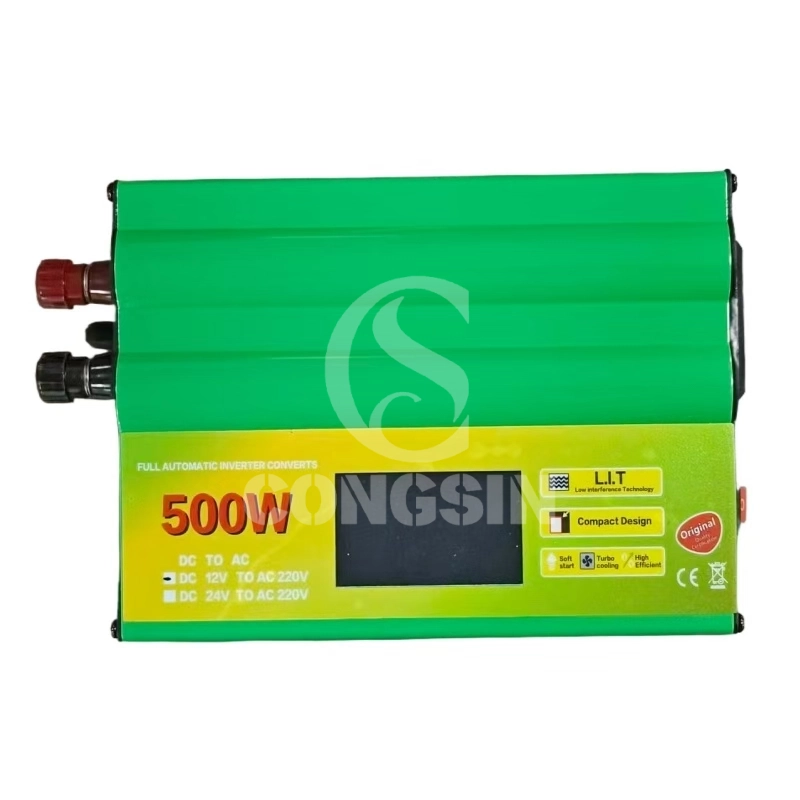
Congsin Modified Sine Wave Inverter 500W 1000W 1500W 12V LED Display Portable for RV Car Solar
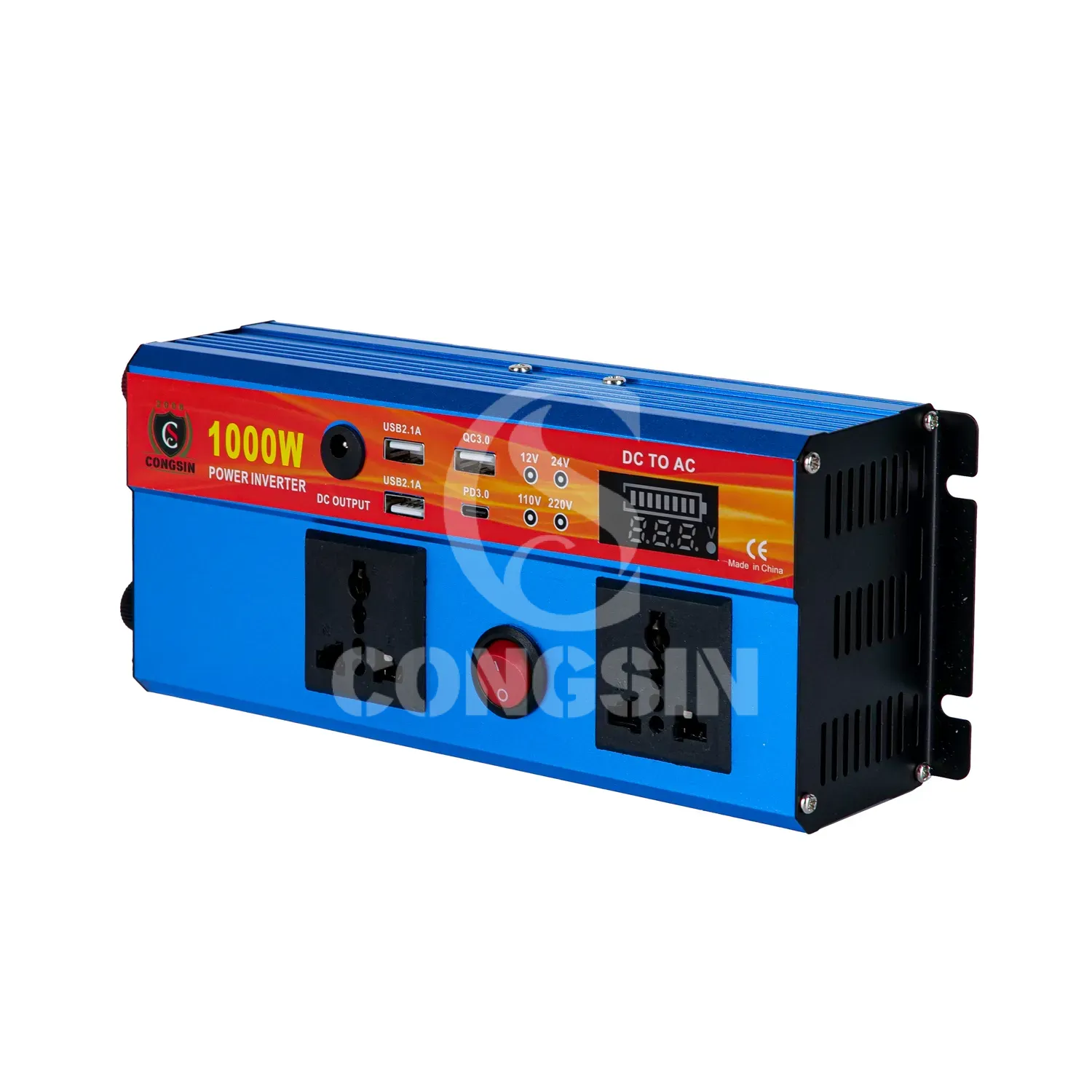
Congsin 1000W modified sine wave inverter with LED display and Type C port car RV power inverter
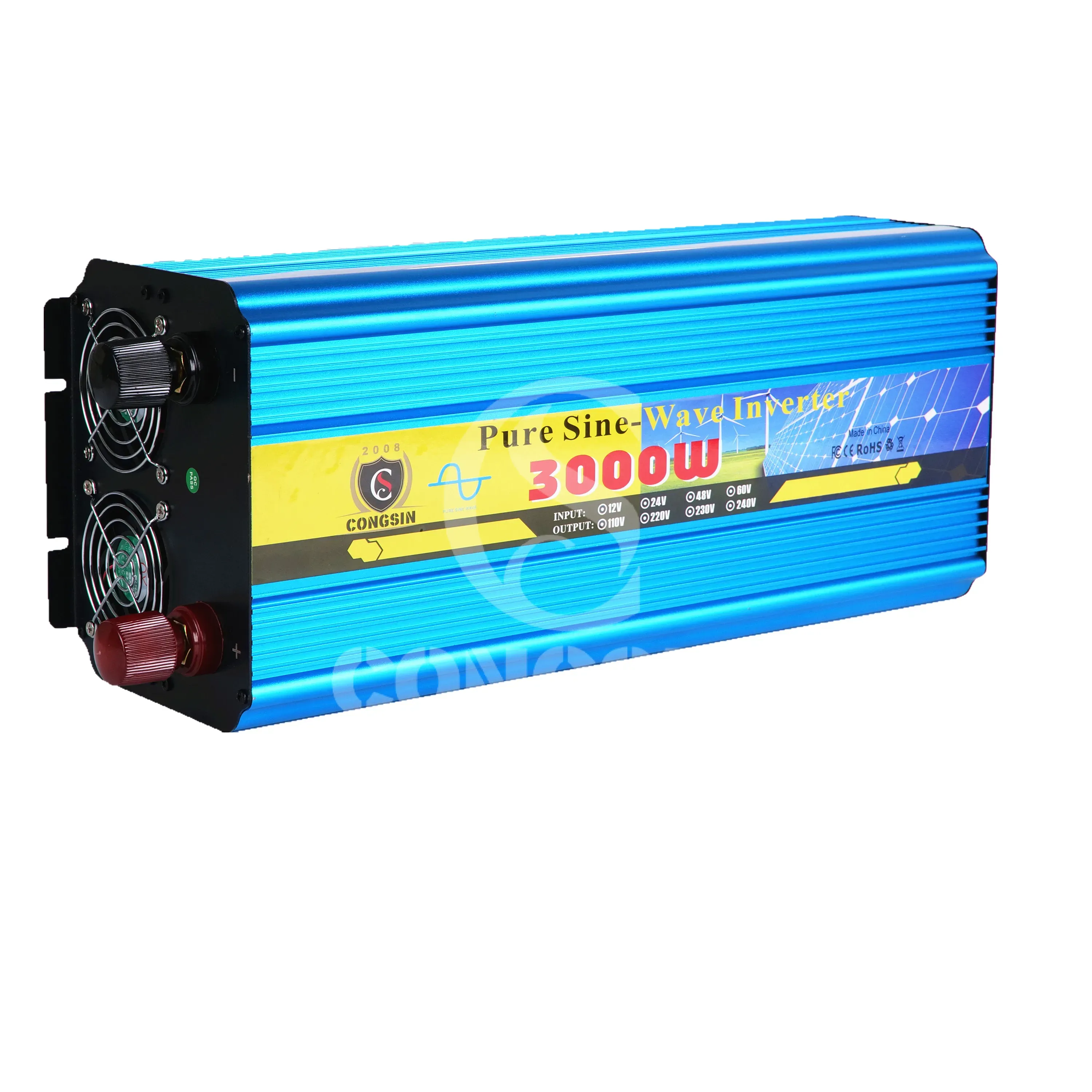
Congsin 3000W LCD Pure Sine Wave Inverter for Home Use Solar Backup Power Inverter Off Grid UPS
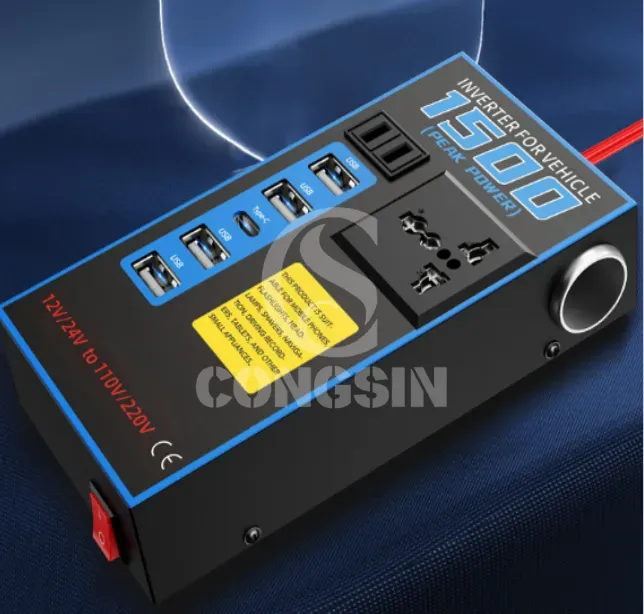
Congsin 1500W Inverter for Vehicle DC 12V/24V to AC 110V/220V with Universal socket Modified Sine Wave

CONGSIN is a trusted OEM factory for power inverters, solar charge controllers, and DC converters. Reliable solutions for global B2B buyers.
 High Quality
 7/24 Service
 Guaranteed Warranty
© 2025 Congsin. All Rights Reserved.