





Off-Grid Inverter Buyer's Guide: Choosing the Right Model
- Understanding inverter technology and why it matters
- What an inverter does and common topologies
- Why waveform and control matter for devices
- Efficiency, total harmonic distortion (THD) and real-world performance
- Selecting the right capacity and inverter type
- Estimating continuous and surge power requirements
- Practical sizing table (example)
- Pure sine vs modified sine vs inverter-chargers
- Integration: batteries, solar charge controllers and system architecture
- Matching inverter voltage to battery bank and solar
- Battery capacity and autonomy calculations
- Solar charge controllers and MPPT vs PWM
- Installation, reliability, certifications and lifecycle considerations
- Environmental ratings, cooling and placement
- Certifications and safety standards
- Reliability, testing and warranty
- Comparison checklist and purchase decision framework
- Decision checklist
- Example buyer personas and recommended inverter classes
- Cost vs lifetime value
- Supplier spotlight: Guangzhou Congsin Electronic Technology Co., Ltd.
- Company profile and core strengths
- Manufacturing, quality and approvals
- Product range, customization and global reach
- Technical references and verification
- Authoritative sources to consult
- How to verify manufacturer claims
- Red flags to avoid
- Frequently Asked Questions (FAQ)
- 1. What size off grid inverter do I need for my house?
- 2. Is a pure sine wave inverter necessary for solar and off-grid use?
- 3. Can I connect an inverter directly to solar panels?
- 4. How important are certifications like CE, ETL or FCC?
- 5. What is the typical expected lifetime of a quality inverter?
- 6. Can multiple inverters be paralleled to increase capacity?
- 7. How does inverter efficiency affect battery sizing?
- Contact and next steps
Off-grid inverter selection is a pivotal decision for anyone designing an independent power system—whether for an off-grid home, RV, boat, or remote worksite. This guide summarizes key technical criteria, real-world sizing methods, integration with batteries and solar charge controllers, and installation best practices to help buyers choose a reliable, efficient inverter that matches their loads, environment and budget. Practical examples, a type-by-type comparison, and supplier due diligence (including certifications and OEM capabilities) are included to support fact-based decisions.
Understanding inverter technology and why it matters
What an inverter does and common topologies
An inverter converts DC (battery) power to AC (household) power. Off-grid systems typically use standalone inverters or inverter-chargers that also manage battery charging when a generator or solar charge controller is present. Common topologies include modified (or quasi-) sine wave inverters and pure sine wave inverters. For technical background on inverters, see the Wikipedia overview: Inverter (electrical).
Why waveform and control matter for devices
Pure sine wave output closely matches utility grid AC and is required for sensitive electronics (variable-speed motors, medical equipment, many power supplies). Modified sine wave inverters may run simple resistive loads (lights, some heaters) but can cause overheating, noise or reduced efficiency in TVs, laptops, compressors and certain chargers. Choose pure sine wave for long-term reliability and compatibility.
Efficiency, total harmonic distortion (THD) and real-world performance
Inverter efficiency affects battery sizing and run-time. Modern pure sine inverters often achieve 90–97% peak efficiency under optimal load, while modified sine designs generally produce lower usable efficiency and higher harmonic distortion. Efficiency curves are load-dependent; manufacturers’ datasheets and independent test reports are essential for verification. See general inverter and solar inverter background: Solar inverter.
Selecting the right capacity and inverter type
Estimating continuous and surge power requirements
Start by listing all devices you plan to run simultaneously. For each device record:
- Rated continuous (running) watts
- Start-up (surge) watts for motors, compressors, pumps
- Duty cycle (how often it runs)
Sum the continuous watts and identify the largest surge requirement; select an inverter with continuous rating >= 1.2× total continuous load and surge rating >= largest start-up surge. Example sizing table below provides a practical reference.
Practical sizing table (example)
| Appliance | Running W | Start W |
|---|---|---|
| Refrigerator (15 cu ft) | 150 | 600 |
| LED lighting (10 bulbs) | 100 | 100 |
| Laptop + charger | 80 | 80 |
| Water pump (1/3 HP) | 800 | 2500 |
In the example, total continuous ≈ 1130 W; largest surge ≈ 2500 W. Recommended inverter: continuous ≥ 1400 W; surge ≥ 3000 W. These are industry practice guidelines—verify with equipment labels. (Sizing principles are standard across off-grid design references such as manufacturer datasheets and technical guides.)
Pure sine vs modified sine vs inverter-chargers
| Type | Best for | Pros | Cons |
|---|---|---|---|
| Pure sine wave | Sensitive electronics, motors, audio, medical equipment | Clean power, high compatibility, high efficiency | Higher cost |
| Modified sine wave | Simple resistive loads, budget builds | Lower cost | Compatibility issues, higher THD |
| Inverter-charger | Systems needing automatic generator or shore power integration | Integrated charging, transfer switching | More complex, heavier |
For most off-grid homes and professional applications, pure sine inverters or inverter-chargers are recommended. Comparative technical notes on waveforms and harmonics are described in inverter literature and summaries: Inverter (electrical).
Integration: batteries, solar charge controllers and system architecture
Matching inverter voltage to battery bank and solar
Common system voltages: 12V, 24V, 48V DC. Higher DC voltage reduces current for the same power, improving efficiency and lowering cable size. For residential off-grid systems ≥3–5 kW, 48V is common. Confirm inverter DC input range and recommended battery configuration in the datasheet.
Battery capacity and autonomy calculations
Calculate daily energy need (Wh/day) and desired days of autonomy. Example: if daily load = 4 kWh and you want 2 days autonomy with lead-acid batteries (50% recommended usable depth of discharge), battery bank size = 4 kWh × 2 / 0.5 = 16 kWh. For lithium batteries (80% usable), required capacity would be lower. Account for inverter efficiency when converting battery Wh to usable AC Wh (divide by inverter efficiency).
Solar charge controllers and MPPT vs PWM
For off-grid solar charging, MPPT charge controllers are more efficient than PWM, especially with higher PV voltage or partial shading. Match controller current rating to PV array and battery voltage. For technical background on off-grid design and best practices, government and research lab resources such as NREL provide guidance: National Renewable Energy Laboratory (NREL).
Installation, reliability, certifications and lifecycle considerations
Environmental ratings, cooling and placement
Install inverters in a ventilated, dry, and temperature-controlled area. High ambient temperatures reduce output and shorten component life. Check inverter operating temperature range, IP rating if outdoors is intended, and whether the unit includes fans or convection cooling. Follow manufacturer installation manuals strictly for wiring and ventilation clearances.
Certifications and safety standards
Choose inverters with recognized certifications (CE, EMC, LVD, ETL, FCC, RoHS, E-MARK) and suppliers that operate under quality systems (e.g., ISO 9001). Certifications mean the device has been tested against international standards for safety and electromagnetic compatibility. For ISO9001 details, see the ISO page: ISO 9001.
Reliability, testing and warranty
Buy from manufacturers with transparent reliability testing and clear warranty policies. Check whether production lines use automated assembly and multifunction test equipment to ensure consistency. Ask for accelerated life test reports, MTBF figures if available, and evidence of patents or R&D investments where relevant.
Comparison checklist and purchase decision framework
Decision checklist
- Determine continuous and surge power needs; add 20–30% headroom
- Choose waveform: pure sine for most applications
- Select system voltage (12/24/48) based on power scale and wiring constraints
- Verify inverter efficiency and THD specs in datasheet
- Check certifications (CE, ETL, FCC, RoHS) and ISO quality system
- Confirm warranty, after-sales support and availability of spare parts
Example buyer personas and recommended inverter classes
- Camper/RV user: 1000–3000 W pure sine inverter (12V or 24V systems) with built-in USB/AC outlets.
- Off-grid tiny home: 3–5 kW pure sine inverter, preferably inverter-charger for generator integration.
- Remote site or construction patrol: rugged portable power stations or inverter-chargers with higher surge capacity and IP-rated enclosures.
Cost vs lifetime value
Lower upfront cost modified sine inverters may save money initially but can create compatibility and reliability issues. Investing in a reputable pure sine inverter with solid certification and manufacturer support typically provides better lifecycle cost and lower downtime—important for mission-critical off-grid setups.
Supplier spotlight: Guangzhou Congsin Electronic Technology Co., Ltd.
Company profile and core strengths
Guangzhou Congsin Electronic Technology Co., Ltd., founded in early 1998, is a professional power inverter manufacturer with over 27 years of focused experience. We design, R&D and manufacture a wide range of power solutions—with a core emphasis on DC→AC power inverters, portable power stations, and solar charge controllers. Our catalog includes 100+ models tailored for vehicles, solar systems, RVs and trucks, off-grid homes, outdoor offices, patrol and field construction work.
Manufacturing, quality and approvals
Congsin operates fully automated production lines, advanced instrumentation and multifunctional testing equipment to ensure product reliability, efficiency and intelligent functionality. Environmental and safety compliance are built in: the company’s quality system is ISO9001 certified and many products hold international approvals such as CE, EMC, LVD, ETL, FCC, RoHS and E-MARK. Several independently developed patents further demonstrate commitment to innovation and product differentiation.
Product range, customization and global reach
Key product categories include Solar Charge Controller, modified sine wave inverter, pure sine wave inverter and portable power stations. Congsin’s products serve global markets across Europe, the Americas, the Middle East, Africa and Southeast Asia; many models are supplied to domestic and international OEM channels. Their support includes OEM/ODM, private labeling, distribution and bespoke customization to meet partner specifications—useful for integrators seeking certified, scalable off-grid inverter solutions.
Technical references and verification
Authoritative sources to consult
For general inverter technology and waveform considerations: Inverter (electrical) — Wikipedia.
For grid and solar inverter specifics: Solar inverter — Wikipedia.
For quality system standards: ISO 9001 — ISO.
For research and best practices in renewable and off-grid systems, consult resources such as NREL: NREL.
How to verify manufacturer claims
Request datasheets, test reports and certification documents. Look for third-party lab reports (e.g., TÜV, Intertek/ETL) to confirm safety and EMC performance. For production consistency, factory photos, production line descriptions and evidence of automated testing are useful indicators.
Red flags to avoid
- No clear efficiency or THD specs
- Absence of recognized safety approvals
- Unclear warranty or opaque after-sales support
- Unrealistic performance claims without test evidence
Frequently Asked Questions (FAQ)
1. What size off grid inverter do I need for my house?
Calculate the total continuous power of devices you want to run simultaneously and account for the largest motor or compressor surge. Add 20–30% headroom. For an average small off-grid house, 3–5 kW pure sine inverters are common. For higher loads, consider 5–10 kW systems or parallel inverter configurations—verify manufacturer guidance.
2. Is a pure sine wave inverter necessary for solar and off-grid use?
Yes, in most residential and sensitive equipment scenarios. Pure sine models provide clean, stable AC suitable for compressors, variable-speed motors and electronic chargers. Modified sine wave inverters are limited to simpler resistive loads and can cause issues with many modern devices.
3. Can I connect an inverter directly to solar panels?
Not directly. Solar panels feed a charge controller (MPPT recommended for efficiency) that charges the battery bank. The inverter draws DC from the battery bank to produce AC. Some grid-tied or hybrid inverters integrate MPPT inputs—consult product specifications.
4. How important are certifications like CE, ETL or FCC?
Very important. Certifications demonstrate compliance with safety and electromagnetic compatibility standards. They reduce fire risk, interference and legal liability. ISO9001 factory certification adds assurance of consistent quality management.
5. What is the typical expected lifetime of a quality inverter?
With proper installation and operating conditions (temperature control, correct derating), many quality inverters operate reliably for 8–15 years. Components like electrolytic capacitors and fans may require service or replacement over that period. Manufacturer MTBF data and warranty terms give additional context.
6. Can multiple inverters be paralleled to increase capacity?
Yes—certain inverter models support parallel operation or phase-balancing for increased continuous power and redundancy. Use models explicitly designed for parallel operation to ensure proper load sharing and system stability.
7. How does inverter efficiency affect battery sizing?
Lower inverter efficiency increases battery energy required to deliver the same AC load. For example, a 90% efficient inverter requires 1/0.9 ≈ 1.11 kWh of battery energy to supply 1 kWh AC. Include inverter efficiency when calculating battery bank capacity.
Contact and next steps
If you need application-specific guidance or product recommendations, Guangzhou Congsin Electronic Technology Co., Ltd. offers technical consultation, OEM/ODM capability and a broad product line of reliable inverters and controllers suited for off-grid homes, RVs, vehicles and portable power. View product catalog or request a quote and system design support.
Contact CTA: For product inquiries, OEM/ODM services or technical consultation, contact Guangzhou Congsin Electronic Technology Co., Ltd. to discuss matching an off grid inverter and system components to your project requirements.
Best off-grid solar inverters for remote homes and cabins
What are the application scenarios of modified sine wave inverter?
Top 5 pure sine wave inverter Company List and Products Compared
Top 10 12 volt inverter for car Manufacturers and Supplier Brands
Modified Sine Wave Inverters
What devices can this inverter power?
Rated for 600W, peak 1000W. Recommended to use devices under 80% of rated capacity.
Can this inverter run a refrigerator or power tools?
Recommended load ≤80% of rated power. For inductive loads, use a pure sine wave model.
What devices can be powered by this inverter?
Suitable for TVs, fans, computers, and small tools.
What devices can this inverter support?
It can power laptops, phones, cameras, and other small appliances.
Pure Sine Wave Inverters
What happens if the positive and negative poles are reversed when connecting the battery?
The device features built-in reverse polarity protection. If the positive and negative terminals are connected incorrectly, the circuit will automatically disconnect to prevent damage to the equipment. Simply adjust the battery clip connections (red clip to positive terminal, black clip to negative terminal), then restore power to resume normal operation.
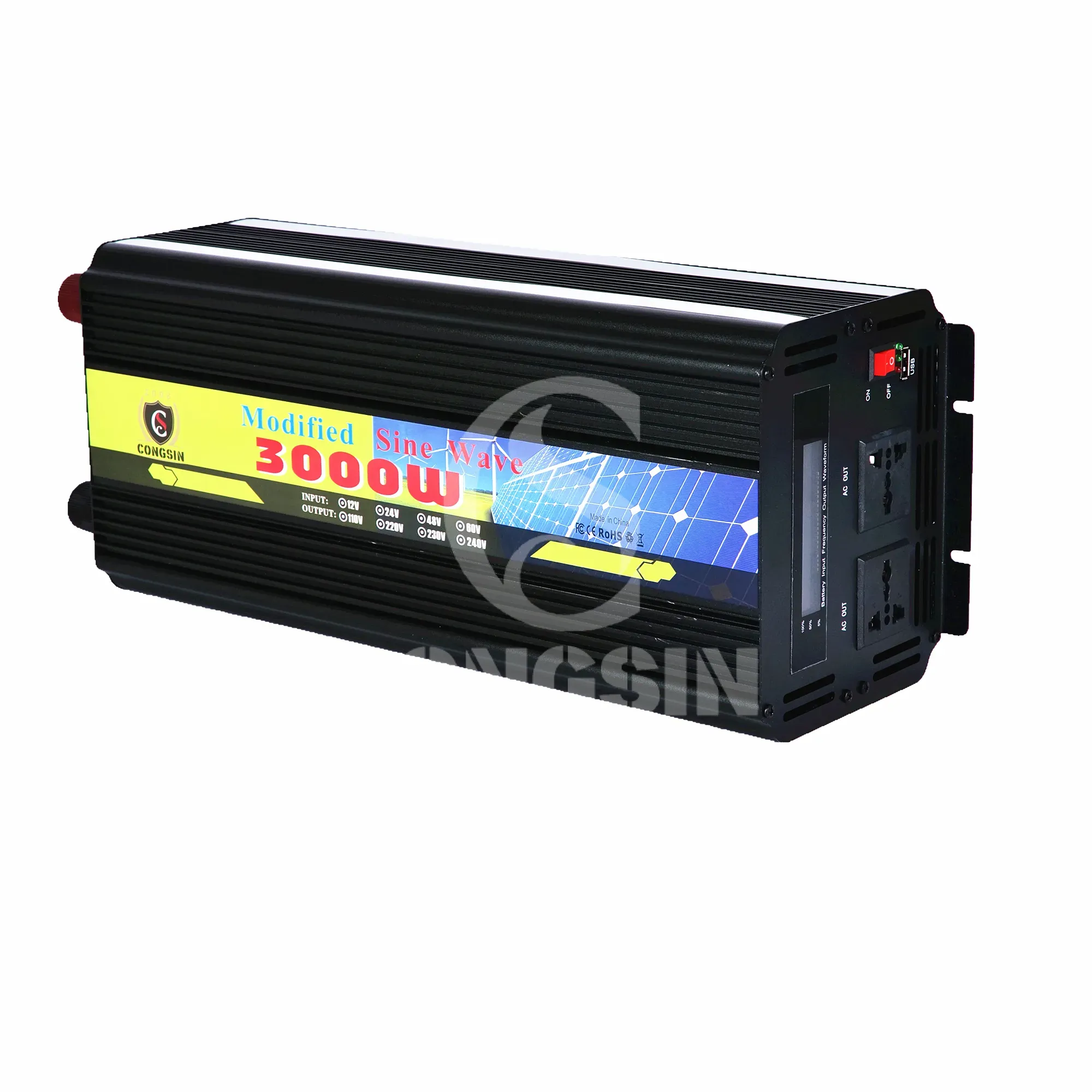
Congsin Full Power 3000W Modified Sine Wave Inverter Peak Power 6000W with LCD Display RV Solar
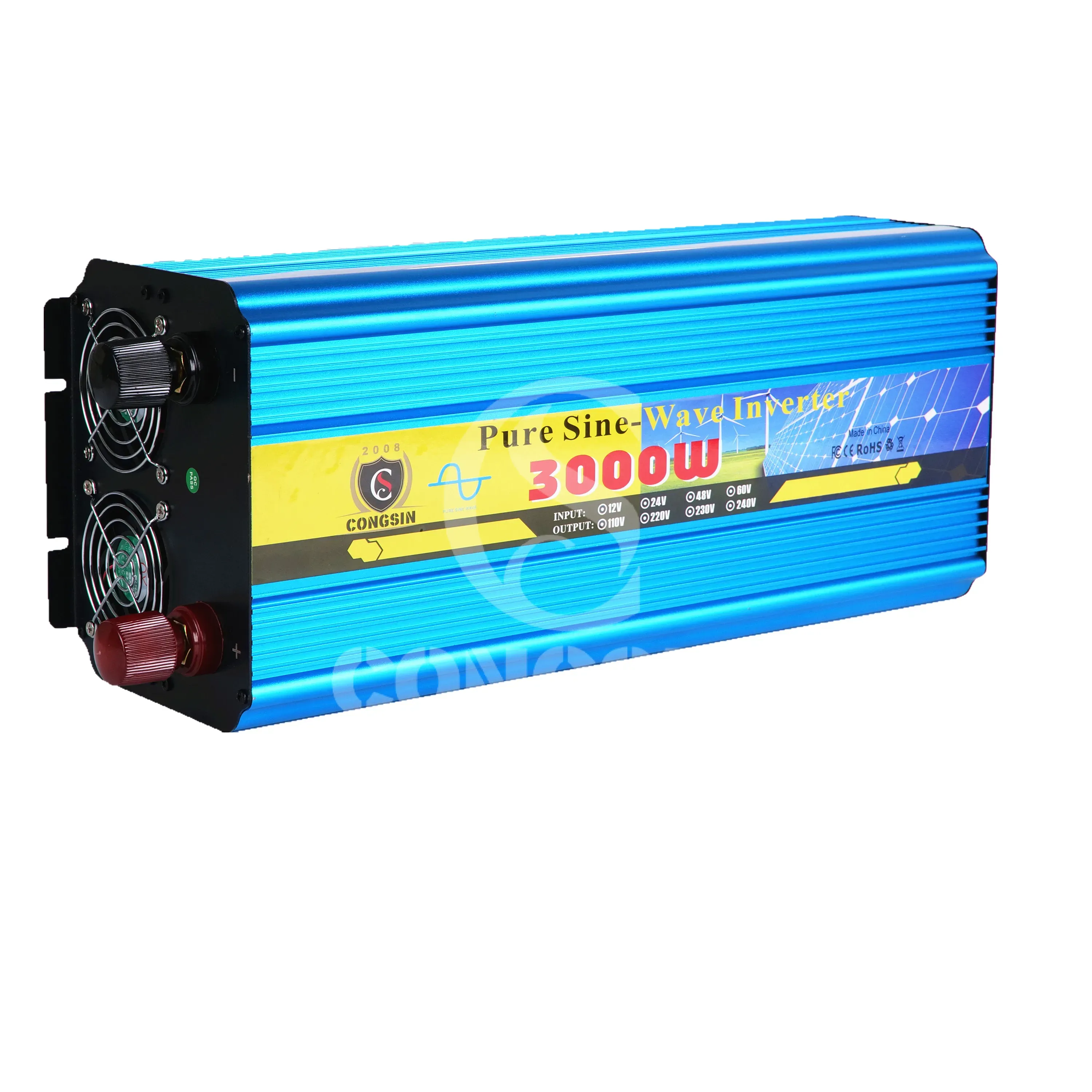
Congsin 3000W LCD Pure Sine Wave Inverter for Home Use Solar Backup Power Inverter Off Grid UPS
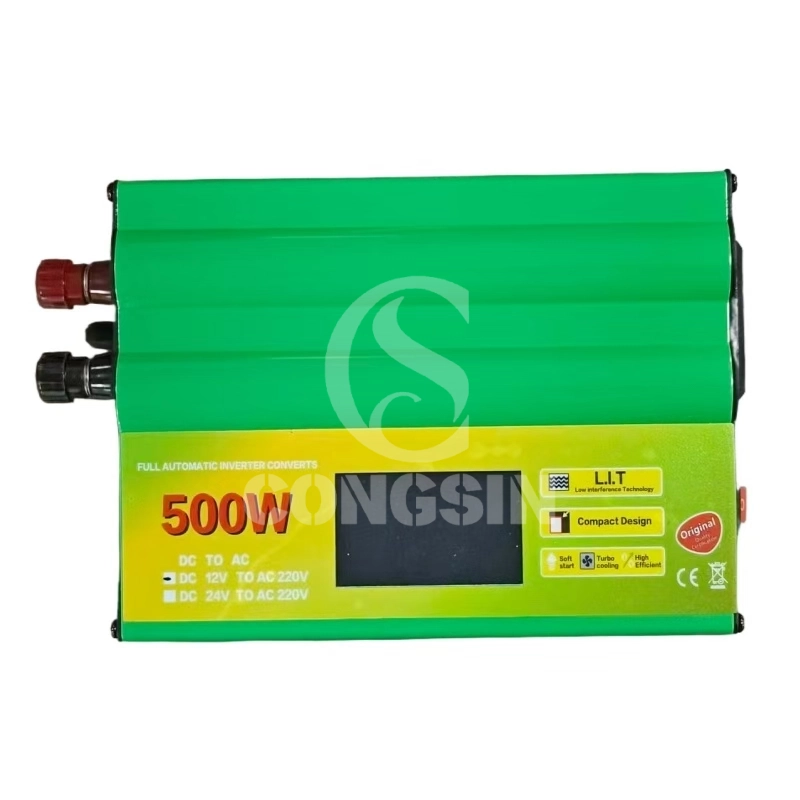
Congsin Modified Sine Wave Inverter 500W 1000W 1500W 12V LED Display Portable for RV Car Solar
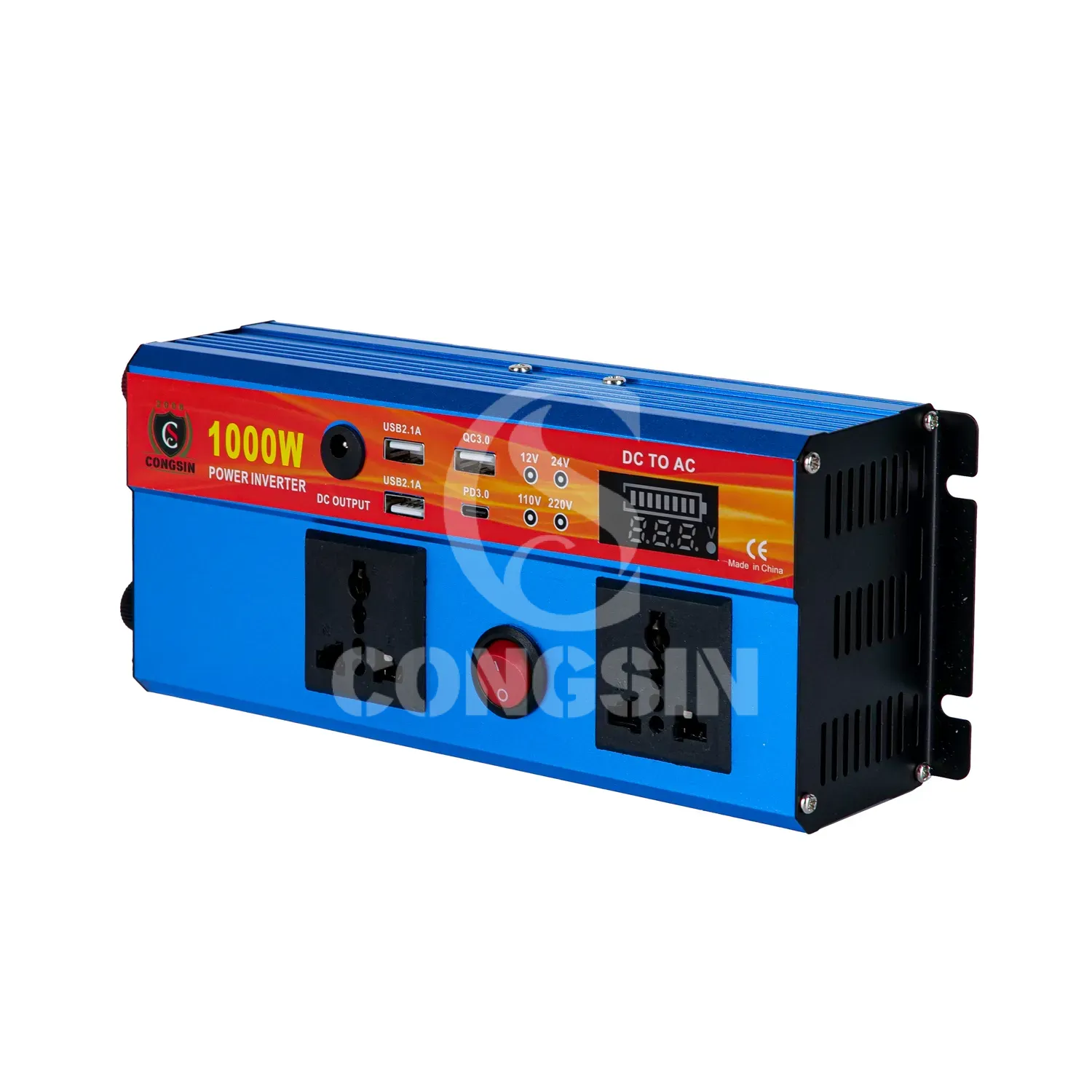
Congsin 1000W modified sine wave inverter with LED display and Type C port car RV power inverter

CONGSIN is a trusted OEM factory for power inverters, solar charge controllers, and DC converters. Reliable solutions for global B2B buyers.
 High Quality
 7/24 Service
 Guaranteed Warranty
© 2025 Congsin. All Rights Reserved.