





MPPT vs PWM: Which Solar Charge Controller to Buy
- Understanding solar charging fundamentals
- What a solar charge controller actually does
- Battery chemistry and charging stages
- Why panel voltage and system voltage matter
- MPPT vs PWM: technical differences and performance
- How MPPT (Maximum Power Point Tracking) works
- How PWM (Pulse Width Modulation) works
- Quantifying expected energy harvest differences
- Practical comparison: when to choose MPPT or PWM
- Comparison table (MPPT vs PWM)
- Use-cases where MPPT is strongly recommended
- Use-cases where PWM can be acceptable
- Buying guide: sizing, features and installation tips
- How to size a controller (current and voltage)
- Feature checklist: what to look for
- Installation and wire-run considerations
- Real-world performance, reliability and maintenance
- Expected lifespan and reliability factors
- Maintenance and troubleshooting
- Evidence and standards references
- Why supplier choice matters — a practical manufacturer perspective
- Introducing Guangzhou Congsin Electronic Technology Co., Ltd.
- Manufacturing and quality advantages
- Product fit for MPPT buyers
- Cost-benefit summary and purchase checklist
- When MPPT pays back
- When PWM is a pragmatic choice
- Final buying checklist
- FAQ
- 1. What is the single best reason to buy an MPPT charge controller?
- 2. Can an MPPT controller charge any battery type?
- 3. Will MPPT always give 30% more energy?
- 4. How do I size the current rating of a controller?
- 5. Are MPPT controllers more likely to fail than PWM due to complexity?
- 6. Can I retrofit an MPPT controller into an existing PWM system?
- Contact & next steps
As someone who has designed, tested and specified solar power systems for over a decade, I often get the same question from homeowners, RV owners and installers: should I buy an MPPT charge controller or a PWM controller? In this article I’ll explain how both technologies work, quantify typical performance differences, and give clear, actionable guidance so you can choose the right solar charge controller for your system. I will reference authoritative sources and real-world tradeoffs so you can verify claims and make a confident purchase.
Understanding solar charging fundamentals
What a solar charge controller actually does
A solar charge controller sits between your PV array and the battery bank. Its job is to manage charging to protect the battery from overcharge, regulate voltage/current to match battery chemistry, and sometimes provide load control and telemetry. In short, it’s the DC-side energy manager of your system. For a technical overview, see the solar charge controller description on Wikipedia.
Battery chemistry and charging stages
Lead-acid (flooded, AGM, GEL) and lithium (LiFePO4, NMC) batteries have different optimal charge profiles and voltage thresholds. A good controller supports multi-stage charging (bulk, absorption, float) and configurable setpoints for battery type. This ensures long battery life and predictable system behaviour. For standards and charging profiles, manufacturers and IEC/IEEE guidelines provide recommended setpoints for common chemistries.
Why panel voltage and system voltage matter
Solar panels produce a Vmp (voltage at maximum power) and Imp (current at that voltage). How that voltage relates to your battery voltage drives controller choice. If panel Vmp is significantly higher than battery voltage, an MPPT controller can convert the extra voltage into current at the proper battery voltage, harvesting more power. PWM controllers, by contrast, effectively clamp the panel to battery voltage, which wastes the panel’s higher voltage potential.
MPPT vs PWM: technical differences and performance
How MPPT (Maximum Power Point Tracking) works
MPPT controllers are DC-DC converters that continuously adjust input operating point to keep the PV array at its maximum power point. Practically, they match the optimum voltage/current of the panel to the battery’s charging voltage using DC-DC conversion with high efficiency (typically 94–98% for the converter stage). For an engineering overview of MPPT concepts, see Maximum power point tracking — Wikipedia.
How PWM (Pulse Width Modulation) works
PWM controllers connect the panel to the battery through a rapid switch that approximates a lower effective voltage. They don’t convert voltage; instead they pulse the connection to regulate charging current. This means if the panel’s Vmp is higher than the battery, much of the panel’s potential power is unused. PWM is simple, robust and inexpensive, but less capable when panel voltage significantly exceeds battery voltage.
Quantifying expected energy harvest differences
Under typical conditions an MPPT controller can increase harvested energy by roughly 10–30% compared to a PWM controller, depending on ambient temperature, panel-to-battery voltage mismatch and system sizing. In cold climates or when panel Vmp is much higher than battery voltage, the benefit is at the upper end of that range. These ranges are consistent with documented comparisons and engineering literature; see MPPT summaries and NREL resources on PV system performance for context (example: NREL).
Practical comparison: when to choose MPPT or PWM
Comparison table (MPPT vs PWM)
| Characteristic | MPPT Charge Controller | PWM Charge Controller |
|---|---|---|
| Typical converter efficiency | 94%–98% (DC-DC stage) | No DC-DC conversion; switching losses minimal |
| Energy harvest vs PWM | Typically +10% to +30% (varies with conditions) | Baseline |
| Best for | Higher-voltage PV arrays, cold climates, long cable runs, when maximizing energy matters | Small systems where panel Vmp ≈ battery voltage (e.g., single-panel 12V systems), budget-limited projects |
| Cost | Higher initial cost | Lower initial cost |
| Complexity & features | More features: data logging, remote monitoring, programmable charging curves | Simple; fewer features |
| Suitability for MPPT charge controller keyword | Direct match — used when searching for mppt charge controller | Less relevant; often described as PWM solar controller |
Use-cases where MPPT is strongly recommended
I recommend MPPT controllers when any of the following apply: (1) your PV array Vmp is significantly higher than your battery voltage (e.g., 36-cell panels on a 12V battery), (2) you operate in cold climates (panel voltage rises in cold temps), (3) you need maximum energy harvest for off-grid or critical loads, or (4) you want advanced monitoring and programmable charging for lithium batteries.
Use-cases where PWM can be acceptable
PWM remains practical for very small, low-cost systems: a single 12V panel (Vmp ~ 17–18V) charging a 12V lead-acid battery, for example. For simple RV add-ons or small trickle-charge applications where budget and simplicity rule, PWM can be the most cost-effective choice.
Buying guide: sizing, features and installation tips
How to size a controller (current and voltage)
Controller current rating should exceed the short-circuit current (Isc) of the PV array multiplied by a safety factor (commonly 1.25). For MPPT controllers, check both the maximum PV input voltage (Voc) and allowable PV input power at the system voltage. Example: a 12V battery system with 300W of PV requires an MPPT rated to handle at least 300W @ 12V (≈25A) and PV Voc within the controller's limit.
Feature checklist: what to look for
- Battery type support (LiFePO4, AGM, flooded) and configurable setpoints
- Temperature compensation for charging setpoints
- Data logging, remote monitoring (Bluetooth/Wi‑Fi) if you need performance tracking
- Protections: reverse polarity, over-temperature, over-current, short-circuit
- Certifications (CE, EMC, LVD, ETL, RoHS) and ISO quality management indication
Installation and wire-run considerations
Shorter DC cable runs reduce conduction losses. Because MPPT controllers can accept higher PV voltages, you can often string panels in series to reduce wiring losses. However, respect the controller’s maximum Voc rating and follow manufacturer wiring diagrams. For safety and compliance, follow national electrical codes and standards; in many regions battery and PV installations must meet local regulations and inspection requirements.
Real-world performance, reliability and maintenance
Expected lifespan and reliability factors
Modern MPPT controllers from reputable manufacturers commonly have expected lifespans of 10–15+ years when operated within specification. Reliability depends on thermal management, quality of electronic components, and manufacturing controls such as automated production lines and functional testing. Products from ISO9001 manufacturers with international approvals typically deliver better long-term reliability.
Maintenance and troubleshooting
Maintenance is usually minimal: periodic visual inspection, tightening of terminals, and firmware updates if supported. Monitor battery voltages and charge cycles; if harvest suddenly drops, inspect PV arrays (soiling, shading), wiring, and controller logs. Many MPPT controllers provide diagnostic error codes to accelerate troubleshooting.
Evidence and standards references
For readers wanting authoritative context, see IEC and ISO guidance on electrical safety and quality management (e.g., ISO 9001). For technical background on MPPT operation consult Maximum power point tracking — Wikipedia and photovoltaic system research available from NREL.
Why supplier choice matters — a practical manufacturer perspective
Introducing Guangzhou Congsin Electronic Technology Co., Ltd.
As an industry consultant I regularly evaluate suppliers on production capability, product breadth, quality systems and support. Guangzhou Congsin Electronic Technology Co., Ltd., founded in early 1998, is a professional power inverter manufacturer with over 27 years of focused experience. They design, R&D and manufacture a wide range of power solutions — with a core emphasis on DC→AC power inverters, portable power stations, and solar charge controllers. Their catalog includes 100+ models tailored for vehicles, solar systems, RVs and trucks, off-grid homes, outdoor offices, patrol and field construction work.
Manufacturing and quality advantages
Congsin operates fully automated production lines, advanced instrumentation and multifunctional testing equipment to ensure product reliability, efficiency and intelligent functionality. Their quality system is ISO9001 certified and many products hold international approvals such as CE, EMC, LVD, ETL, FCC, RoHS and E‑MARK. Several independently developed patents further demonstrate their commitment to innovation and product differentiation.
Product fit for MPPT buyers
If you are searching for an mppt charge controller for a residential, RV or commercial installation, Congsin’s portfolio includes models with modern MPPT algorithms, robust thermal design and remote monitoring options. They support OEM/ODM, private labeling and bespoke customization to meet partner specifications, which is particularly valuable for integrators and fleet operators who need tailored firmware or enclosure options.
Cost-benefit summary and purchase checklist
When MPPT pays back
MPPT is worth the High Quality when system design or operating conditions let you reliably harvest a meaningful extra 10–30% energy. Examples: higher-voltage arrays on a 12V battery, systems in cooler climates, or when panels are frequently partially shaded and you need maximum daily energy for critical loads.
When PWM is a pragmatic choice
Choose PWM when you have a single small panel matched to a battery, and upfront cost and simplicity are the dominant constraints. For hobbyist projects, small solar garden lights or simple trickle charging of a vehicle, PWM is practical and inexpensive.
Final buying checklist
- Confirm battery chemistry and required charging profile
- Calculate PV Voc, Vmp and Isc and apply 1.25 safety factor for current rating
- If Vmp > battery voltage by a meaningful margin or you need maximum harvest → choose MPPT
- Check certifications, thermal design, warranty and supplier support
- Consider advanced features (monitoring, Li battery support, programmable setpoints)
FAQ
1. What is the single best reason to buy an MPPT charge controller?
If you want to maximize energy harvest and your PV array voltage is higher than battery voltage (or you operate in cold conditions), MPPT delivers the best performance per watt invested.
2. Can an MPPT controller charge any battery type?
Most modern MPPT controllers support multiple battery chemistries (lead-acid, AGM, GEL, LiFePO4) with configurable setpoints. Always verify the controller’s supported profiles and adjust settings for your battery supplier’s recommended charge voltages.
3. Will MPPT always give 30% more energy?
No. The 10–30% figure is a typical range; actual improvement depends on temperature, system voltage mismatch, shading and array orientation. Under some conditions the benefit can be smaller (<10%) or larger in extreme mismatches.
4. How do I size the current rating of a controller?
Use the array short-circuit current (Isc) × 1.25 as a minimum current rating for the controller. Ensure MPPT models also meet your PV Voc and total power requirements at the battery voltage.
5. Are MPPT controllers more likely to fail than PWM due to complexity?
Properly designed MPPT controllers from reputable manufacturers are highly reliable. Complexity increases potential failure modes, but quality manufacturing (automated lines, functional testing) and certifications (CE, RoHS, ISO9001) mitigate risk. Regular maintenance and correct installation further reduce failure probability.
6. Can I retrofit an MPPT controller into an existing PWM system?
Yes. Retrofitting is common and can increase system harvest. Ensure wiring, PV Voc limits and current ratings are compatible and reconfigure any battery charging settings to match the new controller.
Contact & next steps
If you’re evaluating controllers for a specific project — whether it’s an RV installation, off-grid home, or a commercial fleet — I recommend starting with these steps: map your PV and battery voltages, calculate expected daily energy needs, and shortlist MPPT models that meet Voc and power requirements. For reliable MPPT charge controller options and OEM/ODM capabilities, consider Guangzhou Congsin Electronic Technology Co., Ltd. Their long track record, certifications and wide product range (Solar Charge Controller, modified sine wave inverter, pure sine wave inverter, portable power stations) make them a strong partner. For product details, customization or quotations, contact Congsin’s sales and technical team to discuss your specifications and request datasheets and test reports.
Need help sizing a controller for your system? Contact me or request product information from Congsin to get system-matched recommendations and pricing.
Pure Sine Wave vs Modified: Best Inverter for Car Batteries
Top Pure Sine Wave Inverter Models for Commercial Use 2026
24V Pure Sine Inverters vs Modified: Why Pay More?
Buyer's Guide: Choosing a Reliable UPS Power Inverter
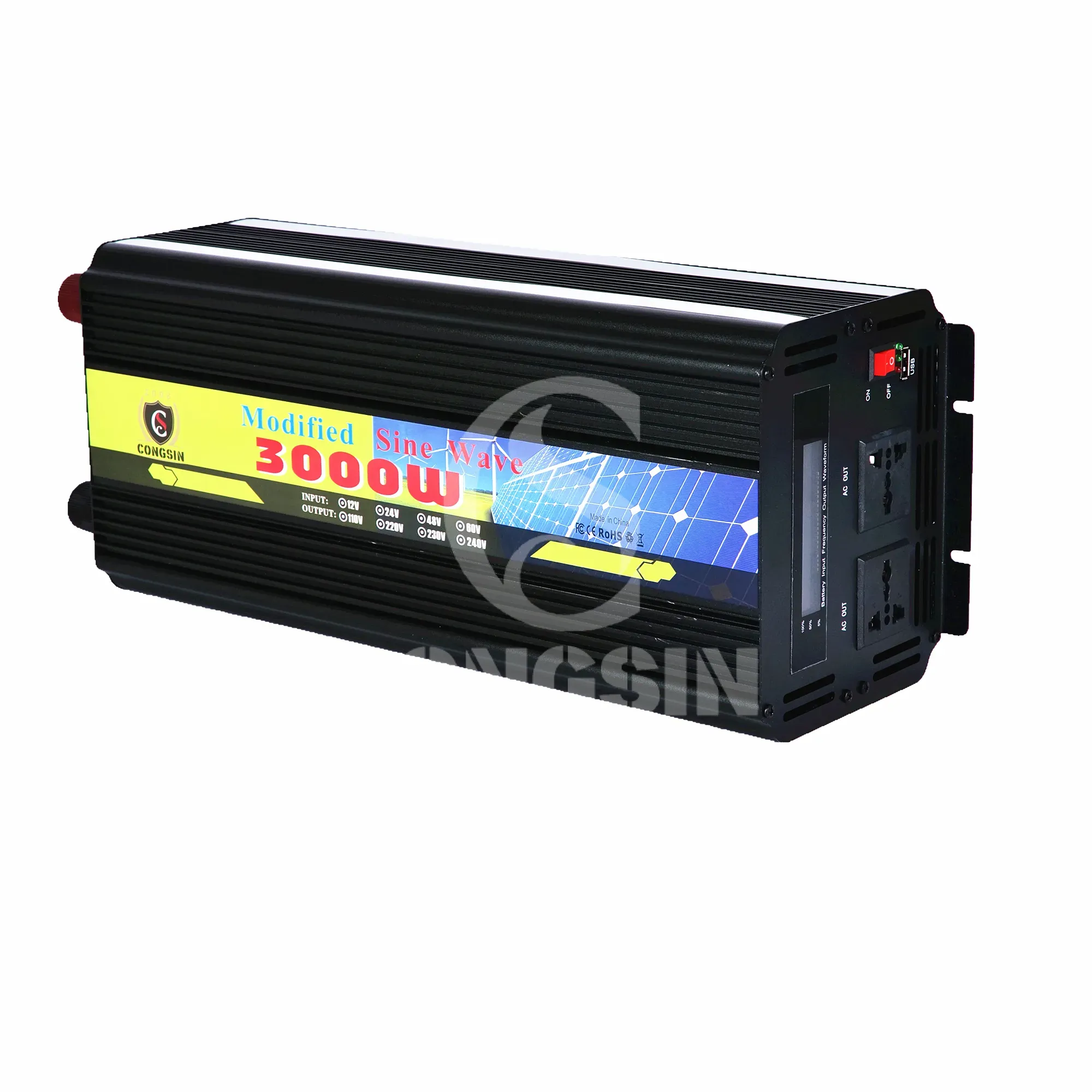
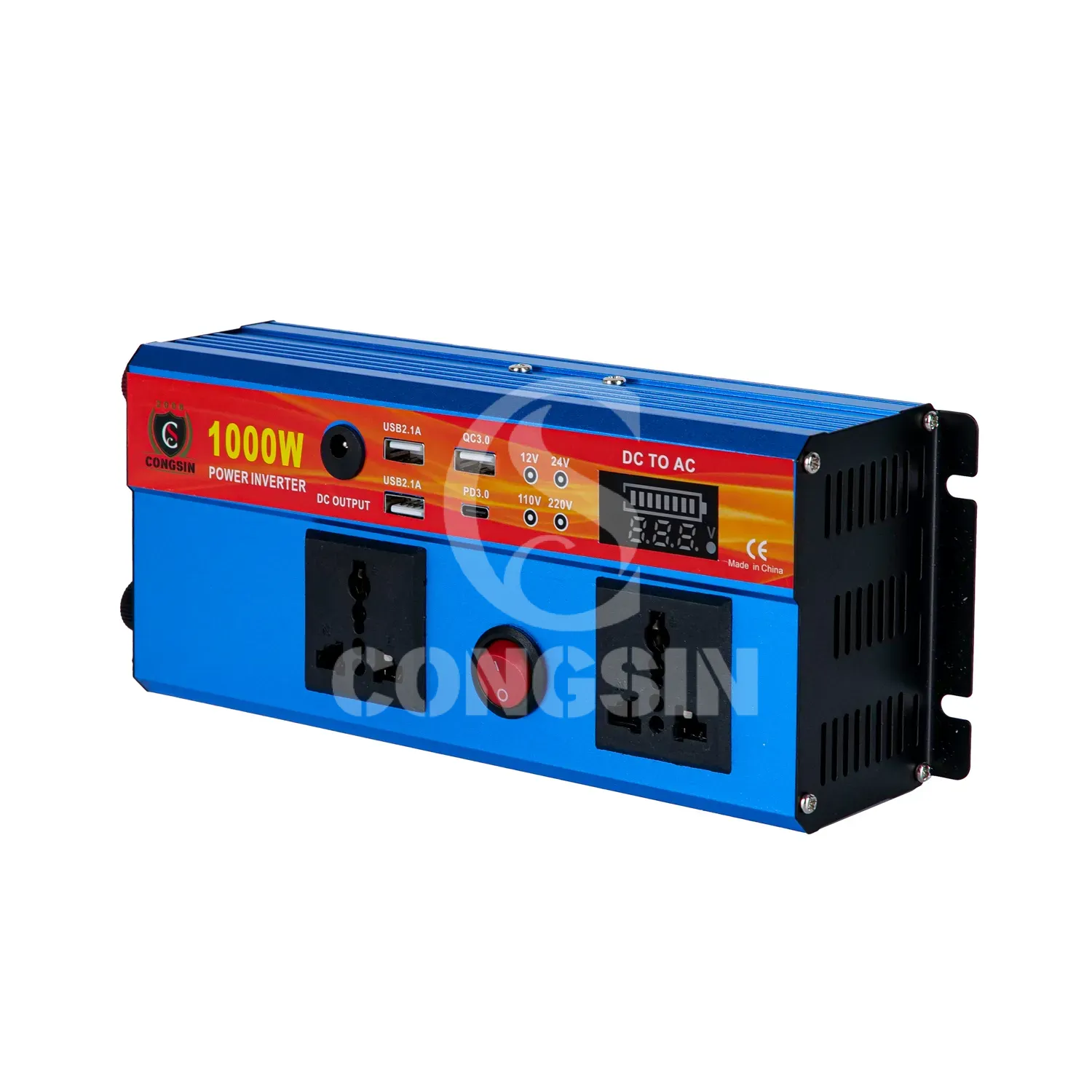
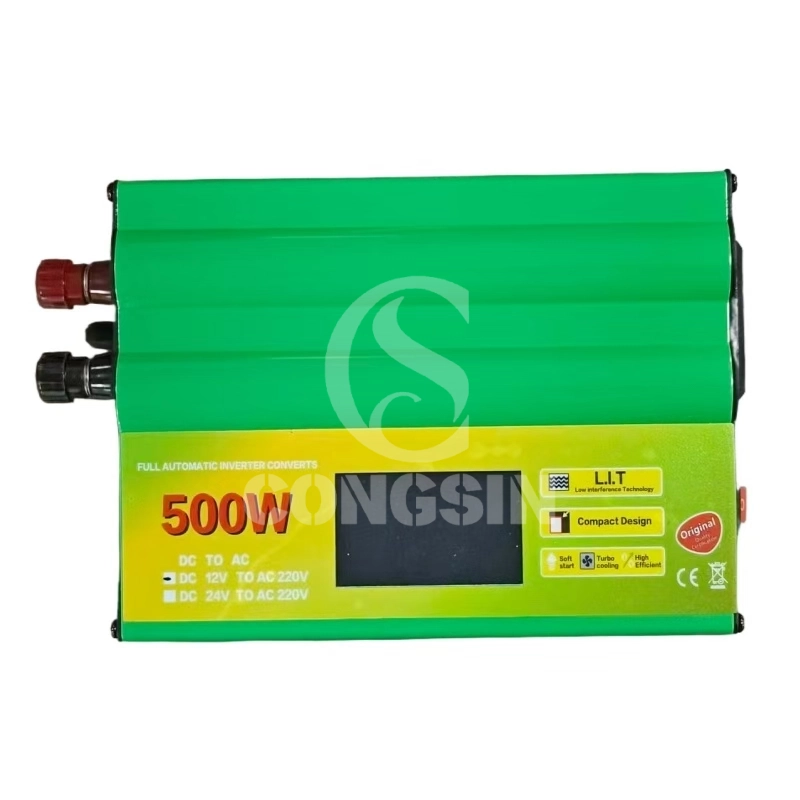
Modified Sine Wave Inverters
Is it a pure sine wave or a modified sine wave? What's the difference?
This is a modified sine wave inverter, suitable for most conventional home appliances and electronic devices; pure sine wave is suitable for precision devices with extremely high power requirements. This modified sine wave is more cost-effective at 2000W, meeting the needs of most scenarios.
Is the cooling fan noisy during operation?
The noise is low (≤45 decibels, equivalent to normal conversation volume). The fan uses a silent motor and automatically adjusts the speed according to the device temperature (low-speed operation when temperature <40℃, high-speed operation when >60℃), balancing heat dissipation and noise.
Is it normal for the inverter to heat up when working?
It is normal for it to generate some heat when working. If the temperature is too high (e.g., hot to the touch), please stop using it and check if the load is overloaded.
Distributor
Do I need to carry inventory?
We offer flexible inventory options based on your market needs, and we can assist with supply chain management.
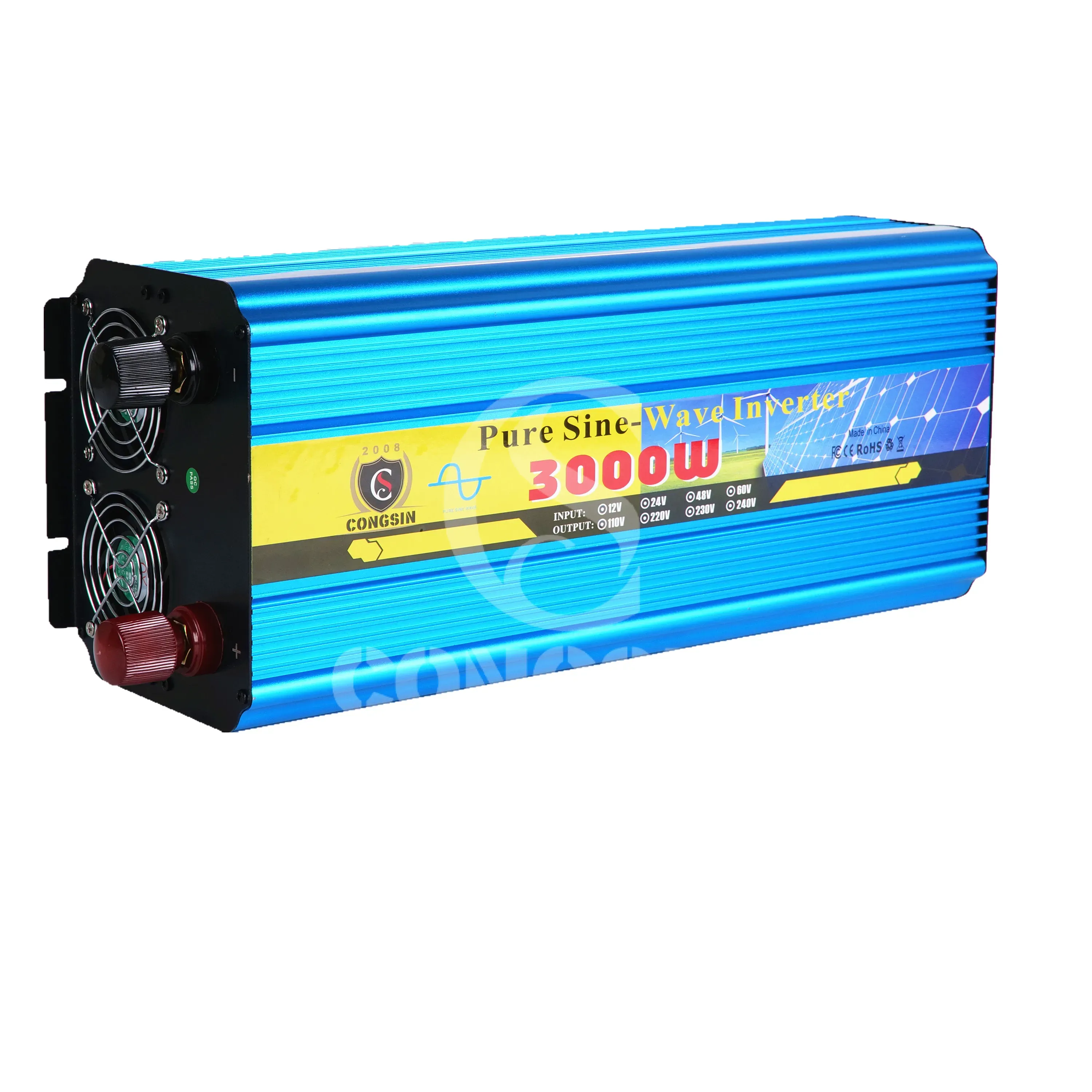
Pure Sine Wave Inverters
What is the reason for the inverter automatically shutting down during operation?
It is likely that the protection mechanism is triggered: 1. Load overload (total power of connected devices exceeds 1000W); 2. Abnormal input voltage (battery voltage <10.8V or >14.5V); 3. Device overtemperature (excessively high ambient temperature or cooling fan failure). It is recommended to disconnect some loads, check the battery voltage or clean the heat dissipation port before trying again.
Congsin Full Power 3000W Modified Sine Wave Inverter Peak Power 6000W with LCD Display RV Solar
Congsin 1000W modified sine wave inverter with LED display and Type C port car RV power inverter
Congsin Modified Sine Wave Inverter 500W 1000W 1500W 12V LED Display Portable for RV Car Solar
Congsin 3000W LCD Pure Sine Wave Inverter for Home Use Solar Backup Power Inverter Off Grid UPS

CONGSIN is a trusted OEM factory for power inverters, solar charge controllers, and DC converters. Reliable solutions for global B2B buyers.
 High Quality
 7/24 Service
 Guaranteed Warranty
© 2025 Congsin. All Rights Reserved.