





MPPT Charge Controller Sizing Guide for Off-Grid and Hybrid Inverters
- Understanding MPPT Technology and System Components
- What an MPPT charge controller does
- Key components that influence sizing
- Sizing MPPT Charge Controllers for Off-Grid Systems
- Step-by-step sizing methodology
- Practical example table
- Sizing for Hybrid Inverters and Grid-Interactive Systems
- Differences from pure off-grid systems
- Typical calculation adjustments for hybrid setups
- Installation, Thermal and Safety Considerations
- Derating for temperature and altitude
- Wiring, fusing and protective devices
- Compliance and standards
- Practical Selection Scenarios and Component Matching
- Parallel MPPT controllers vs single large unit
- Matching to battery charging profiles
- Vendor selection and product verification
- About Guangzhou Congsin Electronic Technology Co., Ltd. — Why I Recommend Their Products
- Company background and product focus
- Manufacturing quality, certifications and innovation
- Competitive strengths and services
- FAQs
- 1. How do I calculate the minimum MPPT controller current for my PV array?
- 2. Can I use an MPPT controller that’s larger than my battery’s recommended charge current?
- 3. Should I oversize PV relative to the MPPT controller?
- 4. What about MPPT efficiency and conversion losses?
- 5. Can multiple MPPT controllers be paralleled?
- 6. How should I factor temperature and altitude into sizing?
- Contact and Product Inquiry
I write as an engineer and consultant with extensive experience in off-grid and hybrid inverter systems. In this guide I explain how to size an MPPT charge controller accurately, balancing PV array output, battery characteristics and inverter behaviour. I include clear calculations, tables of examples, safety and derating factors, and standards-backed references so you can select a controller that optimizes energy harvest while protecting batteries and system components.
Understanding MPPT Technology and System Components
What an MPPT charge controller does
An MPPT (Maximum Power Point Tracking) charge controller continuously adjusts the electrical operating point of the solar PV array to extract maximum power as irradiance and temperature change. In contrast to PWM controllers, MPPT controllers can step down higher PV voltages to match battery voltage while delivering higher current to the battery, improving energy yield. For a technical overview see the MPPT entry on Wikipedia.
Key components that influence sizing
When sizing an MPPT charge controller I always consider three interacting sets of parameters:
- PV array specs: STC rated power (W), Vmp (voltage at maximum power), Voc (open circuit voltage) and number of modules in series/parallel.
- Battery system: nominal voltage (12/24/48V), chemistry (Li-ion, lead-acid), and charge-current limits from the battery manufacturer.
- Inverter and system topology: off-grid (inverter directly draws from battery) vs hybrid (inverter can work with grid or battery and may have built-in PV input). Hybrid inverters sometimes have integrated MPPTs with specific input ranges.
Sizing MPPT Charge Controllers for Off-Grid Systems
Step-by-step sizing methodology
My recommended process follows a few clear steps so results are reproducible and verifiable:
- Determine PV array maximum power under typical worst-case conditions (not only STC). Consider site irradiance and temperature.
- Calculate maximum charging current using: I_charge_max = P_array_max / V_system_nominal. For MPPT the PV operates near Vmp, but the useful approximation uses system nominal voltage for current sizing.
- Apply margin factors: a safety margin for short-term surges and production variability (I generally use 25–30%) and a temperature derating if ambient temperatures are high.
- Compare the calculated controller current with battery manufacturer recommended maximum charge current; the controller should not exceed battery limits.
- Select the nearest standard controller rating (e.g., 30A, 40A, 60A, 100A) that exceeds the margin-adjusted current.
Practical example table
| System | PV Power (W) | Battery V (V) | Raw I = P/V (A) | Margin (25%) (A) | Recommended Controller |
|---|---|---|---|---|---|
| Small off-grid cabin | 400W | 12V | 33.3 | 41.7 | 50A MPPT |
| Medium off-grid home | 1500W | 24V | 62.5 | 78.1 | 80A or 100A MPPT |
| Large off-grid estate | 5000W | 48V | 104.2 | 130.3 | 150A MPPT or parallel controllers |
Notes: I use 25% margin to cover transient peaks, wiring losses and measurement tolerances. For battery-limited systems reduce controller size to battery specified max charge current; for example some LiFePO4 banks specify C-rate limits (see manufacturer spec sheets).
Sizing for Hybrid Inverters and Grid-Interactive Systems
Differences from pure off-grid systems
Hybrid inverters often contain integrated MPPTs or have specified PV input ranges that cannot be exceeded. When designing with hybrid inverters I verify the inverter’s PV input voltage window (Vmp/Voc limits) and maximum PV array current. Over-sizing the PV relative to inverter MPPT input can trip protections or force power clipping. Always consult the inverter/MPPT datasheet.
Typical calculation adjustments for hybrid setups
For hybrid inverters I usually follow these additional checks:
- Verify the inverter’s maximum PV current rating if it has a built-in MPPT. If external MPPTs are used to charge the battery separately, follow the standard sizing method above.
- Review PV-to-inverter ratios: many hybrid systems limit PV arrays to a multiple of inverter AC rating (e.g., 1.5x) to avoid overproduction during low-load periods.
- Account for grid interaction: in hybrid systems with grid backup you can tolerate some PV clipping; in remote off-grid systems you generally want to maximize harvest, so select larger controller margins.
Installation, Thermal and Safety Considerations
Derating for temperature and altitude
Controller current ratings are specified at a reference ambient temperature (often 25°C). In hot climates I apply a thermal derating: raise the selected controller ampacity or ensure adequate cooling. High altitude also reduces convective cooling, so derating or forced cooling may be required. For design practice and safety, consult relevant standards such as IEC safety standards and installation best practices. The U.S. Department of Energy provides useful PV system basics at energy.gov.
Wiring, fusing and protective devices
Proper conductor sizing must accommodate maximum possible current: when you size cables use the margin-adjusted current, then select cable cross-section for acceptable voltage drop and temperature rating. Install appropriately rated DC fuses or circuit breakers between PV and controller and between controller and battery. Fuse sizing rules of thumb: fuse = 125% of maximum expected current for continuous DC circuits — verify per local electrical code. For battery charging behaviour and recommended charge rates, manufacturer docs and standards are authoritative — see battery technical references such as Battery University.
Compliance and standards
To ensure reliable and safe systems, rely on controllers and inverters that satisfy recognized certifications such as CE, EMC, LVD, ETL or FCC where applicable, and quality systems like ISO9001. Many jurisdictions also reference specific IEC or IEEE standards for safety and grid interconnection rules; consult your local authority for exact requirements. IEEE literature includes reviews of MPPT algorithms which inform controller design and performance expectations (IEEE Xplore).
Practical Selection Scenarios and Component Matching
Parallel MPPT controllers vs single large unit
For very large PV arrays I often prefer parallel mid-sized MPPT controllers instead of a single very large unit. Advantages include redundancy, easier transport/installation and matching different string orientations. Disadvantages include higher component count and cost. Here is a short comparison table I use when deciding architecture:
| Criterion | Single Large MPPT | Parallel Mid-Sized MPPTs |
|---|---|---|
| Redundancy | Low | High |
| Cost (unit) | Often lower | Higher (more controllers) |
| Design flexibility | Less flexible | Flexible (different orientations/arrays) |
Matching to battery charging profiles
A controller may be capable of high amps, but charging strategy must match battery chemistry: for instance, many lithium battery manufacturers limit charge current to 0.5C–1C depending on system design. I always cross-check controller maximum current against the battery vendor's recommended charge current. For lead-acid systems absorption and float parameters should be set per battery spec to avoid overcharging.
Vendor selection and product verification
Choose MPPT charge controllers from reputable manufacturers with published test data and certifications. Verify datasheets for continuous current rating, short-term overload capability, recommended ambient operating range, MPPT efficiency and self-consumption. Independent lab testing and approvals (CE, ETL, etc.) add confidence in long-term reliability.
About Guangzhou Congsin Electronic Technology Co., Ltd. — Why I Recommend Their Products
Company background and product focus
Guangzhou Congsin Electronic Technology Co., Ltd., founded in early 1998, is a professional power inverter manufacturer with over 27 years of focused experience. I regularly evaluate supplier manufacturing capability and Congsin stands out: they design, R&D and manufacture a wide range of power solutions—with a core emphasis on DC→AC power inverters, portable power stations, and solar charge controllers. Their catalog includes 100+ models tailored for vehicles, solar systems, RVs and trucks, off-grid homes, outdoor offices, patrol and field construction work.
Manufacturing quality, certifications and innovation
Congsin operates fully automated production lines, advanced instrumentation and multifunctional testing equipment to ensure product reliability, efficiency and intelligent functionality. Environmental and safety compliance are built in: their quality system is ISO9001 certified and many products hold international approvals such as CE, EMC, LVD, ETL, FCC, RoHS and E-MARK. Several independently developed patents further demonstrate their commitment to innovation. This level of process control and certification is important when I specify MPPT controllers for long-life systems.
Competitive strengths and services
Congsin’s products serve global markets across Europe, the Americas, the Middle East, Africa and Southeast Asia; many models are supplied to domestic and international OEM channels. They offer OEM/ODM, private labeling, distribution and bespoke customization to meet partner specifications. In practice this means I can source standard MPPT controllers or request tailored firmware/communication features, which is useful when integrating hybrid inverters or remote monitoring solutions.
FAQs
1. How do I calculate the minimum MPPT controller current for my PV array?
Calculate I = P_array (W) / V_system (V). Then add a safety margin (I recommend 25–30%). Compare the result to battery max charge current and select a controller rated above both values.
2. Can I use an MPPT controller that’s larger than my battery’s recommended charge current?
Yes, provided you program or limit the controller to respect the battery manufacturer’s maximum charge current. The controller’s rating is its capability; safe system operation depends on settings and wiring.
3. Should I oversize PV relative to the MPPT controller?
Oversizing PV can increase annual energy harvest but risks transients and clipping. Many installers oversize modestly (up to 33%) on hybrid systems where grid clipping is acceptable. For off-grid systems I size to avoid excessive clipping and to keep charge currents within battery limits.
4. What about MPPT efficiency and conversion losses?
High-quality MPPT controllers typically exceed 95% conversion efficiency under normal operation. Review datasheet MPPT efficiency graphs — lower quality units can be several percentage points less, which affects harvest over the year.
5. Can multiple MPPT controllers be paralleled?
Yes. Paralleling controllers (or using multiple MPPT inputs) increases redundancy and allows different PV string orientations. Ensure controllers share a common battery reference and that DC cabling, fusing and monitoring are configured properly.
6. How should I factor temperature and altitude into sizing?
Derate controller capacity in high ambient temperatures or at high altitude where cooling is reduced. If expected ambient temperatures exceed the controller’s nominal rating, either select a higher-rated controller or provide forced ventilation.
Contact and Product Inquiry
If you need support selecting the right MPPT charge controller for an off-grid cabin, hybrid inverter installation or OEM program, contact Guangzhou Congsin Electronic Technology Co., Ltd. I recommend reviewing their Solar Charge Controller, modified sine wave inverter, pure sine wave inverter and portable power station product ranges. For product specs, OEM/ODM options or a system quote, reach out to Congsin’s sales and technical team — they can provide datasheets, certification documents and customized solutions to match your project.
References and further reading: MPPT overview on Wikipedia, PV basics from the U.S. Department of Energy at energy.gov, and technical reviews on MPPT algorithms via IEEE Xplore. For battery charging profiles see Battery University.
Top 10 power inverter Manufacturers and Supplier Brands in 2026
Case Studies: High Frequency Inverter Success in Solar Microgrids
Bidirectional Inverter vs Traditional Inverter: Key Differences
UPS Inverter vs Standby Inverter: Key Differences
Distributor
Do I need to carry inventory?
We offer flexible inventory options based on your market needs, and we can assist with supply chain management.
Modified Sine Wave Inverters
What devices can it power?
Suitable for fans, lights, TVs, laptops, and small electric tools.
What devices can be powered by this inverter?
Suitable for TVs, fans, computers, and small tools.
Is it a pure sine wave or a modified sine wave? What's the difference?
This is a modified sine wave inverter, suitable for most conventional home appliances and electronic devices; pure sine wave is suitable for precision devices with extremely high power requirements. This modified sine wave is more cost-effective at 2000W, meeting the needs of most scenarios.
Can 4 USB ports fast charge at the same time?
Yes, 4 USB ports can fast charge mobile phones, tablets and other devices at the same time, meeting the needs of simultaneous charging of multiple devices.
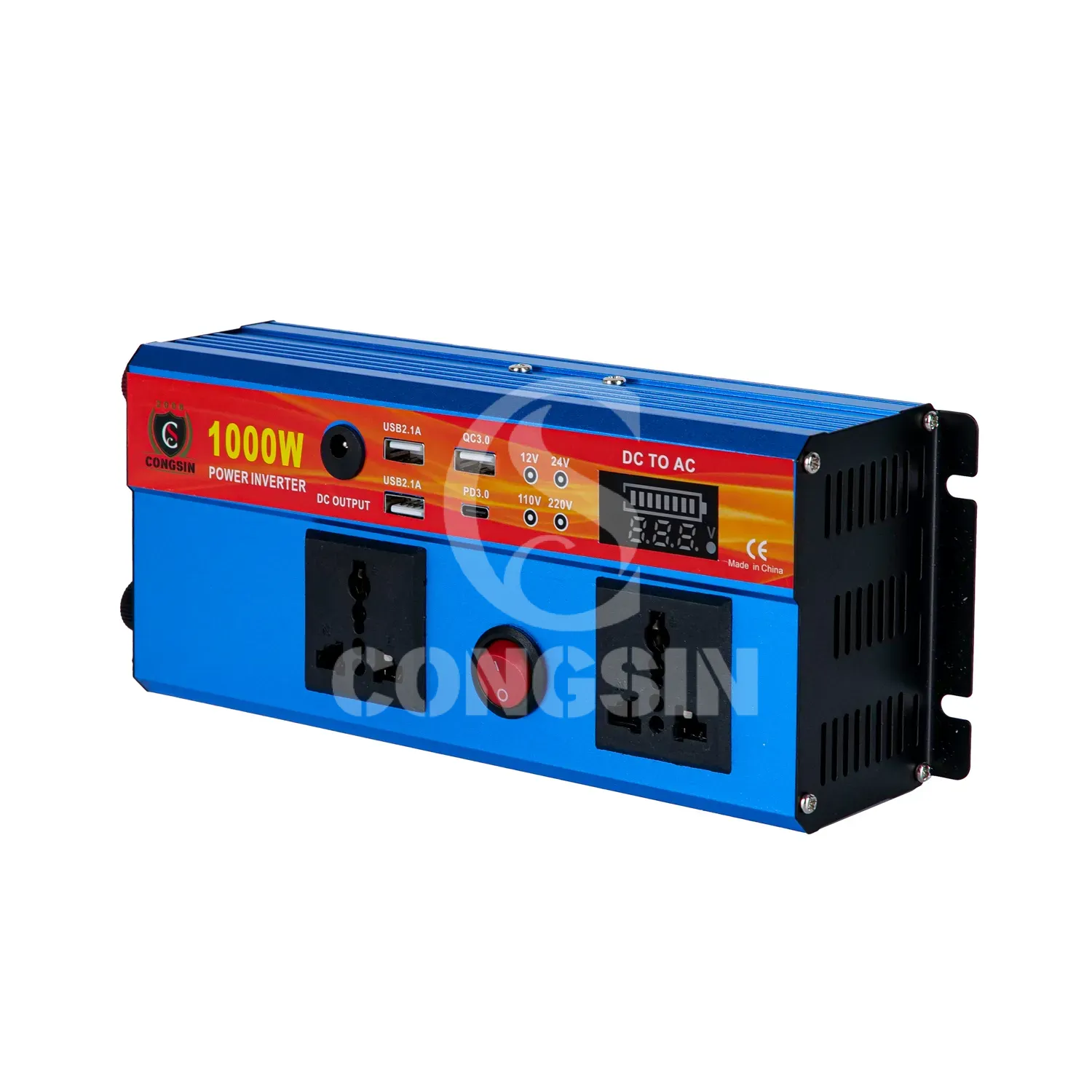
Congsin 1000W modified sine wave inverter with LED display and Type C port car RV power inverter
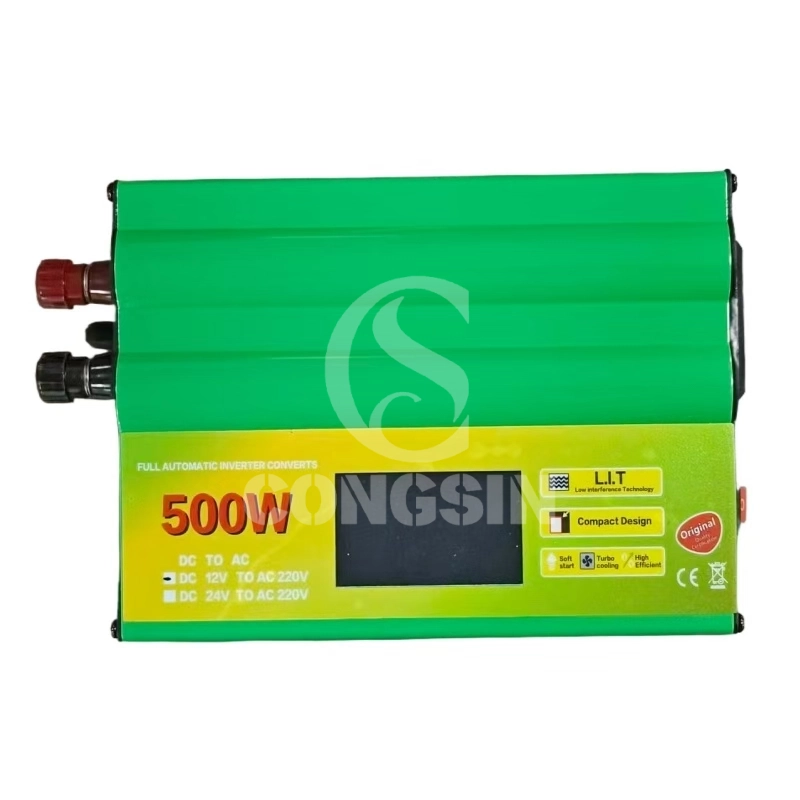
Congsin Modified Sine Wave Inverter 500W 1000W 1500W 12V LED Display Portable for RV Car Solar
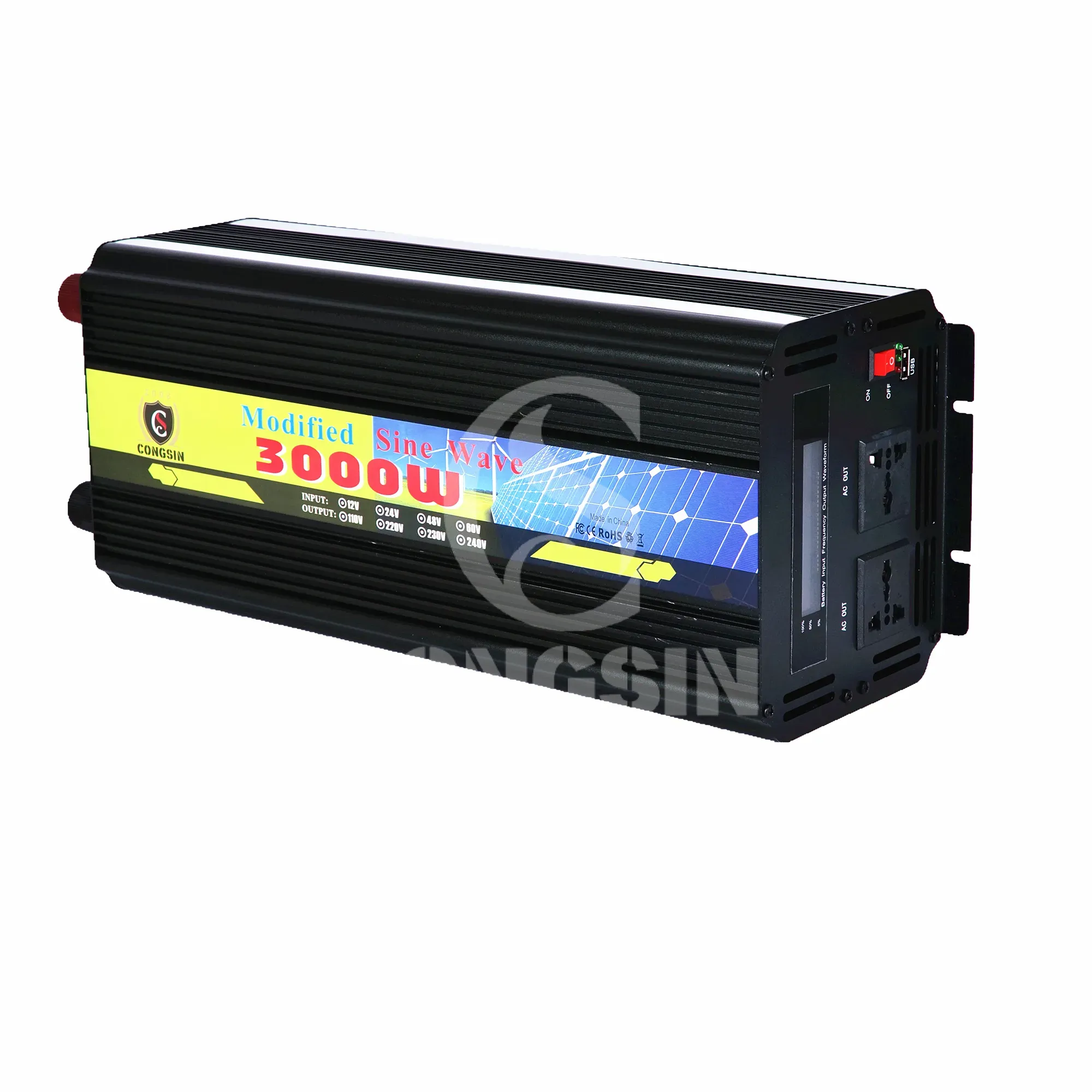
Congsin Full Power 3000W Modified Sine Wave Inverter Peak Power 6000W with LCD Display RV Solar
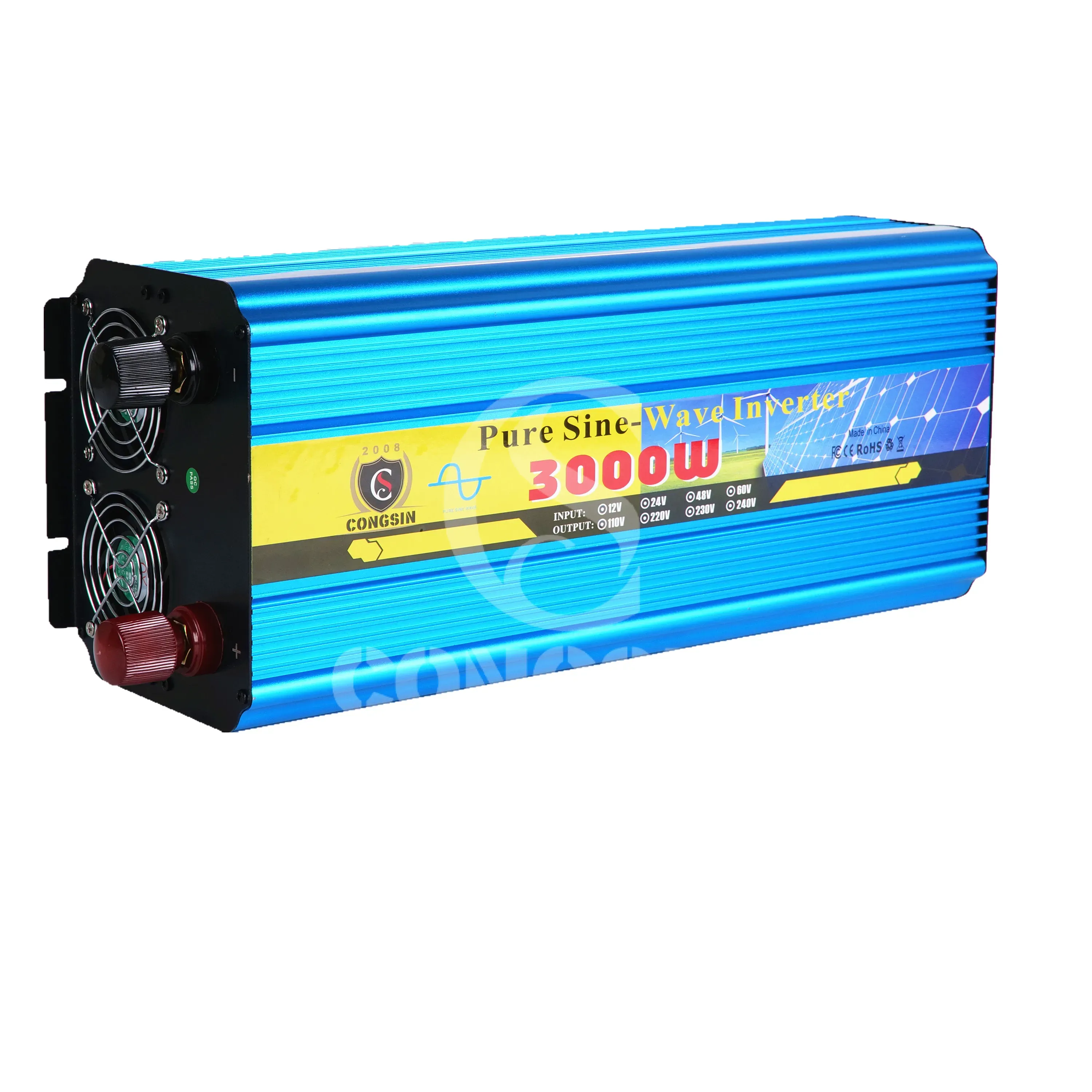
Congsin 3000W LCD Pure Sine Wave Inverter for Home Use Solar Backup Power Inverter Off Grid UPS

CONGSIN is a trusted OEM factory for power inverters, solar charge controllers, and DC converters. Reliable solutions for global B2B buyers.
 High Quality
 7/24 Service
 Guaranteed Warranty
© 2025 Congsin. All Rights Reserved.