





Cost Savings: How MPPT Boosts Solar System Efficiency
- Why solar system efficiency matters
- Energy harvest vs installed capacity
- Impact on economics and system sizing
- Reliability and long-term operational cost
- How MPPT charge controllers work and why they outperform alternatives
- Principles of maximum power point tracking
- DC-DC conversion vs simple switching (PWM)
- Algorithmic and hardware considerations
- Quantifying cost savings and efficiency gains
- Typical performance improvements
- Table: MPPT vs PWM — typical efficiency and cost impacts
- Example ROI calculation
- Choosing and deploying MPPT charge controllers: practical guidance
- Match controller to array and battery chemistry
- Sizing and cabling considerations
- Installation tips to maximize real-world gains
- Reliability, standards, and verifying performance
- Performance verification and monitoring
- Industry standards and safety
- Long-term reliability considerations
- Industry perspective and manufacturer insight
- Why manufacturer capability matters
- About Guangzhou Congsin Electronic Technology Co., Ltd.
- Congsin technical strengths and product highlights
- Common use cases and decision matrix
- When MPPT is a must
- When a PWM may be acceptable
- Decision checklist
- FAQ
- 1. How much more energy will an MPPT charge controller deliver compared to PWM?
- 2. Do MPPT controllers work with all battery chemistries?
- 3. Is MPPT worth it for small off-grid systems or RVs?
- 4. How do I verify an MPPT controller is delivering the claimed gains?
- 5. What are common mistakes that reduce MPPT effectiveness?
- Contact and next steps
As an engineer and consultant with long experience in power inverters and solar systems, I’ve seen MPPT-based charge controllers transform system performance and economics. This article explains, from first principles and real-world data, how an mppt charge controller extracts more energy from PV arrays, reduces the levelized cost of energy (LCOE), and shortens payback periods. I include measurable comparisons, authoritative references, and practical selection and installation guidance so you can apply MPPT benefits to your residential, commercial, or off-grid installations.
Why solar system efficiency matters
Energy harvest vs installed capacity
Installed peak capacity (kWp) is only one part of the story. Annual energy yield (kWh/year) determines revenue or usable energy. Two identical panels can deliver very different yields depending on how their output is tracked and converted. MPPT (Maximum Power Point Tracking) increases the fraction of available solar energy actually captured and stored or inverted, which directly increases yield without increasing panel count.
Impact on economics and system sizing
Higher conversion efficiency means you can meet a given energy demand with fewer panels, smaller BOS (balance of system) costs, and reduced mounting/installation costs. That lowers upfront capital expenditure and materially affects payback and ROI — a critical point for commercial PV, remote installations, and vehicle/RV systems where space and weight are constrained.
Reliability and long-term operational cost
Efficiency gains from MPPT reduce cycling depth on battery-based systems (by capturing more midday power and reducing reliance on discharge cycles), which can extend battery life and reduce replacement and maintenance costs over decades.
How MPPT charge controllers work and why they outperform alternatives
Principles of maximum power point tracking
An mppt charge controller continuously monitors PV voltage and current to identify the operating point (voltage x current) where power output is maximized. Because PV module I–V curves change with irradiance and temperature, the maximum power point (MPP) shifts throughout the day. MPPT algorithms (perturb & observe, incremental conductance, etc.) actively adjust the converter duty cycle so the array operates at or near the MPP. For technical background, see the Wikipedia overview of Maximum Power Point Tracking: https://en.wikipedia.org/wiki/Maximum_power_point_tracking.
DC-DC conversion vs simple switching (PWM)
MPPT controllers use DC-DC converters (usually buck, boost, or buck-boost topologies) to convert array voltage to battery voltage while allowing the PV array to operate at its optimum voltage. By contrast, PWM (Pulse Width Modulation) charge controllers simply switch the PV to the battery rail; the PV must operate near battery voltage, which is rarely at the MPP, especially with high-voltage arrays. The result: PWM wastes the voltage headroom and harvests less energy.
Algorithmic and hardware considerations
Not all MPPTs are equal. The algorithm robustness, sampling rate, converter topology, and component quality determine how closely a controller tracks MPP under rapid irradiance changes (cloud transients, soiling) and temperature swings. High-end MPPT controllers will yield better real-world energy capture, particularly in partially shaded or variable climates.
Quantifying cost savings and efficiency gains
Typical performance improvements
Field studies and review literature report that MPPT controllers often increase energy harvest by 10–30% compared with PWM systems, depending on system configuration, irradiance variability, and mismatch. A review paper on MPPT algorithms and performance trends summarizes algorithmic improvements and the practical energy gains under varied conditions (see Subudhi & Pradhan literature review: https://www.sciencedirect.com/science/article/pii/S1364032112003283).
Table: MPPT vs PWM — typical efficiency and cost impacts
| Metric | MPPT Charge Controller | PWM Charge Controller | Source / Notes |
|---|---|---|---|
| Average energy harvest improvement | +10% to +30% | Baseline | Field studies & literature reviews (range varies by conditions) — see Wikipedia MPPT |
| Typical conversion efficiency (DC-DC) | >95% (modern converters) | ~95% when switching, but energy loss due to voltage mismatch | Controller datasheets and power electronics norms |
| Effect on system size | Can reduce required PV array area by 10–25% for same yield | Requires larger array to match MPPT harvest | Derived from energy harvest improvements and LCOE calculations |
| Typical up-front cost | Higher (controller cost) but offset by panel/BOS savings | Lower initial cost | Site- and scale-dependent |
Example ROI calculation
Consider a small off-grid installation that needs 4,000 kWh/year. If a PWM system yields baseline production and an MPPT system increases harvest by 20%, you could either reduce panel area by ~20% or increase deliverable energy by 20% without additional panels. Using conservative figures: panel+mounting BOS cost $1/W and panels produce 1,200 kWh/kWp annually (site-dependent), a 20% saving on panels for a 3.33 kWp system equates to ~0.67 kWp saved (~$670). Over system lifetime, battery replacement and maintenance savings add further value. For more authoritative system performance context, NREL resources on PV system performance are useful: https://www.nrel.gov/.
Choosing and deploying MPPT charge controllers: practical guidance
Match controller to array and battery chemistry
When selecting an mppt charge controller, ensure voltage and current ratings exceed expected open-circuit voltage (Voc) under cold temperatures and the short-circuit/current rating under high irradiance. Also confirm that the controller supports your battery chemistry (lead-acid, LiFePO4, lithium-ion, etc.) and appropriate charging profiles — wrong charging profiles can negate MPPT benefits by damaging batteries or reducing life.
Sizing and cabling considerations
Use proper gauge cables to minimize conduction losses between PV, controller and battery. MPPT lets you configure higher-voltage PV arrays to reduce current and cable losses; this advantage reduces BOS cost. When higher PV voltage is used, ensure the controller’s maximum input voltage rating is not exceeded (especially in cold conditions when Voc rises).
Installation tips to maximize real-world gains
To approach theoretical MPPT benefits: (1) avoid partial shading on strings where possible (or use per-module optimization), (2) keep PV modules clean, (3) place the controller near the battery to reduce DC cable length, and (4) configure algorithm parameters (if available) for local irradiance variability. For systems with frequent shading or heterogeneous module orientations, consider module-level power electronics or distributed MPPT solutions.
Reliability, standards, and verifying performance
Performance verification and monitoring
Modern mppt charge controllers often include monitoring (local or cloud) that records PV voltage, current, power, and battery state-of-charge. I recommend baseline metering before and after MPPT installation for a clean A/B comparison. Use normalized metrics (kWh/kWp/day) to account for seasonal variation.
Industry standards and safety
Quality MPPT controllers comply with international standards for safety and electromagnetic compatibility. For example, ISO 9001 speaks to quality management systems: https://www.iso.org/iso-9001-quality-management.. Many reputable manufacturers also hold CE, EMC, LVD, ETL, FCC, RoHS certifications, or similar approvals relevant to regional markets.
Long-term reliability considerations
Look for reputable brands, automated production lines, and documented quality processes. Controllers with solid thermal design, high-quality MOSFETs/inductors, and firmware update capabilities tend to stay reliable longer. Warranty, local support, and proven field results should influence purchase decisions.
Industry perspective and manufacturer insight
Why manufacturer capability matters
Manufacturers who integrate R&D, automated production, and robust testing produce controllers with consistent performance and predictable lifetimes. I’ve seen cost savings erode when cheap controllers fail early or underperform, creating unexpected replacement costs and downtime.
About Guangzhou Congsin Electronic Technology Co., Ltd.
Guangzhou Congsin Electronic Technology Co., Ltd., founded in early 1998, is a professional power inverter manufacturer with over 27 years of focused experience. We design, R&D and manufacture a wide range of power solutions—with a core emphasis on DC→AC power inverters, portable power stations, and solar charge controllers. Our catalog includes 100+ models tailored for vehicles, solar systems, RVs and trucks, off-grid homes, outdoor offices, patrol and field construction work.
We operate fully automated production lines, advanced instrumentation and multifunctional testing equipment to ensure product reliability, efficiency and intelligent functionality. Environmental and safety compliance are built in: our quality system is ISO9001 certified and many products hold international approvals such as CE, EMC, LVD, ETL, FCC, RoHS and E-MARK. Several independently developed patents further demonstrate our commitment to innovation.
Congsin’s products serve global markets across Europe, the Americas, the Middle East, Africa and Southeast Asia; many models are supplied to domestic and international OEM channels. Our support includes OEM/ODM, private labeling, distribution and bespoke customization to meet partner specifications. Our mission is to deliver reliable, efficient and affordable energy solutions that enable energy independence.
Congsin technical strengths and product highlights
Key advantages I’ve observed when integrating Congsin components in systems include: well-engineered MPPT algorithms in their solar charge controllers, high-conversion-efficiency pure sine wave inverters, robust portable power stations for field use, and a broad product mix including Solar Charge Controller, modified sine wave inverter, pure sine wave inverter, and portable power stations. These options simplify system design and reduce integration risk for OEMs and installers.
Common use cases and decision matrix
When MPPT is a must
- Cold climates where Voc rises much higher than battery voltage
- High-voltage arrays or long cable runs where reducing current saves BOS costs
- Systems with variable irradiance (cloudy regions, partial shading)
- Space-constrained applications (RVs, boats, rooftops) where maximizing per-panel yield is critical
When a PWM may be acceptable
Small, low-cost systems where panels closely match battery voltage and irradiance is steady (e.g., small hobby systems) can sometimes accept PWM. However, for most residential and commercial systems I advise MPPT because the operational advantages and lifecycle savings typically outweigh the incremental controller cost.
Decision checklist
Before selecting a controller, evaluate:
- Array voltage, panel Voc under coldest expected temperatures
- Battery type and required charging profile
- Expected irradiance variability and shading patterns
- Budget and lifecycle cost targets (including maintenance and replacement)
- Monitoring and communications requirements (remote telemetry, data logging)
FAQ
1. How much more energy will an MPPT charge controller deliver compared to PWM?
Typical field improvements range from 10% to 30%, depending on configuration and site conditions. In variable irradiance or higher-voltage array configurations, the benefit approaches the upper end of that range. For background on MPPT theory and practical gains, see Wikipedia: Maximum power point tracking.
2. Do MPPT controllers work with all battery chemistries?
Most modern MPPT controllers support multiple battery chemistries (lead-acid, AGM, gel, LiFePO4, etc.), but you must configure the correct charging profile. Confirm the controller’s firmware supports your chemistry and that voltage setpoints match manufacturer recommendations for battery longevity.
3. Is MPPT worth it for small off-grid systems or RVs?
In many small systems (RVs, boats), MPPT is highly worthwhile because space and weight limit PV area; squeezing more energy per panel is critical. For very small hobby setups with matched panel/battery voltages and constant sun, PWM can be a low-cost option, but MPPT remains the better long-term choice for reliability and performance.
4. How do I verify an MPPT controller is delivering the claimed gains?
Install energy meters on the PV side and load/battery side before and after commissioning. Normalize production to kWh/kWp/day and compare across similar weather periods. Many MPPT controllers provide built-in logging and telematics; use that data plus independent metering to validate gains.
5. What are common mistakes that reduce MPPT effectiveness?
Common mistakes include undersized cabling causing voltage drop, incorrect Voc margin calculations leading to controller damage, improper battery configuration or charging parameters, and installing MPPT where shading or mismatch without string-level optimization undermines tracking. Address these during design and commissioning.
Contact and next steps
If you’d like to evaluate MPPT integration for a specific project, or review product options (solar charge controllers, pure/modified sine wave inverters, portable power stations), I recommend contacting Guangzhou Congsin Electronic Technology Co., Ltd. Their long experience, automated production, and broad product range make them a reliable partner for OEM, ODM, and bespoke solutions. For product inquiries, support, or OEM discussions, contact Congsin’s sales engineering team to discuss system sizing and a tailored quote.
Want help modeling ROI for your site? Share your location, load profile, panel specs, and budget and I’ll provide a practical, data-driven recommendation.
String vs. Micro vs. Hybrid: Choosing a Home Solar Inverter
Top 10 good pure sine wave inverter Manufacturers and Supplier Brands
Pure Sine Car Inverter Efficiency and Battery Compatibility Tips
Certifications, Warranty, and Compliance for 1000W Car Inverters
Distributor
Do I need to carry inventory?
We offer flexible inventory options based on your market needs, and we can assist with supply chain management.
What kind of support can I expect from Feifan after becoming a distributor?
You will receive ongoing sales support, product training, technical assistance, and marketing resources to ensure your success.
Products
Can this inverter run a refrigerator or power tools?
Recommended load ≤80% of rated power. For inductive loads, use a pure sine wave model.
Modified Sine Wave Inverters
Can the peak 720W supply power continuously?
The peak power is the instantaneous maximum power, and the continuous power supply is 360W. Ensure that the device power does not exceed the rated value when using.
Can this 2000W inverter power an air conditioner?
If the air conditioner power is within 2000W and the input is AC220V, it can supply power normally. It is recommended to ensure stable power when starting.
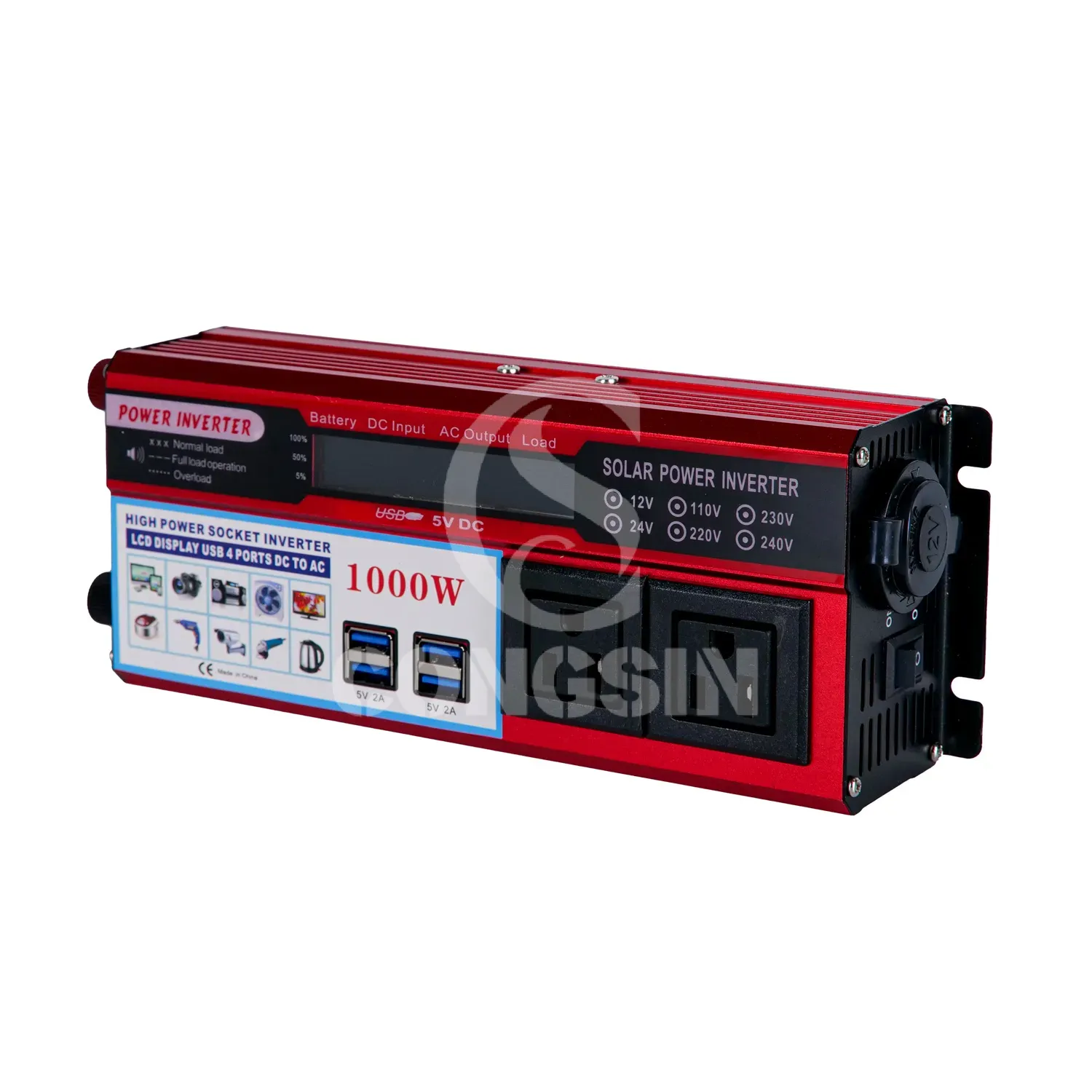
Congsin 1000W modified sine wave inverter with American Sockets and Lcd display portable 12V car RV
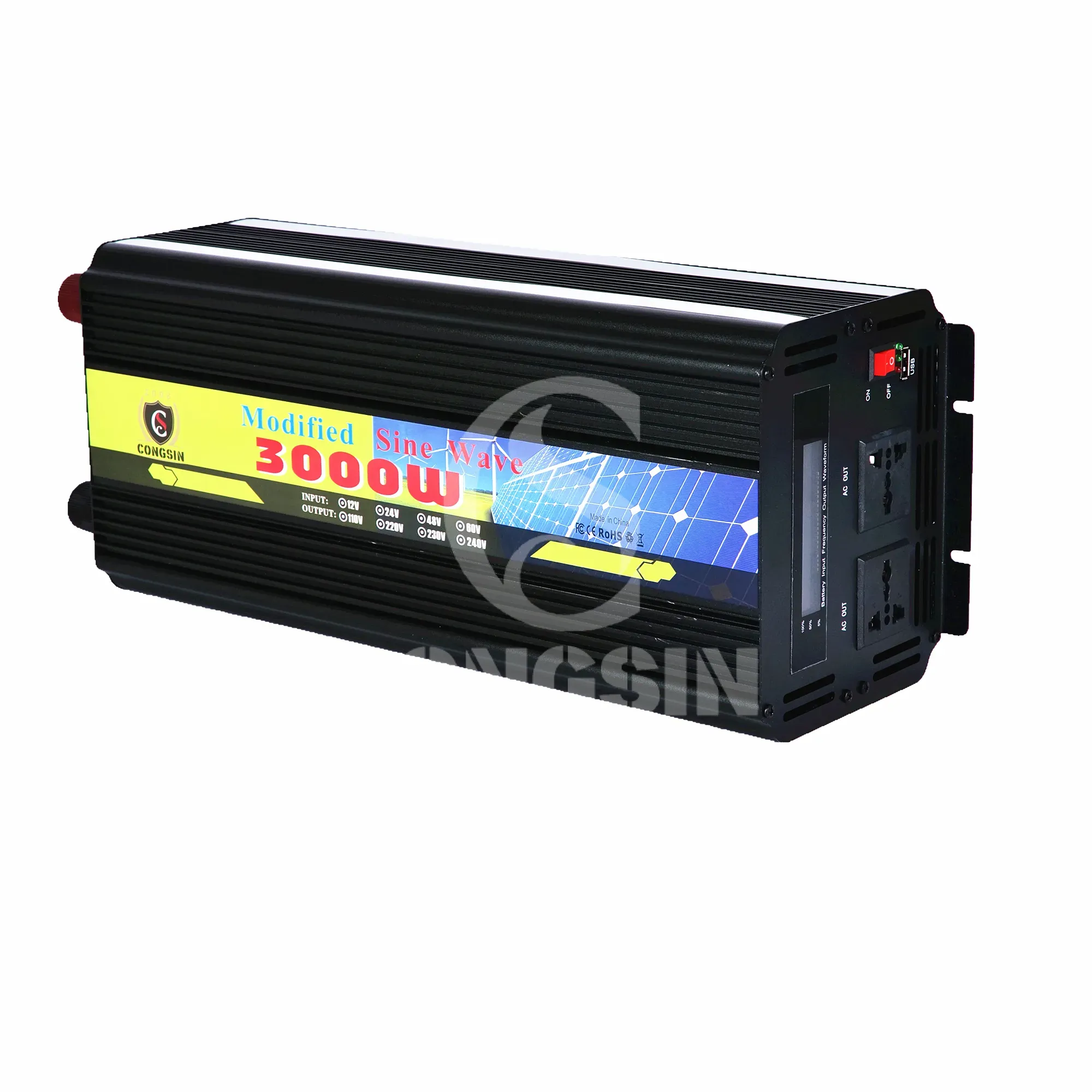
Congsin Full Power 3000W Modified Sine Wave Inverter Peak Power 6000W with LCD Display RV Solar
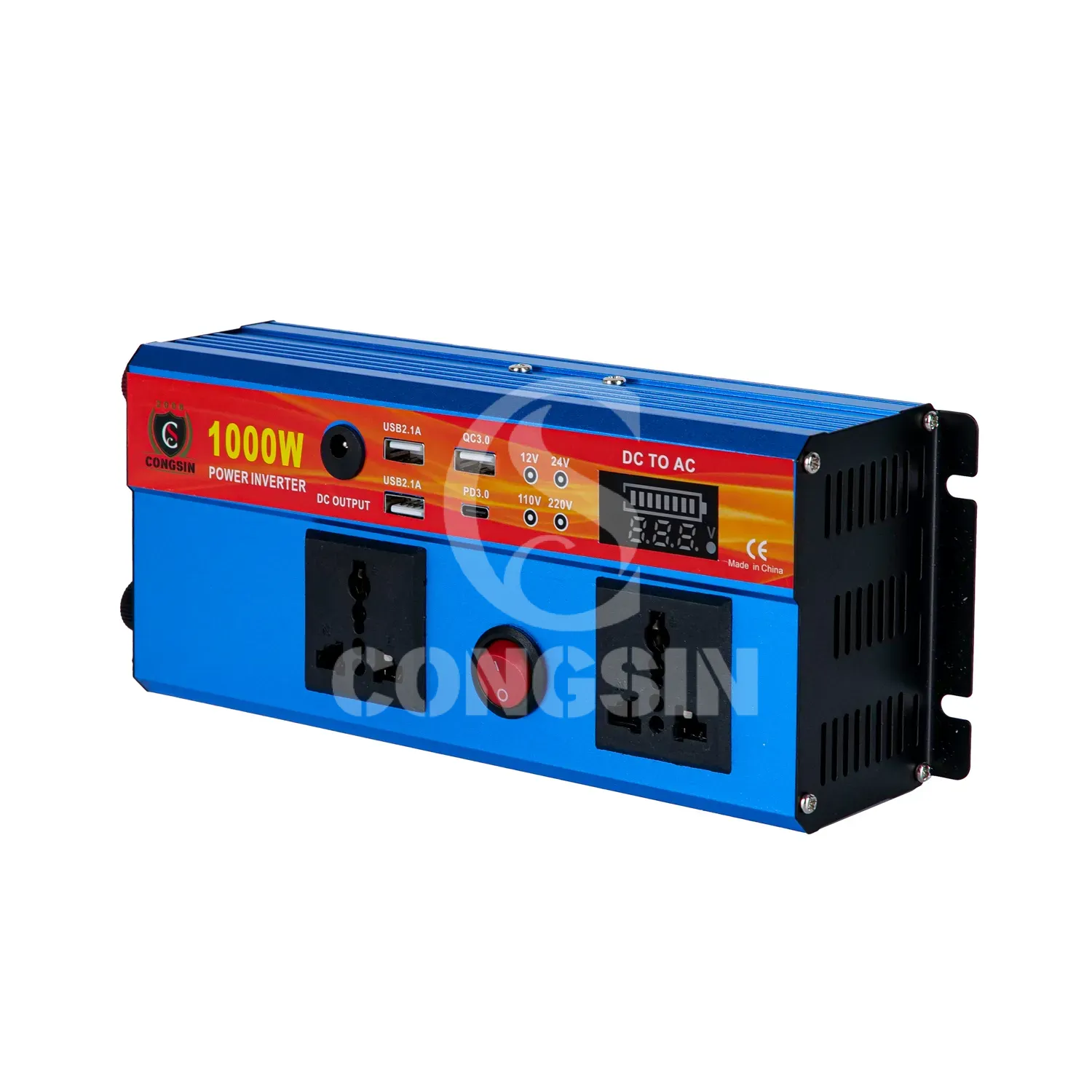
Congsin 1000W modified sine wave inverter with LED display and Type C port car RV power inverter
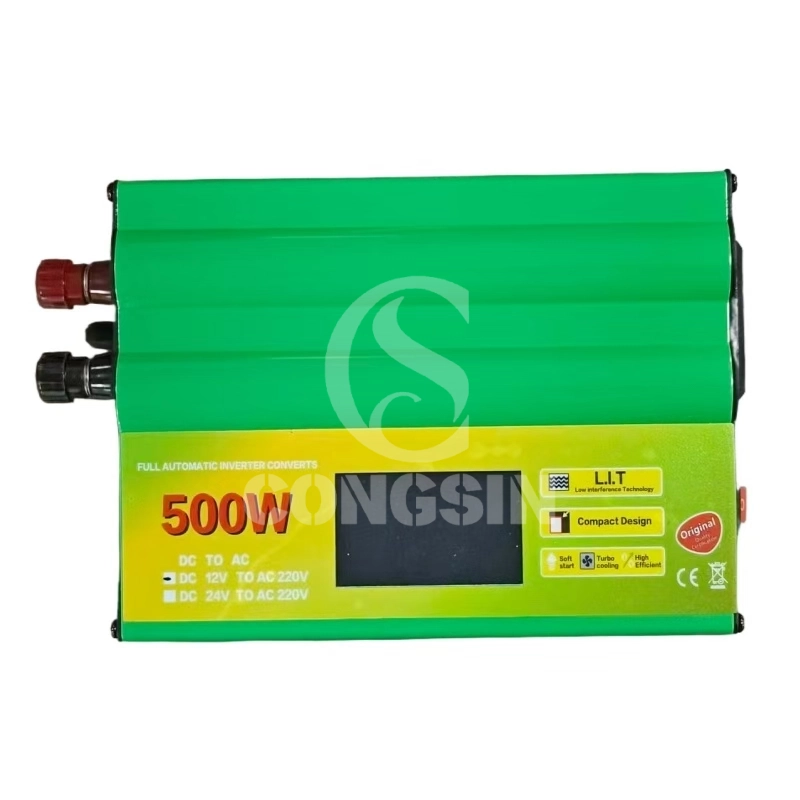
Congsin Modified Sine Wave Inverter 500W 1000W 1500W 12V LED Display Portable for RV Car Solar

CONGSIN is a trusted OEM factory for power inverters, solar charge controllers, and DC converters. Reliable solutions for global B2B buyers.
 High Quality
 7/24 Service
 Guaranteed Warranty
© 2025 Congsin. All Rights Reserved.