





Warranty, Safety and Compliance for Modified Sine Wave Inverters
- Managing Risk and Liability for Modified Sine Wave Power Inverters
- What differentiates modified sine wave inverters in risk profile
- Who is liable: manufacturer, OEM, or installer?
- Embedding without compromising trust
- Warranty Basics and Common Warranty Pitfalls
- Designing a practical warranty for modified sine wave power inverter
- Common warranty claim categories and mitigation
- Warranty wording examples (practical clauses)
- Safety Risks, Testing and Best Practices
- Top safety risks from modified sine wave outputs
- Recommended tests and validation procedures
- Practical installation and user guidance to reduce incidents
- Regulatory Compliance, Certifications and Market Access
- Which certifications matter for modified sine wave power inverters
- Comparing modified vs pure sine wave regarding compliance and warranty impact
- Documentation and labeling to meet regulatory and warranty needs
- Implementation Example: Manufacturing and Market Strategy
- Design choices that reduce warranty and compliance costs
- Service, RMA and field support best practices
- Case for certification investment
- Guangzhou Congsin: A Partner in Reliable, Compliant Power Solutions
- Company profile and compliance credentials
- Manufacturing capability and quality systems
- Product strengths and differentiation
- FAQs — Warranty, Safety and Compliance for Modified Sine Wave Inverters
- 1. Are modified sine wave inverters safe to use with most household devices?
- 2. Will certification (CE, FCC, ETL) prevent warranty claims?
- 3. How should I word warranty exclusions to protect against compatibility claims?
- 4. Can EMI filtering and improved thermal design reduce returns?
- 5. If a customer needs to run sensitive equipment, should they choose modified or pure sine wave?
- 6. How long should I keep compliance and test documentation?
- Contact & Product Inquiry
- References
Managing Risk and Liability for Modified Sine Wave Power Inverters
What differentiates modified sine wave inverters in risk profile
Modified sine wave power inverters approximate an AC sine wave using stepped or squared output. They are cost-effective and fit many resistive and simple inductive loads, but their stepped waveform increases the risk of incompatibility with sensitive electronics, increased electromagnetic interference (EMI), and higher harmonic distortion (THD). These technical traits translate into specific warranty and liability considerations: devices damaged due to waveform incompatibility, EMI-induced malfunctions, or excessive heat may lead to customer claims that manufacturers and resellers must anticipate.
Who is liable: manufacturer, OEM, or installer?
Liability depends on product labeling, contractual terms and local law. Generally, the inverter manufacturer is responsible for defects in design and manufacturing; OEMs and private-label sellers share responsibility for ensuring claims and support processes. Installers or system integrators may bear responsibility for improper installation or usage outside published specifications. Clear warranty language and documented compatibility lists reduce disputes.
Embedding without compromising trust
When selling or specifying modified sine wave power inverters, clearly state intended use cases (e.g., resistive loads, basic lighting, power tools) and expressly exclude sensitive electronics unless tested. Transparent pre-sale compatibility tables, supported devices lists, and limitation-of-liability clauses improve customer satisfaction and reduce return rates.
Warranty Basics and Common Warranty Pitfalls
Designing a practical warranty for modified sine wave power inverter
A robust warranty balances customer assurance and commercial protection. Essential elements: warranty period (e.g., 12–36 months), scope (parts, labor, shipping), exclusions (misuse, unauthorized repairs, non-listed loads), and required proof of purchase/installation. Include procedures for RMA, firmware updates, and how to document claims (photos, load logs). For inverters, specify environmental/installation conditions that invalidate warranty (overtemperature, reverse polarity, overloaded continuous operation beyond nameplate).
Common warranty claim categories and mitigation
Typical claims include: (1) device failure from continuous overload, (2) damage to customer electronics allegedly caused by inverter output, (3) premature fan or capacitor failure from heat/EMI. Mitigations: conservative continuous/peak power ratings, thermal protection, EMI filtering, explicit compatibility guidance, and extended test logs during qualification.
Warranty wording examples (practical clauses)
Use plain-language clauses supplemented by technical annexes. Example protections: This warranty does not cover damage to third-party equipment not specified as compatible in the product documentation. Include an exception list: certain medical devices, injection pumps, precision instruments, and other waveform-sensitive equipment. Offer paid testing/compatibility services as an add-on to reduce blanket exclusions while generating revenue.
Safety Risks, Testing and Best Practices
Top safety risks from modified sine wave outputs
Key risks include overheating of inductive or motor loads due to harmonic currents, misoperation of switch-mode power supplies, inaccurate measurement by electronic meters, and flicker or noise in lighting circuits. These can cause property damage or safety hazards. Designing with proper thermal management, inrush-current control, and current-limiting protections mitigates many risks.
Recommended tests and validation procedures
Test regimen should include:
- Load compatibility testing across resistive, inductive and electronic loads (including SMPS and sensitive medical/telco devices).
- Harmonic and THD measurement per IEC/EN guidance where applicable to document emissions and susceptibility.
- Thermal cycling and accelerated life testing for electrolytic capacitors and fans.
- EMI/EMC pre-compliance scans to identify emission peaks that could interfere with radio devices.
- Overload, short-circuit and fault-mode testing to verify protective circuits function.
Document all test procedures, results and pass/fail criteria—these are crucial when investigating warranty claims and for regulatory compliance.
Practical installation and user guidance to reduce incidents
Provide clear installation manuals: minimum wire gauge, fuse or breaker sizing, ventilation clearance, environmental limits (temperature, humidity), recommended load types, and examples of incompatible devices. Include a troubleshooting flowchart for common symptoms (excessive heat, buzzing, flicker) to prevent premature returns and to guide authorized repairs.
Regulatory Compliance, Certifications and Market Access
Which certifications matter for modified sine wave power inverters
Market and application determine required marks. Typical certifications and standards to consider:
- CE marking (EU): declaration of conformity, often requiring EMC and low-voltage compliance for consumer sale in Europe.
- EMC (electromagnetic compatibility): EN 55032/55035 family or equivalents ensuring emissions and immunity levels.
- LVD (low voltage directive) / safety standards (in some regions) or UL/ETL product safety listings in North America.
- FCC Part 15 for conducted/radiated emissions in the USA (applies to digital and switching devices).
- RoHS / REACH: material and hazardous substance restrictions for sale in EU and many other markets.
Achieving certification reduces market friction and demonstrates due diligence; it also sets testable pass/fail thresholds that can limit warranty exposure.
Comparing modified vs pure sine wave regarding compliance and warranty impact
| Factor | Modified Sine Wave | Pure Sine Wave |
|---|---|---|
| Compatibility with sensitive electronics | Lower; potential malfunctions in SMPS, TVs, some motors | High; designed for all typical loads |
| EMI / Harmonics | Higher THD; more EMI risk | Lower THD; less EMI |
| Cost | Lower initial unit cost | Higher cost |
| Warranty exposure | Higher if compatibility not clearly limited | Lower—fewer compatibility claims |
| Typical certifications | Same set possible (CE, EMC, RoHS, FCC); stricter EMI focus | Same set; easier path re: emissions/compatibility |
Documentation and labeling to meet regulatory and warranty needs
Include compliance statements, safety warnings, and a clear compatibility list on the product, packaging and manual. Maintain a technical file documenting design, test reports, risk assessments and supplier certificates (e.g., capacitor/transformer RoHS compliance). For CE, retain the Declaration of Conformity and test reports for at least 10 years in many jurisdictions.
Implementation Example: Manufacturing and Market Strategy
Design choices that reduce warranty and compliance costs
Design strategies: include input and output filtering to reduce conducted emissions, use higher-grade capacitors with longer lifetimes, derate continuous power by 10–20% for high-ambient conditions, and implement robust protection (overvoltage, overtemperature, short-circuit). These choices raise BOM costs slightly but cut warranty returns and compliance testing iterations.
Service, RMA and field support best practices
Set up a structured RMA process: online claim intake, initial triage checklists, cost-recovery policies for out-of-warranty repairs, and a knowledge base for installers. Offer extended warranty or service packages that include compatibility testing and priority support for commercial customers.
Case for certification investment
Certification (CE/EMC, ETL/UL, FCC) unlocks major markets. The upfront testing and documentation cost is balanced by reduced customer disputes, higher perceived product quality, and smoother distribution partnerships. Track claim rates and warranty costs pre/post-certification to quantify ROI.
Guangzhou Congsin: A Partner in Reliable, Compliant Power Solutions
Company profile and compliance credentials
Guangzhou Congsin Electronic Technology Co., Ltd., founded in early 1998, is a professional power inverter manufacturer with over 27 years of focused experience. We design, R&D and manufacture a wide range of power solutions—with a core emphasis on DC→AC power inverters, portable power stations, and solar charge controllers. Our catalog includes 100+ models tailored for vehicles, solar systems, RVs and trucks, off-grid homes, outdoor offices, patrol and field construction work.
Manufacturing capability and quality systems
We operate fully automated production lines, advanced instrumentation and multifunctional testing equipment to ensure product reliability, efficiency and intelligent functionality. Environmental and safety compliance are built in: our quality system is ISO9001 certified and many products hold international approvals such as CE, EMC, LVD, ETL, FCC, RoHS and E-MARK. Several independently developed patents further demonstrate our commitment to innovation.
Product strengths and differentiation
Congsin’s products serve global markets across Europe, the Americas, the Middle East, Africa and Southeast Asia; many models are supplied to domestic and international OEM channels. Our support includes OEM/ODM, private labeling, distribution and bespoke customization to meet partner specifications. Key products and advantages include:
- Solar Charge Controllers — reliable MPPT/ PWM options designed for residential and mobile systems;
- Modified Sine Wave Inverters — cost-effective solutions for resistive and basic inductive loads with clear compatibility guidance and protective features;
- Pure Sine Wave Inverters — higher-spec models for sensitive electronics and demanding applications;
- Portable Power Stations — integrated battery-inverter-charge solutions for off-grid and mobile use.
Our mission is to deliver reliable, efficient and affordable energy solutions that enable energy independence.
FAQs — Warranty, Safety and Compliance for Modified Sine Wave Inverters
1. Are modified sine wave inverters safe to use with most household devices?
They are safe for many household devices like incandescent and many LED lights, simple motors, and power tools. However, items with switch-mode power supplies (computers, some TVs, laser printers), some medical devices, and precision electronics may not function properly or could be damaged. Always consult the compatibility list provided by the manufacturer.
2. Will certification (CE, FCC, ETL) prevent warranty claims?
Certifications reduce risk by demonstrating compliance with emission and safety limits, but they don’t eliminate warranty claims stemming from misuse, improper installation, or incompatibility with specific loads. Certifications support defensible warranty handling by providing objective test reports.
3. How should I word warranty exclusions to protect against compatibility claims?
Use explicit exclusions for damage to third-party equipment not listed as compatible. Require that sensitive or mission-critical appliances be listed and tested for compatibility to be covered. Include environmental and usage constraints (temperature, ventilation, load type).
4. Can EMI filtering and improved thermal design reduce returns?
Yes. Adding EMI filters, snubbers, improved PCB layout and better thermal paths lowers harmonic emissions and heat-related failures—two common causes of returns for modified sine wave models.
5. If a customer needs to run sensitive equipment, should they choose modified or pure sine wave?
Choose pure sine wave inverters for sensitive electronics. While modified sine wave inverters are economical, pure sine wave provides broader compatibility, lower EMI, and fewer warranty and support headaches in mixed-load environments.
6. How long should I keep compliance and test documentation?
Retain technical files, test reports and declarations of conformity for at least 10 years (common practice under CE and many market requirements) or as required by local law to support post-market surveillance and warranty investigations.
Contact & Product Inquiry
For product specifications, OEM/ODM options, or assistance selecting a compliant inverter solution, contact Guangzhou Congsin Electronic Technology Co., Ltd. Visit our product pages or request compatibility testing and extended warranty options. Our engineering team can advise on selection, testing and certification strategies to reduce warranty exposure.
References
- European Commission — CE Marking: https://ec.europa.eu/growth/single-market/ce-marking/ (accessed 2026-01-12)
- ISO — ISO 9001 Quality Management: https://www.iso.org/iso-9001-quality-management. (accessed 2026-01-12)
- Intertek — ETL Mark overview: https://www.intertek.com/marks/etl/ (accessed 2026-01-12)
- FCC — Equipment authorization & RF emissions: https://www.fcc.gov/engineering-technology/laboratory-division/general/equipment-authorization (accessed 2026-01-12)
- RoHS (European Commission) — Restriction of hazardous substances: https://ec.europa.eu/environment/waste/rohs_eee/index_en.htm (accessed 2026-01-12)
- Wikipedia — Power inverter (technical overview of inverter types): https://en.wikipedia.org/wiki/Inverter_(electrical) (accessed 2026-01-12)
Sizing Off-Grid Inverters: Calculate Load, Battery & Solar Needs
2000W Modified Sine Wave Inverter: Buyer’s Complete Guide
What are the application scenarios of 2000 watt modified sine wave inverter?
Cost vs Performance: Budget Pure Sine Car Inverters Worth Buying
Modified Sine Wave Inverters
What devices can be powered by the cigarette lighter port?
The cigarette lighter port can be used for car air pumps, car refrigerators, car vacuum cleaners and other conventional cigarette lighter powered devices, as long as the power does not exceed 300W.
How to connect the battery with the battery clip?
Connect the positive and negative poles of the battery clip to the positive and negative poles of the battery respectively, and ensure a firm connection.
Can 4 USB ports charge 4 mobile phones at the same time?
Yes, the total current of 6.8A can support simultaneous fast charging of multiple devices, and the charging efficiency is guaranteed.
What devices can be powered by this inverter?
Suitable for TVs, fans, computers, and small tools.
OEM & ODM Services
What’s the main difference between your OEM and ODM services?
OEM uses your brand on our standard products; ODM creates entirely new products based on your concept or specification.
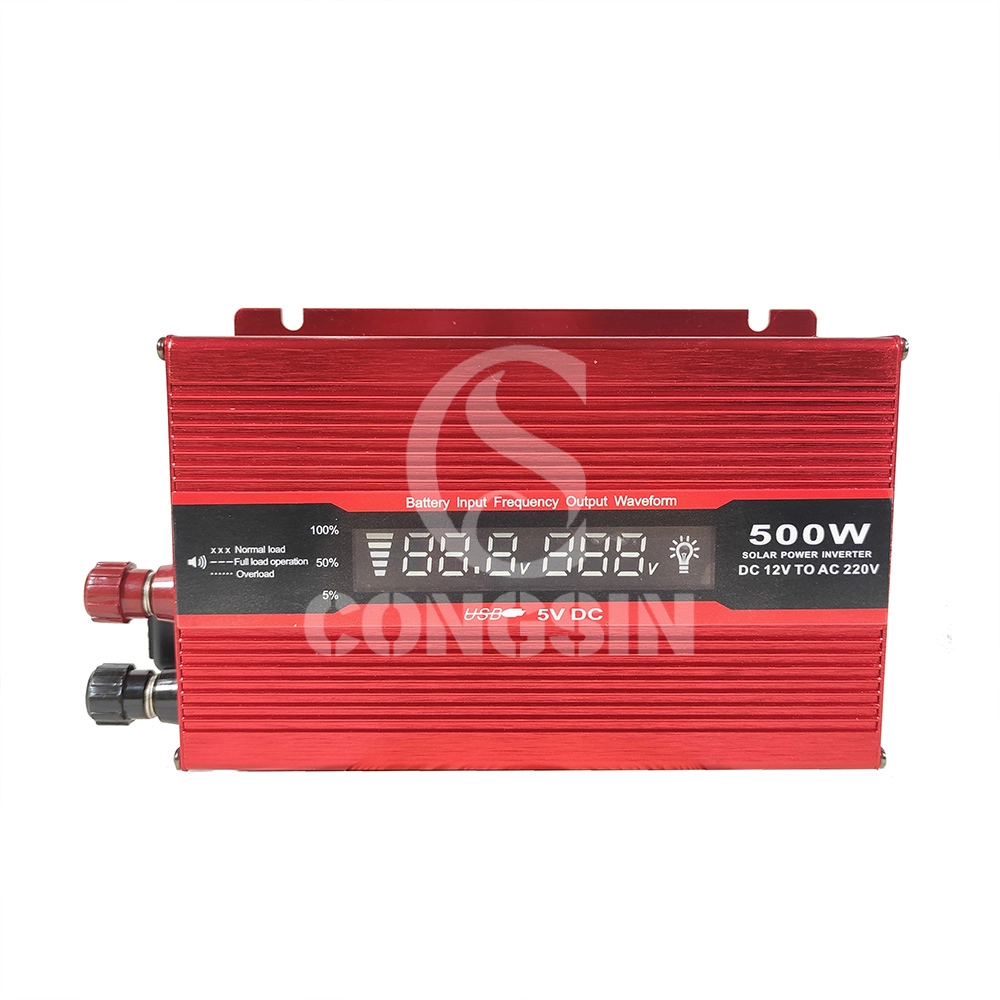
500W Modified Sine Wave Inverter (Rated 360W Peak 720W) DC12V to AC220V Inverter with LED Display Universal Socket
This 500W modified sine wave inverter has a rated power of 360W and a peak power of 720W, with DC12V input and AC220V output. Equipped with 1 USB port, universal socket, LED display, external fuse design, and battery clip, it has an exquisite appearance and stable performance. It can provide reliable AC power conversion for mobile phones, small home appliances, electronic devices, etc. in scenarios such as vehicle, outdoor, and home emergency, meeting the power needs of various devices.
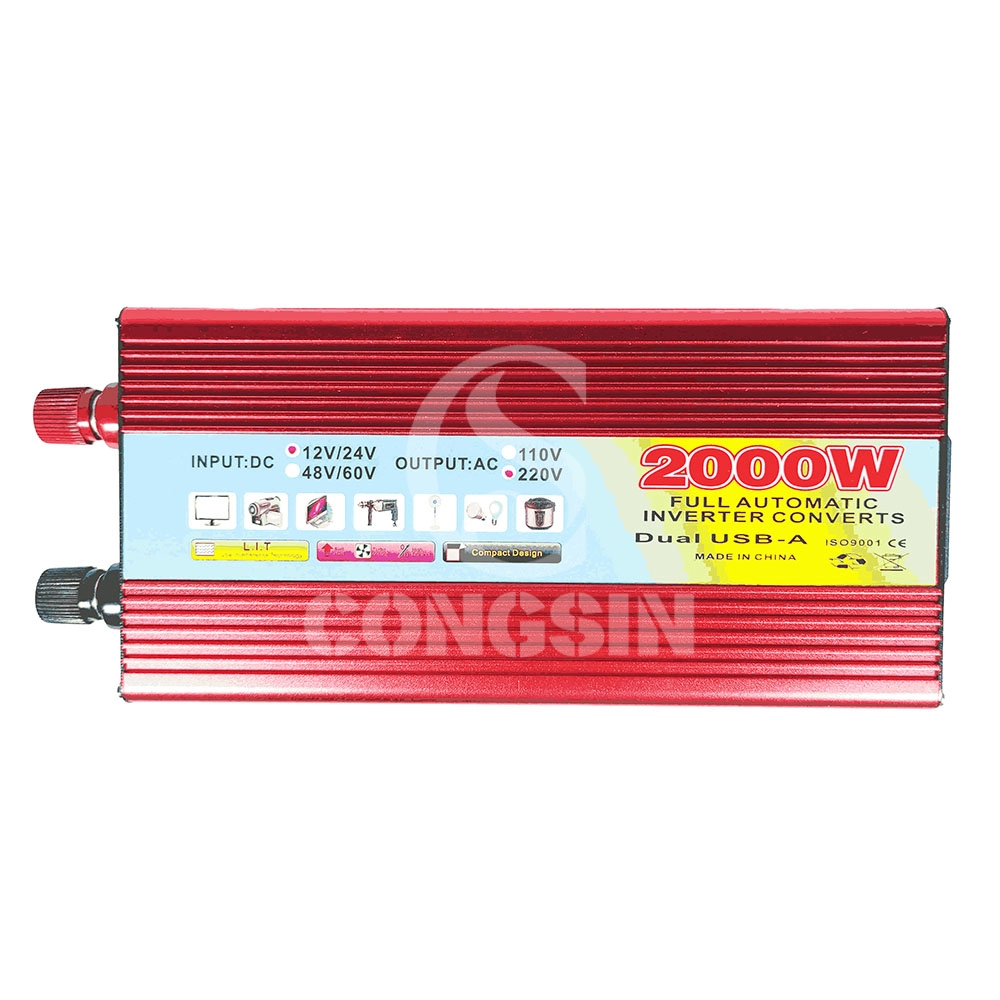
2000W Dual Input Modified Sine Wave Power Inverter (12V/24V or 48V/60V)
This 2000W modified sine wave inverter features a dual-input voltage design (12V/24V or 48V/60V), making it compatible with various DC systems. Compact, efficient, and versatile, it delivers a stable AC 220V output for home, vehicle, and solar power applications.
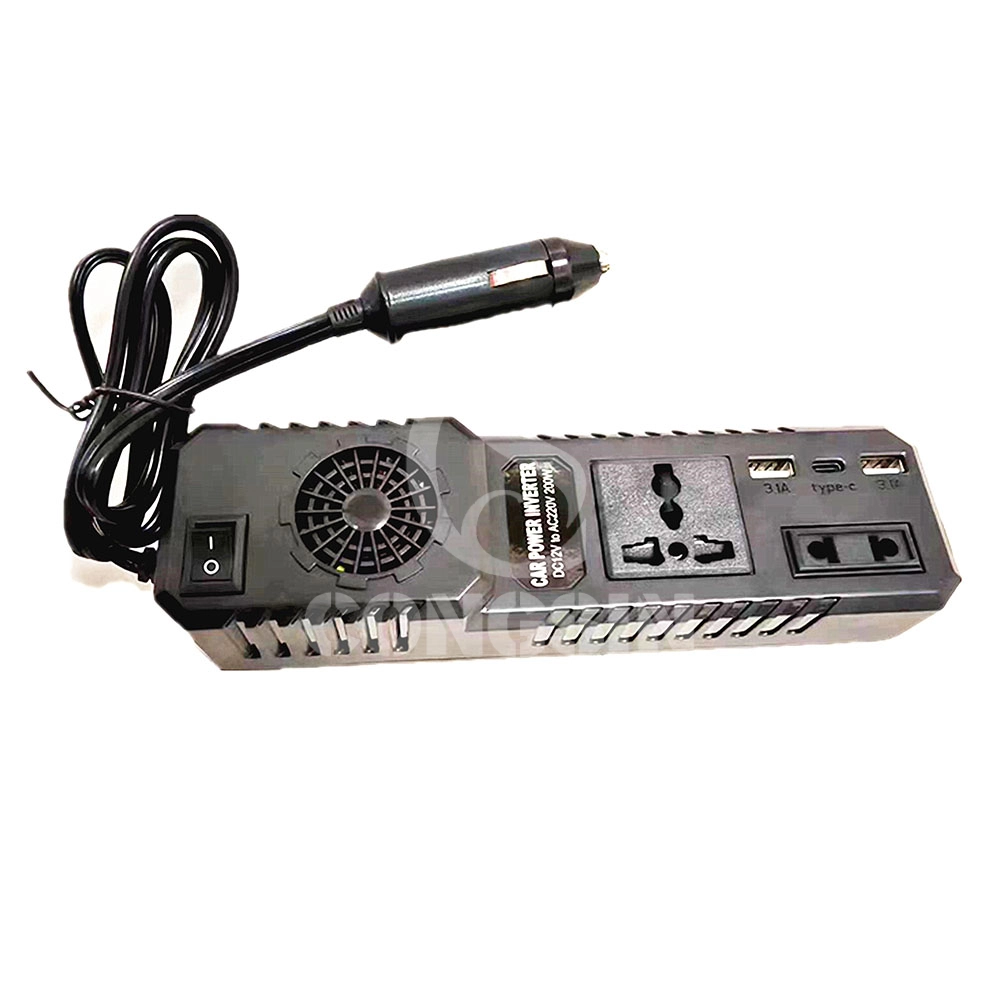
200W Modified Sine Wave Car Power Inverter, Dual Input DC12V/24V to AC220V with Type-C & Dual USB Ports
This 200W Modified Sine Wave Car Power Inverter is a compact and practical power conversion device designed for vehicle use. It supports dual input (DC12V/24V) and outputs AC220V, compatible with various electronic devices. Equipped with a Type-C port and dual 3.1A USB outputs, it can charge laptops, phones, cameras, drones, and other small electronics simultaneously—perfect for outdoor travel, emergency backup, and mobile work scenarios.
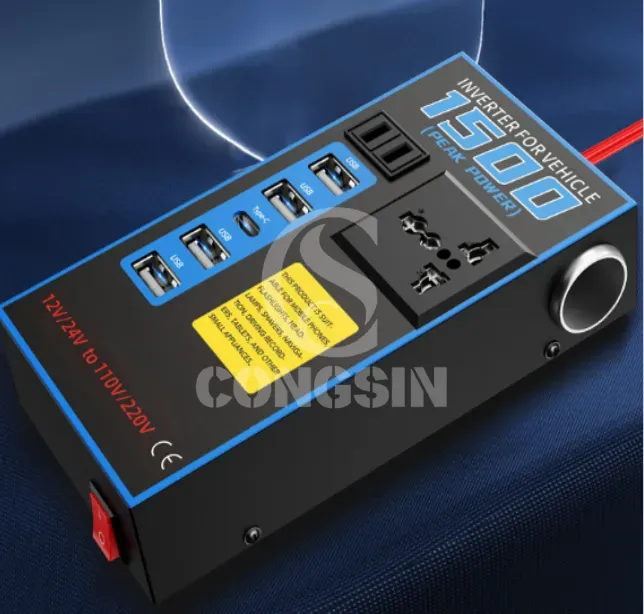
Congsin 1500W Inverter for Vehicle DC 12V/24V to AC 110V/220V with Universal socket Modified Sine Wave

CONGSIN is a trusted OEM factory for power inverters, solar charge controllers, and DC converters. Reliable solutions for global B2B buyers.
 High Quality
 7/24 Service
 Guaranteed Warranty
© 2025 Congsin. All Rights Reserved.