





How to Match Inverter Wattage to Your Car Appliances
- Why correct inverter sizing matters
- Protecting appliances and electronics
- Handling continuous vs. surge (startup) power
- Battery and vehicle electrical system impact
- How to calculate the inverter wattage you need
- Step 1 — List all appliances and note continuous and startup watts
- Step 2 — Add continuous watts and identify the largest startup load
- Step 3 — Account for inverter efficiency and derating
- Common appliances, typical watts and recommended inverter sizes
- Example calculation
- Installation, efficiency and safety considerations
- Cable sizing and fusing
- Battery capacity, depth-of-discharge and run-time
- Ventilation, mounting and thermal derating
- Choosing the right inverter and supplier
- Pure sine vs modified sine wave
- Key specifications to check
- Why work with an experienced manufacturer
- About Guangzhou Congsin Electronic Technology Co., Ltd.
- Why choose Congsin (competitive strengths)
- Frequently Asked Questions (FAQ)
- 1. Can I run a microwave on a car inverter?
- 2. Do I always need a pure sine wave inverter for my car?
- 3. How much battery capacity do I need to run a fridge overnight?
- 4. Why does my inverter alarm when starting a motor?
- 5. How do I choose the right cable size for my inverter installation?
- Need help selecting a model?
How to Match Inverter Wattage to Your Car Appliances
As someone who has advised fleet managers, RV owners and automotive electricians for years, I know the frustration of buying an inverter that can’t start a fridge or that rapidly drains a vehicle battery. In this guide I walk you through a reliable process to match inverter wattage to your car appliances — emphasizing car inverter pure sine wave solutions where sensitive electronics, motor-driven loads and audio/video gear are involved. I provide calculation methods, typical appliance data, safety and wiring guidance, and supplier considerations so you can make a decision that’s both safe and cost-effective.
Why correct inverter sizing matters
Protecting appliances and electronics
Not all inverters are created equal. Pure sine wave inverters produce a clean AC output close to mains electricity and are required for many electronics (laptops, medical devices, some chargers and audio equipment). Using a modified sine wave or an undersized unit can cause overheating, noise, reduced lifespan or immediate failure in sensitive devices. When you search for a car inverter pure sine wave, you’re often trying to avoid these issues and ensure safe, reliable operation.
Handling continuous vs. surge (startup) power
Most appliances specify a running (continuous) wattage and have a much higher startup or surge demand — motors, compressors and pumps can draw 3–7× their running current briefly. Matching only continuous watts without accounting for surge is the most common mistake. For background on inrush currents and why they matter, see the Wikipedia page on Inrush current.
Battery and vehicle electrical system impact
An inverter converts DC battery power into AC. Efficiency losses and inverter draw on the 12V/24V system affect discharge rates and cable requirements. Poor sizing can leave you stranded with a dead battery or damage vehicle wiring. I’ll show calculations to estimate DC current draw and battery amp-hours needed for planned use.
How to calculate the inverter wattage you need
Step 1 — List all appliances and note continuous and startup watts
Start by making a realistic list with typical wattage values for each device you plan to run simultaneously. Use manufacturer labels or measured power where available. When uncertain, use conservative (higher) estimates for motors and compressors.
Step 2 — Add continuous watts and identify the largest startup load
Total continuous watts = sum of running wattages. Required inverter continuous rating should be at least this total plus a safety margin (I recommend 20–30%). Required surge rating must be at least the highest startup wattage among devices running at the same time.
Step 3 — Account for inverter efficiency and derating
Inverter efficiency typically ranges 85–95% depending on quality and load (pure sine units in the 90–95% range at moderate loads). To account for conversion loss, divide the AC watts by expected inverter efficiency to find DC input power.
Example formulas:
- Required inverter continuous AC power = Total continuous watts × 1.2 (20% margin)
- DC current (amps) at 12V = (AC watts) / (12V × inverter_efficiency)
- Battery Ah needed = (AC watts × hours) / (battery_voltage × usable_DoD × inverter_efficiency)
Useful reference on inverter function and efficiency considerations: Inverter (electrical) — Wikipedia.
Common appliances, typical watts and recommended inverter sizes
Below I provide a practical table of common vehicle and camp appliances with typical running and startup watts, and a recommended inverter continuous + surge rating. These are conservative values for safe operation.
| Appliance | Typical Running Watts | Typical Startup / Surge | Recommended Inverter (Continuous / Surge) |
|---|---|---|---|
| Phone/Laptop chargers | 10–60 W | Equal to running (resistive) | 200 W / 400 W |
| Portable fridge / cooler | 40–100 W (avg) | 300–800 W (compressor start) | 1000 W / 1500 W |
| Coffee maker / kettle | 600–1200 W | Equal to running | 1500 W / 2000 W |
| Microwave (700–1000 W) | 700–1000 W | Equal to running | 1500 W / 2000 W |
| Small power tools (drills, saws) | 300–1800 W | 2–3× running (motor inrush) | 2000 W / 4000 W (depending on tool) |
Notes: motor and compressor startup can be several times running current — use the largest expected startup value to size surge capacity. These are typical ranges; always check appliance labels or measure actual current where possible.
Example calculation
Say you plan to run a 60 W laptop, a 50 W LED light, and a portable fridge averaging 80 W running but with 600 W startup. Continuous watts = 60 + 50 + 80 = 190 W. Add 20% margin => 228 W. The fridge startup is 600 W, so choose an inverter with at least 228 W continuous (practically a 300–500 W unit) and at least 600 W surge. A 500 W pure sine inverter with 1000–1200 W surge would be ideal. To size battery draw at 12 V and 90% inverter efficiency: DC current = 228 W / (12 V × 0.9) ≈ 21.1 A.
Installation, efficiency and safety considerations
Cable sizing and fusing
When drawing significant current from a 12 V vehicle battery, cable gauge and fusing are critical. The table below is a conservative guide for continuous DC currents; always refer to manufacturer/specs for exact runs and temperature derating.
| Approx. Continuous DC Current (A) | Recommended Wire Gauge (AWG) | Typical Fuse Size (A) |
|---|---|---|
| 0–10 A | 18–16 AWG | 15 A |
| 10–20 A | 16–14 AWG | 20 A |
| 20–30 A | 14–12 AWG | 30 A |
| 30–50 A | 12–10 AWG | 40–60 A |
| 50–65 A | 10–8 AWG | 70 A |
| 65–95 A | 8–6 AWG | 100 A |
Reference for AWG and conductor sizing: American wire gauge — Wikipedia. For long cable runs and hot environments, step up a gauge to reduce voltage drop.
Battery capacity, depth-of-discharge and run-time
Battery sizing depends on how long you want to run loads and the battery chemistry. A practical formula:
Battery Ah needed = (AC watts × hours) / (battery_voltage × usable_DoD × inverter_efficiency)
Example: To run 228 W for 3 hours from a 12 V lead-acid battery with 50% usable DoD and inverter efficiency 90%: Ah = (228 × 3) / (12 × 0.5 × 0.9) ≈ 126 Ah. Using a 12 V 150 Ah deep-cycle or a smaller lithium pack (higher usable DoD) is typical.
For battery chemistry details and recommended DoD values, see relevant battery chemistry references and vendor datasheets; for general battery concepts consult Battery (electricity) — Wikipedia.
Ventilation, mounting and thermal derating
Inverters produce heat. Install with manufacturer-recommended clearance and airflow. Many inverters reduce continuous rating above certain ambient temperatures; check the datasheet for thermal derating curves. Outdoors and enclosed cabins require extra caution.
Choosing the right inverter and supplier
Pure sine vs modified sine wave
I always recommend a pure sine wave inverter when you plan to run modern electronics, audio equipment, motor-driven compressors or sensitive chargers. Modified sine wave units are cheaper but can cause humming, reduced efficiency and may prevent some devices from operating correctly.
Key specifications to check
- Continuous power rating (W) and surge rating (W)
- Output waveform: pure sine wave
- DC input voltage compatibility (12V/24V/48V) with vehicle system
- Efficiency (%) at expected load
- Protections: low battery, over temp, overload, short circuit
- Certifications: CE, EMC, LVD, ETL, FCC, RoHS and vehicle-specific E-MARK if required
Why work with an experienced manufacturer
Long-term reliability, correct thermal design and compliance are more likely from established manufacturers who operate standardized quality systems. Standards like ISO 9001 indicate a quality management system; see ISO 9001 — ISO for background.
About Guangzhou Congsin Electronic Technology Co., Ltd.
Guangzhou Congsin Electronic Technology Co., Ltd., founded in early 1998, is a professional power inverter manufacturer with over 27 years of focused experience. We design, R&D and manufacture a wide range of power solutions—with a core emphasis on DC→AC power inverters, portable power stations, and solar charge controllers. Our catalog includes 100+ models tailored for vehicles, solar systems, RVs and trucks, off-grid homes, outdoor offices, patrol and field construction work.
We operate fully automated production lines, advanced instrumentation and multifunctional testing equipment to ensure product reliability, efficiency and intelligent functionality. Environmental and safety compliance are built in: our quality system is ISO9001 certified and many products hold international approvals such as CE, EMC, LVD, ETL, FCC, RoHS and E-MARK. Several independently developed patents further demonstrate our commitment to innovation.
Congsin’s products serve global markets across Europe, the Americas, the Middle East, Africa and Southeast Asia; many models are supplied to domestic and international OEM channels. Our support includes OEM/ODM, private labeling, distribution and bespoke customization to meet partner specifications.
Our mission is to deliver reliable, efficient and affordable energy solutions that enable energy independence. Congsin’s core offerings include Solar Charge Controllers, modified sine wave inverters, pure sine wave inverters and portable power stations. If you are looking specifically for a car inverter pure sine wave option, Congsin’s portfolio includes models optimized for vehicle electrical systems with comprehensive protections and high efficiency.
Why choose Congsin (competitive strengths)
- 27+ years focused manufacturing experience in power electronics
- Automated production lines and advanced testing for consistent quality
- International certifications and supply to OEM channels
- Flexible OEM/ODM and customization support for vehicle and off-grid applications
Frequently Asked Questions (FAQ)
1. Can I run a microwave on a car inverter?
Yes, but only with a sufficiently sized inverter. Microwaves are high-power loads — a typical 700–1000 W microwave will need an inverter rated at least 1500 W continuous (often higher to avoid derating) with a matching DC power supply and wiring. Ensure the inverter’s surge capability and inverter efficiency are considered.
2. Do I always need a pure sine wave inverter for my car?
Not always. For simple resistive loads (incandescent lamps, some heaters) or basic phone chargers, modified sine may work. But for laptops, sensitive electronics, audio equipment, compressors and many modern chargers, a pure sine wave inverter is recommended to avoid noise, overheating or malfunction.
3. How much battery capacity do I need to run a fridge overnight?
Estimate the fridge’s average running watts (often 40–100 W), multiply by hours, and apply the battery Ah formula factoring inverter efficiency and usable DoD. For example, 60 W for 10 hours = 600 Wh; at 12 V and 90% efficiency with 50% usable DoD => Ah ≈ (600) / (12 × 0.5 × 0.9) ≈ 111 Ah.
4. Why does my inverter alarm when starting a motor?
Most likely the startup (inrush) current of the motor exceeds the inverter’s surge capacity or the DC supply cannot deliver the transient. Use a higher-surge inverter or stagger startup of heavy loads; verify battery health and cable connections.
5. How do I choose the right cable size for my inverter installation?
Choose wire gauge to safely carry the expected continuous DC current with minimal voltage drop. Use conservative wire charts (AWG) and consult the inverter manual; fuse closeness to the battery and secure crimped connections are essential. For long runs, increase gauge to reduce voltage drop.
Need help selecting a model?
If you’d like personalized sizing assistance or to review Congsin’s vehicle-focused pure sine wave inverter models, contact our technical team. We can recommend models, provide wiring guidance, and support OEM/ODM customization to ensure your inverter matches your car appliances and use case.
Contact / Product Inquiry: Reach out to Guangzhou Congsin Electronic Technology Co., Ltd. for quotations, datasheets and application support. Explore our pure sine wave inverter and portable power station ranges to find a solution matched to your vehicle electrical system.
Sizing Off-Grid Inverters: Calculate Load, Battery & Solar Needs
How to Choose a Reliable 1000 Watt Car Inverter for Camping
UPS vs Inverter: Choosing the Right Backup Power System
High Frequency Inverter Buying Guide for Industrial Applications
Modified Sine Wave Inverters
Is the cooling fan noisy?
The fan is designed for heat dissipation and will make some noise during operation, but it is within a reasonable range and will not interfere with normal use.
Can this inverter support both 12V and 24V inputs
Yes, it can work with different voltage systems via selectable input terminals.
Is the cooling fan noisy during operation?
The noise is low (≤45 decibels, equivalent to normal conversation volume). The fan uses a silent motor and automatically adjusts the speed according to the device temperature (low-speed operation when temperature <40℃, high-speed operation when >60℃), balancing heat dissipation and noise.
Do you support OEM branding?
Yes, we offer logo, packaging, and label customization.
OEM & ODM Services
Do you provide support for shipping and customs clearance?
Yes, we offer international logistics solutions including export documentation and customs advice.
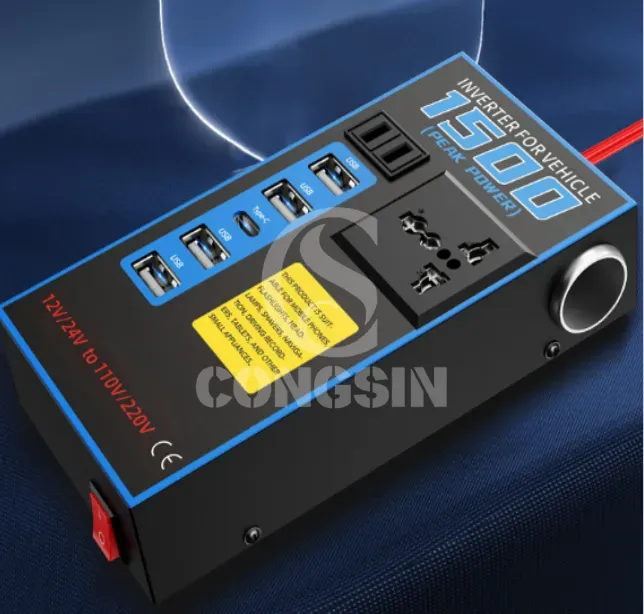
Congsin 1500W Inverter for Vehicle DC 12V/24V to AC 110V/220V with Universal socket Modified Sine Wave
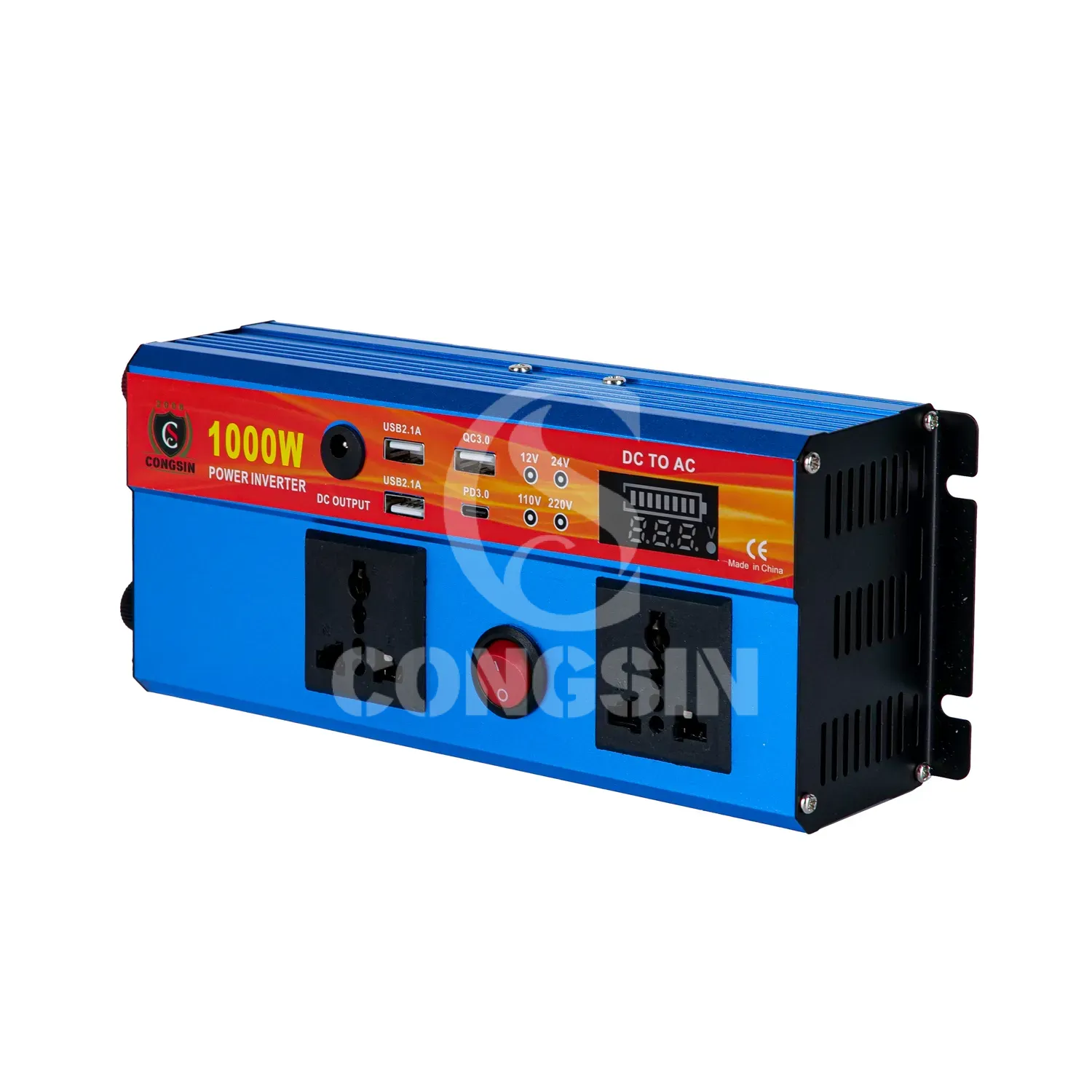
Congsin 1000W modified sine wave inverter with LED display and Type C port car RV power inverter
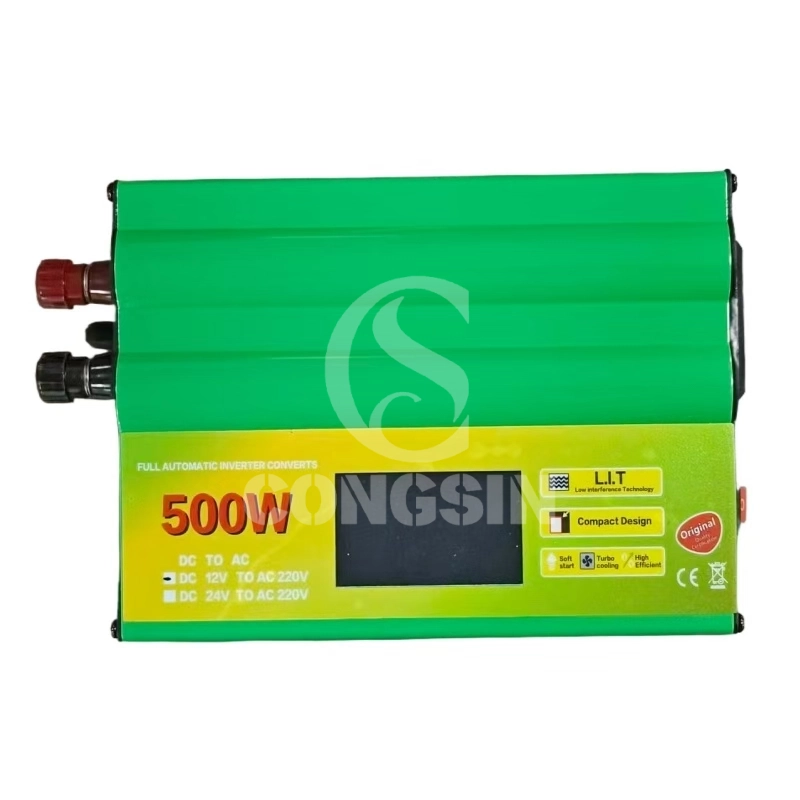
Congsin Modified Sine Wave Inverter 500W 1000W 1500W 12V LED Display Portable for RV Car Solar
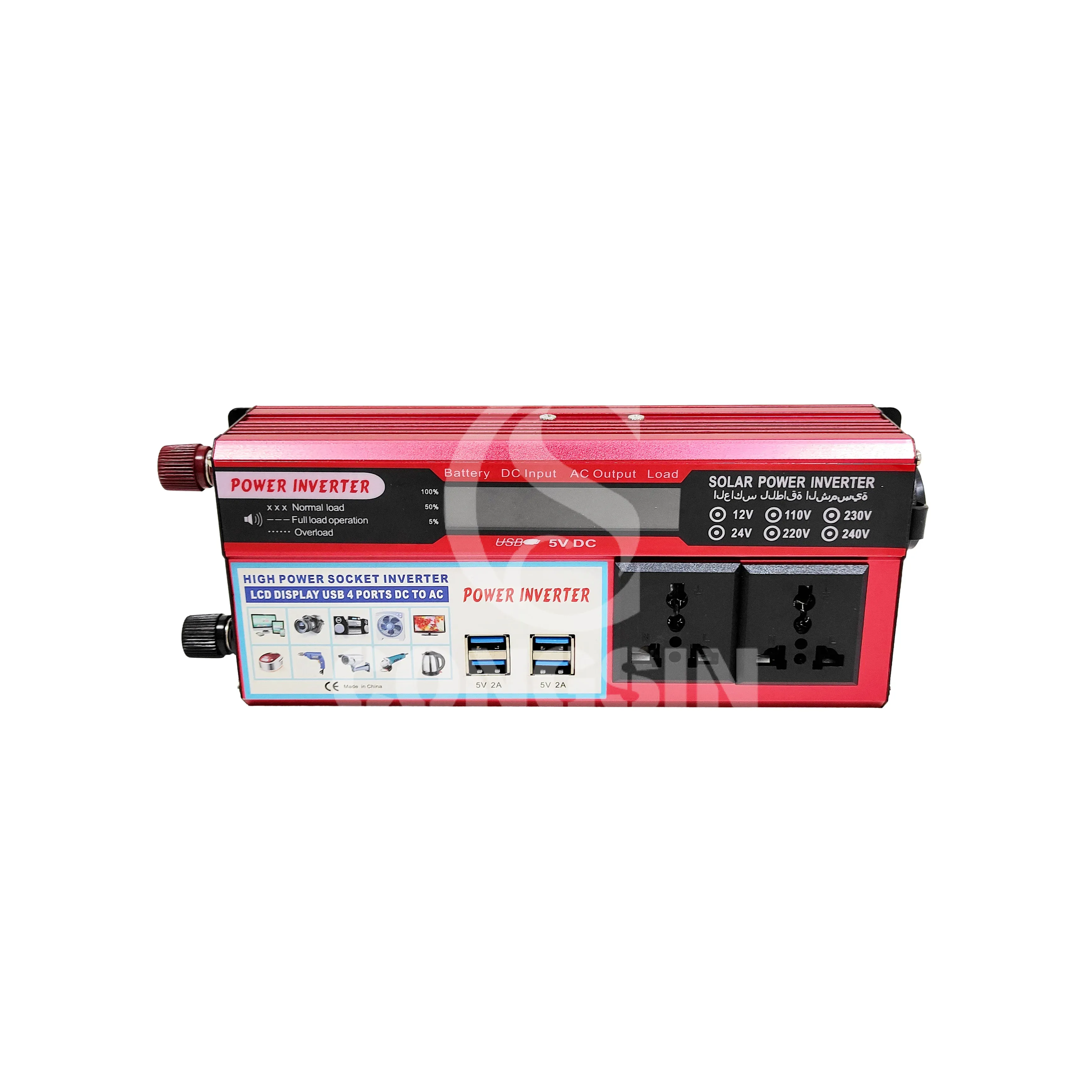
Congsin 1500W modified sine wave inverter with LCD display and USB ports for RV car boat home use

CONGSIN is a trusted OEM factory for power inverters, solar charge controllers, and DC converters. Reliable solutions for global B2B buyers.
 High Quality
 7/24 Service
 Guaranteed Warranty
© 2025 Congsin. All Rights Reserved.