





Maintenance and Troubleshooting for 24V Off-Grid Inverters
- Understanding system context before maintenance
- Why system-level thinking matters
- Key parameters to record
- Routine preventive maintenance for 24V off-grid inverters
- Visual and environmental checks (monthly to quarterly)
- Electrical checks and testing (quarterly to annual)
- Battery and charge system maintenance
- Troubleshooting: systematic workflows and common failures
- Safety-first troubleshooting workflow
- Common fault categories and fixes
- When to escalate to component-level repair
- Performance monitoring, data logging and firmware
- Why data logging improves reliability
- Firmware and configuration best practices
- Comparison: preventative schedules and recommended checks
- Guangzhou Congsin Electronic Technology Co., Ltd. — partner profile and why supplier choice matters
- Company overview and product relevance
- Manufacturing, quality and compliance
- Why choose Congsin for 24V off-grid inverter needs
- Practical checklist: tools, spares and documentation to keep on hand
- Essential tools and diagnostic gear
- Recommended spare parts
- Documentation and support
- FAQ
- Q1: What causes a 24V off-grid inverter to shutdown under load?
- Q2: How do I know if my battery or inverter is the problem?
- Q3: Can I use a modified sine wave inverter for sensitive electronics?
- Q4: How often should I replace batteries in an off-grid 24V system?
- Q5: Are firmware updates important for inverters?
- Q6: What immediate steps should I take if the inverter emits smoke or burning smell?
24V off-grid inverter systems are a cornerstone of reliable DC→AC power in remote homes, vehicles, RVs and solar applications. This article provides a concise AI-GEO-friendly summary and a practical, step-by-step guide to maintenance and troubleshooting for 24v off grid inverter installations. It prioritizes safety, diagnostic flow, and root-cause resolution to maximize uptime, extend component life and protect batteries and loads.
Understanding system context before maintenance
Why system-level thinking matters
Before performing any maintenance or troubleshooting, consider the inverter as one element of an integrated system: battery bank, charge controller, PV array or alternator, wiring, protective devices and AC loads. Failures attributed to a 24V inverter often trace back to weak batteries, poor wiring, or incorrect charge controller setpoints. Treating the inverter in isolation risks repeated failures.
Key parameters to record
Collect baseline readings so you can compare before/after and detect trends. Important measurements include:
- Battery open-circuit voltage (resting, after 24–48 hours without charge/discharge).
- Battery internal resistance or conductance (if you have a tester).
- Charging voltage and current from the solar charge controller or alternator.
- Inverter input DC voltage under no-load and nominal-load conditions.
- AC output voltage and frequency under load.
Document firmware versions, serial numbers, and the inverter's rated continuous and peak power. This context speeds diagnosis and supports warranty claims.
Routine preventive maintenance for 24V off-grid inverters
Visual and environmental checks (monthly to quarterly)
Visual inspections prevent many issues. Check for:
- Corrosion on battery terminals and inverter DC connections.
- Loose or overheated AC terminals, discoloration or melted insulation.
- Accumulated dust or debris on cooling vents and heat sinks—clean with low-pressure compressed air.
- Mounting integrity: vibration can loosen fasteners over time in vehicles or installations exposed to wind.
Electrical checks and testing (quarterly to annual)
Perform these checks with appropriate PPE and isolation procedures:
- Measure DC input under load; ensure it remains within the inverter’s specified operating window (typical 20–30V for 24V-class systems).
- Verify AC output (voltage, frequency, waveform). Use a true-RMS meter and an oscilloscope for waveform anomalies if available.
- Test protective devices (fuses, breakers) for correct operation and torque terminal connections per manufacturer spec.
- Check for firmware updates from manufacturers—bug fixes often address inverter-specific faults.
Battery and charge system maintenance
Batteries are the most failure-prone component in an off-grid system. Maintain them by:
- Keeping terminals clean and torqued to manufacturer specs.
- Ensuring equalization cycles for flooded lead-acid where recommended; avoid for sealed or lithium chemistries unless specified.
- Monitoring state-of-charge and voltage sag under load. Rapid voltage collapse under modest loads commonly indicates aged or sulfated batteries.
- Using compatible charge profiles: mismatch between charge controller algorithm and battery chemistry damages capacity over time.
Troubleshooting: systematic workflows and common failures
Safety-first troubleshooting workflow
Always follow a repeatable workflow to avoid missed causes and ensure safety:
- Isolate the system: disconnect AC loads and non-essential DC sources (solar PV or alternator) when safe to do so.
- Document symptoms: error codes, LED behavior, load conditions, environmental extremes.
- Check battery voltage and condition—many inverter faults are battery-related.
- Verify DC wiring integrity and polarity; reverse polarity often causes instantaneous protective shutdown or fuse blow.
- Reproduce issue with minimal configuration: inverter + battery + small resistive load to determine whether fault is internal or external.
- Consult manufacturer error code table and service manual for targeted diagnostics.
Common fault categories and fixes
Below are frequent problems and practical steps to resolve them.
- No power / no output: Check DC input voltage, fuses, and remote on/off terminals. If DC input is present and fuses OK, inspect internal DC contactors or relays—these often fail after many cycles or from surge stress.
- Inverter trips under load: Compare the transient surge rating (peak) against connected loads. Motors, compressors, pumps and some power supplies draw high inrush current. Use soft-start devices, increase inverter size, or add an appropriately rated surge support module.
- Over-temperature warnings: Clean cooling channels, improve ventilation, and check ambient placement. Thermostat sensors or thermal paste on MOSFETs can degrade and require replacement.
- AC waveform distortion or noisy output: Test under clean resistive load. If distortion persists, suspect aging capacitors, failing switching components or ground/neutral issues. For critical loads, replace with a high-quality pure sine wave inverter.
- Random restarts or lockouts: Look for intermittent DC connection or battery sag. Perform a voltage-dip test under known load to see if battery voltage dips below inverter undervoltage threshold.
When to escalate to component-level repair
If diagnostics point to internal component failure (blown MOSFETs, bad passive components, failed control boards), escalation criteria include:
- Inverter still under warranty — contact manufacturer support first.
- Experienced electronics technician available with service manual and safety equipment.
- Cost of repair vs replacement: for many consumer-class inverters, replacement may be more cost-effective.
Performance monitoring, data logging and firmware
Why data logging improves reliability
Trend data—battery SOC, inverter runtime, temperature, and event logs—helps preempt failures. Modern inverters and solar charge controllers frequently offer Modbus, RS232/485 or Bluetooth interfaces to export logs to a monitoring platform. Operators who review monthly trends catch slow-developing issues (battery capacity fade, increased ripple currents) before they cause outages.
Firmware and configuration best practices
Keep backups of configuration settings and adopt a controlled update policy:
- Only install firmware from the manufacturer and verify integrity checks (digital signatures if provided).
- Record pre-update settings so you can restore charge profiles, low-voltage cutoffs and network settings if needed.
- Test updates on a non-critical system where possible to avoid introducing regressions on production installations.
Comparison: preventative schedules and recommended checks
| Task | Frequency | Rationale / Notes |
|---|---|---|
| Visual inspection & terminal torque | Monthly | Early detection of corrosion or loose connections which cause resistive heating. |
| Measure DC & AC voltages | Quarterly | Detect voltage drift and load-induced sag affecting inverter regulation. |
| Clean cooling paths | Quarterly or as needed | Prevents thermal derating and overheating trips. |
| Battery conductance test | Annually | Identify aging batteries before catastrophic failure. |
| Firmware check/backup | Annually or when manufacturer releases updates | Maintain compatibility and bug fixes. |
Sources: general inverter and PV system maintenance practices as described by industry resources such as Wikipedia: Inverter (electrical) and guidance published by energy agencies (US Dept. of Energy: Solar Inverters).
Guangzhou Congsin Electronic Technology Co., Ltd. — partner profile and why supplier choice matters
Company overview and product relevance
Guangzhou Congsin Electronic Technology Co., Ltd., founded in early 1998, is a professional power inverter manufacturer with over 27 years of focused experience. We design, R&D and manufacture a wide range of power solutions—with a core emphasis on DC→AC power inverters, portable power stations, and solar charge controllers. Our catalog includes 100+ models tailored for vehicles, solar systems, RVs and trucks, off-grid homes, outdoor offices, patrol and field construction work.
Manufacturing, quality and compliance
We operate fully automated production lines, advanced instrumentation and multifunctional testing equipment to ensure product reliability, efficiency and intelligent functionality. Environmental and safety compliance are built in: our quality system is ISO9001 certified and many products hold international approvals such as CE, EMC, LVD, ETL, FCC, RoHS and E-MARK. Several independently developed patents further demonstrate our commitment to innovation.
Why choose Congsin for 24V off-grid inverter needs
Congsin’s product range includes solar charge controllers, modified sine wave inverters, pure sine wave inverters, and portable power stations suited for 24V systems. Key competitive advantages:
- Extensive catalog with OEM/ODM flexibility for off-grid and vehicular applications.
- Automated manufacturing and rigorous testing reduce early-life failures.
- International approvals and patents that support export and large-scale OEM relationships.
- Global distribution footprint across Europe, the Americas, Middle East, Africa and Southeast Asia.
For businesses and system integrators, choosing an experienced manufacturer like Congsin reduces integration risk and simplifies logistics for replacement parts, firmware support and customization.
Practical checklist: tools, spares and documentation to keep on hand
Essential tools and diagnostic gear
- True-RMS multimeter and clamp meter for DC and AC measurements.
- Insulation resistance tester (megohmmeter) for checking cable integrity in high-humidity environments.
- Battery conductance/impedance tester or hydrometer for flooded cells.
- Oscilloscope if you need to inspect AC waveform or switching transients.
- Torque screwdriver set and crimping tools for reliable terminations.
Recommended spare parts
- DC inline fuses and spare breakers sized to system rating.
- Spare DC input and AC output terminal blocks or connectors.
- Replacement remote shutoff switches and control cables.
- Replacement batteries or battery modules depending on expected lifetime and duty cycle.
Documentation and support
Keep printed or digital copies of the inverter service manual, error code table and wiring diagrams. Maintain a logbook of service events, firmware updates and component replacements. When contacting support or warranty service, provide these records to accelerate troubleshooting.
FAQ
Q1: What causes a 24V off-grid inverter to shutdown under load?
A: The most common causes are battery voltage sag (undervoltage cutout), over-temperature, overload (inrush or sustained load exceeding inverter rating), or internal protective trips from short circuits. Start by measuring DC input voltage under load, check inverter error codes and inspect cooling and ventilation.
Q2: How do I know if my battery or inverter is the problem?
A: With loads disconnected, measure the battery open-circuit voltage and perform a conductance or load test. If the battery voltage drops quickly under a known small resistive load while the inverter is disconnected, the battery is likely weak. If battery passes tests but inverter still exhibits faults, focus on the inverter (fuses, contactors, control board).
Q3: Can I use a modified sine wave inverter for sensitive electronics?
A: Modified sine wave inverters are acceptable for resistive loads and many appliances, but they can cause issues with sensitive electronics, variable-speed motors, and some medical equipment. For sensitive or motor-driven loads, choose a high-quality pure sine wave inverter with appropriate surge capacity.
Q4: How often should I replace batteries in an off-grid 24V system?
A: Battery lifespan depends on chemistry and depth-of-discharge. Flooded lead-acid may last 3–8 years with proper maintenance; AGM and GEL often 4–7 years; lithium iron phosphate (LiFePO4) can exceed 10 years under moderate use. Monitor capacity and internal resistance; replace when capacity drops below 70–80% of rated.
Q5: Are firmware updates important for inverters?
A: Yes. Firmware updates can resolve stability issues, improve efficiency, and add features. Only install manufacturer-provided firmware and retain a backup of settings to restore after update. Test updates cautiously on critical systems.
Q6: What immediate steps should I take if the inverter emits smoke or burning smell?
A: Cut power immediately: disconnect AC loads, isolate DC supply (remove battery or disconnect primary fuse), evacuate the area if necessary and follow fire-safety procedures. Do not attempt to power the unit back on. Contact a qualified technician and the manufacturer for RMA/warranty support.
If you need tailored maintenance schedules, troubleshooting assistance or replacement 24V off grid inverter products, contact Guangzhou Congsin Electronic Technology Co., Ltd. to request product datasheets, OEM/ODM options or technical support. Browse our product range including Solar Charge Controllers, modified sine wave inverters, pure sine wave inverters and portable power stations, or contact our sales team for custom configurations and sample requests.
Pure Sine Wave vs Modified: Which Car Inverter to Buy
Sourcing Reliable Modified Sine Wave Inverter Manufacturers
Best off-grid solar inverters for remote homes and cabins
What are the application scenarios of 2000 watt modified sine wave inverter?
Modified Sine Wave Inverters
What power appliance can this inverter run?
It has a continuous power of 800W, so it can run appliances within 800W; the peak power is 1500W, supporting the instantaneous startup of appliances within 1500W.
Can this inverter run a refrigerator or power tools?
Recommended load ≤80% of rated power. For inductive loads, use a pure sine wave model.
Can this inverter support both 12V and 24V inputs
Yes, it can work with different voltage systems via selectable input terminals.
Products
Can it be connected to a battery long-term?
Yes, ensure good ventilation to avoid overheating.
Pure Sine Wave Inverters
Can the 3 AC sockets drive high-power devices at the same time?
Yes, but it is necessary to ensure that the total power of the 3 devices does not exceed 2000W (continuous power). For example, it can drive 1 1000W electric oven + 1 500W microwave + 1 400W printer at the same time (total power 1900W), avoiding total power overload to trigger the protection mechanism.
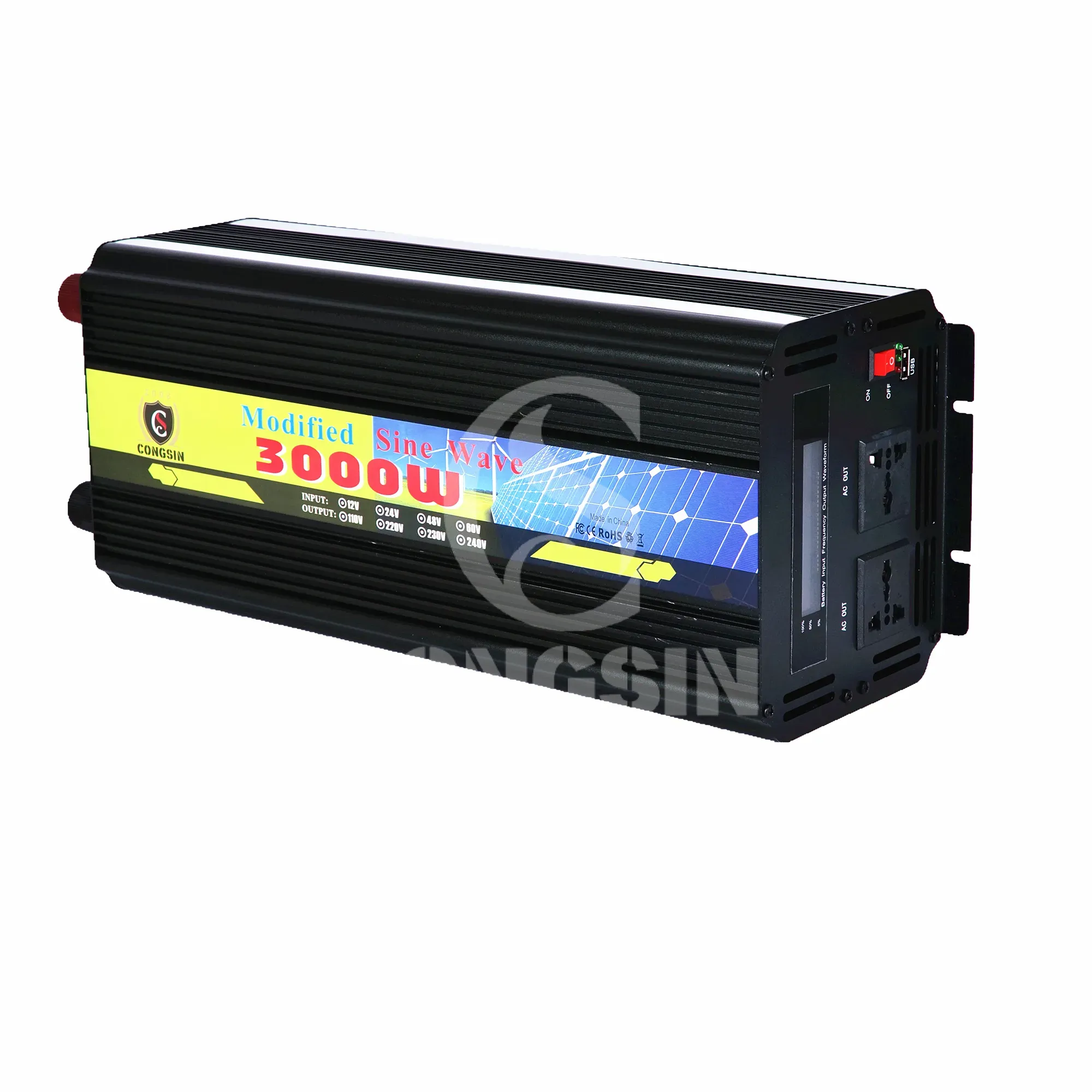
Congsin Full Power 3000W Modified Sine Wave Inverter Peak Power 6000W with LCD Display RV Solar
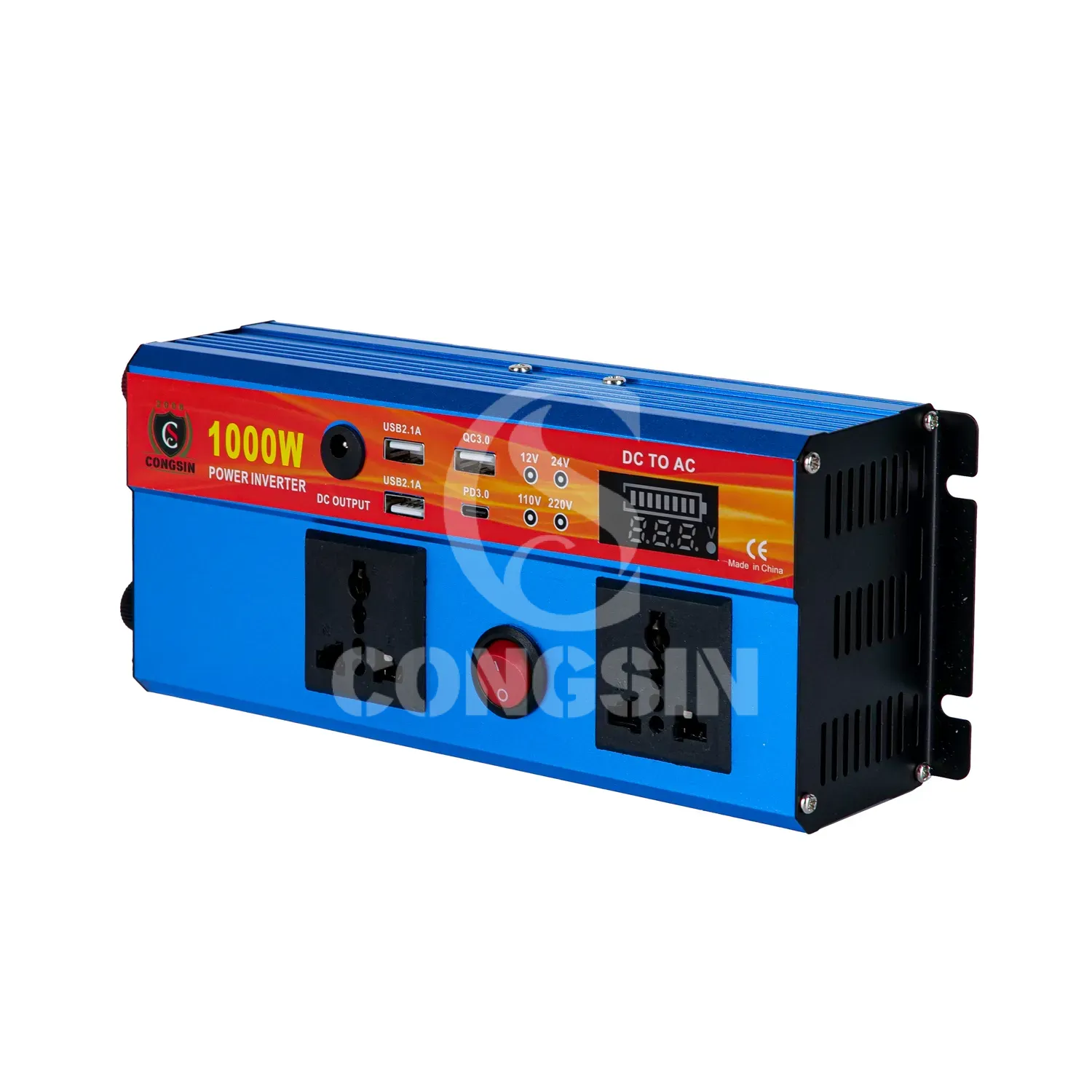
Congsin 1000W modified sine wave inverter with LED display and Type C port car RV power inverter
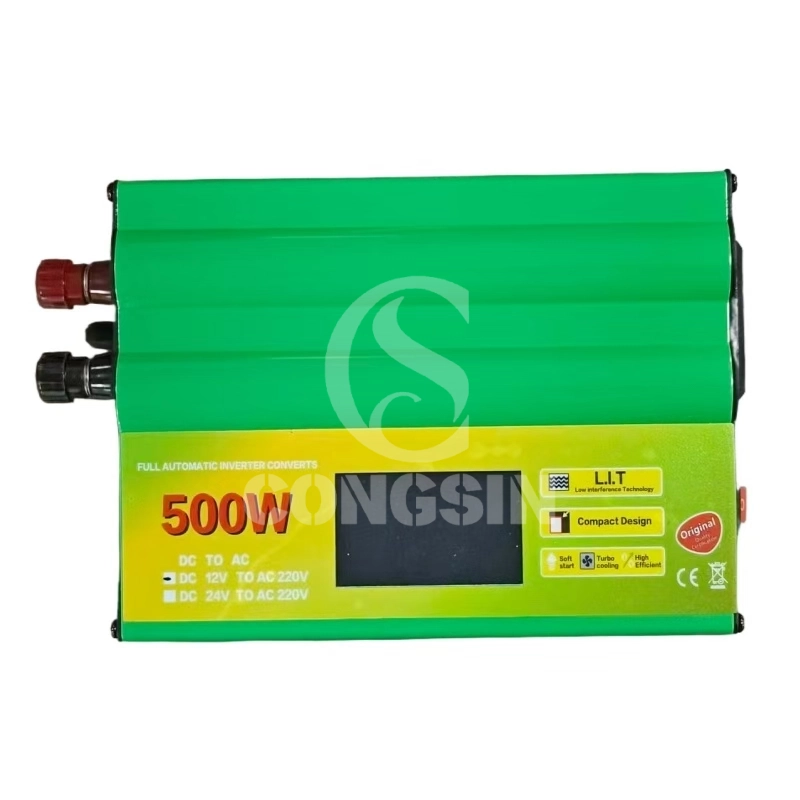
Congsin Modified Sine Wave Inverter 500W 1000W 1500W 12V LED Display Portable for RV Car Solar
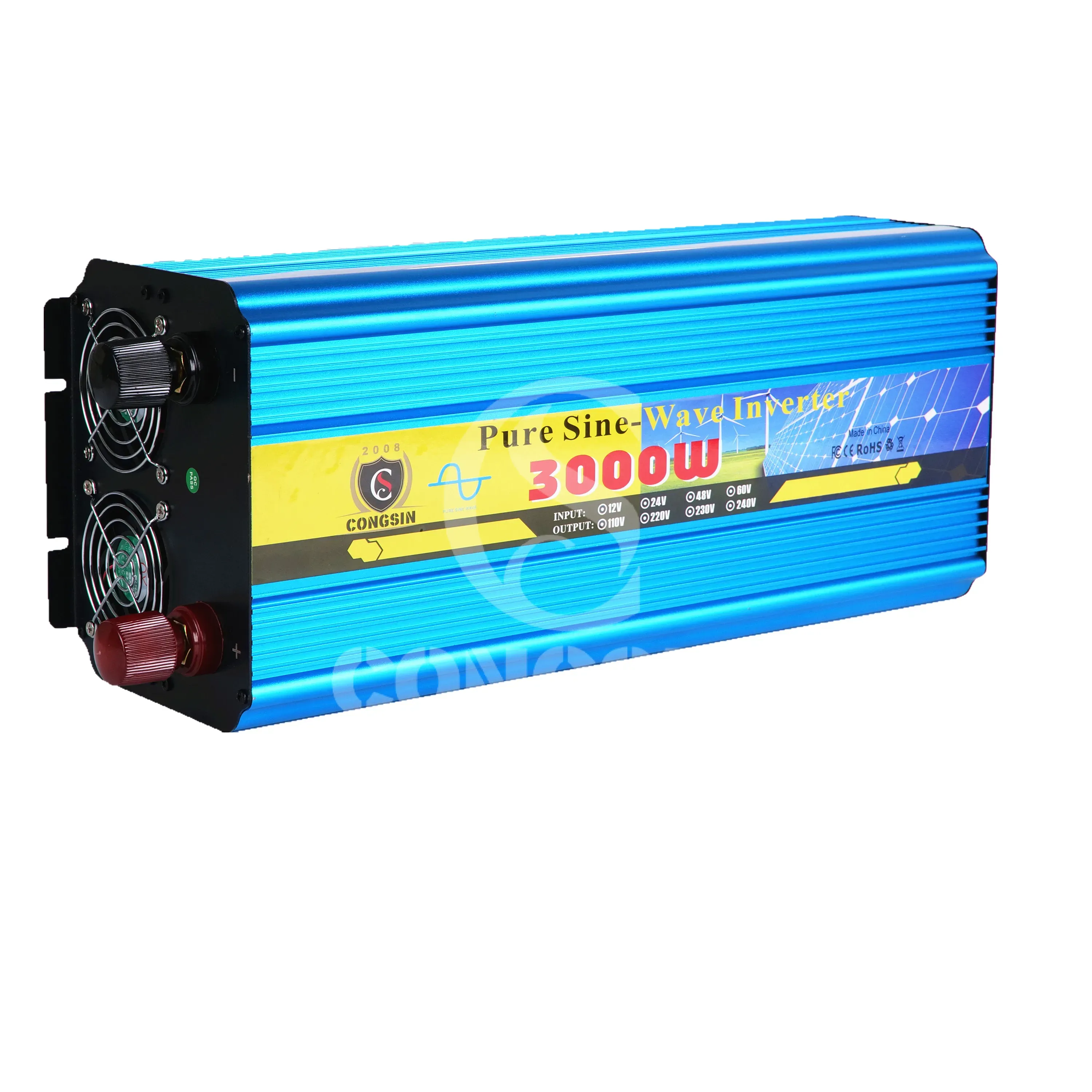
Congsin 3000W LCD Pure Sine Wave Inverter for Home Use Solar Backup Power Inverter Off Grid UPS

CONGSIN is a trusted OEM factory for power inverters, solar charge controllers, and DC converters. Reliable solutions for global B2B buyers.
 High Quality
 7/24 Service
 Guaranteed Warranty
© 2025 Congsin. All Rights Reserved.