





How Bidirectional Inverters Work: The Ultimate Guide to Energy Independence
- Key Takeaways: Quick Summary
- What is a Bidirectional Inverter and How Does it Work?
- The Core Mechanics: Rectification and Inversion Explained
- Vehicle-to-Home (V2H) and Vehicle-to-Grid (V2G) Integration
- Hybrid vs. Bidirectional Inverters: What's the Difference?
- Common Mistakes and Expert Tips for Installation
- Market Trends, Pricing, and ROI (2026 and Beyond)
- Industry Leading Solutions: Upgrading with Congsin
- Conclusion
- Can a bidirectional inverter work without the grid?
- How much does a bidirectional inverter cost?
- Are bidirectional inverters safe for EV batteries?
- What is the difference between an inverter and a bidirectional inverter?
- Do I need a bidirectional inverter for my solar panels?
- How does a bidirectional inverter prevent power outages?
- What size bidirectional inverter do I need for my house?
- Can I upgrade my existing solar inverter to a bidirectional one?
Key Takeaways: Quick Summary
This guide provides a rapid overview of how two-way power systems modernize home energy by enabling electric vehicles and batteries to both draw from and supply power to the grid, drastically improving off-grid resilience and financial return on investment.
To achieve true energy independence in 2026, understanding the underlying technology of your power setup is critical. Here are the core highlights of the shift toward advanced energy conversion:
- Modernizing Home Energy: A brief overview of how two-way power flow modernizes home energy, ensuring you are no longer just a consumer, but an active participant in the energy market.
- Vital Resilience: The vital role of bidirectional inverters in enabling EV-to-home charging and off-grid resilience, guaranteeing your lights stay on even when the centralized grid fails.
- Financial Advantage: Summary of expected ROI and energy savings for 2026, taking advantage of fluctuating utility rates by storing cheap energy and deploying it when prices peak.
What is a Bidirectional Inverter and How Does it Work?
A bidirectional inverter is an advanced power conversion device that changes Direct Current (DC) into Alternating Current (AC) and vice versa, enabling two-way energy flow to charge batteries from the grid and discharge stored energy back to your home.
Unlike standard one-way inverters that simply push solar power down a single path, these modern units act as the intelligent brain of a home microgrid. By utilizing bidirectional power flow, they seamlessly direct traffic between the utility grid, your solar panels, and your battery storage.

- Two-Way Mechanism: A bidirectional inverter is an advanced power conversion device that changes Direct Current (DC) to Alternating Current (AC) and vice versa. Unlike standard one-way inverters, it enables a two-way energy flow, allowing users to charge battery systems from the grid and discharge stored energy back to the home or grid.
- Advanced Switching: The operation relies on an overview of the switching mechanism using advanced semiconductors like Silicon Carbide (SiC) or Gallium Nitride (GaN). These materials operate with minimal thermal loss and incredible switching speeds, maximizing the efficiency of every watt.
- Smart Communication: It relies heavily on how the digital control loop interacts with the battery management system (BMS). The inverter constantly reads the state of charge, temperature, and voltage limits provided by the BMS to safely regulate energy transfer without degrading battery lifespan.
The Core Mechanics: Rectification and Inversion Explained
The core mechanics of a bidirectional inverter rely on two primary phases: inversion, which converts DC from batteries to AC for household use, and rectification, which converts grid AC back into DC to charge your energy storage systems.
To fully grasp the mechanics, it helps to look at the individual operational modes that happen seamlessly inside the chassis:
- Inverter Mode: Converting DC from solar panels or batteries into usable AC power for household appliances. In this traditional mode, the device acts much like a high-quality sine wave inverter, providing clean and stable electricity required by sensitive electronics.
- Rectifier Mode: Converting AC from the utility grid to charge DC battery storage or EVs. When electricity rates are at their lowest overnight, the unit actively pulls from the grid, transforming the AC current into stored DC power.
- Seamless Transition: The role of Pulse Width Modulation (PWM) and static transfer switches for seamless off-grid transition cannot be overstated. When a blackout occurs, these switches detect the voltage drop in milliseconds, isolating your home from the grid to safely operate a grid-tied battery backup.
Vehicle-to-Home (V2H) and Vehicle-to-Grid (V2G) Integration
Vehicle-to-Home and Vehicle-to-Grid integration allows your electric vehicle to function as a mobile, high-capacity battery, capable of powering your household appliances during outages or safely exporting surplus energy back to the public utility grid for profit.
This technology essentially turns your driveway into an active power plant. According to Wikipedia, Vehicle-to-grid (V2G) describes a system in which plug-in electric vehicles sell demand response services to the electrical grid.
- Rolling Home Battery: Exploring how bidirectional charging turns your Electric Vehicle into a rolling home battery. With vehicle-to-home (V2H) charging, the massive capacity of an EV battery (often exceeding 60kWh) can run an entire household for days during an emergency.
- Smart Protocols: Navigating communication protocols like ISO 15118 for smart charging is essential. This international standard ensures that the vehicle, the charger, and the home inverter authenticate and communicate securely.
- Passive Income Generation: Virtual Power Plants (VPPs) and how exporting energy to the grid generates passive income. By networking hundreds of V2G-enabled homes, energy providers can draw on distributed batteries during peak load events, financially compensating homeowners for their participation.
Hybrid vs. Bidirectional Inverters: What's the Difference?
The primary difference between standard hybrid and bidirectional inverters is that true bidirectional models specifically allow active two-way grid communication and vehicle integration, whereas basic hybrids primarily manage one-way solar consumption and simple battery inputs within a single enclosure.
When evaluating a hybrid solar inverter vs bidirectional inverter, it is important to understand the nuances of the hardware architecture:
- Defining the Hardware: Defining standard, hybrid, and true bidirectional hardware. A standard inverter handles only solar; a hybrid integrates a solar and battery controller for self-consumption; a true bidirectional inverter manages complex grid import/export protocols and EV integration.
- System Architecture: Understanding AC Coupled vs DC Coupled system architecture for retrofitting existing solar arrays. Bidirectional inverters are frequently AC-coupled, meaning they can be added to an already installed solar system to introduce battery and V2H capabilities without ripping out old equipment.
- Cost vs. Benefit Analysis: Cost vs. benefit analysis: When to choose a bidirectional unit over a standard string inverter. If you only want basic solar offsetting, a standard unit suffices. However, if your roadmap includes an EV and dynamic grid arbitrage, a bidirectional unit is an absolute necessity.
Common Mistakes and Expert Tips for Installation
The most common installation mistakes involve incorrectly sizing the inverter capacity and neglecting harmonic distortion rules, while expert tips emphasize precise load calculations and strict safety wiring protocols to maximize efficiency and protect your property.
Installing this technology requires precision and a deep understanding of electrical compliance. To prevent costly failures, consider the following advice:
- Sizing Correctly: Expert Tip: Why over-sizing your inverter can lead to efficiency loss during low-load periods. An inverter that is vastly larger than your home's baseline continuous load will suffer from 'parasitic draw,' wasting precious battery energy to simply keep the oversized components running.
- Utility Compliance: Common Mistake: Ignoring total harmonic distortion (THD) and grid compliance codes. Pushing poorly filtered energy back into the grid can result in heavy utility fines and equipment malfunction.
- Wiring and Safety: Best practices for wiring and safety protocols to protect the Battery Management System (BMS). Proper grounding, rapid shutdown devices, and appropriate breaker sizing ensure that sudden grid surges do not fry the sensitive communication boards managing your battery cells.
Market Trends, Pricing, and ROI (2026 and Beyond)
Market trends for 2026 indicate that bidirectional inverter pricing is becoming highly accessible, with return on investment accelerating rapidly due to favorable time-of-use utility rates, upcoming regulatory mandates, and the expanding need for resilient decentralized energy networks.
As adoption surges, the economic landscape of home energy is permanently shifting. As noted by National Grid, V2G requires a special charger that can export power to the grid in a manner that is safe and complies with all utility interconnection requirements.
- Cost Reductions: Analysis of current installation costs and expected price drops by 2026. Economies of scale are driving down semiconductor costs, making bidirectional hardware only marginally more expensive than legacy inverters.
- Accelerated Returns: How new utility rate structures (Time-of-Use) accelerate the ROI of bidirectional systems. By buying grid power at 2:00 AM and selling your stored solar power at 6:00 PM, the system actively pays for itself.
- Future Mandates: Future regulatory mandates requiring bidirectional capabilities in new EV models. Lawmakers and automakers are moving toward standardized V2G compliance, meaning early adopters will have the infrastructure ready when they purchase their next vehicle.
Industry Leading Solutions: Upgrading with Congsin
Upgrading with Guangzhou Congsin Electronic Technology provides you with industry-leading, ISO9001-certified bidirectional solutions built on twenty-seven years of research, ensuring optimal solar utilization, grid-agnostic reliability, and seamless integration with your existing smart home infrastructure.
With over 27 years of focused experience, Congsin stands at the forefront of the global power inverter manufacturing industry. Our commitment to intelligent functionality ensures that homeowners can step into the future of energy with absolute confidence.
- Advanced Hardware: How Congsin's advanced bidirectional architecture maximizes solar utilization. Our fully automated production lines and rigorous testing guarantee that every unit operates at peak efficiency, extracting the maximum allowable energy from your solar array.
- Proven Reliability: Case study: Achieving 100% energy independence and grid-agnostic reliability during outages. From off-grid homes to patrol and field construction work, our robust designs have consistently delivered continuous power in the most demanding environments worldwide.
- Smart Integration: Seamless integration with existing smart home infrastructure. Holding international approvals like CE, EMC, LVD, and ETL, our inverters safely interface with standard home automation panels and external battery storage systems.
Conclusion
In conclusion, bidirectional inverters represent the ultimate bridge to personal energy independence, offering unparalleled operational benefits by transforming your home, solar array, and electric vehicle into a fully unified, cost-saving, and future-proof microgrid ecosystem.
By facilitating a two-way flow of electricity, these systems eliminate the vulnerabilities associated with traditional grid dependency. You are empowered to store cheap energy, deploy backup power instantaneously during grid failures, and even generate passive income through vehicle-to-grid exports. As the market fully matures in 2026, transitioning to a bidirectional setup is the most strategic investment a homeowner can make to secure both environmental sustainability and long-term financial stability.
Contact us today to schedule a consultation and upgrade your home to true bidirectional energy independence.
Can a bidirectional inverter work without the grid?
Yes, most modern bidirectional inverters have 'islanding' or grid-forming capabilities. They use an internal transfer switch to instantly decouple from the grid during an outage, drawing power directly from batteries to keep the home running.
How much does a bidirectional inverter cost?
Costs vary based on capacity, but typically range from $1,500 to $3,500 for the hardware alone. Installation and required sub-panels can push the total system cost between $3,000 and $6,000.
Are bidirectional inverters safe for EV batteries?
Yes, they are designed to communicate directly with the EV's Battery Management System (BMS). They utilize smart control algorithms to ensure discharge cycles do not exceed safe parameters, protecting battery degradation.
What is the difference between an inverter and a bidirectional inverter?
A standard inverter only converts DC power from solar panels to AC power for the home. A bidirectional inverter can convert DC to AC, and also convert AC back to DC to charge a battery system from the grid.
Do I need a bidirectional inverter for my solar panels?
Not necessarily. If you only want to use solar power during the day and have no battery storage, a standard inverter is sufficient. However, if you want battery backup, V2H charging, or peak shaving capabilities, a bidirectional inverter is required.
How does a bidirectional inverter prevent power outages?
It monitors the grid frequency. The moment a drop or failure is detected, it switches from grid-tied mode to off-grid mode. It instantly pulls stored DC energy from connected batteries, converting it to AC to power the home seamlessly.
What size bidirectional inverter do I need for my house?
Sizing depends on your continuous power needs and surge power requirements. A typical home requires an inverter sized between 5kW and 10kW to run essential appliances during a grid outage.
Can I upgrade my existing solar inverter to a bidirectional one?
Yes, this is known as retrofitting or an AC-coupled upgrade. You can add a bidirectional inverter and a battery system to run parallel to your existing standard solar inverter setup.
Safety Standards and Certifications for UPS Inverters
2000W Modified Sine Wave Inverter: Buyer’s Complete Guide
Cost Savings Analysis: High Frequency Inverter vs Traditional
How to Size a 24V Pure Sine Wave Inverter for Your System
Modified Sine Wave Inverters
Is the cooling fan noisy during operation?
The noise is low (≤45 decibels, equivalent to normal conversation volume). The fan uses a silent motor and automatically adjusts the speed according to the device temperature (low-speed operation when temperature <40℃, high-speed operation when >60℃), balancing heat dissipation and noise.
Which country’s voltage standards does it support?
It defaults to AC 220V output, suitable for regions with 220V voltage standards such as China and Europe; it can also be customized to output AC 110V, suitable for regions with 110V voltage standards such as the United States and Japan.
Pure Sine Wave Inverters
Does it include protection features?
Yes, it has sixfold safety protection for reliable performance.
What happens if the positive and negative poles are reversed when connecting the battery?
The device features built-in reverse polarity protection. If the positive and negative terminals are connected incorrectly, the circuit will automatically disconnect to prevent damage to the equipment. Simply adjust the battery clip connections (red clip to positive terminal, black clip to negative terminal), then restore power to resume normal operation.
OEM & ODM Services
Can I order samples before production?
Yes, we offer sample evaluation and prototype testing.
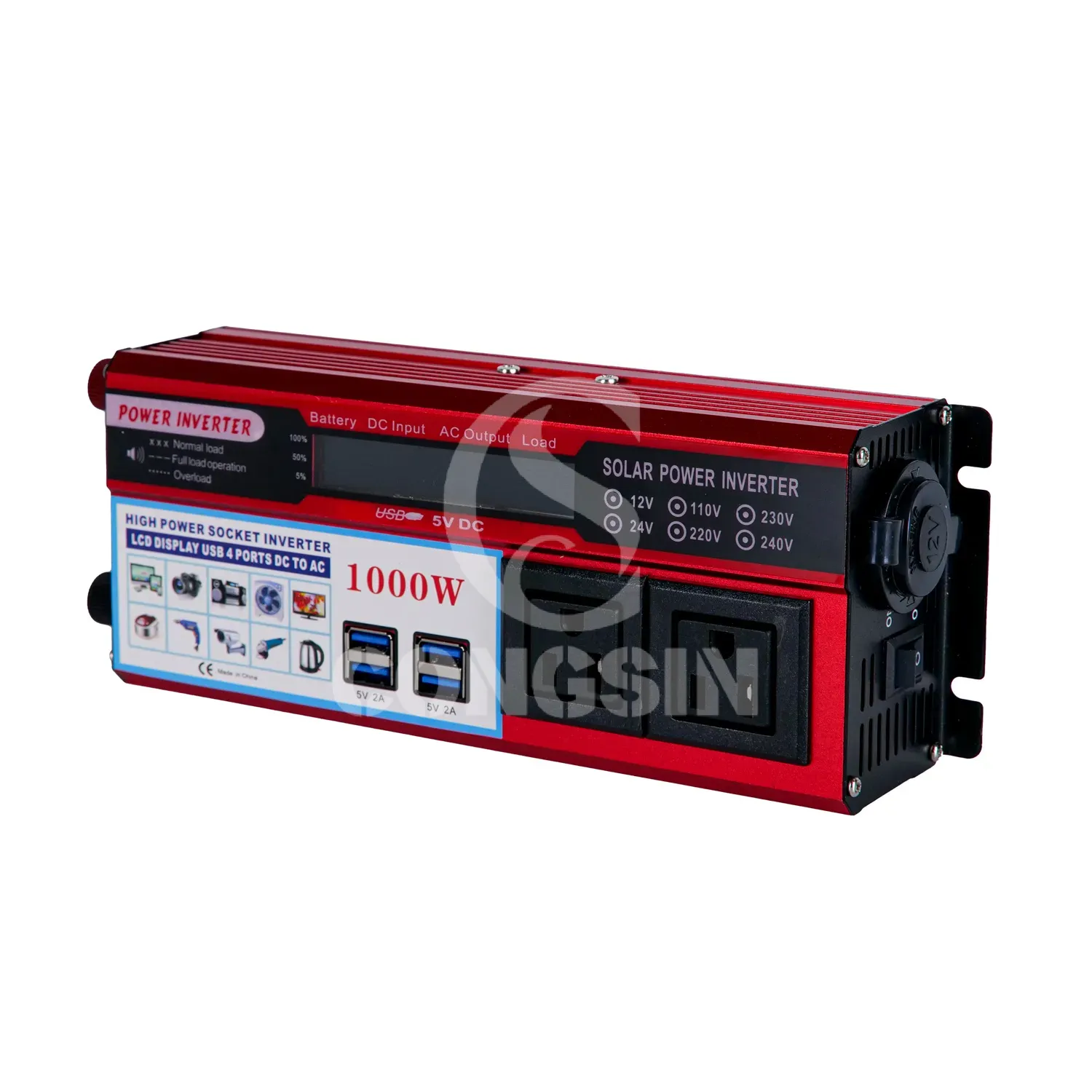
Congsin 1000W modified sine wave inverter with American Sockets and Lcd display portable 12V car RV
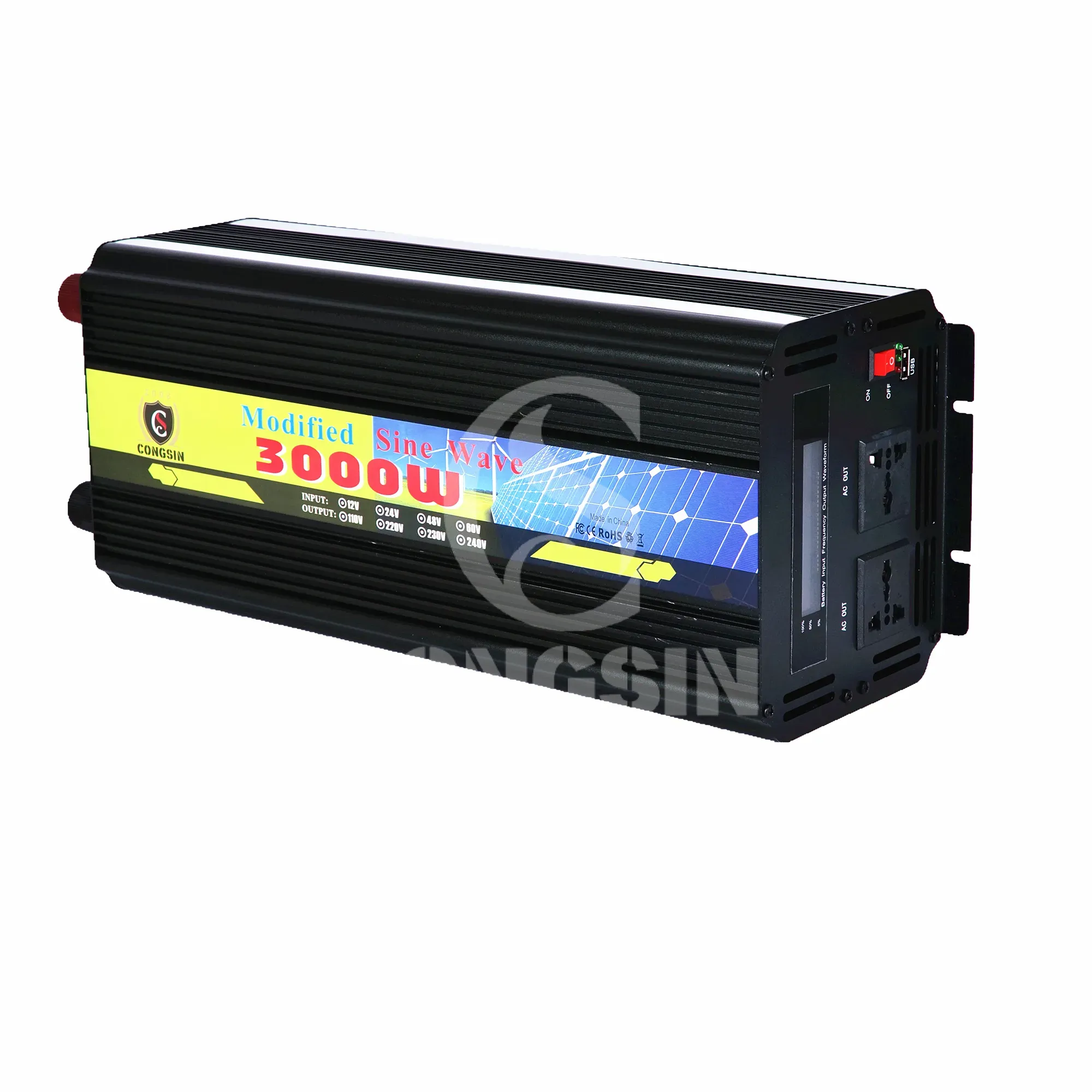
Congsin Full Power 3000W Modified Sine Wave Inverter Peak Power 6000W with LCD Display RV Solar
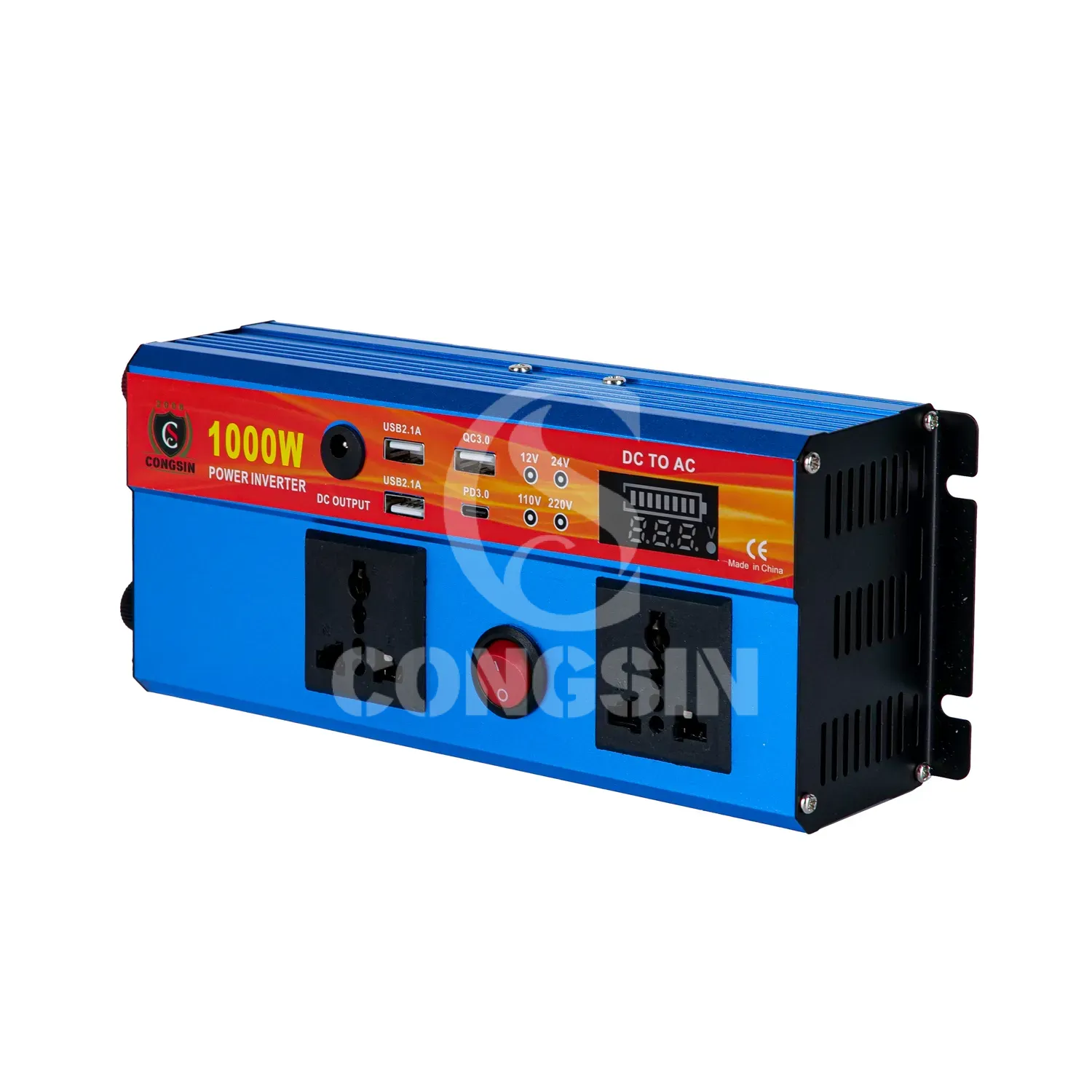
Congsin 1000W modified sine wave inverter with LED display and Type C port car RV power inverter
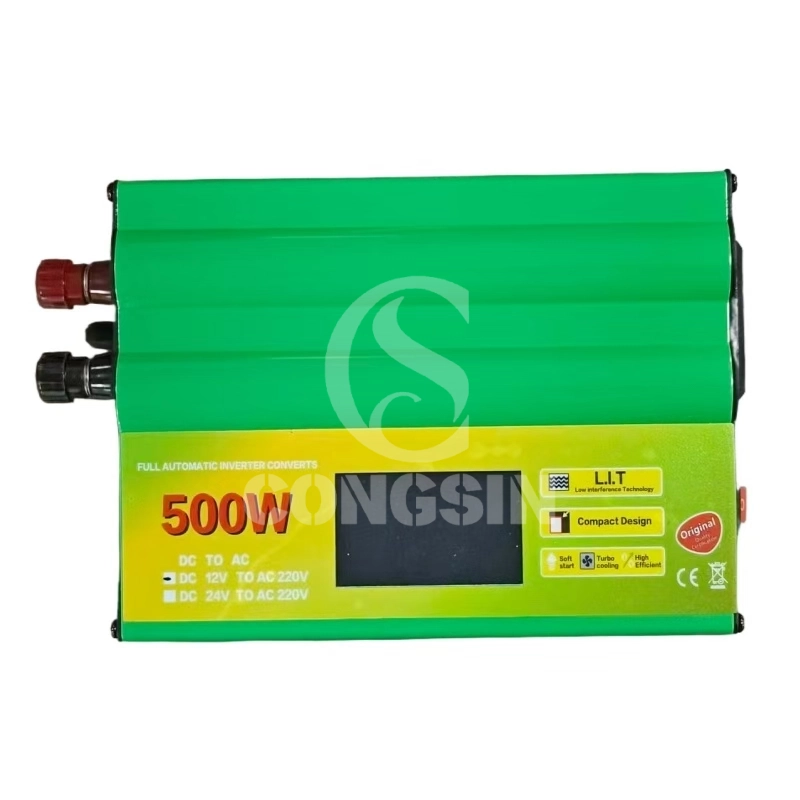
Congsin Modified Sine Wave Inverter 500W 1000W 1500W 12V LED Display Portable for RV Car Solar

CONGSIN is a trusted OEM factory for power inverters, solar charge controllers, and DC converters. Reliable solutions for global B2B buyers.
 High Quality
 7/24 Service
 Guaranteed Warranty
© 2025 Congsin. All Rights Reserved.