





Compare High Frequency vs Low Frequency Power Inverters
- Understanding inverter basics
- What is an inverter and why topology matters
- Key performance specifications to evaluate
- Waveform types and load compatibility
- High frequency vs low frequency: technical comparison
- Topology and operating principle
- Measured performance: efficiency, THD and surge
- Why surge capability differs
- How to choose: application-driven guidance
- Solar systems and portable power stations
- RVs, vehicles and trucks
- Off-grid homes, construction sites and industrial loads
- Long-term reliability, maintenance and safety
- Thermal behavior and lifetime
- Isolation and safety standards
- EMI/EMC considerations
- Manufacturer spotlight: Guangzhou Congsin Electronic Technology Co., Ltd.
- Company profile and core strengths
- Production capability, quality and certifications
- Product highlights and why they matter
- Practical selection checklist and specification examples
- Checklist for buying an inverter
- Example application mapping
- FAQ
- 1. Is a high frequency power inverter suitable for running refrigerators and air conditioners?
- 2. Do high frequency inverters save energy compared to low frequency inverters?
- 3. Are high frequency inverters noisier electrically (EMI) than low frequency ones?
- 4. Which inverter type offers better electrical isolation?
- 5. How should I size an inverter for motor loads?
- 6. Can I upgrade a system from a high frequency inverter to a low frequency one later?
The decision between a high frequency power inverter and a low frequency inverter has concrete consequences for efficiency, surge capacity, waveform quality, safety and total cost of ownership. This article explains how each topology works, compares measurable parameters (efficiency, THD, surge rating, size and cost), maps technologies to real-world applications (solar systems, RVs, portable power stations, off-grid homes, industrial equipment), and offers actionable purchase and specification advice. Sources such as technical notes from Victron Energy and established references on inverter design inform the analysis to ensure claims are verifiable (Wikipedia - Inverter (electrical), Victron - HF inverter technical note, All About Circuits - Inverters).
Understanding inverter basics
What is an inverter and why topology matters
An inverter converts DC (battery or solar panel output) to AC (mains-like voltage). Beyond basic conversion, topology—how the inverter creates AC—determines size, efficiency, waveform purity and how well it handles inductive loads. For general background on inverter types and function see the inverter overview on Wikipedia.
Key performance specifications to evaluate
When comparing high frequency power inverter designs vs low frequency designs, focus on measurable specs: continuous output power, surge (peak) power, conversion efficiency, THD (total harmonic distortion), output waveform (modified vs pure sine), input voltage range, no-load consumption, cooling method, and protective features (overload, short-circuit, thermal). These metrics predict real-world performance for appliances, motors and sensitive electronics.
Waveform types and load compatibility
Many HF and LF inverters can produce a pure sine wave output; some entry-level devices use modified sine wave outputs. For motors, compressors, medical and audio equipment, a true pure sine wave inverter is nearly always recommended because it reduces heating, noise and unpredictable behavior.
High frequency vs low frequency: technical comparison
Topology and operating principle
High frequency power inverter designs use high-speed switching (tens to hundreds of kHz) and small high-frequency transformers or transformerless architectures combined with filter stages to synthesize AC at 50/60 Hz. Low frequency inverters use a heavy 50/60 Hz transformer directly in the DC-AC conversion or use a lower switching frequency with a large LF transformer to produce mains frequency, which provides galvanic isolation and robust surge capability. The Victron technical note on high-frequency inverters offers an in-depth explanation of trade-offs (Victron HF technical note).
Measured performance: efficiency, THD and surge
Typical measured ranges (generalized — check specific datasheets):
| Metric | High Frequency Power Inverter | Low Frequency Inverter | Typical Source / Notes |
|---|---|---|---|
| Continuous Efficiency | 87%–95% (modern HF designs often 90–95% at rated load) | 90%–98% (well-designed LF inverters often reach higher peak efficiency under heavy load) | Victron; manufacturer datasheets |
| Surge (peak) capability | Moderate (typically 1.5–3× continuous rating without damage) | High (commonly 3–8× continuous rating for several seconds) | LF transformer provides stored energy for motor starts |
| Output THD (pure sine) | <1%–5% (good designs) | <1%–3% (very low in well-regulated designs) | Depends on output filter and control algorithm |
| Size & Weight | Compact, lightweight | Large, heavy (due to LF transformer) | Practical for vehicles and portable power stations |
| Cost (per kW) | Lower (mass-produced HF modules) | Higher (cost of large transformers and heavier components) | Market and spec dependent |
Note: these ranges are directional. Always consult specific product datasheets for exact efficiency curves, surge ratings and THD figures.
Why surge capability differs
Low frequency inverters incorporate an LF transformer that can deliver high inrush currents required by inductive loads (motor starts, pumps, compressors). High frequency inverters are optimized for continuous efficiency and compactness; they typically rely on semiconductor switches and electronic control to manage transient events, and therefore need careful derating or additional design features (soft-start, active current limiting) to match LF surge performance.
How to choose: application-driven guidance
Solar systems and portable power stations
For solar-home hybrid systems and portable power stations, high frequency power inverter designs excel when weight, footprint and cost are priorities. They integrate well with MPPT charge controllers and battery systems, and modern HF inverters can offer high continuous efficiency. However, if the system must reliably run compressors (refrigeration) or heavy inductive loads frequently, consider low frequency inverters or ensure the HF inverter provides sufficient surge capability and motor-start features.
RVs, vehicles and trucks
Space and weight constraints favor compact high frequency power inverter solutions for vehicle-mounted systems and portable units. Many automotive and RV inverters use HF topologies to keep units lightweight. Choose a pure sine wave HF inverter for sensitive electronics and appliances; consider LF only if you need superior start-up torque for AC motors or if you prioritize maximum long-term robustness over size.
Off-grid homes, construction sites and industrial loads
Off-grid homes and heavy-duty industrial sites often demand high surge capability and strong long-term thermal stability. Low frequency inverters (or hybrid systems that combine LF inverter stages) are common for such installations because they tolerate harsh loads and provide robust galvanic isolation. For mixed-use residential applications combining many light loads and infrequent motor starts, a high quality HF pure sine wave inverter remains a cost-effective choice.
Long-term reliability, maintenance and safety
Thermal behavior and lifetime
High frequency inverters use fast-switching semiconductors and typically rely on compact heat sinks and forced air cooling. While efficient, their thermal design must be well executed because semiconductor stress increases with temperature. Low frequency inverters, while heavier, often run cooler under heavy loads because the LF transformer shares thermal mass and can buffer short hits. Lifetime depends on component quality, cooling, and operating environment.
Isolation and safety standards
One practical advantage of many LF designs is the built-in galvanic isolation provided by the LF transformer. For installations requiring strict isolation for safety or regulatory reasons, LF inverters are attractive. Both HF and LF devices are designed to meet international standards — typical approvals include CE, EMC, LVD, ETL, FCC, RoHS and regional vehicle approvals such as E-MARK. Always verify product certifications on the datasheet.
EMI/EMC considerations
High switching frequencies increase the potential for electromagnetic interference. Good HF inverter designs add EMI filters and proper PCB/layout practice to meet EMC limits. Low frequency designs inherently produce less high-frequency noise, simplifying EMC compliance in some contexts.
Manufacturer spotlight: Guangzhou Congsin Electronic Technology Co., Ltd.
Company profile and core strengths
Guangzhou Congsin Electronic Technology Co., Ltd., founded in early 1998, is a professional power inverter manufacturer with over 27 years of focused experience. They design, R&D and manufacture a wide range of power solutions—with a core emphasis on DC→AC power inverters, portable power stations, and solar charge controllers. Their product range includes 100+ models tailored for vehicles, solar systems, RVs and trucks, off-grid homes, outdoor offices, patrol and field construction work.
Production capability, quality and certifications
Congsin operates fully automated production lines, advanced instrumentation and multifunctional testing equipment to ensure product reliability, efficiency and intelligent functionality. Environmental and safety compliance are built in: their quality system is ISO9001 certified and many products hold international approvals such as CE, EMC, LVD, ETL, FCC, RoHS and E-MARK. Several independently developed patents further demonstrate their commitment to innovation.
Product highlights and why they matter
Congsin's catalog covers key product categories that directly relate to the HF vs LF decision: Solar Charge Controllers, modified sine wave inverter, pure sine wave inverter, and portable power stations. Their multi-decade manufacturing experience, vertical capabilities (design, R&D, and production), and OEM/ODM services make them a strong partner for customers needing customization, private labeling, or distribution. Congsin supplies global markets across Europe, the Americas, the Middle East, Africa and Southeast Asia and supports OEM channels with bespoke solutions — useful if your project requires tailored inverter surge profiles or unique form factors.
Practical selection checklist and specification examples
Checklist for buying an inverter
1) Identify typical and peak loads (motors, compressors, electronics). 2) Determine whether galvanic isolation is required. 3) Decide on size/weight constraints (portable vs fixed). 4) Confirm desired waveform (pure sine for sensitive equipment). 5) Check surge rating vs motor start requirements. 6) Inspect efficiency curves, no-load consumption and cooling. 7) Verify certifications (CE, EMC, LVD, ETL, FCC, RoHS). 8) Consider manufacturer support, warranty and OEM/ODM capability.
Example application mapping
| Application | Recommended Topology | Reason |
|---|---|---|
| Portable power station / camping / RV | High frequency power inverter (pure sine) | Lightweight, compact, cost-effective for electronics and small appliances |
| Off-grid home with frequent compressor use | Low frequency inverter (or hybrid solution) | Better surge handling and robustness for motors |
| Industrial tools and construction sites | Low frequency inverter | High inrush currents, rugged operation |
| Sensitive electronics, audio, medical test equipment | High quality HF or LF - pure sine with low THD | Low THD and stable voltage regulation are essential |
FAQ
1. Is a high frequency power inverter suitable for running refrigerators and air conditioners?
Yes, many HF inverters can run refrigerators and small air conditioners if they are pure sine wave and have sufficient surge capacity. However, for frequent or heavy compressor starts, a low frequency inverter with higher inrush capacity may be more reliable. Always compare motor start current against inverter surge specs.
2. Do high frequency inverters save energy compared to low frequency inverters?
Modern high frequency inverters can be very efficient, especially at typical operating loads, and can reduce no-load losses in portable applications. Low frequency inverters may offer slightly higher peak efficiency under heavy continuous loads. The energy saving depends on load profile; review the inverter efficiency curve on the datasheet.
3. Are high frequency inverters noisier electrically (EMI) than low frequency ones?
HF inverters operate switching stages at high frequencies and therefore have higher potential for EMI; well-designed HF units include filters and shielding to meet EMC standards. Low frequency inverters generate less high-frequency noise by design.
4. Which inverter type offers better electrical isolation?
Low frequency inverters with a 50/60 Hz transformer provide inherent galvanic isolation. Some HF designs include isolation stages or use isolation transformers on the output, but not all HF inverters provide the same level of built-in isolation — check product specifications if isolation is required for safety or regulatory reasons.
5. How should I size an inverter for motor loads?
Calculate the motor starting current (inrush) and ensure the inverter’s surge rating can accommodate that current for the required time (typically a few seconds). For repeated starts, choose additional margin or a low frequency inverter. If the datasheet shows surge = 3× continuous for 5 seconds but the motor needs 6×, the inverter will likely trip or be damaged.
6. Can I upgrade a system from a high frequency inverter to a low frequency one later?
Yes, upgrades are possible but consider form factor, mounting, wiring, and protection devices. Low frequency units are typically larger and may require different mechanical and ventilation arrangements. Coordinate with your installer or the manufacturer (for example, request guidance from companies like Guangzhou Congsin) for compatibility and installation specifics.
If you have specific load lists, battery specs or installation constraints, we can provide tailored recommendations and product matches. For commercial-grade options, customization and OEM/ODM services, consider Guangzhou Congsin Electronic Technology Co., Ltd., a manufacturer with decades of experience producing pure sine wave inverter, modified sine wave inverter, portable power stations and solar charge controllers.
Contact us to discuss the right inverter topology for your project or to view Congsin’s product catalog and customization services. For product inquiries and technical support, please reach out to Guangzhou Congsin Electronic Technology Co., Ltd.
Battery Compatibility: Best Batteries for UPS Inverters
Best 240V Car Inverters for RVs and Mobile Workshops
Hybrid UPS Inverters for Solar and Grid-Tied Systems
12V vs 24V vs 48V: Picking the Right Vehicle Inverter
Modified Sine Wave Inverters
Is it normal for the inverter to heat up when working?
It is normal for it to generate some heat when working. If the temperature is too high (e.g., hot to the touch), please stop using it and check if the load is overloaded.
What power range of devices can it supply?
It supports devices within 360W in UPS mode and within 500W in regular mode. Ensure the device power does not exceed the corresponding limit.
Is the dual input automatically recognized or manually switched?
Automatically recognize DC12V/24V input, no manual switching required.
Can this inverter power a laptop?
If the laptop power is within 150W and the input is AC220V, it can supply power normally.
Pure Sine Wave Inverters
Can it be used in RVs or trucks?
Yes. The device input voltage is DC 12V, which matches the battery voltage of RVs and trucks. It can be connected via battery clips or cigarette lighter interface (need to confirm that the maximum current of the cigarette lighter is ≥10A) to supply power to car refrigerators, parking air conditioners, laptops, etc.
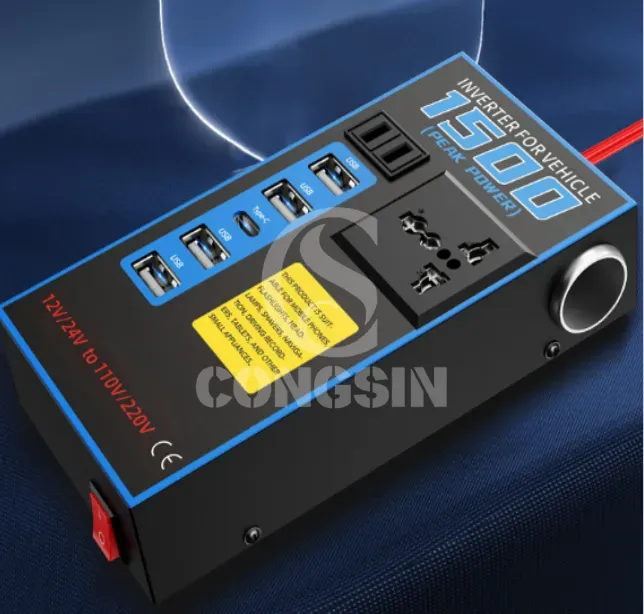
Congsin 1500W Inverter for Vehicle DC 12V/24V to AC 110V/220V with Universal socket Modified Sine Wave
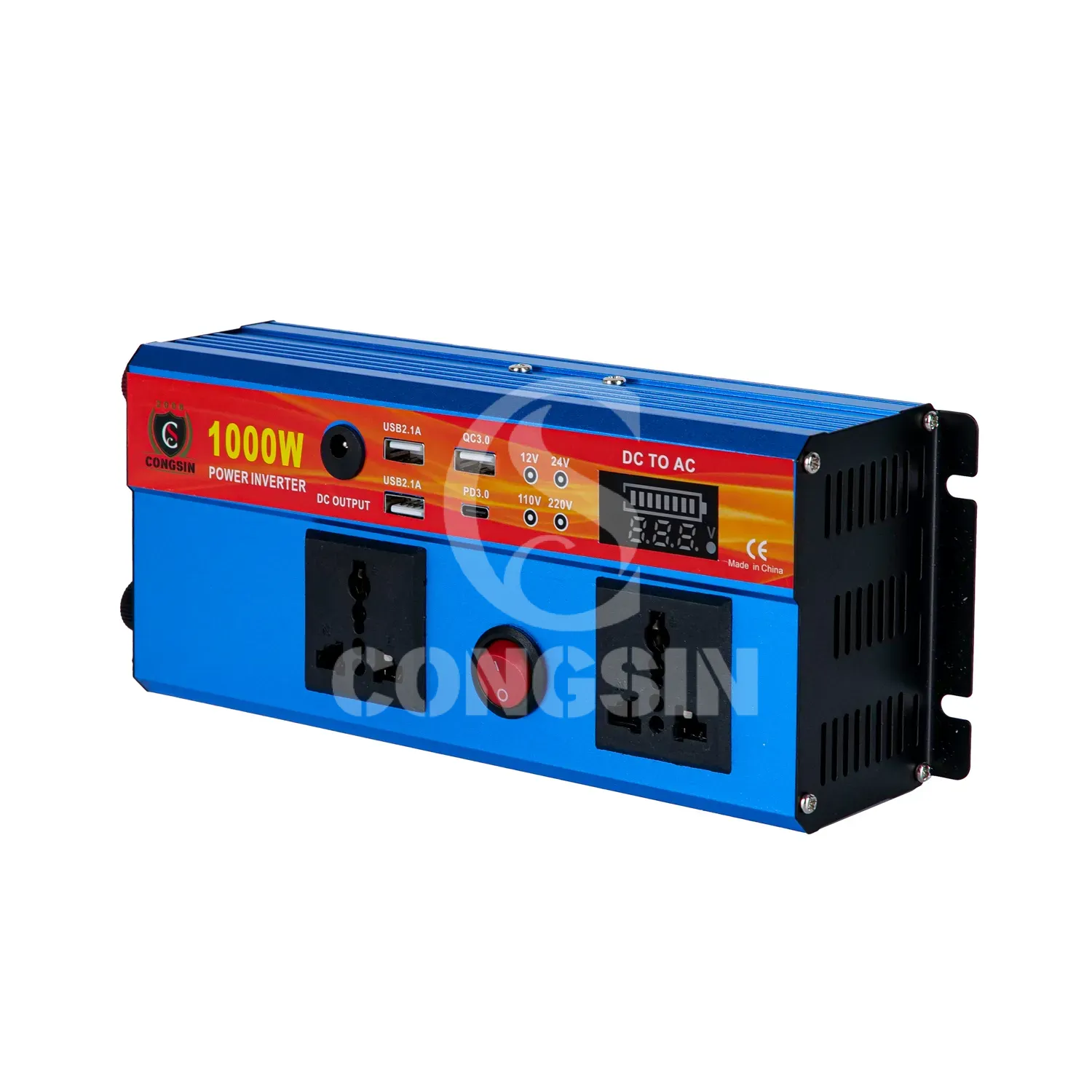
Congsin 1000W modified sine wave inverter with LED display and Type C port car RV power inverter
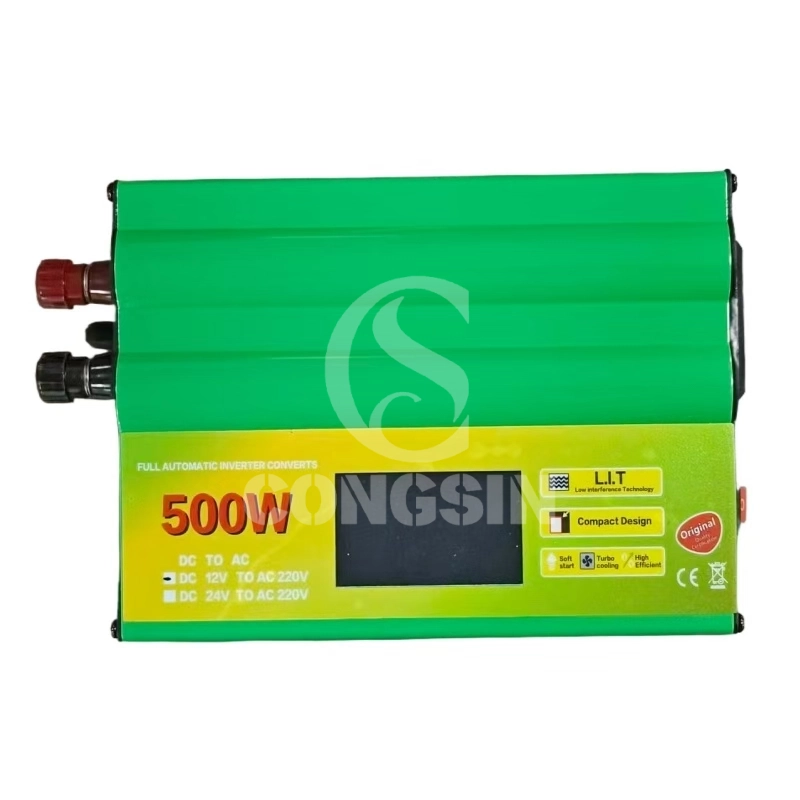
Congsin Modified Sine Wave Inverter 500W 1000W 1500W 12V LED Display Portable for RV Car Solar
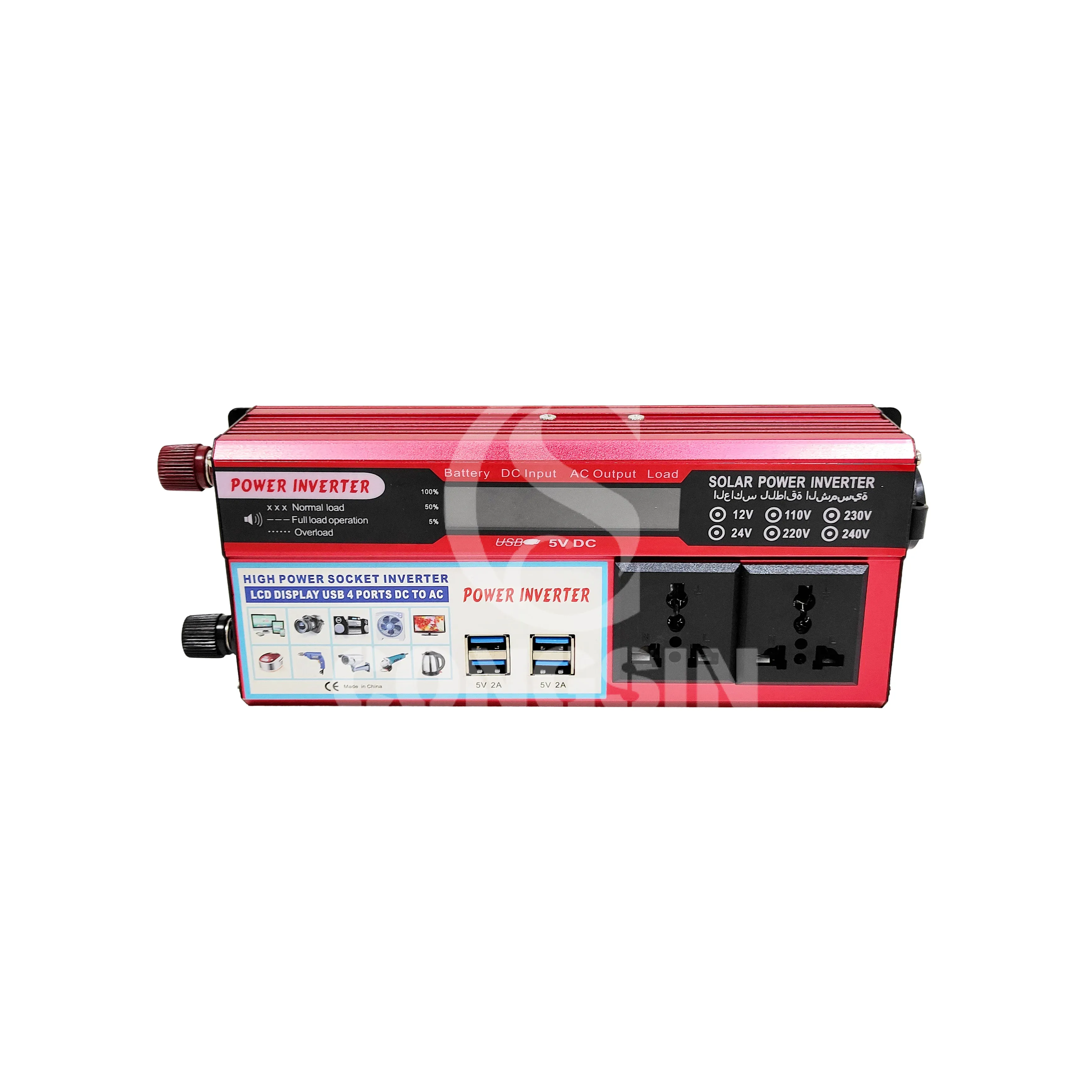
Congsin 1500W modified sine wave inverter with LCD display and USB ports for RV car boat home use

CONGSIN is a trusted OEM factory for power inverters, solar charge controllers, and DC converters. Reliable solutions for global B2B buyers.
 High Quality
 7/24 Service
 Guaranteed Warranty
© 2025 Congsin. All Rights Reserved.