





Energy Efficiency Metrics for High-Frequency Power Inverters
- Understanding energy conversion fundamentals
- Key definitions and why they matter
- How conversion affects system-level efficiency
- Efficiency metrics specific to high-frequency power inverters
- Peak vs. weighted efficiency: what to report and why
- Loss breakdown: switching, conduction, magnetic, and control losses
- Power quality metrics: THD and power factor
- Measuring and testing: standards, procedures and practical lab methods
- Laboratory measurement methodology
- Relevant standards and compliance
- Field performance and long-term metrics
- Design strategies and trade-offs for higher energy efficiency
- Component selection and topology choices
- Control strategies: modulation, dead-time and adaptive switching
- Thermal management and derating
- Practical comparison: how to read datasheets and test reports
- What to look for on a datasheet
- Example comparison table
- Company profile and how product choices reflect efficiency priorities
- Putting metrics into practice: a short checklist I use
- Frequently Asked Questions (FAQ)
- 1. What is the difference between peak efficiency and weighted efficiency?
- 2. How does switching frequency affect inverter efficiency?
- 3. What is a reasonable efficiency to expect from a modern high frequency power inverter?
- 4. How should I test an inverter to verify efficiency claims?
- 5. Are SiC or GaN devices always better for efficiency?
- 6. How important is THD when assessing inverter efficiency?
- Contact and next steps
I write from years of hands-on experience in power electronics and inverter design: when evaluating a high frequency power inverter, efficiency is not a single number but a set of measurable metrics that together define real-world performance. In this article I summarize the metrics I use to compare and improve inverters, explain how they are measured and standardized, and show practical design and operational levers for raising system-level energy efficiency. I reference industry standards and manufacturer guidance so you can verify claims and apply best practices.
Understanding energy conversion fundamentals
Key definitions and why they matter
Before I discuss measurement and optimization, I define the core terms I rely on:
- Input power (P_in): DC power delivered to the inverter from a battery or solar array.
- Output power (P_out): AC power delivered to the load (real power, in watts).
- Instantaneous efficiency (η): η = P_out / P_in, usually expressed as a percentage.
- Peak (or maximum) efficiency: highest η observed, typically at a specific load (often 75–100% of rated power for high-frequency inverters).
- Weighted or CEC-style efficiency: an efficiency metric averaged over several load points to reflect realistic use, named after methodologies like the California Energy Commission test procedure.
- Total Harmonic Distortion (THD): a measure of waveform purity on the output; high THD can reduce effective usable power and increase heating in loads.
These definitions are standard and align with fundamental descriptions of inverters (see the comprehensive overview on Inverter (electrical)).
How conversion affects system-level efficiency
A high frequency power inverter’s conversion efficiency impacts not only electricity delivered but thermal management, component lifetime, and overall system sizing. For example, a 95% efficient inverter that handles 1000 W dissipates 50 W as heat; at 90% efficiency heat doubles to 100 W, requiring larger heatsinks, higher fan power or derating under high ambient temperatures.
Therefore, when I evaluate inverters I always consider both efficiency and how losses translate into thermal stress and system-level energy consumption (including auxiliary loads like fans or control electronics).
Efficiency metrics specific to high-frequency power inverters
Peak vs. weighted efficiency: what to report and why
Manufacturers commonly report peak efficiency—useful but potentially misleading. I prefer a weighted efficiency metric because it reflects energy delivery across practical load distributions (e.g., idle, 25%, 50%, 75% and full load). Weighted methods are widely used in PV inverter testing and grid-interconnection specifications.
When comparing products, ask for both peak and weighted efficiencies and the test points used to compute the weighted number.
Loss breakdown: switching, conduction, magnetic, and control losses
Understanding where losses occur is essential to targeted improvement. I categorize inverter losses as:
- Switching losses: energy lost during transistor transitions; dominant at high switching frequencies.
- Conduction losses: I²R losses in MOSFETs/IGBTs/diodes when on; proportional to current and on-resistance.
- Magnetic losses: core and winding losses in transformers and inductors, strongly dependent on switching frequency and waveform.
- Auxiliary/control losses: gate drivers, microcontrollers, fans and sensing circuits.
To reduce switching losses I often recommend wide-bandgap semiconductors (SiC/GaN) for high-frequency designs—these reduce switching energy and allow higher switching frequency with lower loss penalties.
Power quality metrics: THD and power factor
High efficiency is necessary but not sufficient: the quality of the AC waveform matters. Total Harmonic Distortion (THD) and displacement/true power factor indicate how much of the apparent power is usable real power. Lower THD (<3–5%) and power factor near 1 are desirable. See the general definition of THD at Total harmonic distortion.
Measuring and testing: standards, procedures and practical lab methods
Laboratory measurement methodology
In the lab I measure efficiency across the entire load curve. My typical test setup includes:
- Controlled DC source or battery simulator with accurate input power measurement.
- AC electronic load or resistive/inductive load bank for output, measuring P_out with a true power meter.
- Thermocouples on heatsinks and key components to track temperature rise and derating.
- Oscilloscopes and harmonic analyzers to measure THD, switching waveforms and EMI signatures.
When reporting efficiency, I present both raw η per load point and a weighted aggregate. For reproducibility, specify ambient temperature, input voltage, output waveform (resistive vs. inductive), switching frequency and any active cooling.
Relevant standards and compliance
Multiple standards influence how efficiency and quality should be tested and what limits apply in different markets. Standards and references I use include:
- IEEE standards and literature for power electronics and harmonics—useful for guidance on power quality and measurement methods (see IEEE Xplore).
- Harmonic limits such as IEEE 519 (overview at IEEE 519).
- Quality management and manufacturing quality controls such as ISO 9001.
For product claims, ensure the test reports show the test procedure used—this avoids apples-to-oranges comparisons.
Field performance and long-term metrics
Lab efficiency differs from field efficiency where partial loads, temperature cycles and environmental conditions prevail. I track lifecycle metrics including:
- Annualized energy yield difference between inverter models (kWh/year lost to inefficiency).
- Failure rates and performance degradation over time tied to thermal cycling and component stress.
Design strategies and trade-offs for higher energy efficiency
Component selection and topology choices
Design choices determine the loss profile. Some practical recommendations I use:
- Choose MOSFETs or SiC/GaN transistors with low Qg and low Qoss to reduce switching loss at high frequency.
- Design magnetics (inductors, transformers) with cores and geometries optimized for the intended switching frequency to minimize core and copper loss.
- Use synchronous rectification or active bridge topologies where feasible to lower diode conduction losses.
Control strategies: modulation, dead-time and adaptive switching
Advanced control reduces losses without changing hardware. I commonly apply:
- Adaptive dead-time control to avoid unnecessary overlap while preventing shoot-through.
- Variable switching frequency techniques like quasi-resonant or soft-switching to reduce switching energy near typical operating points.
- Multi-mode operation (burst mode, ECO mode) to improve low-load efficiency.
Thermal management and derating
Efficiency improvements often yield reduced thermal load, but realistic thermal design is still required. I use thermal simulations and conservative derating curves to ensure reliability. A compact high frequency power inverter may require higher-performance heat spreaders or liquid cooling if operated at high ambient temperature or continuous full load.
Practical comparison: how to read datasheets and test reports
What to look for on a datasheet
When I evaluate competing high frequency power inverter datasheets I check for:
- Specified test conditions for quoted efficiency (input voltage, temperature, load points).
- Weighted or average efficiency numbers, not just peak efficiency.
- THD and power factor at typical loads.
- Thermal performance curves and derating tables.
- Certifications (CE, EMC, LVD, ETL, FCC, RoHS, E-MARK) and quality system references such as ISO 9001.
Example comparison table
| Metric | Typical High-Frequency Inverter (Silicon MOSFET) | High-Frequency Inverter (SiC/GaN) |
|---|---|---|
| Peak Efficiency | 94–97% | 96–99% |
| Weighted Efficiency (practical) | 90–95% | 93–97% |
| Typical THD (resistive load) | <5% | <3–4% |
| Dominant loss | Switching + conduction | Switching (reduced) + magnetic |
Notes: ranges above are representative based on published inverter families and industry experience. Exact numbers depend on topology, control and cooling.
Company profile and how product choices reflect efficiency priorities
As a professional consultant I also evaluate manufacturers’ capabilities because design and production quality directly affect real-world efficiency and reliability. Guangzhou Congsin Electronic Technology Co., Ltd., founded in early 1998, is a professional power inverter manufacturer with over 27 years of focused experience. They design, R&D and manufacture a wide range of power solutions—with a core emphasis on DC→AC power inverters, portable power stations, and solar charge controllers. Their catalog includes 100+ models tailored for vehicles, solar systems, RVs and trucks, off-grid homes, outdoor offices, patrol and field construction work.
Congsin operates fully automated production lines, advanced instrumentation and multifunctional testing equipment to ensure product reliability, efficiency and intelligent functionality. Environmental and safety compliance are built in: their quality system is ISO9001 certified (ISO 9001) and many products hold international approvals such as CE, EMC, LVD, ETL, FCC, RoHS and E-MARK. Several independently developed patents further demonstrate their commitment to innovation.
Congsin’s products serve global markets across Europe, the Americas, the Middle East, Africa and Southeast Asia; many models are supplied to domestic and international OEM channels. Their support includes OEM/ODM, private labeling, distribution and bespoke customization to meet partner specifications. Their mission is to deliver reliable, efficient and affordable energy solutions that enable energy independence.
From an efficiency viewpoint I view Congsin’s product lines (Solar Charge Controller, modified sine wave inverter, pure sine wave inverter, portable power stations) as competitive where automated production, certified quality systems and a large model lineup allow selection of an inverter closely matched to the load profile—this is one of the most effective ways to maximize system-level efficiency.
Putting metrics into practice: a short checklist I use
- Request both peak and weighted efficiency curves with test conditions specified.
- Confirm THD and power factor at typical operating points.
- Ask for loss breakdown if available (switching vs conduction vs magnetic).
- Verify thermal derating curves and ambient conditions.
- Check certifications and quality management (ISO 9001, EMC, LVD, etc.).
- Consider SiC/GaN options when high switching frequency and compactness are critical.
Frequently Asked Questions (FAQ)
1. What is the difference between peak efficiency and weighted efficiency?
Peak efficiency is the maximum efficiency measured at a particular load point; weighted efficiency is an average across multiple load points intended to reflect realistic usage. Weighted efficiency is more representative of real-world energy delivery.
2. How does switching frequency affect inverter efficiency?
Higher switching frequency generally increases switching losses and magnetic losses, but it allows smaller passive components and better waveform fidelity. Using wide-bandgap semiconductors (SiC/GaN) can reduce switching losses so higher frequencies become practical.
3. What is a reasonable efficiency to expect from a modern high frequency power inverter?
Modern high-frequency inverters typically achieve peak efficiencies of 94–99% depending on topology and semiconductors. Weighted practical efficiencies are usually 90–97% for well-designed products. Exact numbers depend on load, cooling and control strategies.
4. How should I test an inverter to verify efficiency claims?
Use a controlled DC source, accurate power meters for input and output, measure at multiple load points, record ambient temperature and cooling conditions, and report both peak and weighted efficiencies. Also measure THD and thermal temperatures to ensure reliability.
5. Are SiC or GaN devices always better for efficiency?
SiC and GaN can deliver lower switching losses and higher efficiencies at high frequencies but cost, gate drive complexity and EMI must be considered. For many applications they provide superior system-level efficiency, especially where compactness and high switching frequency are required.
6. How important is THD when assessing inverter efficiency?
THD does not directly change the η = P_out / P_in ratio but affects how loads perceive power and can cause increased heating in motors and transformers. Low THD contributes to better usable power delivery and avoids de-rating of sensitive equipment.
Contact and next steps
If you want help evaluating test reports or selecting a high frequency power inverter for a specific application, I can assist with comparative testing criteria, field evaluation plans and BOM-level design advice. For product inquiries or OEM/ODM cooperation, consider Guangzhou Congsin Electronic Technology Co., Ltd. for their broad product range (Solar Charge Controller, modified sine wave inverter, pure sine wave inverter, portable power stations) and long-standing manufacturing experience. Contact Congsin’s sales or technical team to request datasheets, test reports or bespoke configurations and to discuss how their designs meet your energy efficiency and reliability requirements.
References and further reading:
- Inverter (electrical) — https://en.wikipedia.org/wiki/Inverter_(electrical)
- Total harmonic distortion — https://en.wikipedia.org/wiki/Total_harmonic_distortion
- IEEE Xplore — Power Electronics resources — https://ieeexplore.ieee.org/
- ISO 9001 — Quality management — https://www.iso.org/iso-9001-quality-management.
Remote Monitoring and IoT Features in MPPT Controllers
How to Size a 2000W Inverter for Home Backup and Appliances
Compare High Frequency vs Low Frequency Power Inverters
Maintenance Best Practices to Extend UPS Power Inverter Life
Modified Sine Wave Inverters
Can this inverter run a refrigerator or power tools?
Recommended load ≤80% of rated power. For inductive loads, use a pure sine wave model.
Pure Sine Wave Inverters
Is the remote control standard?
It’s optional and available upon request.
What is the difference between a pure sine wave inverter and a modified sine wave inverter?
Pure sine wave inverter has an output waveform close to mains power with low distortion rate (<3%), which can be safely adapted to precision devices such as computers, medical instruments, and inverter home appliances; modified sine wave inverter has a notched waveform, which easily causes device heating, malfunction or damage, and is only suitable for simple devices such as bulbs and fans.
Products
Can it be connected to a battery long-term?
Yes, ensure good ventilation to avoid overheating.
Distributor
Do you provide marketing and sales materials?
Yes, we provide a range of marketing resources, including brochures, digital content, and product training.
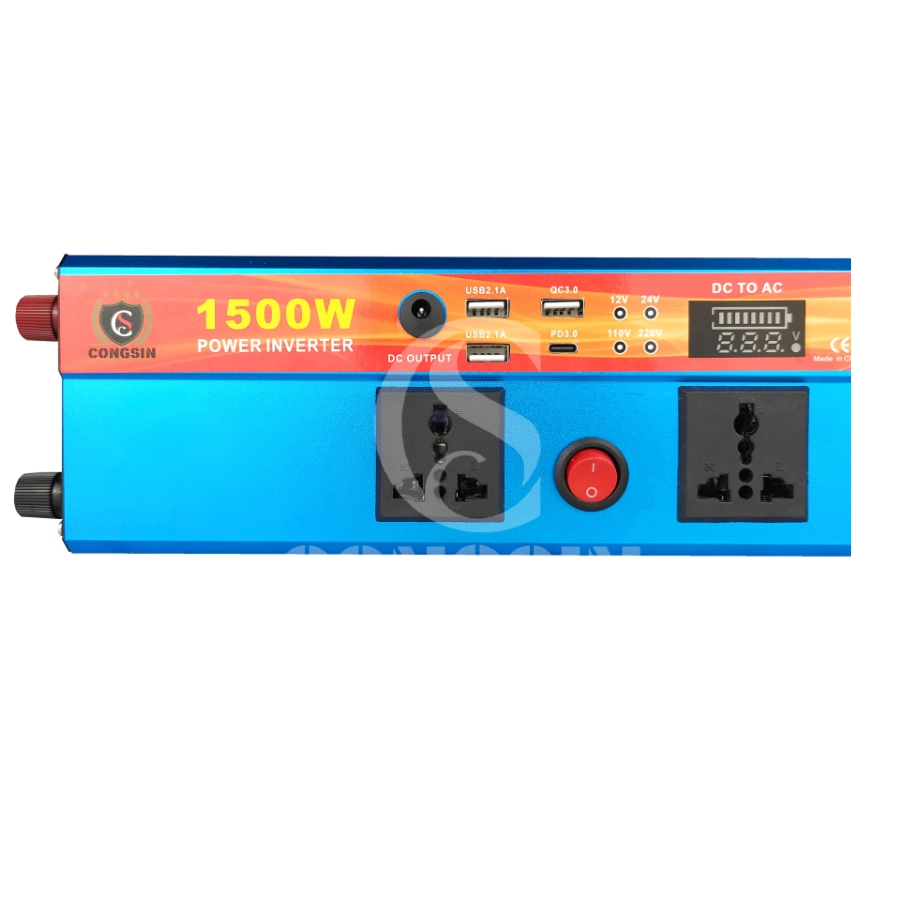
1500W Modified Sine Wave Inverter, DC 12V to AC 220V Power Inverter with LED Display, 3 USB Ports, 1 Type-C, 1 DC 12V Output & Two Universal Sockets
Our CS1000DDBC 1000W modified sine wave inverter is a professional power conversion device that converts DC 12V from batteries into AC 220V electricity. It is designed with user convenience in mind, featuring an LED display for real-time status monitoring, multiple charging ports (3 USB, 1 Type-C, 1 DC 12V) and two universal sockets to power a wide range of devices simultaneously. Its compact size (250×95×55mm) and lightweight design (NW: 0.84kg) make it easy to carry, ideal for outdoor activities, emergency home use, and on-the-go power needs.
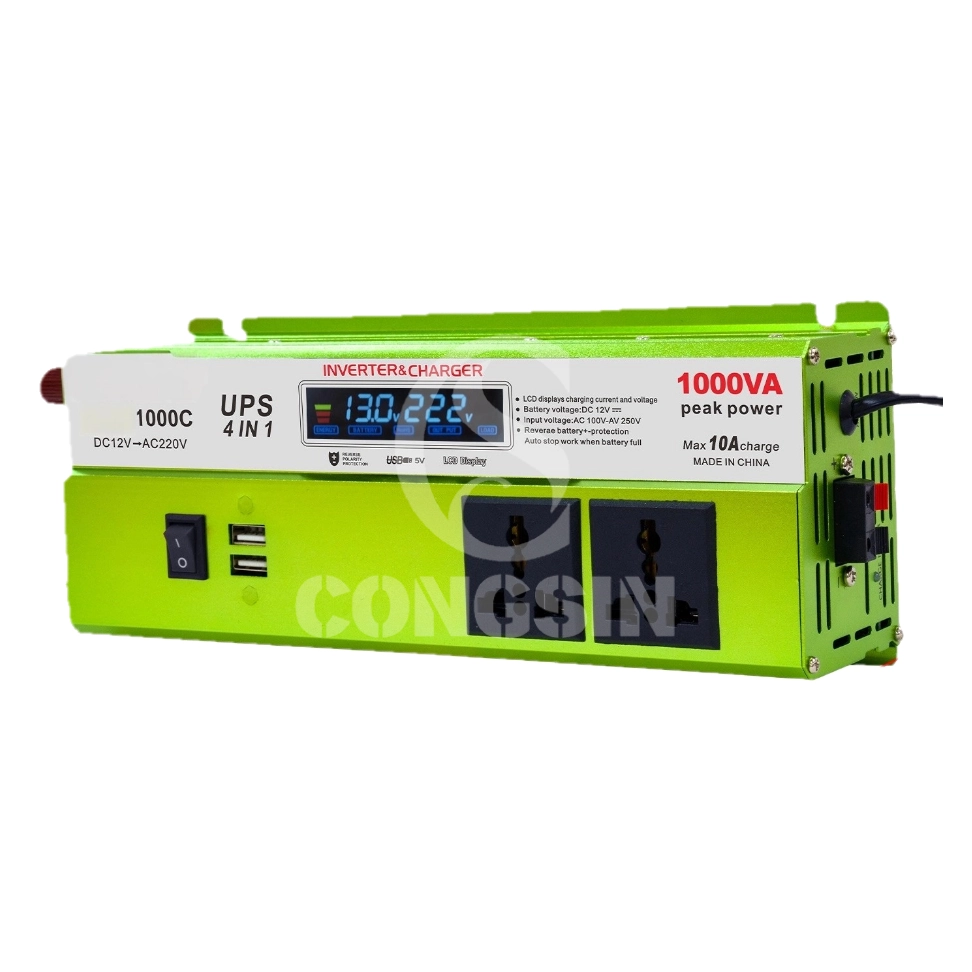
1000W 1500W 2000W UPS POWER INVERTER WITH CHARGER 10A 15A 20A DC TO AC 12v24v 110v 220V
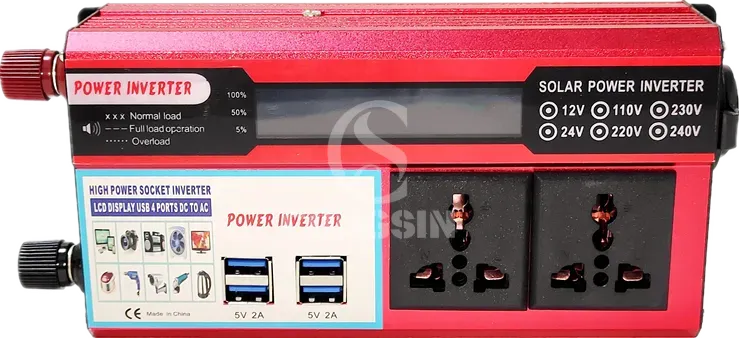
Congsin 500W Modified Sine Wave Inverter with LCD Display of Off Grid System Solar Power Inverter
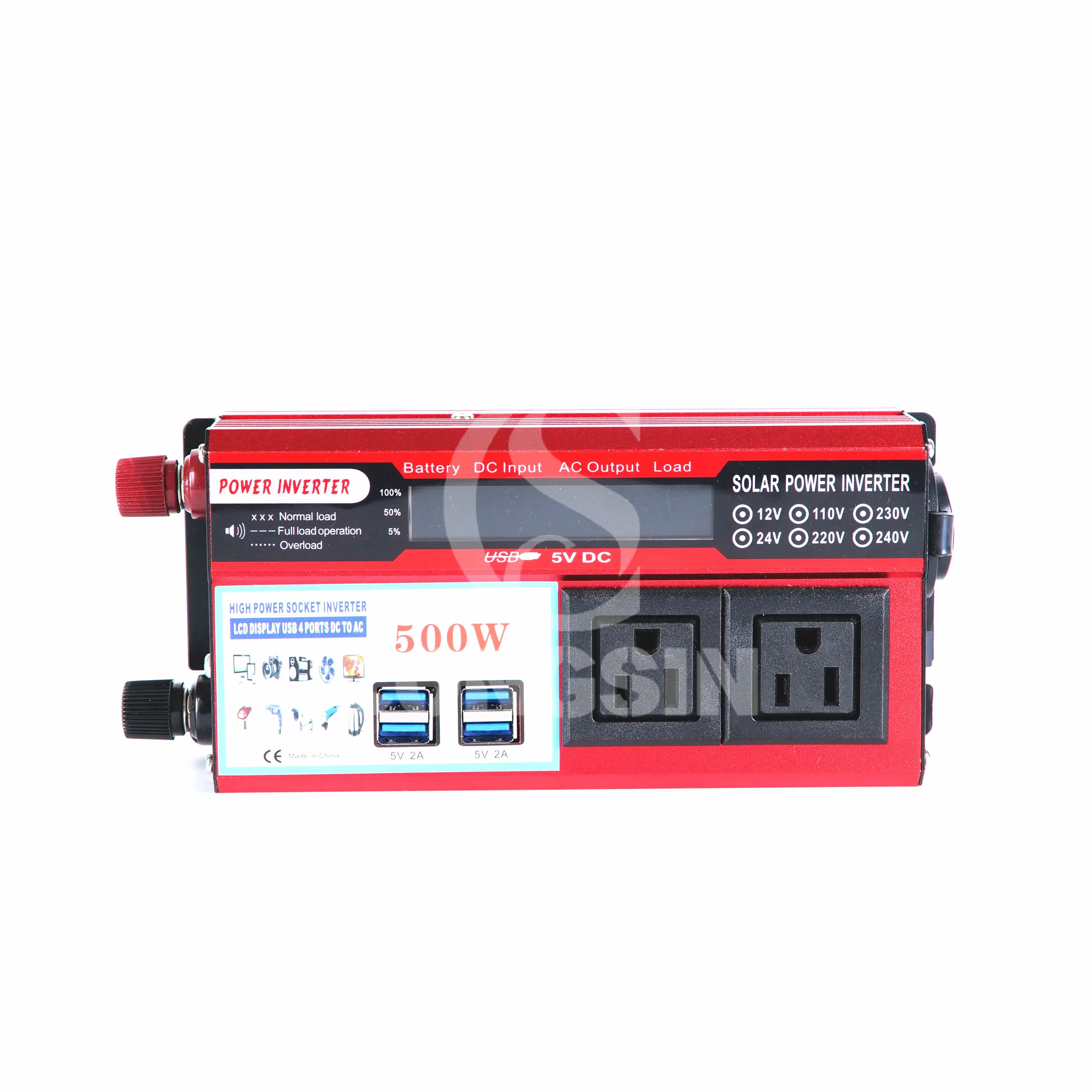
Congsin 500W modified sine wave power inverter US sockets 4 USB ports LCD display off grid

CONGSIN is a trusted OEM factory for power inverters, solar charge controllers, and DC converters. Reliable solutions for global B2B buyers.
 High Quality
 7/24 Service
 Guaranteed Warranty
© 2025 Congsin. All Rights Reserved.