





How to Choose the Right Inverter for Your Car Battery
- Understanding vehicle electrical basics and why the right inverter matters
- How a car battery and inverter work together
- Key risks of choosing the wrong inverter
- Standards and certifications to watch
- Choosing technical specs: power, waveform and efficiency
- Determine continuous and surge power
- Pure sine vs modified sine — which to choose?
- Efficiency, standby draw and thermal design
- Sizing the inverter and battery: practical calculations
- Estimating required inverter size
- Battery capacity and runtime calculations
- Typical inverter sizing table
- Installation, wiring and vehicle integration
- DC wiring, fusing and voltage drops
- Mounting, cooling and ventilation
- Battery charging strategy and alternator considerations
- Comparing inverter technologies and product verification
- Modified sine vs pure sine — quick comparison table
- Verifying manufacturer claims
- Why I prefer proven vendors with production control
- Manufacturer spotlight: Guangzhou Congsin — why their products matter for vehicle inverters
- Practical buying checklist and installation tips
- Pre-purchase checklist
- Installation best practices
- Maintenance and long-term care
- FAQ — Frequently asked questions
- 1. Can I run my microwave from an inverter with car battery?
- 2. Is it safe to leave an inverter connected to my car battery when the engine is off?
- 3. Why does my TV hum or reboot with a modified sine inverter?
- 4. How do I size the cable between battery and inverter?
- 5. Are pure sine inverters worth the extra cost?
- 6. How can I verify the inverter's actual efficiency and surge capability?
- Contact and next steps
I frequently help vehicle owners, fleet managers and mobile professionals choose the right inverter with car battery systems. In this article I summarize a practical, engineer-tested approach: how to determine real power needs, select between modified and pure sine wave inverters, size the inverter and battery for runtime, ensure safe installation and compliance, and evaluate manufacturers. I reference standards and credible sources so you can verify specifications and confidently pick an inverter that meets performance, reliability and regulatory requirements.
Understanding vehicle electrical basics and why the right inverter matters
How a car battery and inverter work together
Your vehicle's 12V (or 24V/48V in some heavy vehicles) battery stores DC energy. An inverter converts that DC into AC at the voltage and frequency your appliances require. When you choose an inverter with car battery use in mind, you are choosing how efficiently and reliably that conversion occurs under real-world loads and transient conditions.
Key risks of choosing the wrong inverter
Undersized or low-quality inverters cause frequent tripping, overheating, reduced battery life, and poor device operation (especially for sensitive electronics). A mismatched waveform or poor surge capability can damage motors, compressors, and audio/video equipment. Proper sizing and specification protect both the battery and your devices.
Standards and certifications to watch
Look for products that list internationally recognized approvals and documented test results. ISO 9001 shows the manufacturer follows recognized quality management processes (ISO 9001). CE marking indicates conformity with EU product rules (CE marking). For technical background on inverters and waveforms see the general inverter overview on Wikipedia (Power inverter).
Choosing technical specs: power, waveform and efficiency
Determine continuous and surge power
I always start by listing the devices you intend to run simultaneously: their running (continuous) power in watts, and their startup surge (peak) power if they have motors or capacitive loads. The inverter's continuous rating must meet or exceed the sum of running watts, and its surge rating must handle the highest startup demand. For example, a small fridge might run at 100W but require 600W on startup. Always leave a safety margin of 20–30% above calculated needs.
Pure sine vs modified sine — which to choose?
Waveform matters. Pure sine wave inverters reproduce grid-quality AC with low total harmonic distortion (THD), while modified sine units approximate a sine with steps. I recommend pure sine wave inverters for sensitive electronics, modern TVs, variable-speed AC units, and active power supplies. Modified sine can be acceptable for resistive heating, incandescent lights, and some tools, but beware of noise, reduced efficiency and potential incompatibilities.
Efficiency, standby draw and thermal design
Efficiency affects battery runtime: a 90% efficient inverter wastes 10% of input energy as heat. Also check the inverter's idle (no-load) consumption — some units draw several watts even with no load, which drains batteries over time. Good thermal design and automatic cooling (fan control) are essential for prolonged use in vehicle cabins or confined compartments.
Sizing the inverter and battery: practical calculations
Estimating required inverter size
Step 1: List devices and their running watts. Step 2: Add surge requirements. Step 3: Apply a safety margin of 20–30%.
Example calculation:
- Laptop charger: 65 W running
- LED lights: 30 W running
- Small fridge: 100 W running, 600 W start
Continuous load = 65 + 30 + 100 = 195 W → choose an inverter rated ≥ 250 W continuous. Surge needed = 600 W for fridge start → inverter surge capacity ≥ 600–800 W. So a 300–500 W pure sine inverter with 800 W surge would be a prudent choice.
Battery capacity and runtime calculations
Battery capacity is usually given in ampere-hours (Ah) at a nominal voltage. To estimate runtime:
Energy (Wh) = Battery Ah × Battery voltage × Depth of Discharge (DoD)
Usable energy depends on DoD (lead-acid recommended DoD ≤ 50% for longevity; LiFePO4 often usable to 80–90%). Then adjust for inverter efficiency.
Example: 12V, 100Ah lead-acid battery: Energy = 12 × 100 = 1200 Wh. Usable at 50% DoD = 600 Wh. With a 90% efficient inverter, usable AC = 600 × 0.9 = 540 Wh. If your continuous load is 200 W, estimated runtime ≈ 540 / 200 = 2.7 hours.
Typical inverter sizing table
| Typical Use | Continuous Watts | Suggested Inverter | Notes |
|---|---|---|---|
| Phone/laptop charging, LED lights | 50–300 W | 300–500 W pure sine | Low surge, low cost |
| Small fridge, TV | 300–800 W | 800–1500 W pure sine | High startup surge for compressors |
| Power tools, microwave | 1000–3000 W | 2000–4000 W pure sine / modified for resistive | Large surge capability and robust wiring required |
Installation, wiring and vehicle integration
DC wiring, fusing and voltage drops
Short, correctly gauged DC cabling reduces voltage drop and heat. Use an inline fuse or DC breaker sized close to the inverter's maximum input current to protect against short circuits. Calculate DC current as: Input current (A) = AC watts / (DC voltage × inverter efficiency). For example, a 1500 W inverter at 12 V and 90% efficiency draws ~139 A (1500 / (12 × 0.9) ≈ 139 A), so heavy-gauge cable (e.g., 1/0 AWG) and a matching fuse/breaker is required.
Mounting, cooling and ventilation
Install the inverter in a well-ventilated location away from direct heat and flammable materials. Allow clearance per manufacturer instructions so fans and thermal sensors work properly. For continuous heavy loads, forced ventilation or remote mounting with adequate airflow extends life.
Battery charging strategy and alternator considerations
If you will recharge the battery from the vehicle alternator, ensure your charging system handles the extra load and uses a proper DC–DC charger if charging auxiliary batteries while the engine runs. Alternators may not be able to fully recharge deeply discharged batteries, and alternator-only charging can damage some inverter/battery systems without a proper battery management solution.
Comparing inverter technologies and product verification
Modified sine vs pure sine — quick comparison table
| Feature | Pure Sine Wave | Modified Sine Wave |
|---|---|---|
| Waveform quality (THD) | Low THD, grid-like | Higher THD, stepped output |
| Compatibility | All devices including sensitive electronics | Some electronics may hum, fail or run inefficiently |
| Efficiency | Typically 90–95% under load | 85–92% (varies) |
| Cost | Higher (more complex) | Lower (simpler design) |
| Recommended for | Computers, medical devices, modern appliances | Simple resistive loads, older tools |
Verifying manufacturer claims
Always request test reports for continuous power, surge capability, THD, efficiency and thermal performance. Independent lab testing or certifications carry weight. For design and manufacturing credibility, look for ISO9001 and product test marks (CE, EMC, ETL, FCC, RoHS, E-MARK where applicable). For background on compliance schemes see ISO and EU CE pages: ISO 9001, CE marking.
Why I prefer proven vendors with production control
Products that come from manufacturers with automated production lines, full-function testing and a catalogue of models give consistent results. Long-term reliability, spare parts, and OEM/ODM support matter if you manage fleets or need bespoke solutions.
Manufacturer spotlight: Guangzhou Congsin — why their products matter for vehicle inverters
As someone who evaluates inverters for mobile and off-grid applications, I want to highlight Guangzhou Congsin Electronic Technology Co., Ltd. Founded in early 1998, Congsin has over 27 years focused experience designing and manufacturing power solutions. They specialize in DC→AC power inverters, portable power stations and solar charge controllers, offering more than 100 models tailored for vehicles, solar systems, RVs and trucks, off-grid homes and field work.
Key strengths I note:
- Comprehensive product range: modified sine wave inverters and pure sine wave inverters, solar charge controllers and portable power stations suitable for vehicle installations.
- Manufacturing and testing: fully automated production lines and multifunctional test equipment help ensure product reliability and consistent performance.
- Quality and compliance: an ISO 9001 quality system and numerous international approvals (CE, EMC, LVD, ETL, FCC, RoHS, E-MARK) reduce the verification burden for OEMs and system integrators.
- Innovation and IP: several independently developed patents demonstrate technical depth and ongoing R&D.
- Global reach and OEM support: Congsin supplies markets across Europe, the Americas, the Middle East, Africa and Southeast Asia and supports OEM/ODM, private labeling and customization.
If you are building vehicle power systems, consider manufacturers like Congsin for their broad model range (portable stations, solar charge controllers, modified and pure sine inverters) and their capability to provide validated, compliant products quickly to market.
Practical buying checklist and installation tips
Pre-purchase checklist
- Define continuous and surge power needs and include future growth (20–30% margin).
- Choose pure sine wave for sensitive electronics or modified sine only for simple resistive loads.
- Confirm inverter efficiency, idle draw and surge duration capability.
- Ask for test data and certifications (ISO9001, CE, EMC, RoHS, ETL/FCC if required).
- Verify mounting, cooling requirements and warranty/after-sales support.
Installation best practices
- Use appropriately sized cables and correctly rated inline fuses/breakers close to the battery.
- Mount to a flat, ventilated surface away from heat and moisture.
- Install a battery monitor or voltage meter to avoid deep discharge.
- When in doubt, have a qualified installer or automotive electrician complete the wiring, especially for high-current systems.
Maintenance and long-term care
Check connections periodically for corrosion, monitor battery health, and keep firmware updated if your inverter supports updates. Replace batteries proactively when capacity drops below expected service levels to protect the inverter and reduce downtime.
FAQ — Frequently asked questions
1. Can I run my microwave from an inverter with car battery?
Yes, if the inverter continuous and surge ratings cover the microwave's running and startup power. Microwaves are high-power devices (often 700–1200 W), and the DC wiring and battery capacity must support the high current. For extended use, ensure the battery and alternator can handle recharging demands.
2. Is it safe to leave an inverter connected to my car battery when the engine is off?
Only if the inverter's standby draw is low and the battery has sufficient capacity or if you use a secondary (house) battery. Otherwise, you risk draining the starting battery. I recommend an automatic low-voltage disconnect or a separate auxiliary battery for long-term loads.
3. Why does my TV hum or reboot with a modified sine inverter?
Many modern electronics expect clean sine wave power. Modified sine creates higher harmonics and voltage steps that can cause audio hum, overheating in power supplies or unpredictable operation. A pure sine inverter usually resolves these issues.
4. How do I size the cable between battery and inverter?
Calculate maximum DC current (AC watts / (DC volts × efficiency)), then choose cable gauge rated for that current and a short run to minimize voltage drop. Use manufacturer tables or an AWG chart; for high currents (100–200 A) you will often need 2/0 or 1/0 AWG cables.
5. Are pure sine inverters worth the extra cost?
Yes, if you run sensitive or modern electronics, compressors, or variable-speed motors. They improve compatibility, reduce noise and often provide better efficiency and surge handling, protecting both devices and batteries in the long term.
6. How can I verify the inverter's actual efficiency and surge capability?
Request independent lab test reports or third-party reviews. Efficiency is usually measured at different load points (10%, 25%, 50%, 75%, 100%). Surge capability should be specified as peak watts and duration (e.g., 3000 W surge for 10 seconds). Manufacturers with automated testing are more likely to provide reliable data.
Contact and next steps
If you want help selecting the right inverter with car battery setup for your vehicle, or if you need product recommendations and OEM/ODM options, contact Guangzhou Congsin Electronic Technology Co., Ltd. Their extensive model range (solar charge controller, modified sine wave inverter, pure sine wave inverter, portable power stations) and manufacturing capabilities make them a strong partner for vehicle installations. For product catalogs, technical datasheets, OEM support or bespoke configurations, reach out to their sales and technical team to discuss your exact load profile and installation constraints.
Ready to evaluate models or request a custom quote? Contact the manufacturer or authorized distributor to obtain datasheets, test reports and warranty terms before purchase.
Pure Sine vs Modified Wave Car Inverters: Buyer Comparison
Top 10 2000W Modified Sine Inverters for RVs and Boats
Bidirectional Inverter vs Hybrid Inverter: Buyer Guide
Efficiency and Heat Management for Pure Sine Car Inverters
OEM & ODM Services
What certifications do your products comply with?
All products meet CE, RoHS, FCC, and other market-specific compliance standards.
Modified Sine Wave Inverters
Is the dual input automatically recognized or manually switched?
Automatically recognize DC12V/24V input, no manual switching required.
What devices can this inverter support?
It can power laptops, phones, cameras, and other small appliances.
Which region’s voltage standards does it support?
It defaults to AC 220V output, suitable for regions with 220V voltage standards such as China and Europe; it can also be customized to output AC 110V, suitable for regions with 110V voltage standards such as the United States and Japan.
Products
Can it be connected to a battery long-term?
Yes, ensure good ventilation to avoid overheating.
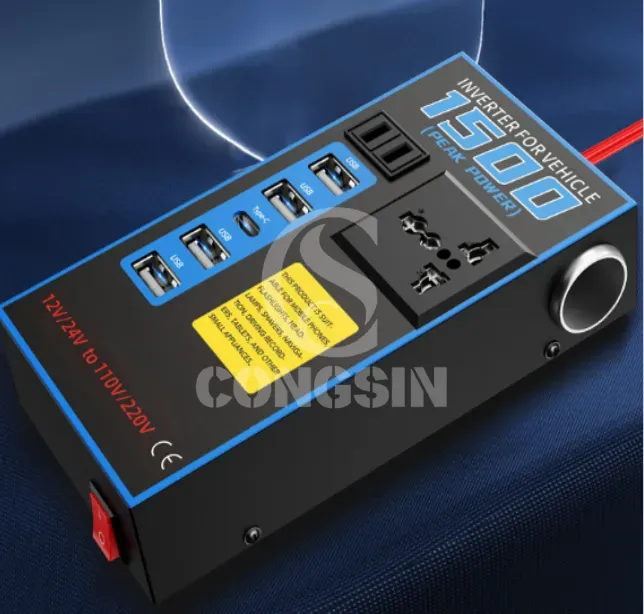
Congsin 1500W Inverter for Vehicle DC 12V/24V to AC 110V/220V with Universal socket Modified Sine Wave
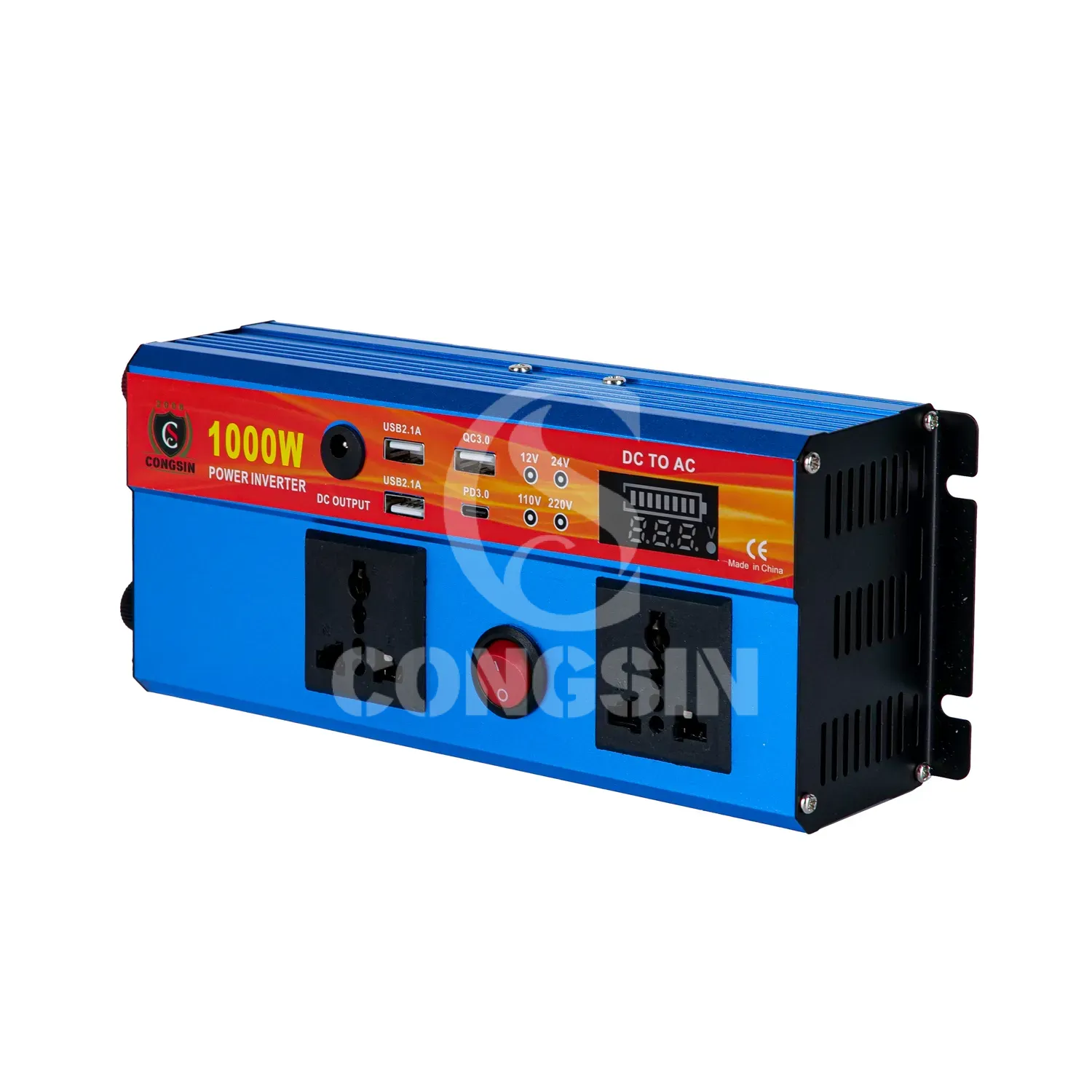
Congsin 1000W modified sine wave inverter with LED display and Type C port car RV power inverter
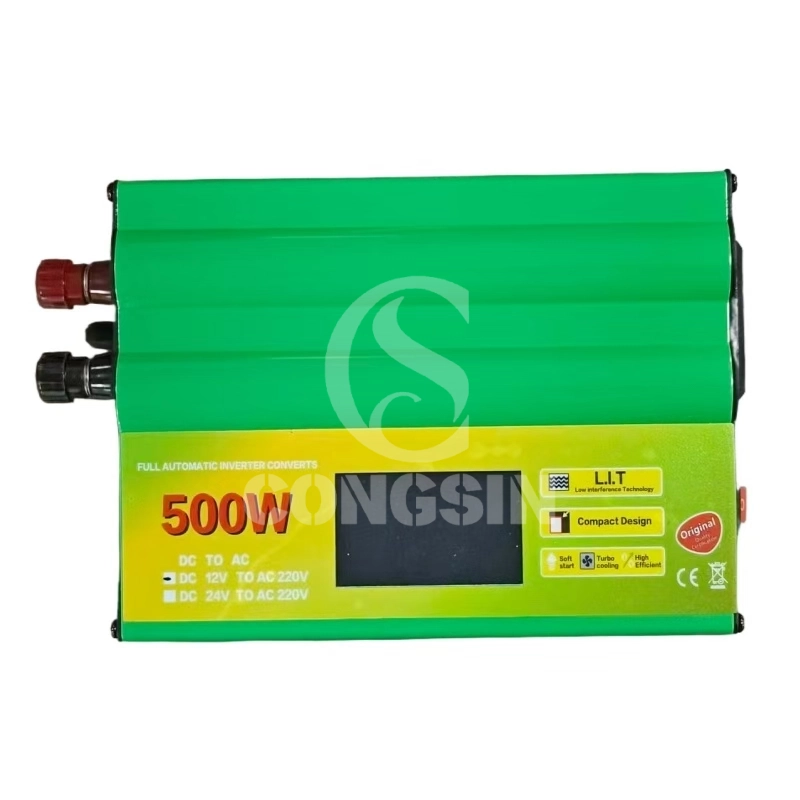
Congsin Modified Sine Wave Inverter 500W 1000W 1500W 12V LED Display Portable for RV Car Solar
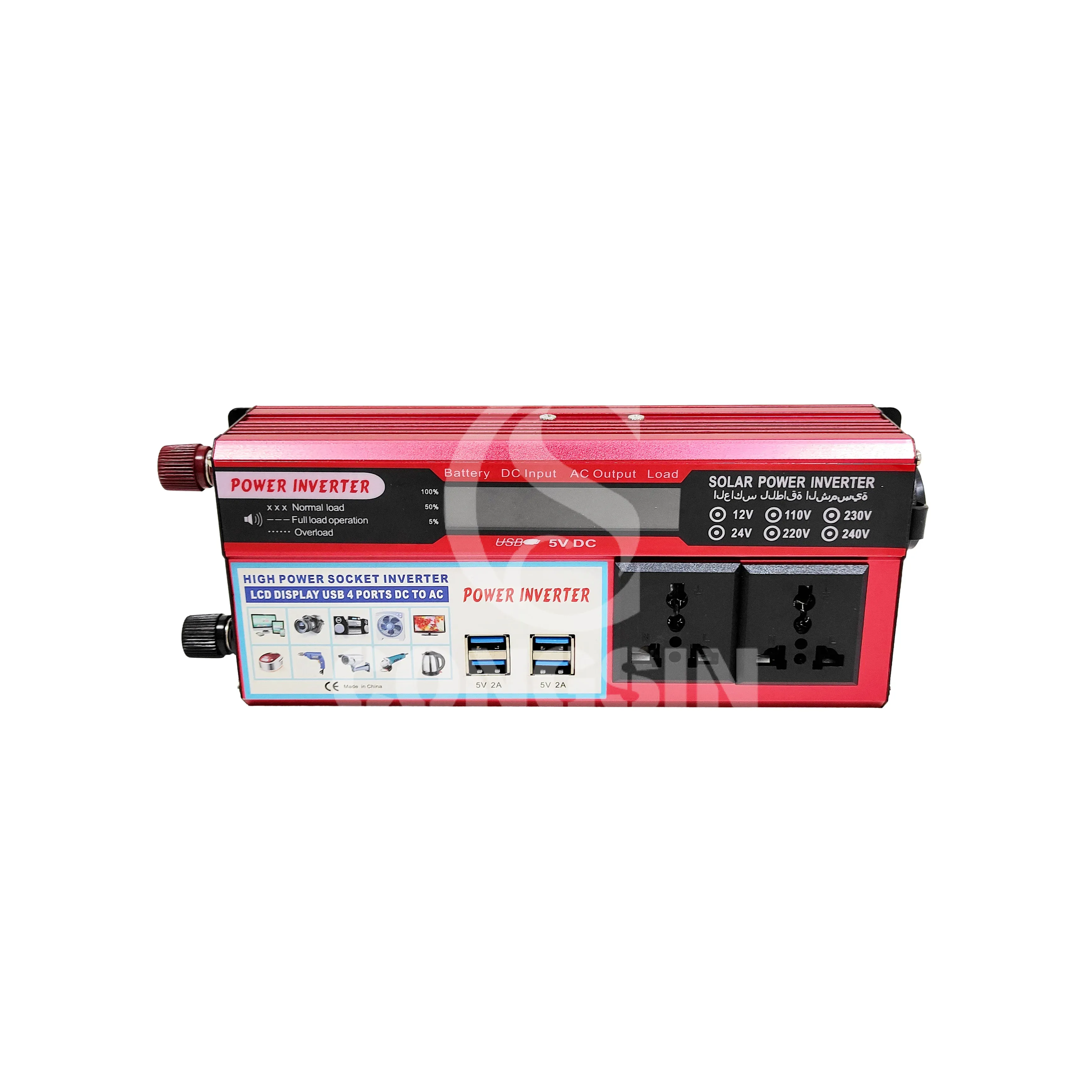
Congsin 1500W modified sine wave inverter with LCD display and USB ports for RV car boat home use

CONGSIN is a trusted OEM factory for power inverters, solar charge controllers, and DC converters. Reliable solutions for global B2B buyers.
 High Quality
 7/24 Service
 Guaranteed Warranty
© 2025 Congsin. All Rights Reserved.