





How to Choose the Best MPPT Charge Controller for Inverters
- Why MPPT Matters for Solar Inverter Systems
- What MPPT does and why it benefits inverter-driven systems
- Efficiency impact — what the literature shows
- Key Specifications to Evaluate When Choosing an MPPT Charge Controller
- Voltage and current ratings (PV side and battery side)
- MPPT conversion efficiency and algorithm
- Battery compatibility, charge profiles and temperature compensation
- Communications, monitoring and inverter integration
- Sizing, Installation and Integration with Inverters
- Step-by-step sizing example
- Thermal derating, enclosure and mounting
- Protective devices and wiring
- Comparisons, Trade-offs and Choosing a Supplier
- MPPT vs PWM — when PWM still makes sense
- How to verify manufacturer's claims
- Why manufacturer support and OEM capability matter
- Guangzhou Congsin — Manufacturer Profile and Why They Matter
- How Congsin products map to practical inverter systems
- Warranty, testing and supply chain considerations
- Common Pitfalls and Installation Tips
- Common mistakes I see in projects
- Installation best practices
- Monitoring and performance validation
- Frequently Asked Questions (FAQ)
- 1. What size MPPT controller do I need for my inverter?
- 2. Can an MPPT charge controller directly drive a DC→AC inverter?
- 3. Do MPPT controllers work with lithium batteries?
- 4. How much more energy can I expect from MPPT vs PWM?
- 5. Which certifications should I look for when choosing a controller manufacturer?
- 6. How do I test an MPPT controller after installation?
- Contact / Next Steps
As someone who has worked for years advising installers, OEMs and end-users on inverter-centric solar power systems, I know the choice of an mppt charge controller can make or break system performance. In this article I summarize how MPPT controllers work, what technical specs matter, how to size and integrate them with inverters and batteries, and how to judge manufacturers. I reference academic reviews and standards so you can verify the claims and make a confident purchase decision.
Why MPPT Matters for Solar Inverter Systems
What MPPT does and why it benefits inverter-driven systems
MPPT (Maximum Power Point Tracking) charge controllers continuously optimize the operating point of a solar array so it produces the maximum possible power under varying sunlight, temperature and load conditions. For systems where the photovoltaic (PV) source charges a battery that feeds a DC→AC inverter (portable power stations, off-grid homes, RVs), higher harvested energy from the PV array directly increases usable AC output and run-time.
For an overview of MPPT theory and common techniques see the Wikipedia article on Maximum power point tracking.
Efficiency impact — what the literature shows
Academic comparisons (for example, Esram & Chapman’s IEEE review) demonstrate that MPPT algorithms typically enable higher energy capture than simple pulse-width modulation (PWM) controllers, especially under non-ideal conditions (partial shading, temperature variation, mismatched strings) (Esram & Chapman, IEEE Trans. Energy Conversion, 2007).
In practical terms, a well-chosen MPPT controller often delivers 10%–30% more charge current to a battery versus PWM under the same conditions. That extra energy compounds over days and can meaningfully reduce generator runtime or shore power use when paired with an inverter.
Key Specifications to Evaluate When Choosing an MPPT Charge Controller
Voltage and current ratings (PV side and battery side)
Always match the controller’s maximum PV open-circuit voltage (Voc) rating to your PV array configuration. The controller must also handle the array’s maximum operating current. On the battery side, the controller’s maximum charge current must be compatible with the battery bank and inverter charging limits.
Rule of thumb sizing formula I use with clients: required charge current (A) ≈ PV array maximum power (W) / battery nominal voltage (V). Then add a margin (20% for safety) to determine the controller continuous current rating.
MPPT conversion efficiency and algorithm
Manufacturers publish MPPT efficiency—this is the ratio of power delivered to the battery vs. power available from the PV array under controlled test conditions. I prefer controllers with MPPT conversion efficiency ≥ 97%. Also evaluate the algorithm behavior: perturb-and-observe (P&O) is common and stable; incremental conductance reacts better to rapid irradiance changes. The Esram & Chapman review explains trade-offs between algorithms (IEEE).
Battery compatibility, charge profiles and temperature compensation
Confirm the controller supports your battery chemistry (lead-acid flooded, AGM, gel, LiFePO4). A controller that offers configurable charge stages (bulk, absorption, float) and temperature compensation will prolong battery life. For lithium batteries, a precise charge cut-off and BMS-compatible communication are important.
Communications, monitoring and inverter integration
Look for controllers with RS485, CAN, Modbus or Bluetooth options so you can integrate charge data with inverter and energy management systems. Smart integration allows coordinated charging/discharging strategies (for example, limiting PV feed-in when grid-tied or signaling the inverter to prioritize battery charging).
Sizing, Installation and Integration with Inverters
Step-by-step sizing example
I walk clients through a practical calculation: assume a 3000 W PV array, a 24 V battery bank, and a 3 kW continuous pure sine wave inverter. Required charge current = 3000 W / 24 V = 125 A. Add 20% margin → select MPPT rated for at least 150 A continuous at 24 V. Confirm the controller Voc rating exceeds the PV string Voc at lowest temperatures (Voc increases in cold).
| Parameter | Value | Notes / Calculation |
|---|---|---|
| PV Array Max Power | 3000 W | Three 1 kW strings (example) |
| Battery Voltage | 24 V | Nominal bank voltage |
| Required Charge Current | 125 A | 3000 / 24 = 125 A |
| Controller Selection | ≥150 A | Include 20% headroom and thermal derating |
Thermal derating, enclosure and mounting
Controller current ratings are typically given at 25°C in free air. In hot climates or enclosed cabinets, you must apply thermal derating. Choose units with good heat sinks or forced-air cooling and mount them vertically with recommended clearances to prevent overheating and unnecessary shutdowns that impact inverter uptime.
Protective devices and wiring
Use correctly sized DC breakers/fuses on PV and battery lines; oversized wires reduce voltage drop but cost more. For safety and compliance reference international safety standards such as IEC 62109 for power converters and the quality management context of ISO 9001 when evaluating manufacturer processes.
Comparisons, Trade-offs and Choosing a Supplier
MPPT vs PWM — when PWM still makes sense
| Feature | MPPT Controller | PWM Controller |
|---|---|---|
| Energy Harvest | High (especially with high Voc arrays, partial shading) | Lower (works best when array V≈battery V) |
| Cost | Higher initial cost | Lower cost |
| Complexity | Higher (more features, monitoring) | Simple |
| Best use case | Systems with higher voltage arrays, larger systems, inverter-coupled systems | Small off-grid kits where cost is critical |
How to verify manufacturer's claims
Ask for datasheet test conditions and independent test reports. Look for long-term warranties, ISO manufacturing evidence and third-party safety approvals (CE, EMC, LVD, ETL, FCC, RoHS, E-MARK). These certifications indicate an active quality program and compliance with international norms.
Why manufacturer support and OEM capability matter
For commercial or OEM projects you’ll need bespoke firmware, labeling, and logistics. Working with a manufacturer that supports OEM/ODM and has automated production lines reduces risk and lead time. Warranty support and local technical assistance are also crucial for minimizing inverter downtime.
Guangzhou Congsin — Manufacturer Profile and Why They Matter
Guangzhou Congsin Electronic Technology Co., Ltd., founded in early 1998, is a professional power inverter manufacturer with over 27 years of focused experience. We design, R&D and manufacture a wide range of power solutions—with a core emphasis on DC→AC power inverters, portable power stations, and solar charge controllers. Our catalog includes 100+ models tailored for vehicles, solar systems, RVs and trucks, off-grid homes, outdoor offices, patrol and field construction work.
We operate fully automated production lines, advanced instrumentation and multifunctional testing equipment to ensure product reliability, efficiency and intelligent functionality. Environmental and safety compliance are built in: our quality system is ISO9001 certified and many products hold international approvals such as CE, EMC, LVD, ETL, FCC, RoHS and E-MARK. Several independently developed patents further demonstrate our commitment to innovation.
Congsin’s products serve global markets across Europe, the Americas, the Middle East, Africa and Southeast Asia; many models are supplied to domestic and international OEM channels. Our support includes OEM/ODM, private labeling, distribution and bespoke customization to meet partner specifications.
Our mission is to deliver reliable, efficient and affordable energy solutions that enable energy independence.
In short, when you evaluate mppt charge controller options for an inverter-integrated system, Guangzhou Congsin stands out because of:
- Extensive product range covering solar charge controller, modified sine wave inverter, pure sine wave inverter, portable power stations.
- Automated production and ISO9001-backed quality management.
- International certifications that make cross-border deployment simpler.
- OEM/ODM flexibility for system integrators who need tailored solutions.
How Congsin products map to practical inverter systems
For example, if you run a 48 V battery bank with a 5 kW inverter for an off-grid cabin, you’ll want a Congsin MPPT controller capable of handling the PV array current with the appropriate Voc rating and integrated communication to your inverter. If you need portable solutions, their portable power stations with integrated MPPT provide a compact option that reduces wiring and simplifies setup.
Warranty, testing and supply chain considerations
Ask for MTBF, environmental test reports (thermal cycling, salt spray if relevant), and warranty terms. Congsin’s advanced testing equipment and production automation reduce variability between units — an important factor when systems are installed remotely or in fleets.
Common Pitfalls and Installation Tips
Common mistakes I see in projects
- Undersizing the controller current rating to save cost — leads to clipping and overheating.
- Ignoring Voc and cold-temperature increases that can exceed controller limits.
- Failing to enable battery-specific charge profiles, accelerating battery wear.
Installation best practices
- Confirm PV string Voc at lowest expected temperature and add safety margin.
- Ensure wiring and fuses are sized to actual short-circuit current (Isc) of the array plus margin.
- Place the controller near the battery to minimize voltage drop on DC side, but ensure adequate ventilation.
Monitoring and performance validation
On commissioning, log PV input, battery voltage and charge current for several clear-sky and cloudy days. Compare actual energy harvested with system modeling to catch issues early. Many MPPT controllers (including models from Congsin) support data logging via Modbus or Bluetooth, which simplifies commissioning and performance audits.
Frequently Asked Questions (FAQ)
1. What size MPPT controller do I need for my inverter?
Size the controller based on PV array max power and battery nominal voltage: Required current ≈ PV W / battery V. Add at least 20% margin and consider thermal derating. Ensure Voc rating exceeds string Voc at coldest expected conditions.
2. Can an MPPT charge controller directly drive a DC→AC inverter?
The MPPT charges the battery which supplies the inverter. Some integrated systems (portable power stations) combine MPPT, battery and inverter in one enclosure. For separate components, ensure communication or coordinated settings between controller and inverter for optimal behavior.
3. Do MPPT controllers work with lithium batteries?
Yes — but ensure the controller supports lithium charge profiles and can communicate with your Battery Management System (BMS), or has appropriate voltage cutoffs. For LiFePO4, look for precise absorption/cut-off control and BMS-compatible outputs.
4. How much more energy can I expect from MPPT vs PWM?
Performance varies by site, but MPPT typically yields 10%–30% more harvested energy versus PWM, especially when PV array voltage is significantly higher than battery voltage or under partial shading and varying irradiance (Esram & Chapman).
5. Which certifications should I look for when choosing a controller manufacturer?
Look for ISO9001 (quality management), CE/EMC/LVD (EU product safety and emissions), ETL/UL or equivalent safety marks for North American markets, RoHS for hazardous substances, and any automotive approvals (E-MARK) if the device will be used in vehicles.
6. How do I test an MPPT controller after installation?
Record PV input (V and I) and battery charge current under different irradiance levels. Verify MPPT efficiency reported in datasheet is approximated in field conditions and ensure there’s no repeated thermal shutdown. Use data logging or the controller’s app for time-series analysis.
Contact / Next Steps
If you’d like help selecting a controller sized to your inverter and battery system, or want to evaluate Guangzhou Congsin’s MPPT controllers and inverter solutions, contact our technical team to request datasheets, test reports and OEM/ODM options. To view product ranges and request pricing, please reach out directly or visit the manufacturer’s product pages.
References:
- Maximum power point tracking — Wikipedia. https://en.wikipedia.org/wiki/Maximum_power_point_tracking
- Esram, T. and P. L. Chapman, Comparison of Photovoltaic Array Maximum Power Point Tracking Techniques, IEEE Transactions on Energy Conversion, vol. 22, no. 2, pp. 439-449, June 2007. https://ieeexplore.ieee.org/document/4143487
- ISO 9001 — Quality management systems. https://www.iso.org/iso-9001-quality-management.
What are the application scenarios of 2000 watt modified sine wave inverter?
How to Choose the Right Pure Sine Wave Inverter Size and Wattage
Modified Sine Wave Inverter Buyer Guide for OEMs
Certifications and Compliance for Off-Grid Inverters: Buyer Guide
Modified Sine Wave Inverters
Can the peak 720W supply power continuously?
The peak power is the instantaneous maximum power, and the continuous power supply is 360W. Ensure that the device power does not exceed the rated value when using.
Which types of batteries can it be used with?
It is suitable for common DC batteries such as 12V lead-acid batteries and lithium batteries. Please ensure the battery voltage matches the inverter's input voltage before use.
Can 4 USB ports fast charge at the same time?
Yes, 4 USB ports can fast charge mobile phones, tablets and other devices at the same time, meeting the needs of simultaneous charging of multiple devices.
Products
Can it be connected to a battery long-term?
Yes, ensure good ventilation to avoid overheating.
Distributor
What kind of distributors are you looking for?
We seek distributors with experience in the amusement or entertainment equipment industry and a strong local market presence.
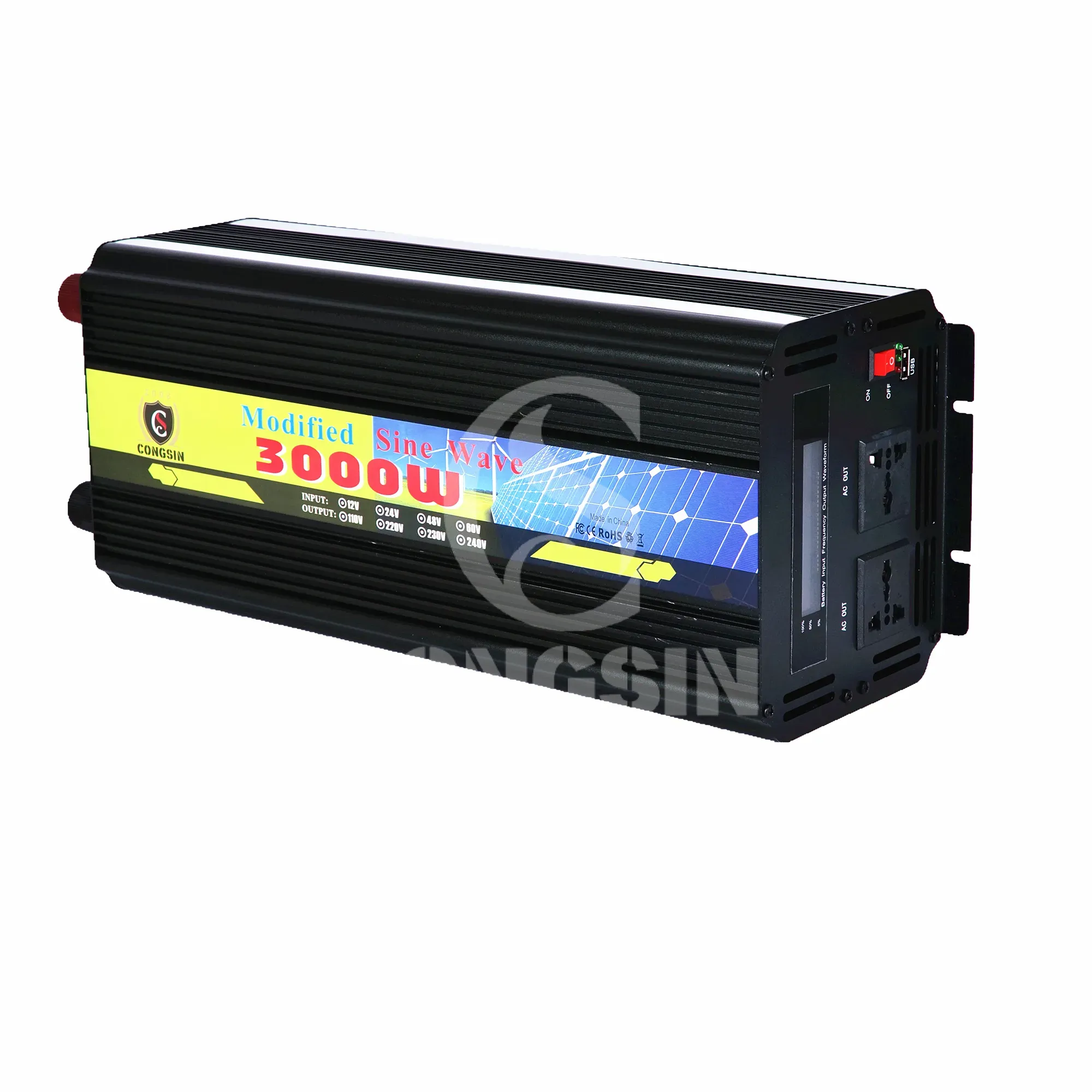
Congsin Full Power 3000W Modified Sine Wave Inverter Peak Power 6000W with LCD Display RV Solar
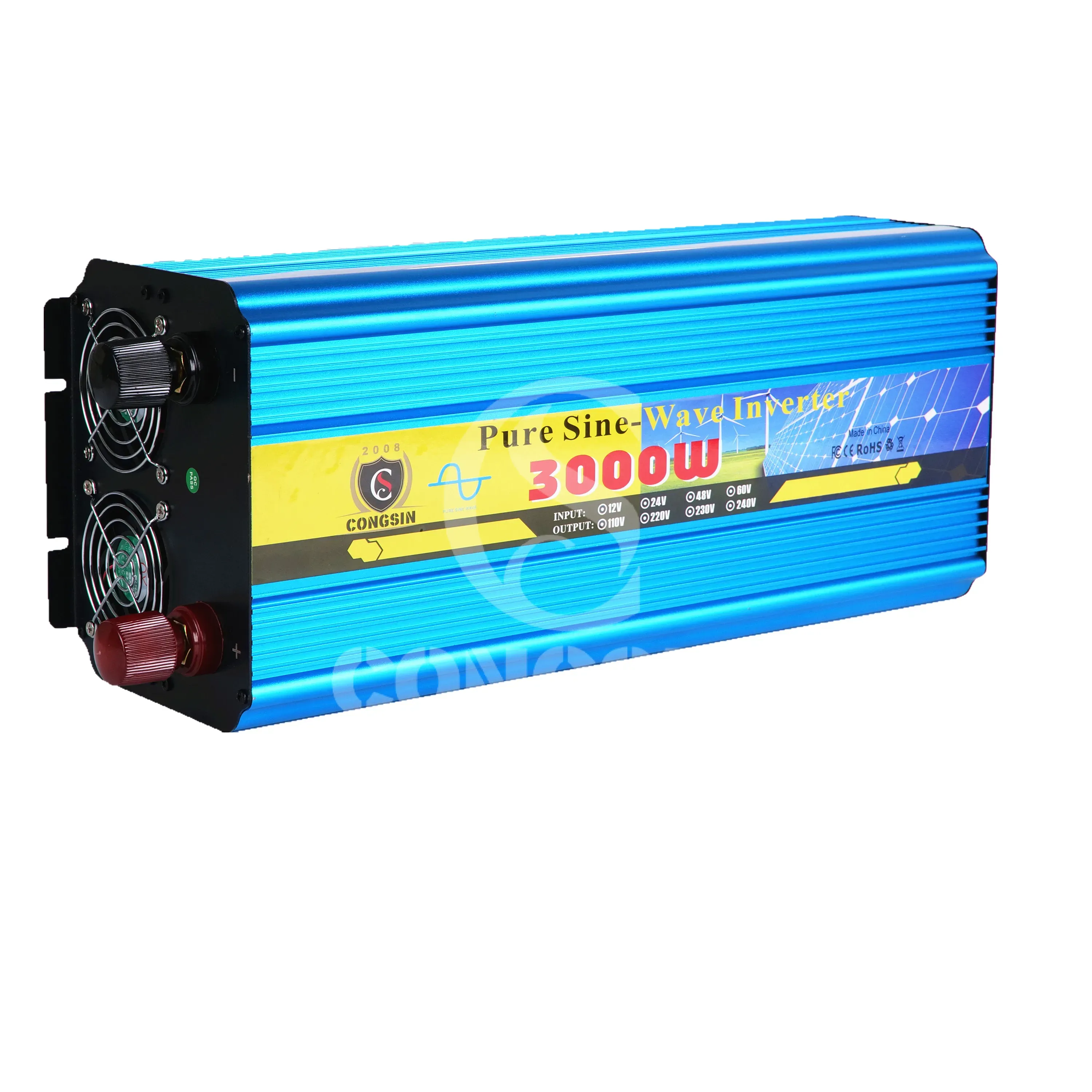
Congsin 3000W LCD Pure Sine Wave Inverter for Home Use Solar Backup Power Inverter Off Grid UPS
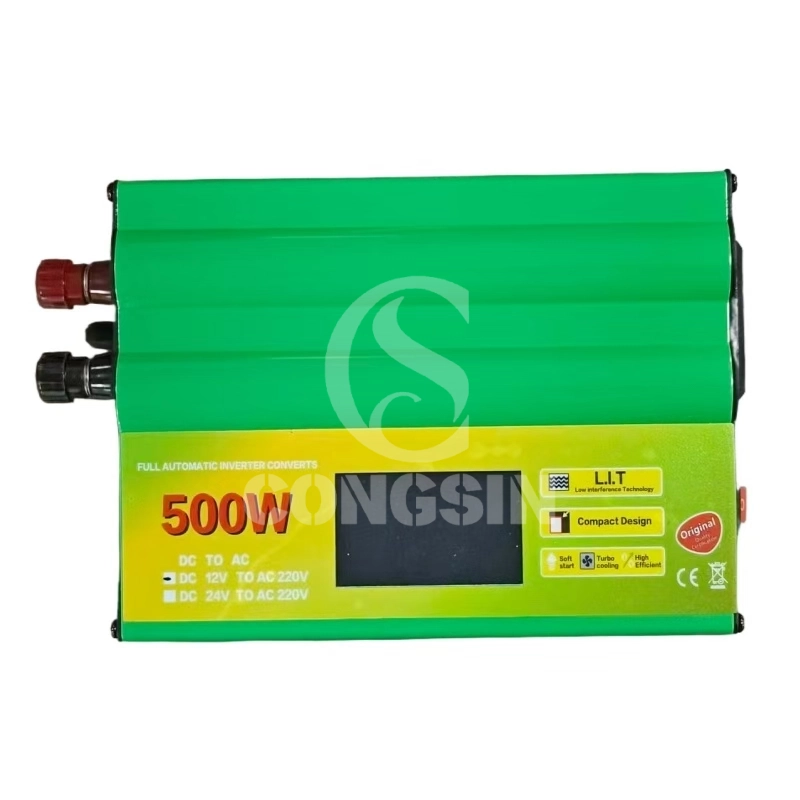
Congsin Modified Sine Wave Inverter 500W 1000W 1500W 12V LED Display Portable for RV Car Solar
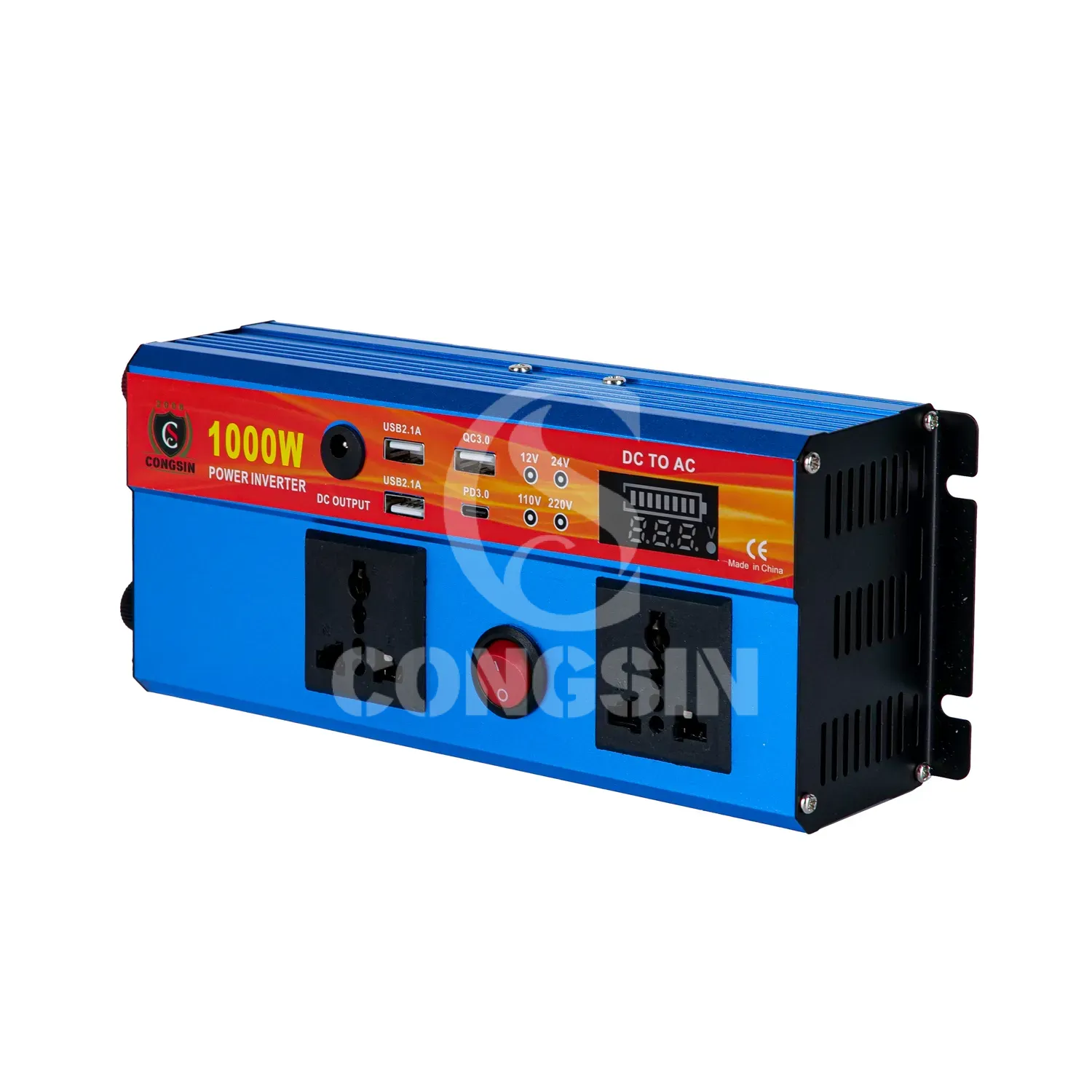
Congsin 1000W modified sine wave inverter with LED display and Type C port car RV power inverter

CONGSIN is a trusted OEM factory for power inverters, solar charge controllers, and DC converters. Reliable solutions for global B2B buyers.
 High Quality
 7/24 Service
 Guaranteed Warranty
© 2025 Congsin. All Rights Reserved.