





Certifications & Safety Standards for Inverter Grid Off Units
- Why certifications matter for off-grid power systems
- Protecting people, property and system reliability
- Market access and regulatory compliance
- Compatibility with grid and safety interlocks
- Key safety, EMC and interconnection standards
- IEC 62109 – safety of power converters
- UL 1741 and related North American requirements
- IEEE 1547 – grid interconnection (relevance for hybrid/off-grid units)
- EMC, environmental and regulatory marks
- CE / EMC / LVD – European market entry
- RoHS and environmental requirements
- FCC and radio/EMI limits
- Testing, compliance workflow and cost considerations
- Typical certification path for inverter grid off units
- Cost and timeline estimates
- Record-keeping, traceability and supplier control
- Design, installation and field-safety considerations
- Hardware design choices that simplify certification
- Installation, grounding and system-level safety
- Field testing and maintenance practices
- Certification comparison — what each approval covers
- Practical recommendations for manufacturers and buyers
- For manufacturers
- For buyers and system integrators
- Handling firmware, updates and cybersecurity
- How Guangzhou Congsin integrates compliance into product development
- FAQ
- 1. What certifications are mandatory for selling inverter grid off units in the EU?
- 2. Do true off-grid inverters need IEEE 1547 compliance?
- 3. What is the difference between UL and ETL listings?
- 4. How can I reduce time and cost for certification?
- 5. Are emissions and EMC tests different for portable power stations versus stationary off-grid inverters?
- 6. What documentation should I request from suppliers to verify RoHS and component safety?
- Contact and next steps
I design and consult on inverter grid off (off-grid inverter) solutions and have studied the patchwork of safety, EMC and grid-interconnection standards that determine whether a unit can be sold and safely used in different markets. In this article I summarize the certifications and standards that matter for inverter grid off units, explain why each requirement exists, lay out practical testing and documentation steps, and describe how manufacturers can streamline compliance to deliver safe, reliable off-grid power products.
Why certifications matter for off-grid power systems
Protecting people, property and system reliability
At the core, certifications exist to reduce risk. For inverter grid off and off-grid units, safety standards reduce shock and fire risk, EMC standards limit electromagnetic interference with other equipment, and performance standards ensure the inverter behaves predictably during faults, battery events and reconnection. A certified product lowers liability for manufacturers, installers and end users and increases consumer confidence.
Market access and regulatory compliance
Different regions require different marks. A CE declaration (covering LVD and EMC directives) is mandatory for the EU market; UL or ETL listings are often expected for the U.S.; some automotive or vehicle-mounted off-grid units need E-MARKs. Without the appropriate approvals, a product can be blocked at customs, fail inspection in building projects, or void insurance coverage. I always map target markets early to define the certification roadmap.
Compatibility with grid and safety interlocks
Even true off-grid systems may momentarily interact with the grid during testing, transport or hybrid configurations. Standards like IEEE 1547 and UL 1741 address anti-islanding, reconnection behavior and protective relays. Ensuring inverter grid off units meet these expectations prevents dangerous backfeed into utility lines and maintains public safety during outages and restorations.
Key safety, EMC and interconnection standards
IEC 62109 – safety of power converters
IEC 62109 is the international benchmark for safety of power converters used in photovoltaic and storage applications. It defines construction, isolation, thermal, and protection requirements that are directly applicable to inverter grid off units. You can reference the standard details at the IEC store: IEC. Manufacturers typically design enclosures, creepage/clearance distances, and protective circuits to meet IEC 62109 clauses and test against them in accredited labs.
UL 1741 and related North American requirements
For North America, UL 1741 (Inverters, Converters, Controllers and Interconnection System Equipment for Use With Distributed Energy Resources) is the principal standard addressing safety and grid-interconnection behavior. Updated versions of UL 1741 incorporate IEEE 1547 requirements. See UL's description: UL 1741. If you plan to sell inverter grid off units in the U.S. or Canada, UL listing or ETL verification is generally expected.
IEEE 1547 – grid interconnection (relevance for hybrid/off-grid units)
IEEE 1547 governs performance and interoperability of distributed energy resources and grid interconnection behavior (anti-islanding, voltage/frequency ride-through, and control/communication requirements). Even off-grid inverters that may operate in microgrids need to consider 1547-derived tests when used in hybrid systems. Official IEEE information: IEEE 1547.
EMC, environmental and regulatory marks
CE / EMC / LVD – European market entry
CE marking in the EU requires conformity with relevant directives (Low Voltage Directive (LVD), Electromagnetic Compatibility (EMC) Directive, and RoHS when applicable). EMC testing ensures the inverter grid off unit does not emit excessive interference and is immune to external disturbances. European Commission guidance: CE marking.
RoHS and environmental requirements
Restriction of Hazardous Substances (RoHS) limits hazardous materials in electrical equipment sold in the EU and many other jurisdictions. Compliance requires material declarations and supplier control. More on RoHS: RoHS Directive.
FCC and radio/EMI limits
In the U.S., FCC rules govern conducted and radiated emissions for equipment that could affect radio services. Even power inverters can produce emissions that require testing and labeling under FCC Part 15. Official FCC lab testing guidance: FCC Test Procedures.
Testing, compliance workflow and cost considerations
Typical certification path for inverter grid off units
From my experience, a practical certification workflow is:
- Define target markets and applicable standards (e.g., IEC 62109, UL 1741, CE/EMC/LVD, RoHS).
- Perform pre-compliance EMC and safety checks in-house or with pre-test services to identify design fixes early.
- Contract an accredited lab for formal testing and corrective actions.
- Compile technical file, user manuals, test reports and declarations of conformity.
- Obtain third-party certification marks (e.g., UL listing, ETL) and register where required.
This staged approach reduces re-test cycles and overall project cost.
Cost and timeline estimates
Costs vary widely: pre-compliance lab work can be a few thousand USD; full safety and EMC testing may run from $10k–$50k+ depending on complexity and iterations. Timelines typically range from 4–16 weeks for lab testing plus additional time for corrective design, documentation and administrative processing. I recommend budgeting contingency time and funds for mitigation of test failures.
Record-keeping, traceability and supplier control
Regulators and auditors expect a technical file that includes BOM traceability, supplier material declarations, test records and quality system evidence (e.g., ISO 9001). Maintaining these records simplifies repeat certifications and supports OEM/ODM customers during audits.
Design, installation and field-safety considerations
Hardware design choices that simplify certification
Design choices that help include adequate creepage and clearance, thermal margins, galvanic isolation, robust overcurrent and ground-fault protection, and EMI filters sized for expected interference. Choosing component suppliers with certifications (e.g., safety-rated capacitors, transformers) shortens the path to product-level approvals.
Installation, grounding and system-level safety
Certification of the inverter unit is a necessary but not sufficient condition for a safe system. Proper installation—correct grounding, cable sizing, protective devices, and label/installation instructions consistent with the certified use-cases—is critical. I always stress clear installation manuals and commissioning checklists aligned with the product's certified scope.
Field testing and maintenance practices
Providing recommended periodic tests (insulation tests, protective device operation checks, firmware update procedures) reduces lifecycle risk. For systems in remote locations, consider remote monitoring and telemetry to flag abnormal behavior and enable preventive maintenance.
Certification comparison — what each approval covers
| Certification / Standard | Scope | Typical Market | Focus Areas |
|---|---|---|---|
| IEC 62109 | Safety of power converters | Global | Electrical insulation, thermal, mechanical safety |
| UL 1741 | Inverter and interconnection safety | U.S., Canada | Safety, anti-islanding, grid interaction |
| IEEE 1547 | Interconnection performance | U.S., widely referenced | Anti-islanding, ride-through, control/communications |
| CE (LVD / EMC) | Safety & EMC declaration for EU | EU / EEA | Electrical safety & electromagnetic compatibility |
| RoHS | Restriction of hazardous substances | EU and many exporters | Material restrictions (Pb, Hg, Cd, etc.) |
| FCC Part 15 | Emissions for electronic devices | U.S. | Radiated & conducted emissions |
| ETL (Intertek) | Product safety testing & listing | U.S., Canada | Alternative to UL; safety verification |
Sources: UL standards catalog (UL 1741), IEEE (IEEE 1547), and European Commission CE guidance (CE marking).
Practical recommendations for manufacturers and buyers
For manufacturers
I advise manufacturers of inverter grid off units to adopt the following checklist:
- Define target markets and applicable standards at project start.
- Implement a design-for-compliance approach (safety, EMC, environmental).
- Use accredited labs for pre-compliance and full compliance testing.
- Maintain ISO 9001-like quality systems to manage traceability and supplier data.
- Document firmware and communication behaviors as they may affect grid safety tests.
For buyers and system integrators
When specifying inverter grid off units, require the following from suppliers:
- Clear list of certifications and the exact scope (model numbers, firmware versions).
- Technical file access or summarized test reports for key safety and EMC tests.
- Installation guides that match the certified use-case (e.g., floating vs. grounded systems).
- Warranty and support commitments for field failures tied to certification scope.
Handling firmware, updates and cybersecurity
Firmware behavior can affect safety and standards compliance (e.g., anti-islanding algorithms). Document versioning, controls for secure updates and rollback procedures. Cybersecurity is increasingly relevant for smart inverters—refer to guidance from standards bodies and implement secure communications and authentication where applicable.
How Guangzhou Congsin integrates compliance into product development
Guangzhou Congsin Electronic Technology Co., Ltd., founded in early 1998, is a professional power inverter manufacturer with over 27 years of focused experience. We design, R&D and manufacture a wide range of power solutions—with a core emphasis on DC→AC power inverters, portable power stations, and solar charge controllers. Our catalog includes 100+ models tailored for vehicles, solar systems, RVs and trucks, off-grid homes, outdoor offices, patrol and field construction work.
We operate fully automated production lines, advanced instrumentation and multifunctional testing equipment to ensure product reliability, efficiency and intelligent functionality. Environmental and safety compliance are built in: our quality system is ISO9001 certified (ISO 9001) and many products hold international approvals such as CE, EMC, LVD, ETL, FCC, RoHS and E-MARK. Several independently developed patents further demonstrate our commitment to innovation.
Congsin’s products serve global markets across Europe, the Americas, the Middle East, Africa and Southeast Asia; many models are supplied to domestic and international OEM channels. Our support includes OEM/ODM, private labeling, distribution and bespoke customization to meet partner specifications. Our mission is to deliver reliable, efficient and affordable energy solutions that enable energy independence.
Key product lines that benefit from our compliance and manufacturing capabilities include Solar Charge Controller, modified sine wave inverter, pure sine wave inverter, and portable power stations. By combining in-house R&D with accredited testing practices and rigorous quality control, I have seen Congsin reduce time-to-market while meeting diverse regulatory requirements.
FAQ
1. What certifications are mandatory for selling inverter grid off units in the EU?
For the EU, CE marking is mandatory and typically requires conformity with the Low Voltage Directive (LVD) and EMC Directive. RoHS compliance is also generally required. The technical file should reference applicable harmonized standards such as IEC 62109 for safety. See EU guidance: CE marking.
2. Do true off-grid inverters need IEEE 1547 compliance?
Purely stand-alone off-grid inverters that never connect to the utility may not require IEEE 1547 testing. However, many products are sold for hybrid applications or are used by integrators in microgrids where 1547 behavior matters. I recommend designing with 1547 principles in mind if there is any chance of grid interaction. Official standard: IEEE 1547.
3. What is the difference between UL and ETL listings?
Both UL and ETL indicate third-party safety verification. UL is a standards organization and testing body; ETL (Intertek) performs similar safety evaluations and grants ETL marks. Market acceptance may vary by customer; both are widely recognized in North America. See Intertek ETL info: ETL.
4. How can I reduce time and cost for certification?
Early design-for-compliance, pre-compliance testing, use of certified components, and partnering with an experienced testing lab reduce iterations and re-tests. Maintaining a robust quality system (e.g., ISO 9001) and good supplier documentation also speeds the process.
5. Are emissions and EMC tests different for portable power stations versus stationary off-grid inverters?
Requirements overlap but can differ in test setups and limits due to intended use and installation environment. Portable power stations may be evaluated as consumer devices and face specific radiated/conducted limits; stationary off-grid inverters are evaluated in their intended installation context. Refer to the applicable EMC standards and regional regulations (e.g., FCC Part 15 in the U.S., EMC Directive in EU).
6. What documentation should I request from suppliers to verify RoHS and component safety?
Request supplier declarations of conformity, material test reports, safety datasheets for critical components, and traceable batch records. Maintain a bill-of-materials with supplier certifications to facilitate audits.
Contact and next steps
If you are developing or specifying inverter grid off products and need help with standards mapping, pre-compliance testing, or selecting a manufacturing partner, I can advise on pragmatic certification roadmaps and design-for-compliance. For turnkey products, Guangzhou Congsin offers a broad portfolio of certified inverters, solar charge controllers and portable power stations, supported by OEM/ODM services. Contact our sales and technical team to request product datasheets, certification reports or to discuss customization.
Get in touch with Guangzhou Congsin Electronic Technology Co., Ltd. for certified off-grid inverter solutions and tailored support to meet your market requirements.
Top 5 portable power station Company List and Products Compared
Best 1000W Car Inverters 2026: Top Models Compared
Bidirectional Inverter for Home Backup and Microgrids
240V Car Inverter Buying Guide: Choose the Right Model
Pure Sine Wave Inverters
What capacity battery is needed to drive a 1000W electric kettle?
It is recommended to match with a 12V 100Ah or larger capacity battery. When a 1000W electric kettle is working, the power consumption per hour is about 83Ah (1000W÷12V≈83A), and a 100Ah battery can support continuous work for about 1 hour (actual battery life is affected by battery aging).
What happens if the positive and negative poles are reversed when connecting the battery?
The device features built-in reverse polarity protection. If the positive and negative terminals are connected incorrectly, the circuit will automatically disconnect to prevent damage to the equipment. Simply adjust the battery clip connections (red clip to positive terminal, black clip to negative terminal), then restore power to resume normal operation.
What appliances can this inverter support?
Rated 1500W, peak 3000W – supports most home appliances.
Modified Sine Wave Inverters
Can I customize the logo?
Yes, OEM/ODM service is available.
How does the UPS function of this inverter work?
When the external power supply is normal, the inverter powers the device while charging the battery; when the external power supply is interrupted, it automatically switches to battery power to ensure uninterrupted operation of the device.
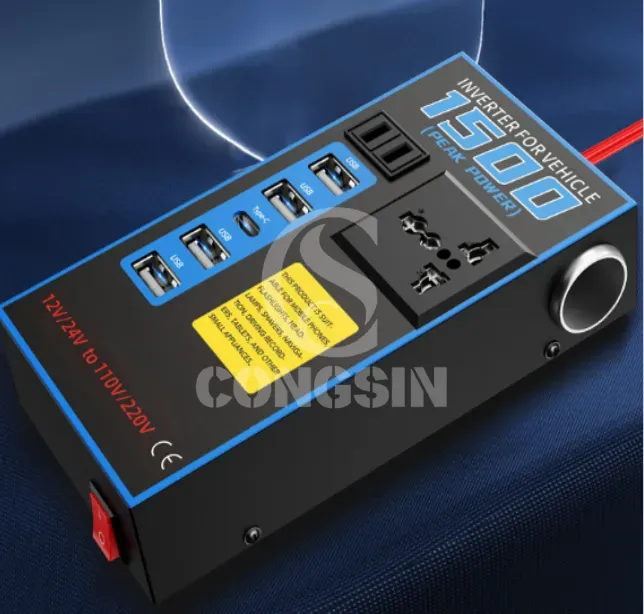
Congsin 1500W Inverter for Vehicle DC 12V/24V to AC 110V/220V with Universal socket Modified Sine Wave
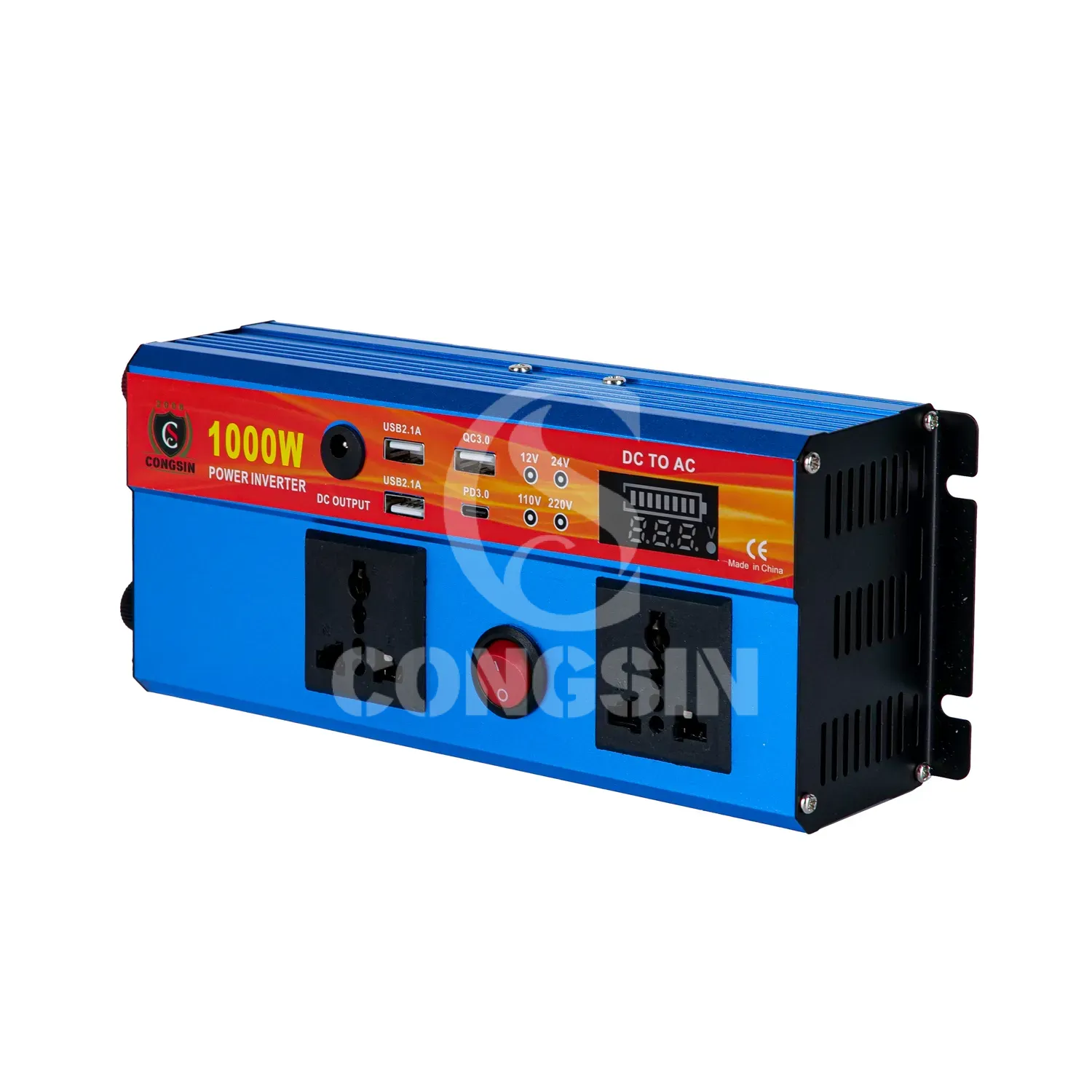
Congsin 1000W modified sine wave inverter with LED display and Type C port car RV power inverter
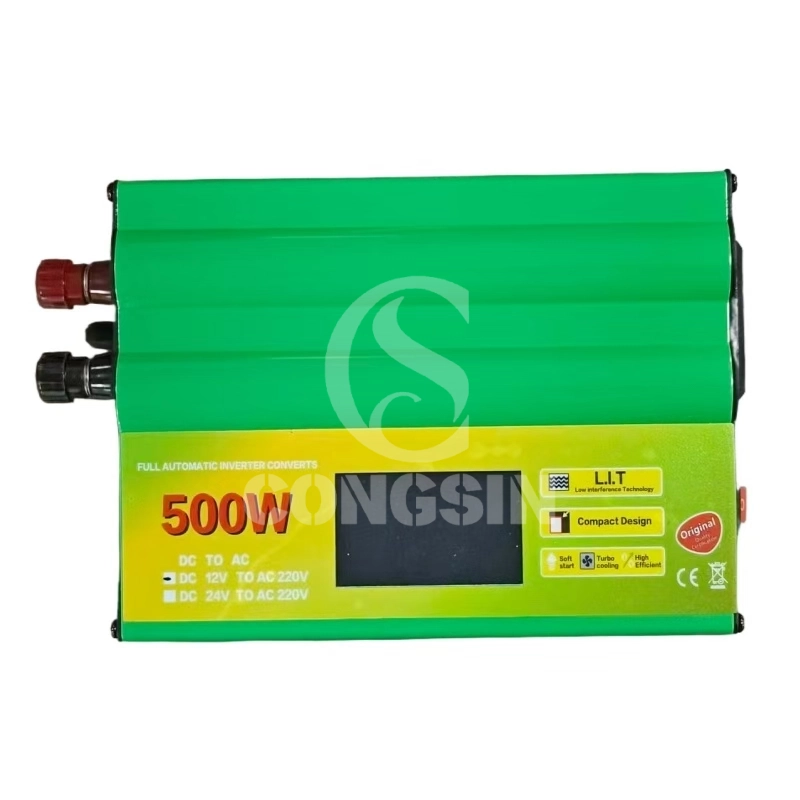
Congsin Modified Sine Wave Inverter 500W 1000W 1500W 12V LED Display Portable for RV Car Solar
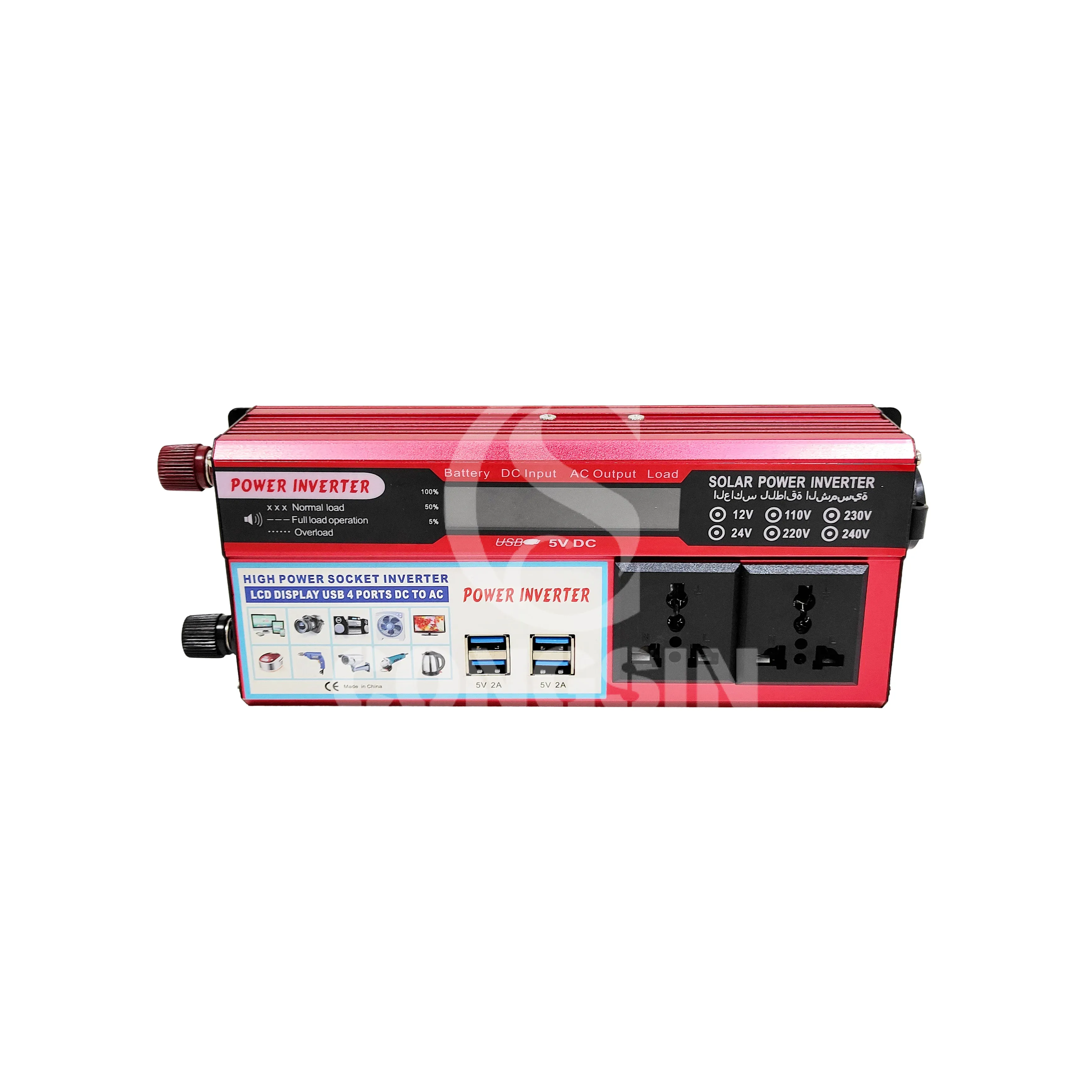
Congsin 1500W modified sine wave inverter with LCD display and USB ports for RV car boat home use

CONGSIN is a trusted OEM factory for power inverters, solar charge controllers, and DC converters. Reliable solutions for global B2B buyers.
 High Quality
 7/24 Service
 Guaranteed Warranty
© 2025 Congsin. All Rights Reserved.